
Enterprise SEO Audit: How We Audit Large Sites for Google and AI Search


Your rankings look healthy, your content calendar is full, and organic revenue is still sliding. On a large site the cause is rarely one broken thing. It is dozens of small failures compounding across thousands of pages, most of them invisible until a structured enterprise SEO audit surfaces them. The stakes have climbed sharply: the analytics firm Seer Interactive found that organic click-through rates fall by around about 61% lower organic CTR where AI Overviews appear on queries where a Google AI Overview appears, so every high-volume keyword an enterprise site owns is now leaking clicks it used to bank. This guide walks through exactly what we audit, in what order, and how we tie each finding back to revenue and AI visibility across both Google and AI search.
A Quick Guide to an Enterprise SEO Audit
An enterprise SEO audit is a structured diagnostic of a large, complex website that finds the technical, content, authority and AI-visibility issues suppressing organic performance, then ranks each finding by revenue impact. Unlike a standard audit that reviews a few dozen pages, it works across thousands to millions of URLs, multiple markets and several teams at once. Google's AI Overviews now appear in around 18% of searches and roughly halve the click-through rate when they show, according to Pew Research Center, which is why a modern enterprise audit measures AI-search visibility beside traditional rankings.
Ready to Audit Your Enterprise Site?
Most large sites are leaking revenue across templates, markets and AI answers they cannot see. We run the full enterprise SEO audit and hand back a prioritised, revenue-mapped plan your teams can ship.
Get Your Enterprise SEO AuditWhat Is an Enterprise SEO Audit (and How It Differs From a Standard Audit)
An enterprise SEO audit is a full diagnostic of a large-scale website, run to find the technical, structural, content and authority problems that limit its visibility and revenue across Google and AI search. It uses the same underlying checks as any audit, but applies them at a scale where manual review breaks down and where a single template fault can repeat across hundreds of thousands of pages. That is why we treat enterprise SEO as its own discipline rather than a bigger version of standard SEO.
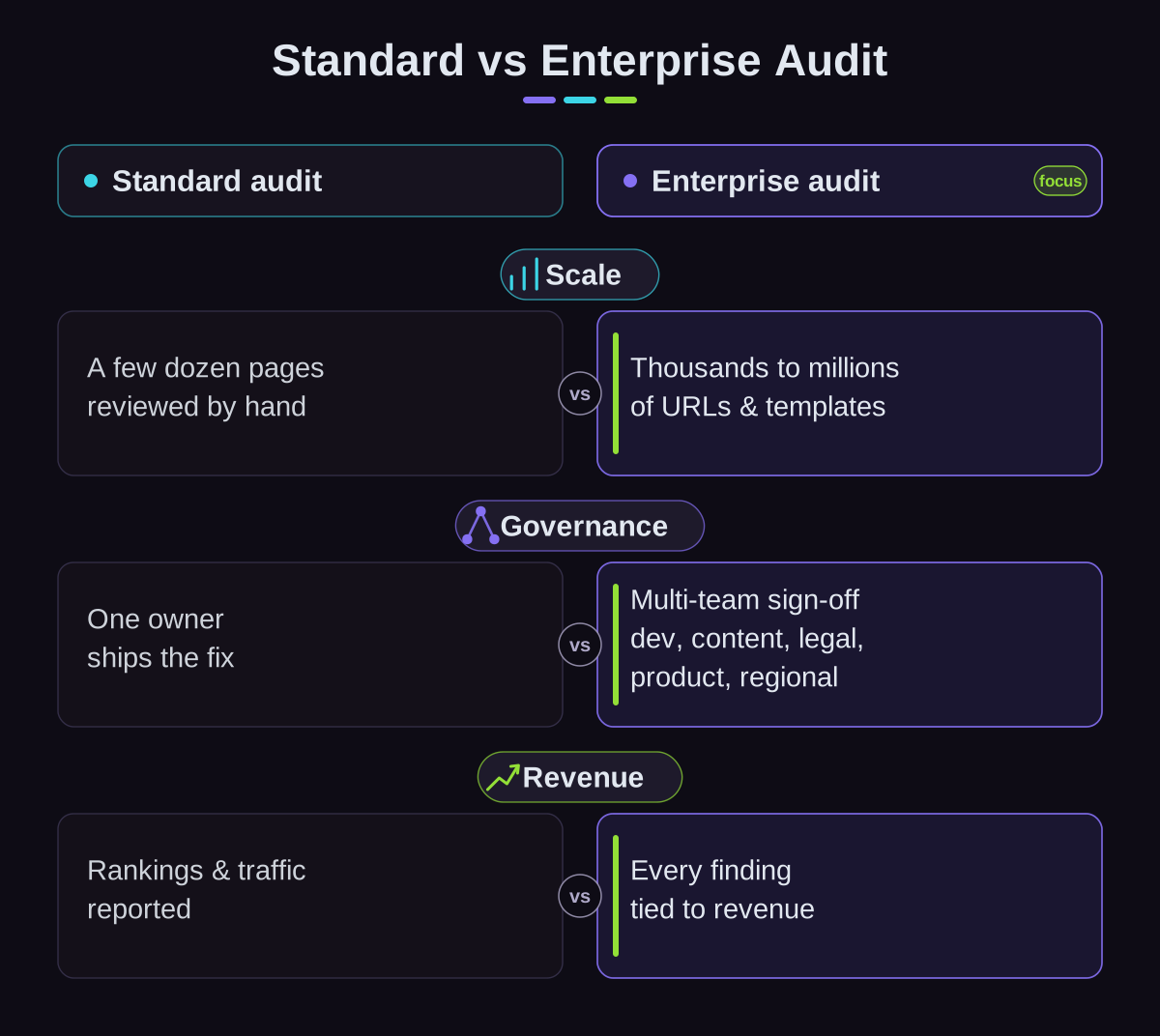
The difference is not the checklist. It is three conditions that change how every check is run.
Scale Changes What You Are Auditing
On a 50-page site you can review every URL by hand. Enterprise sites run thousands, tens of thousands or millions of pages across product lines, categories and markets, so the audit shifts from individual pages to templates, rules and patterns. Fix one page template and the change propagates across every page built from it, for better or worse. Scale also creates failure modes that small sites never meet, such as crawl-budget waste, index bloat from faceted navigation, and thousands of near-duplicate URLs competing with each other.
Governance Decides Whether Fixes Ship
On a small site one person owns the fix and ships it the same afternoon. On an enterprise site the same recommendation needs sign-off across several teams before it reaches a development sprint:
- Development: Owns the technical changes, from redirects to render behaviour and template edits.
- Content and marketing: Owns page copy, internal linking and publishing cadence.
- Legal and compliance: Reviews claims, disclosures and regulated language before anything goes live.
- Product and regional teams: Control URL structures, localisation and market-specific rules.
The technical fix is rarely the hard part. Navigating multi-layered approval so the fix actually ships is where most enterprise programmes stall, which is why our audits produce work already scoped for a dev ticket, not a wishlist.
Revenue Attribution Is the Point
A standard audit can get away with reporting rankings and traffic. An enterprise programme has to connect search performance to revenue, pipeline and customer acquisition cost, because that is the language the board speaks. Every finding in our audits carries an expected commercial impact, so prioritisation is driven by money at stake rather than by a crawler severity score.
When to Run an Enterprise SEO Audit (and How Often)
The short answer is at least once a year, plus a targeted audit before any high-risk change. Large sites drift: templates get edited, plugins get added, markets get launched, and small regressions accumulate into large losses that no single person notices. A yearly full audit resets the baseline and catches the drift before it compounds.
The higher-value trigger is change. Run a focused audit before a site migration, a replatform, a CMS change, a design system rollout or a new-market launch, because those are the moments a large site breaks at scale. Skipping the audit before a multi-market launch is the most expensive mistake we see in this space, and the international workstream below shows exactly why. Between full audits, keep continuous monitoring on crawl stats, indexation, Core Web Vitals and AI citations so a regression is caught in days, not at the next annual review.
Technical and Crawl Auditing at Scale
An enterprise technical SEO audit checks whether search engines and AI crawlers can reach, render and index your pages at scale, before anyone looks at keywords or content. This is where the biggest and most invisible losses hide, because a page that cannot be crawled or indexed cannot rank or be cited no matter how good it is. When we open a new audit, the first thing we look for is not backlinks. It is whether the machines can read the site at all.
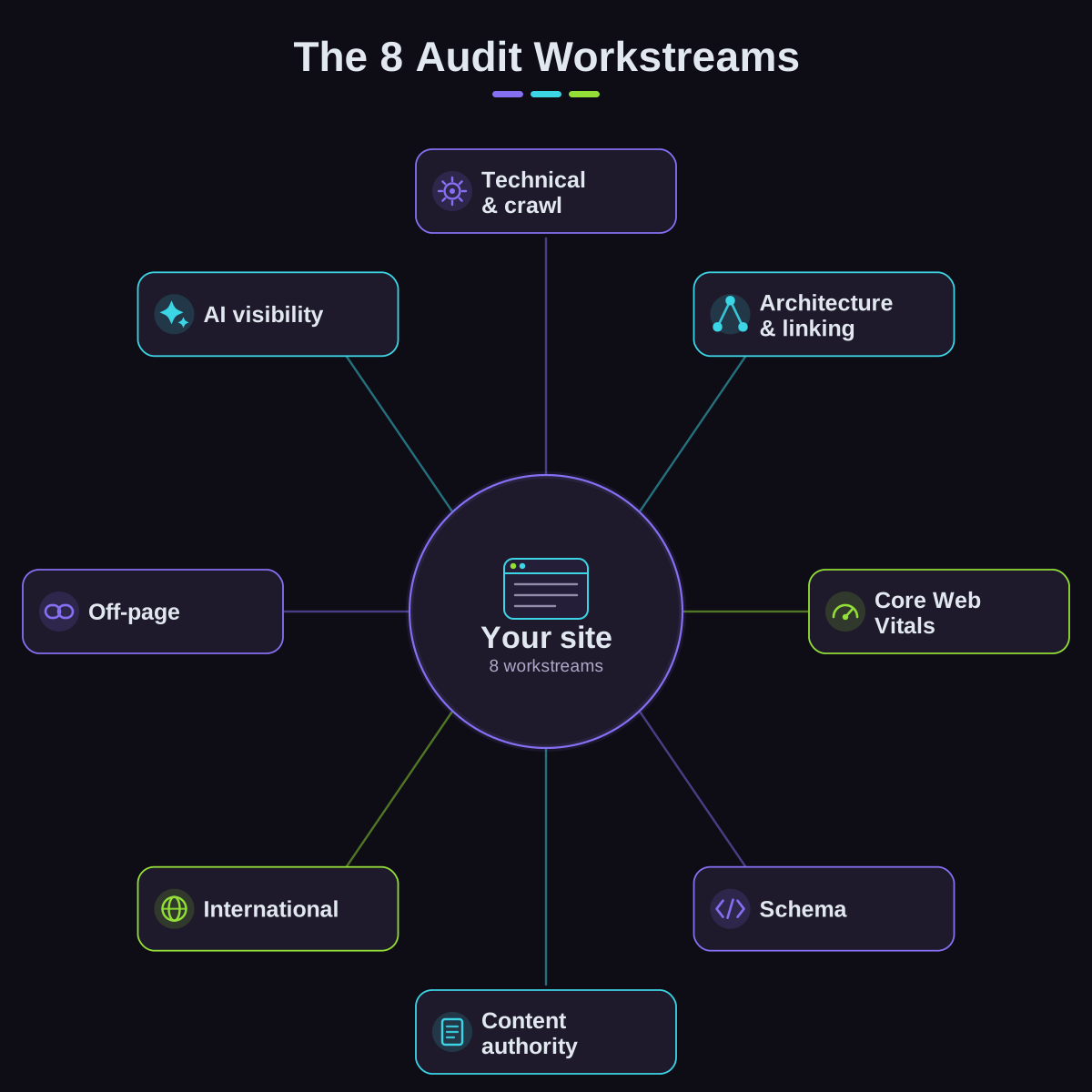
At enterprise scale, technical SEO auditing covers four areas that rarely matter on small sites:
- Crawl budget and log-file analysis: We read server logs to see where Googlebot actually spends its crawl, then cut the waste on parameter URLs, infinite spaces and low-value pages so budget flows to money pages.
- Indexation and status-code hygiene: We map what is indexed against what should be, and hunt for noindex tags left behind on pages the business wants to rank, redirect chains on high-value URLs, and soft 404s draining crawl.
- JavaScript rendering: We confirm that critical content and navigation survive rendering, because if your menu only appears after a tap or a script, a crawler may never see your site structure.
- Index bloat and faceted navigation: We find the thousands of thin, filtered and duplicate URLs that large catalogues generate, then contain them with canonicals, robots rules and parameter handling.
The findings here are usually blunt. A recent technical SEO audit we ran surfaced a set of money pages that no internal link pointed to, noindex tags stranded on pages the business needed to rank, and redirect chains sitting on high-value URLs. None of these show as an error on the page itself, which is exactly why they survive for months. Mobile makes the gap wider still: research shows only 11% of pages rank in the same position on desktop and mobile, so a desktop-strong site can be quietly losing on the version Google actually indexes.
Site Architecture, Internal Linking and Keyword Cannibalisation
This workstream audits how your pages are organised and linked, because on a large site your own pages are often each other's biggest competitor. Three failure modes dominate: keyword cannibalisation where several URLs chase the same query and split their own authority, orphaned commercial pages with almost no internal links pointing to them, and money pages buried four or more clicks from the homepage.
We map every important page against the keyword it is meant to own, then check the internal link graph that should support it. The common finding is a high-value service page stranded deep in the architecture, starved of internal links, and capped well below its potential while a weaker page outranks it for the same term. The fix is structural:
- Give every page a single clear target.
- Route internal links from relevant pillar and cluster content into the pages that drive revenue.
- Flatten the path to key pages so authority and crawl attention reach them.
On an enterprise site this has to run as a governed system with clear rules, not a one-off spreadsheet, or the cannibalisation returns the moment new content ships.
Core Web Vitals and Template-Level Performance
A Core Web Vitals audit measures loading, responsiveness and visual stability against Google's thresholds for every important template, rather than the homepage alone. Google treats the three metrics as ranking signals, and AI platforms lean toward fast, stable pages when they choose what to cite. The thresholds are clear:
- Largest Contentful Paint at 2.5 seconds or less.
- Interaction to Next Paint at 200 milliseconds or less.
- Cumulative Layout Shift at 0.1 or less.
Template-level thinking is what makes this an enterprise workstream. On a large site you do not fix pages one at a time, you fix the product template, the article template and the category template, and the improvement propagates across every page built from each. The findings are often stark. In one eCommerce audit we ran, 590 images were over 100KB and not a single image carried width and height attributes, which forces the browser to reshuffle the layout as each one loads. Compressing and dimensioning 982 images in a single sprint removed most of the slow-loading and layout-shift problems at once, and organic revenue grew 91% over 16 months on an eCommerce engagement. Most enterprise sites carry the same class of issue, hidden beneath the surface until an audit measures each template against Google's bar.
Structured Data and Schema Auditing
Schema auditing checks whether your structured data accurately describes what is on each page, so Google and AI platforms can parse and cite it with confidence. Without it, machines infer meaning from unstructured text. With it, you hand them a clear, machine-readable signal about your business, services, content type and the relationships between them.
At enterprise scale we audit schema by template rather than page by page, checking that the JSON-LD is:
- Present on every template that needs it.
- Valid and error-free.
- Consistent across the site through shared entity identifiers, so your organisation reads as one entity everywhere it appears.
The most common schema finding is markup that describes something the visitor cannot see, for example review or FAQ data with no matching on-page content, which undercuts trust in all of your structured data.
Two things matter for schema in 2026:
- Google no longer shows FAQ or How-to rich results in Search, so schema is not a rich-result shortcut.
- It still earns its place, because non-Google AI platforms lean on structured data more heavily when parsing pages for citation, and at SMX Munich in 2025 Microsoft's Bing team confirmed that schema markup helps its large language models understand content.
We keep the markup aligned to what is visible, scoped by page type, and validated before deploy.
Content and Topical Authority Auditing
This workstream audits the depth and coverage of your content estate, scoring where you already own a topic and where thin or decaying pages are dragging you down. The frame we use with every client is that content depth beats keyword density: one page that answers fifteen to twenty related questions will out-rank and out-cite five thin pages targeting keyword variations. This is semantic SEO, and it is now the baseline for content that ranks, not an advanced tactic.
Across a large content library we look for:
- Coverage gaps where a competitor owns a cluster you do not.
- Decaying pages that have slipped as intent moved on.
- Overlap where several pages compete for one topic.
The goal is topical authority: demonstrating genuine expertise across every meaningful aspect of a subject rather than chasing isolated keywords. Google's 2024 API documentation leak lent weight to what the discipline had long argued, exposing internal signals such as siteFocusScore, which rewards concentrated topic coverage, and siteRadius, which penalises pages that stray from a site's core identity.
The audit output is an editorial plan that decides:
- Which pages to consolidate.
- Which to refresh.
- Which to expand into full clusters.
- Which to retire, so the site reads as a focused authority rather than a sprawling archive.
International and Hreflang Auditing at Scale
International auditing checks that the right language and country version of each page is served to each market, which at enterprise scale is where hreflang quietly breaks. A study of more than 18,000 multilingual sites found 31% of multilingual sites with conflicting hreflang carry conflicting hreflang directives, so this is a common problem rather than an edge case.
The reason we treat it as its own workstream is the migration risk it exposes. In a recent audit for an enterprise SaaS client preparing to launch into a new English-speaking market, we found 2,402 broken hreflang URLs pointing to pages that returned 404 errors, live in production, indexed in Search Console and draining crawl budget across both the existing and the new market.
On the same engagement, 75% of the target market's existing organic traffic sat in just two pages, so any launch had to protect those two pages before touching anything else. A migration that ignored that concentration would have lost half the market's traffic before the new pages had a chance to index.
A thorough international SEO audit maps every part of that setup across every market:
- Hreflang return tags.
- x-default handling.
- Self-referencing tags.
- Per-market sitemaps.
- Server response codes.
- Localisation quality.
Done properly, the launch protects revenue instead of gambling with it.
Off-Page and Backlink Authority Auditing
Off-page auditing measures the authority your site has earned from the rest of the web, and how evenly that authority is spread across a large page estate. Backlinks remain a core ranking signal: Backlinko's analysis of 11.8 million results found the top result has, on average, 3.8 times more backlinks than positions two through ten, and the gap widens in competitive categories.
At enterprise scale we audit the link profile for quality and distribution, not raw volume. That means checking:
- Referring domain quality and relevance.
- The anchor-text mix, for over-optimisation risk under Google's spam policies.
- Toxic or manipulative links that create exposure.
- Whether authority actually reaches the commercial pages that need it, or pools on the homepage.
Off-page SEO auditing now covers AI visibility too. Ahrefs' study of 75,000 brands found that branded web mentions correlated more strongly with visibility across ChatGPT, Google AI Mode and AI Overviews than classic link metrics did. That does not prove causation, but it means the audit checks your presence across review platforms, industry directories and third-party sources that both people and AI systems use to judge a brand, then plans digital PR to close the gaps.
The AI-Visibility Audit (the Workstream Most Teams Skip)
The AI-visibility audit measures whether your brand is cited when ChatGPT, Google AI Overviews, Perplexity, Gemini and Copilot answer buyer questions, and whether AI crawlers can even reach your content. It is the workstream most enterprise audits still ignore, and it is the one we lead with, because the click is moving into the answer box. ChatGPT alone now has 900 million weekly active users, and enterprise buyers increasingly research inside these tools before they ever reach your site.

For one B2B property management client we took to about $8.7M in attributed revenue over 27 months (ongoing) in attributed revenue over 27 months (ongoing), the AI layer showed up as 598 AI cited pages across Google AI Overview, AI Mode, ChatGPT and Gemini, up from zero. We treat those citations as a visibility KPI, a leading indicator that the engines now trust the content, tracked alongside rankings rather than as a revenue number in their own right. The revenue came from the whole programme. The citations are how we know the AI layer is working, which is the same reason we now track AI citations for every client.
The audit itself has three parts. First, citation share of voice: we prompt each platform with the buyer questions that matter and record who gets cited, how often, and where you sit against competitors. Second, AI-crawler access, because a blocked crawler makes citation impossible. At enterprise scale these controls live in robots.txt, the CDN and the WAF, and they need reviewing by name:
- GPTBot and OAI-SearchBot: OpenAI's training and search crawlers, with OAI-SearchBot tied to ChatGPT search visibility.
- ChatGPT-User: The agent that fetches a page when a ChatGPT user follows a link.
- PerplexityBot: Perplexity's crawler for search visibility on that platform.
- ClaudeBot: Anthropic's crawler.
- Google-Extended: Google's separate control for generative-model training, kept distinct from standard Search indexing.
Third, answer extractability: whether your content is structured so a retrieval pipeline can lift a clean, quotable passage. This is where generative engine optimisation meets technical SEO, and it rewards concise definitional openers, clear headings, tables and factual passages over walls of prose. For Google's own AI features there are no extra eligibility requirements beyond standard best practice, so the same clean, crawlable, well-structured pages feed both surfaces. If you want the retrieval mechanics behind this, our guide on how AI search works walks through the pipeline step by step.
Measurement, KPIs and Revenue Attribution
Measurement turns an audit from a list of problems into a business case by tying every finding to a metric leadership cares about. The SEO KPIs that matter at enterprise scale fall into three groups, reported together so the story holds up in a board meeting:
- Visibility: Organic traffic split branded versus non-branded, keyword rankings on commercial-intent terms, and AI citation rate as a visibility KPI tracked alongside the rest.
- Engagement: Organic click-through rate and engagement time, used as UX diagnostics rather than direct ranking factors.
- Conversion: Organic conversion rate and, above all, revenue attributed to organic search.
The attribution model is what makes the number defensible. Last-click reporting robs organic search of credit because it rarely gets the final touch, so we run SEO ROI on GA4 data-driven attribution, and separate attributed revenue from incremental revenue, the stricter figure that strips out demand you would have captured anyway. Done this way, the enterprise website SEO audit report reads as a revenue case, not a vanity dashboard. The approach holds across verticals: a B2B SaaS client reached $1.31M in attributed revenue at a 1,909% ROI over 12 months once the technical foundation and content system were fixed and measured properly.
Governance and Prioritisation (P1 to P4)
Governance is what decides whether an audit's findings ever ship, which on an enterprise site is the hardest part, not the diagnosis. A 300-page report that no team can action is worthless. We convert findings into a single prioritised backlog, scored by revenue impact against implementation effort, using four severity bands:
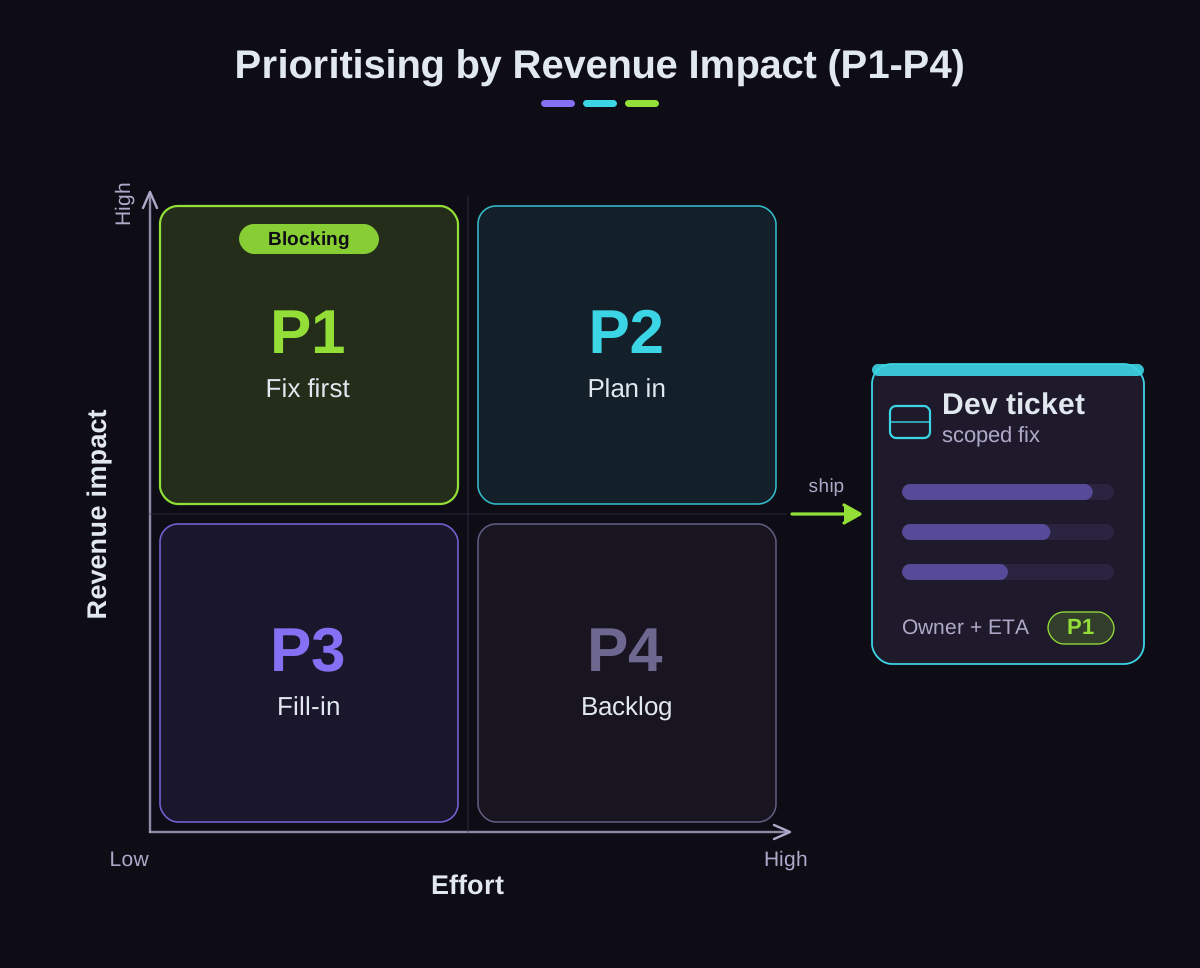
- P1, critical: Issues actively losing revenue or blocking indexation, such as noindex on money pages or a broken migration, fixed first.
- P2, high: Template-level problems suppressing large sections of the site, like Core Web Vitals failures on a key template or widespread cannibalisation.
- P3, medium: Meaningful but contained issues, such as schema gaps or thin content on secondary pages.
- P4, low: Housekeeping and marginal gains that can wait for a later sprint.
Each item ships as a scoped development ticket with the fix, the reason, the expected impact and the owning team already attached, so it slots into a sprint instead of a wishlist. Because template-level fixes touch many pages at once, they usually earn their place near the top. The whole system runs on the cross-team roles that govern an enterprise site, so development, content, legal, product and regional owners each know what is theirs.
The Enterprise SEO Audit Checklist
Use this condensed enterprise SEO audit checklist as a scan of the ground a full audit has to cover. Each line is a workstream, not a single task, and each one can suppress visibility on its own.

- Technical and crawl: Crawl budget, log files, indexation, status codes, JavaScript rendering, index bloat and faceted navigation.
- Architecture and internal linking: Crawl depth, orphan pages, keyword cannibalisation and authority flow to commercial pages.
- Core Web Vitals: LCP, INP and CLS measured per template against Google's thresholds.
- Structured data: Valid, visible-content-matched JSON-LD, scoped by page type with consistent entity identifiers.
- Content and topical authority: Coverage gaps, decay, overlap and cluster depth across the estate.
- International and hreflang: Return tags, x-default, self-referencing tags, per-market sitemaps and localisation, with response codes clean on every annotated URL.
- Off-page authority: Referring domain quality, anchor mix, toxic links and brand presence across third-party sources.
- AI visibility: Citation share of voice, AI-crawler access and answer extractability across the major platforms.
- Measurement and governance: Revenue attribution model, KPI set, and a P1 to P4 backlog scoped for delivery.
How We Run Enterprise SEO Audits
We run enterprise audits for large Australian organisations, from Sydney enterprises to global multi-market brands, and the method is the same every time:
- Diagnose across all nine areas above.
- Quantify the revenue at stake.
- Hand over a backlog your teams can ship.
As an Australian AI SEO agency, we have generated more than $26M in client revenue across Google, AI Overviews, ChatGPT, Perplexity, Gemini and Copilot, which is the track record behind the audit standard we teach here.
What separates our enterprise technical SEO audit services from a tool export is the sequencing and the attribution:
- We fix the plumbing before we scale content, because pouring budget into pages on a site that crawlers cannot read is spending on a leak.
- We measure AI citations beside rankings, so you can see the answer-box layer working before it shows up in revenue.
- We scope every finding for a dev ticket with a commercial number attached, so the audit becomes a plan rather than a report.
That is how a diagnosis turns into compounding organic growth across both Google and AI search.
Frequently Asked Questions
These are the questions we hear most often when enterprise teams start scoping an audit.
How is an enterprise SEO audit different from a standard audit?
A standard audit reviews a few dozen pages and reports rankings and traffic. An enterprise SEO audit works across thousands to millions of URLs, multiple markets and several teams, so it audits templates, rules and patterns rather than individual pages. It also ties every finding to revenue and includes an AI-visibility workstream, because at this scale the commercial stakes and the coordination problem are both far larger.
How often should you run an enterprise SEO audit?
Run a full audit at least once a year to reset the baseline and catch the drift that accumulates on large sites. Run a targeted audit before any high-risk change, such as a migration, a replatform or a new-market launch, because those are the moments a big site breaks at scale. Between full audits, monitor crawl stats, indexation, Core Web Vitals and AI citations continuously so regressions surface in days.
How long does an enterprise SEO audit take?
It depends on the number of pages, markets and templates, but an enterprise audit is a multi-week engagement rather than a same-day tool run. Most of the time goes into log-file analysis, template-level testing, international checks and AI-visibility prompting across platforms, then into scoping each finding for delivery. The output is a prioritised backlog, not a raw export, which is what makes the timeline worthwhile.
What tools do you use for an enterprise SEO audit?
We combine Google Search Console for real-world index and performance data, a site crawler such as Screaming Frog for structure and status codes, log-file analysers for crawl-budget insight, and Ahrefs or Semrush for keywords and backlinks. Tools surface the raw signals, but the value is in interpreting them at scale and connecting each finding to revenue. No single tool audits an enterprise site on its own.
What is an AI-visibility audit and why does it matter?
An AI-visibility audit measures whether your brand is cited when ChatGPT, Google AI Overviews, Perplexity, Gemini and Copilot answer buyer questions, and whether AI crawlers can reach your content. It matters because click-through from traditional results drops sharply when an AI answer appears, so being one of the cited sources protects visibility that rankings alone no longer guarantee. We report citations as a visibility KPI tracked alongside rankings, never as a revenue figure in themselves.
How do you prioritise the issues an enterprise audit finds?
We score every finding by revenue impact against implementation effort, then sort it into four bands from P1 critical to P4 low. Issues actively losing revenue or blocking indexation are fixed first, and template-level fixes that touch many pages at once tend to rank highly. Each item ships as a scoped development ticket so it enters a sprint rather than a backlog nobody owns.
What should an enterprise website SEO audit report include?
A useful report covers all nine workstreams, from technical and crawl to AI visibility, with each finding tied to an expected commercial impact. It should end in a prioritised P1 to P4 action plan scoped for the teams that will deliver it, not a list of raw tool outputs. The test is simple: your developers, content team and leadership should each be able to act on it without a translation layer.
Can an enterprise SEO audit help with Google AI Overviews and ChatGPT visibility?
Yes, and that is a core reason to run one in 2026. The audit checks that AI crawlers can access your content, that your pages are structured so a retrieval pipeline can lift clean passages, and that your brand is present across the third-party sources these platforms trust. Strong technical foundations and well-structured content are what get a page cited, and the audit is how you find where those foundations are breaking.
Audit for the Search You Actually Have
Large sites do not lose visibility to one dramatic failure. They lose it to dozens of small, compounding faults that stay invisible until an audit measures each template, each market and each answer engine against the bar. An enterprise SEO audit is how you find those faults early, while each fix is still small, tie each one to the revenue it protects, and turn a sprawling site into a focused authority across both Google and AI search. Get the diagnosis right and the fixes it produces compound month after month, which is exactly where durable organic growth comes from.
About the Author
Want Insights Like This Fortnightly?

Our AI SEO strategies and tactics delivered fortnightly, including bonus trade secrets not shared anywhere else. No fluff. Just what's working right now. 5-minute read.


