
Backlinks for Google and AI Search: What Still Matters


Backlinks are one of the most studied and most misunderstood topics in SEO, and for good reason. Every few months, someone declares them dead, followed by fresh data showing they still matter, especially in competitive search results. The reality, as with most things in search, is more nuanced than the hot takes suggest. What has changed is what makes a backlink valuable and how those same signals can support your visibility across newer search experiences like ChatGPT, Perplexity and Google AI Overviews. If you're trying to improve your rankings in competitive SERPs and strengthen your broader search visibility, this guide breaks down what backlinks are, how they work and which strategies are actually worth your time.
Quick Guide: What Are Backlinks?
Backlinks are links from one website that point to a page on your website. When another site links to you, that is a backlink. Search engines treat each backlink as a signal that the page being linked to is credible and worth ranking, like a vote of confidence from the linking site. The more high-quality backlinks your pages earn, the stronger the signal to Google that your content deserves to rank. A Backlinko analysis of 11.8 million Google search results found that the #1 result on Google has, on average, 3.8 times more backlinks than pages ranking in positions two through ten. That single data point captures the stakes clearly: in competitive niches, your link profile often determines whether you make it to the top of the page or stay stuck beneath it.
Ready to Build a Backlink Profile That Ranks?
Knowing what backlinks are is one thing. Knowing which links to go after, when you actually need them and how to acquire them without risking a Google penalty is another. Our link-building services are built around competitor gap analysis first, so we only recommend link acquisition when the data shows a genuine authority deficit. If you want a frank assessment of where your backlink profile stands, start there.
See Our Link-Building ApproachHow Backlinks Work
Before you can build them strategically, it helps to understand what Google is actually doing when it crawls and processes a backlink. The mechanism is older than most of the digital marketing industry, but it has become more sophisticated over time.
How Google Uses Links to Judge Authority
Google's original algorithm, PageRank, named after co-founder Larry Page, was built on the insight that a page's importance could be measured by how many other pages linked to it and how authoritative those linking pages were. That core logic still operates within Google's ranking system today, even as hundreds of other signals have been added on top of it. When a high-authority domain links to your page, it passes link equity (often called "link juice") to your page, boosting its authority in Google's eyes. That authority then contributes to how well your page ranks for relevant queries. Crucially, Ahrefs' research across one million SERPs confirms that referring domains still correlate positively with rankings. The signal is not as dominant as it once was, but it remains meaningful, particularly in competitive categories.
DoFollow vs. NoFollow: What Actually Passes Value
Not all links behave the same way. A dofollow link can pass PageRank to the linked page, contributing to its authority. A nofollow link includes an HTML attribute (rel="nofollow"), but since 2019, Google has treated nofollow, along with ugc and sponsored, as hints rather than strict directives for ranking purposes. Most high-value editorial links are still standard followed links. Nofollow links are common on social media platforms, comment sections and many news sites. While they generally pass less direct SEO value than followed links, they are not worthless. They can drive referral traffic, increase brand exposure and contribute to a diverse, natural-looking link profile. Unnatural backlink profiles made up almost entirely of dofollow links from obscure domains can still create risk, so a healthy mix matters.
The Types of Backlinks Worth Building in 2026
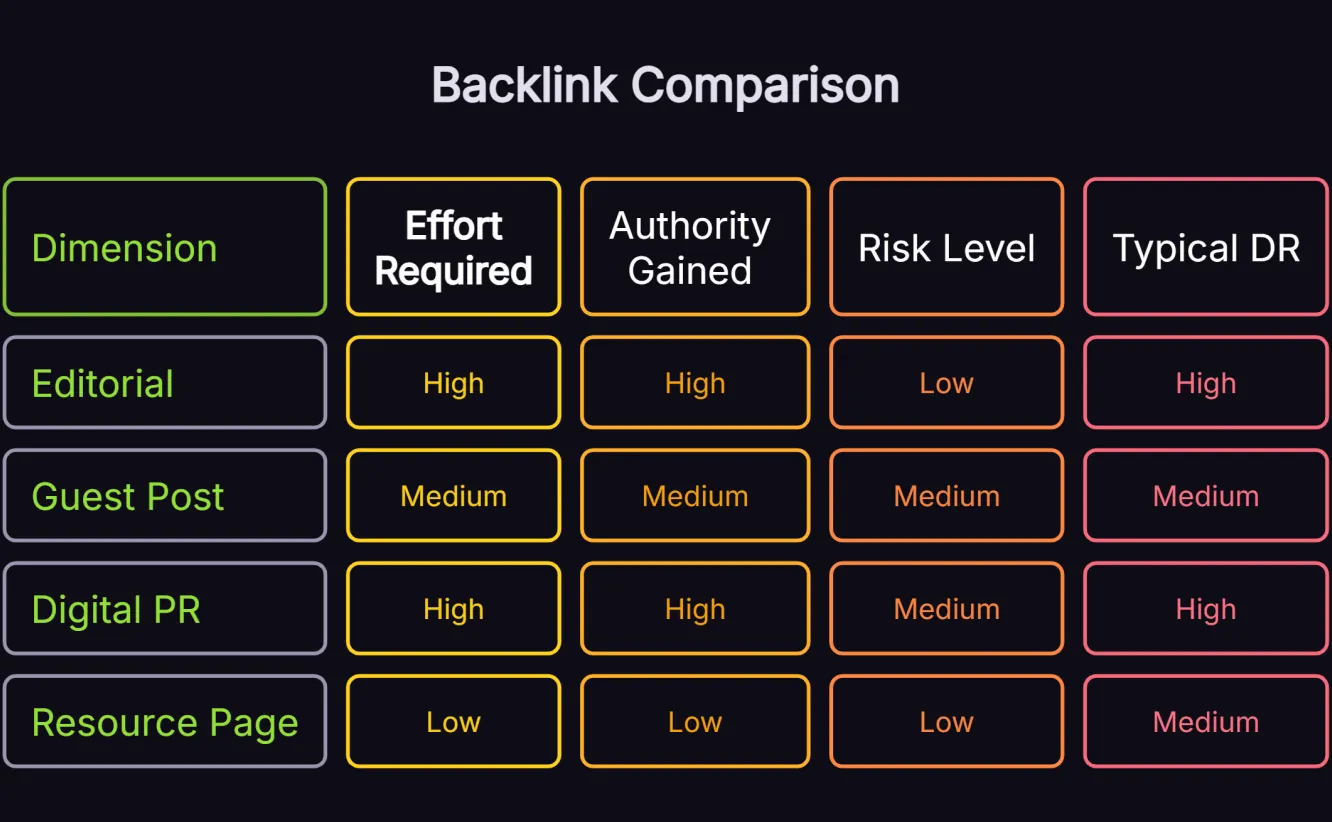
Not every link-building tactic carries the same risk-to-reward ratio. Here is a breakdown of the types that consistently deliver results without endangering your site's standing with Google.
1. Editorial Backlinks
An editorial backlink is earned when another website links to your content because they genuinely find it useful, authoritative or worth citing, without any exchange or request involved. These are the most valuable links in SEO because they represent an independent third-party endorsement. They are also the hardest to earn at scale, which is exactly why they carry so much weight. Editorial backlinks typically come from journalists, bloggers, researchers and industry publications referencing your original data, expert commentary or detailed guides.
2. Guest Post Backlinks
Guest posting involves writing a piece of content for another website in your industry, with a contextual link back to a relevant page on your site. When done properly, on genuinely authoritative and topically relevant sites, guest posts can be an effective way to build links at a controlled pace. The key qualifier is quality. A well-placed guest post on a relevant site with a real audience is far more valuable than large volumes of low-quality placements on irrelevant article farms. We generally treat digital PR as the stronger authority-building tactic, while guest posting works best as a secondary option on relevant, editorially credible sites.
3. Digital PR Backlinks
Digital PR is the process of creating the following types of content:
- Newsworthy content
- Original research
- Data studies
- Expert commentary
- Compelling stories
You pitch it to journalists and publications to earn editorial coverage and high-authority backlinks. When a campaign lands well, it can attract links from highly authoritative publications and create the kind of authority signals that compound over time. The exact quality and scale of those placements depend on these key factors:
- The strength of the story
- The outreach strategy
- The competitiveness of the media landscape
In our link-building service, digital PR is positioned as a high-authority tactic focused on earning relevant editorial placements.
4. Resource Page and Directory Backlinks
Resource pages are curated lists of recommended tools, guides or services in a given niche. Earning a placement on a relevant, well-maintained resource page delivers a clean contextual link with minimal risk. Industry directories, particularly those with genuine editorial standards and a meaningful audience, serve a similar function. These links rarely move the needle on their own, but they contribute to a diverse link profile and can drive qualified referral traffic.
What Makes a Backlink High Quality?
The difference between a link that helps your rankings and one that does nothing (or worse, creates risk) comes down to a handful of factors.
Domain Authority and Relevance
A link from a high-DR website in your industry will do more for your rankings than hundreds of links from low-authority sites with no topical connection. Google's systems assess both the authority of the linking domain and the relevance of the linking page to the content being linked. A property management software company earning a backlink from a construction industry publication will benefit more than the same company earning links from unrelated lifestyle blogs. Referring domains are often a more useful benchmark than raw backlink totals, but the right comparison is always against the pages already ranking for your target query.
Anchor Text and Placement
Anchor text is the clickable text used in a hyperlink. Search engines use anchor text as a relevance signal because it helps them understand what the linked page is about. However, over-optimising anchor text by using the same exact-match phrase repeatedly in external links can create risk under Google’s spam policies. A natural anchor text profile blends these types:
- Branded anchors
- Partial-match phrases
- Generic text
- The occasional exact-match keyword
Placement also matters: links embedded within the main body text of a relevant article are generally more valuable than links in footers, sidebars or boilerplate author bios.
Backlinks and AI Search: Why the Link Between Them Matters
One of the most important developments in SEO over the past 18 months is the intersection between backlink authority and AI search visibility. Many businesses are now asking whether traditional link building is still relevant in a world where ChatGPT and Perplexity surface answers directly. The data says it is, for reasons that go beyond Google rankings alone.
Why Google Rankings Still Drive AI Citations
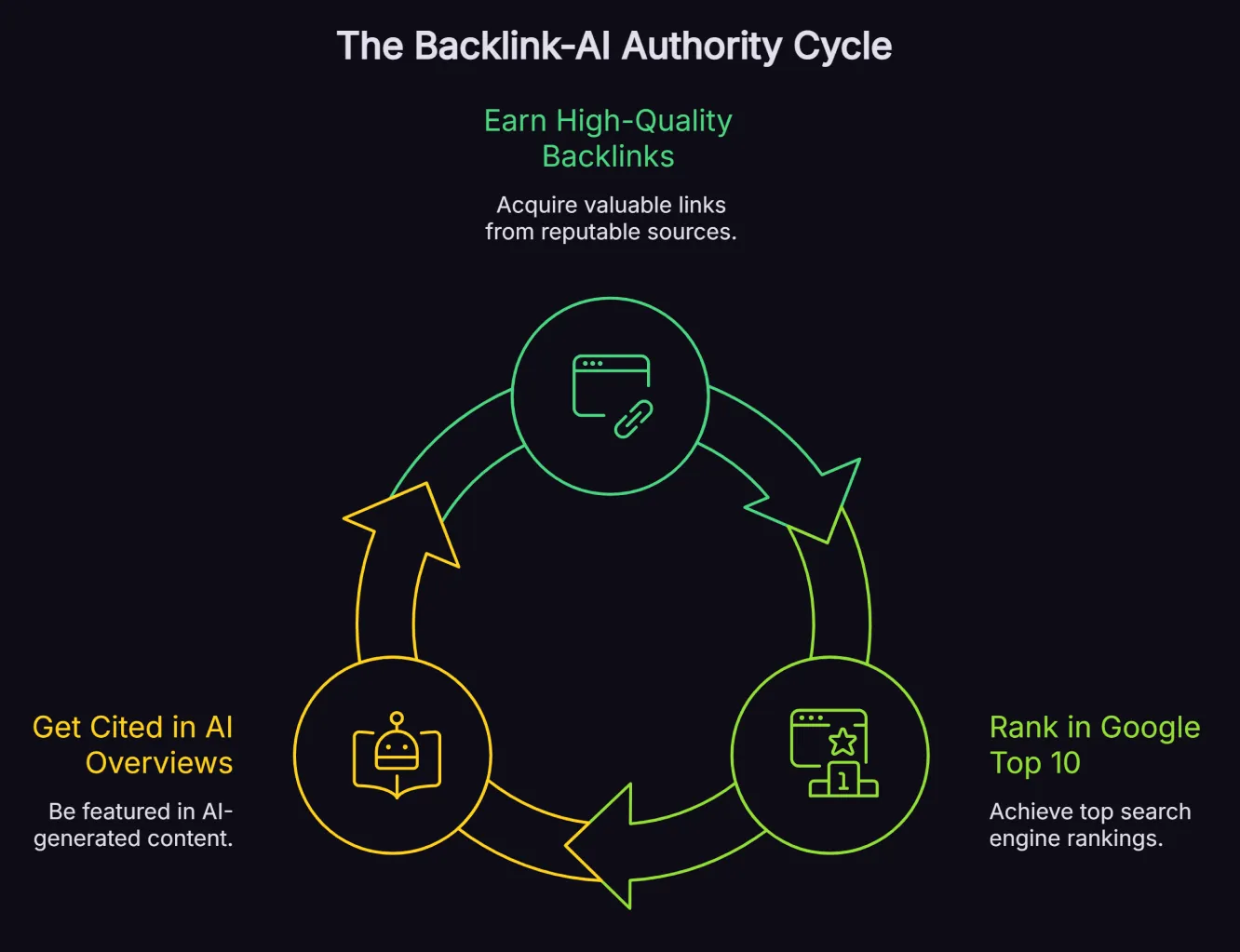
When Google AI Overviews generate a response, they often cite pages that already perform well in organic search. Ahrefs found that 76.10% of pages cited in AI Overviews also rank in Google’s top 10 results for the same query. That suggests a strong relationship between organic visibility and AI citations, but it does not prove that backlinks directly influence AI citations on their own. A stronger backlink profile can improve your ability to rank competitively in organic search, and stronger organic rankings can increase the likelihood of being cited in AI-generated answers. In that sense, backlinks still matter, but mainly because they support the broader authority signals that help strong pages surface across both traditional search and AI search experiences.
Brand Mentions, Co-Citations and the New Authority Signal
This is where things get more nuanced. AI visibility correlates with broader off-site signals, especially branded web mentions, but the evidence is correlational rather than causal. Ahrefs’ research on 75,000 brands found that branded web mentions correlate strongly with AI visibility, although that does not prove a direct causal relationship. A safer takeaway is that digital PR campaigns and editorial coverage can serve a dual purpose. They can earn backlinks that support traditional rankings while also increasing the number of reputable places where your brand is mentioned online. That broader off-site presence may strengthen your visibility across the sources AI platforms draw from when generating answers. You can read more about this in our guide to how AI search works and its implications for content strategy.
How to Audit Your Backlink Profile
Before investing in link acquisition, you need to know where you stand. A backlink audit tells you the strength of your current profile, identifies any toxic links that may be suppressing your rankings and reveals the gap between your site and the sites you are trying to outrank.
The Metrics That Matter Most
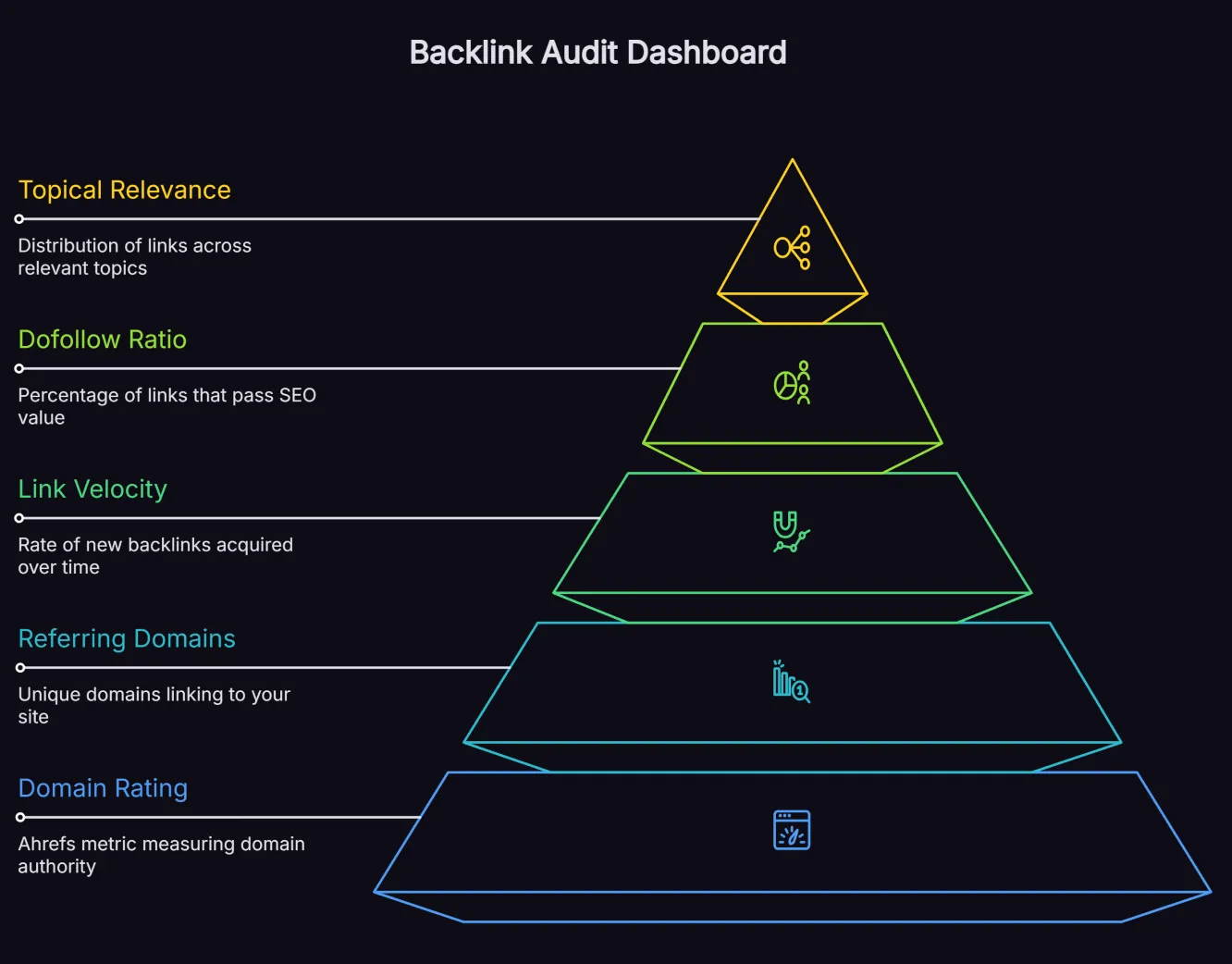
When auditing a backlink profile, focus on these key data points:
- Domain Rating (DR): An Ahrefs metric measuring the overall authority of your domain on a 0-100 scale. Higher is better, but the meaningful question is how your DR compares to your direct competitors.
- Number of Referring Domains: The count of unique domains linking to your site. As a general rule, a page with links from a broader range of relevant domains is often in a stronger position than a page with many repeat links from the same few sites, though the outcome still depends on the page, the query and the wider competitive context.
- Link Velocity: The rate at which you are earning new referring domains each month. Top-ranking pages tend to add between +5% and +14.5% new followed backlinks per month, which tells you the pace you need to sustain to remain competitive.
- DoFollow Ratio: The proportion of your links that pass equity. A healthy profile will have a high dofollow ratio from editorially earned links.
- Topical Relevance Distribution: The proportion of your links that come from sites in your industry or adjacent categories.
Ahrefs is usually the most practical option for a detailed backlink audit because it combines backlink data, historical reporting, and competitor comparison in one place. Semrush is a solid alternative if that is already your primary SEO stack.
Identifying and Removing Toxic Links
Toxic links are those that come from spammy, irrelevant or manipulative sources, such as:
- Link farms
- Private blog networks
- Mass-produced article directories
Google says most sites will not need the disavow tool. Reserve it for cases where you have a considerable number of spammy, artificial, or low-quality links and those links have caused, or are likely to cause, a manual action. Google recommends it mainly when there is a substantial number of artificial or spammy links and a manual action, or a strong reason to believe one is likely. Be conservative, because disavowing legitimate links by mistake can hurt your rankings.
In our AI SEO strategy process, the backlink audit is one of eight core assessment areas. We compare Domain Rating against direct SERP competitors and identify whether link building is actually necessary before recommending any investment. Many clients do not have a link gap at all; their priority is content quality and topical authority. Others are clearly being held back by a meaningful DR deficit, and that is where targeted link acquisition delivers the highest return.
Proven Backlink Building Strategies
With your audit complete and your gap identified, here are the strategies that deliver consistent results.
Create Long-Form, Link-Worthy Content
The single most reliable way to earn backlinks over time is to create content that other people want to cite. Backlinko's analysis of 912 million blog posts found that long-form content of 3,000+ words earns 77.2% more backlinks than content under 1,000 words. Longer content earns more links because it:
- Functions as a self-contained resource
- It answers the core question
- Addresses follow-up questions
- Provides enough context to serve as a citation without the reader needing to look elsewhere
These formats attract the most inbound links:
- Original research
- Comprehensive guides
- Detailed how-to content
- Expert analysis
This is not simply a content quantity play. Most content earns few or no backlinks because it does not offer enough original value, insight or utility to be worth citing. The standard for link-worthy content is high, and it continues to rise as more brands publish competing resources on the same topics.
Run Digital PR Campaigns
Digital PR is one of the fastest ways to earn authoritative backlinks. A strong campaign built around original data or a compelling story can secure high-quality editorial coverage, sometimes including placements on highly authoritative publications with large audiences. The compounding effect can be significant: strong placements can strengthen your site’s authority, which may help future content rank more easily and attract additional organic links over time.
In competitive markets, legal, finance, property, health and SaaS, for example, a meaningful DR gap versus page-one competitors is often the single biggest blocker to ranking improvement. Our B2B AI SEO case study client operated in exactly this environment. Addressing the authority gap through targeted link acquisition, alongside a rigorous content strategy, contributed to $5.9M in attributed revenue and a 6,864% ROI over 17 months.
Guest Post on Relevant, Authoritative Sites
A sustained guest posting programme places your content and backlinks on established sites in your industry. The key is selectivity. A smaller number of well-placed guest posts on relevant sites with real readership and clear editorial standards is far more valuable than large volumes of low-quality placements. Volume without quality will not move the needle and can increase the risk of violating Google’s spam policies. Every placement should have direct topical relevance to your business and genuine value for the site’s audience.
Build Original Research and Data Studies
Few content types earn backlinks as efficiently as original research. When you produce a study with findings others cannot find anywhere else, you become the primary source, and primary sources get cited. Data studies, survey reports, proprietary analysis and benchmark reports all attract editorial links from:
- Journalists
- Bloggers
- Researchers
These people need reliable statistics to support their own content. Our AI SEO strategy includes assessing what proprietary data assets a business already holds and how those can be turned into link-attracting research content.
FAQs: Backlinks
How many backlinks do I need to rank on page one?
There is no fixed number. The better question is how your backlink profile compares to the pages already ranking above you. In less competitive niches, a small number of strong, relevant links may be enough to reach page one. In more competitive categories, you may need a broader and more authoritative referring domain profile to compete. The right benchmark is not a universal backlink target. It is the gap between your site and the current top-ranking pages.
Are backlinks still important in 2026?
Yes. Ahrefs' study of one million SERPs confirms that referring domains still correlate positively with rankings, even as Google has suggested links carry slightly less weight than they did five years ago. The emphasis has shifted from quantity to quality; a single editorial link from a DR 80 publication in your industry can outperform hundreds of low-authority links. In competitive verticals, a strong backlink profile remains one of the most powerful ranking differentiators available.
What is the difference between a backlink and a referring domain?
A backlink is a single link pointing to your site. A referring domain is the unique website that hosts the link. If one website links to your site from five different pages, that counts as five backlinks but only one referring domain. Referring domain count is generally considered the more meaningful metric because it measures breadth of endorsement, the number of independent sites vouching for you, not just raw link volume.
Do backlinks help with AI Overviews and ChatGPT visibility?
Directly, less so than organic rankings. But indirectly, yes. Ahrefs found that 76.10% of pages cited in AI Overviews also rank in Google’s top 10 for the same query. That points to a strong relationship between organic visibility and AI citations, but it does not prove that backlinks directly influence AI citations on their own. Strong backlink profiles can help pages rank more competitively in organic search, and stronger rankings can increase the likelihood of being cited. Digital PR can also expand your brand’s presence across trusted websites, which may support broader authority signals, but the evidence here is still correlational rather than definitive.
How long does it take to see results from link building?
The impact of new backlinks usually takes time to appear. In most cases, ranking improvements happen over several months rather than immediately. Results also tend to compound, with high-quality links strengthening your overall authority over time and making future content more competitive. Patience and consistency matter more than any single campaign.
What is a toxic backlink, and should I disavow it?
A toxic backlink comes from a spammy, irrelevant or manipulative source, such as a link farm, private blog network or mass article directory. In most cases, Google is better at ignoring low-quality links than penalising sites for them. A disavow file is usually only worth considering when there is a substantial number of artificial or spammy links, and you have received a manual action, or there is a strong reason to believe one is likely. Before using disavow, try to remove the link through direct outreach where possible, and be careful not to disavow legitimate links by mistake.
What is the best tool for checking backlinks?
Ahrefs is widely regarded as the industry standard for backlink analysis. Its index is one of the largest and most frequently updated, and it offers a strong combination of backlink data, competitor research and rank tracking. Semrush and Moz are credible alternatives with different strengths, but for most businesses, Ahrefs remains the most practical all-around option.
Is it better to build lots of average links or a few great ones?
A few great links. In most cases, a small number of highly relevant, authoritative links will do more for your rankings than a large volume of low-quality ones. A single editorial placement from a trusted publication in your industry can carry far more value than dozens of weak directory links. The risk profile is also very different: quantity-driven link building built on low-quality placements creates long-term vulnerability, while a quality-first approach builds stronger authority over time.
Build Authority That Lasts
Strong backlinks are not a one-off win. They are built over time through content worth citing, a site worth trusting and a strategy grounded in real competitive gaps. The smartest move is to strengthen your foundations first, then invest in link acquisition, where it will create the biggest return. If you want to see where that opportunity sits, start with our link-building service.
About the Author
Want Insights Like This Fortnightly?

Our AI SEO strategies and tactics delivered fortnightly, including bonus trade secrets not shared anywhere else. No fluff. Just what's working right now. 5-minute read.


