
Topical Authority: The Complete Guide to Dominating Your Niche in Google and AI Search

Ever wonder why a niche site can outrank household names in Google and AI search? The answer is topical authority, which means demonstrating deeper expertise in the subjects your customers care about. If you're investing in content and links yet still stuck below the fold, this guide shows you how to build topical authority step by step to earn visibility, trust and revenue. You'll get practical frameworks, examples and checklists tailored to what's working in 2026 so you can turn organic search into a reliable growth channel. Ready to see how it's done?
A Quick Guide to Topical Authority
Topical authority is an SEO concept where websites establish themselves as go-to experts on specific topics by covering all key aspects in depth rather than targeting individual keywords. Search engines recognise sites with topical authority as trusted sources, rewarding them with higher rankings across related searches. Research demonstrates that sites with strong topical authority gain traffic 57% faster than those without, while ranking faster for new content within their established expertise areas.
Content That Generates Revenue, Not Just Traffic
Our content marketing campaigns connect topical authority building to business outcomes. See how we structure content campaigns around the Compounding Authority Method and Nano Clusters to deliver more revenue & ROI, not vanity metrics.
View Our Content Marketing ApproachWhat Is Topical Authority?
Topical authority represents your website's perceived expertise and trustworthiness on a specific subject in the eyes of search engines and users. Rather than optimising isolated pages for individual keywords, you build authority by systematically covering every meaningful aspect of a topic.
When you publish 50 interconnected articles about property management instead of 5 generic SEO posts, search engines recognise your specialised expertise. This recognition translates to ranking advantages across thousands of related search queries, not just your target keywords.
The shift towards topical authority reflects Google's evolution since the 2013 Hummingbird update, when search algorithms began understanding user intent and semantic relationships rather than simply matching keywords. Google now evaluates entire websites to determine subject matter expertise, not just individual pages.
Why Topical Authority Matters More Than Domain Authority
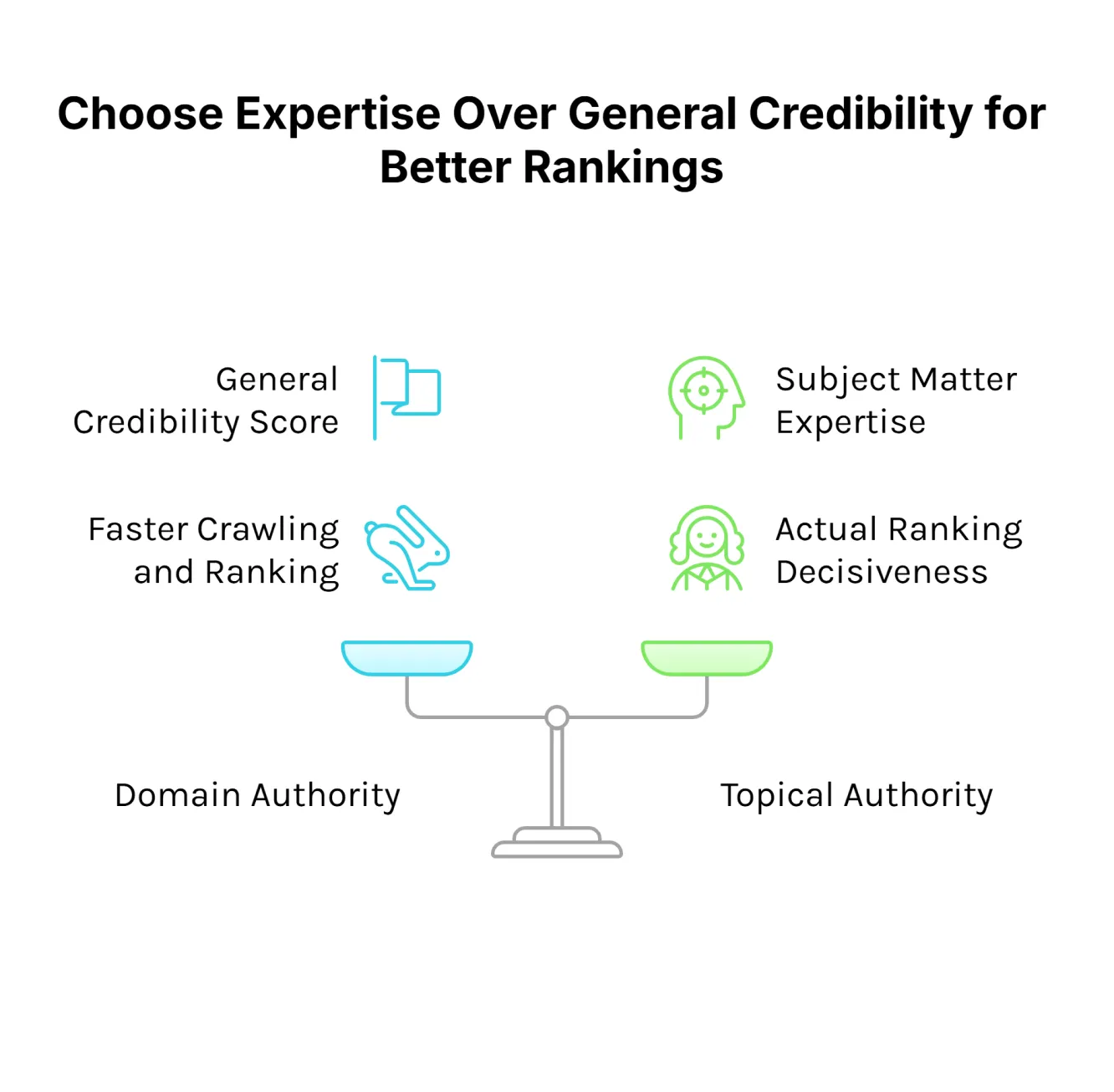
Domain authority and topical authority serve different purposes in modern SEO. Understanding the distinction determines whether you're competing on backlinks or genuine expertise.
Domain Authority: Your Overall Site Strength
Domain authority measures your website's general reputation across the internet. It's calculated from your backlink profile, site age, and technical performance, producing a score that reflects your site's overall strength.
Think of it as your website's general credibility score. A domain authority of 60 suggests you're more trusted than a site with 20, but it doesn't tell search engines what you're actually an expert in. You could have excellent domain authority while knowing nothing about the topics you're trying to rank for.
High domain authority helps your content get crawled faster and potentially rank more quickly for new pages. But it's becoming less decisive for actual rankings, especially when you're competing against sites with focused topical expertise.
Topical Authority: Your Subject Matter Expertise
Topical authority measures the depth of knowledge within a specific subject area. It’s built through thorough topic coverage, strategic internal linking, and demonstrated expertise across every meaningful aspect of a subject.
Rather than being "generally trusted," you become the recognised expert in your niche. When you've published 80 interconnected articles covering property management from every angle, tenant screening, maintenance coordination, lease administration, trust accounting, search engines understand you genuinely know this subject.
Why the Difference Matters
Here's the practical impact: a website with 23 domain rating ranks second for "mountain bike gifts" above Amazon's 96 domain rating. The specialised cycling site wins because it covers bikes, gear reviews, maintenance guides, buying advice, and riding techniques in far greater depth. Amazon sells everything, which means it's authoritative on nothing specific.
This isn't theoretical. Google's 2024 algorithm updates actively penalise sites trying to rank outside their core expertise. In late 2024, Google issued manual actions against sections of Forbes Advisor under its Site Reputation Abuse policy, leading to widespread deindexing of affected pages until the issues were resolved.
High domain authority no longer guarantees ranking for any topic. You need demonstrated expertise in the specific subject you're targeting.
The AI Search Advantage
Topical authority matters even more for AI-powered search platforms than traditional Google results.
ChatGPT, Perplexity and Google's AI Overviews generate answers by summarising information from multiple sources and related queries. They tend to highlight sites with deep, well-structured coverage because those hubs reliably address adjacent questions and can be cited across responses. Build interconnected content around each topic so these systems can find, extract and reference your expertise.
Our eCommerce AI SEO case study client has achieved 866 AI citations across platforms by building topical authority in meal planning and nutrition guidance. They didn't have the highest domain authority in their market, but their extensive dietary coverage made them the natural source for AI systems.
You can acquire backlinks to boost domain authority. You can't fake genuine expertise. Topical authority requires genuinely understanding your subject and proving it through content depth, which is precisely why search engines increasingly reward it.
Now let me rewrite that section based on the documented evidence from the 2024 Google API leak:
How Search Engines Evaluate Topical Authority
Search engines won't admit they use topical authority scores, but the 2024 Google API documentation leak proved otherwise. Over 14,000 attributes accidentally published from Google's internal Content Warehouse API revealed specific metrics measuring topical specialisation - directly contradicting years of public denials.
The leaked documentation exposed three core topical authority signals Google actually uses:
siteFocusScore: Your Topic Concentration
This attribute quantifies how much your site concentrates on a specific topic. Sites demonstrating focused expertise in narrower topic areas receive higher siteFocusScore values than those spreading across multiple unrelated subjects.
When you publish 80 interconnected articles about property management versus 10 scattered posts across property, recruitment, and financial planning, your siteFocusScore for property management can rank significantly higher.
siteRadius: Your Topical Deviation
This metric measures how far individual pages stray from your site's core topical identity. Google creates a topical identity for your entire website, then evaluates each page against that established identity.
Publishing content outside your core expertise increases your siteRadius, weakening your perceived authority. This explains why Forbes Advisor was manually removed from search results - their affiliate content deviated too far from Forbes' established journalism identity.
siteEmbeddings and pageEmbeddings: Semantic Understanding
These compressed embeddings analyse how your content relates semantically to established topics in Google's Knowledge Graph. Search engines map the relationships between entities, concepts, and questions within your content to determine comprehensive topic coverage.
Strategic internal linking, consistent terminology, and thorough subtopic coverage strengthen your embeddings' alignment with Google's topical understanding.
Why Google Denied Topical Authority Exists
For years, Google representatives including John Mueller repeatedly claimed no "domain authority" or topical authority metrics existed in their algorithm. The leak proved these statements were false.
When confronted with the leaked documentation in May 2024, Google issued a carefully worded response cautioning against "making inaccurate assumptions about Search based on out-of-context, outdated, or incomplete information." They confirmed the documents' authenticity while attempting to minimise their significance.
The reality SEO professionals suspected for years was confirmed: Google does evaluate topical authority through specific, measurable signals. They simply chose not to disclose this publicly to prevent manipulation.
Content Comprehensiveness
Beyond the leaked metrics, search engines analyse whether your content addresses the full spectrum of user questions within topics. Publishing one property management article won't establish authority, but 80 interconnected pieces covering tenant screening, maintenance coordination, lease administration, and trust accounting demonstrates systematic expertise.
Internal Linking Structure
Your internal links reveal content relationships to search engines. Strategic linking between related articles creates semantic connections reinforcing topical expertise. When you link a property maintenance guide to articles on preventative checklists and contractor management, search engines understand your coverage depth.
Content Freshness and Consistency
Regular publishing signals active expertise. Our B2B AI SEO case study client published 12 articles monthly on property management topics, achieving 429% traffic growth as search engines recognised their expanding authority.
E-E-A-T Signals
Google's Experience, Expertise, Authoritativeness, and Trustworthiness guidelines directly relate to topical authority. Author credentials, cited sources, and demonstrated first-hand experience all contribute to perceived expertise - even if Google won't explicitly confirm how they weight these factors.
Building Topical Authority With "Nano Clusters"
We've refined our approach through campaigns delivering measurable results. Our SaaS SEO case study client piloted our "nano cluster" method which generated $1.31M revenue over 12 months by building topical authority in legal tech.
1. Choose a Focused Topic
Select a topic specific enough to cover in depth but broad enough to support substantial content. "SEO" is too broad; "AI SEO for B2B SaaS" is too narrow. "AI SEO" is just right - it provides clear relevancy while offering depth.
Your chosen topic should align with your business offerings and target audience needs. Don't build authority in areas that won't drive relevant traffic and conversions.
2. Conduct In-Depth Keyword Research
Identify every meaningful search query within your topic using tools like Ahrefs Keywords Explorer. Go beyond high-volume terms to find the long-tail questions your audience actually asks.
We typically research 2,000-8,000 keywords before clustering them into topical groups. This reveals the full scope of coverage needed to establish authority.
3. Map Content Clusters
Organise keywords into clusters around central themes. Each cluster should include:
- A pillar page providing a detailed overview of the core topic. This becomes your definitive resource, typically 3,000-5,000 words covering the subject from every angle.
- Supporting articles diving deeper into specific subtopics. These cluster spokes address particular questions and scenarios, linking back to the pillar.
For property management SEO, we created pillar pages for major services (property lead generation, maintenance coordination, trust accounting) with 5-7 supporting articles expanding each subtopic.
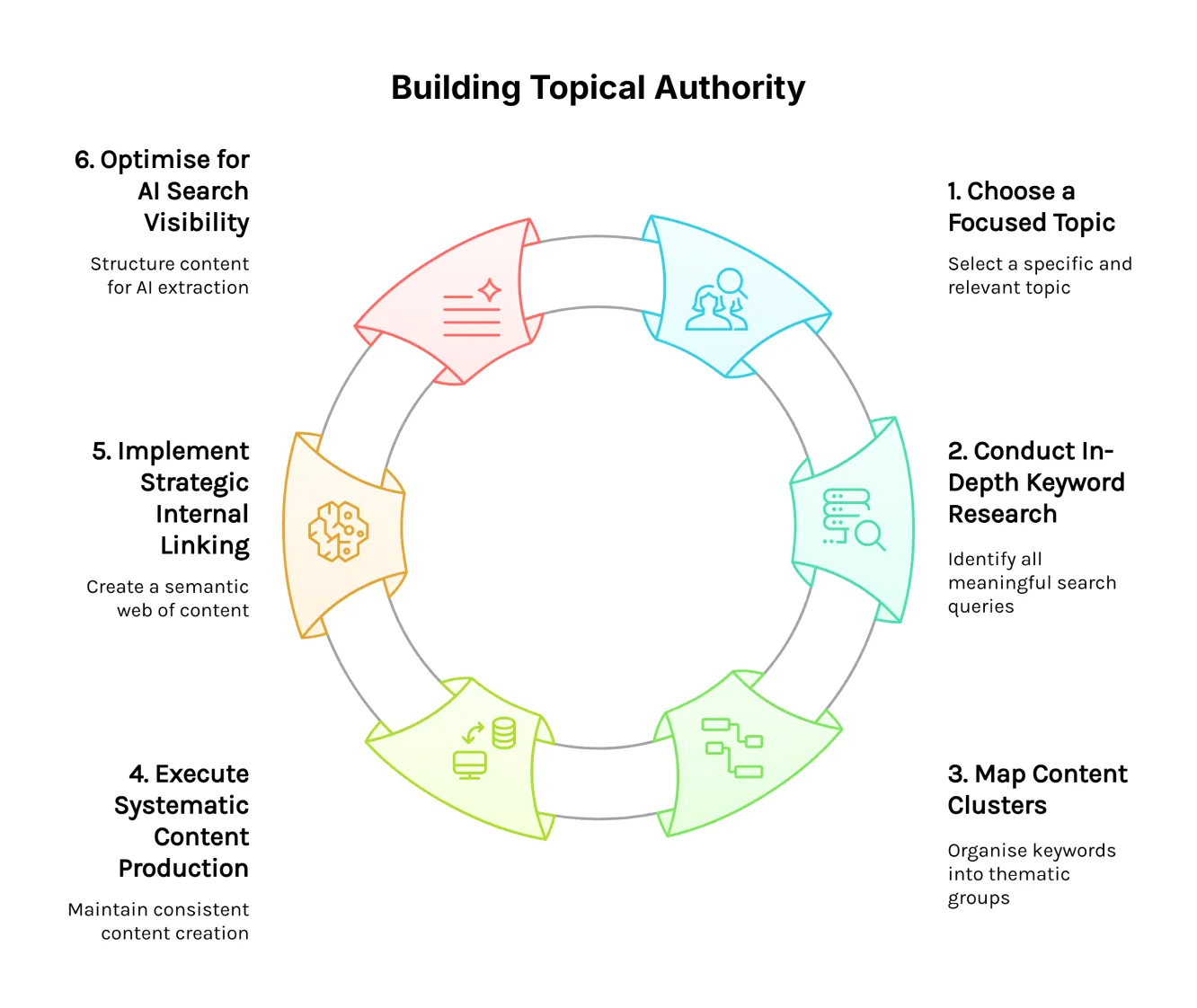
4. Execute Systematic Content Production With "Nano Clusters"
Consistency builds authority faster than perfection. Our "Nano Cluster" approach publishes a minimum of three interconnected pages weekly - 12 complete clusters monthly - creating immediate conversion pathways while building topical depth.
Each Nano Cluster follows a 1+2 structure:
One commercial page targeting transactional keywords where prospects evaluate solutions. Service pages, product categories, or solution-focused landing pages addressing specific business problems.
Two supporting informational pages (2,000-3,500 words each) answering questions prospects ask before they're ready to buy. These establish expertise whilst building semantic relevance around your commercial offering.
For example, an "AI SEO for SaaS Companies" service page pairs with "How AI Search Platforms Evaluate B2B SaaS Websites" and "Measuring SEO ROI for SaaS Marketing Teams." Each article links strategically to the commercial page while ranking independently.
This weekly cadence delivers a minimum of 4 commercial pages and 8 supporting articles monthly. Over 24 months: 96 commercial pages and 192 supporting pieces - comprehensive coverage establishing genuine topical authority.
5. Implement Strategic Internal Linking
Link every supporting article to its pillar page and to related cluster articles. This creates a semantic web that search engines use to understand the depth of your coverage.
Avoid circular linking patterns. Structure should flow from specific subtopics to broader pillar content, guiding both users and search engines through your expertise.
6. Optimise for AI Search Visibility
Structure content for easy extraction by AI systems. Use clear headings, concise definitions, and FAQ sections that directly answer common questions.
Include tables, bullet points, and highlighted key facts that AI platforms can cite. This structural approach has generated hundreds of AI citations for our clients across Google AI Overviews, ChatGPT, Gemini and Perplexity - often appearing within weeks of publication for sites with established topical authority.
Measuring Your Topical Authority
Unlike a domain authority's numerical score, topical authority requires evaluating multiple indicators.
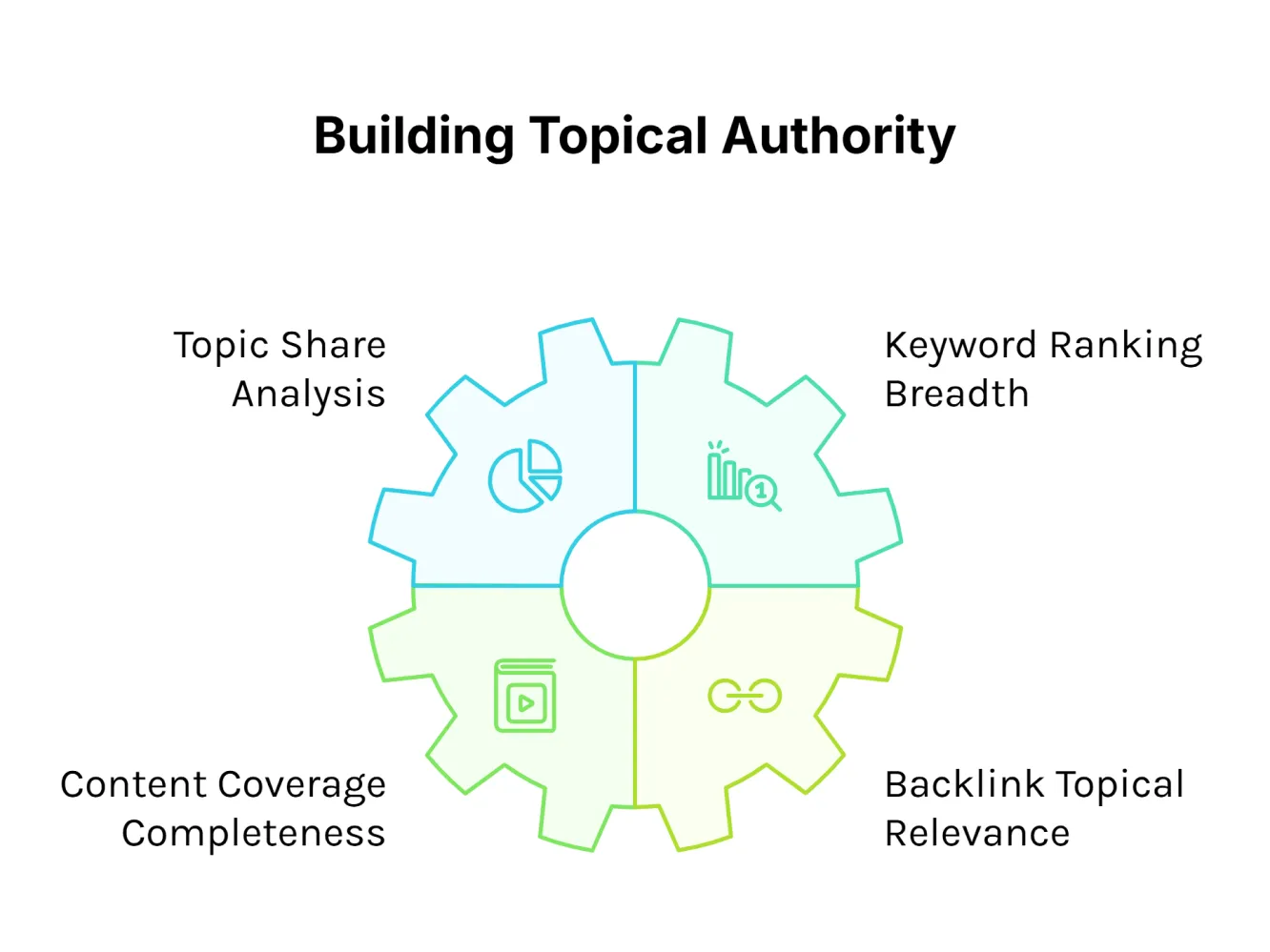
Topic Share Analysis
Calculate the percentage of search traffic you capture for all keywords within your topic compared to competitors. Kevin Indig's Topic Share method uses Ahrefs Keywords Explorer to measure this across the full topic range.
Enter your core topic term, review the traffic share by domain report, and assess your visibility compared to competitors' ranking for the same keyword set.
Keyword Ranking Breadth
Track how many related keywords you rank for within your topic area. Broad ranking coverage indicates strong topical authority.
Use Google Search Console to filter impressions by topic-related terms. Expanding keyword coverage over time demonstrates growing authority.
Content Coverage Completeness
Audit your content against the full scope of user questions in your topic. Identify gaps where competitors provide coverage you lack.
Tools like AnswerThePublic and People Also Ask reveal questions users commonly search. Your authority grows as you systematically address these queries.
Backlink Topical Relevance
Analyse whether sites linking to you operate in related topic areas. Ten backlinks from property management blogs carry a more authoritative signal than 50 from unrelated sites.
Use Ahrefs' Backlink Profile analysis to review linking domain categories and assess topical relevance.
Common Topical Authority Mistakes
Even strong teams slip into predictable pitfalls that stall topical authority. Use this checklist to spot them fast and apply the fix to keep momentum.
1. Spreading Too Thin
Attempting to build authority across multiple unrelated topics dilutes your expertise. Sites covering 10-15 disconnected subjects rarely achieve meaningful authority in any of them. Focus beats breadth. Comprehensive coverage of three core topics delivers better ranking results than surface-level content across fifteen disparate areas.
2. Publishing Without Strategy
Random article publication doesn't build authority. Each piece should fit within your cluster strategy, addressing specific gaps in your topical coverage.
3. Neglecting Content Depth
Thin sub-500-word articles can struggle to demonstrate topical expertise. In-depth, expertly written guides of 2,000+ high quality words can help show you genuinely understand your topic.
4. Ignoring Internal Linking
Publishing great content without strategic internal linking fails to signal your topical relationships to search engines. Every article should link to related content within your clusters.
Topical Authority for AI Search Platforms
AI-powered search tools evaluate content differently from traditional search engines. They seek thorough sources that answer multi-faceted questions through query fan-out techniques.
Optimising for ChatGPT Citations
Structure content to answer questions directly and completely. ChatGPT favours sources that provide clear, accurate information without requiring users to navigate multiple pages.
Include FAQ sections addressing common follow-up questions. This completeness increases citation likelihood.
Appearing in Google AI Overviews
AI Overviews appear in 13.14% of searches and feature concise answers extracted from authoritative sources.
To earn these placements: Use clear, descriptive headings that match question formats. Structure answers in scannable formats with tables, lists, and highlighted facts. Maintain technical accuracy supported by credible sources.
Perplexity and Gemini Visibility
These platforms prioritise recent, thorough sources demonstrating subject matter expertise. Regular content updates and thorough topic coverage increase visibility.
Accelerating Topical Authority Development
Building authority typically requires 6-24+ months of consistent execution, but strategic approaches can help accelerate progress.
- Leverage Existing Momentum: Identify topics where you already rank positions 5-20 in Google organic search. These represent areas where you have emerging authority. Focus content expansion on these topics for faster ranking improvements.
- Target Low-Competition Clusters: Some topic clusters face less competition than others. Strategic topic selection allows you to establish authority in underserved niches before expanding to competitive areas.
- Repurpose and Refresh Existing Content: Update older content with current information and expanded coverage. This improves rankings while demonstrating your ongoing expertise.
Topical Authority in Competitive Markets
Established competitors with high domain authority seem insurmountable, but topical focus provides competitive advantages.
Niche Down Strategically
Rather than competing for "accounting software," target "accounting software for the property industry" The specificity allows deeper coverage that competitors overlook.
Demonstrate Unique Expertise
Original research, proprietary methodologies and first-hand experience differentiate your content. Our case studies provide proof of expertise that generic content cannot match.
Build Systematically
Consistent content production compounds over time. Our B2C AI SEO case study client went from a single-page website to 1,102 keyword rankings over 27 months and counting through systematic topical authority building.
Frequently Asked Questions
How long does it take to build topical authority?
Initial results typically appear within 1-3 months of consistent content publication. Meaningful authority requiring broad ranking improvements usually takes 12-24+ months. The timeline depends on your starting position, competition level, and content production velocity. Sites publishing 12-16 page monthly build authority faster than those publishing sporadically. Our clients typically see measurable ranking improvements by month 4, with accelerating gains thereafter.
Can you build topical authority without backlinks?
Yes, though quality backlinks accelerate progress. Topical authority primarily stems from thorough content coverage and strategic internal linking. Low-domain-authority sites regularly outrank high-authority competitors through superior topical coverage. However, backlinks from topically relevant sites strengthen your authority signals. Focus first on covering your topic in depth, then pursue natural link building as your authority grows.
How many articles do you need to establish topical authority?
The number varies significantly by topic scope and competition level. There's no magic threshold - it depends on how comprehensively you need to cover your topic and who you're competing against. Quality and interconnectedness matter more than hitting arbitrary numbers. Ten thoroughly researched 3,000-word guides with strategic internal linking build more authority than 50 thin, low quality pages. Start with comprehensive coverage of your core topic's primary subtopic - typically 15-20 foundational pieces - then expand systematically based on keyword opportunities and competitive gaps in your market.
Does topical authority work for eCommerce sites?
Absolutely. eCommerce sites benefit significantly from topical authority through in-depth buying guides, product comparisons, and usage tutorials. Our eCommerce AI SEO case study client achieved 2,087% average ROI by building authority in meal planning, nutrition guidance and dietary topics surrounding their meal delivery products. The key is creating genuinely helpful content beyond product descriptions.
How do you maintain topical authority once established?
Authority requires ongoing maintenance through regular content updates and expansion into emerging subtopics. Monitor search trends to identify new questions within your topic area. Update statistics in existing content annually. Publish fresh content addressing new developments in your field. Our clients typically maintain authority through 12-48 new or refreshed pages monthly.
Can AI tools help build topical authority?
AI tools accelerate research and content production but cannot replace strategic planning and subject matter expertise. We use AI to identify content gaps, generate article outlines, and analyse topic coverage, but human experts must provide unique insights and verify accuracy. The combination of AI efficiency with human expertise delivers superior results to either approach alone.
What's the difference between topical authority and domain authority?
Domain authority measures your website's overall strength through backlinks and technical factors across all topics. Topical authority evaluates your expertise in specific subject areas through thorough content coverage. A site can have low domain authority but high topical authority in a focused niche. Both metrics matter, but topical authority increasingly drives rankings as search engines prioritise subject matter expertise over general site strength.
How does topical authority affect local SEO?
Local businesses benefit from combining topical authority with geographic focus. A Melbourne plumber building authority around specific plumbing topics (hot water systems, blocked drains, gas fitting) captures both topical and local signals. This thorough coverage of your topic positions you as the local expert. Structure content to address location-specific questions and regulations within your topic area.
Your Path to Recognised Authority
Topical authority beats legacy signals by proving depth across the topics your customers care about. Start now: pick a focused topic, map the full scope of coverage, ship consistently and connect your content so it mirrors how people and search understand the domain. Commit for 12-24 months to unlock durable rankings and revenue as expertise compounds while tactics fade. For a faster path, book a 45-minute discovery session with me to map your plan.
About the Author
Want Insights Like This Fortnightly?

Our AI SEO strategies and tactics delivered fortnightly, including bonus trade secrets not shared anywhere else. No fluff. Just what's working right now. 5-minute read.


