
B2B AI SEO Case Study: $8.7M Attributed Revenue Over 27 Months

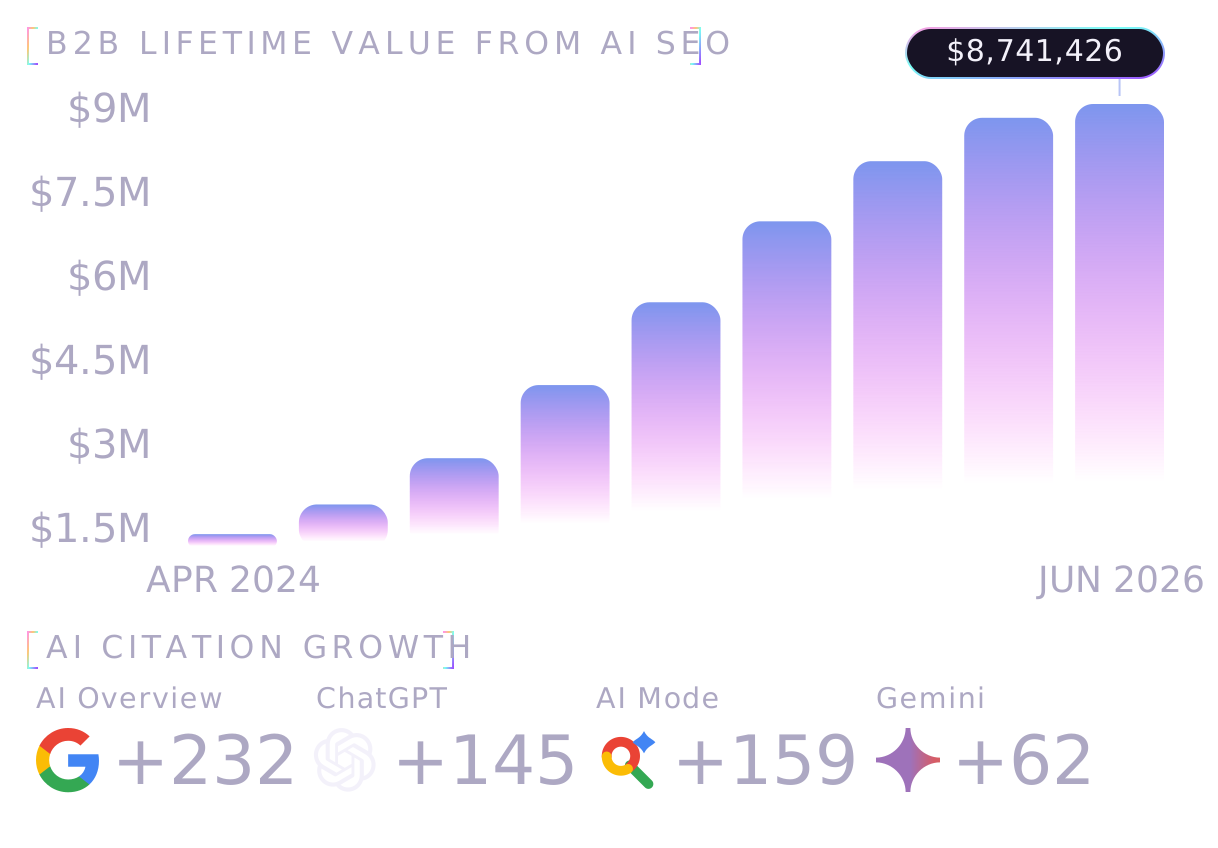
Before working with us, this B2B property management outsourcing company watched competitors dominate search for their highest-value keywords. Google organic search was already their strongest inbound lead source, but growth had stalled. This B2B AI SEO case study is a look at twenty-seven months and counting of dual Google and AI SEO work from April 2024 through June 2026: about $8.7 million in attributed organic-and-AI revenue so far, organic users from 4,973 to 26,313 in the main climb window, AI cited pages at 598 across ChatGPT, Google AI Overview, AI Mode and Gemini, and a full reverse of competitive share of voice - with measurement tightened to actual signed organic VA placements from April 2026 onward. The programme is still active.
A Quick Overview of This B2B AI SEO Case Study
This is a first-party look at a property management outsourcing brand that needed qualified inbound demand from property managers and real estate principals. We paired technical cleanup, service-page expansion, topical content clusters, expertise signals (EEAT) built on the client's published work, and early AI search optimisation. The engagement began in April 2024 and is still running; the figures below run through June 2026.
How revenue is measured
- April 2024 to March 2026: attributed revenue is modelled from organic and AI traffic using the client's locked lifetime value and conversion assumptions on the monthly series the client reviewed.
- April 2026 to June 2026: attributed revenue is actual organic-sourced VA agreements signed, each valued at the locked average lifetime value ($54,352.50). No assumed booking rates.
- Total through June 2026: modelled segment plus actual segment equals about $8.7 million ($8,741,426).
Campaign snapshot through June 2026
- $8.7M attributed revenue from April 2024 through June 2026 (modelled through March 2026, then actual organic VAs)
- Actual organic VAs (April to June 2026): 5 signed placements (1 + 1 + 3), about $272k lifetime value, including June with 3 Google-sourced VAs from one new client
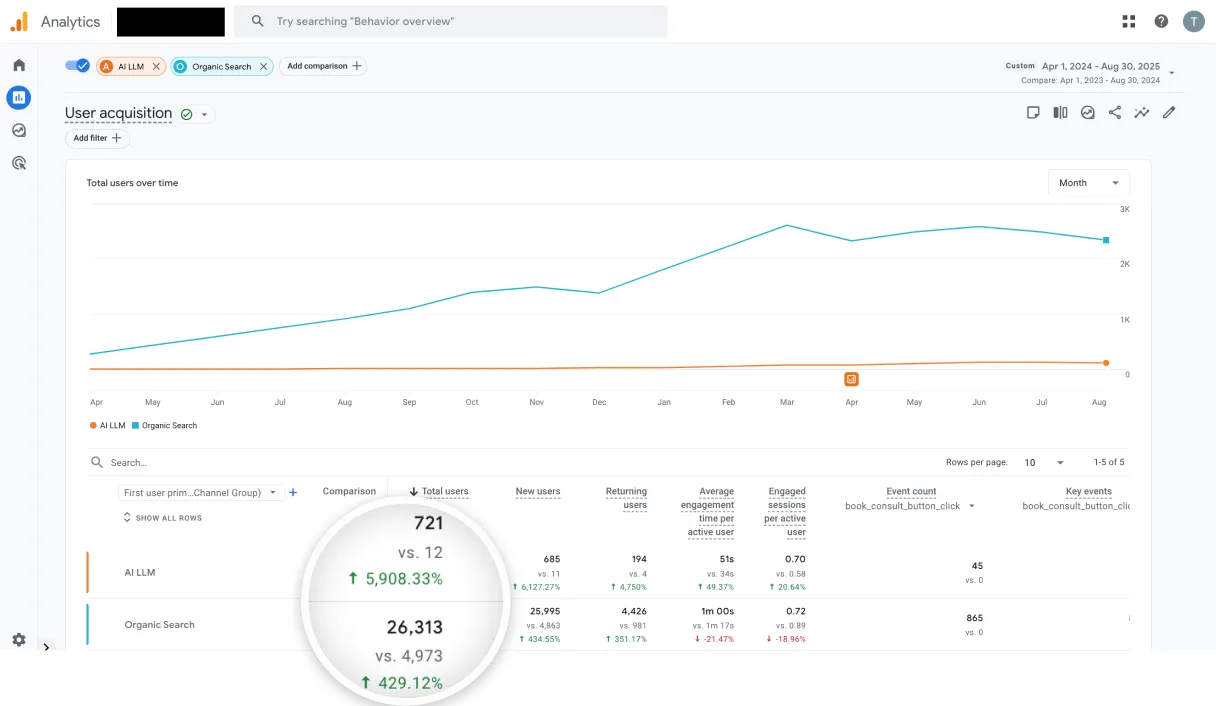
- 429% organic traffic growth in the main climb window: 4,973 to 26,313 users (April 2024 to August 2025)
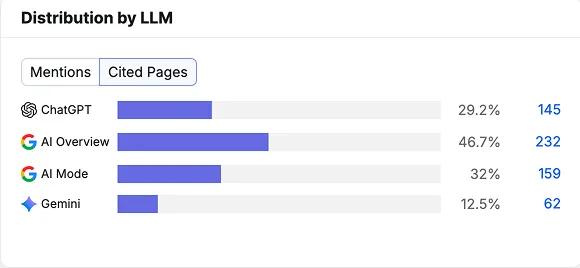
- AI cited pages: 598 across ChatGPT (145), Google AI Overview (232), AI Mode (159) and Gemini (62), up from a 138-citation stack by August 2025
- Share of voice (SOV) 0.6% to 6.2% (+933%), overtaking the prior leader within about twelve months
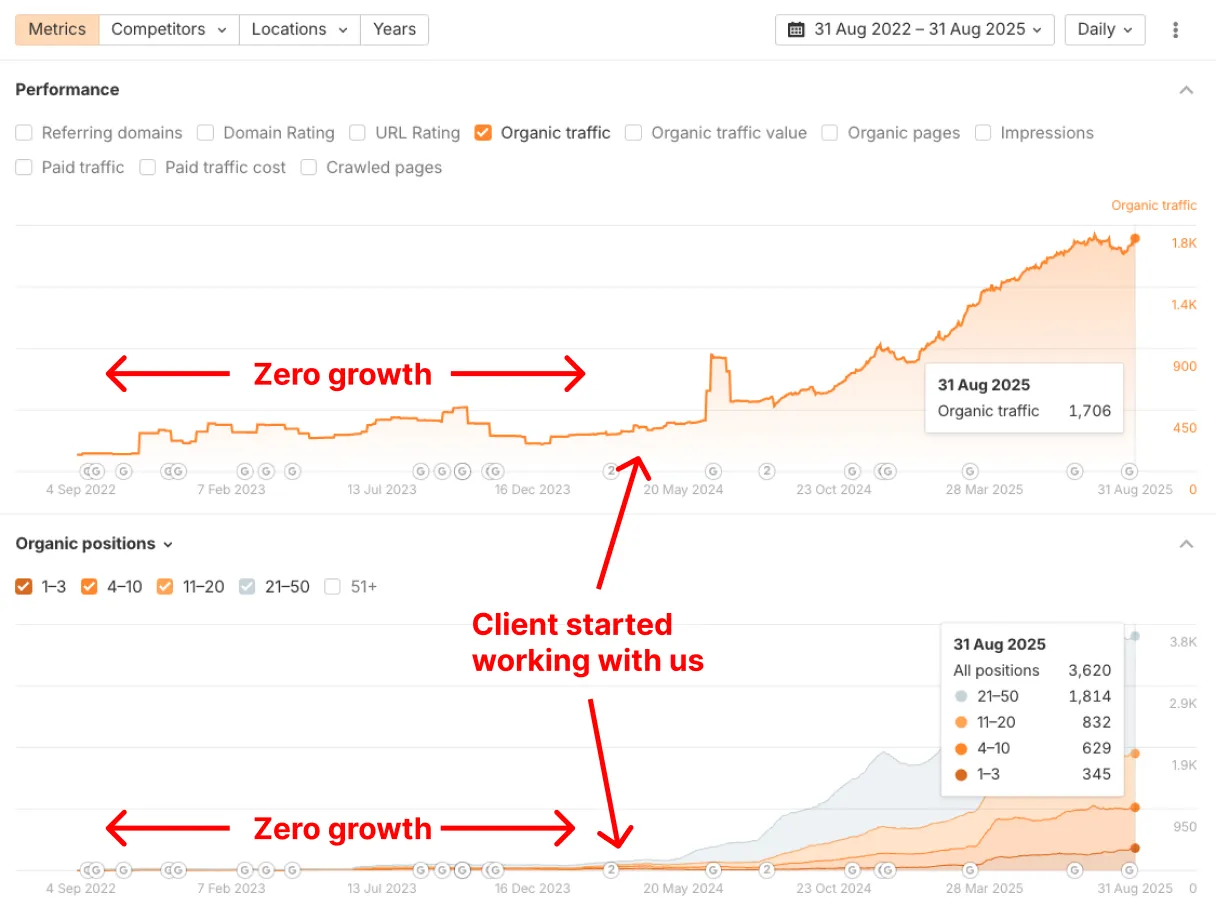
- Keyword footprint 162 to 4,947 ranking keywords (about 30.5 times) in the climb window
- Referring domains 19 to 85 (+347%) with no paid outreach or link buying
- Organic pages 18 to 180
- Site health 61 to 99 within three months, then held in the mid-to-high 90s
- Consultation bookings from organic and AI rose from about 4 to 40+ per month in the climb window
The Challenge: Stagnant Organic Search in a Competitive B2B Niche
Every durable SEO programme starts with a clear picture of what is blocking growth.
Before Rankmax: Visibility Without Momentum
The company had been in market for about seven years and already knew organic search produced ideal clients. What they lacked was competitive visibility where it mattered.
Thin keyword footprint
They ranked for about 162 keywords, with most positions buried past page three. Competitors held the high-intent property management and outsourcing queries.
Competitor share of voice gap
One established rival controlled the landscape. At the start of tracking, that leader held about 15.4% share of voice (SOV) versus about 0.6% for our client - roughly 26 times the organic visibility in the tracked set.
Service coverage gap
They offered dozens of specialised outsourcing services but had fewer than half a dozen real service pages. That created two problems:

What the programme had to build
We needed comprehensive service pages that matched the real service catalogue, then informational clusters under each commercial hub. Example pattern used in market: a Real Estate Lead Generation Outsourcing service page supported by guides on lead generation strategy, prospecting templates, checklists, tips and property-manager-specific tactics - then the same pattern across other service lines.
Prior stop-start SEO
Earlier work had been short, one-off projects. Rankings rose briefly, then slipped when competitors kept publishing. The business needed a sustained programme that could compound technical health, content depth and authority - not another three-month spike.
The Solution: Dual Google and AI SEO for B2B Buying Cycles
Once competitor gaps and site limits were clear, the path was a three-pillar system built for longer B2B cycles and emerging AI answers.
Pillar 1: Strategic foundation and competitive gap analysis
After clustering thousands of property management keywords, we prioritised high-relevance, lower-competition clusters the market leader had under-served. Those clusters built topical authority and ranking momentum before heavier head-on terms.
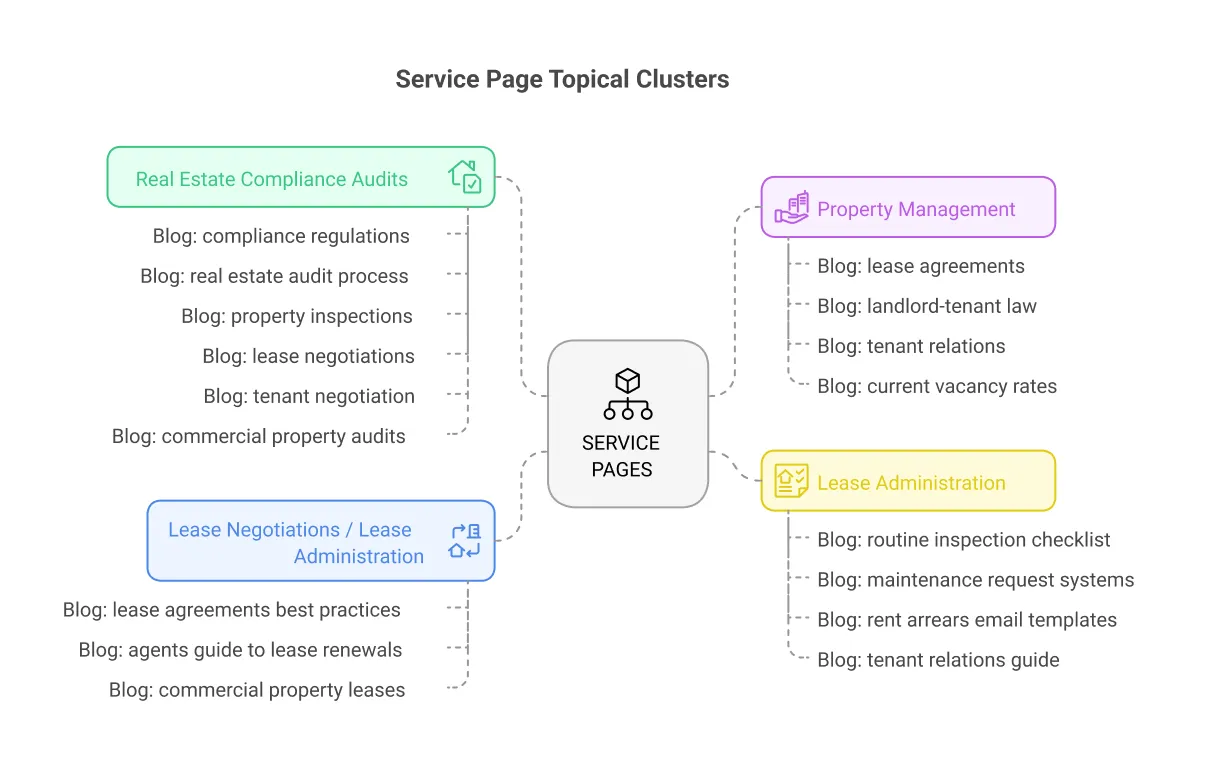
This matched how Google rewards coherent topic coverage. Public discussion of the Google Search API document leak (SparkToro) reinforced that page-level topical signals matter - we used that as supporting context, not as a silver bullet.
Pillar 2: Authority content with real subject-matter depth
Content targeted middle- and bottom-of-funnel questions property managers and principals actually ask. Each piece drew on the client's published book, From Stress to Success in Property Management, and on operational experience managing property portfolios. That is expertise, experience, authority and trust (EEAT) in practice: named expertise and first-person industry knowledge competitors cannot fake with generic writers.
Hub pages for major service categories linked out to supporting guides with implementation detail, comparison tables and objection-handling for multi-stakeholder B2B buyers.
Pillar 3: AI search optimisation
We structured pages for passage-level answers, FAQ blocks and clear definitions so the same assets could rank in classic results and be citable in AI Overviews, ChatGPT, Gemini and related surfaces. The goal was dual capture: blue links and assistant-mediated discovery, measured in the same commercial dashboard.
For the broader system behind this work, see our AI SEO strategy overview.
How We Ran the Programme
Strategy only matters if it ships. Here is how the work moved in phases.
Months 1 to 3: Technical foundations and first authority pages
We fought on two fronts: critical technical debt and first content into underserved clusters.
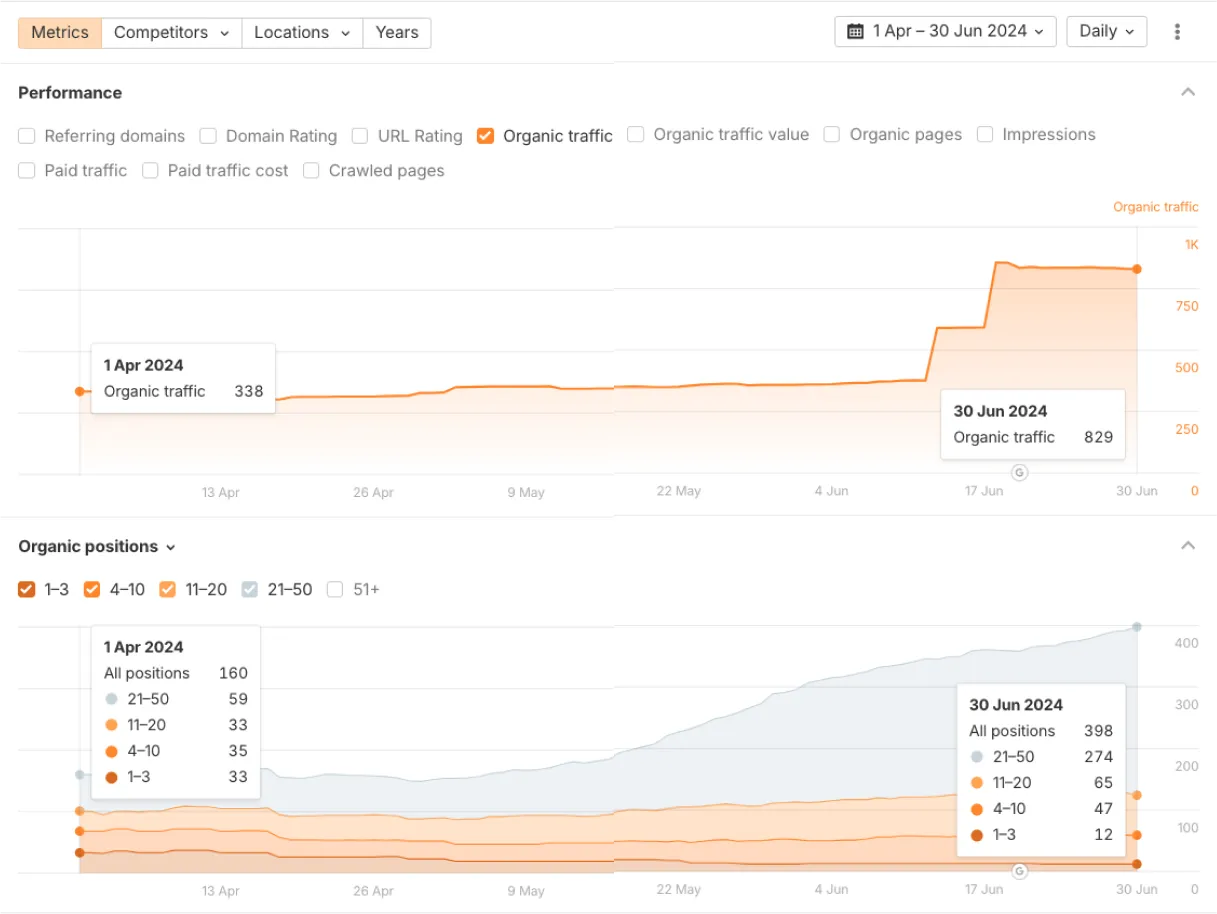
Starting health score sat at 61 with about 1,030 technical issues, including about 229 critical items (broken links, HTTPS/HTTP conflicts, orphan pages and related crawl waste). Architecture underneath was already sound - mobile-first layout, Core Web Vitals-capable stack, semantic structure and existing schema - so fixes were remediation, not a full rebuild. By month three, health reached 99.
Content focus: core service pages (including social media marketing support, photo editing, lead generation and bookkeeping-related outsourcing) plus supporting clusters around real estate marketing, prospecting, trust accounting, property maintenance, copywriting, newsletters and facilities management. Book-backed expertise ran through the set.
Quarter 1 outcomes
- About 669 new and improved rankings across three months
- Organic clicks up about 91% year over year by month two
- Early attributed revenue on the modelled return on investment (ROI) series, including about $179,910 in the opening quarter window
- Average position improved from about 47.9 to 39.5
- First-month modelled ROI on the series reached about 1,952%, with months two and three also in four figures on the same methodology
Months 4 to 6: Content acceleration

Publishing cadence moved to about 12 pieces per month, mapped to buying-stage intent and sales feedback. Topics spanned reverse prospecting, trust account compliance, newsletters, social and video marketing, prospecting tools, efficiency and virtual assistant services. New URLs began reaching page one faster than in month one as topical coverage thickened.
Months 7 to 9: Links earned from useful resources
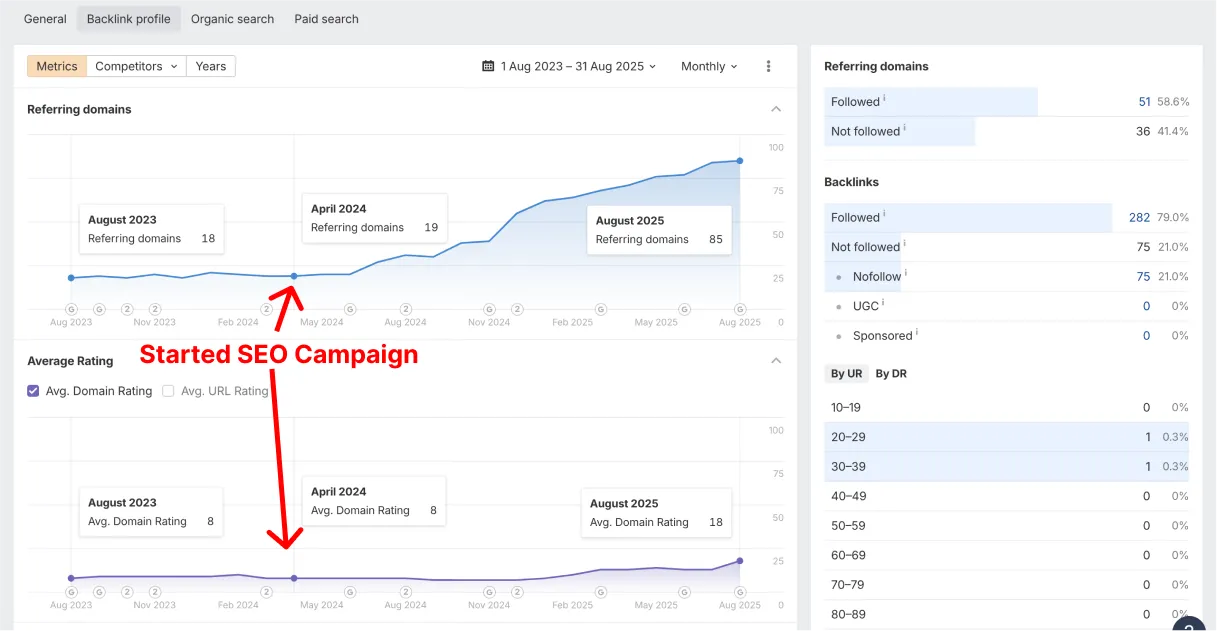
Referring domains moved from about 19 to 85 (+347%) with no cold outreach programme. Examples of higher-authority domains that linked in the live profile included industry and software properties such as libsyn.com, jobstreet.com, rexsoftware.com, nucamp.co, eliteagent.com and console.com.au. About 73% of referring links in the summarised set were dofollow. Relevance mattered as much as raw domain rating (DR): these are properties property managers already use.
Months 10 to 17: AI optimisation and market leadership
The later climb concentrated on AI-citable structure while defending and extending organic wins: FAQ coverage, extractable definitions, step sequences, comparison blocks and conversational question patterns.

AI citation stack by August 2025
- 115 Google AI Overview citations
- 12 ChatGPT citations
- 10 Gemini citations
- 1 Perplexity citation
Citations are a visibility KPI tracked alongside rankings, not a replacement for commercial outcomes.
Current AI visibility proof (cited pages by platform):
From month 18 onward: hold the climb, measure on actual signings
From late 2025 into 2026 the programme kept publishing, defending commercial rankings and tightening conversion tracking. The engagement did not stop at a fixed end date. In April 2026 reporting switched from traffic-based modelling to actual organic-sourced VA agreements signed in the CRM, each valued at the locked lifetime value. Later months are more conservative and more defensible than the earlier model. The total through June 2026 is modelled revenue through March 2026 plus actual VA lifetime value from April to June 2026, while the campaign continues.
The Results: Revenue, Rankings and Market Position
B2B SEO is not "more traffic" alone. The scoreboard is attributed pipeline, revenue quality and competitive position.
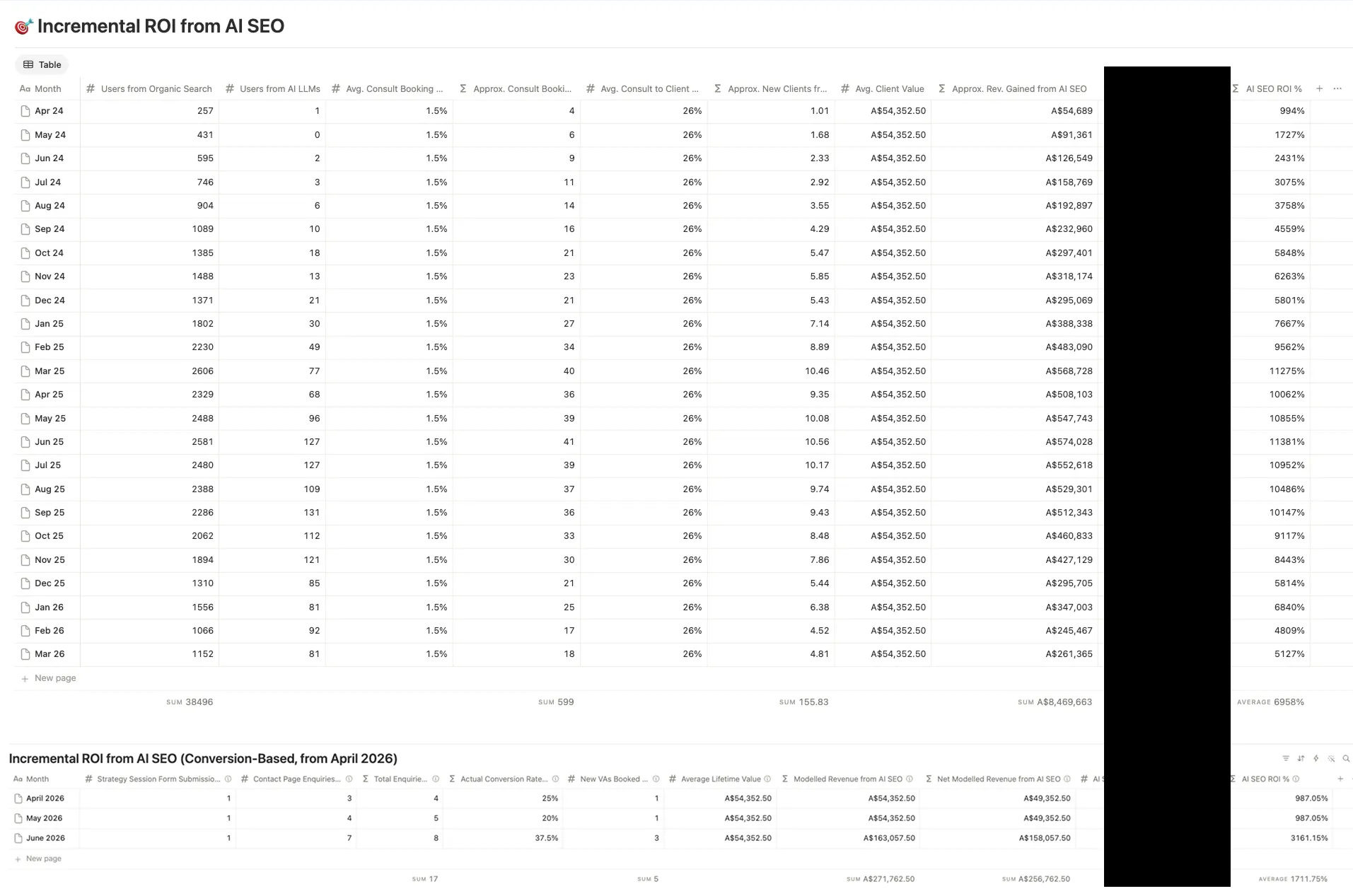
Revenue and pipeline impact
| Metric | Result |
|---|---|
| Attributed revenue through June 2026 (Apr 2024 onward) | $8.7M ($8,741,426) |
| Of which modelled (Apr 2024 to Mar 2026) | $8.47M ($8,469,663) |
| Of which actual organic VAs (Apr to Jun 2026) | $272k (5 VAs × $54,352.50) |
| June 2026 actual month | 3 Google-sourced VAs about $163k LTV |
| Consultation bookings (climb-window series) | 419 bookings about 109 modelled clients |
| Monthly consultation run-rate (climb window) | About 4 to 40+ |
Where climb-window charts still show the earlier peak period (for example the seventeen-month revenue view through August 2025), that window attributed about $5.9M at a 6,864% average ROI on the same modelled series - a milestone inside an ongoing programme, not the end of the story.
Sales reported organic and AI leads were better educated and further along than typical outbound prospects - a qualitative signal that matches higher-intent search and assistant research behaviour.
Traffic and ranking transformation
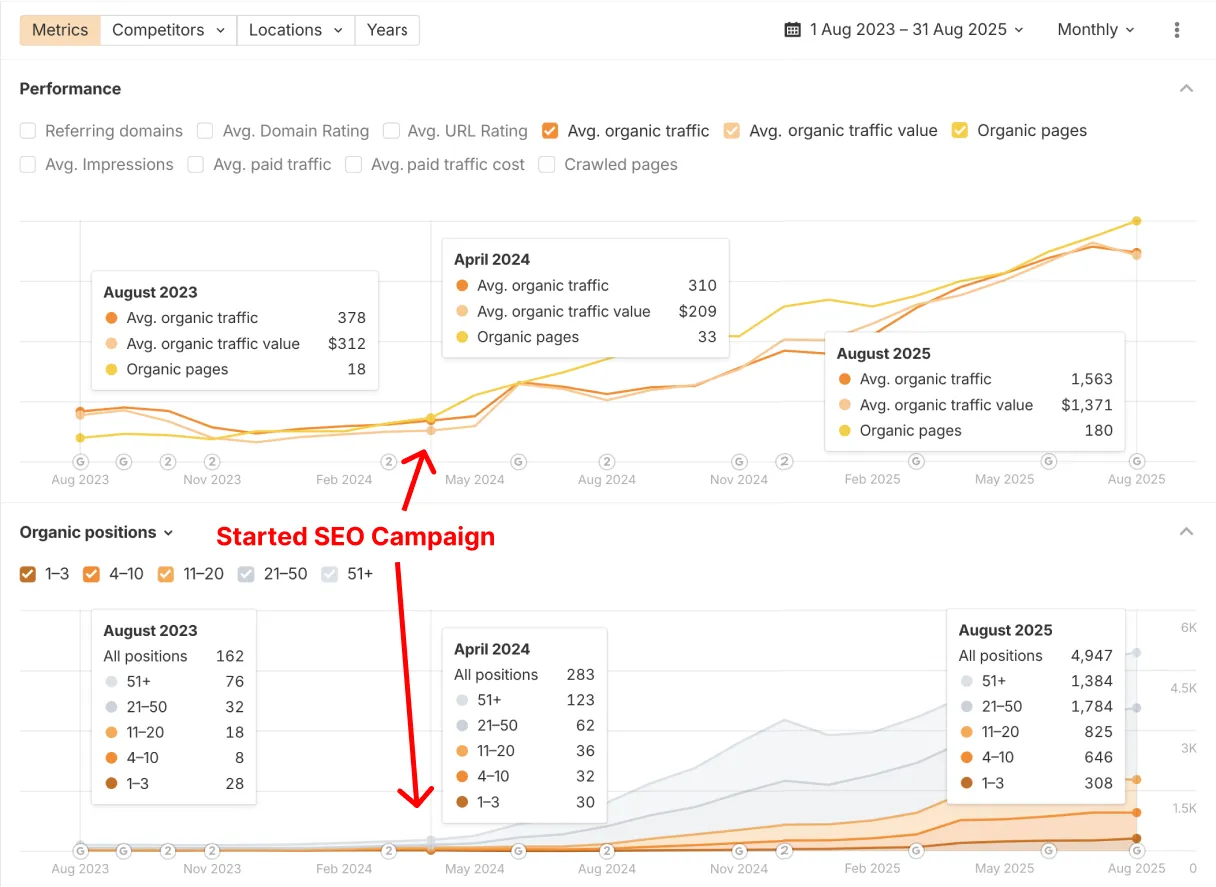
- Organic users (climb window): 4,973 to 26,313 (+429%)
- Ranking keywords: 162 to 4,947 (about 30.5 times)
- Organic pages: 18 to 180
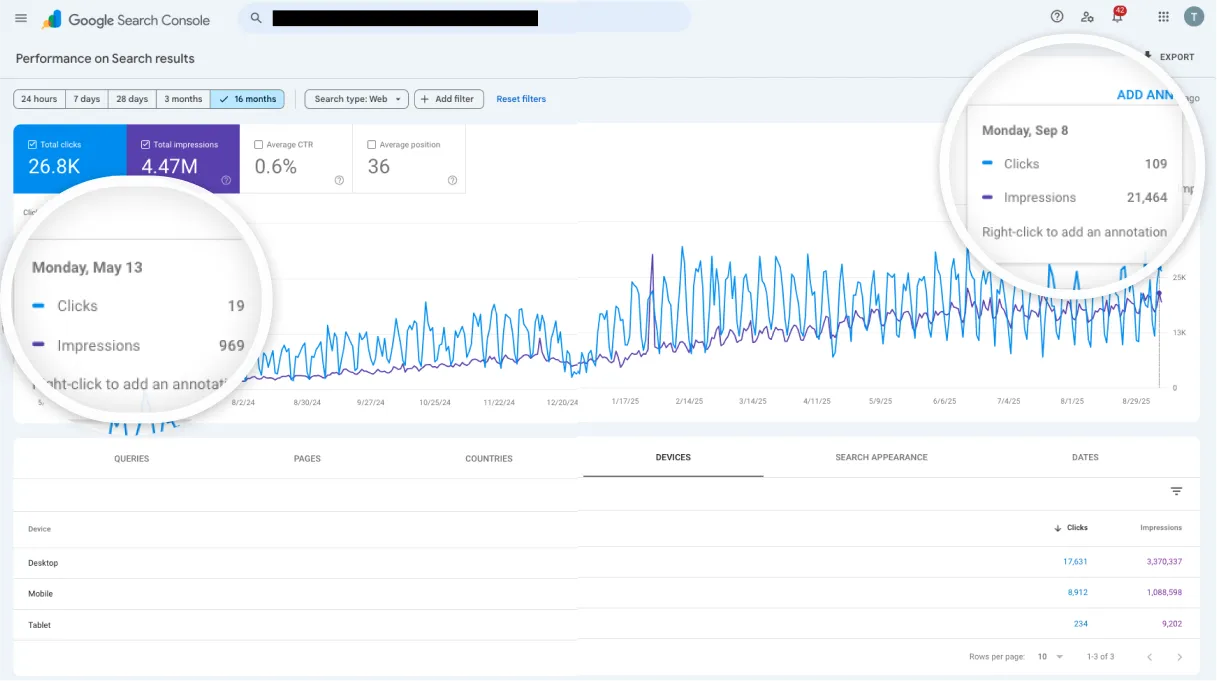
- Search Console across the main climb: about 26.8K clicks and 4.47M impressions over roughly sixteen months of the export window
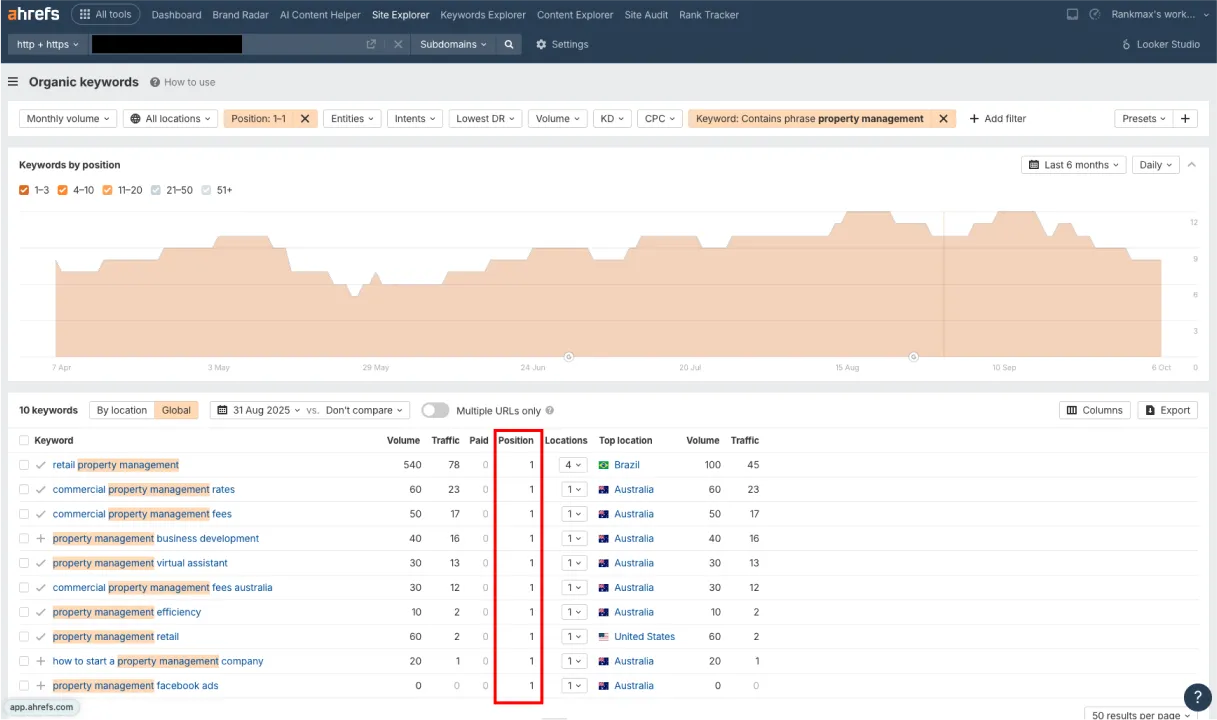
Example position-1 wins (climb-window ranking view)
- retail property management
- commercial property management rates
- commercial property management fees
- property management virtual assistant
- commercial property management fees australia
- property management efficiency
AI traffic quality

| Channel | Users (window) | Conversions | Conversion rate |
|---|---|---|---|
| Organic Search | 26,313 | 865 | 3.29% |
| AI LLM | 721 | 45 | 6.24% |
AI volume was smaller than classic organic, but conversion quality was higher in this cut - consistent with buyers who already researched in assistants before requesting a conversation.
Market share reversal
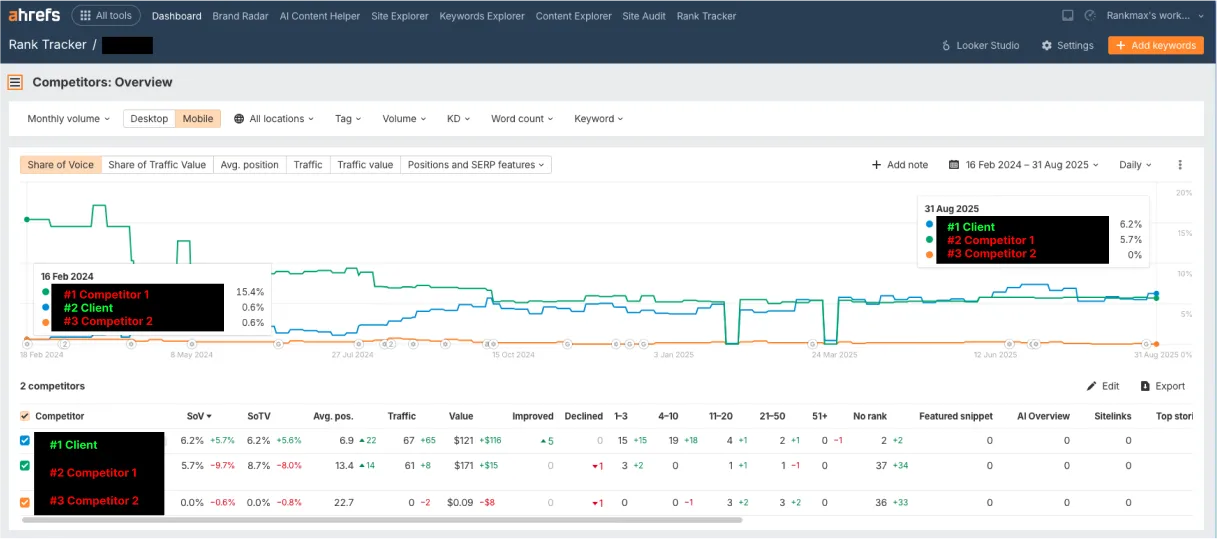
That is a 933% relative share of voice (SOV) increase and a practical leadership flip inside roughly a year of sustained execution - driven by content-gap targeting and technical cleanup, not a single viral page.
Technical excellence held

Technical work was not a one-off launch checklist. Sustained crawl health let new service and guide URLs rank on merit instead of fighting indexation debt. By mid-2026 site health remained in the high 90s (June reporting: 97).
What changed when measurement moved to actual signings
From April 2026, monthly attributed revenue counts signed organic VA agreements only, each at the locked lifetime value. That is stricter than the traffic model:
- April 2026: 1 organic VA, about $54k lifetime value
- May 2026: 1 organic VA, about $54k lifetime value
- June 2026: 3 Google-sourced VAs from one new client, about $163k lifetime value - the strongest conversion-based month so far
June also saw 23 commercial keywords enter page 1 for the first time, AI Overview appearances rise from 1 to 17, and six target keywords enter the top 10 (including real estate virtual assistant australia, virtual assistant services real estate and tenant screening services). Those visibility gains sit beside the signed-VA revenue line, not instead of it.
What We Learned From This B2B SEO Engagement
Technical debt still decides how fast content can win
Sound architecture let us clear 1,030 issues in weeks rather than rebuild for months. Sites that need foundational rebuilds should expect a longer runway before content compounds.
Depth beats thin B2B posts
The strongest URLs averaged about 3,400 words, answered clusters of related questions, and included original structure (tables, templates, implementation steps). One definitive guide outperformed fleets of thin posts.
AI optimisation is part of commercial SEO now
B2B buyers use assistants for vendor research. A 138-citation climb-window stack that later expanded to 598 cited pages across four major large language models (LLMs) created a channel competitors in this set largely ignored during the climb. Treat citations as a visibility layer beside rankings and revenue.
Links follow useful industry resources
+347% referring domains arrived without a paid link programme because the assets were worth citing inside the property management and real estate software ecosystem.
Measure pipeline honestly - and upgrade the model when you can
Traffic and rankings matter. For B2B they are incomplete without attributed revenue, consultation quality and a methodology the client reviews monthly. When CRM signings became reliable enough, we stopped relying on traffic assumptions alone and counted actual organic VA agreements. That is why the figures through June 2026 are hybrid by design, while the campaign continues.
Frequently Asked Questions
How long does it take to see results from B2B SEO?
Initial movement often shows inside 3 to 4 months when technical blockers are cleared in parallel with publishing. This engagement posted four-figure monthly modelled ROI early because foundations were fixable quickly. Multi-million attributed revenue still took a multi-year compounding window. Sites that need deep architectural rebuilds should plan extra runway before expecting the same pace.
What is the difference between B2B and B2C SEO strategies?
B2B programmes usually serve longer cycles, multiple stakeholders and higher deal values. Content has to speak to operators and decision-makers, prove process competence, and support sales conversations - not only drive a quick consumer checkout.
How important is AI optimisation for B2B companies?
It is now table stakes for discovery. Buyers start research in assistants as well as Google. This case study's climb-window 138 citations (later 598 cited pages across four LLMs) and higher AI conversion rate show a real complementary channel, not a novelty metric.
What metrics should B2B companies track for SEO success?
Track attributed revenue and pipeline from organic and AI channels, consultation or demo requests, ranking breadth on commercial terms, AI citations by platform, engagement quality and multi-touch contribution. Use vanity traffic only as a supporting chart. When you can, move from modelled attribution to signed-deal attribution.
How should B2B companies think about SEO investment?
Budgets vary with competitive intensity, service catalogue size and how much senior strategy versus production the programme needs. Public industry write-ups often place serious B2B SEO programmes across a wide monthly range once content, technical work and specialist time are included. For mid-market B2B services we typically see spend weighted toward strategic content, technical enablement and measurement - not paid link catalogues. Starting points depend on scope; book a discovery conversation if you want a fit check for your category.
Can SEO work for niche B2B industries?
Yes. Niche categories often have clearer intent and thinner competition than generic head terms. The requirement is still the same: accurate service coverage, deep expertise, clean technical foundations and honest revenue attribution.
What role does technical SEO play in B2B success?
It is the floor. This programme's traffic and revenue curve sat on a move from health 61 to 99 and sustained high-90s scores. Without that floor, even strong content under-performs.
How do you measure SEO ROI for B2B?
We use a standard marketing return on investment (ROI) framing on attributed revenue from organic and AI channels on the client's approved monthly series. Through March 2026 this engagement used a traffic-based model with locked lifetime value and conversion assumptions. From April 2026 it counts actual organic-sourced VA agreements at the same lifetime value. For the full method behind that framing, see our guide to SEO ROI. This public case study reports attributed revenue and ROI % only - not the client's commercial fee schedule.
Why This B2B AI SEO Case Study Still Matters
After more than two years of dual Google and AI SEO - and with the programme still running - this property management outsourcing brand has about $8.7 million in attributed organic-and-AI revenue through June 2026. The early climb flipped competitive share of voice and built durable AI visibility; from April 2026 the same work is measured on actual organic VA signings. The takeaway is simple: fix the technical floor, publish deep service authority, optimise for people and machines, and keep measuring revenue honestly as the model improves.
For teams that need the full system - architecture, content, technical and AI visibility - see our AI SEO strategy company overview.
What The Client Had To Say:
"I've checked all the pages and they are all approved! Great work! I even got my first ideal client lead from Google this morning, representing 1200 properties! The 'Real Estate Virtual Assistant' content is excellent. It's great to see continued increases on our key words. Awesome work!"
- Tiffany, Founder & CEO
About the Author


Want Help Putting This into Practice?

Everything we publish comes from the same methodology we run for clients every day. Book a discovery call and we will show you how it applies to your business.


