
How to Calculate SEO ROI (And Finally Prove It to Your Leadership Team)


Most marketing managers know SEO works. The challenge is proving it - in dollars, not rankings. SEO ROI cuts through vanity metrics and connects your organic search investment directly to revenue, which is exactly what your CFO and CEO want to see. Get this right and you stop defending your SEO budget. You start expanding it.
SEO ROI: A Quick Answer for Marketers
SEO ROI measures the return generated from your organic search investment compared to what you spent to achieve it. A basic formula is: (Organic search revenue - SEO investment) / SEO investment x 100. If you want a stricter and more defensible figure, use attributed or incremental revenue consistently rather than treating them as the same thing. A 400% SEO ROI means every dollar invested returned four dollars in revenue above the original cost. The real challenge is not the formula itself, but deciding which revenue to include, how to attribute it and what time period gives a fair picture of performance.
Turn Your SEO Investment into a Revenue Argument
Understanding SEO ROI is the first step. Getting results that produce it is the second. Our AI SEO strategies have generated more than $26M in attributed client revenue, and every campaign is measured against revenue outcomes using Google Analytics data-driven attribution rather than traffic, rankings or vanity metrics.
Explore Our AI SEO StrategyWhat Is SEO ROI?
SEO ROI stands for search engine optimisation return on investment. It measures the commercial return your business receives from money spent on organic search, including:
- Agency fees
- Content production
- Tools
- Internal labour
Broad SEO ROI averages are less useful than business-specific case studies. Our published results include:
- about $8.7M attributed over 27 months for a B2B client (6,864% average ROI on the 17-month climb window)
- 14,738% average monthly ROI over 21 months and counting for a B2C client
- 2,087% average ROI for an eCommerce brand
- 1,909% average ROI over 12 months for a SaaS client
For leadership teams, the real question is not the industry median. It is whether SEO is producing attributable revenue growth in your business over a defined period.
These are case study results, not industry averages. What matters most is the ROI your business achieves based on:
- Your investment level
- Your conversion rate
- Your average revenue per customer
- How you measure performance, which is critical
Why Most Businesses Miscalculate SEO ROI
The formula is simple. The measurement decisions behind it are not. These are the three areas where most calculations break down.
The Attribution Problem: Why First Click and Last Click Mislead You
Attribution models determine which marketing touchpoint gets credit for a conversion. First-click attribution gives 100% of the credit to the first channel a customer touched. Last-click gives it all to the final one before purchase.
Organic search rarely gets the last click. A customer might find you through a blog post, leave, return via a direct visit and then convert through paid search. Under last-click attribution, SEO gets zero credit despite starting the journey. Under first-click, it gets all the credit even if the paid ad was the deciding factor.
In GA4, data-driven attribution is the default for event-scoped attribution reports, where conversion credit is shared across touchpoints based on their contribution. That is the model we use for client ROI analysis, rather than first-click or last-click reporting.
The difference in your SEO ROI calculation can be enormous. One client journey we analysed showed organic search receiving the majority of attribution credit across a long multi-touch path under data-driven attribution. Under last-click, that credit would have gone elsewhere entirely.
Revenue vs Profit: Choosing the Right Numerator
Most SEO agencies calculate ROI using revenue. We do the same for our clients, and here is why.
Profit margin is set by the business, not the agency. An SEO campaign that delivers 500 qualified leads cannot control whether the sales team converts them, what price is negotiated or what the cost of goods is. Using revenue to calculate ROI keeps the metric within the scope of what SEO actually delivers: customers arriving at your door.
For businesses that have direct ownership over their margin - or for evaluating SEO as an internal investment - profit-based ROI (what we call pROI) is more accurate. If a business spends $5,000 on SEO in a period and the resulting customers generate $50,000 in revenue with a 30% margin, pROI is based on $15,000 profit, not $50,000 revenue. Those dollar inputs are a teaching example only. Both calculations are valid; they just answer different questions.
Incremental vs Attributed Revenue: The Difference That Matters Most
Attributed revenue is everything Google Analytics assigns to organic search. Incremental revenue is the portion of that total that would not have existed without your SEO investment.
These are not the same number.
Some customers would have found you anyway through direct search, referral or brand recall. Incrementality analysis strips out that baseline and measures only the lift created by the SEO campaign. This produces a more conservative and more defensible ROI figure - which is exactly what you need when presenting to a leadership team that is sceptical of marketing attribution.
Our reporting starts with GA4 attributed revenue using data-driven attribution. Estimating incremental revenue requires additional modelling or testing beyond standard GA4 attribution.
The SEO ROI Formula
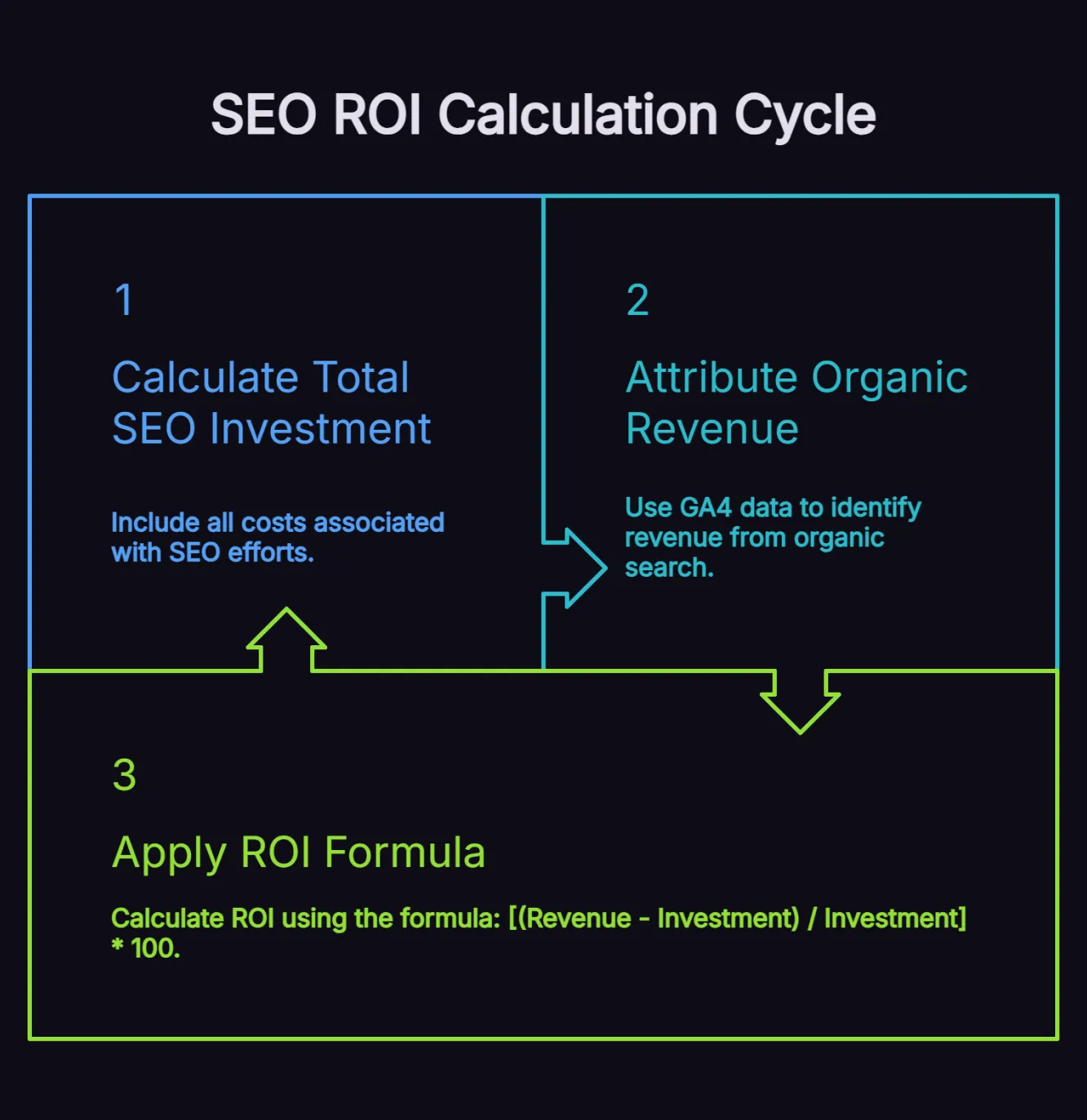
The core formula is straightforward:
SEO ROI (%) = [(Incremental Revenue from Organic Search - Total SEO Investment) / Total SEO Investment] x 100
To apply it, you need two clean numbers.
- Calculating your total SEO investment means including everything: agency or freelancer fees, SEO tools and subscriptions, content production costs (including internal writer time), and technical development costs. Missing internal labour is the most common error. Research confirms that without factoring in your time and internal resources, your ROI assessment will be misleading.
- Calculating attributed organic revenue in GA4 means filtering organic search performance and using your chosen attribution model. Calculating incremental revenue requires an extra layer of analysis beyond GA4 attribution alone.
A practical worked example (illustrative inputs only, not a published Rankmax fee): if monthly SEO investment is $5,000 and GA4 shows $93,000 in incremental organic revenue that month, SEO ROI is [(93,000 - 5,000) / 5,000] x 100 = 1,760%.
That math lines up with a real February 2026 result from one of our eCommerce clients - A$93,110.17 in total organic revenue, delivering a 1,762% ROI. We do not publish client monthly campaign fees.
How Long Does SEO Take to Show ROI?
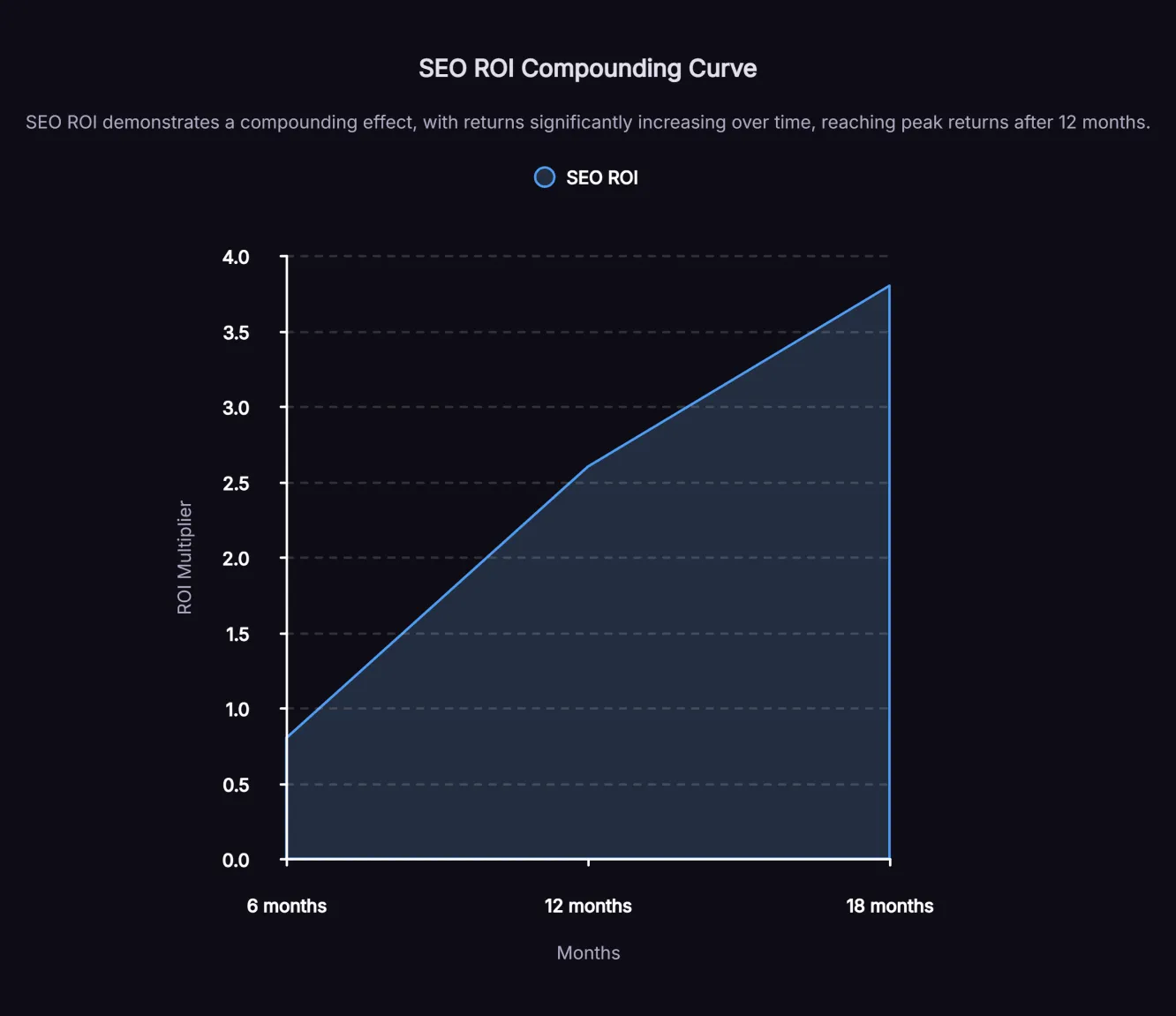
This is the question every CMO asks before approving an SEO budget. The honest answer: SEO usually needs six to twelve months to show meaningful ROI, with the strongest returns often appearing after the first year as rankings, authority, and attribution build over time.
That is the pattern visible across Rankmax case studies. The biggest gains do not come from a short spike. They come from sustained execution that compounds month after month. Content published today can keep ranking, generating leads, and influencing revenue well beyond the month it goes live.
That is also what separates SEO from paid advertising. Paid media can drive results quickly, but once spending stops, traffic usually drops with it. SEO works differently. Strong content and rankings can continue delivering traffic and revenue long after the initial work is done, which is why the upside builds over a longer time horizon.
The implication for ROI measurement is simple: do not judge SEO at the three-month mark. Use six months as the earliest point for directional analysis, and a twelve-month rolling window for a more credible view of commercial impact.
What Is a Good SEO ROI?
SEO ROI varies by industry, competition level, average order value, conversion rate and the quality of execution. There is no universal benchmark, but useful reference points do exist. Key factors include:
- Industry
- Sales cycle
- Competition
- Attribution model
Some industry research reports that B2B SaaS companies achieve an average 702% ROI from SEO, with break-even in around seven months, but the more credible benchmark is your own attributed revenue growth over a defined period.
From Rankmax's own client data across February 2026:
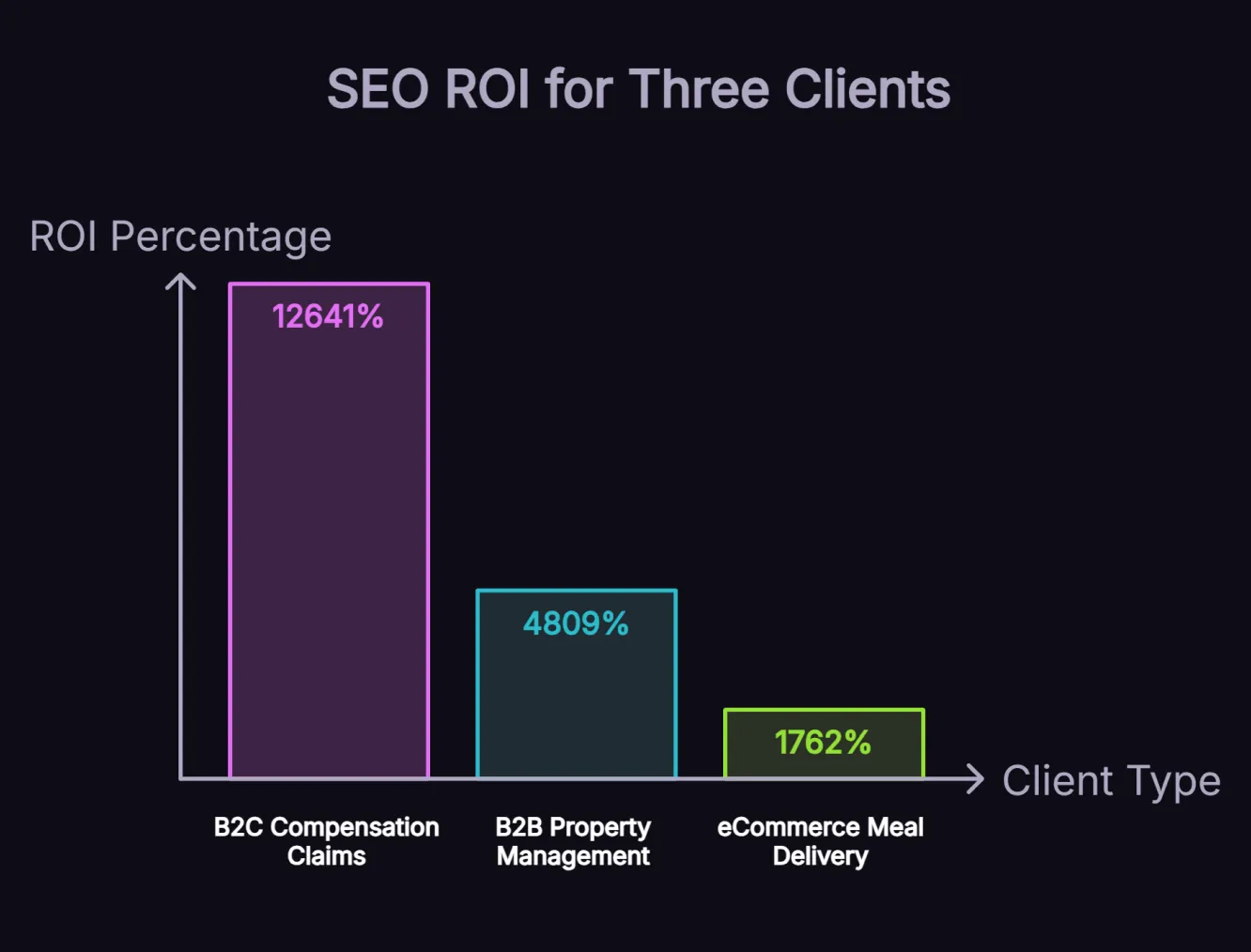
- A B2B real estate outsourcing client (property management virtual assistant services) achieved 4,809% ROI in February 2026, generating A$245,466 in incremental organic revenue in a single month. See the full B2B case study here.
- A B2C compensation claims client recorded 12,641% ROI in February 2026, with 137 webform submissions generating approximately A$637,050 in incremental revenue. The B2C case study covers how this result was built over seven months.
- An eCommerce meal delivery client delivered 1,762% ROI - A$93,110 in organic revenue - consistent with January 2026 (1,774%), confirming the campaign has fully compounded. The eCommerce SEO case study breaks down the three-month build.
These results are not guaranteed and vary by business. What they demonstrate is the ceiling that is achievable when the methodology is sound and the investment is sustained.
How AI SEO Changes the SEO ROI Equation
Traditional SEO optimises for Google rankings. AI SEO optimises for visibility across Google, Google AI Overviews, ChatGPT, Perplexity, Gemini and Copilot simultaneously.
The ROI impact is still unfolding, but early campaign data suggests two effects worth tracking.
- First, AI search is generating a new revenue stream that may not show up cleanly inside standard organic search reporting. Traffic from platforms like ChatGPT can still be tracked in analytics tools, but it often sits outside traditional SEO channel views. That makes AI search worth measuring separately, especially as it starts contributing attributable traffic and revenue alongside conventional organic search.
- Second, AI citations can expand how and where a business is discovered online. That broader visibility creates more potential entry points to the brand, which can support stronger traffic growth and a higher long-term ROI ceiling.
The businesses that achieve the highest long-term SEO ROI will be those that treat AI visibility as part of the investment now, not an afterthought later. Our AI SEO strategy service builds this into every campaign from day one, with revenue attribution frameworks that measure both traditional and AI-driven organic performance.
Real SEO ROI: What the Numbers Look Like at 12 and 17 Months
Our B2B property management case study is one of the clearest illustrations of how SEO ROI compounds over time.
- Starting from a near-zero organic presence, the campaign reached 378 page-one rankings and 2,103 total ranking keywords after 12 months. Clicks grew 793% year-on-year and impressions increased 2,278%. over 27 months and counting, the business accumulated 598 AI cited pages - meaning it now appears in Google AI Overviews and AI search responses as a cited authority in its category.
- At the end of year one, organic search was contributing to 762 key conversions with an average 2.4 touchpoints per conversion path. The campaign's ROI figure - which we calculate against incremental revenue and data-driven attribution rather than raw attributed traffic value - reflects the compounding effect of rankings, AI citations and domain authority working together.
This is the model. SEO ROI is not a point-in-time measurement. It is a curve, and it steepens the longer the investment is sustained.
Frequently Asked Questions
What is a good SEO ROI for a B2B business?
For a B2B business, a good SEO ROI creates measurable pipeline and attributable revenue, not one that matches a generic industry average. We judge ROI against your contract value, sales cycle, competition and attribution model. In high-value B2B markets, modest organic lead volume can still produce a strong ROI because each qualified lead carries meaningful revenue potential.
Should I use revenue or profit to calculate SEO ROI?
For most businesses assessing the performance of an SEO agency, revenue is the right metric. The agency cannot control your margins, pricing or close rate - only the volume and quality of organic traffic it delivers. For internal decision-making, or for businesses with direct ownership over their cost structure, profit-based ROI (pROI) gives a more accurate picture of the real financial return.
How do I calculate SEO ROI in Google Analytics 4?
In GA4, navigate to Reports > Acquisition > Traffic Acquisition and filter by the Organic Search channel to review organic performance. For attribution-based revenue analysis, use GA4’s attribution reporting and make sure the revenue figure is being interpreted through your selected attribution model, ideally data-driven rather than first-click or last-click alone. To calculate ROI, subtract your total SEO investment for the period from that revenue figure, divide by your investment and multiply by 100. For a more defensible result, separate branded from non-branded organic traffic where possible and assess performance over a rolling 12-month window rather than month by month.
Why does my SEO ROI look low after three months?
Three months is too early to measure SEO ROI accurately. Most SEO results take six to twelve months to materialise as new content indexes, authority builds and rankings stabilise. Measuring at three months captures the cost but not the return - which is why early calculations almost always look unfavourable. Set a measurement cadence of quarterly reviews with the primary evaluation at 12 months for a true picture.
What is the difference between attributed and incremental SEO revenue?
Attributed revenue is every dollar Google Analytics assigns to the organic search channel based on your attribution settings. Incremental revenue is the portion of revenue that would not have been earned without your SEO investment. It aims to separate genuine lift from conversions that may have happened anyway through brand demand, direct visits or other channels. Incremental figures are usually lower and more conservative than attributed figures, but they are often more defensible when presenting ROI to a leadership team or CFO. They also require a stricter measurement approach, because incrementality cannot be assumed from attribution data alone.
Does AI SEO produce better ROI than traditional SEO?
AI SEO does not replace traditional SEO - it builds on it. The ROI advantage comes from two sources. AI-optimised content ranks for a broader set of keyword variations in traditional search, increasing organic traffic without additional investment. Meanwhile, AI search platforms like ChatGPT and Perplexity generate a growing share of referral traffic that does not appear in standard GA4 organic search reports. Businesses that build AI visibility now are building a compounding asset that will increase in value as AI search adoption grows.
Make SEO ROI Easy to Defend
SEO ROI becomes a growth argument when you measure it with clear investment, credible attribution, and enough time for results to compound. The formula is simple, but the real advantage comes from building an organic strategy that drives revenue you can defend in a leadership meeting. That is exactly what a strong AI SEO strategy should do: turn SEO from a budget line into a measurable growth channel.
About the Author
Want Insights Like This Fortnightly?

Our AI SEO strategies and tactics delivered fortnightly, including bonus trade secrets not shared anywhere else. No fluff. Just what's working right now. 5-minute read.


