
National SEO: How We Built Multi-Vertical Authority Across $26M in Client Revenue


Ranking for high-volume keywords across an entire country is a different challenge than showing up in local search results. National SEO targets broader audiences without geographic limits. When done right, it becomes one of the most scalable revenue channels a business can build. With organic search driving 53% of all website traffic and the global SEO services market estimated at $83.98 billion in 2026, the opportunity for businesses competing nationally has never been larger. But the playbook has changed. AI search platforms like Google AI Overviews, ChatGPT and Perplexity now influence how buyers discover and evaluate brands, making national SEO a dual-channel discipline that requires strategy across both traditional and AI-powered search.
A Quick Guide to National SEO
National SEO is a search engine optimisation strategy that improves your website's visibility for non-location-specific keywords across an entire country. It focuses on broad, competitive terms such as "best project management software" or "commercial insurance" rather than geographic-specific searches like "plumber in Melbourne." A strong national SEO strategy combines comprehensive keyword research, authoritative content creation, technical site health and high-quality backlink acquisition to compete at scale. In 2026 it also requires optimising for AI search platforms where Google AI Overviews appear in roughly 30% of search queries and AI-referred sessions have grown 527% year-over-year.
National SEO ROI Is Real Across Every Vertical We've Run
Our published results include 6,864% ROI on the 17-month climb window for a B2B client, 14,738% average monthly ROI for a B2C client, 2,087% average ROI for an eCommerce brand and 1,909% ROI for a SaaS client. The same dual-channel methodology, applied to the keyword set, content velocity and technical foundation each vertical needs. Our AI SEO strategies have generated over $26M in attributed client revenue.
Explore National SEO ServicesWhat Is National SEO and Why Does It Matter?
Most businesses that struggle with national search visibility aren't failing because of bad content; they're failing because they treat national SEO as a scaled-up version of local tactics. That is the single most common pattern I see when we audit underperforming national campaigns. The keyword approach, the content depth, the technical architecture and the link strategy all change when the geographic constraint disappears.
National SEO is the practice of optimising a website to rank for broad, high-volume keywords that attract audiences across a country rather than within a specific city or region. It is designed for businesses whose products or services are not limited by geographic boundaries, including eCommerce brands, SaaS platforms, national service providers and businesses shipping products nationwide.
The goal is straightforward: appear at the top of search results when someone anywhere in the country searches for terms relevant to your business, then convert that traffic into revenue. Across the work we have done so far, our AI SEO strategies have generated over $26M in attributed client revenue.
Who Needs a National SEO Strategy?
Not every business needs to compete at the national level. National SEO is the right fit if your business matches one or more of these profiles:
- eCommerce stores: Shipping products across the country or internationally
- SaaS and technology companies: Selling software to a distributed customer base
- National service providers: Operating across multiple states or regions
- B2B companies: Serving clients regardless of their physical location
- Media and publishing businesses: Competing for broad topical visibility
If your revenue potential is not capped by geography, a national SEO strategy should be a core part of your marketing mix.
The Scale of the National SEO Opportunity
The numbers tell a clear story about why national SEO deserves serious investment. The first position on Google captures a 39.8% click-through rate, with position two dropping to 18.7% and position three falling to 10.2%. For national keywords with tens of thousands of monthly searches, the difference between ranking first and fifth translates directly to hundreds or thousands of additional leads each month.
What makes this even more significant is how the search environment has shifted. AI Overviews now reduce clicks by 58% when they appear, which means businesses need to optimise not only for traditional rankings but also for citation in AI-generated answers. The brands that appear in both organic results and AI responses will capture a disproportionate share of traffic and trust.
National SEO vs Local SEO: Understanding the Key Differences
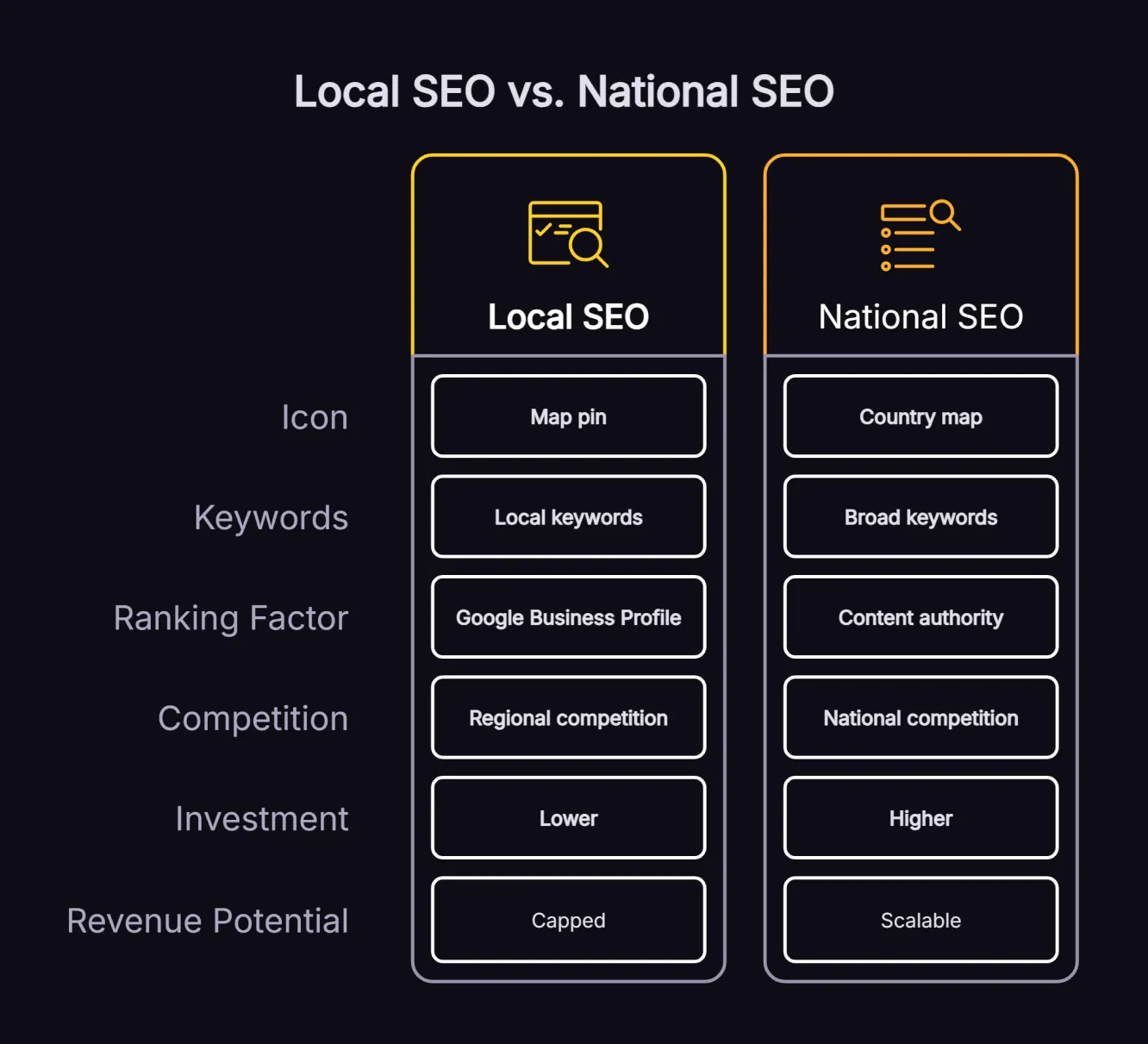
Choosing between national and local SEO, or determining the right balance of both, starts with understanding how they differ in scope, strategy and execution.
Target Audience and Keyword Approach
Local SEO targets people searching with geographic intent. These are queries like "dentist near me" or "electrician in Brisbane." The keywords are specific to a location and often trigger Google's local map pack.
National SEO targets people searching without location constraints. These are queries like "best CRM software" or "how to choose business insurance." The keywords are broader, more competitive and attract larger search volumes.
Competition and Investment Level
Local SEO pits you against other businesses in your area. National SEO puts you in competition with industry leaders, large enterprises and well-funded brands across the entire country. This means national campaigns require more content, stronger backlink profiles and deeper technical foundations.
Local SEO is often more affordable and delivers faster results due to less competition. National SEO demands a bigger budget for content creation, link building and ongoing optimisation, but the revenue ceiling is far higher.
Core Strategy Components
For many businesses, the right approach is a combination. Our local SEO services work alongside national strategies to capture demand at every level.
How to Build a National SEO Strategy That Drives Revenue
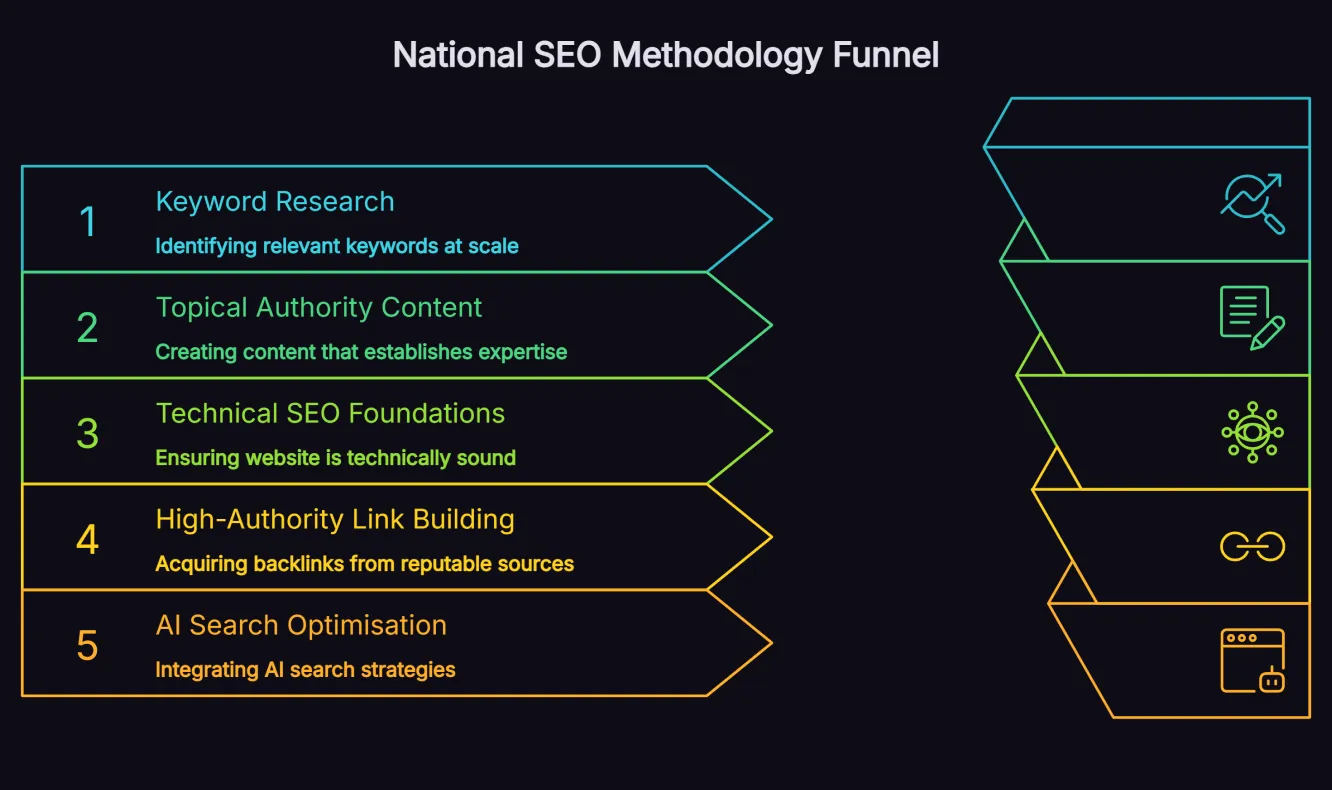
A national SEO campaign that delivers measurable business outcomes requires a structured approach. Here is the process we follow, informed by our AI SEO Strategy SOP, to build and execute national campaigns for clients.
1. Conduct Comprehensive Keyword Research at Scale
National keyword research is different from local research. You are targeting high-volume terms without geographic modifiers, which means greater competition and a need for strategic prioritisation.
In our experience running campaigns across B2B, SaaS, eCommerce and B2C verticals, national keyword sets need much more long-tail support than the head-term volume initially suggests. The B2B property management client we worked with started at 162 ranking keywords and finished at 4,947 over 27 months and counting. The vast majority of that growth was not the head terms; it was the long-tail body of buyer-journey queries clustered around them. A national keyword set built only on the high-volume head will under-rank because there is no supporting topical context for AI systems and search engines to anchor your authority to.
Start by identifying your core commercial terms, the keywords directly tied to your products or services. Then expand outward to map the full topic landscape. This includes:
- Informational queries that your target audience searches before they are ready to buy
- Comparison queries where they evaluate options
- Long-tail variations that capture specific buyer intent
Effective national keyword research should:
- Map keywords to stages of the buyer journey, not just search volume
- Identify topical clusters that build authority around core themes
- Prioritise terms with clear commercial intent alongside awareness-level keywords
- Analyse competitor keyword gaps to find opportunities others have missed
- Account for how AI platforms process and surface content for these same queries
Professional keyword research services combine tools like Ahrefs with strategic analysis to build a roadmap rather than just a keyword list.
2. Build Topical Authority Through Strategic Content
Content is the engine of national SEO. But producing volume without a strategy wastes resources. The goal is to build topical authority, the depth and breadth of coverage that signals to both search engines and AI systems that your site is the definitive resource on a subject.
This requires a pillar-and-cluster content model:
- Pillar pages: Cover broad topics comprehensively (3,000+ words) and target your most competitive head terms
- Cluster content: Targets specific subtopics, long-tail keywords and related questions, linking back to the pillar page
- Supporting content: Includes case studies, data-driven research and comparison pages that earn backlinks and build credibility
The velocity that this requires is higher than most teams plan for. Our SaaS client engagement that ended at 1,909% ROI ran on a content pipeline that produced 5 high-quality articles weekly, approximately 260 optimised pages over 12 months. That is the benchmark we use when scoping national campaigns: depth and breadth come from sustained weekly output, not from a single quarterly content sprint.
There is a second mechanic worth pulling out. AI search engines like Google's AI Mode do not evaluate your page as a single unit. When a user submits a query, the AI system splits that query into roughly 5 to 11 sub-queries, retrieves content for each in parallel, and then synthesises the answer. The unit of evaluation is the passage, not the page. This means a paragraph from a mid-ranking cluster article can outrank a comprehensive pillar guide if that paragraph answers a specific sub-query more directly. The practical implication for national content: every section needs to stand on its own with a clean answer, citation and supporting structure, because individual passages are competing independently.
For national campaigns, content must demonstrate genuine expertise. Google's EEAT guidelines (Experience, Expertise, Authoritativeness and Trustworthiness) directly influence ranking outcomes, especially for competitive national keywords. This means content should be written or reviewed by subject matter experts, include original data or insights and reference authoritative sources.
The B2B property management client mentioned earlier expanded from 162 to 4,947 ranking keywords through a structured content strategy that targeted national search terms alongside AI search optimisation. That growth in visibility contributed to about $8.7M in additional revenue over 27 months and counting; the 17-month climb window ran at a 6,864% average ROI on the 17-month climb window over 27 months and counting.
3. Optimise Technical SEO for National-Scale Performance
Technical SEO provides the foundation for every other effort. Without a technically sound website, even the best content will struggle to rank nationally.
For national sites, which tend to be larger and more complex, technical priorities include:
- Site architecture and internal linking: Logical URL structures and strategic internal links help search engines understand content relationships and distribute authority across pages.
- Page speed and Core Web Vitals: Only 54.6% of websites meet Core Web Vitals standards. Passing these performance benchmarks provides a ranking advantage, particularly for competitive national queries.
- Mobile optimisation: With mobile devices driving over 50% of global web traffic, mobile-first design is non-negotiable.
- Crawlability and indexing: Ensuring search engines and AI crawlers can access and understand your content is the minimum requirement for visibility.
- Structured data and schema markup: Proper schema helps search engines and AI platforms interpret your content, improving eligibility for rich results and AI citations.
Technical SEO is not a one-time project. National sites need ongoing monitoring to catch issues before they affect rankings. Our enterprise SEO services include monthly technical health checks to maintain peak performance.
4. Earn High-Authority Backlinks at Scale
Backlinks remain one of the strongest ranking signals in Google's algorithm. For national SEO, where competition is intense, building a strong link profile is a requirement rather than an option.
National link building differs from local citation building. You need links from authoritative national publications, industry-leading websites and trusted domains in your sector. Quality matters more than quantity. A single link from a high-authority domain delivers more ranking value than dozens of links from low-quality sources.
Effective national link-building strategies include:
- Original research and data: Publish industry studies, surveys or benchmark reports that journalists and bloggers want to reference.
- Guest contributions: Contribute expert insights to respected industry publications.
- Digital PR: Create newsworthy content that earns media coverage and natural backlinks.
- Strategic partnerships: Collaborate with complementary businesses on co-branded content or resources.
Link building should be integrated with your content strategy, not treated as a separate activity. The content you create for topical authority should naturally attract links because it provides genuine value.
5. Integrate AI Search Optimisation Into Your National Strategy
This is where national SEO in 2026 diverges from what worked even two years ago. Early data shows AI-referred sessions growing by more than 500% year over year, and initial studies suggest visitors arriving from AI platforms such as ChatGPT can be several times more valuable than traditional organic traffic. The growth rate alone says nothing about quality. The growth rate combined with the per-visitor value is why ignoring AI search means leaving compounding revenue on the table.
We have data points from our own client work that match this pattern. The same B2B property management client that has driven about $8.7M in additional revenue earned 598 AI cited pages across Google AI Overviews, ChatGPT, Gemini and Perplexity over 27 months and counting while their direct competitors had zero AI visibility. Those AI citations were not a vanity metric. They opened a new lead source that traditional search rankings alone would not have produced. 82% of enterprise SEO teams plan to increase AI investment over the next year, which tells you the AI visibility window for being early is closing.
AI search optimisation currently works alongside traditional SEO, but Google is steadily shifting toward AI-first experiences. Treat AI search and traditional SEO as parts of one strategy, with AI search expected to take an increasingly large share of discovery over time. The core requirements include:
- Passage-level clarity: AI systems extract specific passages to answer queries. Each section of your content should provide clear, self-contained answers that can be cited independently.
- Structured formatting: Use clear headings, lists and tables that AI systems can parse and reference.
- Factual accuracy and citations: AI platforms prefer content backed by verifiable data and authoritative sources.
- Entity optimisation: Ensure your brand and topic entities are clearly defined and consistently referenced.
- Semantic completeness: Cover topics thoroughly so AI systems recognise your content as the most comprehensive source available.
The businesses that will dominate national search in 2026 are those treating AI SEO and traditional SEO as two sides of the same strategy. We build this dual-channel approach into every national campaign through our AI SEO strategy methodology.
Measuring National SEO Performance and ROI
The metrics that matter for national SEO go beyond traffic and rankings. Revenue attribution is where the real story lives.
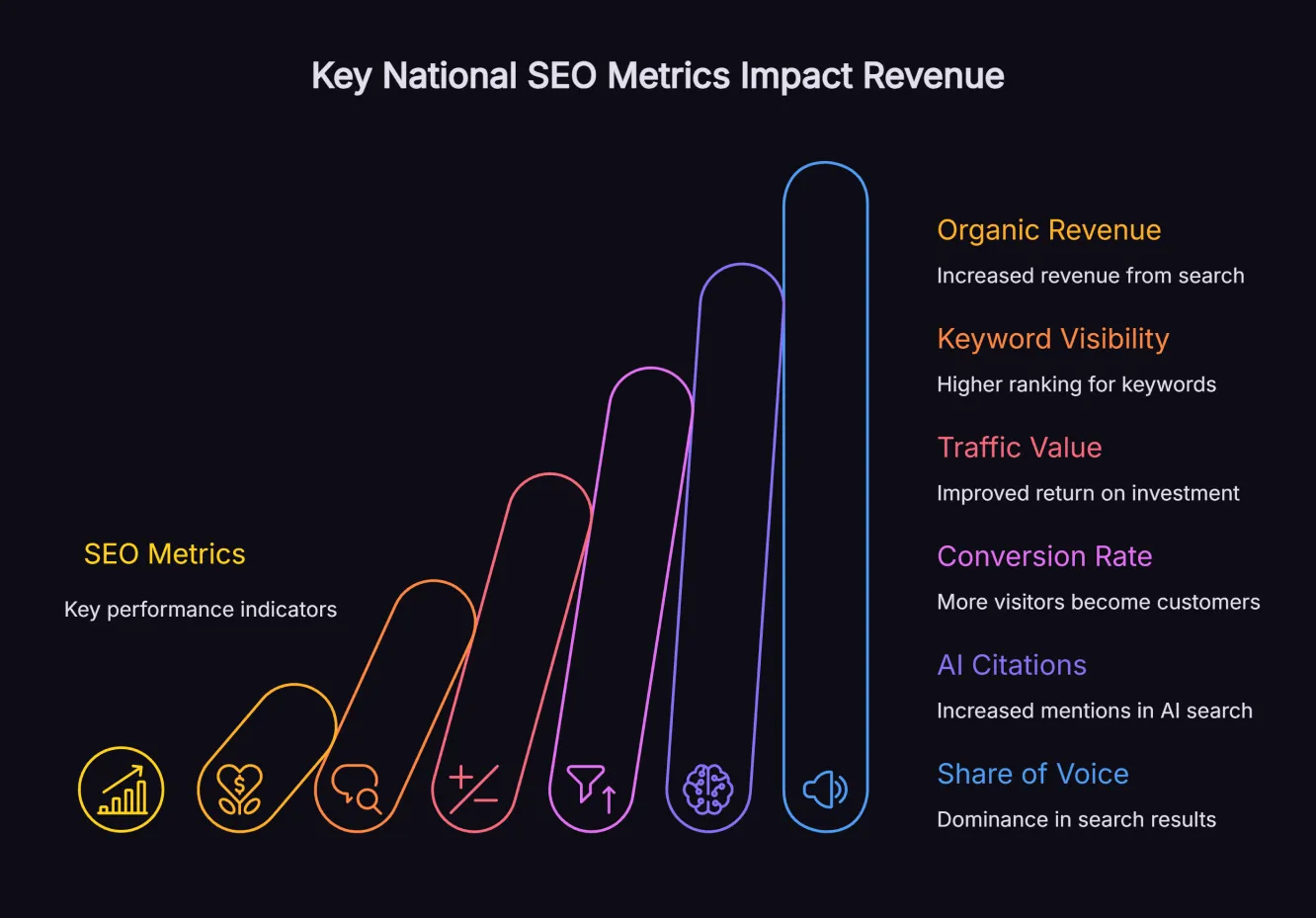
Key Performance Indicators for National SEO Campaigns
Track these metrics to evaluate whether your national SEO investment is delivering business outcomes:
- Organic revenue: The total revenue attributed to organic search traffic, tracked through Google Analytics 4 conversion paths.
- Keyword visibility: The number of keywords ranking on page one and their position trends over time.
- Organic traffic value: The estimated cost to acquire the same traffic through paid search, which quantifies the return on your SEO investment.
- Conversion rate by landing page: Identifies which content converts visitors into leads or customers.
- AI search citations: Track appearances in Google AI Overviews, ChatGPT responses and other AI platforms.
- Share of voice: Your visibility relative to competitors for your target keyword set.
Vanity metrics like total sessions or page views are useful context, but they should not drive strategic decisions. Our clients receive monthly revenue attribution reports that show exactly how organic search contributes to their bottom line.
What National SEO Returns Look Like Across Verticals
When a buyer asks me whether national SEO ROI is real, I send them the lineup of published Rankmax results. The numbers vary by vertical, but the pattern is consistent:
- B2B (property management): 6,864% average ROI on the 17-month climb window over 27 months and counting, $8.7M in additional revenue and 598 AI cited pages
- B2C (compensation claims): 14,738% average monthly ROI over 21 months and counting
- eCommerce (meal delivery): about $1.75M attributed revenue at 2,087% average ROI over 16 months
- SaaS: 1,909% average ROI over 12 months, with monthly revenue scaling from $25,000 to $135,000
These are case-study figures from real engagements, not models. The national SEO ROI claim is falsifiable across markets, which is the bar I would hold any agency to before signing a national campaign retainer.
Setting Realistic Timelines for National SEO Results
National SEO is not a quick-win channel. Most clients begin seeing meaningful ranking improvements within three to six months, with compounding traffic and revenue growth over 12 months and beyond.
This timeline exists because national keywords are competitive. Building the content depth, technical foundations, and link authority required to rank alongside established competitors takes sustained effort. However, unlike paid advertising, where traffic stops the moment you stop paying, the organic traffic generated by national SEO compounds over time.
The eCommerce meal delivery client we worked with on an AI-first SEO campaign grew monthly revenue from $77,000 to $147,000 in the first eight months; full-window attributed revenue is about $1.75M at a 2,087% average ROI. The campaign delivered consistent, compounding growth over time rather than a one-off spike.
Common National SEO Mistakes That Limit Growth
Knowing what to avoid saves time and budget. These are the most common pitfalls we see when auditing national SEO campaigns through our SEO competitor analysis process.
1. Targeting Keywords Without Commercial Intent
Chasing high-volume keywords without evaluating their commercial value leads to traffic that does not convert. A keyword with 50,000 monthly searches but purely informational intent will generate page views, not revenue. Balance your keyword portfolio between awareness-level content that builds authority and commercial keywords that drive conversions.
2. Ignoring AI Search as a Traffic and Trust Channel
Over 86% of SEO professionals now use AI in their workflows, yet many national SEO campaigns still focus entirely on traditional rankings. With AI Overviews appearing in a growing percentage of search results, optimising for AI citation is no longer optional. Review how AI search impacts SEO and integrate these practices into your strategy.
3. Neglecting Technical Foundations
Even the strongest content strategy will fail if search engines cannot efficiently crawl and index your site. Technical issues that create ceilings on your ranking potential include:
- Slow page speeds
- Broken internal links
- Duplicate content
- Poor mobile experience
Regular technical audits are part of any serious national SEO programme.
4. Treating Content as a One-Time Project
National SEO requires ongoing content investment. Search algorithms change, competitors publish new content, and topics evolve. A "publish and forget" approach leads to declining rankings. Plan for regular content refreshes, gap analysis and expansion of your topical coverage.
Frequently Asked Questions
How Much Does National SEO Cost?
National SEO investment varies based on your industry's competitiveness, your current site authority and the scope of work required. Most businesses competing nationally should expect to invest more than they would for local SEO campaigns, with budgets reflecting the need for comprehensive content creation, technical optimisation and link building. The return on investment typically outweighs the cost, as national SEO delivers compounding organic traffic that reduces reliance on paid advertising over time.
How Long Does It Take for National SEO to Show Results?
Most national SEO campaigns begin showing ranking improvements within three to six months. Meaningful traffic and revenue growth typically follow within six to twelve months, with results compounding over time. The timeline depends on your starting authority, the competitiveness of your target keywords and the consistency of execution. Unlike paid search, the traffic generated by national SEO continues to grow even after the initial investment period.
Can a Business Run Both Local and National SEO Simultaneously?
Yes, and many businesses benefit from combining both strategies. A company with physical locations can use local SEO to capture nearby customers while running a national campaign to build broader brand visibility. The key is ensuring your site architecture supports both approaches without creating keyword cannibalisation between location pages and national content.
What Is the Difference Between National SEO and International SEO?
National SEO targets audiences within a single country using one language and search engine ecosystem. International SEO extends reach across multiple countries, languages and search engines, requiring additional technical elements like hreflang tags, localised content and country-specific domain strategies. Businesses expanding beyond their home market need an international approach layered on top of their national foundations.
Does National SEO Work for eCommerce Businesses?
National SEO is one of the most effective strategies for eCommerce brands. It drives scalable organic traffic to product and category pages, reducing dependence on paid advertising for customer acquisition. Product schema implementation, category page optimisation and content-driven authority building are all core components of eCommerce SEO at the national level.
How Does AI Search Affect National SEO Strategy?
AI search platforms like Google AI Overviews and ChatGPT are changing how users discover and interact with search results. AI Overviews now appear in roughly 30% of queries, primarily informational ones. For national SEO, this means optimising content to be cited by AI systems alongside ranking in traditional results. Businesses that appear in both channels build stronger brand trust and capture a larger share of qualified traffic. Read our complete guide to AI SEO for the full methodology.
Is National SEO Worth the Investment for Mid-Market Businesses?
For businesses with $2M-$100M revenue that serve customers beyond a single local area, national SEO is one of the highest-ROI marketing investments available. Unlike paid channels, where costs rise with scale, organic search traffic compounds over time. The key is working with a team that focuses on revenue attribution, not just rankings or traffic, to prove the commercial return on every dollar invested.
What Role Does Content Play in a National SEO Campaign?
Content is the primary driver of national SEO performance. Building topical authority through comprehensive pillar pages, supporting cluster content and data-driven resources signals to search engines and AI systems that your site is the definitive source on a topic. Content also earns backlinks, supports internal linking structures and provides the material that AI platforms cite in their responses. Without a strategic content programme, national SEO cannot deliver sustained results.
Your National SEO Strategy Starts With the Right Foundation
National SEO is how businesses break free from geographic limits and build scalable, revenue-generating search visibility. The strategy requires more depth than local campaigns, including stronger content, better technical foundations and smarter link building, but the returns compound in ways that paid channels simply cannot match. The shift toward AI search makes this even more urgent. Businesses that build for both traditional and AI search visibility now will capture market share that becomes increasingly difficult for competitors to reclaim. If you are ready to build a national SEO strategy grounded in revenue outcomes, explore our national SEO services for mid-market businesses across Australia and beyond.
About the Author
Want Insights Like This Fortnightly?

Our AI SEO strategies and tactics delivered fortnightly, including bonus trade secrets not shared anywhere else. No fluff. Just what's working right now. 5-minute read.


