
Local SEO in 2026: What Ranks in Maps, AI Search and the Profile Mistake That Costs Weeks


Your customers are searching for a business like yours right now, and most will pick from whatever Google shows them in the first few seconds. 46% of all Google searches have local intent, and 80% of consumers search for a local business every week. The businesses that win local search are rarely the ones with the prettiest websites. They are the ones that get the unglamorous basics right and avoid the mistakes that quietly pull a listing offline. This guide covers what actually ranks in Google Maps, reviews and AI search in 2026, drawn from the patterns I see repeat across my client campaigns.
A Quick Guide to Local SEO
Local SEO is the practice of optimising your online presence so customers searching for products and services in a specific area find you first. In 2026, it spans your Google Business Profile, consistent citations, reviews, local links, location-specific content and visibility inside AI search results like Google AI Overviews and ChatGPT. Google research found that 76% of people who search for something nearby on a smartphone visit a related business within a day, so getting this right is a direct line to revenue. Across 18 years in SEO, my client work has generated more than $26M in attributed revenue across Google and AI platforms, and the local fundamentals below are where that growth starts.
Want Local SEO That Wins Maps and Turns Near-Me Search Into Revenue?
We fix Google Business Profile foundations, citations and reviews so you show up cleanly in the Local 3-Pack and local AI answers. Same local systems we use on client programmes where search-led growth is measured in attributed revenue, not vanity rankings.
Explore Local SEO ServicesWhy Local SEO Matters More Than Ever in 2026
Local search has become one of the main discovery channels for service businesses and brick-and-mortar brands. The numbers tell a clear story about why investing in local SEO delivers measurable returns.
The Scale of Local Search Opportunity
Consumer search behaviour has shifted hard toward local intent. Google processes over 16.4 billion searches daily, with nearly half having local intent. On mobile, Google reports that "near me" searches containing purchase phrases such as "can I buy" or "to buy" have grown by more than 500% in two years. That tells you most local searches are high-intent and close to a purchase decision.
These searches convert at remarkable rates. Backlinko’s local SEO statistics roundup reports that 60% of mobile users have contacted a business directly from search results. For businesses appearing in local results, that creates a direct pipeline to customers who are already close to a purchase decision.
Mobile Dominance in Local Discovery
Mobile devices now drive local search behaviour. Over 60% of Google searches happen on mobile, and checking a phone to find a nearby business has become a daily habit. Google Maps and Google Search are among the most-used mobile apps, so visibility on these platforms is now a prerequisite for steady customer acquisition.
Convenience drives this. People search while commuting, walking down the street or standing in a competitor's store, comparing options. If your business shows up at those moments, you capture customers at their highest intent.
The Competitive Advantage of Local SEO Investment
Despite the clear opportunity, around 58% of businesses still do not optimise for local search or run a coherent local strategy. That gap is a real advantage for brands that prioritise local visibility. That is the same commercial lens we apply when local visibility has to move real revenue, not vanity map pins. Across Rankmax campaigns we have helped clients attribute over $26M+ in search-led growth, and local SEO is often the channel that turns high-intent map and near-me demand into booked work. While many competitors rely on word of mouth or outdated offline channels, businesses with strong local SEO appear where high-intent customers already search and capture those enquiries first.
How Google Ranks Local Businesses
Knowing Google's local ranking factors helps you prioritise. Google has publicly stated three primary factors that determine local rankings.
The Three Pillars of Local Rankings
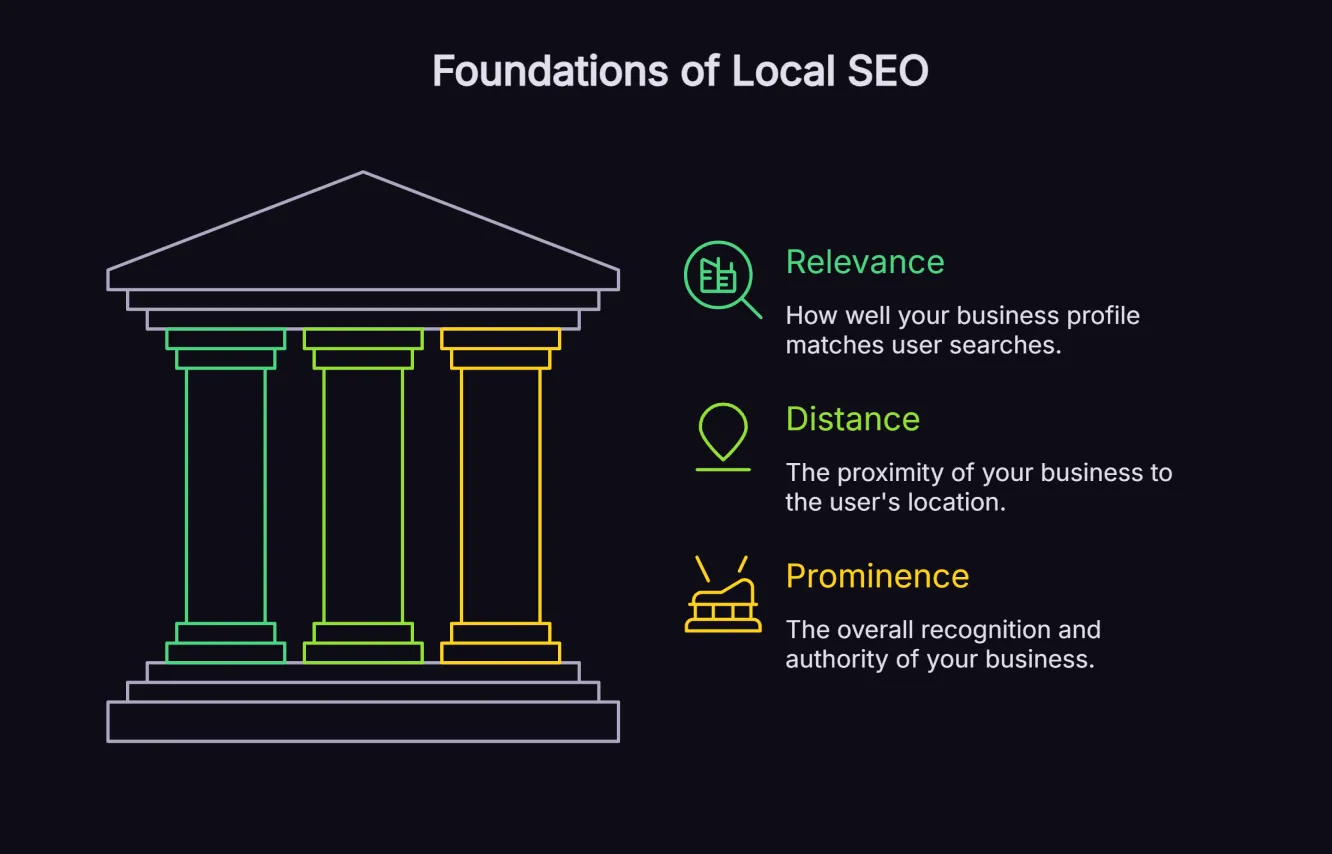
Google’s official local ranking documentation says local results are mainly based on relevance, distance and prominence.
- Relevance: How well your business profile matches what someone is searching for. Complete, detailed business information helps Google understand your business and match it to the right searches.
- Distance: How far each result is from the location term used in a search. If a searcher does not specify a location, Google calculates distance from what it knows about their location.
- Prominence: How well known a business is, based on offline reputation and on signals from across the web, including links, articles, directories and reviews.
The Whitespark Local Search Ranking Factors Survey
The 2026 Whitespark Local Search Ranking Factors Survey gives deeper insight into what drives local rankings. For the Local Pack and Maps results, Google Business Profile signals account for 32% of ranking influence, making it the single most important factor.
On-page signals contribute 33% to local organic rankings, covering your website's content, internal linking and location-specific pages. Link signals account for 24%, which keeps quality backlinks from relevant local sources firmly in play. Review signals carry significant weight for both Local Pack and organic results, with the quantity, velocity and diversity of reviews all shaping how Google reads your prominence.
Optimising Your Google Business Profile
Your Google Business Profile is the foundation of local SEO. This free listing helps determine whether you appear in the Local 3-Pack, which is the map-based result shown above many organic listings. As we tell every client, Google Business Profile is mandatory for local visibility. BrightLocal’s Local Consumer Review Survey 2026 found that Google remains the leading review source, even though its share dropped from 83% in 2025 to 71% in 2026. Your listing quality affects how quickly customers can evaluate your business and whether you have a realistic chance of appearing in the three-pack.
The Profile Mistake That Quietly Costs Weeks of Visibility
Here is the lesson we wish more businesses learned before they make the mistake, not after. Google has become extremely sensitive to anyone trying to keyword-stuff a Business Profile, especially the business title. Google’s Business Profile guidelines say your profile name should reflect your real-world business name as used consistently on your storefront, website, stationery and branding. Including unnecessary information in the business name is not permitted and could result in profile suspension.
We have seen businesses lose several weeks of local visibility because they tried to optimise their profile title with keywords. They then had to go through manual reverification or profile lockout before the listing was fully trusted again.
It gets worse than a slow ranking dip. Any content or change on your profile that gets flagged as keyword or SEO spam can take the profile offline or block it from being edited. We have watched this happen to businesses using automated posting and optimisation tools that pushed changes without a human checking them first. Our approach is simple: keep the business name clean and exact, and put your optimisation effort instead into:
- Categories
- Descriptions
- Posts
- Reviews
If you do use a tool like Localo, review every recommendation and every piece of generated content before it goes live.
Complete Every Section Thoroughly
Google rewards complete profiles with better visibility. Fill in every available field, including your:
- Business name
- Address
- Phone number
- Website
- Business hours
- Service areas
- Business categories
The more information you provide, the more chances Google has to match you to relevant searches. Your primary category matters most, so choose the most specific category that describes your core business. A plumbing company should pick "Plumber" rather than the broader "Home Services". Add secondary categories for related services, but remember the primary category drives which searches trigger your listing.
Visual Content and Regular Updates
Photos and visual content shift engagement with your listing. Businesses with photos receive 42% more requests for directions and 35% more website clicks. Upload high-quality images of your location, team, products and services. Aim for at least 10 photos, and add new ones regularly to signal that your business is active.
Google Posts let you publish timely content directly on your profile, including:
- Updates
- Promotions
- Events
- Special offers
Posts appear for seven days and show that your business keeps an active online presence. Weekly posting keeps the listing fresh and gives potential customers more to engage with.
Accurate Business Hours and Attributes
Accurate hours help Google show your business during your operating times, and businesses that are open during the search period rank higher than competitors that are closed. Update hours for holidays and special occasions so the listing stays accurate. Attributes let you highlight specific features, from wheelchair accessibility to payment methods and service options, which helps Google match you to filtered searches.
The Critical Role of NAP Consistency
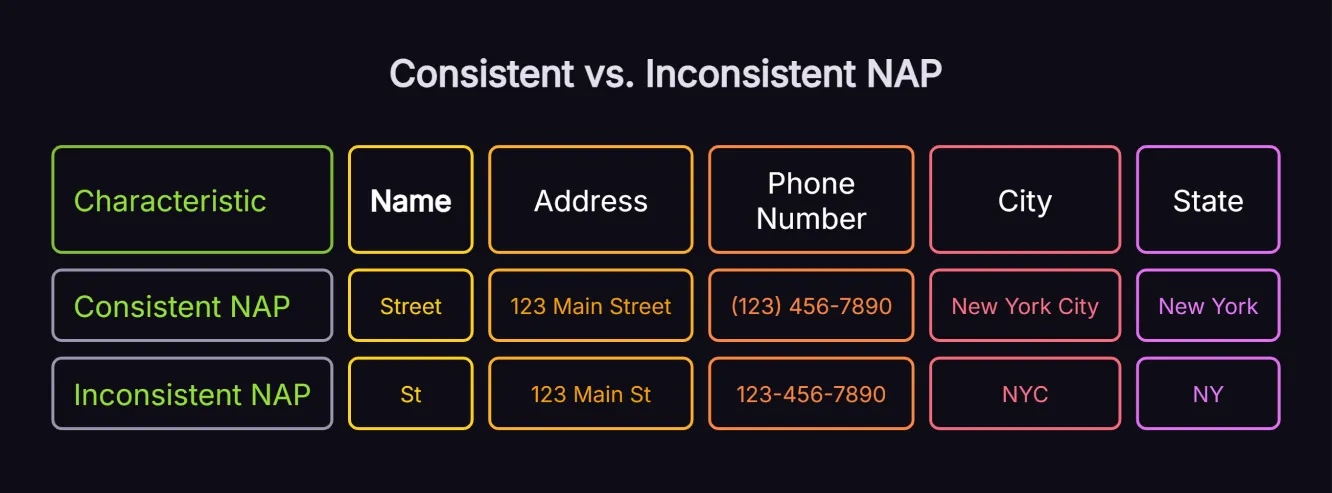
NAP stands for Name, Address and Phone Number, the three foundational details that identify your business online. Consistent NAP information across all platforms ranks as a top-five factor for both Local Pack and organic local rankings.
Why Consistency Matters
Search engines cross-reference your business details across hundreds of sources. When they find the same details everywhere, it builds confidence that your business is legitimate and established. Inconsistencies create confusion, make it harder for Google to verify you and can split your authority across multiple perceived entities.
Even small mismatches cause problems. If your address reads "123 Main St" on one platform and "123 Main Street" on another, algorithms can struggle to confirm they describe the same place. Business data also spreads through the local data ecosystem quickly, so once an incorrect detail appears in one listing, it tends to multiply across other directories and data providers. Fixing it then takes systematic effort across the whole ecosystem.
Building Consistent Citations
Local citations are mentions of your business NAP on third-party websites, including:
- Directories
- Review sites
- Social platforms
- Local business listings
These citations act as trust signals that validate your existence and location. Start with the major platforms:
- Google Business Profile
- Bing Places
- Apple Maps
- Yelp
- Industry-specific directories relevant to your business
Use identical formatting across every listing, and watch for auto-generated listings on platforms you never joined, since sites can create entries from public information that contain errors. Claim and correct these to keep control of your presence.
Managing and Auditing Citations
Regular citation audits catch inconsistencies before they hurt your rankings. On tooling, we will give you our honest preference rather than a neutral list:
- BrightLocal is our preferred platform for local citation submission and management, and we use it across client campaigns for directory listings as well as Google Business Profile management.
- Yext still has the best network of citation listing inventory. It makes sense once you have outgrown what BrightLocal can handle, typically at 50 or more locations. At that scale, real-time syncing across a large footprint pays off. For most single-location and small multi-location businesses, Yext is overkill and BrightLocal is the better fit.
- If budget is the deciding factor, Moz Local is a lower-cost option for basic listing management, with plans starting from $16/month per location.
For budget planning, we usually treat local SEO tooling in three tiers:
- A single-location business can often cover the basics with roughly $40-80/month for citation management, Google Business Profile support and local rank tracking
- Small multi-location businesses should expect closer to $100-300/month as reporting, listings and location-level tracking become more involved
- Enterprise groups with 50+ locations often need $500+/month once Yext-style listing management, geo-grid reporting and internal workflow requirements are added.
One contrarian note from running these campaigns: the discovery side of citations is valuable. Knowing where your competitors are listed shapes your own strategy. The actual submission work is best handled by a tool or service rather than done by hand.
Review Management Strategy
Reviews influence local rankings and customer decisions. 71% of consumers use Google to find local business reviews, and 93% say online reviews affect their buying decisions. Building and managing reviews deserves strategic attention.
Review Recency as a Ranking Signal
Review recency is a key local ranking signal. A steady stream of new reviews proves to Google that your business actively serves customers. Sporadic collection, such as a campaign every six months, creates gaps that competitors with consistent review flow will exploit. Monitor competitor review velocity so you know what you are up against. Use competitor review velocity as a benchmark, then set a sustainable review target that keeps your profile visibly active.
Quality Over Quantity
Not all reviews carry equal weight. Detailed reviews that discuss specific services and experiences provide more value than brief ratings. Encourage customers to describe their experience, mention specific services and include photos. BrightLocal’s survey found that 68% of consumers will only use a business with four or more stars, while 31% will only use a business with 4.5 stars or more, so maintaining rating quality starts with excellent service and proactive outreach to satisfied customers.
Review Response Best Practices
Respond to every review, positive and negative, within 24 hours when you can. Responses show future customers that you value feedback. For negative reviews, address concerns professionally, offer to resolve issues offline and show commitment to customer satisfaction. Use responses to naturally mention your location and services. A reply thanking a customer for visiting your Melbourne showroom adds a relevant signal without looking manipulative.
Building Reviews Across Multiple Platforms
BrightLocal’s Local Consumer Review Survey 2026 found that the average consumer uses six different review sites when choosing businesses. Google remains the leading review source, though its share dropped from 83% in 2025 to 71% in 2026, so relying on Google alone leaves gaps across the wider review journey.
BrightLocal’s local SEO statistics roundup also reports that 37% of US consumers use Instagram to find local business reviews. Another 29% use TikTok, which makes these channels a growing opportunity for businesses targeting younger customers.
Local Link Building
Backlinks from local sources signal geographic relevance and community trust. Unlike traditional link building that chases high-authority sources, local link building targets websites with geographic connections to your area.
The Value of Local Links
Local links show that your business is an active part of the community. A single link from a local news site or Chamber of Commerce can carry more local relevance than many links from generic directories. These links signal trust inside your geographic market, especially when they come from organisations, publications and partners tied to the area you serve.
Effective Local Link Building Tactics
Community partnerships create natural link opportunities. Sponsor local events, sports teams or charities, which often result in links from the organisation's website, local news coverage and social mentions. Local business associations and Chambers of Commerce typically maintain member directories with links, and professional or industry groups offer similar opportunities.
Locally focused content attracts links on its own. Guides to your area, community resource pages or local industry reports give other websites a reason to reference you. Guest posting on local blogs, contributing expert commentary to local news and joining community forums build relationships that lead to links. Focus on providing genuine value and the opportunities will follow.
Analysing Competitor Link Profiles
Tools like Ahrefs and Semrush reveal where competitors earn their local links. Identify the sources linking to competitors, then work out which you can pursue. If a competitor appears on a local university's vendor page, research how to qualify for similar inclusion. Look for patterns: if several competitors have links from the same local publication, it likely accepts contributed content.
Voice Search and Local SEO
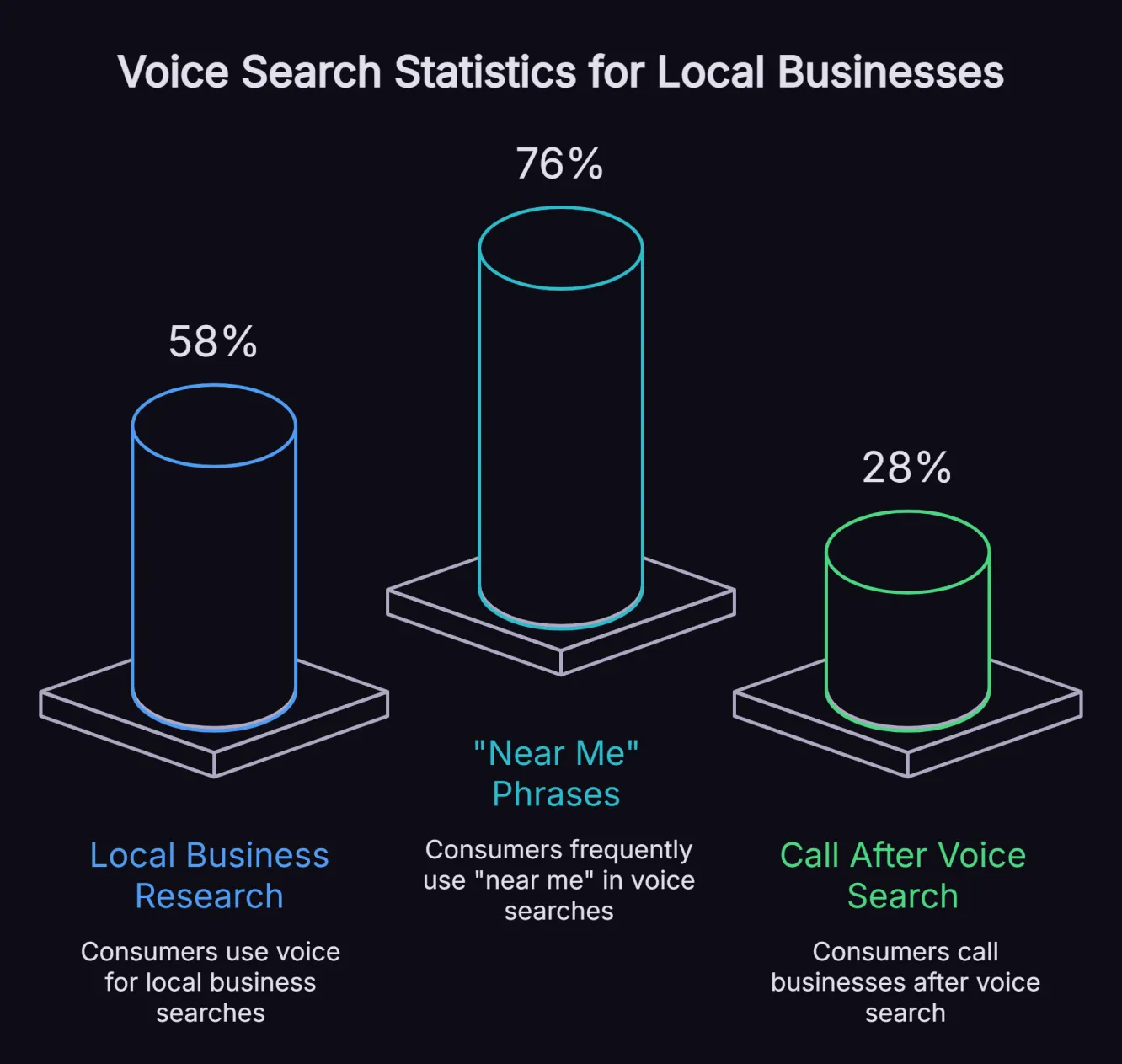
Voice search has changed how consumers find local businesses. 58% of consumers use voice search to find local business information, and 76% of voice searches include "near me" or local intent phrases.
Voice Search Behaviour Explained
Voice queries differ from typed searches. Voice queries are usually more conversational than typed searches, so structure local pages around complete customer questions rather than only short keyword phrases. People speak naturally and ask complete questions. "Where is the nearest plumber open now?" is typical voice behaviour, compared to the typed query "plumber near me". Optimising for these conversational, question-based queries needs a different content approach to traditional keyword targeting.
Optimising for Voice Results
40.7% of voice search answers come from featured snippets, and over 80% come from the top three search results. Earning those positions for local queries means writing content that directly answers common questions.
Create FAQ content that addresses the specific questions customers ask, and keep answers concise, around 15 to 30 words, so voice assistants can read them aloud. Use natural question phrases in your content, including:
- Who
- What
- Where
- When
- Why
- How
Structured data also helps. FAQ schema and LocalBusiness schema increase your chances of appearing in voice results, so implement schema for your:
- Business hours
- Services
- Location
- Reviews
- Frequently asked questions
Local Voice Search Opportunities
51% of consumers use voice search to research restaurants, making it the most commonly voice-searched category. Hotels, doctors, insurance companies and many service businesses also see strong voice volume. 28% of consumers call the business they voice searched for, so make sure your phone number appears prominently and that someone answers during business hours.
AI Search Visibility for Local Businesses
AI search is the next frontier in local discovery. AI platforms including ChatGPT, Perplexity, Gemini and Google's AI Overviews, are starting to change how consumers find and evaluate local businesses. This matters commercially: AI-referred visitors convert 23x higher than organic search visitors, which makes AI citation a high-value channel for any business with a considered purchase.
Current AI Search Landscape
AI Overviews are appearing in local search, but there is no single universal percentage to use across every query type. Ahrefs’ broader keyword dataset found AI Overviews on 7.9% of local queries, while Local Falcon’s local-business research reported AI Overviews in approximately 40% of local searches as of May 2025. We treat AI Overview visibility as query- and dataset-dependent, not a fixed percentage. Informational local queries are more likely to trigger AI Overviews, while simple location-based and transactional searches still often lean on the Local Pack. You can see the same shift reflected in our local SEO statistics roundup.
ChatGPT Search data shows that business websites account for 58% of local sources, which tells you traditional website optimisation still plays a major role in AI visibility alongside platform-specific signals.
Why Citations Still Matter in the AI Era
If you are questioning whether citation building is still worth the investment, it absolutely is. Local citations remain valuable in the AI search era, and even no-follow local citations influence AI search visibility through local references and entity signals. The mechanics of how AI systems verify a business lean on the same consistent, distributed signals that have always underpinned local trust.
Optimising for AI Discovery
AI search engines parse content differently from traditional algorithms. They look for comprehensive, well-structured information that fully answers a question, so content depth, accuracy and clear organisation matter more than keyword density. This is the same passage-level discipline we apply across client content, and our guide to passage optimisation goes deeper on the technique.
Structured data helps AI systems understand your business context, so LocalBusiness, FAQ, Organisation, Review and Service schemas give AI engines what they need to represent you accurately. Reviews also shape AI recommendations, because large language models parse review language to understand sentiment, common praise and frequent complaints. The semantic content of reviews, not just star ratings, influences how AI systems perceive and recommend your business.
Multi-Platform Visibility
AI platforms pull data from many sources. Coverage across Google, Apple Maps, Bing, Yelp, TripAdvisor and industry directories helps AI systems find accurate information regardless of their primary data source. Consistent NAP becomes even more important as AI systems aggregate data. Third-party "best of" lists and authoritative recommendations can also support AI citations. Appearing in trusted local roundups increases the chance of being mentioned.
On-Page Optimisation for Local SEO
Your website supports and amplifies your Google Business Profile and citation work. On-page signals account for 33% of local organic ranking factors, which makes website optimisation essential for local visibility.
Location-Specific Content
Create dedicated pages for each location your business serves. Multi-location businesses need unique content for each branch, not duplicated pages with swapped city names. Each location page should include the following:
- Specific address
- Phone number
- Hours
- Team members
- Locally relevant content
For service-area businesses without storefronts, build content targeting the specific areas you serve. A Sydney-based plumber might create pages for each suburb, covering the plumbing challenges, regulations and service details relevant to each area.
Technical Foundations
Mobile optimisation is non-negotiable for local SEO. Pages ranking for voice search load 52% faster than average, and mobile page speed influences both traditional and voice rankings. Test your site monthly using PageSpeed Insights and fix any performance issues. Include NAP information prominently, usually in the footer and on your contact page, so search engines can verify your details match your listings.
Implement LocalBusiness schema markup on your website to give explicit signals about your:
- Business name
- Address
- Phone number
- Hours
- Services
- Geographic service area
Use Google's Rich Results Test to verify your implementation.
Content Strategy for Local Relevance
Create content that shows local expertise and relevance. Blog posts about local events, industry news affecting your area and community involvement signal geographic relevance while providing value to local readers. Your internal linking should connect location pages, service pages and blog content. Link from blog posts to relevant service pages. Then link from service pages to location pages, so users and search engines can understand your site structure.
Measuring Local SEO Success
Tracking the right metrics keeps your local SEO tied to business results. Focus on metrics that connect visibility to customer acquisition and revenue.
Key Performance Indicators
Track Google Business Profile insights, including:
- Search views
- Map views
- Website clicks
- Direction requests
- Phone calls
Monitor rankings for target local keywords across both map pack positions and organic rankings, and watch position changes over time. Website analytics then reveal local SEO's contribution to traffic and conversions, so segment traffic by geographic area and landing page to see which local pages drive results.
Go Beyond a Single Rank Position
A single rank check no longer tells you the truth about local visibility. You can rank well two streets over and be invisible at the exact spot that matters for foot traffic. This is where geo-grid tracking earns its place, and it is particularly useful in dense urban environments such as CBDs, where block-by-block visibility is critical. Standard rank tracking misses this nuance. Tools like Local Falcon scan across entire neighbourhoods to reveal the blind spots, and even a strong all-round rank tracker is not a replacement for street-level geo-grid precision.
Do not forget Apple Maps. StatCounter data shows iOS accounts for 62.8% of mobile operating system market share in Australia and 31.94% worldwide, so Apple Maps tracking can reveal a meaningful slice of local demand that many businesses never measure.
Review and Conversion Metrics
Monitor review quantity, velocity and average rating across all platforms, and set targets based on competitor benchmarks. Then connect visibility to actual outcomes. Track phone calls using dedicated tracking numbers for different sources, and monitor form submissions, appointment bookings and quote requests tied to local search traffic. For businesses with physical locations, correlate foot traffic with improvements in local search visibility to validate the work.
Common Local SEO Mistakes to Avoid
Recognising common pitfalls helps you focus on strategies that work and avoid wasting resources.
1. Inconsistent Information
The most damaging mistake is letting NAP inconsistencies spread across the web. Once incorrect information multiplies, cleanup takes systematic effort across dozens of platforms. Audit existing citations before building new ones, and set a single source of truth for business information.
2. Keyword-Stuffing Your Profile Name
The fastest way to lose local visibility is over-optimising your Google Business Profile, especially the business title. Keep the name an exact match with your real business name, and put optimisation effort into categories, descriptions, posts and reviews instead.
3. Neglecting Reviews
Ignoring reviews signals to search engines and customers that you do not value feedback. Respond to every review, address negative feedback professionally and build systems that encourage satisfied customers to share their experiences.
4. Generic or Duplicated Content
Location pages with minimal or duplicate content add little value. Each page should contain substantial, unique content relevant to that specific location or service area.
5. Mobile Neglect
Most local searches happen on mobile, so a site that performs poorly on mobile loses customers at the moment of highest intent. Prioritise mobile experience in design, development and ongoing optimisation.
Frequently Asked Questions
Do I Need a Physical Location for Local SEO?
Service-area businesses without customer-facing locations can still benefit from local SEO. Google Business Profile lets you specify service areas without displaying a street address. Focus on building citations, earning reviews and creating content targeting the specific areas you serve.
How Do I Compete With Larger Businesses in Local Search?
Local SEO gives smaller businesses advantages that traditional marketing does not. Focused attention on a specific area, genuine community connections and personalised service create differentiation. Consistently earning reviews, building local links and creating locally relevant content can outperform larger competitors running generic national strategies.
How Does Voice Search Affect Local SEO?
Voice search changes query patterns from short keywords to conversational questions. 58% of consumers use voice to find local businesses, typically asking complete questions like "where is the nearest pharmacy open now". Optimise for these queries with FAQ content, featured-snippet-worthy answers and a complete Google Business Profile, including accurate hours and services.
How Important Are Reviews for Local SEO Rankings?
Reviews significantly influence local rankings through both quantity and quality signals. Review signals account for a meaningful portion of local ranking factors, with recency, velocity and sentiment all contributing. Beyond rankings, reviews directly shape customer decisions, since 71% of consumers avoid businesses rated below three stars.
How Long Does Local SEO Take to Show Results?
Local SEO improvements typically become visible within 3 to 6 months, though some changes, such as Google Business Profile optimisation, can show a faster impact. Citation-building and link-acquisition strategies take longer to influence rankings. Consistent effort over 12 months or more builds sustainable local visibility that competitors find difficult to displace.
What Is the Difference Between Local SEO and Traditional SEO?
Local SEO focuses on geographic visibility, prioritising Google Business Profile, local citations, review management and location-specific content. Traditional SEO targets broader search visibility regardless of location. Most local businesses need both, with local SEO driving immediate-area customers and traditional SEO capturing broader search traffic.
What Is the Local 3-Pack and How Do I Appear in It?
The Local 3-Pack is the three business listings shown prominently in Google results alongside a map. Appearing requires a well-optimised Google Business Profile, consistent NAP citations, positive reviews, relevant website content and signals indicating proximity to the searcher. Competition varies by industry and location, but consistent optimisation improves three-pack visibility over time.
Should I Focus on Google or Other Platforms?
Google dominates global search with around 90% market share, making Google Business Profile your top priority. However, the average consumer uses six different review sites when choosing businesses, so build presence on Yelp, Facebook, Apple Maps and industry-specific platforms to capture customers across the wider review journey.
Your Path to Local Search Dominance
Winning in local search comes down to doing the basics better than your competitors, then protecting them. A fully optimised Google Business Profile, an exact-match business name, consistent citations, strong reviews, local links and focused on-page work do most of the heavy lifting. Nearly half of all Google searches now carry local intent, and many of those searchers are ready to visit or buy, so the businesses that show up cleanly take the demand. Start by tightening your foundations and avoiding the profile mistakes that pull listings offline.
About the Author
Want Insights Like This Fortnightly?

Our AI SEO strategies and tactics delivered fortnightly, including bonus trade secrets not shared anywhere else. No fluff. Just what's working right now. 5-minute read.


