
How to Build Sustainable AI SEO Authority With Pillar Content in 2026


You've published dozens of blog posts but your organic traffic remains flat. Sound familiar? The problem likely isn't your content quality. It's your content architecture. Without pillar content at the centre of your strategy, search engines struggle to understand what you're actually an expert in. Pillar content changes this by serving as the foundational hub that connects and elevates everything else you publish. This guide explains what pillar content is, why it matters more than ever in 2026 and how to use it to build the topical authority that drives rankings and revenue.
Pillar Content Overview
Pillar content is comprehensive, in-depth content that serves as the central hub for a specific topic on your website. It provides a thorough overview of a broad subject and links to more detailed cluster pages that explore related subtopics. This interconnected structure helps search engines understand your expertise and surfaces your content more prominently in both traditional search results and AI answer engines.
Ready to Build Content That Drives Revenue?
We build pillar and cluster systems that rank on Google and get cited in AI search. The same content architecture has contributed to over $26M in attributed client revenue across our case studies.
Explore Our Content Marketing ServicesWhat Is Pillar Content and How Does It Work?
A pillar page is the definitive resource on a broad topic. It answers the big question a reader has, then hands off the finer detail to a set of supporting pages. Those supporting pages are the cluster (or spoke) pages, and each one covers a single narrow subtopic in depth. The pillar links down to every cluster page, and every cluster page links back up to the pillar. That two-way linking is what turns a pile of separate posts into one connected body of work.
The Hub and Spoke Model
The hub-and-spoke model is the architecture behind every strong pillar. The pillar is the hub. The clusters are the spokes. When we build a topic cluster this way, we give search engines a clean map of how your pages relate to one another, and we give readers an obvious path from the overview to the specifics. If you want the full mechanics of designing one, our guide to the topic cluster model walks through it step by step.
The model works because it mirrors how both Google and AI answer engines now read a website. They no longer judge a page in isolation. They judge how well your pages, taken together, cover a subject. A pillar with a well-linked cluster tells them you have covered the topic properly, not just written one thin post and moved on.
Why Pillar Content Builds Topical Authority
Topical authority is the trust a site earns by covering a subject deeply and consistently. Pillar content is how you build it. Each cluster page adds a piece of proven coverage, and the internal links between them concentrate that authority on the pillar at the centre.
The compounding effect is real, and we can show it from our client work rather than a borrowed statistic. On one B2B engagement we prioritised low-competition, high-relevance clusters first and let the authority build outward. The client's ranking keywords grew from 162 to 4,947, a 30.5x increase, while their share of voice moved from 0.6% to 6.2%. That is topical authority compounding in practice: the more of the topic you own, the easier each new ranking becomes. Google's own helpful content guidance describes the same idea from the other direction, rewarding sites that demonstrate genuine depth and expertise on a subject.
Pillar Content Versus Regular Blog Posts
Pillar content and regular blog posts do different jobs, and treating them as the same thing is where a lot of content strategies go wrong. A pillar page is broad, long and structural. A regular blog post is narrow, shorter and tactical. The table below sets out the practical differences.
| Attribute | Pillar Content | Regular Blog Post |
|---|---|---|
| Scope | Broad topic overview | Single narrow subtopic |
| Typical length | 2,000 to 5,000+ words | 800 to 1,500 words |
| Linking role | Hub that clusters link back to | Spoke that links up to the pillar |
| Purpose | Build topical authority and rank for the head term | Answer one specific query in depth |
| Update cadence | Refreshed and expanded over time | Updated as needed |
You need both. The blog posts capture the long-tail queries and feed authority upward. The pillar consolidates that authority and competes for the broad, high-value term. Neither works nearly as well on its own.
The Three Main Types of Pillar Content
Not every pillar page looks the same. The format you choose should match what your reader is trying to do and what the search results for your topic reward. There are three main types.
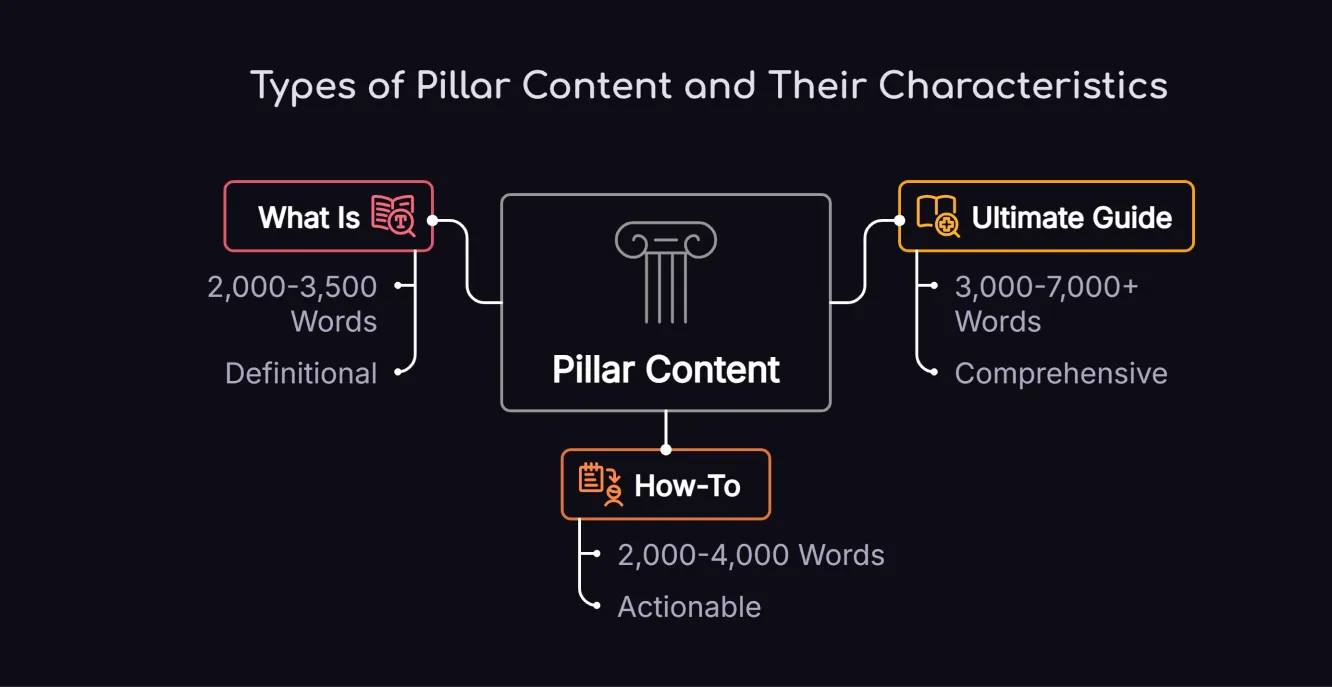
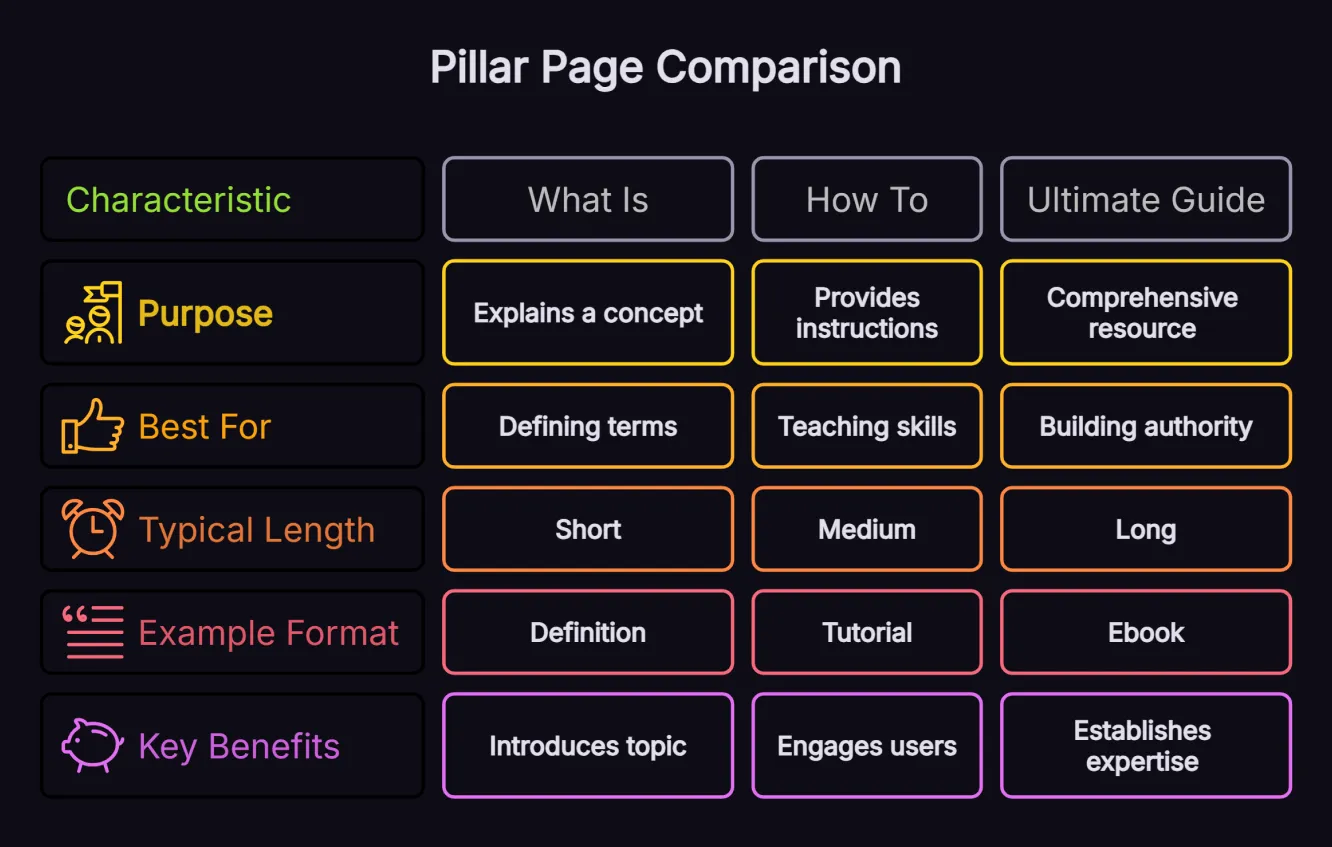
- Ultimate Guide pillars: An Ultimate Guide pillar gives a complete overview of a broad subject, then links out to cluster pages for the detail. These are the workhorses of most content strategies. They tend to run long, often 3,000 to 7,000+ words, because they need to touch every major facet of the topic while pointing readers deeper.
- How-To pillars: A How-To pillar walks the reader through a process from start to finish. It is procedural rather than encyclopaedic, usually 2,000 to 4,000 words, and each major step can spin off into its own cluster page. This guide is a How-To pillar: it defines pillar content, then teaches you to build a pillar content strategy step by step.
- What-Is pillars: A What-Is pillar defines a concept and its context, typically 2,000 to 3,500 words. It is the most vulnerable of the three formats, and here is where our recommendation differs from most advice you'll read.
our recommendation comes in three parts:
- Prioritise How-To and Ultimate Guide pillars: These formats reward depth and first-hand process that an AI answer cannot fully replace, so they keep pulling traffic and citations.
- Deprioritise standalone What-Is pillars: AI Overviews now answer most "what is" queries directly in the results, so a page built only to define a term increasingly loses the click to the AI answer above it.
- Fold the definition into a bigger page: When you do need to define a term, place it inside a How-To or Ultimate Guide pillar (as we have here) rather than spending a whole page on it.
Why the Build Order Is Where Most Pillar Strategies Break
The hub-and-spoke idea is not the hard part. Most teams already grasp that a pillar page sits at the centre and cluster pages branch off it. If you want the full breakdown of what pillar content is and the formats it can take, we cover that in our pillar content guide. What separates a build that ranks from one that stalls is execution: how you cluster, what you publish first and how authority flows between pages. Get the order wrong and your own pages compete against each other while Google picks one winner and buries the rest.
Pick the Format That Matches the Query, Not the Other Way Around
Before you build, decide what the pillar needs to achieve. Some pillars need to teach a process, some need to frame a broad topic and some need to support a commercial page with topical depth. We do not spend long on format labels here because the strategy lives in the build. The format should follow the query, the funnel stage and the role the pillar plays in the wider cluster. For the full format breakdown, see the pillar content guide.
The 6-Step Pillar Content Strategy Build
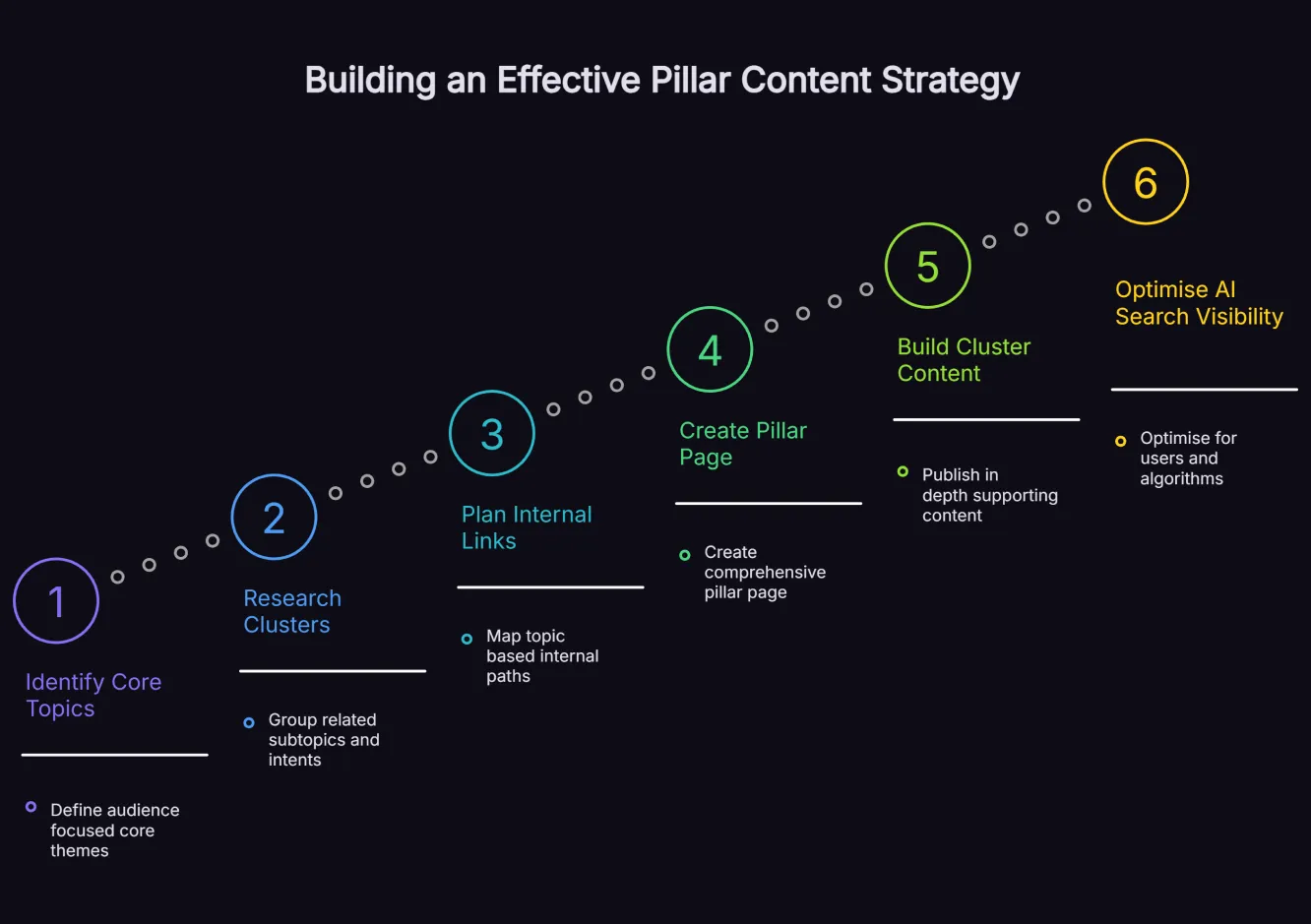
Here is the build in the order we run it. Each step sets up the next, so resist the urge to skip ahead to writing.
Step 1: Identify Your Core Topic Areas
Every engagement we run starts with a topical authority audit. We use it to identify the topics where a client can realistically become the most thorough resource, then map the roadmap to get there. Pick three to five broad topics that sit at the intersection of genuine business expertise and real audience demand. That intersection is where the strongest pillars live, because you can out-cover competitors on subjects you actually know.
For a B2B property management client, that meant building service pages that reflected the actual services on offer, then creating informational blog content to support each one. Before you commit to a pillar, check a few things:
- Verify there is consistent demand across related terms, not just one high-volume keyword.
- Confirm your team has first-hand expertise you can put on the page.
- Map the full landscape of search behaviour within each topic before scoping the clusters.
Step 2: Map the Cluster With a Clustering Tool, Then Audit by Hand
With pillar topics chosen, break each one into the subtopics and questions that make up its cluster. This is where cannibalisation is won or lost, so we run every topic through a clustering tool before building anything. We use Keyword Insights to group keywords by intent and semantic relationship, which shows which terms belong on the same page and which need their own. On a SaaS build, we mapped 2,300+ manually selected keywords into clusters so each article targeted distinct buyer pain points and nothing competed with itself.
Tools alone are not enough. we always follow with a manual audit to confirm that:
- Each cluster page targets a genuinely distinct topic.
- There is no close overlap that could trigger cannibalisation.
- Every page adds unique value rather than rehashing a neighbour.
That manual pass matters most at the edges, where two clusters share a term but serve different intent. A tool will sometimes split those into separate pages, or merge them when they should stay apart. Reading the actual queries in each group and the pages already ranking for them is what catches the calls a tool gets wrong.
For our SaaS build, we manually selected the 2,300+ keywords before clustering because our team was producing content at scale. One bad merge repeated across dozens of articles would have been expensive to unwind later. My keyword clustering framework walks through the method in detail.
Where Builds Break: Keyword Cannibalisation
If you create cluster pages on topics too close in meaning, they fight each other in the results, and Google picks a winner while the rest languish. The fix is clear differentiation: the pillar covers the broad topic, and each cluster owns one subtopic the pillar only touches. When two topics look too similar to separate cleanly, consolidate them into one stronger page rather than splitting thin content across two.
Step 3: Plan the Internal Linking Architecture Before You Write
Plan the links before the content, because the link structure decides how authority flows. The pattern we use is a content silo. Each commercial or conversion page sits at the centre of its own sub-cluster, supported by three to five informational posts that link up to it.
Every cluster page links to the pillar with descriptive anchor text. The pillar then links out to each cluster. Related clusters can also link to one another, where it genuinely helps the reader. We usually only link sideways when the second page helps the reader make the next decision, not just because the keyword looks related. When one page earns a backlink or starts ranking, that authority flows through the structure to the rest of the cluster instead of dead-ending on a single post.
Step 4: Build the Pillar Page First
Start with the pillar page. It sets the framework every cluster page hangs from, so publishing it first helps keep the entire hub consistent.
A strong pillar page should include:
- A clear heading hierarchy with one H1, H2s for major sections and H3s for subsections.
- A table of contents for longer guides.
- Coverage of each major subtopic, with links to cluster pages that explore them in greater depth.
- Original data, examples or other forms of distinctive proof.
Ahrefs found that only 1.74% of newly published pages reach Google's top 10 within a year. That is why pillar structure matters. The page needs to do more than cover a topic broadly. It needs a clear hierarchy, strong internal linking and enough topical depth to build authority over time.
Step 5: Sequence Clusters Low-Competition First
This is the step most guides get backwards. The instinct is to chase the highest-volume, most commercial terms first. we do the opposite.
On the B2B property management build, our team prioritised low-competition, high-relevance clusters first. That gave the site topical authority and organic signals before we moved into the competitive phrases the client’s competitors had long dominated. Winning the winnable pages first gives Google evidence of authority, which makes the harder pages easier to rank later. Four to eight cluster pages per pillar is a sensible starting point, and complex topics will need more. Quality beats volume every time; a handful of authoritative pages outranks a pile of shallow ones.
That sequencing matters because the click curve is steep. Backlinko’s organic CTR study found that the top three Google results earn 54.4% of all clicks, while only 0.63% of searchers click something from page two. A pillar strategy should not just produce more pages; it should build enough topical authority for the right pages to move into the positions where clicks actually happen.
Step 6: Optimise for Both Google and AI Search
A modern pillar build has to earn Google rankings and AI citations at the same time. For Google, get the fundamentals right: heading structure, meta titles and descriptions, mobile performance, page speed and schema markup. For AI platforms, lead each section with a clear, self-contained answer before you elaborate, use descriptive headings and keep key facts easy to extract. The payoff is concrete: covering the full topic cluster, not just the commercial keywords, is what earned a B2B property management client 138 AI citations across multiple search surfaces in seventeen months. That same build has grown to ~$8.7M attributed over 27 months (ongoing).
A Worked Example: The Build Across Two Engagements
Here is how the six steps come together in practice, across two very different clients.
Building Authority Before Head Terms
On the B2B property management engagement, we started with the service pages as pillars: one core service page, then a cluster of supporting blog posts feeding each one. we sequenced the low-competition clusters first, built the internal silo so every commercial page had three to five informational posts pointing at it and structured everything for AI extraction. Sequencing this way meant the early pages ranked while the harder, head-term pages were still being written. The site started accumulating authority and traffic from month one instead of waiting for the competitive terms to land.
Over seventeen months that build drove 429% organic traffic growth, from 4,973 to 26,313 organic users, 138 AI citations in the early climb and ~$8.7M attributed over 27 months (ongoing; early climb included a 6,864% ROI window).
Mapping 2,300+ Keywords by Funnel Stage
The SaaS build looked different in scale but identical in method. Our team mapped more than 2,300 keywords into clusters upfront to prevent cannibalisation, then organised them by funnel stage:
- Educational content for top-of-funnel awareness.
- Comparison content for the consideration stage.
- Feature-focused content for the decision stage.
Each commercial page anchored its own silo of supporting content. That structure grew monthly revenue from $25,000 to $135,000 and delivered a 1,909% average return over twelve months.
A simple way to plan the funnel mapping is to sort queries by stage. Use awareness queries such as "what is [topic]", interest queries such as "how to [task]", consideration queries such as "[topic] comparison" or "[outcome] calculator" and commercial pages built to convert. Map each cluster to the stage it serves so the pillar covers the whole journey, not just the bottom of it.
How to Measure a Pillar Content Strategy Build
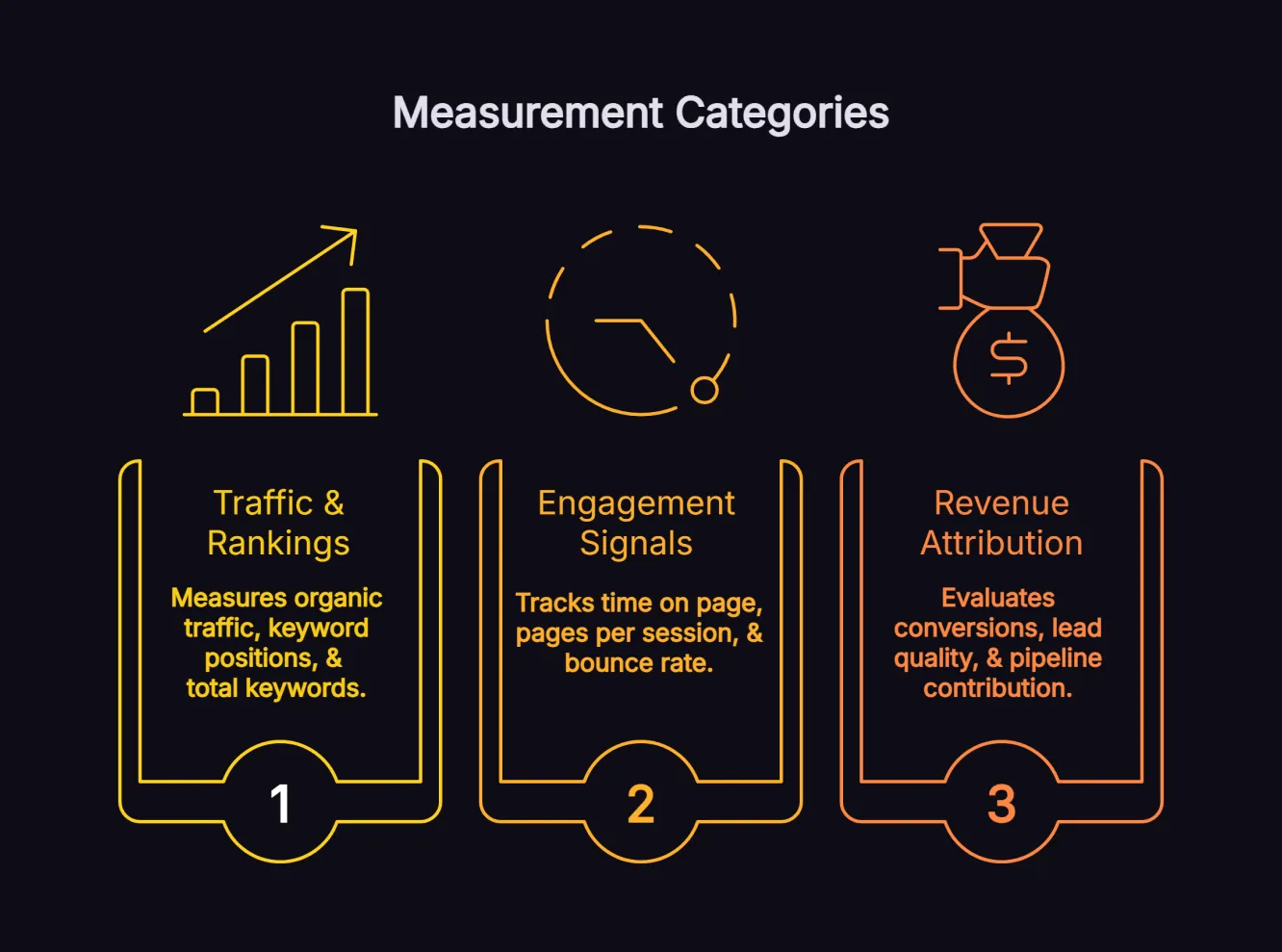
Track the metrics that connect the build to revenue, not just traffic. Watch organic traffic and keyword rankings across both pillar and cluster pages. Then check how many keywords each cluster ranks for as a read on topical coverage. Pillar builds compound, so look at the trend over months rather than any single week.
On engagement, we treat time on page and returning visits as early signals only. The real test is whether the cluster starts earning more ranking keywords, assisted conversions and AI citations over time. If a pillar is working, we expect to see the cluster expand from a few isolated rankings into broader topical coverage, then connect that growth back to pipeline, revenue or AI visibility.
On revenue, trace conversions from organic traffic through to the pipeline. My B2B case study shows how this architecture drove ~$8.7M attributed over 27 months (ongoing) through systematic organic growth. The SaaS case study shows the same method at keyword scale. One maintenance note: review pillars at least quarterly, refresh any dated statistics and add links to new cluster content as you publish it.
For the marketing meaning of content pillars as brand themes (not SEO hub pages), see the separate guide once published at what is a content pillar. This page stays on the SEO pillar-page and cluster build.
A Real Rankmax Pillar in Action
The clearest way to understand pillar content is to look at a working one. our own AI SEO guide is a live Ultimate Guide pillar. It gives the broad overview of optimising for Google AI Overviews, ChatGPT and generative search, then links out to cluster pages on the narrower pieces, from passage optimisation to how AI search works.
One pattern worth stealing from our client work is the service-page-as-pillar approach. Instead of treating the pillar as a blog post only, we build a commercial service page as the hub, then wrap it in a supporting cluster of informational blogs that feed authority into it. we ran this pattern on one B2B engagement. There, the pillar plus its cluster was part of the build that has driven about $8.7M in attributed revenue over 27 months, and grew the site from 4,973 to 26,313 users in the 17-month climb window (the numbers are in the B2B AI SEO case study). The pillar earns rankings; the service page at its centre turns those rankings into revenue.
How Pillar Content Improves SEO Performance
Pillar content improves SEO on several fronts at once, which is why it outperforms a scattered posting schedule. The main mechanisms:
- Better crawlability: A tight internal-linking structure helps search engines discover and understand every page in the cluster, so more of your content gets indexed and ranked.
- Stronger topical signals: Deep, connected coverage of one subject tells Google you are a genuine authority on it, which lifts the whole cluster rather than one page.
- Improved user experience: Readers move easily from the overview to the detail and back, which keeps them on site longer and signals quality.
- More backlinks: Comprehensive pillar pages are the pages other sites choose to link to, because they are the definitive resource on the topic.
The ranking payoff compounds because click-through is so top-heavy. The top three organic results capture the majority of clicks, while pages sitting on the second page pick up a tiny fraction of the traffic. Getting a pillar into that top band, and keeping it there, is where the traffic actually lives, and a well-built cluster is what gets you there.
Pillar Content and AI Search Visibility
AI search has changed what a pillar is competing for. It is no longer only about ranking blue links; it is also about being the source an AI answer engine cites when it responds to a question. Pillar content is well suited to this because answer engines reward exactly what a good pillar already has: depth, clear structure and demonstrable expertise. Google is explicit that there are no special tricks here. Its guidance on AI features in Search states there are no extra requirements to appear in AI Overviews or AI Mode beyond the same foundational SEO you already do, which is exactly what a strong pillar delivers.
The visibility gains show up as citations, and we track them as a KPI in their own right alongside rankings, as a leading indicator that revenue is coming rather than a replacement for ranking data. On one full topic-cluster strategy, the content earned 598 AI cited pages across search surfaces over 27 months and counting, spread across Google AI Overviews, ChatGPT, Gemini and Perplexity. That was the same engagement that attributed $8.7M in attributed revenue (the citation breakdown is in our guide on AI Overview versus AI Mode SEO). Topical authority is also a confirmed input here: the leaked Google Search documentation showed that site-level topical authority is a genuine ranking factor, which is precisely what a pillar-and-cluster structure is built to earn. To make your pillar extractable, keep sections self-contained and answers direct, the same principles we cover in our guide to passage optimisation.
Common Mistakes That Undermine Pillar Content
Most pillar content underperforms for a handful of avoidable reasons. When we audit a stalled content campaign, these are the faults we find most often:
- No supporting cluster: A pillar page published with no cluster around it is just a long blog post. Without spokes, the hub has nothing to draw authority from.
- Keyword cannibalisation: Two or more pages chasing the same keyword split the signal, as covered in Step 2. This is the most common structural fault and the easiest to prevent with a cluster plan.
- Weak or missing internal links: If the pillar and clusters are not linked in both directions, search engines cannot see the relationship, and the authority never concentrates.
- Thin coverage: A pillar that skims the topic instead of covering it properly fails to earn authority and rarely gets cited by AI engines.
- Set and forget: Pillars need refreshing as the topic and the search results move. A pillar left untouched for two years slowly loses ground to competitors who keep theirs current, which is why a regular content refresh is part of the job.
Measuring Pillar Content Success
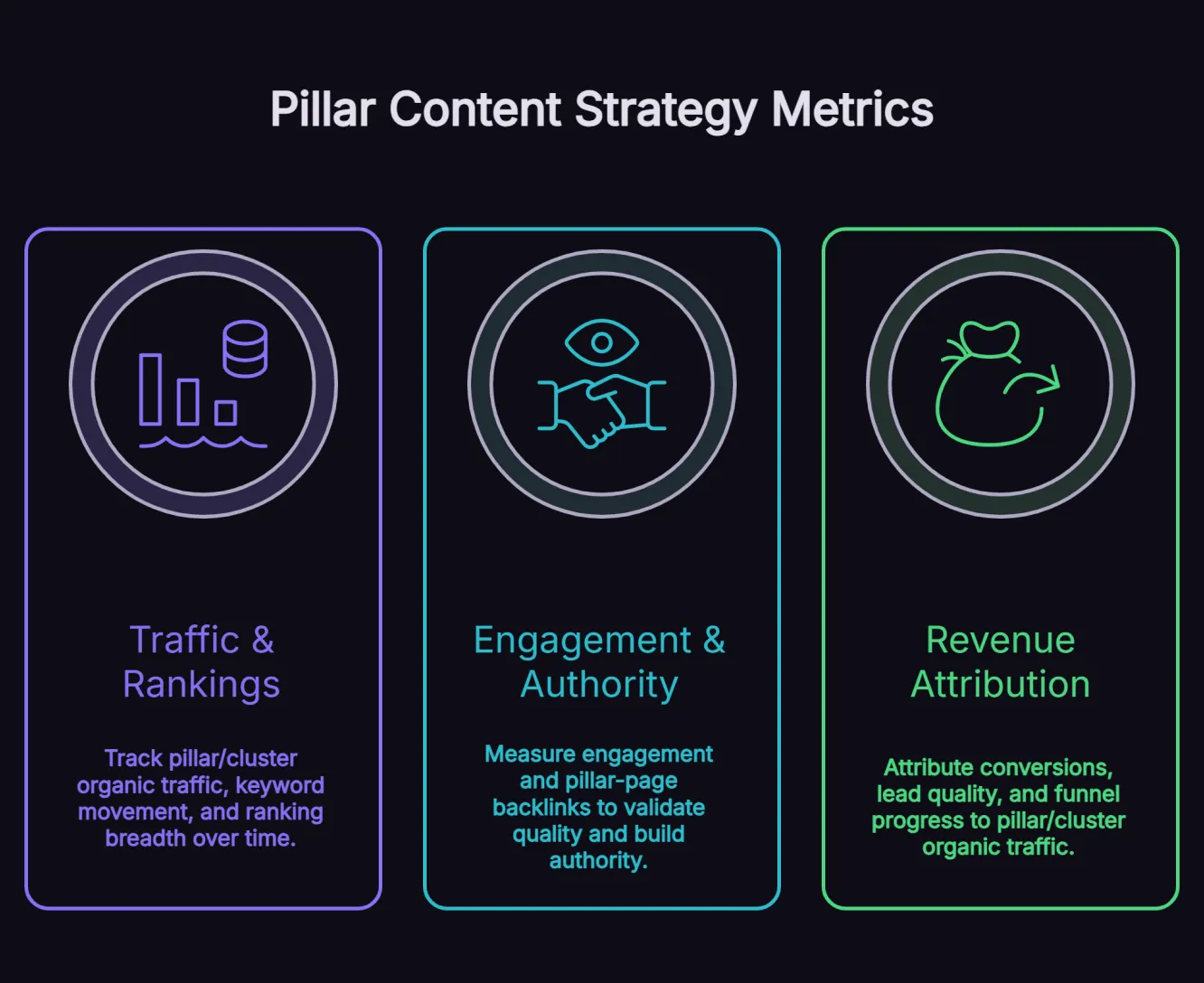
You measure a pillar the way you measure any commercial investment: by what it returns, not by how it feels. Track three layers together.
- Traffic: Organic sessions to the pillar and its cluster, plus keyword rankings for the head term and the supporting subtopics.
- Engagement: Time on page, scroll depth and internal navigation between the pillar and its clusters, which tell you the structure is working for readers.
- Revenue attribution: The commercial outcome the cluster drives, which is the number that actually justifies the work.
Revenue is the layer most teams skip, and it is the one that matters most. When we structure a content hub along the buyer journey, from awareness through interest and consideration to commercial intent, the revenue becomes traceable to the content. On one B2C engagement built this way, the hub drove $14.6M in organic revenue over 21 months (the model is laid out in the B2C AI SEO case study). That is the difference between measuring pillar content as a traffic exercise and measuring it as a revenue one.
Frequently Asked Questions
What is a pillar content strategy?
A pillar content strategy is the build order and operating system behind pillar pages: choose the hub topic, map supporting cluster articles, publish the pillar, interlink deliberately, and measure rankings, traffic and AI citations over time. The 6-step build earlier on this page is the process we use at Rankmax.
Can Existing Content Become Pillar Content?
Yes, and it is often the fastest route. If you already have a strong post on a broad topic, you can expand it into a pillar. Deepen the coverage, add a clear H2 and H3 structure, and build or connect a cluster of supporting posts around it. Refreshing an existing page that already has some authority usually beats starting a brand new one from scratch.
Does Pillar Content Work for AI Search Visibility?
It does, and it is one of the better formats for it. AI answer engines cite content that is deep, well structured and demonstrably expert, which is exactly what a good pillar-and-cluster structure provides. A single topic-cluster strategy we ran has earned 598 AI cited pages across Google AI Overview, AI Mode, ChatGPT and Gemini over 27 months.
How Long Before Pillar Content Shows Results?
Expect early movement in three to six months and meaningful authority gains over six to twelve, depending on your starting authority and how competitive the topic is. Pillar content compounds, so the results build rather than arrive all at once. Publishing the pillar and its clusters together, then refreshing them, speeds the curve up.
How Long Should Pillar Content Be?
Long enough to cover the topic properly, which usually means 2,000 words or more. Ultimate Guide pillars often run 3,000 to 7,000+ words, How-To pillars 2,000 to 4,000, and What-Is pillars 2,000 to 3,500. Length should follow the substance of the topic, never a word-count target for its own sake.
How Many Cluster Pages Should Support Each Pillar?
Four to eight cluster pages per pillar is a sound starting point, and you can grow from there as the topic proves itself. What matters more than the count is that each cluster covers a genuinely distinct subtopic and links cleanly back to the pillar. Quality and distinctness beat sheer volume.
Turn Pillar Content into Compounding Revenue
Pillar content is the difference between publishing posts and building an asset that keeps earning. Get the architecture right, structure the clusters to build authority, and measure the result in revenue rather than raw traffic, and each new page makes the next one easier to rank and easier to get cited. That compounding is the whole point.
About the Author
Want Insights Like This Fortnightly?

Our AI SEO strategies and tactics delivered fortnightly, including bonus trade secrets not shared anywhere else. No fluff. Just what's working right now. 5-minute read.


