
How Keyword Mapping Took a B2C Client From 15 to 1,102 Positions


When we started working on a B2C compensation claims engagement in late 2024, the client had a single-page website with only 15 organic keyword positions and no meaningful non-brand search footprint. Sixteen months later, the same site held 1,102 keyword positions, including 96 in the top three, representing a 7,247% increase in organic keyword coverage from the baseline. The keyword map was built around low-competition, high-intent claim clusters, with the final target list averaging just 3.64 keyword difficulty. That mapping decision shaped the whole campaign, helping the client build topical coverage quickly and earn AI citations across Google AI Overviews, ChatGPT, Gemini and Copilot.
What Is Keyword Mapping?
Keyword mapping is the process of assigning targeted keywords to specific URLs on your website and documenting which page should rank for which query. It connects keyword research to content strategy by mapping primary and secondary keywords to existing or planned pages, with search intent and content status documented alongside. A working map keeps every page focused, eliminates keyword cannibalisation and makes content priorities visible to whoever picks up the project next.
Get Expert Help With Your Keyword Strategy
Building a keyword map at scale takes ongoing effort. We combine traditional research with AI-search mapping - the same approach behind over $26M in attributed revenue across our case studies.
View our Keyword Research ServicesWhy Keyword Mapping Matters for Your SEO Results
The top three organic results account for about 54.4% of all clicks, while only about 0.63% of users click through to the second page. Without a keyword map, you're gambling on which pages rank where. With one, you treat your site like a portfolio: every URL has a job, every job has a target and you can spot the conflicts before they become rankings problems.
Preventing Keyword Cannibalisation
Keyword cannibalisation happens when multiple pages on your site compete for the same keyword and search intent. The damage is threefold:
- It dilutes your ranking potential because Google doesn't know which page to surface.
- It splits backlink authority between pages that should be reinforcing each other.
- It confuses AI search systems trying to identify the canonical resource on your site.
Keyword mapping prevents cannibalisation by ensuring each page targets distinct primary keywords and clearly differentiates intent. Before creating new content, our rule is simple: check the map first. If a page already owns those terms, the new content needs a different angle or it shouldn't be written at all.
Creating Clear Content Priorities
When you know exactly which keywords each page targets, content decisions get faster. A useful map shows:
- Which existing pages need optimisation for their target terms
- Where content gaps exist for high-value keywords
- Which pages have the strongest ranking potential based on difficulty scores
- How to prioritise your content calendar based on search volume and commercial intent
This clarity is what stops marketing teams burning budget on content that ranks for nothing.
Building Logical Site Architecture
Search engines and users both benefit from a logical site structure. Keyword mapping reveals natural content hierarchies. Pillar pages target broad topic keywords, while supporting cluster content addresses specific variations.
For example, a pillar page targeting "keyword research services" connects to cluster content covering:
- "Keyword mapping"
- "Search intent analysis"
- "Keyword clustering"
This topical authority structure signals expertise to search engines and gives users a comprehensive resource on related subjects.
How Search Intent Shapes Your Keyword Map
Understanding search intent is fundamental to effective keyword mapping. Just over half of all search queries have informational intent, while purely transactional searches make up only about 0.69% of total queries. Mapping keywords without considering intent results in mismatched content that fails to meet user needs.

The Four Types of Search Intent
Every keyword in your map needs an intent classification. Get this wrong and you'll create content that ranks nowhere because it fundamentally mismatches what searchers expect to find. Here's how each intent type works and which content format best serves it.
- Informational Intent: Users seeking knowledge or answers. Keywords include terms like "what is", "how to" and "guide to". These searches represent users in the awareness stage. Blog posts, guides and educational content best serve informational queries.
- Navigational Intent: Users seeking a specific website or page. Searches often include brand names or specific product terms. The user already knows where they want to go; they're using search as a navigation tool.
- Commercial Investigation Intent: Users researching before a purchase decision. Keywords include "best", "vs", "review" and "comparison". These searchers are evaluating options, making comparison pages, reviews and detailed feature breakdowns ideal content formats.
- Transactional Intent: Users ready to take action. Keywords include "buy", "sign up", "get quote" and specific product names with purchase modifiers. Product pages, service pages and conversion-focused landing pages align with transactional searches.
Understanding these four search intent types ensures you match each keyword in your map to the right content format.
Matching Content Types to Intent
Your keyword map should specify which content type suits each keyword based on its intent. Assigning a transactional keyword to a blog post, or an informational keyword to a product page, creates a fundamental mismatch that hurts rankings.
For each keyword in your map, analyse the current search results to determine what content formats Google rewards. If the top 10 results for your target keyword are all comprehensive guides, a short product page won't compete effectively. The SERP tells you what intent Google has assigned to the query, regardless of what you think the intent should be.
Building Your Keyword Map Step by Step
Creating a keyword map involves systematic research, organisation and strategic assignment. The process below is the same one we run at the start of every campaign.
Step 1: Conduct Comprehensive Keyword Research
Start by building the full keyword landscape, not just a short seed list. For Rankmax campaigns, that often means expanding the market into a 6,000+ keyword dataset across core services, pain points, competitor gaps, question-based searches, long-tail commercial terms and AI-triggering informational queries.
Use keyword research tools to discover:
- Related terms and variations
- Long-tail keyword opportunities
- Question-based keywords from "People Also Ask" data
- Competitor keyword gaps
- URL-friendly keyword variations
URLs that include words related to a keyword see a 45% higher click-through rate than those without, so document URL-friendly variations during research.
Don't limit research to high-volume terms. While 94.74% of keywords have monthly search volumes of 10 or less, these long-tail terms often convert at higher rates and face less competition. This is where the map starts to become strategic: the goal is not to chase every keyword, but to identify the clusters with enough relevance, intent and ranking potential to justify creating or optimising a page.
Step 2: Group Keywords Into Semantic Clusters
Keyword clustering groups terms that share similar search intent and would naturally appear on the same page. This prevents the creation of separate pages for terms Google considers synonymous.
Two primary clustering methods exist:
- Semantic Clustering: Groups keywords based on meaning and topic similarity. Terms like "keyword mapping", "keyword URL mapping" and "SEO keyword map" belong together because they describe the same concept.
- SERP Clustering: Analyses which keywords produce similar search results. If two keywords show significant overlap in their top 10 results, they likely share intent and should target the same page.
Each cluster should contain one primary keyword and 5-10 secondary keywords. The primary keyword drives your on-page optimisation focus, while secondary keywords are incorporated naturally throughout the content. For automated semantic and SERP clustering at scale, we use Keyword Insights for every client campaign.
Disclosure: Keyword Insights is an affiliate partner. we use the tool ourselves on every Rankmax campaign and recommend it on that basis. See our affiliate disclosure.
Step 3: Analyse Existing Content and URLs
Before assigning keywords to pages, audit your current content. For each existing URL, document:
- Current primary keyword target (if any)
- Keywords the page currently ranks for
- Search positions and traffic data
- Content quality and comprehensiveness
- Last update date
This audit reveals which pages need optimisation versus which already perform well. It also exposes cannibalisation issues where multiple URLs rank for the same keywords.
Step 4: Assign Keywords to URLs
With clusters defined and existing content audited, map each cluster to either an existing URL or a planned new page.
For existing pages, assess whether the current content adequately covers the cluster's keywords. A page may need to be expanded, restructured or refreshed to effectively target its assigned terms.
For keywords without matching existing content, add these as new page entries in your map with "to be created" status. The prioritisation principle we lean on is one we've seen work across every vertical: prioritise low-competition, high-relevance clusters first to establish topical authority quickly, before moving on to the more competitive phrases that established competitors have long dominated. Going straight for the head terms looks ambitious on a content calendar but it leaves you ranking nowhere for 12 months. Getting wins on adjacent low-difficulty terms compounds.
Specifically prioritise based on:
- Search volume potential
- Keyword difficulty relative to your domain authority
- Commercial value and conversion potential
- Strategic importance to business goals
Step 5: Document and Maintain Your Map
Here is the keyword map template Rankmax uses for client campaigns. we hand this to clients at the start of an engagement, then maintain it throughout the campaign so every page, keyword and content action stays accountable.
Download the Google Sheet template: [Download the template]
| Column | Purpose |
|---|---|
| Target URL | Existing URL or proposed new page |
| Primary Keyword | Main term this page optimises for |
| Secondary Keywords | Related terms included in content |
| Monthly Search Volume | Combined volume for all keywords |
| Keyword Difficulty | Average difficulty score |
| Search Intent | Informational, navigational, commercial or transactional |
| Content Status | Published, needs optimisation or to create |
| Last Updated | Date of most recent content update |
Review and update your keyword map monthly. Search volumes shift, new keywords emerge and competitors change the landscape. Regular maintenance keeps your map aligned with current opportunities.
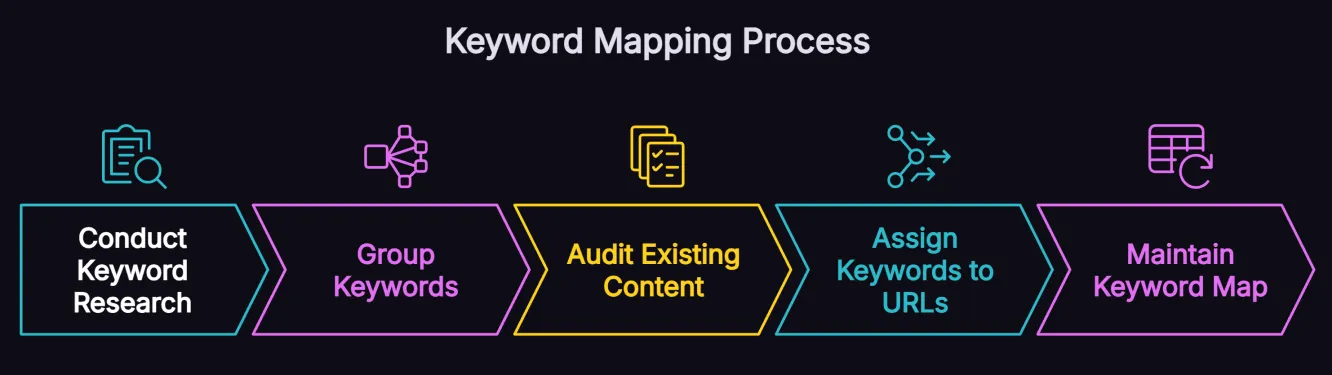
Follow this systematic five-step process to build a keyword map that eliminates cannibalisation and maximises ranking potential.
Keyword Mapping in Action: A Rankmax Example
To make the process concrete, here's how we ran it for the B2C compensation claims engagement we mentioned at the top of this guide.
The starting position was unfavourable. The client held 2.4% organic search visibility in their sector, with a single-page website ranking for one keyword: their business name. Their competitors owned thousands of high-intent searches for terms like "DVA compensation claims", "permanent impairment claims" and "veterans mental health claims". The reliance on paid advertising was consuming the majority of their marketing budget.
- Step 1: Produced a list of seed terms anchored on the specific claim categories the client served. we expanded these into the long tail, deliberately ignoring the head terms our competitors had locked down.
- Step 2: Produced clusters built around claim types and stage-of-claim queries. we did not cluster by raw search volume. Across our client work, the pattern that has held consistently is the one we observed on this engagement: competitors were all fighting over the same high-volume terms while ignoring hundreds of specific, high-intent queries. Clustering by intent and commercial value, not search volume, is what surfaced the opportunity.
- Step 3: Was straightforward because there was almost nothing to audit on the existing site.
- Step 4: Was the leverage point. Terms like "PTSD compensation claims" and "permanent impairment claims" had stronger commercial intent due to search specificity, despite lower volume than generic "compensation claims" searches. The keyword difficulty across our final target list averaged just 3.64. That difficulty score was the green light to invest in content quality rather than expensive link-building campaigns we couldn't justify on the budget.
- Step 5: Ran continuously. we maintained the map across the engagement, updating intent classifications as search behaviour shifted with the rollout of AI Overviews.
The outcome of running this process honestly: organic keyword positions grew from 15 to 1,102 in 16 months. Top-three positions reached 96. AI citations across Google AI Overviews, ChatGPT, Gemini and Copilot reached 65. The full numbers are in the B2C AI SEO case study.
Detecting and Fixing Keyword Cannibalisation
Even with careful mapping, cannibalisation issues emerge over time as sites grow and content accumulates. Proactive detection prevents ranking deterioration.
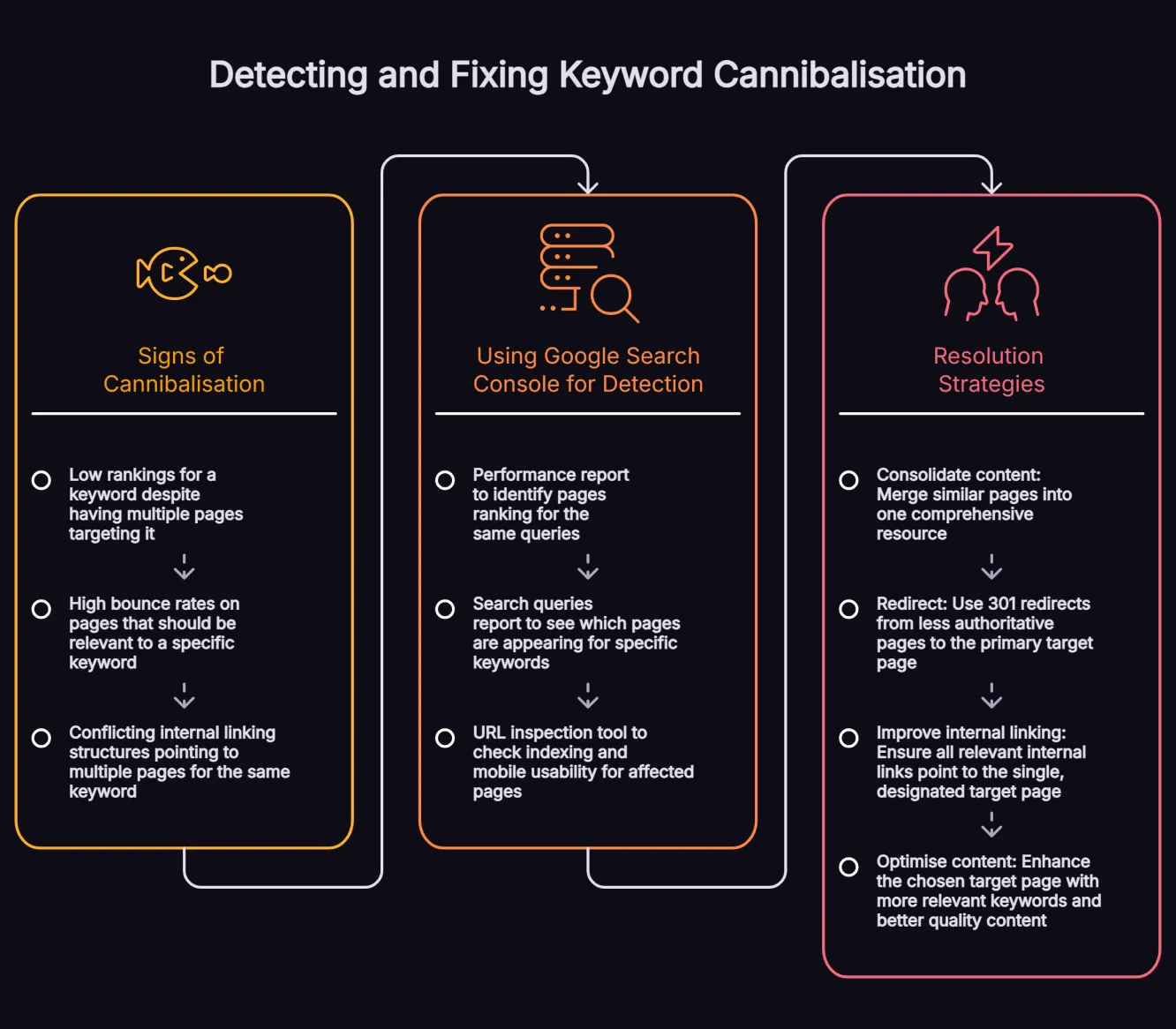
Signs of Cannibalisation
Watch for these indicators that multiple pages compete for the same keywords:
- Ranking positions fluctuate frequently for target keywords
- Different URLs appear in search results for the same query at different times
- Traffic splits between multiple pages on related topics
- Rankings plateau despite optimisation efforts
Using Google Search Console for Detection
Google Search Console reveals cannibalisation through the Performance report. Filter by a specific query and check which pages receive impressions. If multiple URLs appear for the same query, you may have cannibalisation.
The site search operator (site:yourdomain.com [keyword]) was historically the quick check for this, but in 2026 we'd treat it as a backup signal at best. Google has limited the reliability of site: results for ranked-order analysis, and the index sample it returns is not representative of what users actually see. The GSC Performance report filter is the cleaner detection method now because it shows the queries actually triggering impressions for each URL.
Resolution Strategies
Once you identify cannibalisation, several solutions exist:
- Content Consolidation: Merge competing pages into a single comprehensive resource. 301 redirect the eliminated URL to the consolidated page to preserve any backlink value.
- Intent Differentiation: Modify competing pages to target different intents. One page might focus on informational queries while another targets commercial investigation.
- Canonical Tags: Tell search engines which URL should be considered the primary version when similar content exists across multiple pages.
- Strategic Redirects: Eliminate weaker pages by 301 redirecting them to stronger alternatives. This consolidates ranking signals and removes the competition from inside your own site.
Keyword cannibalisation splits your ranking authority. Proper mapping consolidates pages to maximise search visibility.
Tools for Effective Keyword Mapping
Several tools streamline the keyword mapping process, from research through implementation.
Free Options
- Google Search Console: Provides actual keyword data for your site, showing which queries drive impressions and clicks. This data reveals your current keyword landscape and cannibalisation issues.
- Google Keyword Planner: Offers search volume estimates and keyword suggestions, though it's designed for paid advertising and groups volume ranges broadly.
- Google Sheets: Serves as a capable keyword map repository. Templates from various SEO resources provide starting structures you can customise.
Professional Tools
- Ahrefs Keywords Explorer: Delivers comprehensive keyword research with accurate difficulty scores, search volume data and SERP analysis. Its Content Gap tool identifies keywords that competitors rank for that you don't.
- Semrush Keyword Strategy Builder: Combines research with clustering capabilities, grouping related keywords automatically based on semantic relationships.
- Keyword Insights: Specialises in clustering keywords by SERP similarity and intent classification, reducing manual grouping time significantly.
AI-Powered Approaches
AI tools increasingly support keyword mapping by automating research, clustering and intent classification. They connect to keyword databases and produce organised outputs faster than manual methods.
That said, AI-generated maps still need human review. Strategic alignment with business goals, nuance around competitive positioning and intent calls on edge cases are all things automated systems get wrong with confidence. Treat the AI output as a draft, not a deliverable.
Advanced Keyword Mapping Strategies
Basic keyword mapping ensures coverage. Advanced strategies maximise competitive advantage.
Topical Authority Mapping
Beyond individual keywords, map entire topics to establish topical authority. This involves creating content clusters that comprehensively cover a subject area, signalling expertise to search engines.
A topical authority map identifies:
- Pillar content targeting broad topic keywords
- Supporting cluster content addressing specific aspects
- Internal linking structures connecting related content
- Content gaps within your topic coverage
This approach has hard evidence behind it. The 2024 leak of internal Google Search algorithm documentation confirmed that topical authority is a ranking factor, with pages demonstrating expertise across related topic clusters receiving ranking advantages over isolated pages on the same subject. our AI SEO strategy for clients always begins with a topical authority audit, identifying the topics where a client can realistically become the most comprehensive resource, and building the content roadmap to get there.
AI Search Optimisation Integration
Traditional keyword mapping focuses on Google search results. But Ahrefs’ September 2025 analysis of 146 million desktop SERPs found that AI Overviews appeared on 20.5% of all SERPs, with much higher rates for question-led, informational and longer queries. That means your keyword map now needs to factor in AI search visibility, not just blue-link rankings.
Here's the structural shift most mapping guides miss. Traditional SEO was built around a simple model: one keyword, one page, one target ranking. That model no longer reflects how AI search actually retrieves information. When a user types a question into Google AI Mode, ChatGPT or Perplexity, the AI doesn't stop at the exact words. It typically splits the query into roughly 5 to 11 related sub-queries, retrieves content for each in parallel and then synthesises a single answer. we call this query fan-out, and it changes what you're mapping for.
In a query fan-out world, your map needs to cover the parent query and the likely sub-queries the AI will generate against it. AI search platforms favour:
- Clear, factual statements that answer specific sub-questions directly
- Content structured with explicit question-and-answer formats
- Authoritative sources with demonstrated expertise
- Passages that can be extracted and cited independently of the surrounding article
Practically, that means each cluster in your map should have a list of associated sub-queries the AI is likely to fan out into, and your content for that cluster should answer each sub-query in a self-contained passage.
On timing: when content is structured this way from the start, our experience across recent campaigns is that pages typically appear in traditional search results within 60 days and start being cited by ChatGPT and other AI platforms within 90 days. Mapping is the upstream lever that makes that possible.
Competitive Keyword Gap Analysis
Your keyword map should include competitor intelligence. Identify valuable keywords where competitors rank but you don't, then add these to your map as opportunities.
Gap analysis reveals:
- Keywords within your competitive reach based on domain authority
- Content topics competitors cover that you've missed
- Market positioning opportunities through underserved keywords
- Prioritisation data based on competitor traffic estimates
Regular gap analysis keeps your map current with market dynamics and prevents competitors from establishing unchallenged positions in clusters you should own.
Common Keyword Mapping Mistakes to Avoid
After running keyword audits across dozens of campaigns, the same mapping errors keep showing up. Here are the five worth flagging.
1. Ignoring Search Intent Alignment
Assigning keywords to pages without verifying intent match creates content that won't rank effectively. Always analyse current search results to confirm your planned content format aligns with what Google rewards for that query.
2. Targeting Identical Keywords Across Multiple Pages
Each page needs a distinct primary keyword targeting. Overlap creates cannibalisation, even when secondary keywords naturally appear across related content. Your map should make primary assignments clear and unique.
3. Focusing Exclusively on High-Volume Keywords
This is the mistake that costs the most. High-volume keywords attract attention but often carry high difficulty and lower conversion rates. Across our client engagements, the consistent pattern is that competitors are all fighting over the same high-volume terms while ignoring hundreds of specific, high-intent queries that convert at higher rates and rank far more easily. A balanced keyword map includes long-tail terms with clear purchase intent alongside broader awareness keywords. Cluster by intent and commercial value, not by volume alone.
4. Neglecting Regular Updates
Keyword landscapes shift constantly. Monthly reviews:
- Identify new opportunities
- Detect emerging cannibalisation
- Ensure your map reflects current search behaviour, including AI search trigger patterns
5. Creating Content Without Checking the Map
Every new content piece should start with a keyword map check:
- Does this topic already have an assigned URL?
- Would this content cannibalise existing pages?
- What primary keyword should it target?
The map answers these questions before content creation begins. Skipping the check is how internal cannibalisation gets seeded into a site over a 12-month content calendar.
Frequently Asked Questions
Can I target the same keyword on multiple pages?
Targeting the same primary keyword across multiple pages typically creates cannibalisation, where your pages compete against each other. However, the same secondary keywords can naturally appear across related content without issues. The key distinction is primary versus secondary targeting. Each page should have one unique primary keyword, but related terms will logically appear in supporting content about similar topics. If you must cover the same topic across multiple pages, ensure each page targets a different search intent.
How often should we update our keyword map?
Review your keyword map monthly at a minimum. Search behaviour changes, new keywords emerge and your content library grows. Monthly reviews identify new cannibalisation issues, reveal content gaps and ensure your map reflects current search data. More frequent updates make sense during active content campaigns or after significant website changes. Many businesses also conduct quarterly deep reviews that reassess the entire map against the current competitive landscape.
What is the difference between keyword mapping and keyword research?
Keyword research identifies valuable search terms worth targeting. Keyword mapping takes those researched terms and assigns them to specific URLs on your website. Research comes first, gathering data on search volumes, difficulty and intent. Mapping follows, creating the strategic plan for which pages target which terms. Both processes work together, but research focuses on discovery while mapping focuses on organisation and assignment.
Your Keyword Map Is Your AI SEO Roadmap
A clear keyword map turns scattered research into an accountable publishing system. With each URL owning specific opportunities, content planning gets simpler, budgets go further and rankings build on each other instead of competing.
About the Author
Want Insights Like This Fortnightly?

Our AI SEO strategies and tactics delivered fortnightly, including bonus trade secrets not shared anywhere else. No fluff. Just what's working right now. 5-minute read.


