
AI SEO vs Traditional SEO Explained: Why You Need Both to Dominate Search

Your SEO strategy that worked in 2019 is leaving money on the table in 2026. Google's global search share has dipped below 90% for the first time since 2015, while AI platforms like ChatGPT now process 800 million weekly queries. Understanding AI SEO vs traditional SEO is no longer optional - it's the difference between capturing tomorrow's customers and watching competitors take them. This guide breaks down exactly how these approaches differ, where they overlap, and how to build a strategy that dominates both ecosystems. Here's what's working right now based on real client results.
AI SEO vs Traditional SEO: A Quick Guide
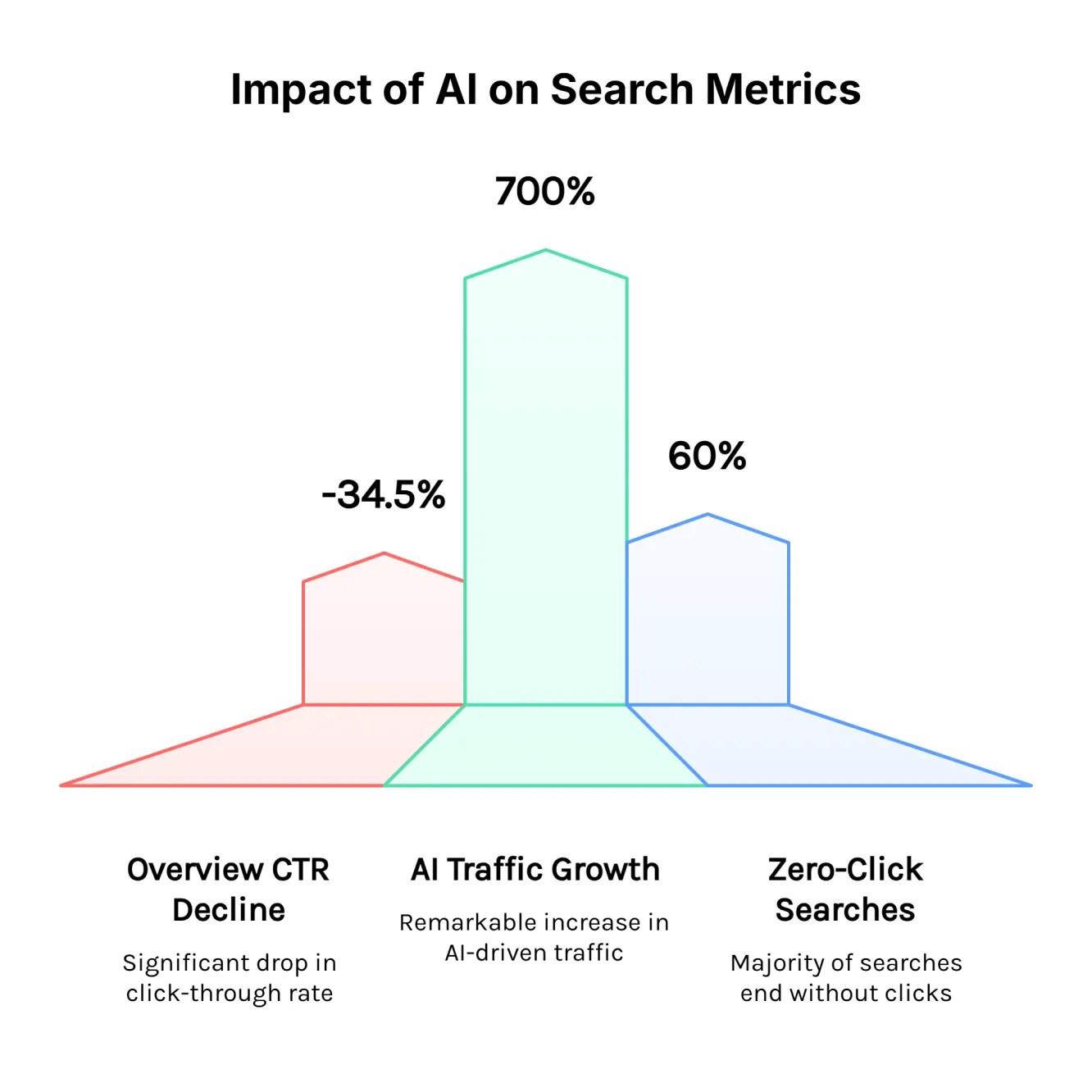
AI SEO vs traditional SEO represents two complementary approaches to search visibility. Traditional SEO optimises content to rank in Google's blue links through keywords, backlinks and technical excellence. AI SEO optimises for citations in ChatGPT, Perplexity, Google AI Overviews and other AI-powered platforms. AI Overviews reduce clicks to traditional results by 34.5% when they appear - but they only show on around 21% of searches. You need visibility in both: AI citations for queries where Overviews trigger, and strong rankings for the 80% where they don't.
Ready to Dominate Both Search Ecosystems?
Book a 45-minute discovery session with me to review your current organic search position and identify the exact steps needed to optimise for both traditional search and AI platforms. We'll analyse your current visibility and map out your path to dominating both ecosystems in your market.
Speak with the FounderWhat Traditional SEO Actually Involves
Traditional SEO has been the foundation of organic growth for over two decades. It focuses on helping search engines understand, crawl and rank your content so users find you when they search on Google or Bing.
The Core Elements of Traditional SEO
Traditional search engine optimisation relies on several interconnected practices that signal relevance and authority to search engines.
- Keyword research identifies the specific terms your target audience searches for. This involves analysing search volumes, competition levels and user intent to prioritise the terms most likely to drive qualified traffic.
- On-page optimisation structures your content so search engines understand what each page covers. This includes optimising title tags, meta descriptions, header hierarchies, image alt text and internal linking.
- Technical SEO ensures search engines can properly crawl and index your site. Core Web Vitals, mobile responsiveness, site speed and clean URL structures all contribute to how well your pages perform in rankings.
- Link building establishes your site's authority through external endorsements. Quality backlinks from reputable sites signal to Google that your content deserves higher rankings.
Why Traditional SEO Still Delivers Results
Despite the rise of AI search, traditional SEO remains important for several reasons.
- Google still processes over 16.4 billion searches daily, making it the largest source of organic traffic. While AI platforms are growing, traditional search still drives the majority of commercial intent queries.
- Research confirms that 76.1% of URLs cited in AI Overviews also rank in Google's top 10. Strong traditional rankings provide the foundation that AI systems use when selecting sources to cite.
Our SaaS SEO case study demonstrates how traditional SEO fundamentals, technical excellence, comprehensive content and strategic link building delivered $1.31M in revenue within 12 months.
What AI SEO Means for Modern Businesses
AI SEO represents the evolution of search optimisation for a world where users increasingly get answers directly from AI systems rather than clicking through to websites.
How AI Search Differs From Traditional Search
The fundamental difference lies in how users interact with each system and what they expect in return.
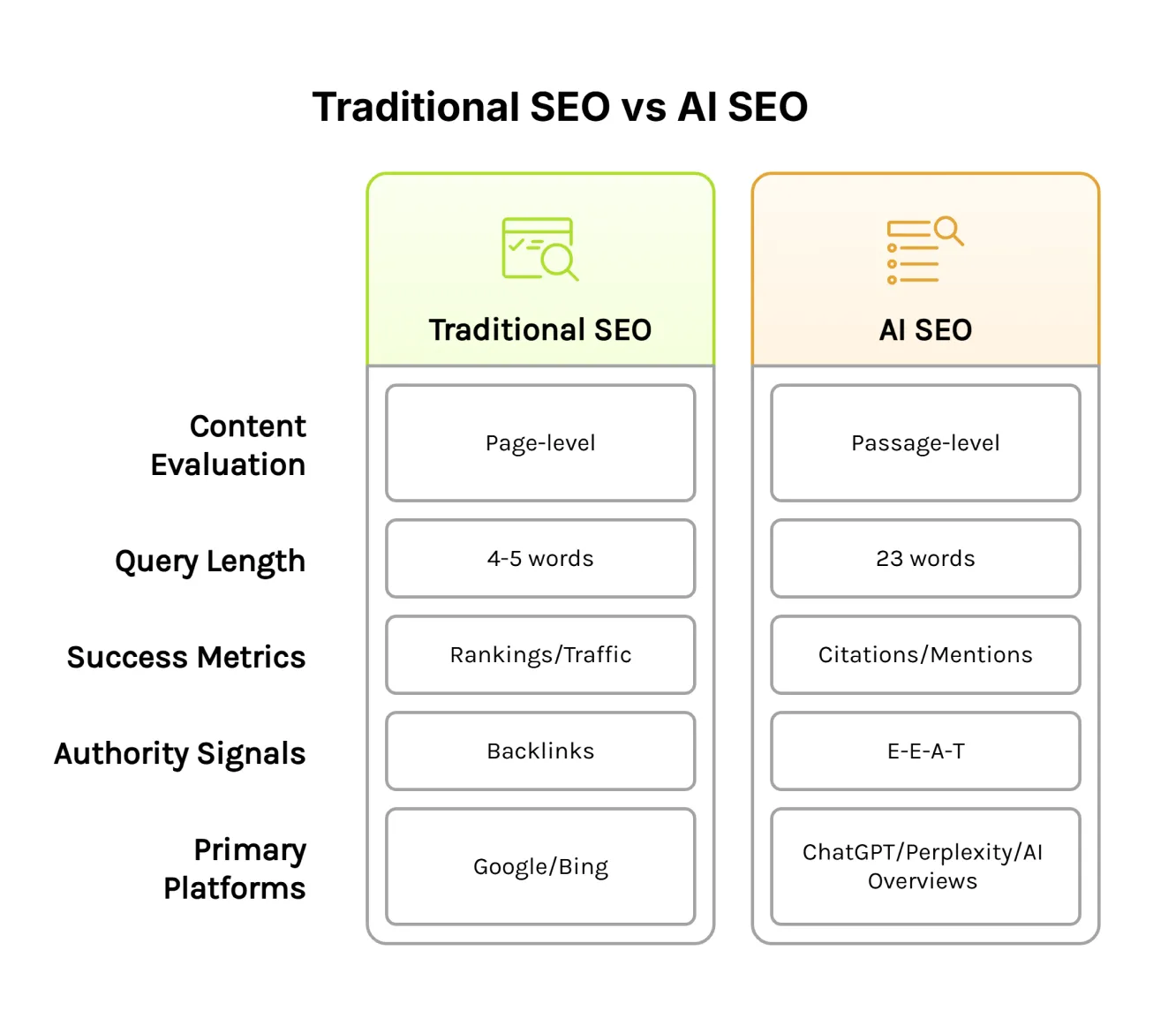
- Traditional search queries average 4-5 words, short keyword phrases like "best CRM software" or "SEO agency Melbourne". Users scan a list of results and click through to find their answer.
- AI search queries average 23 words, conversational questions like "What's the best CRM software for a B2B SaaS company with 50 employees that integrates with HubSpot?" Users receive a synthesised answer directly without needing to visit multiple websites.
This shift means 70% of ChatGPT prompts are unique queries that rarely appear in traditional search. Your content needs to answer questions users haven't even asked on Google yet.
The AI Platforms That Matter for SEO
Several AI platforms now influence how potential customers discover your business.
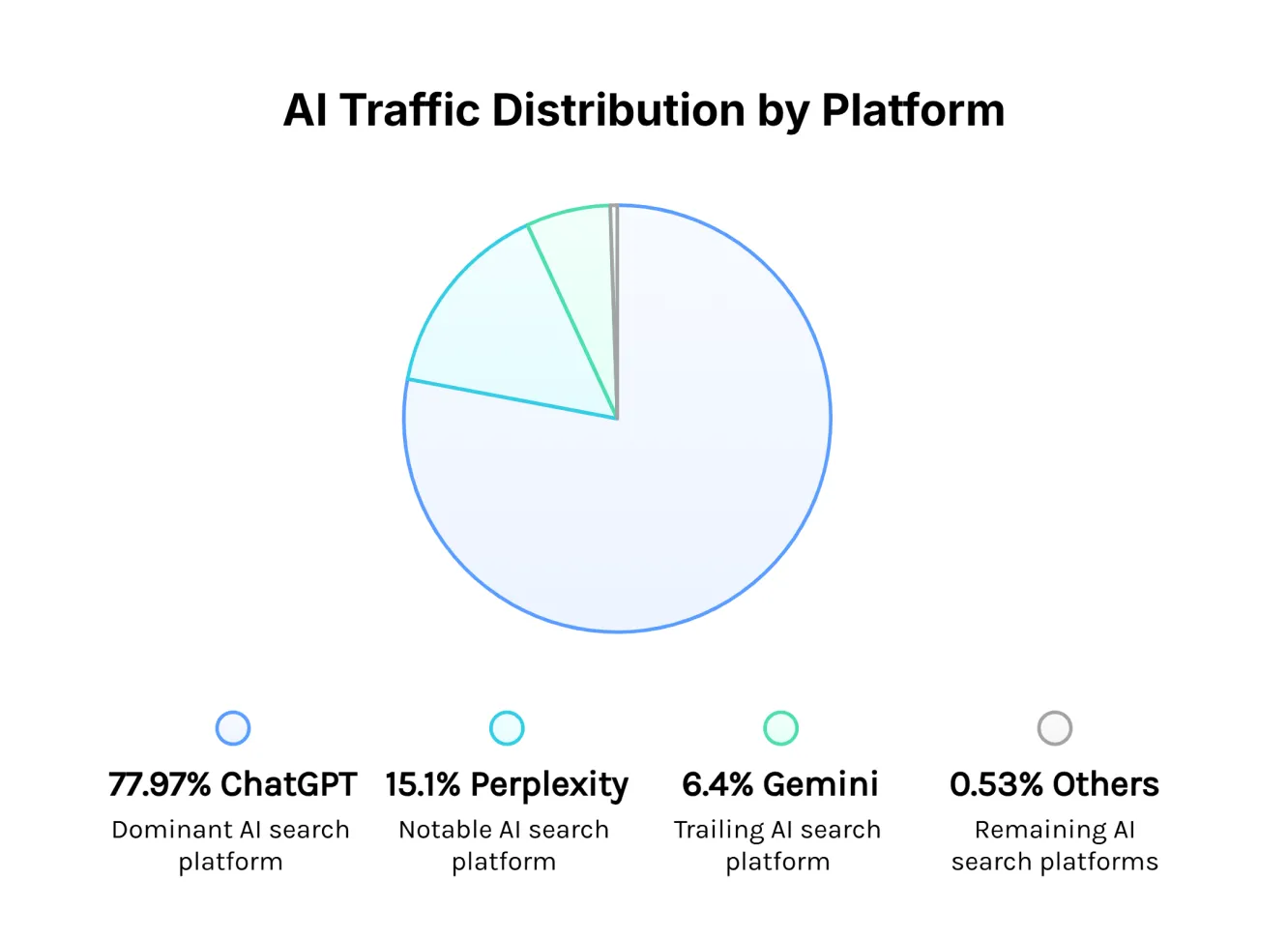
- ChatGPT dominates the AI search landscape with 77.97% of all AI-driven traffic. With 800 million weekly users, it's become a primary research tool for business decisions.
- Google AI Overviews appear on 21% of all searches as of November 2025, up from 6.49% in January. These AI-generated summaries sit above traditional results and capture attention before users even see the blue links.
- Perplexity AI handles 780 million monthly queries and accounts for 15.1% of AI traffic. Its citation-heavy approach makes it particularly valuable for B2B businesses building thought leadership.
Understanding how AI search works is essential for developing an effective optimisation strategy.
Key Differences Between AI SEO and Traditional SEO
The approaches share common foundations but differ significantly in their execution and measurement.
Content Optimisation Approaches
- Traditional SEO (before 2020) evaluates content at the page level. Your entire page needs to demonstrate relevance to rank for target keywords.
- AI SEO and Google after 2020 evaluates content at the passage level. AI systems extract specific paragraphs or sentences for their responses, so every section of your content needs to stand alone as a complete, citable answer.
This difference changes how you structure content. Instead of building toward a conclusion, each section should provide immediate value that an AI can extract and quote independently.
Keyword Strategy Differences
- Traditional SEO targets specific keyword phrases with exact match optimisation. You create separate pages for each keyword variation to capture different search intents.
- AI SEO targets semantic topics and conversational variations. AI systems understand context and synonyms, so your content needs comprehensive topic coverage rather than keyword repetition.
Websites with complete topic coverage rank for 2-3 times more keywords than those targeting isolated terms.
Authority and Trust Signals
- Traditional SEO builds authority through backlinks, domain age and consistent publishing. Google's algorithms assess these signals to determine ranking positions.
- AI SEO prioritises E-E-A-T signals more heavily. Experience, Expertise, Authoritativeness and Trustworthiness determine whether AI systems confidently cite your content as a reliable source.
This means author credentials, factual accuracy, citations to authoritative sources and demonstrable expertise all influence AI visibility more directly than traditional rankings.
Success Metrics
- Traditional SEO measures rankings, organic traffic, click-through rates and conversions from search.
- AI SEO measures citations, brand mentions, share of voice in AI responses and conversion quality from AI referrals.
- ChatGPT users click through to external websites twice as often as Google users: 1.4 links per visit versus 0.6, indicating higher-intent traffic.
How to Optimise for AI Search Platforms
Building visibility in AI search requires adapting your content strategy to how these systems process and cite information.
1. Structure Content for AI Extraction
AI systems prefer content that's easy to parse and quote. This means using clear headings, direct answers and well-organised information architecture.
- Start each section with a direct statement that answers the implied question. If your heading is "What is AI SEO?", your first sentence should immediately define it rather than building up to the answer.
- Use schema markup to help AI systems understand your content structure. FAQ schema, HowTo schema and Article schema all provide machine-readable context that improves citation likelihood.
- Break complex topics into digestible sections. AI systems extract passages of 2-3 sentences for citations, so ensure each paragraph can stand alone as a complete thought.
2. Build Topical Authority
AI systems favour sources that demonstrate comprehensive expertise on a topic. Building topical authority requires covering your subject matter thoroughly across multiple interconnected pieces of content.
- Create content clusters around your core topics. A pillar page covering AI SEO comprehensively, supported by detailed articles on specific aspects, signals expertise to AI systems.
- Include original data, research and case studies. AI systems prioritise unique insights over recycled information. This is why we document detailed performance metrics in our case studies - original data gives AI platforms something they can't find elsewhere.
- Update content regularly with current statistics and developments. AI platforms favour recent, accurate information and may deprioritise outdated content.
3. Optimise for Each Platform's Preferences
Different AI platforms cite various sources, requiring platform-specific approaches.
- ChatGPT favours business and service sites, which account for 50% of all citations. Comprehensive service pages and detailed how-to content perform well.
- Google AI Overviews prefer sources that already rank in the top 10, with 76.1% of citations coming from top-ranking pages. Strong traditional SEO remains the foundation for AI Overview visibility.
- Perplexity heavily cites community-generated content, with 46.7% of top citations coming from Reddit. Active participation in relevant online communities can boost Perplexity's visibility.
Integrating AI SEO With Your Existing Strategy
The most effective approach combines traditional and AI optimisation rather than treating them as separate disciplines.
1. Start With Strong Traditional Foundations
AI visibility builds on traditional SEO fundamentals. Technical excellence, quality content and domain authority all influence how AI systems perceive your credibility.
- Audit your current technical SEO to ensure AI crawlers can access your content. Update robots.txt to allow GPTBot, ClaudeBot and PerplexityBot access. Maintain fast page speeds and mobile-friendly designs.
- Review your existing high-performing content for AI optimisation opportunities. Pages ranking well in traditional search often need only structural improvements to earn AI citations.
2. Layer AI-Specific Optimisation
Once your traditional foundation is solid, add AI-specific enhancements to maximise visibility across both ecosystems.
- Reformat existing content with standalone, citable passages. Add FAQ sections that directly answer common questions. Include statistics with clear attribution that AI systems can confidently quote.
- Build out content that addresses conversational queries, the longer, more specific questions users ask AI but not search engines. These represent untapped opportunities competitors haven't discovered.
- Create content for different stages of the AI-assisted buyer journey. AI search visitors convert at higher rates because they're often further along in their research process.
3. Measure What Matters
Track both traditional and AI metrics to understand full-funnel performance.
- Monitor brand mentions in AI responses using tools like Ahrefs' Brand Radar. Check how often your content appears when users ask relevant questions.
- Track referral traffic from AI platforms in Google Analytics. While volumes are currently small, AI traffic grew 7x between 2024 and 2025, and engagement metrics from AI referrals typically exceed traditional search.
- Measure citation context: are you being mentioned as "one option" or recommended as "the best"? The quality of AI mentions matters as much as quantity.
The Business Case for Investing in Both Approaches
Companies that optimise for both ecosystems capture opportunities competitors miss entirely.
Current Market Reality
Search behaviour is fragmenting. 24% of Americans now choose ChatGPT before Google when searching for information. This percentage skews higher among younger demographics and B2B decision-makers.
AI Overviews reduce clicks to traditional results by 34.5% on average, with some categories seeing 70% drops. If you're only optimising for blue links, you're missing visibility where attention is shifting.
60% of searches now end without a click as users get answers directly from AI summaries. Being cited in those summaries is increasingly necessary to maintain brand visibility.
The Revenue Opportunity
Our eCommerce AI SEO case study demonstrates what's possible when you optimise for both ecosystems. The client achieved $968K in additional revenue within 8 months by combining traditional ranking improvements with AI citation strategies.
AI SEO delivers up to 4.4x higher conversions than traditional SEO alone. AI visitors arrive with higher intent because they've already received contextual information about your solution.
Early movers have significant advantages. Most competitors haven't begun AI optimisation, creating a window to establish authority before the market matures.
Common Mistakes to Avoid
Several approaches that work for traditional SEO can actually harm AI visibility.
1. Over-Optimising for Keywords
Keyword stuffing has always been problematic, but AI systems are particularly sensitive to unnatural language. Write for humans first; AI systems are trained to recognise and prefer natural, conversational content.
Focus on semantic coverage rather than keyword density. Cover related concepts, answer adjacent questions and provide comprehensive context rather than repeating target phrases.
2. Neglecting Content Quality for Quantity
Thin content that barely addresses a topic won't earn AI citations regardless of how well it ranks traditionally. AI systems evaluate whether your content actually answers the question fully.
One comprehensive guide outperforms 20 shallow articles for AI visibility. Depth, accuracy and unique insights matter more than publishing frequency.
3. Ignoring Technical AI Requirements
AI crawlers have different requirements than traditional search engine bots. Blocking AI crawlers prevents your content from being indexed by these platforms entirely.
Ensure your robots.txt allows access for GPTBot (ChatGPT), ClaudeBot (Claude), and PerplexityBot (Perplexity). Test that your pages render correctly for AI systems.
4. Treating AI SEO as a One-Time Project
AI platforms update their models and citation preferences regularly. What works today may need adjustment as these systems evolve.
Build AI optimisation into your ongoing content processes rather than treating it as a one-time implementation. Regular monitoring and iteration are essential.
Frequently Asked Questions
Do I need different content for AI SEO vs traditional SEO?
You don't necessarily need entirely different content for AI SEO and traditional SEO. The same content can perform well in both ecosystems when properly optimised. The key is structuring content with standalone, citable passages that answer questions directly while maintaining the depth and keyword relevance needed for traditional rankings. Focus on comprehensive, well-structured content that serves both purposes.
How do I know if my content is being cited by AI platforms?
You can track AI citations through several methods. Tools like Ahrefs' Brand Radar monitor brand mentions across AI platforms. You can also manually test by asking relevant questions on ChatGPT, Perplexity and Claude to see if your content appears. Google Analytics can track referral traffic from AI platforms to measure direct visits. Regular monitoring helps you understand which content earns citations and refine your approach.
How long does it take to see results from AI SEO?
AI SEO results can appear faster than traditional SEO in some cases. Brand mentions and citations can shift within weeks as you publish optimised content. However, building substantial AI visibility typically requires 3-6 months of consistent effort. Our AI SEO clients typically begin seeing measurable AI citations within 90-120 days, with significant revenue impact by month 6-9.
Is traditional SEO dead?
Traditional SEO is not dead - it's evolving. Google still processes over 16.4 billion searches daily, making traditional rankings valuable for organic traffic. However, traditional SEO alone is increasingly insufficient as AI platforms capture more search activity. The most effective strategy combines traditional optimisation with AI-specific approaches to maintain visibility across all search ecosystems.
What's the difference between AI SEO and Generative Engine Optimisation?
AI SEO and Generative Engine Optimisation (GEO) refer to the same practice - optimising content for visibility in AI-powered search platforms like ChatGPT, Perplexity and Google AI Overviews. GEO is the more technical term used in the industry, while AI SEO is more commonly understood by marketers. Both involve structuring content for AI extraction, building E-E-A-T signals and earning citations in AI-generated responses.
Should I stop investing in traditional SEO and focus only on AI SEO?
You should not abandon traditional SEO for AI SEO. Research shows that 76.1% of URLs cited in AI Overviews also rank in Google's top 10, meaning traditional rankings directly influence AI visibility. Strong technical SEO, quality content and domain authority all contribute to how AI systems evaluate your credibility. The recommended approach is optimising for both ecosystems simultaneously.
Your Next Steps Toward AI-Ready SEO
Search has shifted: traditional SEO still matters, but as AI platforms drive discovery, only brands optimising for both ecosystems will capture what competitors miss. Audit your content for AI citation potential, ensure approved AI crawlers can access your site, and structure standalone, citable passages. Then expand comprehensive topical coverage to demonstrate genuine expertise and connect it with clean internal links. Book a 45-minute discovery call to prioritise quick wins and map your next steps.
About the Author
Want Insights Like This Fortnightly?

Our AI SEO strategies and tactics delivered fortnightly, including bonus trade secrets not shared anywhere else. No fluff. Just what's working right now. 5-minute read.


