
Passage Optimisation: The Section-Level Structure That Earned One Client 54 AI Overview Citations

Your content might hold the perfect answer to a searcher's question, but if it sits buried in a wall of text, neither Google nor an AI assistant will surface it. Passage optimisation is the practice of structuring your content so search engines and large language models can extract, understand and cite specific sections as standalone answers. Google introduced passage ranking to its core algorithm in 2020, well before ChatGPT and AI Overviews existed, and said it would improve 7 percent of search queries globally. Now that AI search fans a single question out into many sub-queries and answers each from the best passage it can find, passage optimisation has moved from a nice-to-have to the mechanic that decides whether you get cited at all. This guide shows how we structure content at the passage level for both traditional search and AI platforms, and the proof points from client work that back it up.
A Quick Guide to Passage Optimisation
Passage optimisation means structuring your content so individual sections work as standalone answers, not just the page as a whole. A clear heading hierarchy, self-contained paragraphs and precise, liftable language let Google and AI assistants extract and cite the exact passage that answers a query, wherever it sits on the page. That section-level structure is what earns citations in AI Overviews, ChatGPT and Perplexity, and it is what this guide walks through.
Content That Drives Revenue, Not Just Traffic
We build content that ranks in Google, earns AI citations and generates pipeline. Same structure we use on client programmes, not pageview bait.
See Our Content Marketing ApproachWhat Is Passage Optimisation and Why It Matters in 2026
Passage optimisation is the practice of structuring individual sections of a page so search engines and AI systems can identify, extract and rank them independently of the whole page. Rather than judging only page-level relevance, Google and every major AI assistant now evaluate content at the passage level and surface the specific section that best answers a query. Done well, one clear, self-contained passage can be cited even when the rest of the page covers other ground.
The reason this matters more now than it did in 2020 is that the way answers get assembled has changed. When someone asks Google AI Mode, ChatGPT or Perplexity a question, the system rarely matches one page to one query. It breaks the question into related sub-queries, retrieves content for each in parallel, then synthesises a single answer. Your passages are what it retrieves. If a section reads as a complete answer on its own, it can be lifted and quoted. If it depends on the three paragraphs above it for context, it gets passed over.
How Google's Passage Ranking Works
Understanding the mechanics helps you structure content that actually earns the benefit. Google's passage approach differs from traditional page-level ranking in one important way: it can reward a single strong section inside an otherwise broad page.
The Technical Foundation
When Google crawls your page it still indexes the entire document. Its systems then also assess individual passages to understand their standalone relevance. Google described the breakthrough as being able to find the "needle-in-a-haystack information you're looking for", because the single sentence that answers a very specific search is often buried deep in a longer page. Google's own documentation on its ranking systems confirms passage ranking uses AI to identify sections of a page and assess their relevance to a search.
This does not mean Google indexes passages separately from pages. It treats passage relevance as an additional signal alongside the traditional ones:
- Page authority
- Backlinks
- Overall content quality
A page with strong authority and one highly relevant passage can rank for a specific query even against pages narrowly focused on that topic.
What Passage Ranking Means for Your Rankings
The practical impact varies by content type and query intent:
- Long-form content with multiple subtopics gains the most: A comprehensive guide covering ten aspects of a topic can rank for specific questions about any of them, not just the primary topic. This rewards genuine depth over thin, siloed pages.
- Pages with weak structure but valuable information also benefit: Google built passage ranking partly to surface answers stranded in poorly organised pages. That is not a licence to write badly. Well-structured content with clear passages still outperforms disorganised alternatives.
- Highly specific, long-tail queries see the biggest effect: Passage ranking was designed for very specific searches where the exact answer might be a single sentence. If your content thoroughly covers a topic and answers niche questions directly, those passages can surface for relevant searches.
How Query Fan-Out Made Passages the Unit of Retrieval
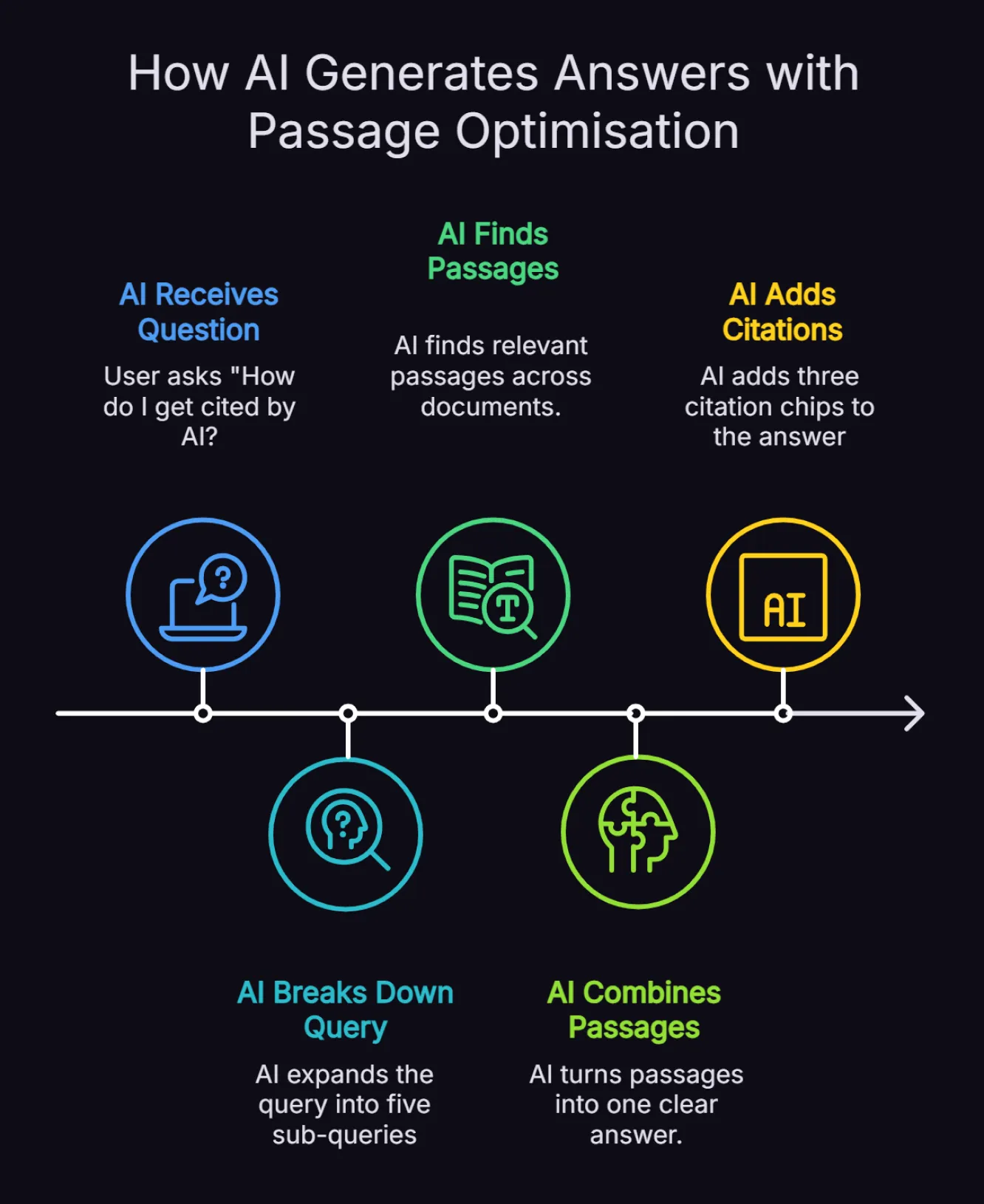
The single biggest reason passage optimisation matters in AI search is a technique called query fan-out. Instead of searching for a direct match to your exact words, AI systems expand your question into a set of related sub-queries, retrieve content for each at the same time, then assemble one answer. Our guide to query fan-out covers the full mechanism, but the part that matters here is what it does to the unit of competition.
In traditional search Google evaluates your whole page against a query. With query fan-out the evaluation happens at the passage level. A single paragraph from a mid-ranking page can beat a comprehensive guide if that paragraph answers a specific sub-query more directly. Google's Head of Search, Elizabeth Reid, confirmed at Google I/O 2025 that AI Mode divides a question into subtopics and issues multiple queries simultaneously, and Google's own Search Central documentation confirms both AI Overviews and AI Mode may use this technique to develop a response.
Two consequences follow, and they reframe the whole job:
- Ranking first for the head term no longer guarantees the citation: The sources that appear in an AI answer are the ones that best answered the hidden sub-queries, which are frequently not the pages ranking number one for the original query.
- You are competing across a topic landscape, not a single keyword: Covering the full set of questions a reader has, each with its own answerable passage, is what pulls a page into more answers.
This is why depth and structure now compound. A page that answers fifteen related questions, each in a clean self-contained passage, is eligible for far more sub-queries than a page built around one keyword.
How AI Platforms Retrieve and Cite Your Content
To structure content for AI citation, it helps to know what is happening under the hood. Nearly every major AI assistant runs on some form of retrieval-augmented generation, or RAG, and the mechanics decide what gets pulled in. Our technical guide to how AI search works walks through all five layers; the retrieval stage is the one passage optimisation targets.
Chunking, Embeddings and Retrieval
AI systems do not read a page the way a person does. The pipeline runs roughly like this:
- Chunking: Your content is split into smaller units. Some systems chunk by a fixed size (a set number of tokens or characters); better ones chunk semantically, keeping a whole paragraph or section together as one coherent unit. How your content is chunked decides what can be retrieved as a single answer.
- Embedding: Each chunk is converted into a vector, a numerical representation of its meaning, and stored in a database.
- Retrieval: When a query arrives, the system embeds it too, then finds the chunks whose vectors are most similar in meaning and feeds those passages to the model as grounding for the answer.
The reason structure matters so much is that it maps onto chunking. A clean, self-contained paragraph under a descriptive heading tends to survive chunking as one coherent unit that answers a question. A single idea smeared across five loosely connected sentences gets split awkwardly, and the resulting fragments answer nothing cleanly. As we put it in the how-AI-search-works guide, your pages are the retrieval corpus: if a passage can be retrieved, parsed and quoted cleanly, it can be cited, and if it cannot, the model answers from someone else's content.
Why Structure Determines AI Visibility
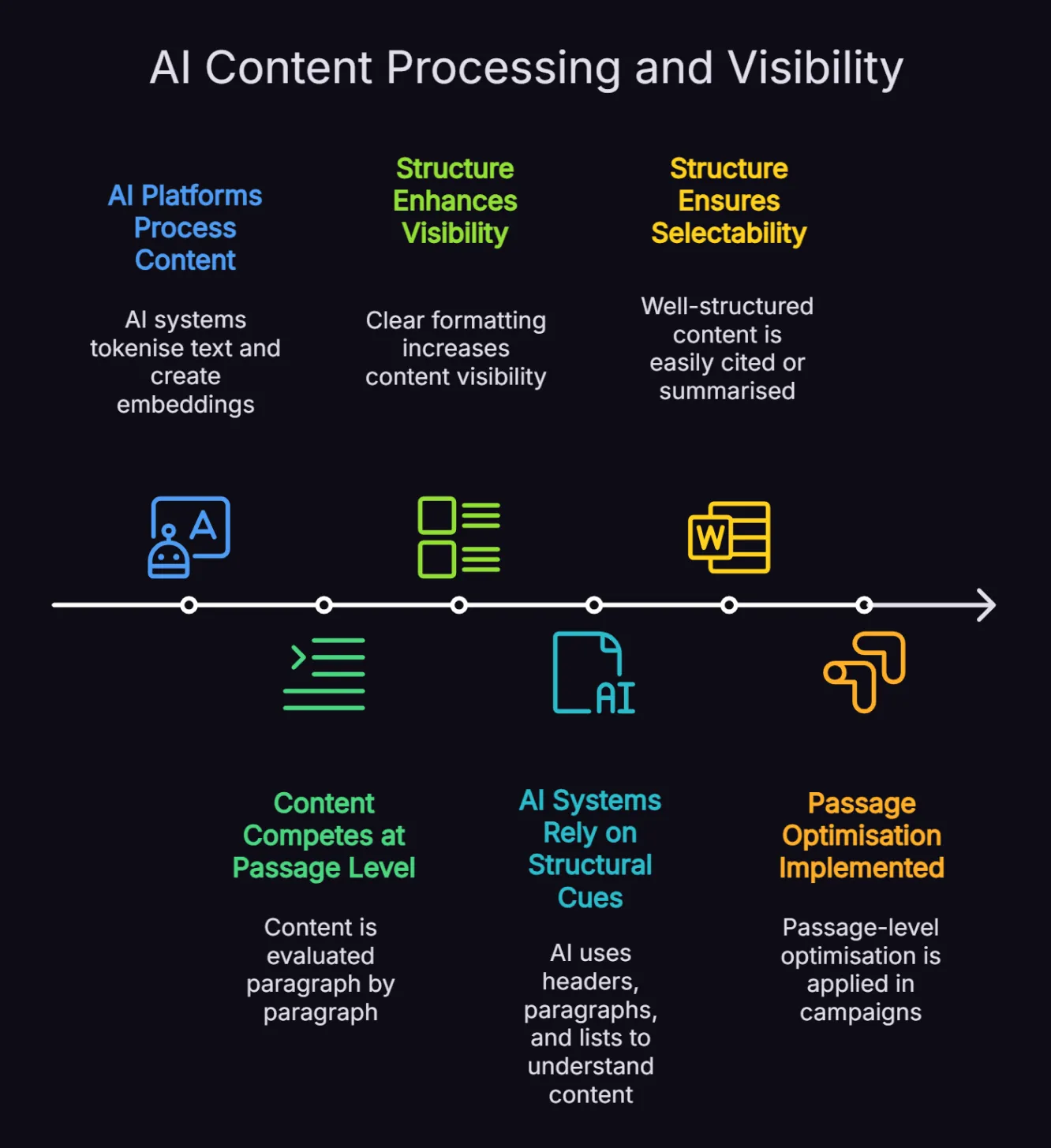
AI systems lean on structural cues to work out how a page is organised and where the answers are. Headings signal topic boundaries. Short paragraphs create distinct units that can be extracted on their own. Lists and tables present information in a form the model can parse reliably. Independent research backs the front-loading instinct: a February 2026 analysis by growth advisor Kevin Indig, covering 1.2 million AI answers and 18,012 verified citations and reported by Search Engine Land, found 44.2 percent of ChatGPT citations came from the first 30 percent of a page, a consistent pattern the study called statistically indisputable. Lead with the answer, then expand.
We have built passage-level structure into every client campaign. In our B2C AI SEO engagement, restructuring a compensation-claims site with semantic HTML and passage-level optimisation helped the client reach $14.6M in organic revenue over 21 months and secure 54 Google AI Overview citations while competitors stayed invisible in AI results.
How Extraction Differs Across AI Platforms
A common mistake is to assume every AI assistant reads content the same way, so you can optimise once and win everywhere. The foundations do overlap, but the retrieval plumbing differs enough to change where your effort goes. The table below summarises how the main surfaces behave and what each rewards.
| Platform | Where it retrieves from | What it rewards at the passage level |
|---|---|---|
| Google AI Overviews | Google's own index, via query fan-out across subtopics | Front-loaded, self-contained answers on indexed pages eligible to show with a snippet |
| Google AI Mode | Google's index, more aggressive fan-out for multi-step research | Topical depth across a full cluster, not just one keyword; only 13.7 percent citation overlap with AI Overviews |
| ChatGPT | Bing's index plus OpenAI's own crawler and index | Clean structure, question-style headings, comparison tables; only about 15 percent of retrieved pages earn a citation |
| Perplexity | Live parallel web searches it shows in the interface | Sub-document passages that directly answer each visible sub-query |
| Microsoft Copilot | Bing's index, through Grounding with Bing Search | Being indexed and ranked in Bing first, then a clear liftable answer high on the page |
The differences are real. Ahrefs found only 13.7 percent citation overlap between Google's own two surfaces, AI Overviews and AI Mode, which is why we treat them as separate targets in our comparison of AI Overviews and AI Mode. ChatGPT leans on the Bing index while building its own, and cites only around 15 percent of the pages it retrieves, a filter we unpack in our ChatGPT SEO guide. Copilot grounds its web answers almost entirely in Bing, so a strong Bing presence is the most direct path to a Copilot citation, as we lay out in our Microsoft Copilot SEO guide.
The reassuring part is that underneath the differences the job is one job. The same well-structured, genuinely useful passage that a person can read and understand is the passage every one of these systems can retrieve and quote. You are not building five strategies. You are building one and pointing it at several surfaces.
How to Implement Passage Optimisation
Effective passage optimisation combines content structure, writing style and clean markup. Each element reinforces the others, and all of it serves the human reader first. You are not writing for a machine. You are writing clearly enough that a machine can follow along.
1. Build a Clear Heading Hierarchy
Your heading structure signals passage boundaries. Use H2s for major sections, H3s for subtopics and H4s for specific details when needed. Each heading should describe what follows so both a scanning reader and an AI system can grasp the organisation without reading every paragraph. Question-style headings work especially well, because AI assistants often treat an H2 as a prompt and the paragraph beneath it as the answer.
2. Write Self-Contained Paragraphs
Each paragraph should make sense read in isolation. Avoid references like "as mentioned above" or "this approach" without saying what you mean, because AI systems extract passages without the surrounding context. Keep each paragraph focused on a single idea, aim for two to four sentences, and start a new one when the topic shifts. That discipline creates natural passage boundaries that line up with how retrieval systems chunk your page.
3. Lead With the Answer
Open each section with a direct, complete answer in the first sentence or two, then expand with the supporting detail and examples. This matches how featured snippets and AI answers select content, and it aligns with the front-loading pattern the citation research above found. The most reliable structure is: a question heading, a direct answer in one or two sentences, then the explanation and any data.
4. Use Lists and Tables for Structured Information
Lists, tables and FAQ blocks give AI systems explicitly structured content they can parse reliably. When you present options, steps or comparisons, format them rather than burying them in prose. Tables are particularly strong for comparisons and specifications, and a genuine FAQ section doubles as a set of clean question-and-answer passages. The comparison table earlier in this guide is a worked example: each row is a self-contained fact an assistant can lift without the paragraphs around it.
5. Reinforce Structure With Clean Semantic HTML
Proper markup makes your structure legible to machines. Use real semantic elements, headings, ordered and unordered lists, tables, and definition lists where they fit, rather than styling ordinary paragraphs to look like headings. Avoid over-complex templates that hide the underlying structure. Structured data adds a further signal about what your content is and how it relates to your organisation, which we cover next.
Where Structured Data Fits
Schema markup is the layer that tells search engines and AI platforms what your content means, who created it and how it connects to your organisation. It does not replace clean passage structure, and it is not a direct ranking factor, but it makes well-structured content easier for machines to interpret and attribute. Our schema SEO guide covers the full framework; a few points matter specifically for extraction.
The evidence that structured data helps AI systems is now on the record. At SMX Munich in March 2025 Microsoft's Principal Product Manager for Bing, Fabrice Canel, stated publicly that schema markup helps Microsoft's large language models understand content. Structured data appears repeatedly in content that AI systems cite, though the relationship is best read as supportive rather than causal: strong pages tend to combine schema, clear authorship, consistent entity signals and well-structured content all at once.
Two cautions keep schema honest:
- Mark up only what is genuinely on the page: FAQ and HowTo schema should be used only when a real FAQ or a genuine step-by-step process is visible to the reader, and the markup must match the on-page text. Google also restricts FAQ rich results largely to authoritative government and health sites, so treat FAQ schema as a machine-readability aid, not a rich-result guarantee.
- Clean structure still matters more: Schema helps a machine understand a page it can already parse. It cannot rescue a wall of undifferentiated text. Structure the passages first, then mark them up.
Common Passage Optimisation Mistakes
Knowing what fails saves time and protects rankings. These are the errors we see most often when we audit content.
1. Writing for Keywords Instead of Answers
Stuffing keywords into a passage without answering the question hurts both rankings and AI visibility. Modern systems use semantic understanding, not keyword matching, and they evaluate whether a passage genuinely answers the query. Focus on comprehensive, specific answers that show you did the work. The citation research is blunt on what earns the pull: heavily cited passages averaged 20.6 percent proper nouns against the 5 to 8 percent of typical text, because named tools, brands and specifics anchor an answer and reduce ambiguity. Vagueness gets skipped.
2. Writing Long Paragraphs With No Structure
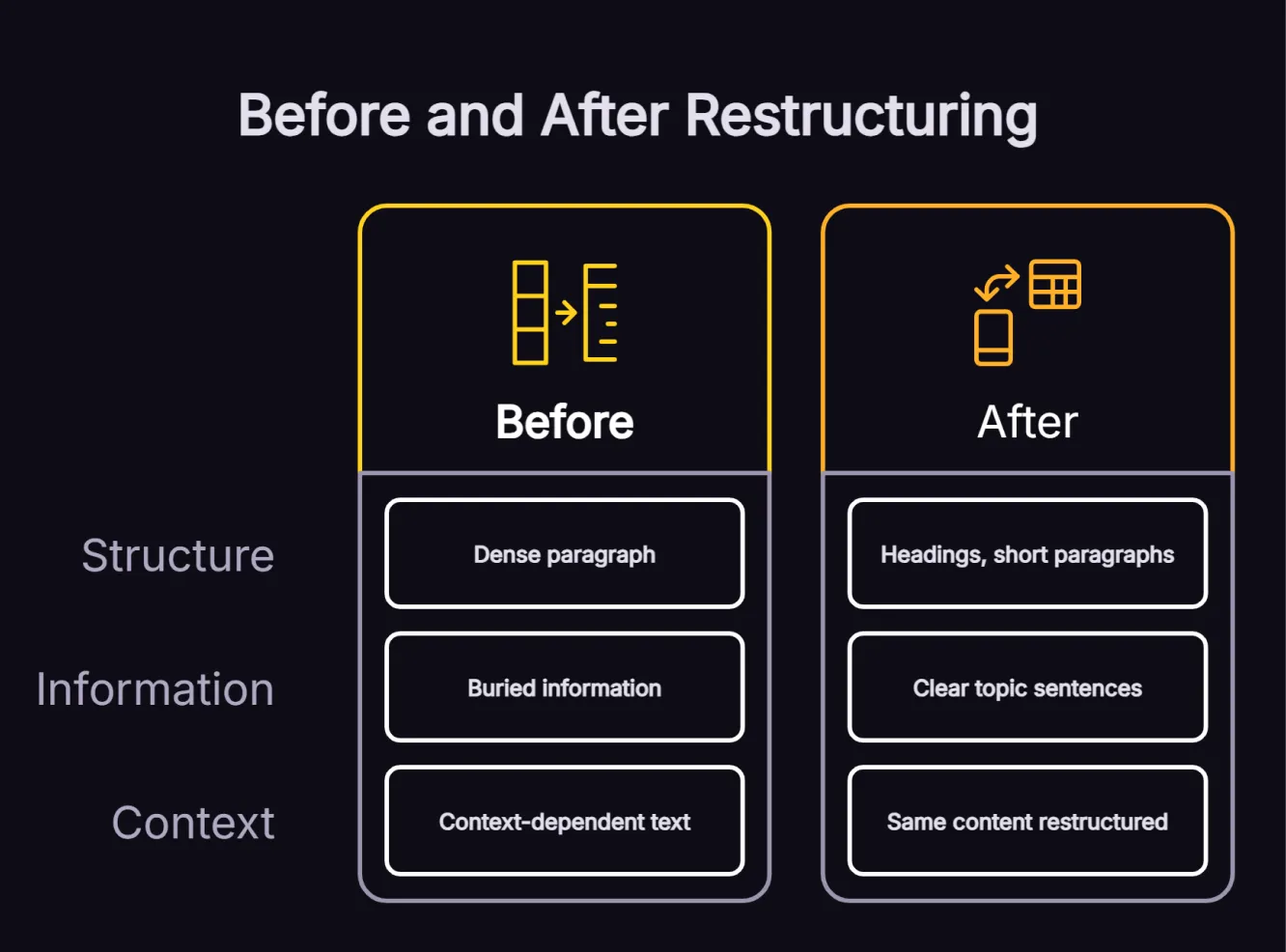
Dense paragraphs bury the information an AI system needs to extract. When a passage runs 200 words with no break, retrieval systems struggle to isolate a discrete unit, and your content loses to a competitor who structured the same information more clearly. Break long explanations into shorter paragraphs, use a list when you have three or more parallel items, and insert a subheading when the topic shifts.
3. Relying on Context From Other Sections
Passages that depend on earlier content fail as standalone units. Phrases like "this method", "the above approach" or "as we discussed" leave a retrieved passage incomplete. Give each section enough context to stand on its own. Repeat a key term rather than leaning on a pronoun, and briefly restate the relevant background instead of assuming the reader has just read the previous section.
4. Leaving the Answer Until Late
Saving your definition or conclusion for the end works against how AI retrieval behaves. With 44.2 percent of citations coming from the first 30 percent of a page, an answer stranded in your final paragraph is far less likely to be pulled. Lead with the key point, then earn the reader's time with the depth underneath it.
Measuring Passage Optimisation
Passage-level performance needs different signals from traditional page analytics, and the point is to read them as a set, not to chase any one number. AI citations sit alongside your rankings and revenue as a leading indicator that your visibility is compounding, never as a replacement for them. We now report citation tracking beside rankings for every client, a shift we explain in how AI impacts SEO, where AI Overviews now appear in roughly 16 percent of searches.
Focus on these signals:
- AI Overview and AI answer citations: Track whether your content appears in AI Overviews and AI assistant answers for target queries. Tooling is maturing, and manual checks of priority queries still reveal a lot. Treat rising citations as a leading indicator that revenue is coming, tracked alongside rankings rather than instead of them.
- Featured snippet acquisition: A featured snippet means Google selected a specific passage as the best answer. Rising snippet wins are direct evidence your passage structure is working.
- Search Console query diversity: Well-optimised passages often earn impressions for long-tail queries beyond the page's primary target. Growing query diversity in Search Console suggests individual passages are earning their own visibility.
- Behaviour by query cluster: Compare engagement across query clusters where you appear in an AI answer or snippet against those where you do not, to see which passages are pulling their weight.
The proof this works at scale sits in our B2B property management engagement, where the same passage-level and topical-authority approach took the client from zero AI visibility to broad multi-platform citation coverage, alongside $8.7M in attributed revenue over 27 months. Getting cited is not a vanity metric. It is an early signal of the revenue that follows.
Passage Optimisation and Topical Authority
Passage-level structure is one half of the equation. The other is topical authority: the depth across a whole subject that tells Google and AI systems your passages are worth trusting. A perfectly structured paragraph on a site with no authority on the topic still struggles to get cited. The two work together, which is why our semantic SEO guide frames the goal as depth beating keyword density. Structure your passages so they can be extracted, and build the surrounding cluster so they deserve to be.
Frequently Asked Questions
How Is Passage Optimisation Different From On-Page SEO?
Traditional on-page SEO focuses on page-level signals like title tags, meta descriptions and overall keyword targeting. Passage optimisation goes a level deeper, structuring individual sections so they can rank and be cited independently for specific queries. The two work together rather than competing. Passage optimisation builds on solid on-page fundamentals, it does not replace them.
Does Passage Optimisation Work for Short Content?
Passage optimisation delivers the most benefit for long-form content covering several subtopics, since each subtopic becomes an extractable passage. Short, focused pages already function as a single passage. Even so, shorter content still benefits from a clear structure, a direct opening answer and self-contained paragraphs. The principles apply universally, but the payoff scales with length and topic diversity.
How Long Should an Optimised Passage Be?
It depends on the question. A simple definition works in one or two sentences, while a complex explanation may need three or four short paragraphs. The test is completeness: each passage should fully answer its target question without sending the reader elsewhere. For paragraph-style featured snippets, roughly 40 to 60 words is a common sweet spot.
Will Passage Optimisation Help With ChatGPT and Perplexity Citations?
Yes, though the effect varies by how each platform crawls, indexes and retrieves. Perplexity, for instance, often retrieves sub-document passages before it generates an answer, so a clean, self-contained section is exactly what it is looking for. Passage-level structure increases the likelihood of a citation across platforms, but it works best paired with the topical authority and technical foundations that make you eligible in the first place.
Should I Restructure Existing Content or Create New Content?
Both have merit. Restructuring a high-performing page that lacks passage optimisation often delivers quick wins because the authority already exists, so prioritise pages ranking in positions 5 to 20 where better passage relevance can push them into snippet or citation territory. Creating new content with the structure built in from the start lays the foundation for long-term visibility. Most programmes do both in parallel.
Does Passage Optimisation Affect Voice Search?
It can. Clear, self-contained passages are easier for voice assistants to read aloud, so the same structure that earns AI citations tends to help here too. Sources vary by assistant and are not always disclosed, so treat this as a best-practice benefit rather than a guarantee. Favour speakable writing: lead with the answer, use plain language and short clauses, and avoid long nested sentences.
Start Structuring for the AI Search Era
Passage optimisation has gone from a nice-to-have to the mechanic that decides whether your content gets cited. Google's passage ranking was estimated to improve around 7 percent of searches at launch, and now that AI systems fan a single query into many and answer each from the best passage they can find, section-level structure is what earns you a place in those answers. Start with your highest-potential pages, apply the structure in this guide, and measure the gains in snippet wins, AI citations and query coverage. The work that makes your content easy for a machine to cite is the same work that makes it genuinely useful to a reader.
About the Author
Want Insights Like This Fortnightly?

Our AI SEO strategies and tactics delivered fortnightly, including bonus trade secrets not shared anywhere else. No fluff. Just what's working right now. 5-minute read.


