
AI SEO Strategy: The Complete Guide to Dominating Google, ChatGPT and AI Search in 2026


Google processes over 16.4 billion searches daily, but 58.5% now result in zero clicks. Meanwhile, ChatGPT processes more than 1 billion queries daily, fundamentally changing how customers discover businesses. Your AI SEO strategy needs to capture visibility across both traditional search engines and AI platforms like ChatGPT, Perplexity and Google AI Overviews before competitors do. This guide reveals exactly how to build an AI SEO strategy that delivers measurable results, based on proven methodologies that have generated over $26 million in attributed revenue for our clients.
A Quick Guide to AI SEO Strategy
An AI SEO strategy optimises content for discovery across both traditional search engines and AI platforms including Google AI Overviews, ChatGPT, Perplexity and Gemini. It requires systematic technical audits, semantic content analysis, structured data implementation and multi-platform keyword targeting. Rankmax clients using AI SEO strategies have generated over $26 million in attributed revenue, with individual businesses achieving 429% to 498% growth in traffic and conversions while securing hundreds of citations across AI platforms - results that traditional SEO alone cannot deliver.
See How AI SEO Strategy Actually Works
Most businesses waste months debating AI search while competitors capture citations across ChatGPT, Perplexity and AI Overviews. Discover our strategic 6-phase framework that's generated $26M+ in client revenue across both traditional and AI search
Explore Our AI SEO ApproachWhy AI SEO Strategy Matters Now
The search landscape has fundamentally shifted. Research from Siteimprove shows that 73% of marketers plan to implement or expand AI-integrated search solutions within the next year. This isn't optional anymore; it's survival.
Consider what's happening right now. When someone asks ChatGPT for business recommendations, your competitors might appear while you remain invisible. Google's AI Overviews now appear in 52% of searches as of early 2025, answering questions without sending traffic to websites. Nearly 25% of U.S. adults had already used ChatGPT by early 2024, and that percentage is growing rapidly.
The businesses that build comprehensive AI SEO strategies today will dominate their categories tomorrow. Those waiting for "proof" will find themselves fighting for scraps of a fragmented market.
The Zero-Click Reality
Traditional SEO focused on ranking position, getting to spot #1 for "meal delivery Melbourne." AI SEO is about citation frequency, appearing multiple times when ChatGPT, Claude or Perplexity answer questions about meal delivery. With 58.5% of searches now resulting in zero clicks, visibility matters more than position.
You can own one billboard or have your brand mentioned throughout an entire conversation. That's the difference between traditional rankings and AI citations.
The Multi-Platform Challenge
Each AI platform favours different signals:
- ChatGPT: Gravitates toward structured, canonical explanations; 47.9% of citations come from Wikipedia
- Google AI Overviews: 21% of citations from Reddit, valuing lived experiences and community insights
- Perplexity: Leans heavily into community-generated content with 46.7% Reddit citations
Your AI SEO strategy must account for these platform differences while maintaining consistency across your digital presence.
Traditional SEO vs AI SEO: Understanding the Shift
The fundamentals haven't disappeared; they've evolved. AI-driven strategies now dominate the SEO industry, utilising advanced machine learning algorithms to enhance search engine optimisation efforts.
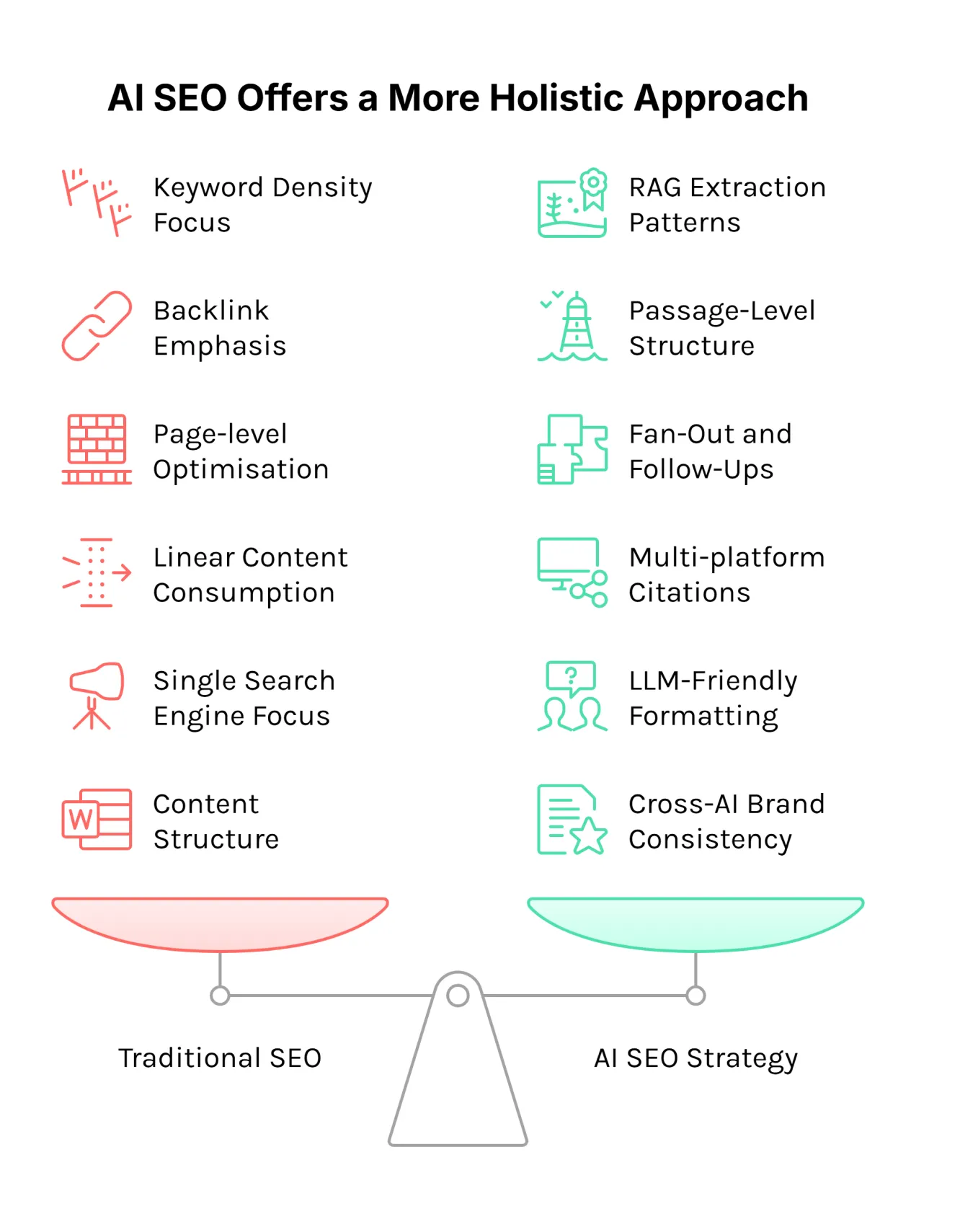
Traditional SEO optimised for:
- Keyword density and exact matches
- Backlink quantity over quality
- Page-level optimisation
- Linear content consumption
- Single search engine (Google)
AI SEO Strategy optimises for:
- RAG (Retrieval Augmented Generation) extraction patterns
- Passage-level content structure for AI parsing
- Query fan-out coverage (answering follow-up questions before they're asked)
- Multi-platform source citation monitoring
- Content formatting for optimal LLM comprehension
- Brand representation across AI training sources
The core difference? Traditional SEO competed for blue link rankings. AI SEO competes for inclusion in generated answers by understanding how each AI platform interprets your brand, then optimising the sources they cite to position your content as the authoritative answer across ChatGPT, Google AI Overviews and Perplexity simultaneously.
What Still Matters
Strong technical foundations remain critical. Our AI SEO audits consistently reveal that 82% of marketers found the inability to improve organic search results and the lack of unified systems challenging. Sites with poor technical health struggle regardless of content quality.
Core Web Vitals, mobile optimisation, crawlability, proper site structure and schema markup form the foundation. Without these, even brilliant content won't achieve visibility in AI platforms.
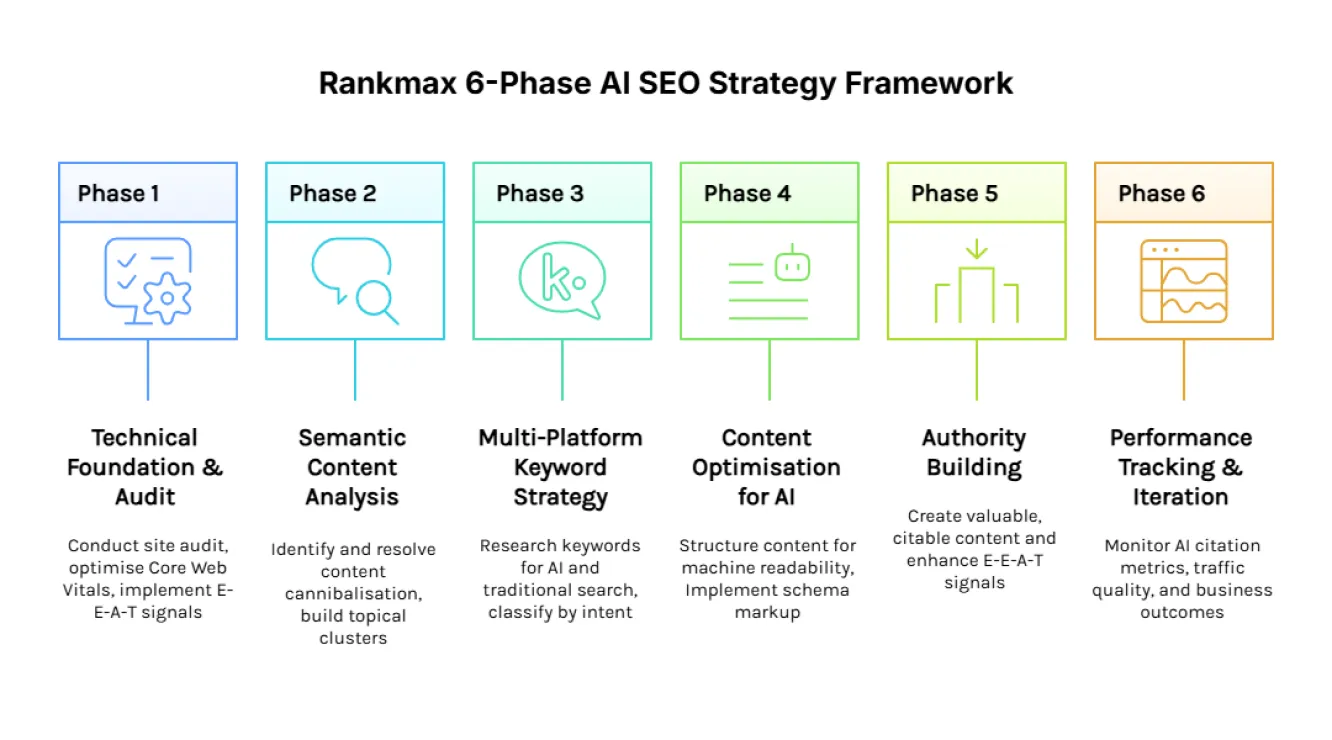
The Rankmax 6-Phase AI SEO Strategy Framework
Our comprehensive AI SEO methodology has generated over $26 million in attributed revenue for clients. Here's the systematic framework we use.
Phase 1: Technical Foundation & Performance Audit
Every AI SEO strategy begins with technical excellence. We conduct systematic audits covering:
Core Web Vitals Assessment
- Largest Contentful Paint (LCP) must be < 2.5s
- Interaction to Next Paint (INP) must be < 200ms
- Cumulative Layout Shift (CLS) must be < 0.1
Use tools like Google's Chrome UX Report for real-world performance data. If your Core Web Vitals fail, AI platforms will struggle to access and understand your content effectively.
Technical Optimisation Priorities
- Site crawling and indexing configuration
- XML sitemap coverage and accuracy
- Canonical implementations to prevent duplication
- Internal linking structure and architecture
- Mobile responsiveness and touch target sizes
E-E-A-T Signal Implementation
Google and AI platforms prioritise content demonstrating Experience, Expertise, Authoritativeness and Trustworthiness. Implement:
- Author profiles with verifiable credentials
- Organisation schema markup
- Updated copyright notices and business information
- Clear content attribution
- Expert citations and references
One B2B property management client achieved 429% traffic growth after we implemented comprehensive E-E-A-T signals, including nutritionist credentials and professional certifications.
Phase 2: Semantic Content Analysis
Traditional keyword research misses semantic relationships that AI systems understand. Our semantic analysis prevents content cannibalisation while identifying gaps.
Semantic Similarity Detection
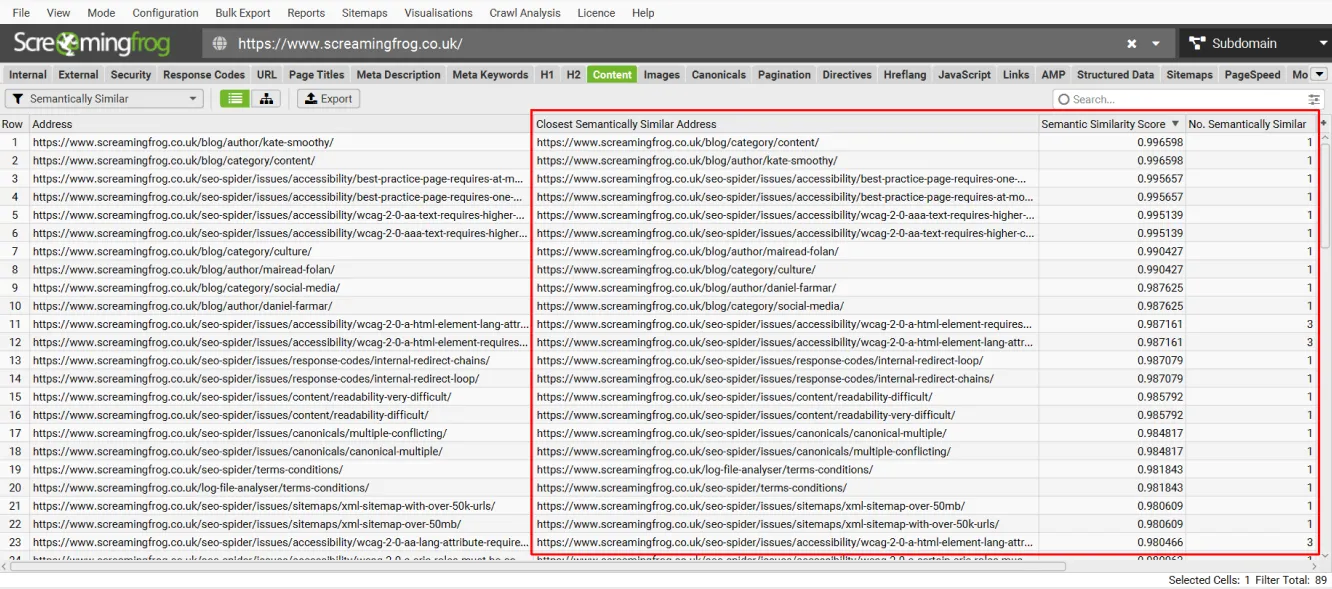
Use tools like Screaming Frog's semantic analysis features to identify pages with >0.95 similarity scores. These pages could be competing against each other, diluting your topical authority.
Key Actions:
- Identify pages targeting identical search intent
- Consolidate duplicate content into authoritative resources
- Differentiate similar pages with distinct angles
- Implement canonical tags where appropriate
- Remove low-value duplicates with proper redirects
A SaaS client indexed 26,402 new keywords after we resolved semantic cannibalisation issues and built proper topical clusters.
Content Cluster Architecture
AI systems understand topic relationships. Build comprehensive content silos:
- Identify primary keywords with commercial intent
- Create conversion-focused landing pages
- Build 3-5 supporting informational articles per topic
- Implement strategic internal linking
- Continuously expand until achieving topical authority
Phase 3: Multi-Platform Keyword Strategy
AI platforms respond to queries differently than traditional search. Your keyword strategy must account for conversational patterns and platform preferences.
Keyword Research Approach
- Seed Keywords: Identify core product/service terms
- Exact Match Keywords: Direct product/service descriptions
- Broad Match Variations: Wider reach opportunities
- Conversational Queries: How users ask AI platforms
- Question-Based Keywords: "How to", "What is", "Best way to"
Research shows AI Overviews trigger most often for queries containing 5 words and using terms like "how," "tips," "practices", and "best".
Intent Classification
Categorise keywords by:
- Informational: Educational content, how-to guides, explanations
- Commercial: Product comparisons, reviews, "best of" lists
- Navigational: Brand-specific queries, product pages
- Transactional: Purchase-intent keywords, pricing queries
AI platforms pull different content for each intent type. Match your content format to the dominant intent pattern.
Phase 4: Content Optimisation for AI Understanding
Machine learning algorithms can identify patterns, trends and correlations within data sets, allowing AI systems to uncover valuable insights into user behaviour and search trends.
Structural Requirements
AI systems parse content differently than humans. Optimise for machine readability:
- Clear Answer Structure:
- Begin with concise 50-70 word summaries answering primary queries
- Use simple, accessible language aligned with user intent
- Don't bury key information deep in articles
- Conversational Formatting:
- Write in natural language, matching how people speak
- Structure content around real user questions
- Answer questions clearly in the first sentences
- Expand with supporting details after direct answers
- FAQ Sections:
- Address related queries that users might ask
- Provide complete answers in 2-3 sentences
- Use natural question phrasing
- Include schema markup for machine parsing
- Multimedia Integration:
- Add descriptive alt text to images
- Upload videos to YouTube (AI Overviews prefer YouTube)
- Create custom graphics and data visualisations
- Use landscape image formats with SEO-friendly file types
Schema Markup Implementation
Structured data helps AI systems understand content context. Implement:
- Organisation schema for business information
- Article schema for blog content
- HowTo schema for instructional content
- FAQ schema for question-answer sections
- Product schema for eCommerce content
Phase 5: Authority Building Through Value Creation
AI platforms favour content with external validation. Build authority through natural link acquisition rather than manipulative tactics.
Content Worth Citing
Create resources that other sites naturally want to reference:
- Original research and data studies
- Comprehensive industry guides
- Interactive tools and calculators
- Expert insights and unique perspectives
- Clear answers to common questions
One of our eCommerce clients earned 141 referring domains without a single cold outreach email by creating genuinely valuable operational templates and industry research.
E-E-A-T Enhancement
Strengthen expertise signals across your content:
- Feature qualified experts with verifiable credentials
- Cite authoritative external sources
- Build author profiles with professional accomplishments
- Showcase client results and testimonials
- Maintain content freshness and accuracy
Phase 6: Performance Tracking & Iteration
AI SEO requires different success metrics than traditional SEO. Track what actually matters for business growth.
Key Performance Indicators:
- AI Citation Metrics:
- Appearances in Google AI Overviews
- ChatGPT recommendations and citations
- Perplexity source mentions
- Gemini feature inclusions
- Traffic Quality Indicators:
- Average session duration
- Pages per session
- Conversion rate by source
- Revenue attribution by channel
- Traditional SEO Metrics:
- Organic traffic growth
- Keyword ranking positions
- Click-through rates
- Backlink acquisition
- Business Outcome Metrics:
- Lead generation volume
- Customer acquisition cost
- Attributed and actual revenue from organic sources
- Attribtued and actual return on investment from AI SEO
Use tools like Google Search Console, Ahrefs and specialised AI tracking platforms, such as Brand Radar, to monitor performance across all channels. Google has indicated that links in AI Overviews get more clicks than the same page in traditional listings, but comprehensive tracking reveals the complete picture.
Practical AI SEO Strategy Implementation
Theory means nothing without execution. Here's how to actually implement an AI SEO strategy at your organisation.
Month 1-2: Foundation Building
Week 1-2: Technical Audit
- Run a comprehensive site crawl with Screaming Frog
- Analyse Core Web Vitals for key pages
- Identify technical issues affecting crawlability
- Document schema markup gaps
- Review mobile responsiveness
Week 3-4: Content Analysis
- Export existing keyword rankings
- Identify semantic cannibalisation issues
- Map current topical coverage
- Analyse competitor strategies
- Document content gaps
Month 1-2 Deliverable: Technical audit report with prioritised fixes and content strategy framework.
Month 3-4: Strategic Optimisation
Content Cluster Development:
- Build comprehensive topical coverage
- Create pillar content for main topics
- Develop supporting articles
- Implement proper internal linking
- Add FAQ sections with schema
Technical Implementation:
- Fix Core Web Vitals issues
- Implement schema markup sitewide
- Optimise page speed
- Enhance mobile experience
- Resolve crawlability problems
Month 3-4 Deliverable: Core content clusters published with proper technical foundation.
Month 5-8: Scale & Refinement
Publish high-quality, original and human-refined content consistently at scale:
- 12-48 optimised pages monthly
- Each targeting specific keyword clusters
- All following AI-optimisation standards
- Articles with supporting product/service pages
- Building topical authority systematically
Performance Monitoring:
- Track AI citation frequency
- Monitor traditional ranking improvements
- Analyse traffic quality metrics
- Measure conversion rates
- Calculate ROI by channel
Month 5-8 Deliverable: Consistent high-quality content production with measurable traffic and citation growth.
Month 9-12: Authority & Expansion
Link Building:
- Create citation-worthy original research
- Build relationships with industry publications
- Develop shareable resources
- Monitor natural link acquisition
- Measure domain authority growth
Multi-Platform Optimisation:
- Fine-tune ChatGPT visibility
- Expand Google AI Overview citations
- Expand Perplexity citations
- Enhance Gemini's appearance
- Monitor cross-platform performance
Month 9-12 Deliverable: Established authority with consistent AI citations, revenue and ROI attribution.
Common AI SEO Strategy Mistakes
Most businesses fail at AI SEO because they make these fundamental errors:
Mistake 1: Treating AI SEO as Separate from Traditional SEO
AI SEO isn't a replacement; it's an evolution. Businesses that abandon traditional SEO fundamentals struggle in both traditional and AI search.
The Fix: Build AI SEO strategies on solid technical foundations. Core Web Vitals, mobile optimisation and proper site structure remain essential.
Mistake 2: Chasing AI Tools Instead of Strategy
Using AI for keyword research to identify opportunities at scale helps, while freeing marketers to focus on higher-level strategic and creative decisions. Many businesses deploy AI writing tools without understanding search intent or content quality requirements. This can lead to violating Google's scaled content abuse spam policy, resulting in your domain being shadow banned from Google Search and AI Overviews.
The Fix: Use AI to amplify human expertise, not replace it. AI excels at pattern recognition and data analysis. Humans excel at strategic decisions, crative problem solving, original insights and quality control.
Mistake 3: Ignoring Semantic Cannibalisation
Publishing more content without semantic analysis creates competing pages that dilute topical authority. Multiple pages targeting identical intent confuse AI systems about which content is authoritative.
The Fix: Conduct semantic similarity analysis before creating new content. Consolidate duplicate pages and differentiate similar topics with distinct angles.
Mistake 4: Focusing on Rankings Over Citations
Traditional SEO was obsessed with position #1. AI SEO requires visibility across multiple generated answers and platforms.
The Fix: Track AI citation frequency alongside traditional rankings. Optimise for appearing in multiple AI-generated responses, not just the blue link position.
Mistake 5: Creating Generic, Unoriginal AI-Generated Content
Content that directly addresses user questions in a clear, concise manner performs better in AI platforms. Generic AI-written content without expertise, originality or unique value gets ignored.
The Fix: Use AI for research and outlines, but infuse content with genuine expertise, original insights and specific examples. AI platforms favour content demonstrating clear expertise and unique perspectives.
Measuring AI SEO Strategy Success
Success looks different for every business, which is why measurement frameworks must align with specific goals.
Leading Indicators
Track these metrics monthly for early performance signals:
- AI citation frequency across platforms
- Organic traffic growth rate
- New keyword rankings achieved
- Referring domain acquisition
- Content indexation speed
- Technical health scores
Lagging Indicators
These metrics show business impact over 3-6 months:
- Revenue from organic search
- Customer acquisition cost reduction
- Lead generation volume growth
- Market share of voice increases
- Brand search volume expansion
- Customer lifetime value by channel
ROI Calculation Framework
Calculate AI SEO ROI using this standard formula: (Revenue Generated - Marketing Investment) / Marketing Investment × 100
Example Calculation:
- Monthly Investment: $10,000
- Revenue Generated: $135,000
- ROI: (135,000 - 10,000) / 10,000 × 100 = 1,250%
Our B2C client achieved 14,738% average monthly ROI, attributing about A$14.6M in revenue over 21 months and counting through systematic AI SEO implementation.
The Future of AI SEO Strategy
AI SEO will become simply "SEO" as these practices become standard. Early adopters gain compound advantages that late entrants struggle to overcome.
Emerging Trends
- Voice Search Integration: AI platforms increasingly power voice assistants. Content optimised for conversational queries naturally performs well in voice search scenarios.
- Visual Search Optimisation: AI systems are learning to understand images and videos contextually. Proper alt text, image schema and video optimisation become more valuable.
- Personalised Search Experiences: AI enables personalisation at scale. Generic content performs worse as AI systems surface increasingly relevant, personalised results.
- Multi-Modal Content: AI platforms will integrate text, images, audio and video seamlessly. Content strategies must span multiple formats.
The Competitive Advantage Window
The businesses building comprehensive AI SEO strategies today will dominate their categories tomorrow. AI-driven strategies now dominate the SEO industry, but most competitors remain in exploratory phases.
Your window for first-mover advantage is closing. The question isn't whether to invest in AI SEO, it's whether you'll lead your category or scramble to catch up.
Beyond Theory: AI SEO Strategy That Delivers Results
AI SEO strategy isn't about following trends or deploying the latest tools. It's about systematically implementing proven methodologies that deliver measurable business outcomes.
The strategies outlined here have generated over $26 million in attributed revenue for Rankmax clients across B2B, B2C, eCommerce and SaaS industries. From property management companies achieving 429% traffic growth to meal delivery brands securing 866 AI citations, the framework delivers when executed properly.
Your competitors are debating whether AI SEO matters. While they discuss, you can build comprehensive strategies that capture visibility across every platform where your customers search. The path forward is clear; the only question is whether you'll take it.
FAQ
What is an AI SEO strategy?
An AI SEO strategy is a comprehensive approach to optimising content for visibility across both traditional search engines and AI-powered platforms, including Google AI Overviews, ChatGPT, Perplexity and Gemini. It combines technical SEO fundamentals with AI-specific optimisation techniques like semantic content analysis, structured data implementation and multi-platform keyword targeting to position your content for citation by large language models while maintaining traditional search performance.
How is AI SEO different from traditional SEO?
Traditional SEO optimises for keyword rankings and backlink quantity, focusing on securing top positions in search results. AI SEO optimises for RAG (Retrieval Augmented Generation) extraction patterns, passage-level content structure and query fan-out coverage - answering follow-up questions before users ask them. While traditional SEO competed for blue link rankings, AI SEO competes for inclusion in generated answers by understanding how each AI platform interprets your brand, then optimising the sources they cite. This requires formatting content for optimal LLM comprehension, monitoring multi-platform citations and ensuring your brand is represented accurately across the sources AI systems reference when generating answers.
How long does it take to see results from an AI SEO strategy?
Initial improvements typically appear within 3-6 months for technical optimisations and content published targeting low-competition keywords. Significant traffic impact usually manifests by month 6, with compound growth continuing long-term as topical authority builds. Most Rankmax clients see measurable revenue impact by month 6-9, with a comprehensive transformation requiring 12-18 months of consistent execution. AI citation visibility often appears faster, with some clients achieving citations within 30-90 days of implementing proper content structure.
Do I need to abandon traditional SEO for AI SEO?
No. AI SEO builds on traditional SEO foundations rather than replacing them. Technical excellence, mobile optimisation, Core Web Vitals, proper site structure and quality backlinks remain essential. The difference is layering AI-specific optimisations, semantic analysis, multi-platform content structure, conversational query targeting and schema markup, on top of solid traditional SEO fundamentals. Businesses abandoning traditional SEO principles struggle in both conventional and AI search platforms.
What tools do I need for AI SEO strategy?
Essential tools include Screaming Frog for technical audits and semantic analysis, Ahrefs or Semrush for keyword research and competitor analysis, Google Search Console for performance tracking, schema markup validators, Core Web Vitals measurement tools and Brand Radar for AI-specific tracking to monitoring citations across ChatGPT, Perplexity and AI Overviews. However, tools amplify strategy; they don't replace strategic thinking, content quality or original insight.
How do I optimise content for ChatGPT visibility?
ChatGPT optimisation requires strong traditional SEO fundamentals, along with a conversational content structure. Implement clear question-answer formatting, comprehensive FAQ sections with schema markup, natural language that matches how people speak, authoritative citations and E-E-A-T signals. ChatGPT favours structured, canonical explanations from authoritative sources, with 47.9% of citations coming from Wikipedia-style content. Focus on becoming the definitive resource for your topic rather than keyword stuffing.
How much should I invest in AI SEO strategy?
Investment depends on business size, industry competition and growth objectives. Mid-market companies ($2M-$100M revenue) typically invest $10,000-$50,000+ monthly for comprehensive AI SEO programmes including strategic planning, content production, technical optimisation and performance tracking. ROI varies by execution quality and timeline, but Rankmax clients average 1,909% ROI for SaaS, 2,087% for eCommerce, 6,864% climb-window ROI for B2B and 14,738% average monthly ROI for B2C professional services. The question isn't cost, it's whether you can afford not to invest while competitors capture your market share.
Can small businesses compete with AI SEO?
Absolutely. Smaller businesses often see faster AI SEO results due to agility and focus. While enterprise competitors debate strategy in committees, nimble teams can publish content and iterate quickly. Focus on specific niches where deep expertise beats broad coverage, target long-tail keywords with clear commercial intent before attempting competitive terms, and build topical authority systematically. Many Rankmax small business clients outperform larger competitors by moving faster and targeting underserved keyword clusters.
How do I track AI SEO performance?
Track performance across four dimensions: AI citation metrics (appearances in AI Overviews, ChatGPT recommendations, Perplexity mentions), traffic quality indicators (session duration, conversion rates, revenue attribution), traditional SEO metrics (organic traffic, keyword rankings, backlink acquisition) and business outcome metrics (lead generation, customer acquisition cost, ROI). Use Google Search Console for traditional tracking, Ahrefs for comprehensive SEO analysis and AI citation tracking across platforms. Manual checking through prompt testing supplements what automated trackers miss.
What content types work best for AI SEO?
Content that directly answers user questions in clear, concise formats performs best across AI platforms. Effective types include comprehensive how-to guides with step-by-step instructions, FAQ pages addressing common questions, comparison articles evaluating multiple options, data-driven research providing original insights, expert roundups featuring verified credentials and structured list posts with clear organisation. Content demonstrating genuine expertise, original perspectives and comprehensive topic coverage consistently outperforms generic AI-generated material across all platforms.
Transform Your Organic Growth with Strategic AI SEO
AI search is already reshaping how customers find you; leaders are executing a comprehensive AI SEO strategy across Google, ChatGPT and Perplexity today. Use the 6-phase framework, combined with technical excellence, semantic coverage, and multi-platform optimisation, to earn citations, protect rankings, and turn visibility into measurable revenue. Ready to move? Book a 45-minute discovery session with me, and we will assess your performance and map the fastest path to results.
About the Author
Want Insights Like This Fortnightly?

Our AI SEO strategies and tactics delivered fortnightly, including bonus trade secrets not shared anywhere else. No fluff. Just what's working right now. 5-minute read.


