
AI SEO: The Complete Guide to Optimising for Google AI Overviews, ChatGPT and Generative Search in 2026


Search has fundamentally changed. Over 800 million people use ChatGPT weekly, while Google's AI Overviews now appear in 13.14% of all searches. Your customers aren't just searching Google anymore. They're asking AI platforms for recommendations, and most businesses aren't showing up in those answers. This guide reveals exactly how AI SEO works and how to optimise your content to appear in both traditional search results and AI-generated responses, using proven strategies that are delivering measurable results right now.
What Is AI SEO?
AI SEO optimises content for discovery across traditional search engines and AI platforms like ChatGPT, Perplexity and Google's AI Overviews. It combines proven SEO fundamentals with new optimisation techniques tailored to how large language models (LLMs) retrieve, understand and cite information. The AI-powered SEO sector reached $67 billion in 2025, with 86% of SEO professionals now integrating AI into their strategy.
Ready to Dominate AI Search?
Our AI SEO strategies have helped clients achieve first-position visibility in AI Overviews and ChatGPT citations while maintaining strong traditional search rankings. We'll audit your current visibility across AI platforms, identify high-impact optimisation opportunities and implement the technical and content strategies that get you cited where your customers are actually searching.
Speak with the Founder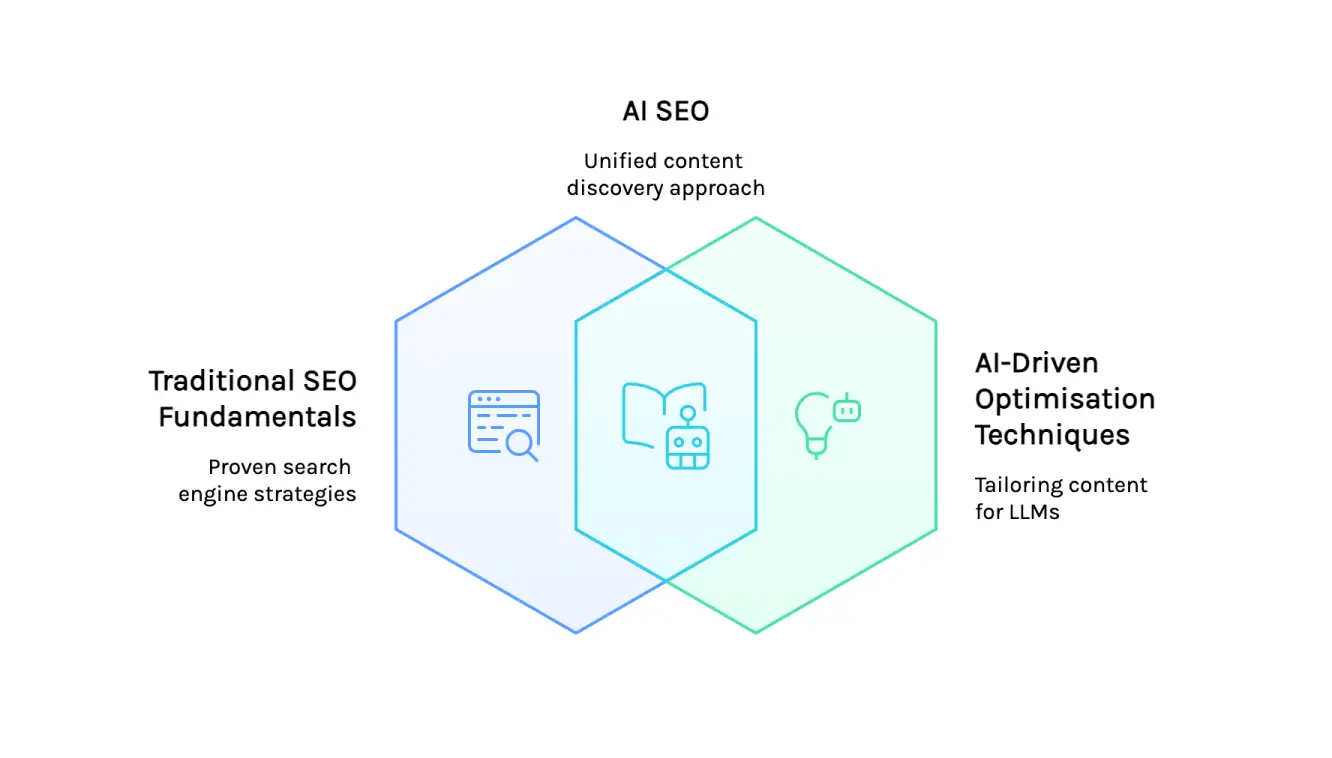
How AI SEO Differs From Traditional SEO
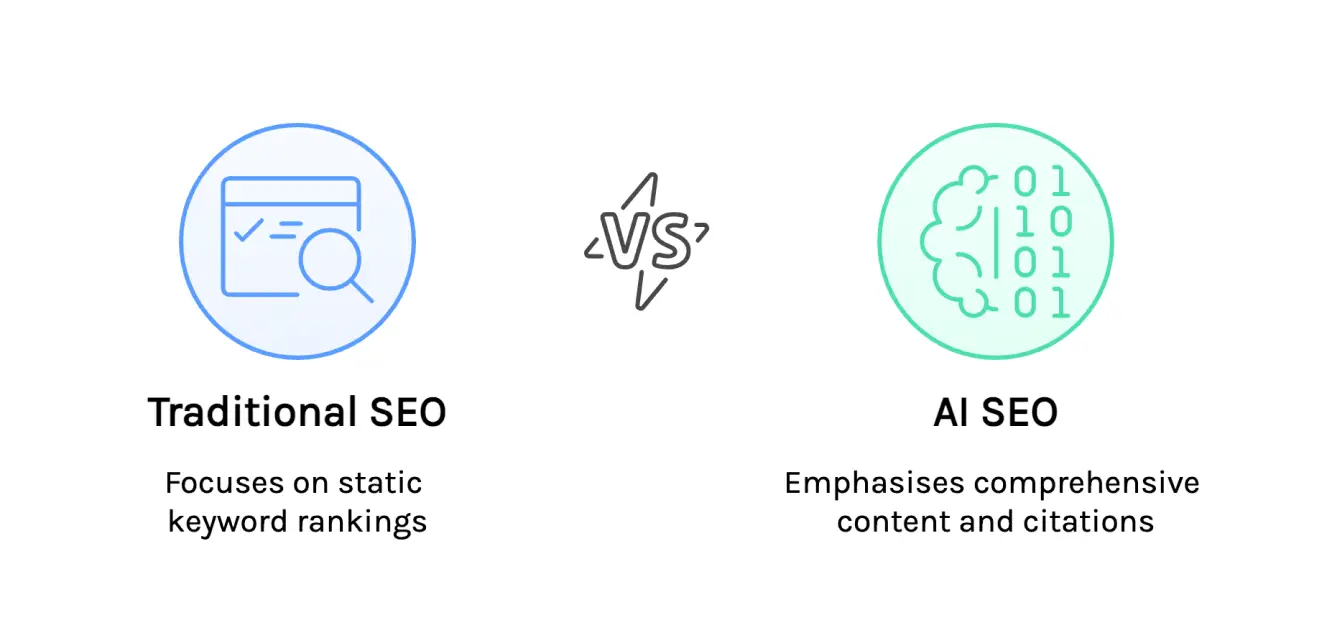
Traditional SEO focused on ranking web pages for specific keywords. AI SEO requires a broader approach that accounts for how AI platforms process and synthesise information.
Search Query Evolution
AI search queries average 23 words compared to traditional Google searches of 4-5 words. People now ask complete questions like "What's the best AI SEO tool under $30/month for researching brand questions?" instead of typing "AI SEO tool."
This shift means your content must answer comprehensive questions directly rather than just targeting short keywords.
From Rankings to Citations
Traditional SEO measured success through search engine rankings. AI SEO prioritises citations - appearing as a source within AI-generated answers.
Research shows that visitors from LLM tools like ChatGPT are worth 4.4 times more on average than traditional organic search visitors. When ChatGPT recommends your brand directly in an answer with attribution, you're reaching users at a critical decision-making moment.
Content Understanding Requirements
Search engines match keywords. AI platforms understand context, semantic relationships and entity connections across your entire content ecosystem.
Structured content with citations, quotations and statistics boosts source visibility by over 40% in AI-generated responses, according to Princeton University research.
Understanding the Terminology: GEO, LLMO, AEO
You'll encounter various terms for AI SEO across the industry: Generative Engine Optimisation (GEO), Large Language Model Optimisation (LLMO) and Answer Engine Optimisation (AEO). These are all different names for essentially the same practice: optimising content for AI platforms that generate direct answers rather than traditional search result lists.
The terminology varies because different researchers, agencies and platforms coined their own terms, but they all describe the same fundamental shift in how people find information.
The Research That Proved It Works
The landmark research paper from Princeton University, Georgia Tech and other institutions demonstrated that specific optimisation methods increased source visibility by over 40% in AI-generated responses. The study, which introduced the term "Generative Engine Optimisation," showed that including citations, adding statistics and using authoritative quotations significantly improved how often AI platforms referenced specific sources.
This research validated what we were already seeing in practice: content optimised for AI comprehension performs measurably better across ChatGPT, Perplexity, Google's AI Overviews and other platforms.
Proving AI SEO Works in Practice
By 2025, AI SEO started gaining recognition as a valid marketing strategy, with agencies worldwide beginning to explore and theorise about best practices. However, most were still in the experimental phase, unable to demonstrate clear ROI attribution from AI optimisation efforts.
At Rankmax, we were among the first AI SEO agencies globally to prove quantifiable, measurable returns from AI search optimisation. Since early-to-mid 2024, we've generated over $26 million in revenue directly attributed to our AI SEO campaigns across client accounts - results we can track, measure and replicate. Our case studies from the last 18 months document this performance with complete attribution data, demonstrating that AI SEO delivers tangible business outcomes when implemented strategically.
The terminology you use - GEO, LLMO, or AI SEO - matters less than implementing proven strategies that get your content cited where your customers are actually searching.
Core AI SEO Strategies That Work
1. Optimise Technical Accessibility for AI Crawlers
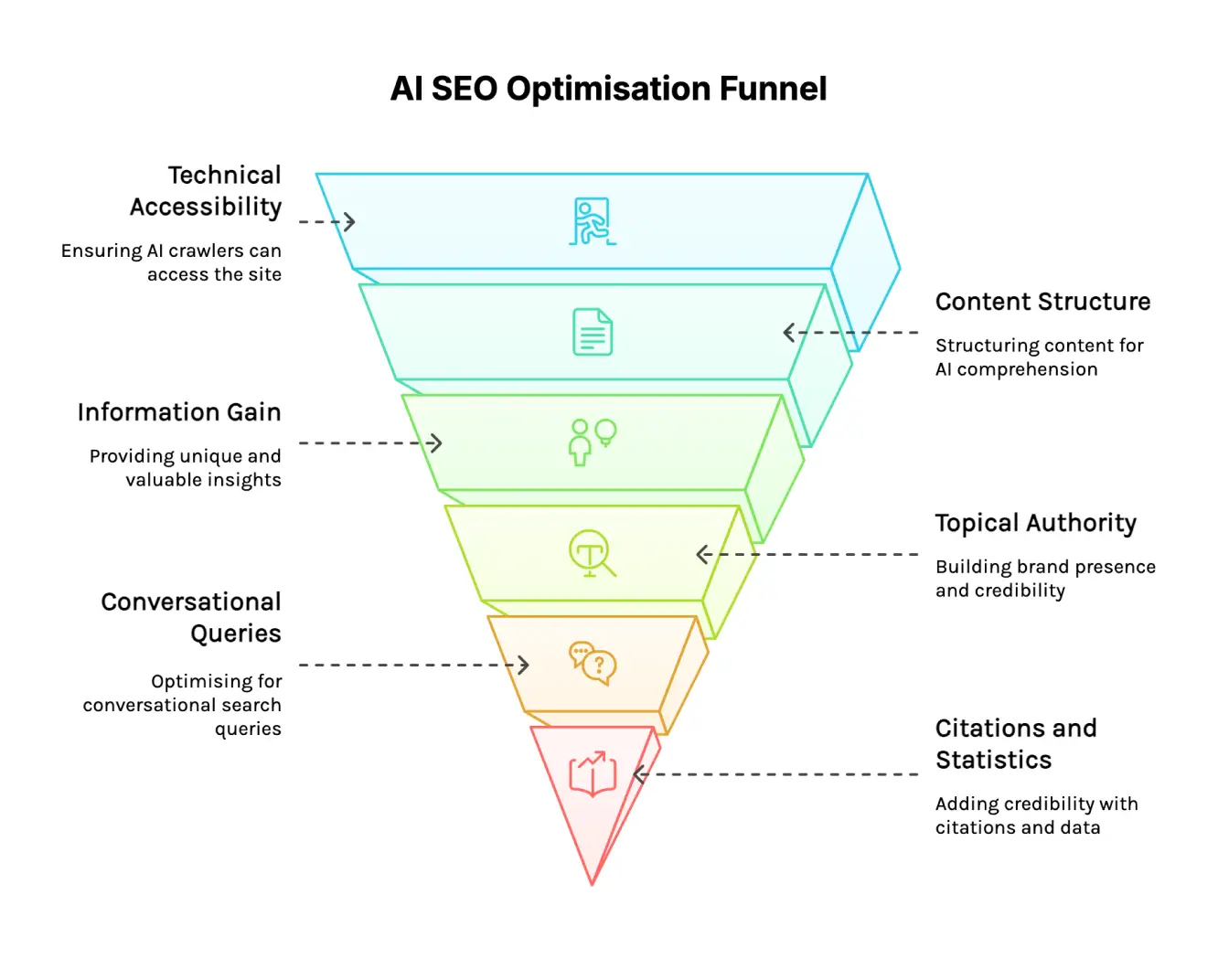
AI platforms use specialised crawlers to access web content. You must explicitly allow these crawlers access to your site.
ChatGPT uses OAI-SearchBot as its crawler. If you're blocking it in robots.txt, you're invisible to ChatGPT's search functionality.
Allow key AI crawlers by adding these lines to your robots.txt:
User-agent: GPTBot
Allow: /
User-agent: OAI-SearchBot
Allow: /
User-agent: PerplexityBot
Allow: /
User-agent: ClaudeBot
Allow: /
User-agent: Google-Extended
Allow: /
Ensure your XML sitemap is up to date so AI crawlers can efficiently discover all relevant content.
2. Structure Content for LLM Comprehension
AI tools favour structured sources with clear headings, lists and schema markup. Nearly half of ChatGPT's top citations come from Wikipedia, where information follows strict structural patterns.
Use semantic HTML properly:
- One H1 that states your main topic clearly
- H2 headings for major sections
- H3 elements for supporting points
- Keep headings descriptive and question-focused
Implement schema markup using JSON-LD format. FAQPage schema, HowTo schema and Article schema help AI platforms understand your content structure.
Research tracking 30 million AI citations shows ChatGPT favours predictable markup patterns where answers sit in clear containers the model can extract efficiently.
3. Create High Information Gain Content
Information gain means providing unique value users can't find elsewhere. AI platforms prioritise original insights over repeated information.
How to add information gain:
- Share proprietary methodology and frameworks
- Include original case studies with specific metrics
- Add expert analysis backed by real data
- Present contrarian viewpoints supported by evidence
- Provide first-hand experiences and lived examples
Instead of writing "10 Top SEO Tips," create "How We Increased Organic Traffic 300% Using Unconventional SEO Tactics Competitors Ignore." The specificity and originality signal higher value to LLMs.
4. Build Comprehensive Topical Authority
AI platforms consider web-wide brand signals when deciding which sources to reference. Visibility extends beyond your website to include:
- Brand mentions in trusted third-party publications
- Consistent expert contributions across platforms
- Guest posts on authoritative websites
- Profile presence on reputable directories (LinkedIn, industry-specific platforms)
- Active participation in relevant online communities
Reddit appears in over 40.11% of AI results with additional links, often outpacing traditional brand websites. Building presence where conversations happen naturally increases AI platform recognition.
5. Optimise for Conversational Queries
AI queries are longer and more conversational than traditional searches. Structure content to answer complete questions people actually ask.
Create Q&A format content:
- Use FAQ sections with schema markup
- Write conversational headings that mirror user questions
- Provide direct answers in the first 2-3 sentences of each section
- Include follow-up information that addresses related concerns
When someone asks ChatGPT "What's the best email marketing tool for small businesses?", the AI looks for content that answers that exact question comprehensively, not just pages targeting "email marketing tools" as a keyword.
6. Add Citations and Statistics
Content including citations, quotations and statistics sees over 40% better visibility in AI-generated responses. Link to authoritative sources to build credibility.
Best practices for citations:
- Link to peer-reviewed research, government data and industry reports
- Include specific statistics with source attribution
- Quote recognised experts with proper credit
- Reference recent data (within 12 months when possible)
- Use diverse, high-authority sources
This signals to AI platforms that your content is well-researched and trustworthy.
7. Maintain E-E-A-T Standards
Google's E-E-A-T framework (Experience, Expertise, Authoritativeness and Trustworthiness) increasingly influences AI algorithm decisions.
Demonstrate Experience:
- Share first-hand accounts and case studies
- Include specific examples from your work
- Showcase practical implementation details
Show Expertise:
- Add author bios with credentials
- Link to professional profiles and achievements
- Contribute expert commentary unique to your knowledge
Build Authority:
- Earn mentions in reputable publications
- Secure speaking engagements and media coverage
- Maintain consistent brand messaging across platforms
Establish Trust:
- Display security certificates (HTTPS)
- Include clear contact information
- Show customer testimonials and verified reviews
- Maintain transparent business practices
Platform-Specific Optimisation Strategies
ChatGPT SEO Optimisation
ChatGPT reached 800 million weekly users as of February 2025, making it a critical platform for brand visibility.
Key ChatGPT optimisation tactics:
- Allow OAI-SearchBot crawler in robots.txt
- Implement structured data using Schema.org markup
- Create quotable content with standalone sentences that work out of context
- Track referral traffic using utm_source=chatgpt.com in analytics
- Submit product feeds if you're in eCommerce (when available)
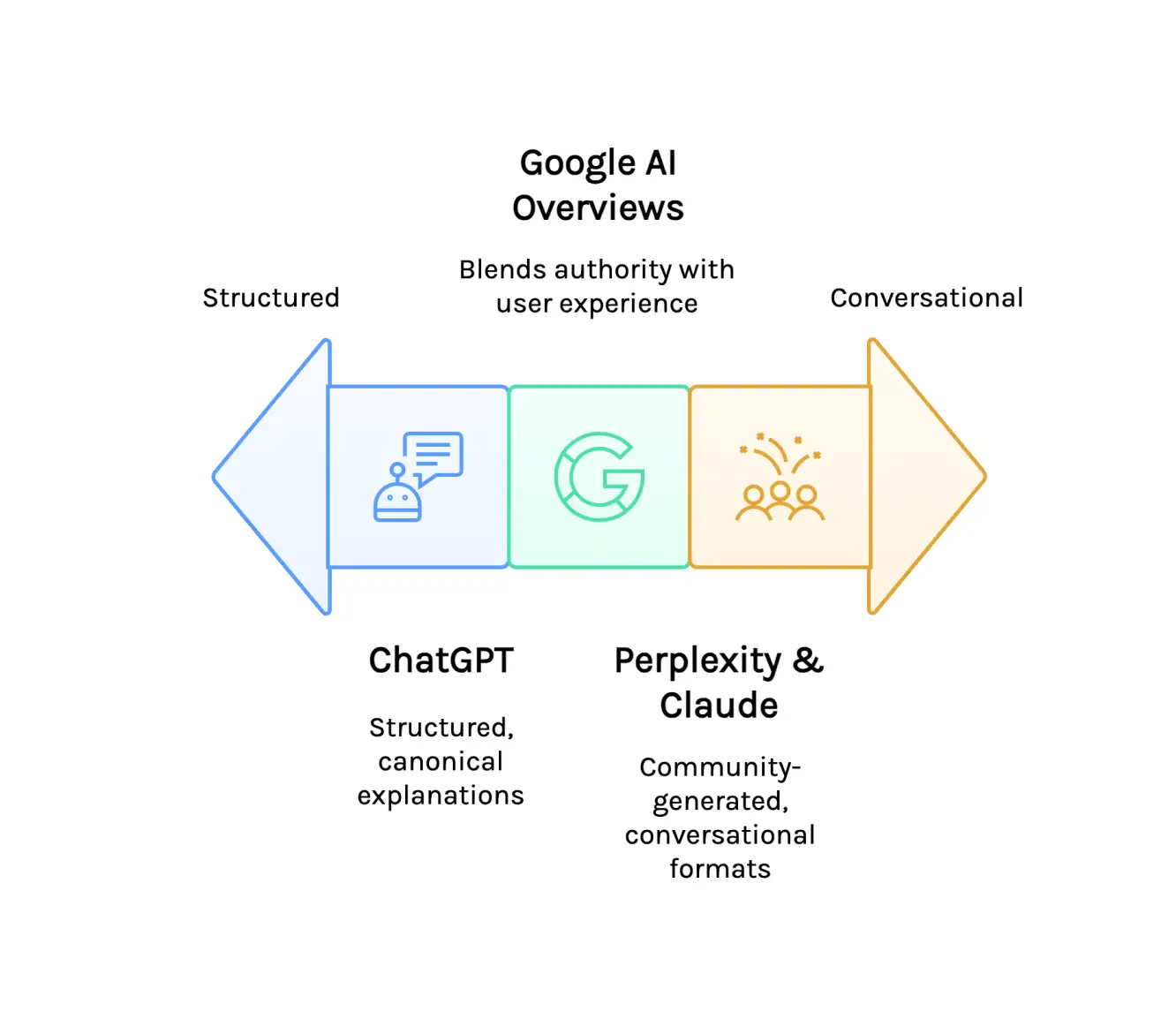
ChatGPT gravitates toward structured, canonical explanations, defaulting to Wikipedia when possible. Make your content similarly clear and authoritative.
Google AI Overviews Optimisation
88.1% of queries triggering AI Overviews are informational. Google surfaces AI-generated summaries for queries seeking knowledge rather than transactions.
Optimise for AI Overviews:
- Target informational keywords with comprehensive answers
- Use featured snippet formatting (clear answers in the first paragraph)
- Maintain Google Merchant Centre listings for eCommerce
- Add structured data for products, reviews and FAQs
- Create step-by-step guides with numbered lists
- Include comparison tables for decision-making queries
Google's AI Overviews blend traditional authority signals with practical user experiences, pulling from diverse content types.
Perplexity and Claude Optimisation
Perplexity and Claude favour community-generated content and conversational formats.
Key tactics:
- Encourage customer reviews and discussions on public platforms
- Participate authentically in Reddit and Quora conversations
- Create content that addresses real user pain points with specificity
- Use natural language that mirrors how people actually speak
- Build entity associations through consistent messaging across channels
Measuring AI SEO Success
Traditional SEO metrics don't fully capture AI visibility. Track these indicators:
AI Citation Metrics
Monitor:
- Frequency of brand mentions in AI responses
- Citation context and sentiment (positive/negative/neutral)
- Which content pieces AI platforms reference most
- Competitor share of voice in AI answers
Tools: Semrush AI Toolkit, Profound, Ahrefs Brand Radar
Referral Traffic Analysis
Traffic from AI platforms shows up distinctly in analytics. Monitor:
- utm_source=chatgpt.com for ChatGPT referrals
- ai.google for Google Gemini clicks
- perplexity.ai referrals
- Conversion rates from AI traffic vs traditional search
Content Performance Indicators
Track:
- Which pages appear most frequently in AI citations
- Query types that trigger your content in AI responses
- Content formats (guides, case studies, tools) that perform best
- Topics where you have strong AI visibility
Manual Baseline Testing
Regularly test AI platforms directly:
- Ask relevant questions about your niche across ChatGPT, Perplexity and Claude
- Note whether they cite you, which pages they reference and how they describe you
- Document positioning relative to competitors
- Identify content gaps where you should increase visibility
Common AI SEO Mistakes to Avoid
Over-Reliance on AI-Generated Content
Research shows that 35% of businesses are unaware that AI can be used for content and SEO, while others over-rely on it.
AI tools help with research and drafting, but content requires human expertise to:
- Ensure accuracy and avoid hallucinations
- Maintain brand voice consistency
- Add authentic experience and nuanced insights
- Build trust through genuine authority
Ignoring Traditional SEO Foundations
Strong traditional SEO remains essential for AI visibility. AI platforms largely train on content that already ranks well in search engines.
Continue investing in:
- Comprehensive keyword research
- Quality backlink acquisition
- Technical SEO optimisation
- Core Web Vitals performance
- Mobile responsiveness
Neglecting User Experience
Poor user experience hurts engagement metrics that both search engines and AI platforms can detect. Maintain:
- Fast page load speeds
- Clean, intuitive navigation
- Responsive design across devices
- Accessible content structure
- Clear calls to action
Blocking AI Crawlers Accidentally
Many websites unknowingly block AI crawlers through overly restrictive robots.txt files. If you're blocking OAI-SearchBot, you're effectively invisible to ChatGPT's search experience.
Audit your robots.txt regularly to ensure legitimate AI crawlers have access.
Real-World AI SEO Results
Early Mover Advantages
Businesses leveraging AI reported better rankings after Google algorithm updates - 49.2% saw improvements.
Companies optimising for AI search early capture visibility before markets become saturated. ChatGPT now refers 10% of new Vercel signups, demonstrating measurable business impact from AI platform visibility.
B2B Success Patterns
Our B2B AI SEO case study shows how a property management outsourcing company has attributed about $8.7M in revenue over 27 months and counting; the 17-month climb window ran at a 6,864% average ROI while capturing first-mover advantage in AI search platforms.
The strategy focused on:
- Building comprehensive topical authority in their niche
- Creating detailed guides answering specific industry questions
- Implementing structured data across all content
- Earning citations from authoritative industry publications
B2C Market Share Gains
Our B2C AI SEO case study demonstrates how a compensation claims business went from a single-page website to attributing about A$14.6M in organic revenue over 21 months and counting, with an average monthly ROI of 14,738%.
Key tactics included:
- Optimising for conversational legal queries
- Creating extensive FAQ content with schema markup
- Building authority through third-party mentions
- Targeting information-seeking queries that AI platforms prioritise
The Future of AI SEO
Continued Platform Fragmentation
AI-native search is fragmenting across platforms like Instagram, Amazon and Siri, each powered by different models and user intents. Successful AI SEO strategies must account for:
- Multiple AI platforms with different algorithms
- Diverse content formats (text, images, video)
- Platform-specific optimisation requirements
- Varying citation and attribution standards
Integration, Not Replacement
The brands that master both traditional SEO and AI Search Optimisation will win the visibility battle. Traditional SEO provides the foundation; AI optimisation extends reach into new discovery channels.
56% of marketers already use generative AI for SEO in 2025 and this adoption will only accelerate. The most successful strategies combine proven SEO principles with AI-specific optimisation techniques.
Multimodal Optimisation
Future AI SEO will extend beyond text to:
- Visual search optimisation for AI platforms
- Audio content for voice assistants
- Video content structured for AI comprehension
- Real-time data integration for current information needs
Frequently Asked Questions
How does AI SEO differ from traditional SEO?
Traditional SEO focuses on ranking web pages in search engine results. At the same time, AI SEO optimises content to be cited and recommended within AI-generated answers on platforms like ChatGPT and Google's AI Overviews. AI search queries average 23 words compared to 4-5 for traditional searches, requiring more comprehensive, conversational content.
Do I still need traditional SEO if I'm doing AI SEO?
Yes. Strong traditional SEO remains essential because most AI platforms train on content that already ranks well in search engines. Traditional SEO provides the foundation that enables AI visibility. The most effective approach combines both strategies.
How quickly can I see results from AI SEO?
Results vary based on existing authority and implementation. Companies using AI reported better rankings after Google algorithm updates, with 49.2% showing improvement. Expect 3-6 months to establish meaningful AI platform visibility, with ongoing optimisation required as platforms evolve.
Which AI platforms should I optimise for first?
Prioritise based on where your audience searches. ChatGPT has 800 million weekly users, making it critical for most businesses. Google's AI Overviews appear in 13.14% of all searches, particularly for informational queries. Start with these two platforms, then expand to Perplexity, Claude and Gemini.
Can AI-generated content rank in AI search results?
AI platforms can detect and deprioritise low-quality AI-generated content. Google's position is clear: AI-generated content faces no inherent penalties. Content quality and usefulness lead the way. Use AI tools to assist research and drafting, but ensure human expertise, original insights and fact-checking before publishing.
How do I track my visibility in AI search results?
Use specialised tracking tools like Semrush's AI Toolkit, Profound, or Ahrefs Brand Radar to monitor brand mentions in AI responses. Track referral traffic from AI platforms using utm_source parameters in Google Analytics. Additionally, manually test AI platforms regularly by asking relevant questions about your niche.
What's the difference between GEO and AI SEO?
They're essentially the same thing, just different terminology. Generative Engine Optimisation (GEO), Large Language Model Optimisation (LLMO) and Answer Engine Optimisation (AEO) are all names for optimising content for AI platforms. Different researchers and agencies coined different terms, but they all describe the same practice: making your content discoverable and citable by AI systems like ChatGPT, Perplexity and Google's AI Overviews. We use "AI SEO" as the umbrella term because it's clearest for our clients.
How important is structured data for AI SEO?
Structured data using schema markup plays a pivotal role in making information easily extractable by AI systems. Content with schema sees up to 214% boosts in AI visibility. Implement FAQPage, HowTo, Article and Product schema where relevant.
Should I block AI crawlers to protect my content?
Blocking AI crawlers makes you invisible in AI-generated responses. If you block ChatGPT's OAI-SearchBot, you're effectively invisible to ChatGPT's search functionality. Unless you have specific legal or competitive reasons, allow AI crawlers to access your public content to maintain discoverability.
What content formats perform best in AI search results?
AI platforms favour comprehensive guides, detailed case studies, FAQ sections and how-to content with clear structure. Content demonstrating first-hand experience, including statistics and citations and providing unique insights consistently outperforms generic informational content.
Your AI SEO Advantage Starts Here
The AI-powered SEO sector reached $67 billion in 2025, and 86% of SEO professionals have already integrated AI into their strategy. Waiting to optimise for AI search means conceding visibility to competitors while your audience increasingly turns to ChatGPT, Perplexity and AI Overviews for answers. The companies capturing this visibility now, before markets saturate, gain sustainable advantages in brand authority and organic revenue growth.
About the Author
Want Insights Like This Fortnightly?

Our AI SEO strategies and tactics delivered fortnightly, including bonus trade secrets not shared anywhere else. No fluff. Just what's working right now. 5-minute read.


