
How Does AI Impact SEO? Why I Now Track AI Citations Alongside Rankings


How does AI impact SEO when Google now answers first? AI sits at the centre of Search, shaping which brands people see, so understanding its impact is no longer optional for teams that depend on organic traffic. Google's AI Overviews now show in roughly 16% of all queries, while ChatGPT processes over 5 billion monthly visits and 900 million weekly users. The game has changed. This guide explains what shifted and what to do now to protect visibility and growth in 2026. More importantly, it shows you the metric I have started reporting to clients alongside rankings, and why.
Quick Guide: How Does AI Impact SEO?
AI impacts SEO by changing both how search engines deliver results and how people find information. Google's AI Overviews reduce organic click-through rates by around 61%, while platforms like ChatGPT now drive 87.4% of all AI referral traffic. Ranking in the "10 blue links" no longer guarantees visibility. Success now means optimising for search engines and the AI platforms that generate direct answers from your content. The brands winning this shift are not just ranking. They are getting cited, and I now track those citations as a KPI in their own right.
See How AI SEO Drives Real Revenue
AI has changed how customers find businesses online. The brands appearing in Google's AI Overviews and ChatGPT recommendations are capturing market share while competitors watch traffic decline. Across our client base we have generated over $26 million in attributed revenue, including a B2C campaign that reached a 14,738% average monthly ROI over 21 months and counting. Results vary by business, market and starting position, but the pattern is consistent: get cited, and revenue follows. Book a 45-minute discovery session with me to see how AI SEO can work for your growth.
Speak with the FounderThe Rise of AI in Google Search
Google has built AI directly into its core search experience, and that has changed how results reach users. This section covers the AI features reshaping search and what each one means for your strategy.
Understanding Google's AI Overviews
Google's AI Overviews are powered by Gemini models that generate summaries at the top of search results. They pull from multiple sources and present a direct answer before the traditional organic listings.
The rollout has been fast, if volatile. AI Overviews appeared for just 6.49% of queries in January 2025, peaked at 24.61% in July, then settled at around 16% of all queries by late 2025. Research from Semrush, analysing over 10 million keywords, found that 91.3% of queries triggering AI Overviews were informational in January 2025. By October, that share had fallen to 57.1% as commercial, transactional and navigational queries triggered far more of them. Educational content still feels the heaviest impact, but lower-funnel pages are no longer insulated.
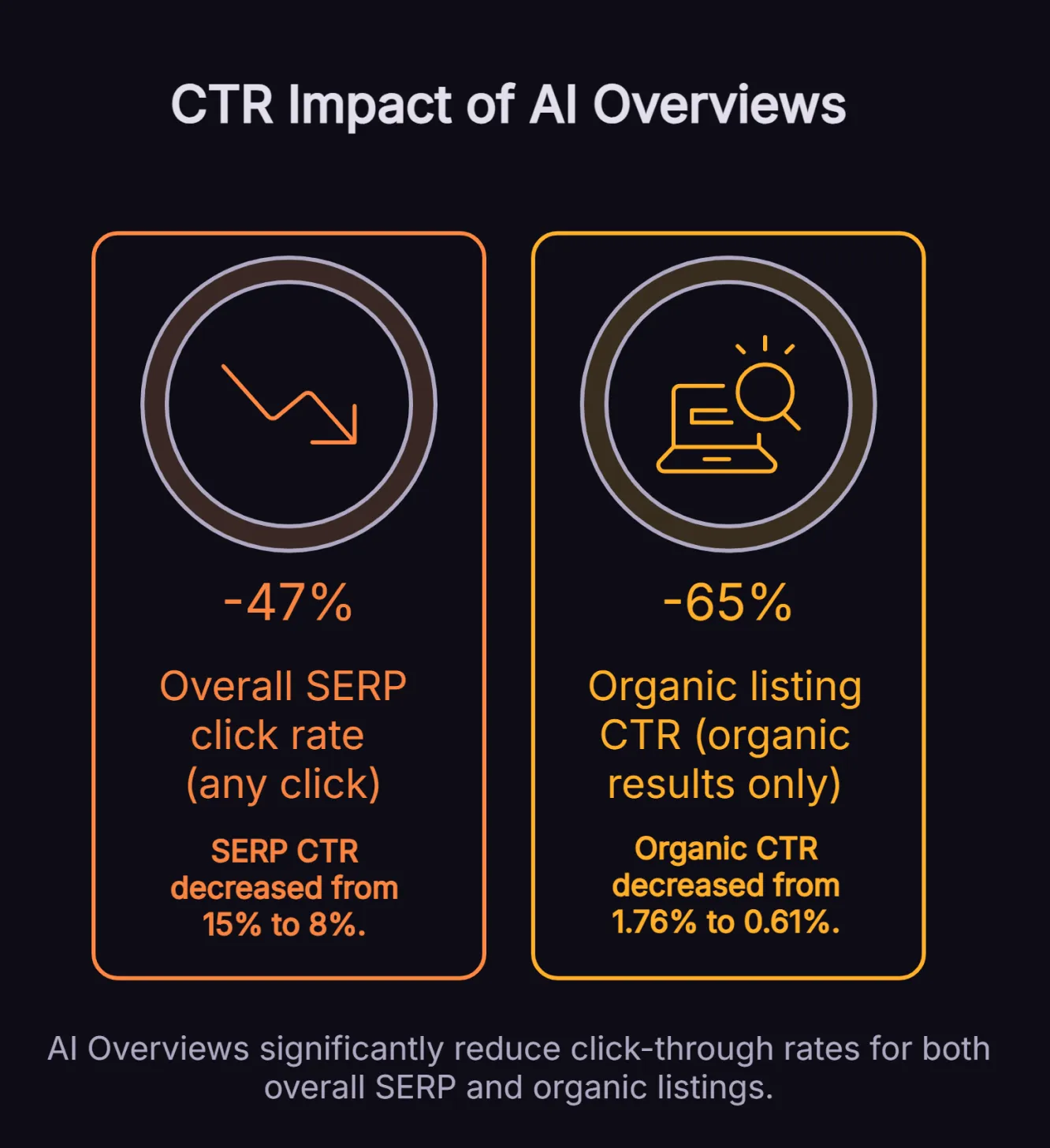
When an AI Overview appears, behaviour changes. Pew Research found the share of people clicking any result fell from 15% to 8% when an AI summary was present. For teams that have invested heavily in content, that is a real challenge to absorb.
Google AI Mode: The Next Evolution
Google AI Mode was announced in Search Labs on March 19, 2025, with a broader rollout following in May. Unlike AI Overviews, which sit on top of traditional results, AI Mode is a fully conversational search experience similar to ChatGPT. At Google I/O 2026, Google reported that AI Mode had surpassed one billion monthly users just one year after its debut, with queries more than doubling every quarter since launch.
Users in AI Mode do not see the "10 blue links" at all. They get synthesised answers from Google's Gemini model. AI Mode uses query fan-out to run several searches in parallel and combine the results. In practice, the system splits a single question into roughly 5 to 11 related sub-queries, retrieves content for each, then synthesises one answer. That detail matters, because your page does not need to win the head term. It needs to be the best answer to one of those hidden sub-queries.
Early data from Semrush's study on AI Mode shows the average query length in AI Mode is nearly double that of traditional search (7.22 words versus 4.0 words). People treat AI Mode like a conversation, asking full questions rather than typing keyword fragments.
For marketers, the rule is simple. You either get cited in AI Mode's responses or you are invisible. There is no middle ground.
How AI Platforms Are Capturing Search Traffic
The shift goes well beyond Google. ChatGPT, Perplexity and Microsoft Copilot are emerging as alternative search destinations, especially for complex research queries.
ChatGPT's Growing Influence on Search
ChatGPT is now a legitimate search channel. With 900 million weekly active users as of February 2026 and more than 5 billion monthly visits, it ranks among the most visited sites in the world. Real-time search has turned ChatGPT from a chatbot into a direct competitor to Google for certain query types.
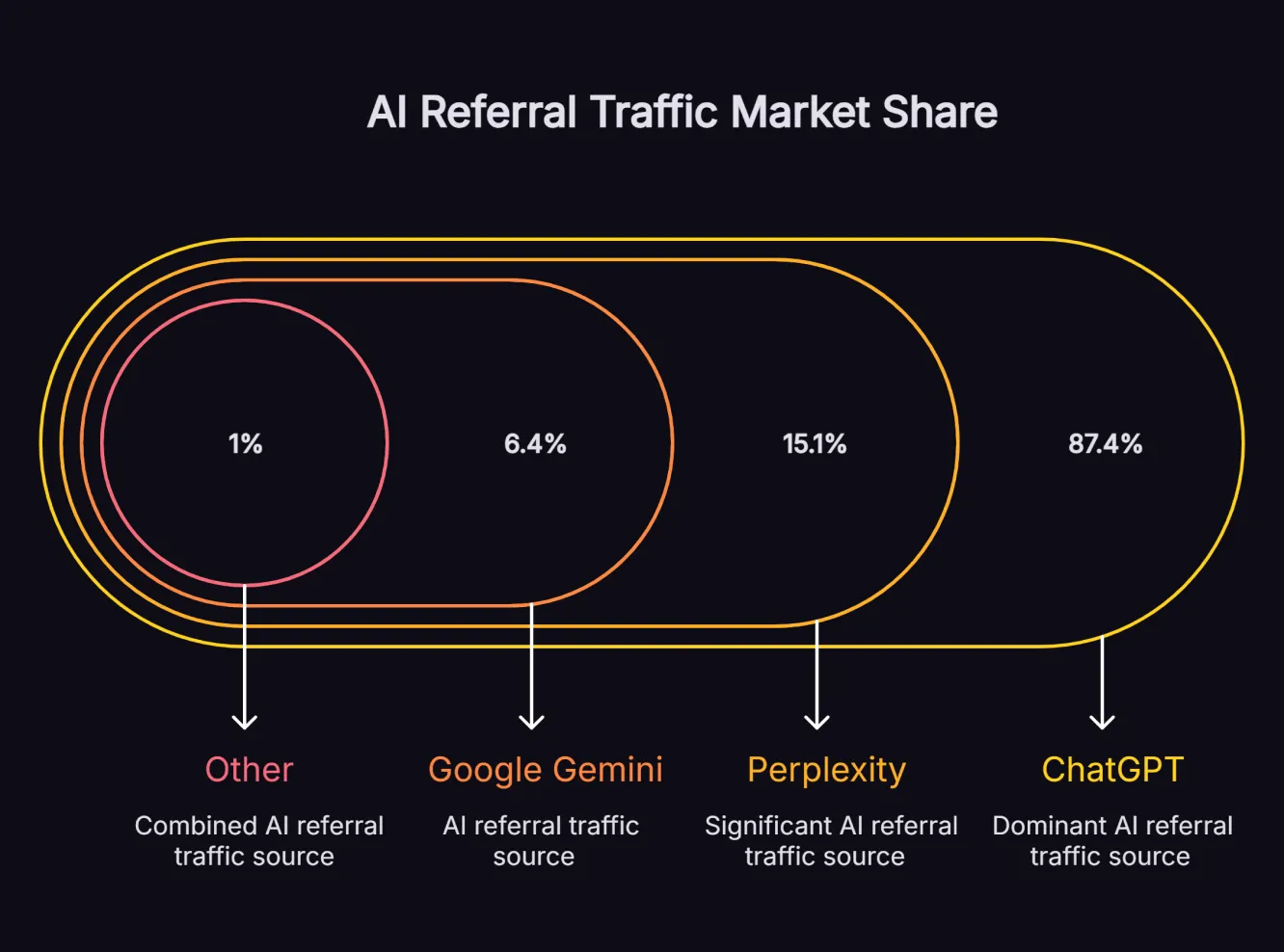
The platform drives 87.4% of all AI referral traffic. AI referrals currently account for 1.08% of total website traffic, while SE Ranking’s earlier AI traffic study found AI platforms had grown from 0.02% in 2024 to 0.15% in 2025. The direction of travel is clear.
ChatGPT's citation patterns differ from Google's rankings. Ahrefs found that only 12% of links cited by ChatGPT, Gemini and Copilot appear in Google’s top 10 results for the same prompt. Ranking well on Google does not guarantee visibility in AI platforms. Selection appears to favour content depth, freshness, query-fit and direct relevance, not just traditional ranking signals. I see the same pattern in my own work: getting cited in ChatGPT follows a three-step sequence of fixing the technical foundation, structuring content for extraction, then building topical authority that earns citations over time.
The Multi-Platform Search Landscape
SE Ranking’s earlier 2025 study showed the same pattern before the newer 87.4% benchmark, with ChatGPT driving 77.97% of AI-driven visits, followed by Perplexity at 15.10% and Google’s Gemini at 6.40%. Smaller players like DeepSeek and Claude held minimal share but showed interesting growth.
Users arriving from AI platforms behave differently from organic search visitors. SE Ranking found that visitors referred by AI platforms spend 68% more time on websites than visitors from traditional organic search. AI tools act as “intent filters”, bringing people who are further along in their research and more likely to convert.
I have seen this convert in practice, not just in theory. For one B2B property management client, AI search traffic converted at 6.24% against 3.29% for traditional organic search over the same period. Nearly double the conversion rate from the channel most marketers are still ignoring. That is the real argument for taking AI visibility seriously: it is not a vanity channel, it is often the better-converting one.
For B2B companies, this matters even more, because ChatGPT is now widely used inside the workplace for research, not just at home.
I have seen a similar pattern on the B2C side. In one eCommerce engagement, AI-referred conversion was comparable to organic conversion, even while AI traffic made up a smaller share of sessions. That matters because it reframes AI search as a quality channel, not just a volume channel.
The Impact on Organic Traffic and Click-Through Rates
The spread of AI features has created measurable traffic effects that marketing leaders need to understand and plan around.
Understanding the Click-Through Rate Decline
Seer Interactive's study tracking 3,119 search terms across 42 organisations found that organic CTR for queries with an AI Overview fell by around 61%, from 1.76% to 0.61%. Paid CTR dropped even harder, falling 68% from 19.7% to 6.34%.
There is an important upside inside that decline. Seer also found that brands cited in AI Overviews earned 35% more organic clicks and 91% more paid clicks than brands that were not cited. That does not prove citation causes the lift, but it does show why citation tracking now belongs beside rankings, CTR and revenue in the SEO reporting stack.
These are not isolated findings. BrightEdge research confirmed a 30% average CTR drop across its client base after AI Overviews expanded. MailOnline reported that when AI Overviews appear for its content, CTR drops to less than 5% on desktop and 7% on mobile, down from 13% and 20% for queries without AI features.
This is also why position has become a weaker proxy for value. A page ranking in the top three positions for a term searched 200 times a month by buyers will typically outperform a page ranking eighth for a term searched 5,000 times a month by researchers. When AI absorbs the easy informational clicks, the clicks that remain are worth more, and they are not evenly distributed across the keywords you rank for.
Why Zero-Click Searches Are Increasing
Research from Bain & Company found that 60% of searches now end without the user clicking any result. When AI answers the question in the interface, people have less reason to visit a site.
This trend is not new, but AI has accelerated it. Featured snippets, knowledge panels and "People Also Ask" boxes have been trimming clicks for years. AI Overviews are the biggest expansion of zero-click search in Google's history.
The impact varies by query type. Informational queries lose the most clicks, while commercial and transactional queries hold up better. Health, science, education and legal topics see particularly high AI Overview appearance because people want complex information simplified.
Reframing Success Metrics for the AI Era
The data points to one conclusion: traffic-first KPIs need a rethink. I now recommend treating AI citations as a competitive KPI in their own right, tracked separately from ranking and traffic.
Here is what that looks like in practice. For a B2B property management client, I treated AI citations as a tracked outcome from day one. over 27 months and counting, from April 2024 to August 2025, the campaign grew organic users from 4,973 to 26,313, a 429% increase, while earning 598 AI cited pages across multiple search surfaces. Revenue attributed to organic search and AI platforms has reached about $8.7M over 27 months and counting; the 17-month climb window attributed $5.9M at a 6,864% average ROI.
Across the wider Rankmax AI SEO work I oversee, I have now tracked more than $26M in attributed client revenue, with selected campaigns achieving up to 14,738% average monthly ROI on the B2C series. Those figures are not a guarantee of future performance, but they show why I no longer treat AI citations as a footnote in reporting. They can become the leading indicator that revenue is coming.
Being cited carries a real premium. A cited brand is the one AI repeats, recommends and links, which is the closest thing to shelf space in an answer-first world. For marketing leaders, that means shifting some measurement focus toward brand visibility in AI responses, mention frequency across platforms and conversion quality from the traffic you do receive, rather than chasing volume alone.
How AI Is Transforming SEO Workflows
AI has not just changed how people search. It has changed how marketing teams do SEO work. A recent survey found that 47% of marketers now use AI SEO tools to improve efficiency, with 84% using them to spot emerging trends.
AI-Powered Keyword Research and Analysis
AI tools analyse search patterns at a scale manual research cannot match. In practice, they do three things well:
- They identify semantic relationships between topics
- They predict trending and rising queries
- They surface keyword opportunities that would take a human researcher weeks to find
In my workflow, I do not use AI to create a raw keyword dump. I use it to expand a seed topic into query fan-out patterns, then check those against search volume, ranking difficulty, SERP format and commercial intent. That matters because AI search rarely answers only the head query. It often pulls from the smaller supporting questions hidden underneath it.
These tools use natural language processing to read intent beyond exact-match keywords. They pick up question-based queries, conversational phrases and topical clusters that map to how AI search systems actually process information.
Content Creation and Optimisation
I use AI to speed up research, structure and first-draft development, but not to replace subject-matter expertise. The real value comes after the draft exists: checking whether the page has a clear answer capsule, evidence-backed claims, original examples, a clean heading structure and extractable passages that AI systems can cite. That is the difference between using AI to publish more content and using AI to produce content that deserves to be selected. The bar to clear is non-commodity content: pages built on original insights, first-hand data and analysis that does not already exist on a thousand other sites. Lean on AI to mass-produce automatically generated content without that layer and you will likely get caught by Google's scaled content abuse policy.
Predictive Analytics and Trend Forecasting
I use predictive analysis less as a forecasting gimmick and more as a prioritisation tool. The practical question is: which topics are rising early enough to justify content investment before the SERP hardens? For AI SEO work, I look for patterns across query growth, AI Overview appearance, competitor coverage and citation potential. That helps decide whether a topic should become a quick refresh, a new article or a full cluster. The specific tool I use for this is the Semrush AI Visibility Toolkit, which surfaces prompt-level demand and competitor AI citations early, before that demand shows up in classic keyword data.
How to Optimise for AI Search Visibility
Winning in the AI era takes specific approaches that differ from traditional tactics. Google's official guidance confirms that the fundamentals that earn rankings also improve AI visibility, but the implementation needs refining.
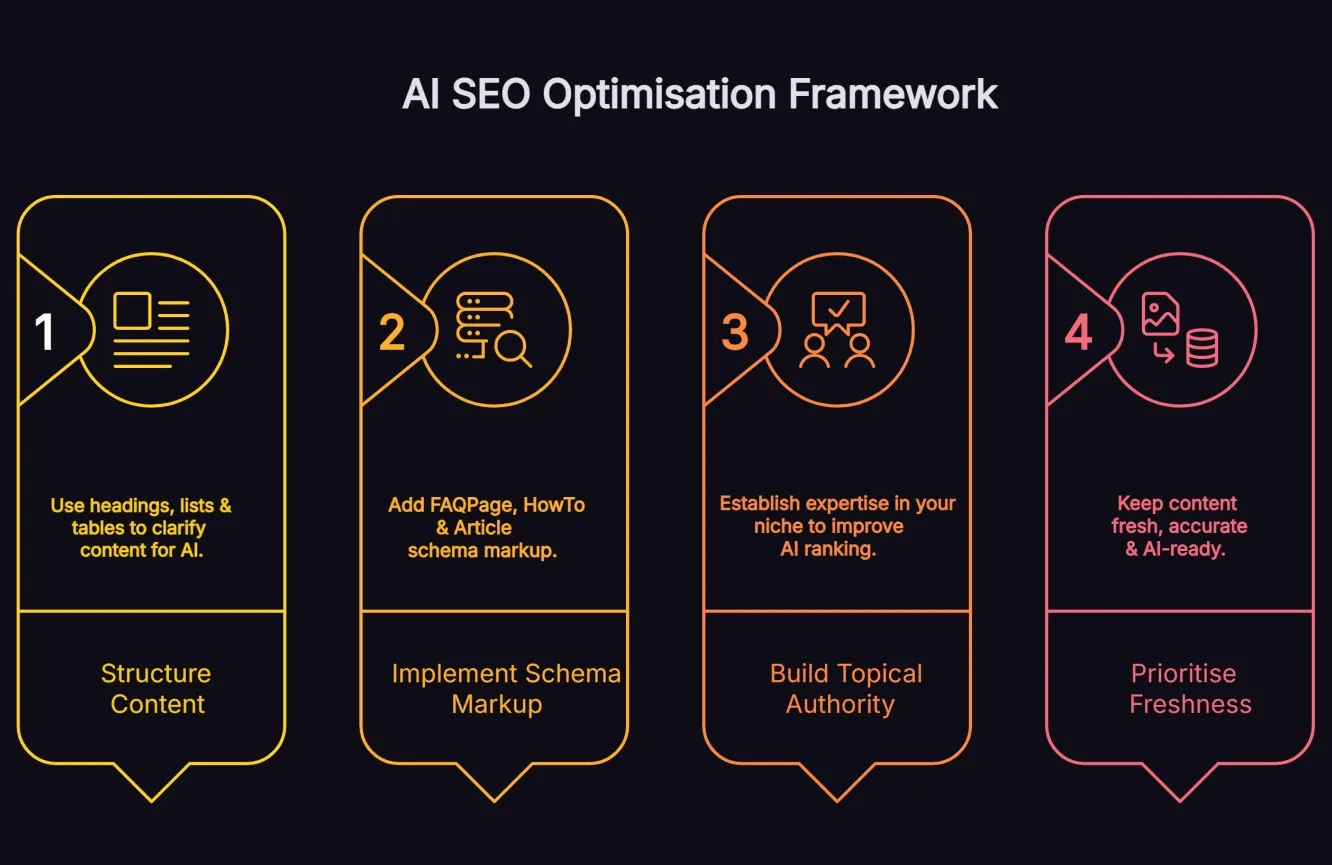
1. Structure Content for AI Comprehension
This is not about writing content for machines. Write for humans first, then structure it so machines can parse it; the two are not in tension, and the pages that win do both well at the same time. AI systems parse pages into smaller, structured pieces and evaluate each for authority and relevance, so content that reads naturally for a person while segmenting cleanly for a machine is the content that earns citations.
Every page should have one clear H1 stating the topic, followed by logical H2s for major sections and H3s for subsections. These act as signposts that help AI navigate your hierarchy. Use direct, descriptive headings rather than clever but vague ones.
Break information into bullet points or numbered steps where it fits. AI systems handle simple lists well. If you have data or comparisons, present them in a table for easy parsing.
2. Implement Schema the Way I Do It
Structured data is not a special requirement for AI Overviews or AI Mode. Google states that there is no special schema.org structured data required to appear in these AI features. Google can afford that position: it has its own Knowledge Graph and has spent 25 years learning to understand the open web. Other AI systems cannot. ChatGPT, Perplexity and Copilot run less sophisticated crawlers and have no search index of their own at Google's depth, so they lean on schema far more heavily to work out who you are, what you offer and why you should be trusted. If multi-platform visibility is the goal, and it should be, in-depth and relevant schema that surfaces your E-E-A-T signals is one of the strongest levers you have outside Google.
The method matters as much as the markup. Every schema implementation I build uses the @graph format, which groups multiple entity types in a single JSON-LD block and cross-references them with @id values, so entities relate to each other cleanly without duplicating information. I apply it in two tiers. Core and pillar pages (home, about, contact, main service pages) carry the full Organisation entity. Content pages like articles and case studies reference that entity by @id rather than repeating it. That keeps your business identity consistent everywhere and avoids the contradictory duplicate-entity signals that confuse both Google and AI systems.
Implement schema in JSON-LD, which Google prefers, then validate with Google's Rich Results Test. Done well, schema supports clearer entity understanding and eligibility for relevant rich results. It should sit beneath strong content, internal linking and technical accessibility, not be treated as a shortcut to AI citation. And schema can only surface E-E-A-T signals that actually exist, which is exactly where the next step comes in.
3. Build Topical Authority and E-E-A-T Signals
Google's AI systems still lean on many of the same quality signals that support traditional search visibility. Ahrefs found that 76.1% of URLs cited in AI Overviews also rank in Google’s top 10, which suggests traditional authority still influences AI citation, especially inside Google’s own search experience.
Build topical authority by covering whole topics comprehensively rather than publishing isolated pieces aimed at single keywords. Create content clusters that address a primary topic and its related subtopics, connected through internal linking.
Show expertise through detailed author bios, real credentials and references to primary sources. Google's AI systems favour content with clear authorship and original insight over aggregated summaries.
4. Prioritise Content Freshness and Accuracy
AI systems lean toward recently published or updated content, especially in fast-moving industries. Depth, readability and freshness matter more than traffic and backlinks when you are trying to earn AI mentions.
Update existing content regularly with current statistics, new developments and refreshed examples. Add timestamps showing when a page was last reviewed. For time-sensitive topics, set a review cycle rather than waiting for content to go stale.
Fact-check every claim and link to authoritative sources. AI systems weigh both your content and its supporting evidence when deciding what to cite.
The Future of SEO in an AI-Dominated Landscape
Search will keep evolving as AI capability grows. Marketing leaders need to read the emerging trends and position accordingly.
Rankings and Citations, Not Rankings or Citations
Traditional SEO measured success mostly through ranking position and organic traffic. Those still matter, and nothing here replaces them. AI search adds new metrics centred on citation frequency, mention sentiment and brand visibility inside AI answers. The goal is comprehensive coverage of both: organic search rankings and AI citations, across every platform your buyers use, not a migration from one scoreboard to the other.
Measurement is still imperfect. Google reports AI Overviews and AI Mode inside Search Console’s Performance report, counted within the “Web” search type, rather than in a dedicated AI-only report. That means the cleanest signal still comes from pairing Search Console with analytics, AI referral tracking and dedicated AI-visibility monitoring.
The citation explosion is real once you measure for it. For an eCommerce client, treating citations as a dedicated KPI surfaced 866 AI citations across ChatGPT, AI Overviews, AI Mode and Gemini, from Google AI Overviews to ChatGPT, Perplexity, Gemini and Copilot. My advice is to set your baseline AI visibility now, before competition intensifies. You cannot improve a number you have never measured.
Content Quality Over Content Volume
Google has signalled that its index is getting more selective. It does not want more generic, low-value content, because processing it is expensive. The bar is rising and thin pages are being pruned.
This favours brands that invest in fewer, more comprehensive pieces over those publishing high volumes of shallow content. AI-referred users tend to convert better because they arrive more engaged and further along in their decision. Quality over quantity becomes a revenue strategy, not just a content principle.
Diversified Search Presence
Visibility increasingly means showing up across multiple platforms, not Google alone. ChatGPT now drives 20% of referral traffic to major retailers like Walmart, which shows how significant a traffic source AI platforms can become for the brands that optimise for them.
Your strategy should address visibility across:
- Google's traditional results
- AI Overviews
- AI Mode
- ChatGPT
- Perplexity and industry-specific platforms
Each channel has different selection criteria, but content quality and structured presentation help across all of them.
Frequently Asked Questions
Does ranking #1 on Google guarantee visibility in AI Overviews?
No. While there is a correlation between top rankings and AI citations, with 76.1% of AI Overview citations coming from top-10 results, position alone does not guarantee citation. AI systems evaluate relevance, structure and how directly your content answers a specific query. Some top-ranking pages never appear in AI Overviews, while lower-ranking content that nails query intent sometimes gets cited. Optimising for AI visibility means focusing on answer comprehensiveness and structural clarity alongside traditional ranking factors.
How do I measure AI search performance?
Track AI visibility through tools like Ahrefs Brand Radar and platform-specific analytics. Monitor referral traffic from chatgpt.com, perplexity.ai and other AI platforms in Google Analytics, and build custom channel groups for AI traffic using regex patterns. Test relevant queries manually to watch for brand mentions in AI answers. In Google Search Console, AI Overviews and AI Mode now feed into the Performance report within the "Web" search type, so review impressions and CTR there for queries where you rank well but clicks have fallen.
How long does it take to see results from AI SEO optimisation?
For established sites, I usually look for early movement within 60 to 90 days, but consistent AI visibility takes longer. In one eCommerce engagement, the first ranking gains appeared around the 60-day mark, while the first ChatGPT citations appeared closer to 90 days. In another eCommerce campaign, tracking AI citations as a dedicated KPI surfaced 169 citations across five platforms within five months. Newer sites or highly competitive industries may still need 6 to 12 months because authority, crawlability and topical depth all compound over time.
What content types perform best in AI search?
Content that answers questions directly, and backs those answers with unique insights and original data, performs best. A direct answer on its own is commodity content that AI systems can find on a hundred other sites; original research, first-hand numbers and lived experience are what make a page worth citing. With that foundation in place, FAQ pages, how-to guides, comparison articles and comprehensive explainers earn the highest citation rates. AI systems favour clear structure, including proper heading hierarchy, bullet points, numbered lists and data in tables. Product pages, case studies and pricing information also perform well for commercial queries where AI provides recommendations.
Will AI replace traditional SEO completely?
AI will not replace SEO, but it is changing what effective SEO looks like. Traditional signals like backlinks and keyword optimisation still matter for appearing in Google's index, which AI systems rely on for source material. SEO now extends beyond rankings to include optimisation for AI citation and visibility across multiple platforms. The fundamentals of creating helpful, well-structured content still hold, but implementation has to account for how AI systems process and cite information.
Should I block AI crawlers from accessing my website?
Blocking AI crawlers is usually counterproductive unless you have a specific content-usage concern that outweighs the visibility cost. Brands that allow AI crawling stay visible in AI answers, while those that block crawlers become invisible to AI platforms. Amazon's decision to block ChatGPT crawlers, for example, reduced its referral traffic while competitors gained. Weigh your own situation, but most businesses benefit from AI visibility rather than exclusion.
Adapting Your Strategy for AI-Powered Search
AI is driving the biggest shift in search since mobile-first indexing, reshaping traffic, behaviour and the metrics that matter. The move that has paid off most for my clients is a measurement one: tracking AI citations as a KPI in their own right, alongside rankings and sessions rather than instead of them. Balance SEO fundamentals with AI-specific optimisation so your content satisfies both human readers and AI systems. Support discoverability across Google's traditional index and the emerging AI platforms and widen measurement to include citation rates and brand visibility. Build your AI SEO strategy around these realities now, and the advantage compounds as AI search adoption accelerates.
About the Author
Want Insights Like This Fortnightly?

Our AI SEO strategies and tactics delivered fortnightly, including bonus trade secrets not shared anywhere else. No fluff. Just what's working right now. 5-minute read.


