
What Is Query Fan-Out? How AI Search Turns One Query Into Many


When you type a question into Google AI Mode, ChatGPT, or Perplexity, something happens behind the scenes that most marketers never see. The AI does not stop at your exact words. It splits your question into a set of related sub-queries, retrieves content for each one in parallel, then synthesises everything into a single answer. This is called query fan-out, and it has changed how content earns visibility in search. Understanding how it works, and building your content around it, is now one of the highest-leverage things you can do for organic growth. Here is how it works, and how we optimise for it at Rankmax.
Query Fan-Out: A Quick Guide
Query fan-out is a retrieval technique used by AI search systems, including Google AI Mode, AI Overviews, ChatGPT, and Perplexity, that breaks a single user query into multiple parallel sub-queries. Rather than matching your exact words to one page, the AI expands, or "fans out," your query into a set of related questions, angles, and subtopics, retrieves content across all of them at once, and synthesises one answer. The result is that your content still benefits from strong keyword rankings, but in AI search it also has to compete for relevance across an entire topic landscape, not just a single query.
Turn Query Fan-Out Knowledge Into Measurable Revenue
Understanding query fan-out is only half the job. We structure content so AI platforms can cite you across Google AI Mode, AI Overviews, ChatGPT and Perplexity - the same approach behind over $26M in attributed client revenue in our case studies.
Explore AI SEO StrategyHow Query Fan-Out Works: The Step-by-Step Process
The mechanics of query fan-out follow a consistent pattern across the major AI search platforms. Here is what happens from the moment a user hits search to the moment an answer appears.
Query Analysis
The moment a user submits a search, the AI analyses the prompt to understand intent, complexity, and what kind of response will be most useful. This happens in milliseconds. Simple factual queries like "capital of France" may trigger little fan-out at all. Broader, exploratory, or comparative questions are far more likely to activate it fully. In practice, a complex prompt like "how to optimise website performance" is decomposed into several related sub-queries, each targeting a specific angle, before the final answer is assembled.
Decomposition Into Sub-Queries
The AI breaks the original query into multiple sub-queries covering different angles, subtopics, and follow-up questions the user is likely to have. Take a search for "best CRM software for small businesses." Rather than looking for one page that matches that phrase, the AI might generate sub-queries such as "best free CRM tools," "CRM with email automation," "CRM for remote sales teams," "CRM pricing for small business," and "ease of use comparison for small business CRMs." Each targets a different facet of what the user actually wants to know, and each is retrieved separately. The final answer is stitched together from whichever sources answered those facets best.
The scale of decomposition depends on the platform and the depth of the request. According to Ahrefs, Google AI Mode typically issues 5 to 11 sub-queries per search, while ChatGPT Deep Research has been observed running 420 sub-queries for a single prompt. The technique is grounded in a Google patent on query decomposition, which describes generating a set of related synthetic queries from an original query and retrieving results for each. Search Engine Journal's analysis of the patent is a useful primer on the underlying mechanism.
Parallel Retrieval Across Multiple Sources
All fan-out sub-queries run at the same time, letting the AI search across multiple sources at once:
- Web indexes
- Knowledge graphs
- Product databases
- News sources
- Specialised repositories
This means the AI is not looking at your page as a whole. It is scanning for specific passages that answer each individual sub-query. As Google confirmed in its Search Central documentation, both AI Overviews and AI Mode use the query fan-out technique, "issuing multiple related searches across subtopics and data sources to develop a response."
Synthesis Into a Final Answer
Once retrieval is complete, the AI synthesises the results from all sub-queries into a single, cohesive answer. It weighs the passages retrieved for each sub-query, favours the most relevant and trustworthy sources, cites them, and presents the response. Systems typically use a ranking-and-merging step (a reciprocal rank fusion approach) to combine results from many sub-queries into one ordered set before writing the answer. The sources that appear are not necessarily those that rank number one for the original query. They are the sources that best answered the specific sub-queries the AI generated.

Why Query Fan-Out Changes Everything for AI SEO
Query fan-out is not just a technical curiosity. It directly determines whether your business earns visibility in AI search or gets bypassed. Three shifts matter most.
The End of Keyword-Centric SEO
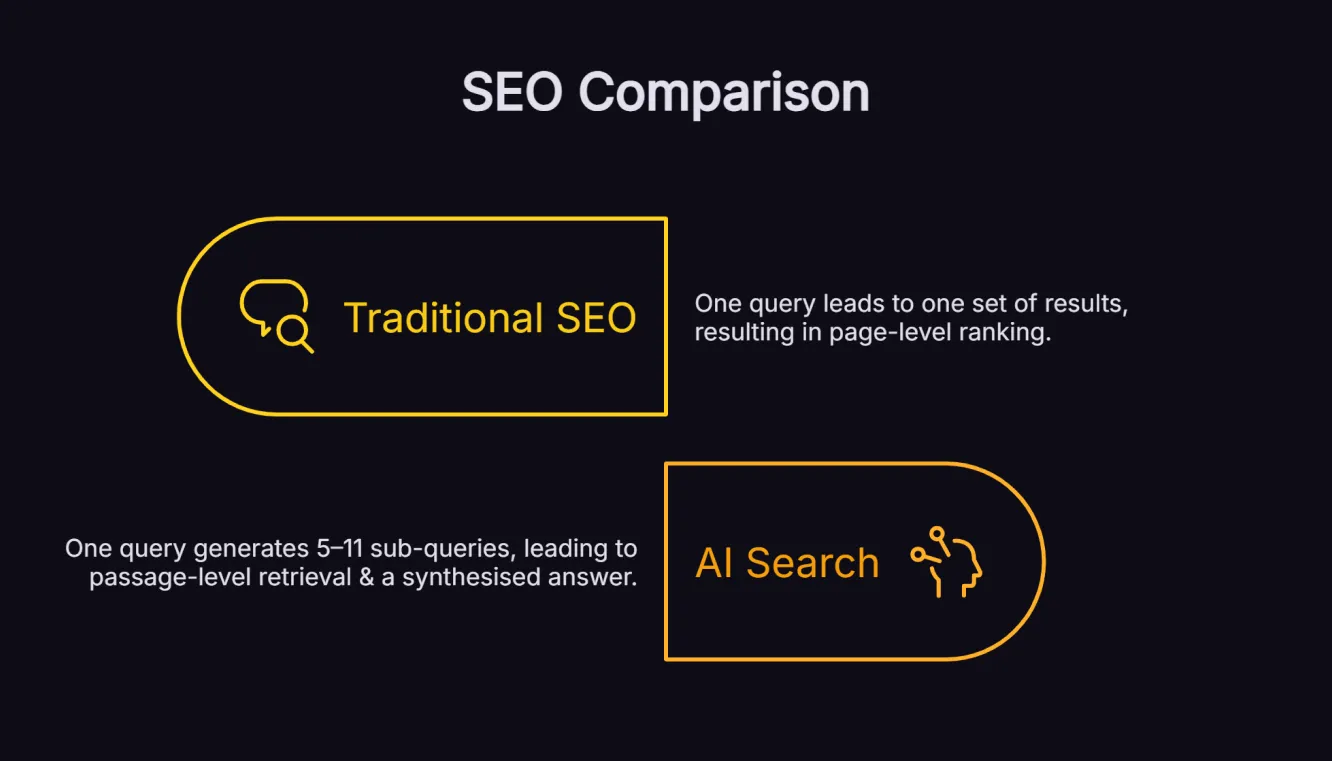
Traditional SEO was built on a simple model: one keyword, one page, one target ranking. That model no longer reflects how AI search retrieves information. Search Engine Land reported that an analysis of 173,902 URLs found around 68% of pages cited in Google AI Overviews did not appear in the top 10 organic results. Ranking number one for a keyword does not guarantee you appear in the AI answer for it. What matters is whether your content answers the sub-queries the AI generates, and most traditional strategies are not built to do that.
Passage-Level Ranking Over Page-Level Ranking
In traditional search, Google evaluates your whole page and ranks it against a query. In AI search with query fan-out, the evaluation happens at the passage level. A single paragraph from a mid-ranking page can outperform a comprehensive guide if that paragraph answers a specific sub-query more directly. This shifts the whole optimisation challenge. You are not just writing pages, you are writing individual passages that need to be precise, well-structured, and useful as standalone answers. For a deeper treatment, see our guide to passage optimisation.
We see this pattern in our own client work. For one B2B property management client, we built 598 AI cited pages across platforms over 27 months and counting, including 115 Google AI Overview citations. Many of those citations came from supporting cluster pages that answered a specific sub-query well, not only from the pages ranking highest for the head term. Covering the topic landscape, rather than chasing a single ranking, is what earned those passages a seat in the answer.
The Hidden Cost of Optimising for Traditional Search Only
Brands that rely solely on traditional rankings miss most AI citation opportunities. Ahrefs' 2026 update on AI Overview citations found that the share of cited pages also ranking in Google's top 10 has fallen to around 38%, down from roughly 76% in its earlier study. The majority of AI citations now come from beyond the first page. The pages winning AI visibility are increasingly not the pages winning the classic ranking.
How Query Fan-Out Works Across AI Platforms
Query fan-out is not exclusive to Google. Every major AI search platform uses a version of it, and each behaves differently in ways that matter for optimisation. Understanding each one helps you build a strategy that earns visibility across all of them at once.
Google AI Mode and AI Overviews
Google officially announced query fan-out at Google I/O 2025, describing it as the core mechanism behind AI Mode. Head of Search Elizabeth Reid explained that AI Mode "calls on our custom version of Gemini to break the question into different subtopics, and it issues a multitude of queries simultaneously on your behalf." Google's documentation confirms both AI Overviews and AI Mode use the technique, and Deep Search extends it, issuing hundreds of searches to produce a fully cited report.
The scale has grown fast. At launch in mid-2025, AI Mode had passed 100 million monthly users across the US and India. By Google I/O 2026, AI Mode had surpassed 1 billion monthly users and rolled out to more than 180 countries, with Gemini 3.5 Flash as its default model. AI Overviews now reach over 2.5 billion monthly users. Fan-out is no longer an edge case, it is how a growing share of all search happens.
ChatGPT
ChatGPT uses query fan-out as part of its reasoning, particularly for complex or research-oriented queries. Ahrefs documented a clear example: asked how to start an SEO podcast, ChatGPT ran parallel searches across podcast equipment, hosting platforms, episode structure, and guest outreach, all from a single prompt. Deep Research mode takes this much further. The implication is that ChatGPT rewards sources that cover a topic comprehensively, not just sources ranking for one narrow phrase. Our guide to how AI search works breaks down the retrieval mechanics in more detail.
Perplexity
Perplexity operates as a direct answer engine that shows its search process, making query fan-out visible to you. It runs parallel web searches, displays them in its interface, and selects cited sources based on how well specific passages answer each sub-query. If you want to watch fan-out happen in real time, Perplexity is the easiest place to see it.
How the Platforms Compare
The platforms share the fan-out mechanism but differ in how aggressively they decompose a query and how they surface sources. Those differences shape where the optimisation effort pays off.
| Platform | Fan-out behaviour | What it rewards |
|---|---|---|
| Google AI Mode | 5 to 11 sub-queries per search; Deep Search issues hundreds | Topical depth across a cluster of related pages |
| Google AI Overviews | Fan-out on broader and informational queries | Clear, extractable passages that answer sub-questions |
| ChatGPT | Parallel searches on complex prompts; 420 sub-queries in Deep Research | Comprehensive coverage of a topic, not a single phrase |
| Perplexity | Visible parallel searches, source list shown | Passages that directly answer each displayed sub-query |
For a closer look at how the Google surfaces differ, see our comparison of AI Overviews versus AI Mode and our guide to Google AI Mode SEO.
How to Structure Content for Query Fan-Out
Optimising for query fan-out means shifting from targeting a single keyword to covering the full landscape of sub-queries the AI is likely to generate. Here is the process we run for clients.
Step 1: Map the Fan-Out for Every Target Keyword
The first move is to see the topic the way the AI does. For each target keyword, we prompt ChatGPT, Claude, and Perplexity with the term and study how each system interprets it. This surfaces the semantic connections and related questions that traditional keyword tools miss, typically uncovering 20 to 30 related queries per keyword. Those related queries become the map of passages your content needs to answer. This exact fan-out mapping step is part of the strategy that took one eCommerce client to 866 AI citations and $1.75M in revenue in eight months. It turns a single keyword into a blueprint for the whole topic.
Step 2: Build Content That Answers the Whole Cluster
Once you have the fan-out map, structure your content so that each sub-query has a clear, standalone answer. This is where topic clusters and keyword clustering earn their keep: a pillar page plus supporting pages that, between them, cover every angle the AI fans out to. A single long page trying to be everything rarely wins across a fanned-out query. A connected cluster of focused pages does, because each page can own a set of sub-queries and the cluster signals topical authority as a whole.
Step 3: Write for Passage-Level Extraction
Because the AI retrieves passages, not pages, format matters as much as depth. Use subheadings that mirror the way people actually ask questions. Give each answer up front, in the first sentence or two, before the supporting detail. Keep passages self-contained so a paragraph still makes sense when it is lifted out of context and dropped into an AI answer. Clear, structured semantic SEO, with tables, definitions, and short direct answers, makes it easy for AI systems to parse and cite your content.
Step 4: Cover the Sub-Queries Competitors Miss
The real opportunity sits in the sub-queries nobody else has answered well. Mine Google's People Also Ask, Reddit threads, Quora, and your own customer questions for the specific angles the fan-out surfaces, then build the answers competitors have skipped. This is how mid-sized businesses win citations against far bigger brands. You do not have to outspend the market leader. You have to out-cover them on the questions their content ignores, and query fan-out rewards exactly that.

How to Tell If You Are Winning Fan-Out
You will not see query fan-out in a rankings report, so track it directly. Watch how often your brand and pages are cited in AI Overviews, AI Mode, ChatGPT, and Perplexity for your priority topics, and which pages earn those citations. If supporting cluster pages start getting cited for sub-queries, your fan-out coverage is working. AI citations are a leading indicator of visibility, not a revenue metric on their own, but rising citations across a cluster are the clearest early sign that AI search is starting to recommend you.
Get Found in AI Search Before Your Competitors Do
Query fan-out has quietly rewritten the rules: AI search rewards the brand that answers the whole topic, not the one that ranks for a single keyword. That is a window, and it is closing. Businesses that build AI-search visibility now are opening an early-mover lead that late movers will struggle to close, and 82% of enterprise SEO teams already plan to increase their AI investment. The proof is in the results: strong Google AI Overview citation coverage for one B2C compensation-claims client, $8.7M attributed over 27 months for a B2B property management client, and AI-driven traffic that converted at 6.24% versus 3.29% for traditional organic search. The businesses earning those citations now are the ones AI will keep recommending.
About the Author
Want Insights Like This Fortnightly?

Our AI SEO strategies and tactics delivered fortnightly, including bonus trade secrets not shared anywhere else. No fluff. Just what's working right now. 5-minute read.


Want Help Putting This into Practice?
Everything we publish comes from the same methodology we run for clients every day. Book a discovery call and we will show you how it applies to your business.


