
Topic Cluster Strategy: How to Build AI SEO Authority and Dominate AI Search


You publish quality content consistently and target keywords with decent search volume, yet traffic stays flat while competitors keep outranking you. The problem usually isn't the writing; it's the architecture. Google and AI search platforms now judge a site on how thoroughly it covers a subject, not on how many individual pages it has. A topic cluster turns scattered articles into one interconnected system that signals genuine expertise to Google and gives ChatGPT, Perplexity and AI Overviews a coherent source to cite. This guide shows how we build topic clusters that earn rankings and AI citations, with the frameworks and real client numbers behind them.
What Is a Topic Cluster?
A topic cluster is a group of interconnected pages organised around one central theme: a comprehensive pillar page covering the broad topic, multiple cluster pages each exploring a specific subtopic in depth and internal links that tie them together. Think of it as a wheel. The pillar page is the hub, the cluster pages are the spokes and the internal links are what hold the structure together.
The model exists because search moved past keyword matching years ago. Google now interprets a query in context and connects it to a broader subject rather than an exact phrase. A content marketing agency, for example, might build a cluster around "content strategy" with cluster pages on content audits, editorial calendars, distribution and performance measurement, each one linking back to the pillar and out to its siblings. Covered well, that structure tells Google the site understands the whole subject, not just one keyword.
Want a Topic Cluster Built for Your Business?
One B2B property management client we built this framework for earned 598 AI cited pages from zero and grew organic traffic 429%. over 27 months and counting that work has attributed about $8.7M; the climb window generated $5.9M at a 6,864% average ROI on the 17-month climb window. We handle the keyword research, clustering and content roadmap, then hand you a plan your team can execute.
Get Your AI SEO StrategyWhy Topic Clusters Matter for Rankings and AI Search
Search engines and AI systems both reward depth of coverage. A topic cluster is how you demonstrate it.
How Google Evaluates Topical Focus
Google assesses how thoroughly and credibly your site covers a subject area, not just whether a single page mentions the right words. This connects directly to the E-E-A-T principles of experience, expertise, authoritativeness and trustworthiness that Google describes in its people-first content guidance. A cluster supports those signals by showing consistent, in-depth coverage instead of surface-level content scattered across unrelated topics.
There is harder evidence too. The 2024 Google Content Warehouse API leak exposed more than 14,000 internal attributes. Among them are site-level signals such as siteFocusScore, siteRadius and siteEmbeddings, which measure how focused and topically coherent a site is. When Search Engine Land confirmed the documents were authentic, it backed up what practitioners had long suspected: topical focus is a real, measurable signal, and a tight cluster is how you send it.
Why Borrowed Authority Collapses
The flip side makes the case for focus even more bluntly. Forbes Advisor spent years ranking for high-value terms far outside its core subject, from pet insurance to credit cards, on the strength of the parent domain's authority. When Google enforced its site reputation abuse policy, those rankings fell away. The lesson for everyone else is that authority borrowed across unrelated topics is fragile. Authority earned through genuine, focused coverage of subjects you actually know is what survives an update, and a topic cluster is the structure that builds it.
The Business Impact of a Topic Cluster
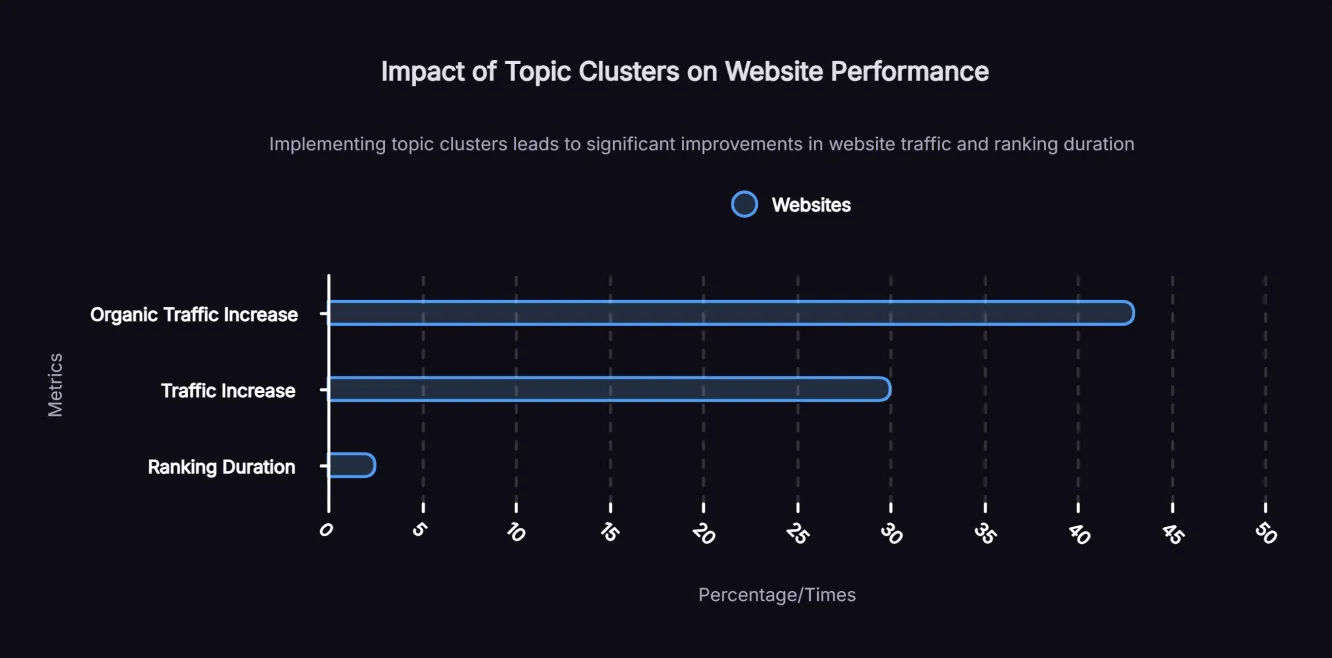
Beyond rankings, clusters deliver measurable outcomes. Sites that build them rank for more keywords with fewer backlinks, and each piece stays relevant longer because it forms part of a comprehensive resource rather than standing alone. The clearest example from our own work is a B2B property management client. After we published 12 mapped articles per month across their core service topics, they grew organic traffic 429% and earned 598 AI cited pages from zero. Over 27 months and counting that work has attributed about $8.7M in revenue; the 17-month climb window attributed $5.9M at a 6,864% average ROI. The cluster was the difference: it let us build authority in low-competition subtopics first, then expand into the head terms competitors had locked up.
How AI Search Reads a Topic Cluster
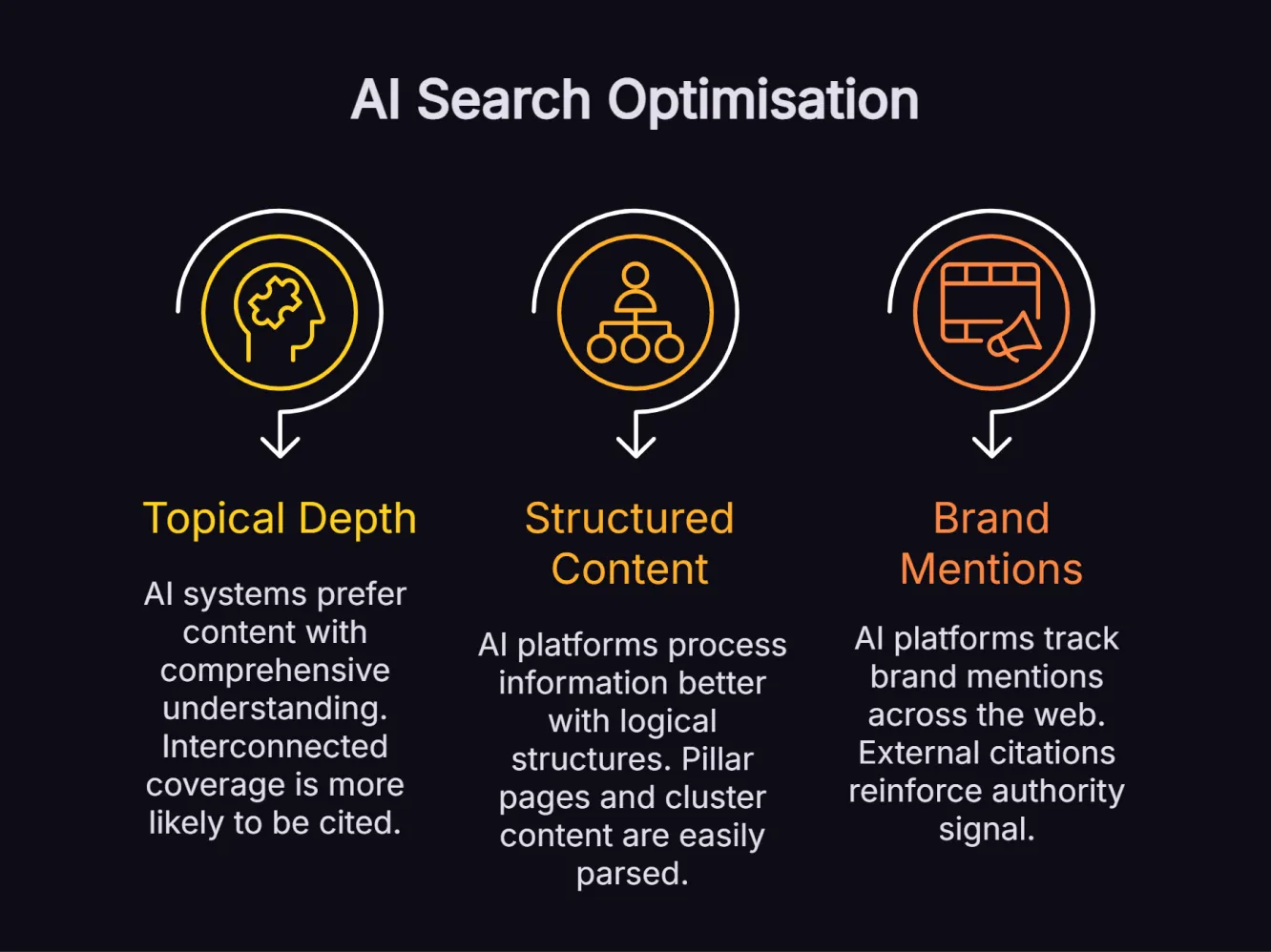
A topic cluster is built for readers first, but it happens to be exactly what AI search engines need to find, extract and cite you. With ChatGPT now serving more than 900 million weekly active users, that visibility is no longer a side benefit. Three behaviours make the difference.
AI systems expand one question into many related sub-questions before they answer. This is query fan-out: ask ChatGPT or Google's AI Mode a single question and it quietly runs a fan of related searches behind the scenes. A cluster that already covers those adjacent questions gets surfaced repeatedly, because it answers the whole fan rather than the head term alone.
AI engines also lift specific passages rather than whole pages, so a comprehensive cluster gives them more clean, self-contained answers to quote, which is the heart of passage-level optimisation. And Google's AI Overviews lean on sites with deep, well-structured coverage because those hubs reliably answer the follow-up questions a generated summary needs. We saw this with an eCommerce meal-delivery client. By mapping their topic comprehensively, they earned 866 AI citations across platforms, with pages cited by ChatGPT within 90 days of publishing. Track those citations alongside your rankings as a leading indicator that the authority is landing. They are a visibility signal in their own right, not a replacement for ranking and traffic.
How to Build a Topic Cluster That Ranks and Gets Cited
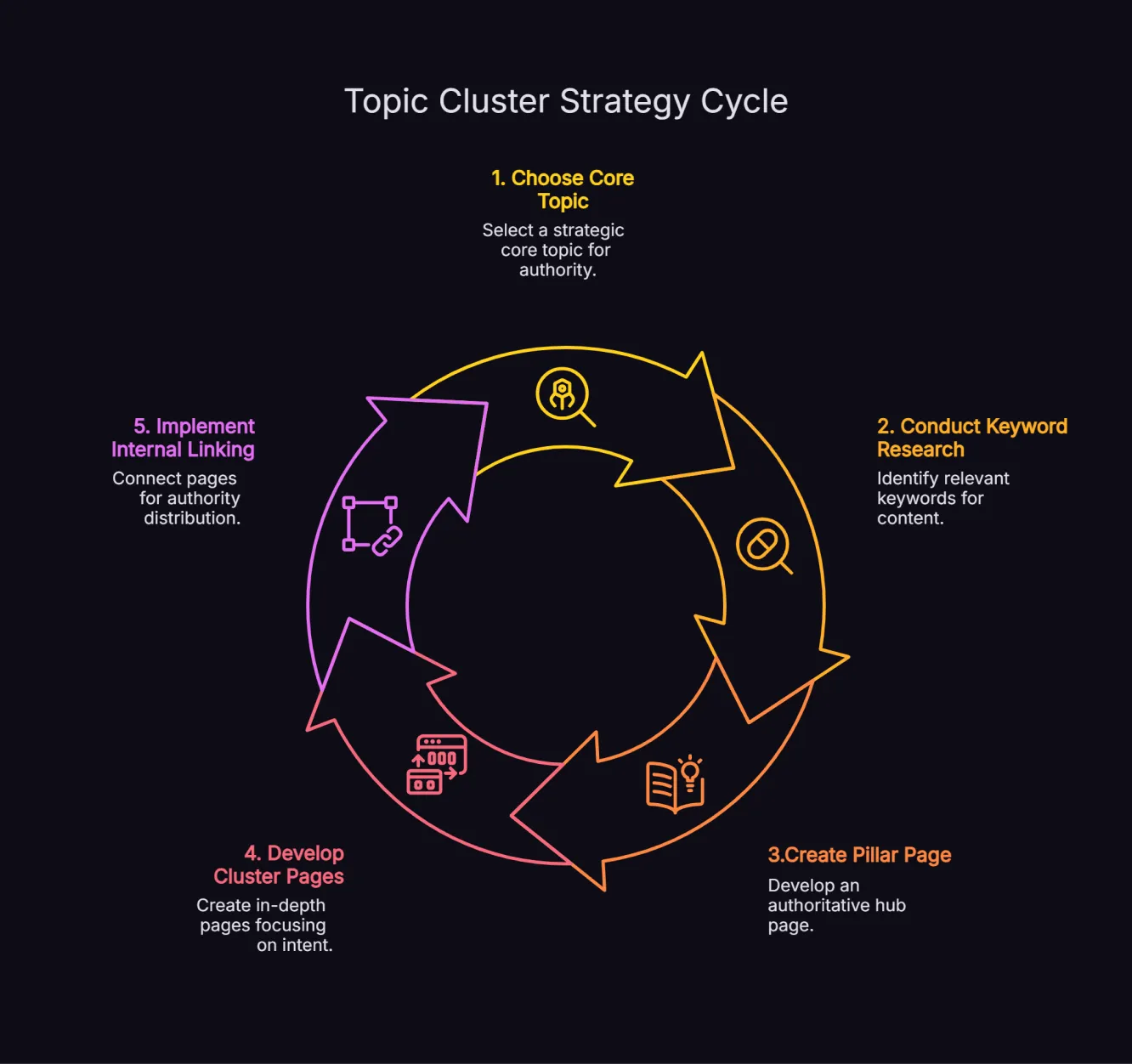
Building a cluster that works takes research and planning before you write a word. Here is the process we use with clients.
Step 1: Choose a Core Topic You Can Genuinely Own
Your pillar topic needs to be broad enough to support a real cluster of subtopics, commercially relevant to what you sell, validated by genuine search demand and achievable at your current level of authority. Start where you have real expertise, because topical authority builds faster around subjects your team actually knows.
There is no magic number of cluster pages. The right count depends on how many distinct subtopics and questions your core topic genuinely contains, not an arbitrary target. As a starting guide, most pillars support somewhere around 10 to 20 supporting articles, but comprehensive coverage of one focused topic beats shallow coverage spread thin. Add pages as real subtopics emerge rather than padding a cluster to hit a quota.
Step 2: Map the Whole Topic With Keyword Research
With your core topic set, uncover every relevant search term inside it. Tools like Ahrefs and Semrush surface the short-tail, long-tail and question-based queries your audience actually uses, including the People Also Ask and conversational phrasings AI platforms process. Look past raw volume: intent, difficulty and commercial value matter more. A 500-search term with strong purchase intent often beats a 5,000-search query that never converts.
Step 3: Cluster Your Keywords Into Page Groups
A raw keyword list is not a content plan, and this is the step most teams skip. Before you build a single page, group those keywords into clusters by shared search intent and SERP overlap, because keywords that return the same results and want the same kind of answer belong on one page, not spread across several. This is the bridge between research and architecture: keyword clustering turns hundreds of scattered terms into a finite set of pages, and it is where the cluster actually takes shape. The relationship is direct. A group of related keyword clusters is what forms a topic cluster: each keyword cluster becomes one page targeting its own intent, the broadest cluster becomes the pillar and the rest become cluster pages. Clustering this way also prevents cannibalisation before it starts, because you assign each intent to exactly one page instead of letting three thin pages compete for the same terms. Skip this step and you are guessing at your own structure.
Step 4: Build the Pillar Page as the Authoritative Hub
Your pillar page is the central resource for the topic. It should cover the subject comprehensively without exhausting any single subtopic, carry a table of contents with jump links and link to every cluster page with descriptive, keyword-relevant anchor text. Structure it with clear H2 sections, each useful on its own while naturally pointing readers to a cluster page for the deeper dive. A strong pillar content strategy gives every supporting piece a hub to point back to.
Step 5: Write Cluster Pages With Depth and Intent
Each cluster page targets one subtopic and matches its search intent precisely. Analyse what the reader actually wants (a definition, a comparison, a tutorial, a solution) and deliver exactly that, going deeper than the pages currently ranking and backing every claim with evidence.
A useful pattern here is the Nano Cluster structure we developed and piloted with a B2B SaaS client in legal tech. Each Nano Cluster follows a 1+2 shape: one commercial page targeting a transactional keyword, paired with two supporting informational pages that answer the questions prospects ask before they buy. Mapping their content into these clusters, around 2,300 keywords in all, helped them reach 4,118 first-page rankings and $1.31M in revenue at a 1,909% ROI over 12 months. The structure gives you commercial intent and topical depth in the same motion, and it compounds: every cluster you complete makes the next one easier to rank.
Step 6: Connect Everything With Internal Links
Internal links turn individual pages into a cluster. Every cluster page links up to the pillar at least once with natural, contextual anchor text; the pillar links down to all of its cluster pages; and cluster pages cross-link where it genuinely helps the reader. Disciplined keyword mapping keeps each page anchored to the term you clustered it around, so they reinforce each other instead of competing. Keep the links genuinely useful, not forced for search engines.
Step 7: Measure Cluster Performance
Track the cluster as a unit, not page by page. Watch the topic-level ranking distribution (how many keywords across the cluster move into the top 10), segment organic traffic by cluster rather than by individual page and monitor how often AI platforms cite your pages alongside your rankings. Sustained growth across the whole cluster, even as individual pages fluctuate, is the signal that Google and AI systems now recognise your authority.
Common Topic Cluster Mistakes That Stall Rankings
Avoiding these saves months of wasted effort.
- Building without keyword research: Creating clusters from assumptions rather than data wastes resources and dilutes focus. If you cannot tie a cluster page to a real query and a business reason, question whether it belongs.
- Ignoring search intent: Mapping a commercial keyword to an informational article creates a mismatch that hurts rankings. Match the content format to what the searcher actually wants.
- Creating competing pages: Without a map, teams publish multiple pages targeting the same variations and split their own ranking signals through cannibalisation. Assign each cluster page a distinct keyword and consolidate overlaps.
- Neglecting internal links: A cluster without internal links is just a pile of articles. Build linking into your workflow so every new page links to relevant existing content and is linked from it.
- Padding for the sake of size: Thin pages added only to hit a cluster-page count drag the whole structure down. Depth on the subtopics that matter beats breadth across ones that don't.
Frequently Asked Questions
What Is the Difference Between a Pillar Page and a Topic Cluster?
A pillar page is one comprehensive page covering a broad topic. A topic cluster is the whole structure: that pillar page plus the cluster pages around it and the internal links connecting them. The pillar gives the broad overview and links to every cluster page; the cluster pages go deep on one subtopic each and link back. You need both, working together, for the structure to signal authority.
What Is the Difference Between a Keyword Cluster and a Topic Cluster?
A keyword cluster is a group of search terms that share the same intent and get targeted together on a single page, so it works at the page level. A topic cluster works at the site level: it is the pillar page, the cluster pages and the internal links between them. The two connect directly, because a group of related keyword clusters is what forms a topic cluster, with each keyword cluster becoming one page in the structure. You build keyword clusters first to decide what each page should cover, then arrange those pages into the topic cluster.
How Many Pages Should a Topic Cluster Have?
There is no magic number. The right count depends on how many genuine subtopics and questions your core topic contains, not an arbitrary target. Most pillars support somewhere around 10 to 20 supporting articles as a starting guide, but comprehensive coverage of a focused topic builds more authority than thin coverage spread across too many pages. Add pages as real subtopics emerge.
How Is a Topic Cluster Different From a Topical Authority Map?
A topic cluster is one pillar plus its supporting articles around a single theme. A topical authority map is the layer above: it organises every cluster across your whole site and the links between them. Think of clusters as the neighbourhoods and the map as the city plan that shows how they all connect.
What Is an Example of a Topic Cluster?
A SaaS company selling CRM software might build a pillar on "CRM software" with cluster pages on CRM implementation, CRM pricing, CRM integrations, choosing a CRM and CRM for small business. Each cluster page targets its own long-tail query, answers one clear question and links back to the pillar, while the pillar links out to each. The result is one coherent resource that can rank for the head term and dozens of long-tail variations at once.
How Do Topic Clusters Improve AI Search Visibility?
AI platforms evaluate topical depth when they choose which sources to cite. A cluster gives them interconnected, comprehensive coverage and clean, self-contained passages to lift, which is why they cite well-structured clusters more often than isolated pages. Strong topical authority is the foundation that earns those citations.
How Long Does It Take a Topic Cluster to Rank?
Plan for around 6 to 12 months of consistent publishing against your map, longer in competitive niches and faster for established sites adding depth to existing foundations. Across our campaigns we typically see measurable movement around month four, with gains accelerating from there as the interconnected pages compound on each other.
Turn Scattered Content Into a Cluster That Compounds
A well-built topic cluster turns a pile of disconnected articles into a content engine where every page, subtopic and internal link compounds your rankings, your revenue and your AI visibility. Start by choosing a core topic you can genuinely own, mapping its real subtopics through keyword research and connecting the whole structure so Google and AI systems can read it as one authoritative resource. If you want a partner to own the research, mapping and production, our content marketing team builds 12-month content roadmaps and cluster frameworks backed by real keyword and AI-citation data.
About the Author
Want Insights Like This Fortnightly?

Our AI SEO strategies and tactics delivered fortnightly, including bonus trade secrets not shared anywhere else. No fluff. Just what's working right now. 5-minute read.


