
How AI Search Works: What 598 AI Cited Pages Taught Me About Google AI Overviews, ChatGPT and AI Mode in 2026


If AI answers your customer before they click, do you know how AI search works well enough to stay visible? Organic traffic is fragmenting as Google AI Overviews, ChatGPT, Perplexity and Copilot summarise results, cutting clicks and leaving teams unsure what to optimise next. This guide explains the retrieval, synthesis and citation pipelines behind today's AI search systems, and I'll show you the patterns I saw firsthand when one B2B engagement went from zero to 598 AI cited pages. You'll get practical, testable plays you can apply now. Ready to look under the hood and turn it to your advantage?
How AI Search Works: A Technical Overview
AI search uses natural language processing, machine learning and large language models to understand context and anticipate intent. Instead of simple keyword matching, it reads the semantic meaning of a query, synthesises evidence from multiple sources and produces a conversational answer that addresses the question directly. Most modern systems use retrieval-augmented generation, combining real-time web retrieval with generative AI. When you submit a query, the system decomposes it, searches authoritative sources, evaluates quality and assembles a current answer in seconds rather than relying on static training data alone.
Ready to Optimise for AI Search Before Your Competitors?
Most businesses are still working out AI search while early movers quietly take the citations. The B2B engagement I reference throughout this guide earned 598 AI cited pages and about $8.7M in attributed revenue over 27 months and counting by getting ahead of exactly this shift. Book a 45-minute call with me to see which of these patterns apply to your site.
Speak with the FounderUnderstanding AI Search vs Traditional Search Engines
Here is a side-by-side view of how traditional search and AI search work. Scan the highlights below to see how they differ in approach and outcome.
Traditional Search
Traditional search engines like Google match typed words with indexed content, weighing keyword relevance, backlinks and site authority to rank results. You type a query, get a list of blue links and sift through pages to find your answer.
AI Search
AI search moves beyond keyword matching to read query intent, context and semantic relationships.
- Instead of ten links, it synthesises information from multiple sources into a single conversational response, with citations and follow-up capability.
- You can ask natural questions like "what's the best time to visit Paris for warm weather but fewer tourists" rather than rigid keyword phrases.
The core difference: traditional search points you to information, while AI search reads your question and delivers the answer directly. Traditional search needs multiple queries and manual evaluation. AI search handles research, synthesis and presentation in one interaction, changing how people discover and consume information online.
The Core Technologies Powering AI Search
The technology matters because each layer affects whether a page is retrieved, understood and cited. In audits, I look at five layers: language understanding, learning signals, vector matching, generation and the retrieval architecture that ties them all together.
Natural Language Processing (NLP)
NLP lets machines understand and process human language, which is what makes conversational queries possible. It powers semantic search by reading the meaning behind words rather than matching exact phrases. NLP also handles sentiment analysis, picking up emotional context in reviews and feedback.
Machine Learning Algorithms
Machine learning improves search accuracy by analysing past searches, user behaviour and click patterns. These algorithms learn which results satisfy intent, then adjust future rankings. The more data the system processes, the better it predicts what you need.
Vector Search and Embeddings
Vector search turns words, phrases and concepts into multidimensional numerical representations, letting AI read semantic relationships between content. When you search "Apple benefits," vector embeddings help the system work out whether you mean fruit nutrition or technology products based on the surrounding context.
Word2vec and GloVe algorithms analyse huge text collections to learn these relationships, mapping similar concepts close together in vector space. This is how AI search handles synonyms, related concepts and even typos while still returning relevant results.
Large Language Models (LLMs)
LLMs like GPT-5 and Gemini provide the generative layer that synthesises information into coherent responses. They can hold context across multiple sentences, maintain conversation threads and generate human-like text from retrieved information.
LLMs don't just retrieve content, they comprehend, reason and explain it in accessible language.
Retrieval-Augmented Generation (RAG)
Retrieval-augmented generation is the architecture that ties the other four layers together. Instead of answering from training data alone, a RAG system retrieves relevant documents at query time, often using the vector search described above, and feeds those passages to the LLM as grounding context for the answer. Grounding responses in retrieved sources reduces hallucination, keeps answers current and lets the system cite where each claim came from.
Every major AI search platform in this guide, from Google AI Overviews to ChatGPT Search, Perplexity and Copilot, runs some form of RAG pipeline. That matters more than any other technical detail here: your pages are the retrieval corpus. If a passage can be retrieved, parsed and quoted cleanly, it can be cited. If it cannot, the model answers from someone else's content. Most of the optimisation plays later in this guide are really about making your content easy for RAG pipelines to retrieve and extract.
How Google AI Overviews Work
Google AI Overviews use a custom Gemini model that combines multi-step reasoning, planning and multimodality with Google's established search systems. When you submit a query that could benefit from a generated summary, Google's systems decide whether to show an AI Overview at the top of the results.
The model stack behind this keeps advancing. At Google I/O 2026, Google announced Gemini 3.5 Flash as the new default model in AI Mode for everyone globally, and you can now ask a follow-up question right from an AI Overview and flow into a full AI Mode conversation, so the same retrieval and citation mechanics increasingly sit behind both surfaces.
- The process starts when Google's LLMs analyse your query to understand context and intent.
- The system then uses a "query fan-out" technique, issuing multiple related searches across subtopics and data sources to gather information.
- As responses are generated, the models identify supporting web pages and display diverse links alongside the summary.
Google's patent "Generative Summaries for Search Results" describes producing result summaries with supporting sources.
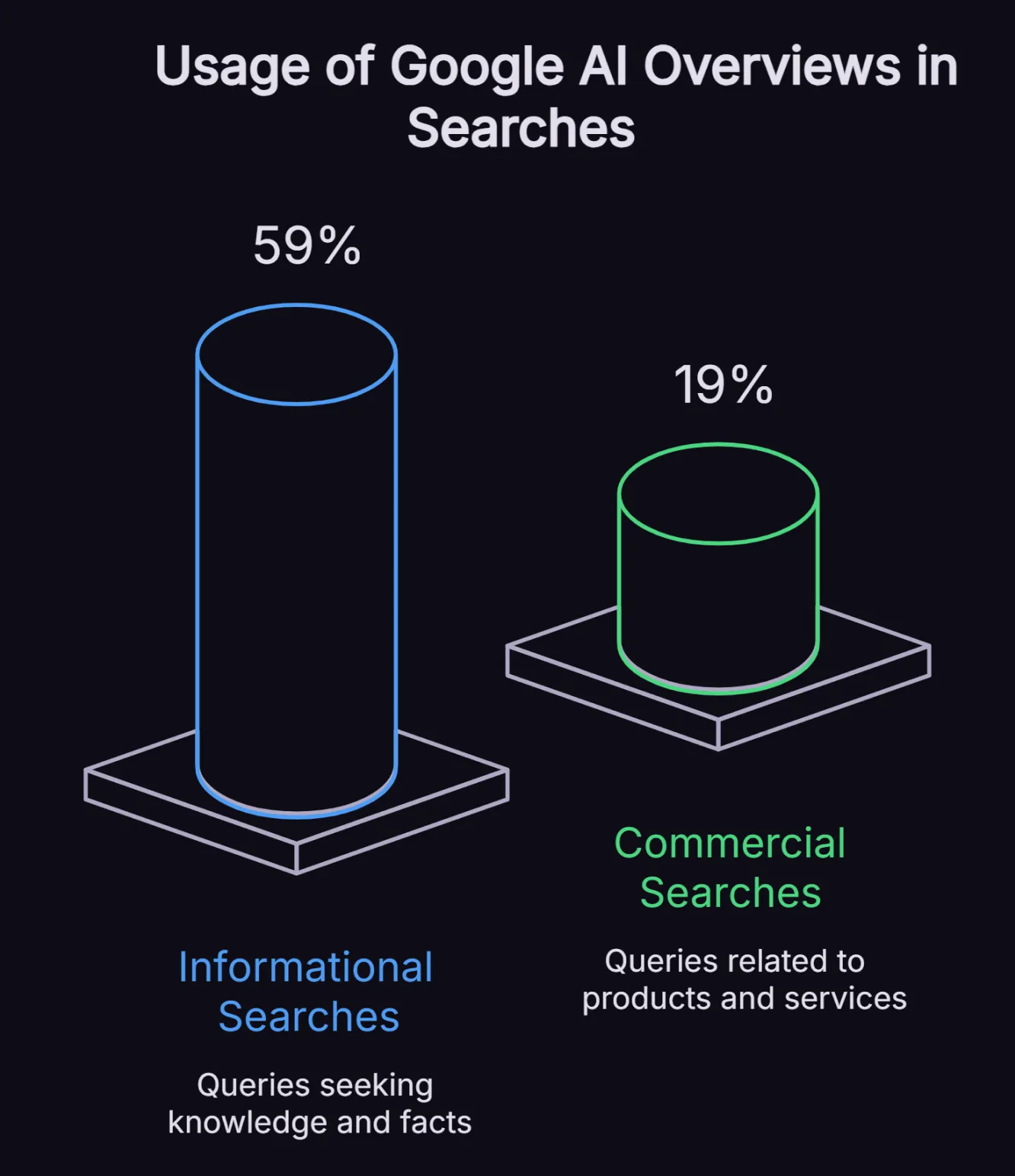
Google's AI Overviews now appear in over 200 countries and territories across 40+ languages. The feature has grown from the Search Generative Experience launched in 2023 into a core part of Google Search, with 59% of informational searches and 19% of commercial searches triggering AI Overviews.
To be cited in an AI Overview, your content must be indexed, eligible to show with a snippet and ideally ranking well. The system matches your content against the generated response, citing the pages that best support it. No special markup or AI-specific files are required; existing SEO fundamentals remain the primary path.
A pattern worth naming here, because it changes how you target Overviews: in my own client work, query fan-out reliably surfaced far more than the obvious head term. When I prompt ChatGPT, Claude and Perplexity with each target keyword to see how the systems interpret a topic, I typically uncover 20 to 30 related queries per keyword that traditional keyword tools miss. Building content that answers that wider set, not just the head term, is what gets a page pulled into more Overviews.
How ChatGPT Search Works
ChatGPT Search launched on a fine-tuned version of GPT-4o, trained for search using synthetic data and distilled outputs from OpenAI's o1-preview model. OpenAI retired GPT-4o from ChatGPT in February 2026, and ChatGPT, including its search experience, now runs on the current GPT-5 series models. Unlike chatbots limited by a training cutoff, ChatGPT Search retrieves current information from the web when a query needs it.
The process starts when ChatGPT analyses your query and may rewrite it into more effective search terms. Asking "what's the latest on CCR8 cancer drugs" might become "CCR8 immunotherapy drug development 2025" before it hits search partners. ChatGPT primarily uses third-party search providers alongside its own OAI-Searchbot crawler and partnerships with news organisations.
When retrieving information, ChatGPT may compare multiple current sources, assess whether the source set is strong enough and synthesise an answer with citations. If the first pass lacks enough evidence, it can refine the query and retrieve again.
ChatGPT Search launched on 31 October 2024, replacing the earlier SearchGPT prototype. It became available to everyone without logging in, where ChatGPT is available, as of February 5, 2025. OpenAI has partnerships with major publishers, including Associated Press, Reuters, Financial Times and The Atlantic, which gives it access to authoritative news sources.
Optimising for this retrieval behaviour is its own discipline, not a bolt-on to your Google work. The approach I use treats ChatGPT SEO as a three-step process: fix your technical foundation, structure content for AI extraction, then build the topical authority that earns citations over time. Each step compounds the previous one, which is why one-off tactics rarely move the needle. I’ve broken the full method down in my ChatGPT SEO guide.
Refer to OpenAI's ChatGPT Search announcement, the web search tool guide and the API reference for implementation details.
How Perplexity Search Works
Perplexity operates as a search engine focused on quick, direct answers with clear citations, sitting between traditional search and conversational AI. It is strong on fact-checking and research-heavy queries and is transparent about its sources:
- Perplexity uses retrieval-augmented generation like other AI search platforms, combining real-time web retrieval with LLM synthesis.
- It retrieves from multiple sources, evaluates credibility and generates responses that cite specific references.
- You can verify claims by reviewing the linked sources directly.
The platform leans on source transparency more than competitors, displaying citations throughout responses. That appeals to researchers, students and professionals who need to confirm accuracy. Perplexity positions itself as a research tool rather than a general-purpose chatbot, optimising for information quality over conversational polish.
Perplexity's Search API and SDK documentation cover result retrieval, freshness and citation behaviour.
How Microsoft Copilot Search Works
Microsoft Copilot integrates LLMs into Microsoft's application suite, improving workplace productivity through natural language understanding.
- It retrieves contextually relevant documents, streamlines workflows and delivers search across Teams, Outlook and SharePoint.
- It leverages Microsoft's Azure AI infrastructure and Bing's search index for web information.
- It lets you search corporate knowledge bases, retrieve specific documents and automate repetitive tasks through conversational queries.
- It reads context within Microsoft's ecosystem, pulling from emails, documents and calendar entries alongside web sources.
The enterprise focus sets Copilot apart from consumer AI search. Rather than competing with Google for general web search, it optimises for workplace scenarios: finding internal documents, analysing data across systems, automating processes. It combines private corporate data with public web information while keeping security boundaries intact.
Microsoft's Copilot architecture covers grounding with Microsoft Graph and optional web grounding via Bing, plus admin controls for web search.
How Anthropic's Claude Search Works
Claude's web search feature lets the assistant retrieve current information beyond its training cutoff. When a question needs up-to-date facts, Claude accesses web sources through a browser tool that queries search engines and retrieves page content.
The functionality works much like other AI platforms, using:
- Query analysis
- Web retrieval
- Synthesis
Claude evaluates multiple sources for credibility and relevance before using them, and provides source attributions so you can verify claims against the originals.
Claude's implementation emphasises accuracy and a nuanced understanding of complex queries. The search capability sits inside its conversational interface, holding context across multi-turn discussions while bringing in fresh web information. That lets you explore a topic deeply, asking follow-up questions that build on earlier responses and newly retrieved data.
Anthropic's web search and web fetch tool documentation explains how browsing and citations are handled.
The Technical Process Behind AI Search
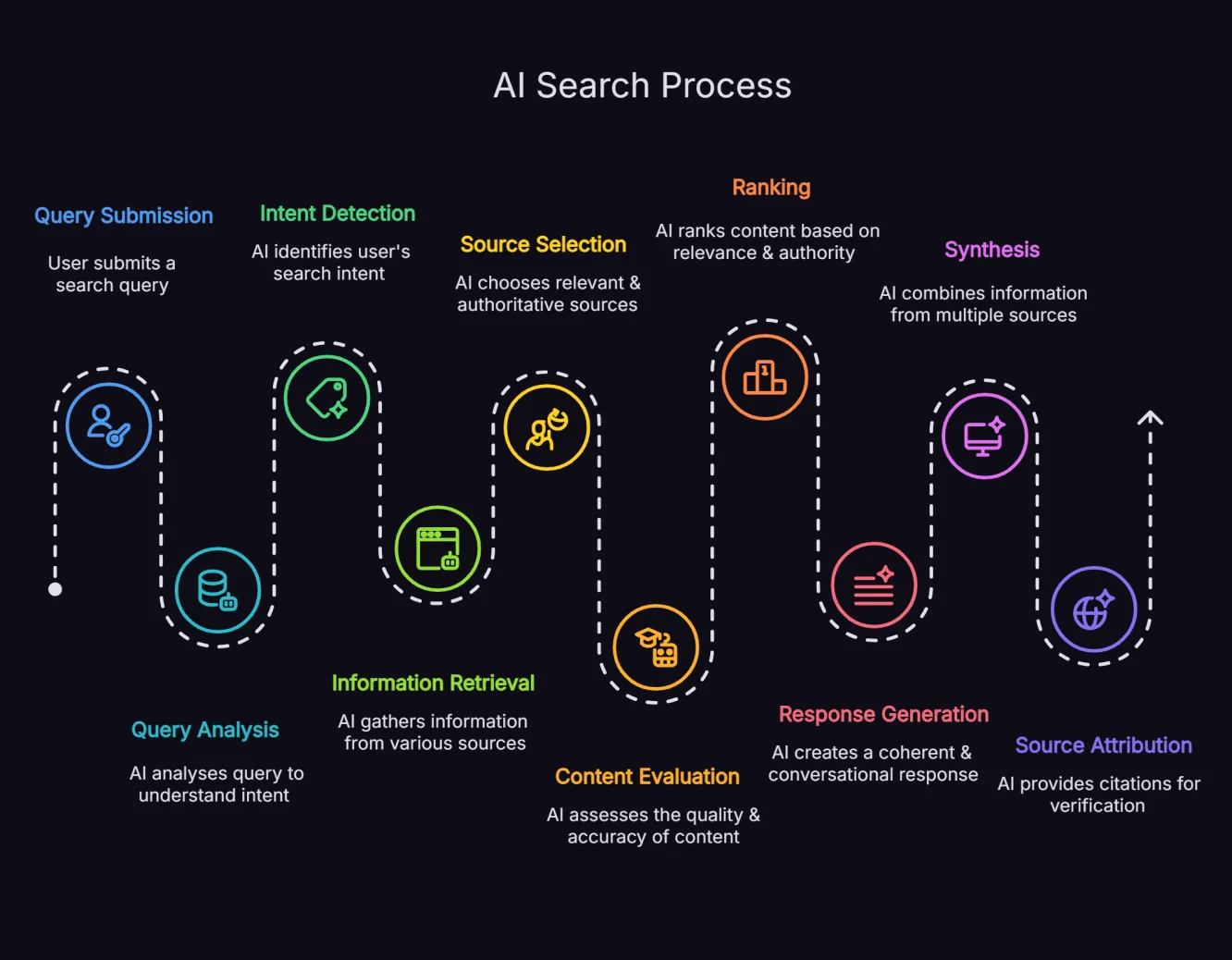
AI search systems follow a consistent multi-stage process regardless of platform. Understanding the four stages tells you where your content can win or lose a citation.
1. Query Analysis and Intent Detection
When you submit a query, the system first breaks it into components to understand intent. It identifies whether you are seeking information, comparing options, making a purchase or navigating to a site. That classification decides which sources to prioritise and how to structure the response.
Advanced systems use context from previous searches, history and location to sharpen intent. If you have been researching health topics, "apple benefits" will lean toward nutrition over technology.
What most marketers miss is how far the query travels from here. The AI does not stop at your exact words. It typically splits a query into roughly 5 to 11 related sub-queries, retrieves content for each in parallel, then synthesises the result. I see this constantly in my own query fan-out testing, and it is the single biggest reason a page that answers only the head term gets passed over.
2. Information Retrieval and Source Selection
AI search does not rely on one data source. Systems query multiple indexes, including web crawlers, structured databases and knowledge graphs, to gather information. Retrieval considers relevance, source authority and freshness.
Vector similarity search matches your query against embedded content, finding semantically related information even when exact keywords are absent. This is how AI understands that "vehicle financing" and "auto loans" mean the same thing and retrieves relevant content regardless of wording.
3. Content Evaluation and Ranking
Retrieved information is assessed for quality before it makes the response. Models weigh trustworthiness, accuracy and relevance to the specific query, prioritising authoritative publishers, recent content and material that directly answers the question.
The ranking differs fundamentally from traditional algorithms. Rather than ordering links by a relevance score, AI search decides which facts and explanations best satisfy intent, often combining a statistic from one document with an explanation from another.
This is where passage-level retrieval rewrites the old rules. In traditional search, Google evaluates your whole page and ranks it against a query. In AI search with query fan-out, the evaluation happens at the passage level, so a single paragraph from a mid-ranking page can outperform a comprehensive guide if that paragraph answers a sub-query more directly. That has a real strategic consequence: you do not always need the definitive 4,000-word pillar to get cited; you need the clearest paragraph for a specific sub-query.
4. Response Generation and Synthesis
LLMs take the retrieved information and generate coherent, conversational responses. Generation involves reading relationships between facts, spotting contradictions across sources and structuring information logically. AI does not copy-paste; it comprehends and explains.
Synthesis includes source attribution so you can verify claims and explore further. Generated responses keep a conversational tone while preserving factual accuracy. Systems like Google AI Overviews and ChatGPT Search provide inline citations and expandable source lists so you can judge quality independently.
Optimising Your Content for AI Search Visibility
AI search platforms use different algorithms from traditional engines, so the optimisation playbook adapts. The five plays below are the ones I keep coming back to.
Structure Content for AI Comprehension
AI search systems favour a clear information hierarchy. Use descriptive headings that answer questions. Break complex topics into discrete sections with explicit subheadings. Add FAQ sections covering variations of your main topic. This helps the system identify which sections answer which queries.
Implement schema through a tiered model rather than adding random markup to every page. The first tier should define the core site entities: Organisation, WebSite, author and key service relationships. The second tier should describe the page itself with the most relevant type, such as Article, FAQPage, HowTo or Service. I built this in @graph format so each entity connects through stable @id values instead of sitting as disconnected markup. This does not guarantee AI citations, but it helps search engines and AI systems understand the page, the author and the entity relationships more clearly. For the full model, see my schema SEO guide.
Answer Questions Directly and Comprehensively
AI search rewards content that answers the query without making readers hunt. Lead with a clear, concise explanation in the first paragraph of each section, then add supporting detail, examples and context. That pattern matches how systems extract information for citations.
Cover topics comprehensively rather than superficially. Platforms prefer authoritative sources that explain a concept fully over shallow content that needs three other pages to be useful. If you are writing about how AI search works, explain the whole process; don't define the term and move on.
Demonstrate Expertise and Authority
Google's AI Overviews value EEAT signals: Experience, Expertise, Authoritativeness and Trustworthiness. Include:
- Author credentials
- Cite authoritative sources
- Show first-hand experience
Systems weigh content quality when choosing what to cite, favouring recognised experts over generic content.
Link to supporting research, original data and primary sources throughout. When you reference a statistic, link to the original study rather than a secondary article. AI platforms increasingly prioritise primary sources when generating responses.
Optimise for Passage-Level Retrieval
AI search often extracts specific passages rather than whole articles. Make every paragraph stand alone as a complete thought. Start with a topic sentence that captures the main idea. Use transitions to show relationships between concepts. This raises the chance of being cited for a specific fact.
Build content clusters around core topics and link the related articles together. That topical authority signals expertise across a subject area, making your content more likely to be selected when a system needs comprehensive information. My eCommerce AI SEO case study shows how clustering produced a citation spread of 126 Google AI Overview citations, 12 in ChatGPT, 10 in Perplexity, 12 in Gemini and 9 in Copilot, 169 across the five platforms.
Monitor AI Search Visibility
Track how often your content appears in AI responses. Generic advice here is "use a tool"; the specific workflow I run is more useful. I monitor AI citations with Ahrefs Brand Radar, which tracks how a brand appears across ChatGPT, Perplexity, Google AI Overviews and other platforms. I track client brands monthly to find the content gaps where competitors are cited, and my client’s brand is not, then commission content to close them. That monthly gap analysis, not a one-time check, is what compounds into citation share.
Test your own content by asking AI platforms the questions your audience would ask. Do you get cited? If a competitor shows up instead, study what makes their content more citable and adjust. Base the work on actual AI behaviour, not assumptions.
Common Misconceptions About AI Search
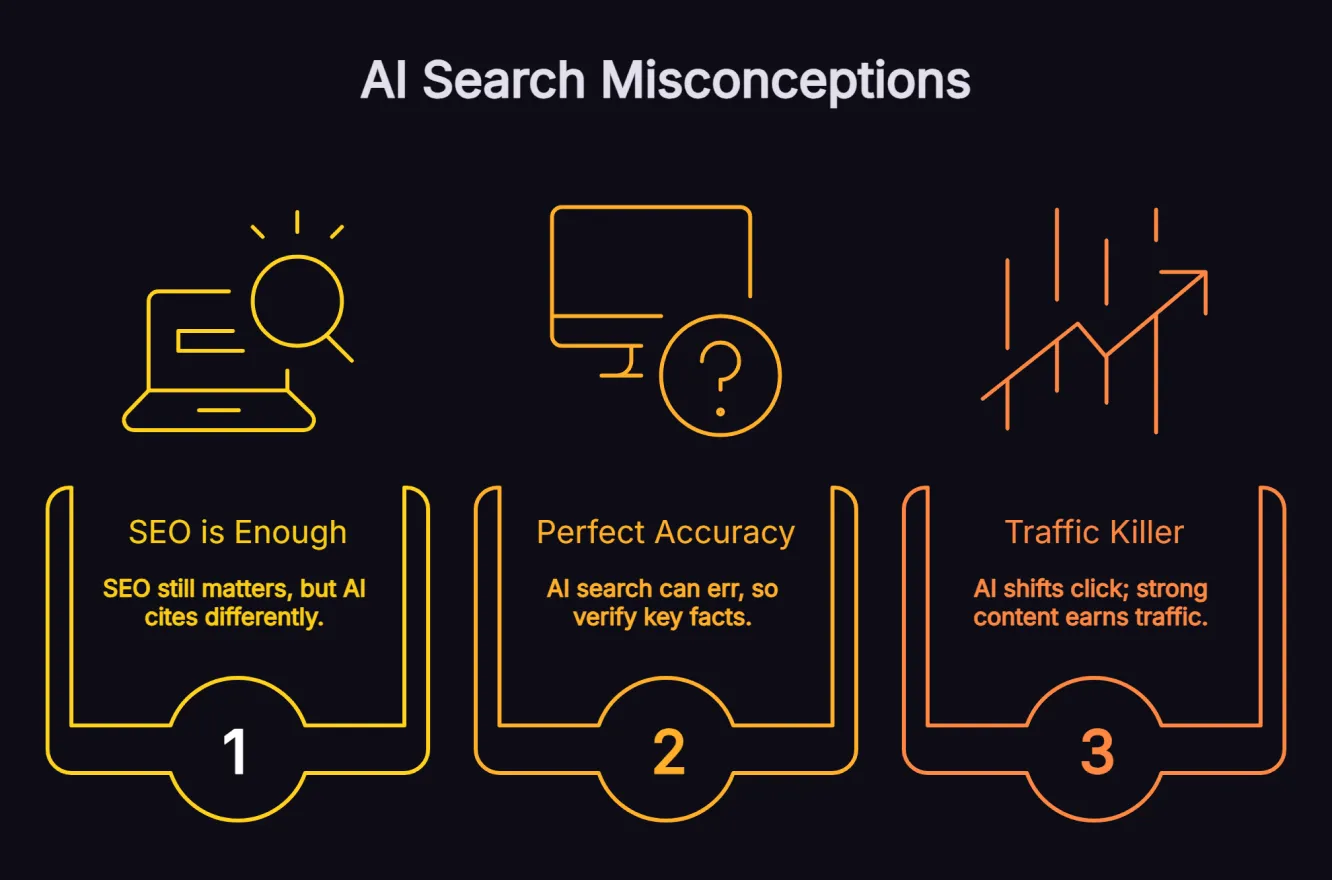
Several myths about AI search persist despite the evidence. Here are the four I correct most often.
Misconception: AI Search Won't Replace Traditional Search Engines
Many assume AI search will simply augment link-based results indefinitely. Google's roadmap tells a different story.
Google's Official Position on AI Search
Google CEO Sundar Pichai said search will "change profoundly", able to "tackle more complex questions than ever before." The direction is clear:
- At Google I/O 2025, Google expanded AI Mode as a more conversational Search experience, using Gemini and query fan-out to handle more complex questions, surface richer web results and support deeper follow-up exploration through AI Mode in Search.
- The legacy engine remains "for now," but Google confirmed its future strategy centres on making AI apps like Gemini the primary point of contact between you and search.
What AI Mode Actually Means
AI Mode shifts the experience from ranked links to a conversational interface:
- You ask questions conversationally.
- AI generates direct answers with source citations.
- Follow-up questions build on previous context.
- The traditional ten blue links become secondary.
The scale now makes the direction unambiguous. At Google I/O 2026, Google confirmed AI Mode had passed one billion monthly users just one year after launch, with queries more than doubling every quarter, and made Gemini 3.5 Flash its default model globally. Features proven in AI Mode keep graduating into standard Search. The timeline is no longer "underway"; it is well advanced.
The Transition Timeline
Google VP of Search Liz Reid has positioned generative AI as central to the next stage of Search, with AI Overviews and AI Mode designed to help people ask longer, more complex questions and explore the web through richer, cited answers. Google explains this direction in its AI Overviews rollout and AI Mode update, and made it concrete in her I/O 2026 announcement, "A new era for AI Search". The shift happens gradually:
- AI Mode scales globally, passing one billion monthly users in its first year.
- Features proven in AI Mode graduate into standard Search.
- The Search box itself is reimagined around AI input.
- Search agents become a primary discovery mechanism.
What This Means for Your Business
The question is not whether AI changes link-based results. Google's stated direction confirms it will. What matters is how fast the transition lands and whether you are positioned to hold visibility through it. The teams adapting now, building comprehensive topic coverage, demonstrating expertise and optimising for passage-level retrieval, are already securing citations while competitors debate whether the shift is real.
Misconception: AI Search Optimisation Is Just SEO
Traditional SEO fundamentals are necessary but not sufficient for AI visibility. You need crawlable architecture, indexed content, mobile optimisation and strong backlinks, but AI platforms cite content differently from how algorithms rank pages.
AI-Specific Techniques That Actually Matter
- Query fan-out targeting: Overviews issue multiple related searches across subtopics when building a response. Cover the primary query plus the surrounding questions the AI explores.
- Passage-level clarity: AI extracts passages, not whole articles. Start each paragraph with a topic sentence, complete the thought and avoid pronouns that need earlier context.
- Direct answer positioning: Lead each section with a concise answer before the detail. AI prioritises content that addresses the query in the first one or two sentences.
- Strategic schema implementation: FAQ, HowTo, Article and Organisation schema help comprehension and support EEAT signals.
What This Looks Like in Practice
This is the part I can speak to from direct experience rather than theory. For a B2B property management client, this approach produced 598 AI cited pages across multiple search surfaces over 27 months and counting, with about $8.7M in attributed revenue over 27 months and counting; the climb window showed $5.9M at a 6,864% average ROI, as organic traffic grew 429%, from 4,973 to 26,313 organic users between April 2024 and August 2025. The detail that matters: the content strategy covered the full topic cluster, not just the commercial keywords. The fundamentals got the site indexed. The AI techniques got the brand cited. You can read the full B2B AI SEO case study for the method.
Misconception: AI Search Provides Perfect Accuracy
AI search systems make mistakes. Google AI Overviews faced criticism for suggesting people eat rocks and put glue on pizza, drawing from satirical Reddit posts. LLMs can hallucinate, cite sources incorrectly or misread nuanced topics. Users should verify critical information against sources rather than taking AI responses at face value.
The accuracy issue cuts both ways. You need critical evaluation skills for AI responses, and as a content creator, you must make your content easy to verify with precise citations and accurate facts. Platforms keep improving filtering and validation, but the fundamental limits of LLMs mean perfect accuracy stays out of reach.
Misconception: AI Search Kills Website Traffic
While 58.5% of searches end in zero clicks, that is evolution, not elimination. AI search changes traffic patterns rather than destroying them, and the clicks it does send hold their quality. In my own measurement on a B2C compensation claims campaign, AI search traffic converted at 2.34%, effectively matching the 2.39% rate of traditional organic, and on high-consideration purchases I have seen AI-referred visitors convert at several times that rate. Fewer, more qualified visitors are a trade plenty of businesses would take.
Sites seeing declines usually have content that offers only surface-level information, the kind AI summarises in a sentence. Comprehensive content that demonstrates real expertise and proprietary insight keeps earning clicks. The opportunity shifts from generic informational queries to specialised knowledge and transactional intent.
The Future of AI Search
Google laid out its clearest statement yet of where search is heading at Google I/O 2026, billed by Search VP Liz Reid as "a new era for AI Search". AI Mode passed one billion monthly users in its first year, queries are more than doubling every quarter, and Gemini 3.5 Flash is now the default model in AI Mode globally. The part I'm watching most closely is not whether AI search gets more capable; it is where the retrieval surface moves. In client work, the biggest risk is not losing a single ranking. It is losing the source position behind the answer, and I/O 2026 named the surfaces that battle will be fought on next.
An AI-Native Search Box and Multimodal Input
Google calls the reimagined Search box announced at I/O 2026 its biggest upgrade in over 25 years. It expands dynamically as you type, suggests questions beyond autocomplete and accepts text, images, files, videos and Chrome tabs as inputs. Multimodal search is no longer an experiment; it is the default entry point in every country where AI Mode is available.
That makes optimising visual content for AI comprehension non-negotiable. Image alt text, video transcripts and audio descriptions become critical to staying visible, and content strategy has to account for how AI interprets non-text media.
Search Agents Working in the Background
I/O 2026 marked what Google calls the era of Search agents. Information agents run in the background 24/7, reasoning across blogs, news sites, social posts and real-time data to monitor a standing question, then send synthesised updates, launching first for Google AI Pro and Ultra subscribers. This changes the visibility question for businesses: your content is no longer retrieved only when someone types a query; it can be retrieved continuously by agents monitoring a topic. Fresh, structured, passage-clear content is what those agents can read and relay.
Agentic Booking, Calling and Commerce
Google is expanding agentic booking in Search to local experiences and services: share your criteria and Search assembles live pricing and availability with direct links to complete the booking, and for select categories like home repair or beauty, Google can call businesses on your behalf. If you sell anything bookable, your pricing and availability need to be machine-readable, because increasingly the agent, not the customer, does the comparing.
Generative Interfaces Built on the Fly
Using its Antigravity platform and the agentic coding in Gemini 3.5 Flash, Search now builds custom generative UI: interactive visuals, tables, graphs, simulations, and soon persistent dashboards and trackers that work like mini apps for ongoing tasks. The page of links is becoming a custom interface assembled in real time from retrieved data, and structured, extractable content is the raw material those interfaces are built from.
Personalised Search Experiences
At I/O 2026, Google expanded Personal Intelligence in AI Mode to nearly 200 countries and territories across 98 languages, letting people securely connect apps like Gmail and Google Photos, with Calendar coming, so answers reflect their own context. Rather than identical results for everyone, platforms adjust depth, source selection and presentation to the user.
That challenges keyword-first optimisation. Content needs to satisfy users at different levels, from beginners wanting basics to experts wanting depth, so the system can extract the right information for each context.
Deeper Integration With Workflows
AI search will keep embedding into productivity tools, surfacing information when you need it rather than in a separate session. Microsoft Copilot and Google Gemini already do this, pulling relevant information from corporate systems without an explicit search. Expect proactive recommendations based on your current task, calendar and documents.
From Retrieval to Reasoning
Advanced models keep moving from retrieval to reasoning, conducting research and weighing trade-offs. Instead of answering "what are the best project management tools," AI will ask about team size, budget and needs, then analyse options against your requirements. Combined with background agents, that turns search from information discovery into decision support, and it raises the bar for content: the sources that win are the ones a reasoning model can quote, compare and act on.
Frequently Asked Questions
How does AI search differ from keyword-based search?
Keyword-based search matches exact words and phrases, while AI search reads the semantic meaning, context and intent behind a query. Traditional search returns ranked lists of matching documents. AI search synthesises information from multiple sources into direct answers with citations. You can ask natural questions, and the system holds context across follow-up questions.
Do I need to create special content for AI search engines?
You need both traditional SEO fundamentals and AI-specific techniques. Google says existing best practices remain relevant, but that is only half the story. Quality content, sound site architecture and authoritative backlinks get you indexed; AI-specific techniques get you cited.
The tactics that drive AI citations include passage-level clarity (every paragraph stands alone), direct answer positioning (lead with concise answers), query fan-out targeting (cover the related questions AI explores) and strategic schema. My B2B engagement achieved 598 AI cited pages by applying both fundamentals and AI-specific techniques, not one or the other.
Start with solid technical SEO, then layer on AI optimisation. Teams using only traditional techniques leave visibility on the table as platforms cite content built for their retrieval mechanisms.
Will AI search fully replace Google and traditional search engines?
Google’s roadmap points to a more AI-led search experience, but replacement is likely gradual rather than immediate. Sundar Pichai confirmed search will "change profoundly," with the next generation "fully powered by artificial intelligence and intelligent agents." Google said the legacy engine remains "for now" while making clear the future belongs to conversational, AI-driven interfaces.
AI Mode shifts traditional Google Search toward a conversational experience, with features proven there graduating into standard Search. At I/O 2026, Google reported AI Mode had passed one billion monthly users, with queries more than doubling every quarter. The question is not whether AI reshapes traditional search; Google has confirmed it will, but how quickly it happens and whether your content strategy keeps you visible throughout.
How do AI search engines decide which sources to cite?
Systems weigh relevance to the query, source authority and trustworthiness, freshness and how directly the content answers the question. For Google AI Overviews, pages must be indexed, eligible for snippets and typically ranking well. Platforms prefer comprehensive content from recognised experts over generic or thin content. In practice, passage-level clarity matters as much as overall page authority, because evaluation happens at the paragraph level.
Can I prevent my content from appearing in AI search results?
Yes, standard controls work, but use the right one for the job. To keep a page out of search results, use a meta robots noindex tag or an X-Robots-Tag HTTP header. Robots.txt controls crawling; it does not reliably remove an already-discovered page from search results. Google also offers preview controls that can limit snippets without blocking indexing. Blocking AI visibility may also reduce potential traffic and brand exposure as users increasingly rely on AI platforms for discovery.
How accurate are AI search responses?
Accuracy varies by platform and query complexity. Simple factual queries are usually answered well, while complex or divisive topics need verification. Systems can hallucinate, misread context or cite sources incorrectly. Verify critical information through the linked sources rather than accepting responses uncritically. Platforms keep improving through better training data, validation and filtering.
What’s the best way to optimise existing content for AI search?
Review for comprehensive coverage, direct answers to common questions and a clear hierarchy. Add FAQ sections for query variations. Implement Organisation, Article and FAQ schema. Make author credentials visible and link to authoritative sources. Structure content with descriptive headings and topic sentences that support passage-level retrieval. My SaaS SEO case study shows how systematic optimisation led to first-page rankings and stronger AI visibility.
How do I measure AI search visibility for my content?
Monitor AI citations with tools like Ahrefs Brand Radar that track AI Overview and LLM citation appearances. Test your content by querying AI platforms with the questions your audience asks, then check whether you get cited. Watch organic traffic patterns to see whether AI search is sending new visitors. The workflow that works for me is a monthly brand-level gap analysis: find where competitors are cited and you are not, then commission content to close those gaps.
Your Next Move in AI Search
AI search now rewards comprehensive, expert content that answers questions directly and is easy to cite. Focus your next sprint on tight topic clusters, passage-level answers and technical excellence, including schema, internal linking and performance, while tracking AI citations alongside rankings. Start with one high-value topic, publish authoritative coverage, measure and iterate so you win the summary, the click and the customer. The 598 Cited-Pages engagement I described did not start with a grand plan; it started with one cluster done properly. Ready for a proven roadmap? Book a discovery call with me to map your path to AI search visibility.
About the Author
Want Insights Like This Fortnightly?

Our AI SEO strategies and tactics delivered fortnightly, including bonus trade secrets not shared anywhere else. No fluff. Just what's working right now. 5-minute read.


