
eCommerce SEO: The Revenue-Focused Guide to Ranking Your Online Store in 2026


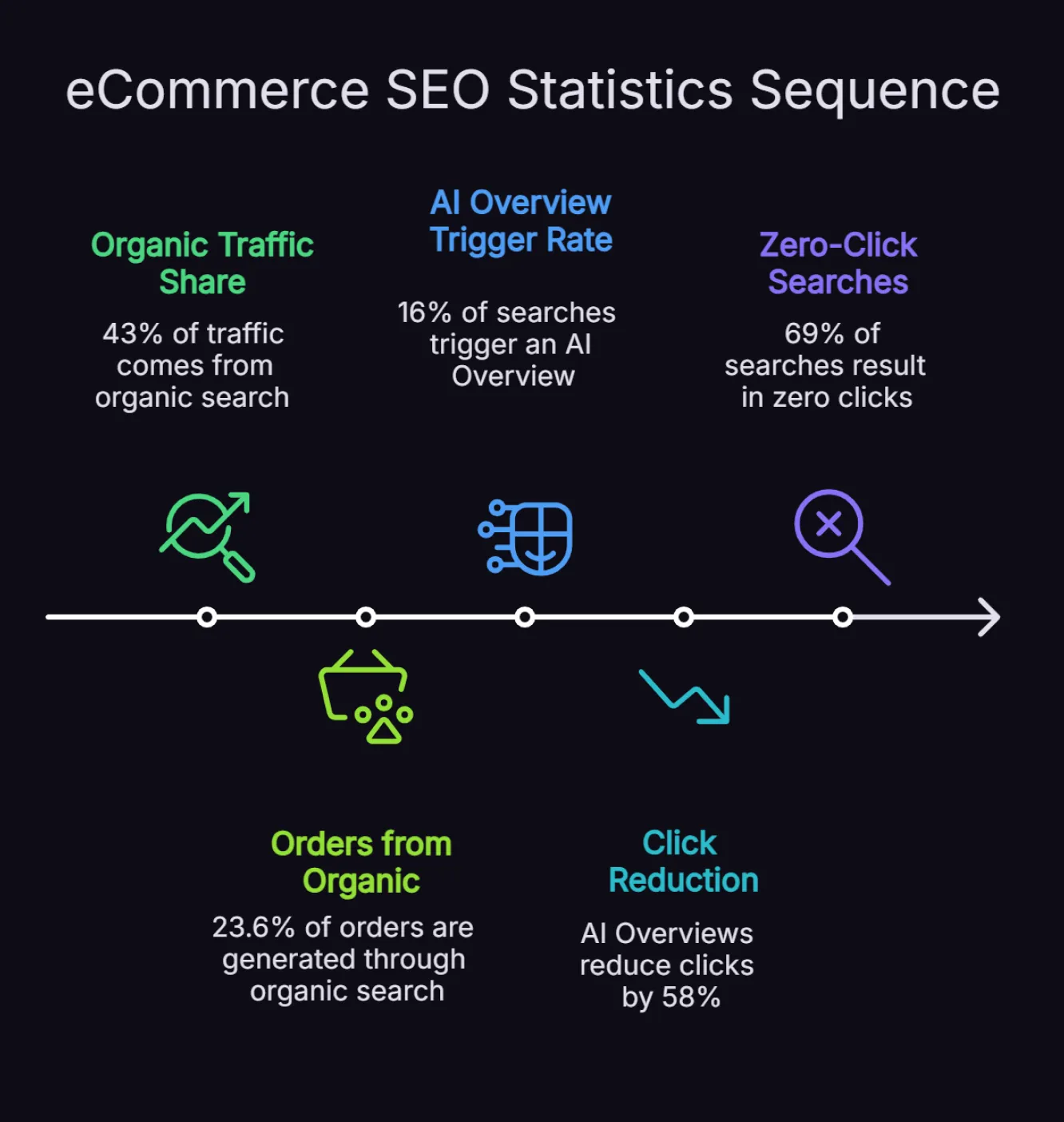
eCommerce SEO is the single largest driver of online store traffic, yet most retailers still treat it as an afterthought. Analysis from Search Engine Land data shows that at least 43% of eCommerce traffic comes from Google’s organic results. But here is the challenge most guides will not tell you about: search itself is changing. AI platforms like ChatGPT, Google AI Overviews and Perplexity are now where shoppers research and discover products. The eCommerce brands that only optimise for traditional Google rankings are leaving revenue on the table. This guide covers both sides - how to build a strong eCommerce SEO foundation and how to extend that visibility into AI search to capture every buyer touchpoint.
A Quick Guide to eCommerce SEO
eCommerce SEO is the process of optimising your online store so product pages, category pages, and supporting content rank higher in both traditional search results and AI-generated answers. It involves keyword research, smart site architecture, on-page optimisation, technical SEO, structured data, and link building tailored to how shoppers buy. In 2026, it also means appearing in AI search platforms like ChatGPT, Perplexity and Google’s AI Overviews, with surveys showing around 84% of shoppers now turn to AI to help them shop and effective eCommerce SEO returns an average ROI of about 317% that compounds over time.
See eCommerce SEO Drive Real Revenue Growth
Everything in this guide is built on the same strategies we use with our eCommerce clients. Our eCommerce AI SEO case study shows exactly what happens when you combine traditional eCommerce SEO with AI platform optimisation - real revenue growth, not just traffic numbers.
Explore the eCommerce SEO Case StudyWhy eCommerce SEO Matters More Than Ever in 2026
The eCommerce SEO landscape has shifted significantly. Understanding why it deserves your investment now requires looking at two converging forces: the proven revenue impact of organic search and the rapid rise of AI-powered product discovery.
Organic Search Is Still the Biggest Revenue Channel for Online Stores
The data is consistent across multiple studies. Organic search drives 53% of all website traffic and remains the most cost-effective acquisition channel for eCommerce businesses. For every dollar spent on SEO, eCommerce brands typically see a 3x return on average, with positive ROI achieved within 6 to 12 months.
What makes eCommerce SEO different from paid advertising is the compounding effect. Paid ads stop delivering visitors the moment you stop spending. A well-optimised product or category page continues generating traffic and sales for months or years after the initial investment. That is why 70% of marketers confirm that SEO generates more sales than PPC over time.
AI Search Is Creating a Second Discovery Layer for Shoppers
Here is what most eCommerce SEO guides miss entirely:
- 16% of eCommerce searches now trigger an AI Overview in Google results.
- AI Overviews reduce organic clicks by 58% for affected queries.
- And zero-click searches now make up 69% of all queries
- 23.6% of orders from organic search
This means shoppers are getting product answers without clicking through to your store. If your product pages and content are not structured for AI search, you are invisible in this growing channel.
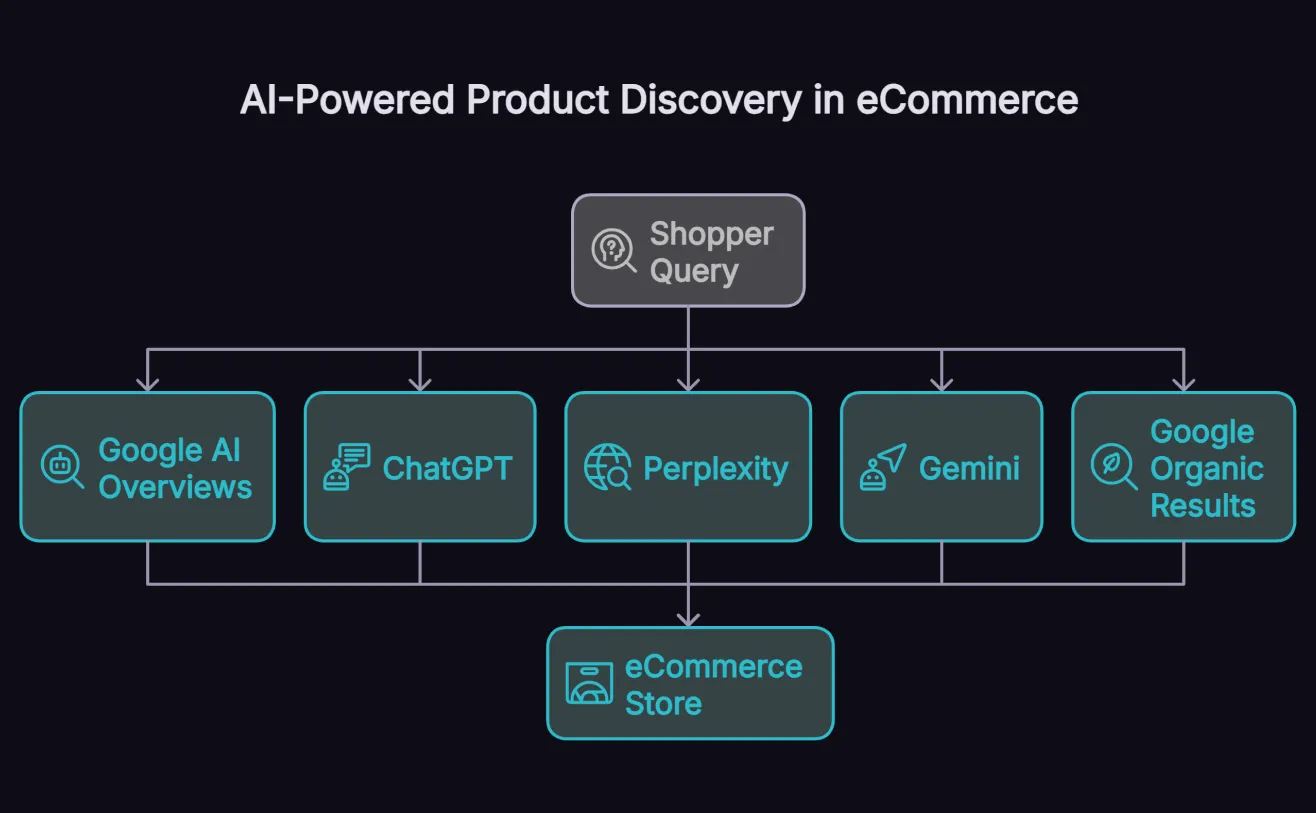
The shift extends beyond Google. ChatGPT now handles around 66 million search-style prompts daily. Shoppers ask questions like "best running shoes for flat feet" or "waterproof laptop bag under $200" and receive AI-curated product recommendations. The brands that AI platforms cite are the ones capturing that demand.
This is why our approach to AI SEO strategy covers both traditional search rankings and AI platform visibility simultaneously.
How to Build a Strong eCommerce SEO Foundation
Before focusing on advanced tactics or AI optimisation, your online store needs to get the fundamentals right. These core elements form the backbone of every successful eCommerce SEO campaign.
eCommerce Keyword Research That Drives Purchases
Keyword research for eCommerce is different from standard SEO keyword research. You need to target a mix of commercial and informational keywords that cover the full buyer journey.
Start with your product and category pages. These should target commercial-intent keywords where shoppers are ready to buy:
- Product keywords: "men's leather boots size 10" or "organic face moisturiser SPF 30"
- Category keywords: "women's running shoes" or "wireless noise-cancelling headphones"
- Comparison keywords: "Dyson vs Shark vacuum cleaner" or "best protein powder for beginners"
Then build out your informational content strategy. 61% of US online consumers make purchases based on blog recommendations. Blog posts, buying guides and how-to content targeting informational queries build topical authority and attract shoppers earlier in their purchase journey.
A strong keyword research service maps keywords to search intent and purchase stages so every page on your store has a clear purpose.
Site Architecture That Search Engines and Shoppers Both Love
eCommerce sites often have hundreds or thousands of pages. How you organise them directly affects how well search engines crawl and index your products - and how easily shoppers find what they need.
The best eCommerce site structures follow a shallow hierarchy:
- Homepage links to main category pages.
- Category pages link to subcategory pages.
- Subcategory pages link to individual product pages.
- Every product should be reachable within three clicks from the homepage. This flat structure ensures search engine crawlers can discover all your pages efficiently and pass link equity from your homepage down to the product level.
- Breadcrumb navigation is not optional for eCommerce. Breadcrumbs help shoppers understand where they are on your site and give search engines a clear picture of your page hierarchy. When combined with breadcrumb schema markup, they also create richer search result displays.
- Internal linking deserves particular attention. Many eCommerce brands still overlook basic internal link optimisation, even on high-visibility sites. Link related products, connect category pages to supporting blog content and make sure every important page receives contextual internal links from other relevant pages.

On-Page SEO for Product and Category Pages
Product pages are the revenue-driving pages on your eCommerce site. Optimising them properly means going beyond basic keyword placement.
Product page essentials:
- Write unique, detailed product descriptions that answer buyer questions. Avoid manufacturer copy that every other retailer uses.
- Optimise title tags with the primary product keyword, brand name and a differentiating detail like "free shipping" or "4.8 stars"
- Use descriptive H1 headings that match what shoppers search for
- Add high-quality images with descriptive alt text that includes product keywords
- Include customer reviews on product pages. Products with 50+ reviews convert 4.6x better.
Category page essentials:
- Write unique introductory content for each category that naturally includes the target keyword
- Use descriptive subheadings to break up product listings
- Add filtering and sorting options that help shoppers narrow their search
- Include FAQ sections that address common category-level questions
Technical SEO for eCommerce Websites
Technical SEO ensures search engines can efficiently crawl, index and understand your entire product catalogue. eCommerce sites face unique technical challenges that smaller websites do not.
Page Speed and Core Web Vitals
A 0.1-second improvement in load time increases retail conversion rates by 8.4%. With mobile commerce making up 68% of all eCommerce traffic, page speed on mobile devices is not a nice-to-have - it directly affects revenue.
Crawl Budget Management
Large eCommerce sites with thousands of product pages need to manage how search engines spend their crawl budget. Use robots.txt and XML sitemaps to guide crawlers toward your most important pages. Block faceted navigation URLs that create thin or duplicate content.
Duplicate Content Handling
Product variants (sizes, colours and configurations) often create duplicate content issues. Use canonical tags to tell search engines which version of a page is the primary one. This prevents diluting your ranking signals across multiple near-identical URLs.
Mobile-First Optimisation
Google uses mobile-first indexing, which means the mobile version of your site determines your search rankings. Test every product page, category page and checkout flow on mobile devices. Mobile users still convert at 2.8% in 2025 - on par with desktop - so a poor mobile experience means lost revenue.
Structured Data and Schema Markup for eCommerce SEO
Structured data is one of the most underutilised opportunities in eCommerce SEO. It tells search engines exactly what your pages contain and unlocks rich results that make your listings stand out.
Why Schema Markup Matters for eCommerce
Pages with schema markup achieve 25% higher click-through rates than pages without it. In a Google case study with Nestlé, pages shown as rich results recorded an 82% higher CTR than the same pages appearing as standard listings. For ecommerce, Product schema is also a prerequisite for many Google Shopping and merchant listing experiences, improving product exposure and click-through opportunities.
But the schema's value extends beyond traditional search. As AI search platforms increasingly rely on structured data to understand products and generate recommendations, clean schema markup positions your products to be cited and recommended by AI assistants.
Essential Schema Types for Online Stores
- Product schema is the highest priority for every eCommerce site. It should include product name, description, price, availability, reviews, ratings and shipping details. Google uses this data to generate rich snippets showing price, stock status and star ratings directly in search results.
- Organisation schema establishes your brand identity and connects your business details across all pages of your site.
- BreadcrumbList schema helps search engines display your site hierarchy in search results, improving click-through rates with clear navigation paths.
- The FAQ schema on product and category pages answers common buyer questions directly in search results. This is particularly valuable for appearing in AI Overviews and People Also Ask results.
- Review and AggregateRating schema displays star ratings in search results, building trust before the shopper even visits your page.
Implement schema using JSON-LD format, which Google recommends. Validate your markup using Google's Rich Results Test and monitor it through Google Search Console's Enhancements tab.
eCommerce SEO for AI Search and Generative Platforms
This is where the eCommerce SEO landscape is shifting fastest - and where most online stores are completely unprepared. Understanding how AI search works and how to optimise for it is the difference between growing and shrinking organic revenue in 2026.
How AI Platforms Discover and Recommend Products
Google AI Overviews, ChatGPT, Perplexity and Gemini each pull product information differently. But they share common patterns in what they cite:
- Well-structured content with clear headings, concise answers and logical organisation
- Comprehensive product information including specifications, pricing, comparisons and use cases
- Structured data that makes product attributes machine-readable
- Authoritative domains with strong backlink profiles and established topical relevance
- Fresh, accurate content that reflects current pricing, availability and product details
BrightEdge’s study of Google AI Overviews found that only 16.7% of citations come from top-10 organic results. Meaning over 80% of sources are pulled from deeper rankings. Your content needs to be structured specifically for how AI platforms interpret and synthesise information.
Optimising Product Content for AI Citations
To get your products recommended by AI assistants, focus on creating content that AI can easily parse and reference:
- Write detailed product descriptions that answer specific buyer questions in clear, factual language.
- Create comparison content that positions your products against alternatives using objective criteria.
- Build comprehensive buying guides that cover selection criteria, use cases and price ranges.
- Include specific data points - dimensions, materials, performance benchmarks and customer satisfaction metrics.
- Structure content with clear question-and-answer formatting that AI can extract.
Our AI SEO strategy goes deeper into the technical requirements for earning AI citations across all major platforms.
Content Marketing That Serves Both Search Engines and AI Platforms
A strong content marketing strategy is what separates eCommerce brands with steady organic growth from those stuck on a traffic plateau.
For eCommerce, your content needs to serve multiple purposes:
- Product-adjacent blog content that captures informational searches and builds topical authority around your product categories
- Buying guides and comparisons that match commercial research queries and get cited by AI platforms
- How-to content and tutorials that demonstrate product use and answer post-purchase questions
- Industry trend content that positions your brand as a knowledgeable authority in your niche
Every piece of content should link strategically to relevant product and category pages, passing authority to the pages that drive revenue.
eCommerce Link Building and Off-Page SEO
Backlinks remain one of the strongest ranking signals for eCommerce sites. Most eCommerce brands already rank for hundreds or even thousands of keywords, but the ones dominating page one are usually the ones with far stronger backlink profiles.
Earning Quality Backlinks for eCommerce
The most effective link-building strategies for online stores include:
- Digital PR campaigns built around original data, product launches or industry insights that earn links from high-authority media sites
- Product reviews and editorial features in niche publications that link back to your product pages
- Resource and guide creation that other sites in your industry naturally reference and link to
- Supplier and manufacturer partnerships that include links from their websites to your store
Focus on quality over quantity. Digital PR typically earns backlinks from much stronger, more authoritative sites than lower-quality tactics ever reach. A smaller number of high-authority links will outperform hundreds of weak ones.
Link building for eCommerce also feeds directly into AI visibility. Domains with stronger backlink profiles and more referring domains are more likely to be cited in AI Overviews and Perplexity results.
Measuring eCommerce SEO Performance and ROI
SEO without measurement is just guesswork. For eCommerce specifically, the metrics that matter most are the ones connected to revenue, not vanity traffic numbers.
Essential eCommerce SEO Metrics
Track these metrics to understand the real business impact of your SEO investment:
- Organic revenue attribution: How much revenue comes directly from organic search visitors? This is your north star metric.
- Organic traffic by page type: Break down traffic between product pages, category pages and blog content to understand which areas drive the most value.
- Keyword rankings for commercial terms: Track your positions for high-purchase-intent keywords that directly drive sales.
- Conversion rate from organic traffic: Organic search traffic converts at 2-4% on average. If your rate is below this benchmark, focus on conversion rate optimisation alongside SEO.
- AI search visibility: Monitor whether your products appear in AI Overviews, ChatGPT responses and Perplexity citations. This is the newest - and increasingly important - metric for eCommerce brands.
The eCommerce brands seeing the strongest SEO returns are those measuring revenue impact, not just rankings. Our B2C AI SEO case study demonstrates how tracking revenue attribution reveals the true ROI of an integrated SEO approach.
Frequently Asked Questions
How long does eCommerce SEO take to show results?
Most eCommerce SEO campaigns begin showing measurable traffic improvements within 3 to 6 months. Revenue impact typically follows within 6 to 12 months, depending on your site's current authority, competitive landscape and the scope of optimisation work required. Unlike paid advertising, SEO results compound over time, meaning the return on investment increases the longer you maintain the campaign.
What is the difference between eCommerce SEO and regular SEO?
eCommerce SEO focuses on optimising product pages, category pages and shopping-specific features like structured data, product feeds and faceted navigation. Regular SEO typically targets informational content and service pages. eCommerce sites also face unique technical challenges, including managing thousands of product URLs, handling duplicate content from product variants and optimising for Google Shopping and Merchant Centre integration.
Is SEO worth the investment for eCommerce businesses?
SEO delivers up to 317% ROI when executed as a long-term strategy. Unlike paid ads that require continuous spending, organic rankings generate ongoing traffic and revenue after the initial optimisation work is complete. The compounding nature of SEO means that each optimised page continues working for your business over time.
How does AI search affect eCommerce SEO in 2026?
AI platforms like Google AI Overviews, ChatGPT and Perplexity now play a direct role in product discovery. 16% of eCommerce searches display an AI Overview and 61% of US shoppers use AI tools to assist with purchases. eCommerce brands that optimise only for traditional Google rankings miss visibility in this growing channel. Structured data, comprehensive product content and AI-specific content optimisation are now required to maintain full search visibility.
What are the most important technical SEO factors for eCommerce sites?
The highest-impact technical factors for eCommerce include page speed (where a 0.1-second improvement lifts conversion rates by 8.4%), mobile-first design, proper canonical tag implementation for product variants, clean XML sitemaps, structured data markup and efficient crawl budget management. Core Web Vitals scores directly affect both rankings and the shopping experience.
Should eCommerce brands focus on product page SEO or content marketing?
Both are necessary for sustained growth. Product and category pages capture commercial-intent searches from shoppers ready to buy. Content marketing - including buying guides, how-to articles and comparison content - captures informational queries earlier in the buyer journey and builds the topical authority that strengthens your entire domain. The most successful eCommerce SEO strategies integrate both under a unified content marketing approach.
How important is schema markup for eCommerce SEO?
Schema markup is one of the highest-impact, lowest-effort improvements an eCommerce site can make. Pages with schema achieve 25% higher click-through rates and product schema delivers higher Google Shopping visibility. As AI search platforms increasingly rely on structured data to understand and recommend products, schema is also becoming a prerequisite for AI visibility.
The eCommerce Brands Winning in 2026 Are Playing a Different Game
The eCommerce SEO playbook is no longer just about keywords and backlinks. The brands capturing the most organic revenue in 2026 are the ones optimising across both traditional search and AI platforms simultaneously. They are investing in structured data, building comprehensive product content, earning authority through quality links and measuring success by revenue impact rather than ranking positions. The opportunity is significant for retailers willing to take this more complete approach to search visibility. Start by auditing your current eCommerce SEO foundation, then layer in AI search optimisation to capture every buyer touchpoint. If you want a partner who has already done this for eCommerce brands with measurable results, explore our eCommerce SEO services.
About the Author
Want Insights Like This Fortnightly?

Our AI SEO strategies and tactics delivered fortnightly, including bonus trade secrets not shared anywhere else. No fluff. Just what's working right now. 5-minute read.


