
Keyword Research for Revenue: An Intent-First Process for Google and AI Search


Most keyword research advice tells you to chase search volume. After running campaigns that have contributed to $26M+ in aggregate attributed client revenue, I can tell you that volume is rarely the number that matters most. Keyword research is the process of finding the exact terms your customers use before they buy, then deciding which of those terms are actually worth winning. Get that decision right and organic search becomes a predictable revenue channel across both Google and AI platforms like ChatGPT and Perplexity. In this guide, I will walk you through the process we use at Rankmax, including the buyer-intent filter and prioritisation method that separate keywords that drive sales from keywords that only drive traffic.
A Quick Guide to Keyword Research
Keyword research is how you discover and evaluate the words people type into Google and ask AI search tools, then choose the terms with real commercial potential that you can realistically rank for. The strongest keyword research weighs search intent and revenue potential above raw search volume. A page ranking in the top three positions for a keyword searched 200 times a month by people ready to buy will often generate more business value than a page ranking eighth for a keyword searched 5,000 times a month by researchers. That is why I treat keyword research as a prioritisation exercise, not a search volume hunt.
Turn Keyword Research Into Revenue, Not Just Traffic
Finding profitable keywords takes more than intuition. Our keyword research services combine Google and AI search analysis with the intent-first prioritisation method behind results like about $8.7M attributed over 27 months for a B2B client, about $14.6M organic over 21 months for a B2C client, and $1.31M for a B2B SaaS client. We pinpoint the exact terms your customers use when they are ready to buy.
See Our Keyword Research ApproachWhat Is Keyword Research, and Why Does It Matter?
Keyword research is the systematic process of finding and evaluating the search terms people enter into search engines and AI assistants. These terms become the foundation for your content strategy, helping search engines understand what your pages are about and matching them with relevant searches.
The importance of keyword research goes well beyond ranking higher. When you understand the exact language your customers use, you create content that meets their needs and guides them toward a decision. The real lesson from our client work is about position and intent, not volume. A page ranking in the top three for a high-intent buyer term will usually drive more revenue than a page ranking eighth for a high-volume research term. Targeting the right keywords, at a position you can actually reach, decides whether you capture valuable demand or lose it to competitors.
The Shift From Keywords to Topics
Search engines have changed significantly over the past decade. Google's algorithms now understand context, synonyms and user intent rather than simply matching exact keyword phrases. This shift means modern keyword research has to consider entire topic clusters rather than isolated terms.
Building topical authority has become essential for ranking success. This is not just theory, but we would avoid overstating the Google documentation leak as official confirmation. The leak strengthened the case that topic-level signals matter, while Google’s own guidance still frames quality around helpfulness, expertise, trust and people-first value. The practical takeaway is simple: when you cover a subject comprehensively through interconnected content, search engines and AI systems have more evidence that your site is a credible source. When you cover a subject comprehensively through interconnected content, search engines recognise your expertise and reward you across related queries. The same depth positions your content for AI search platforms, which lean on authoritative sources when they generate answers.
Understanding Search Intent
Search intent is the reason behind a query, and it is the single most useful lens in keyword research. Someone searching "what is keyword research" has very different needs from someone searching "keyword research agency Sydney". Understanding that difference is what lets you create content that satisfies the searcher and converts.
The Four Types of Search Intent
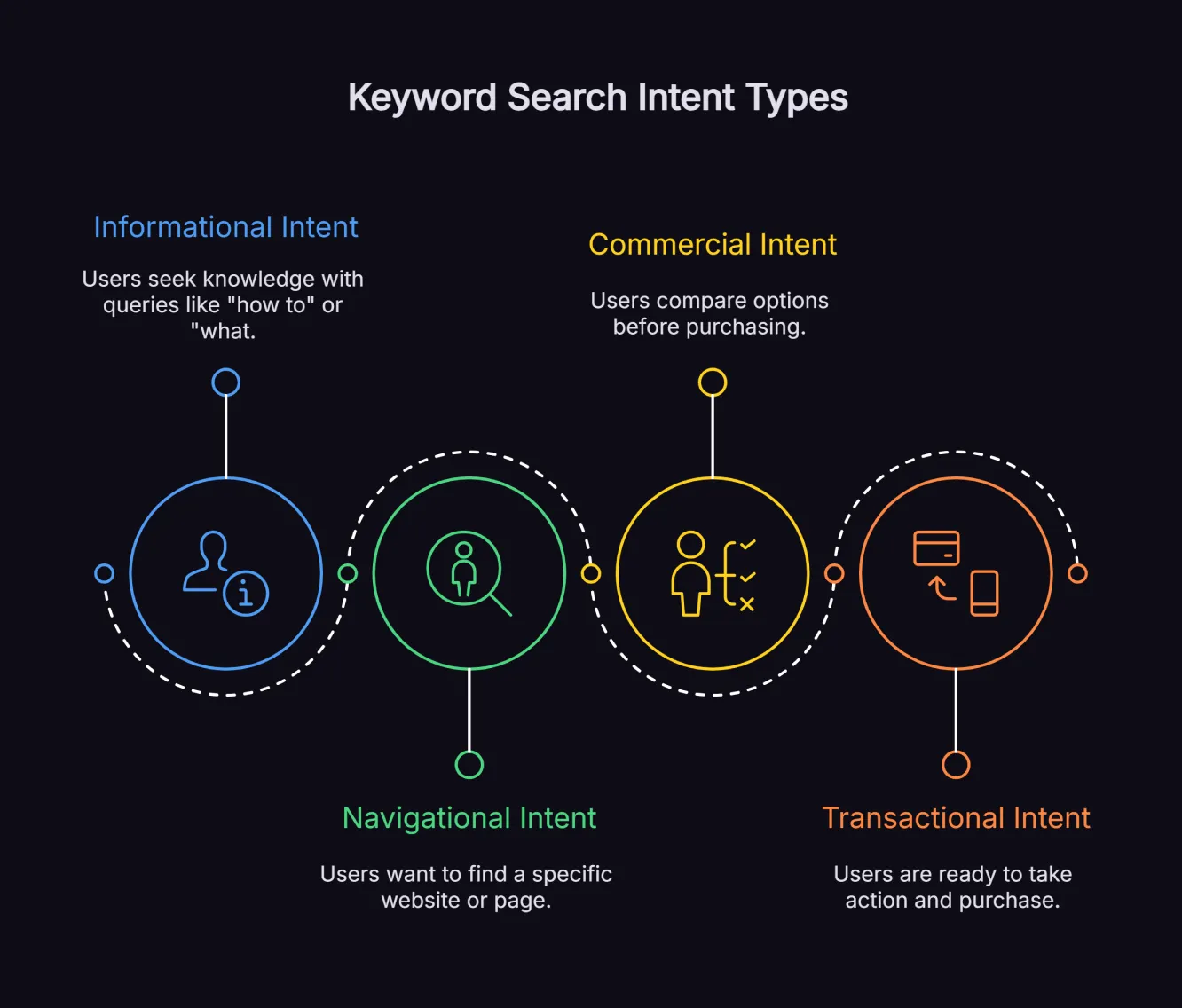
Four primary categories of search intent shape how you approach keyword targeting:
- Informational intent: Represents users seeking knowledge. These queries often start with "what", "how" or "why". Examples include "how to do keyword research" or "what are long-tail keywords". Informational content builds awareness and establishes your expertise with potential customers.
- Navigational intent: Occurs when users want a specific website or page. Branded searches like "Google Keyword Planner login" fall into this category. These queries usually favour the brand being searched.
- Commercial intent: Describes research-focused searches where users compare options before buying. Queries like "best keyword research tools" or "keyword research software comparison" signal someone evaluating solutions but not ready to buy.
- Transactional intent: Signals users ready to take action. Terms containing "buy", "hire" or "get started" often indicate high purchase intent. These keywords usually convert at the highest rates despite sometimes lower search volumes.
Why Intent Matters More Than Volume
Chasing high-volume keywords without considering intent wastes budget. A keyword with 5,000 monthly searches but informational intent will convert far fewer visitors than a 500-search transactional keyword where buyers are ready to act.
I have seen this play out directly. For a B2C compensation claims client, terms like "PTSD compensation claims" and "permanent impairment claims" carried stronger commercial intent than the generic, higher-volume "compensation claims", precisely because the specificity signalled a ready-to-act searcher. We prioritise terms that line up with commercial outcomes for exactly this reason. When we built the strategy for our B2B SaaS client, we focused on keywords with strong buying signals rather than broad informational terms, and that focus contributed to $1.31M in revenue at a 20.1:1 return over 12 months.
How to Do Keyword Research: A Step-by-Step Process
Effective keyword research follows a systematic approach that balances data analysis with strategic thinking. Here is the process we use at Rankmax when building keyword strategies for clients.
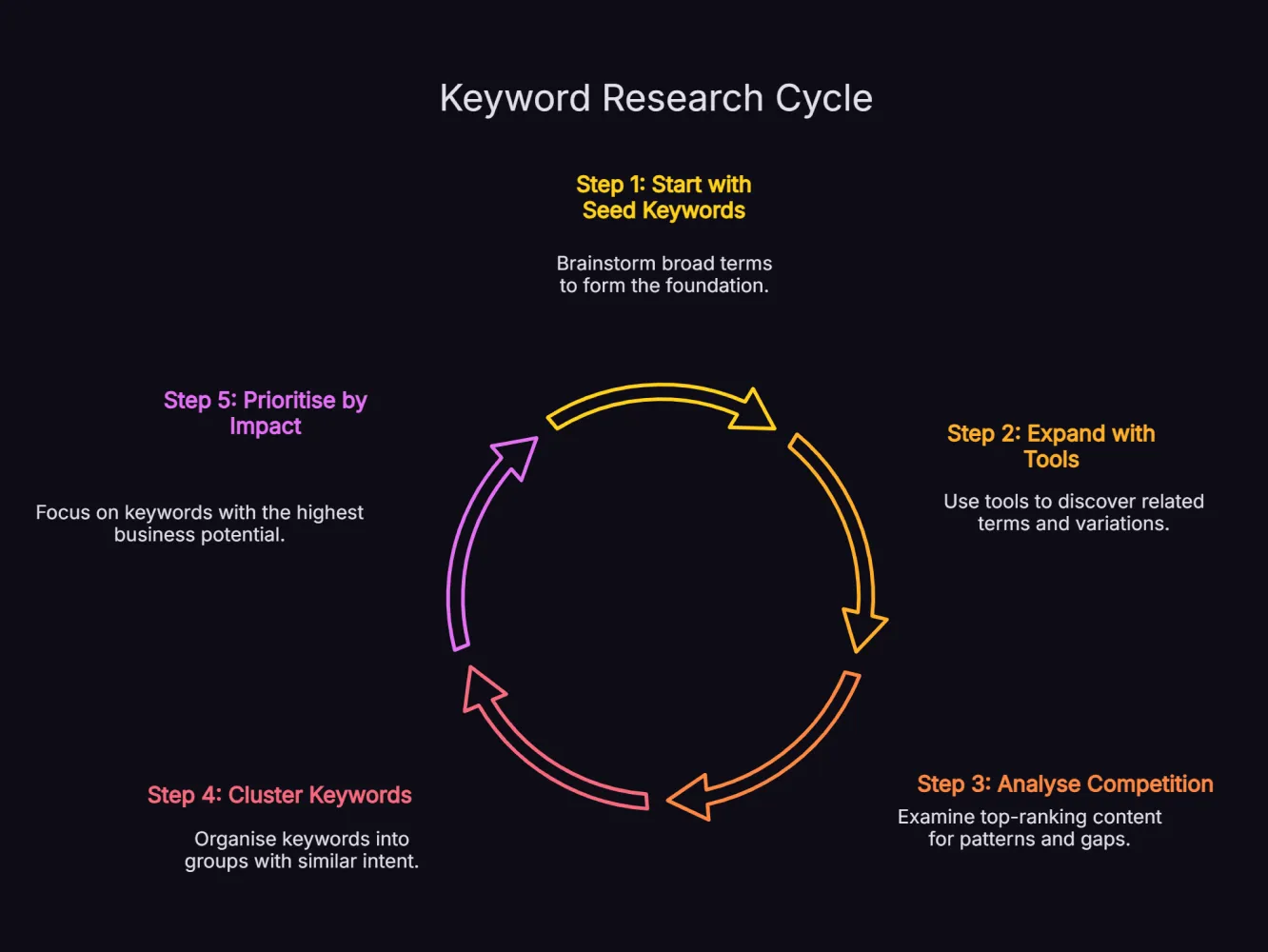
Step 1: Start With Seed Keywords
Seed keywords are the broad terms that describe your core products, services or topics. They form the foundation for expanding your keyword list. Begin by brainstorming the main categories your business addresses.
Consider how your customers describe their problems, not just how you describe your solutions. The language you use internally is often different from what customers type into search engines. Review customer enquiries, support tickets and sales conversations to find the natural-language patterns that become your strongest seed terms.
Step 2: Expand With Keyword Research Tools
Once you have seed keywords, use specialised tools to find related terms, variations and long-tail opportunities. Popular options include:
You can also use Google Search Console to assist with keyword research if you already have it set up for your website. Search Console shows the queries that already drive impressions and clicks, which helps you expand from terms you partially rank for and spot long-tail opportunities the paid tools may underweight.
When you evaluate keywords, examine these key metrics:
- Search volume: Indicates how many people search a term each month. Higher volume means more potential traffic but usually more competition.
- Keyword difficulty: Estimates how hard ranking will be, based on the authority of the pages already ranking. Newer sites should prioritise lower-difficulty keywords first.
- Cost per click (CPC): Reveals commercial value. High CPCs flag terms where businesses already spend on ads, which signals strong conversion potential.
- Search intent: Classification tells you what type of content will satisfy users. Most tools now include intent indicators for each keyword.
Step 3: Analyse the Competition
Before targeting any keyword, examine what currently ranks. Search your target terms in an incognito browser and study the top 10 results.
- Look for patterns in content type, format and depth. If the first page is dominated by comprehensive guides over 3,000 words, a brief 500-word post will not compete. If product pages dominate, informational content may not match intent.
- Identify content gaps where the current results fall short. Competitors often cover a topic broadly but miss the specific subtopics your audience cares about. Those gaps are your opportunities to publish something better.
Step 4: Cluster Keywords by Topic
Modern SEO means organising keywords into clusters that share intent. Rather than separate pages for "keyword research tools" and "best keyword research software", you combine them into one comprehensive resource. Clustering lets a single page rank for dozens of related terms and signals topical depth to search engines.
This is where disciplined process pays off. On a B2B SaaS engagement, we mapped 2,300+ keywords into topical clusters, making sure each article targeted specific buyer pain points while avoiding cannibalisation. We run clustering through Keyword Insights, the tool we have used across client campaigns for years, then sense-check every cluster by hand. Group keywords based on:
- Shared search intent (Do users want the same type of content?)
- SERP overlap (Do the same pages rank for both terms?)
- Topic relevance (Do the terms belong to the same subject cluster?)
For a deeper framework on evaluating and grouping terms once you have them, see our guide to keyword clustering.
Step 5: Prioritise by Business Impact
Not all keywords deserve equal attention. In client work, we use a 100-point Keyword Opportunity Score so keyword research becomes a sequencing decision, not a volume-sorting exercise.
We score each shortlisted keyword across four weighted factors:
- Commercial intent - 35 points: How close the term sits to a buying decision.
- Revenue potential - 30 points: The likely value of a customer who arrives through that term.
- Achievability - 20 points: How realistic a first-page result is based on the current SERP, backlink gap, content quality and the client site’s authority.
- Strategic fit - 15 points: Whether the term strengthens a topic cluster we are already building.
Search volume, CPC and keyword difficulty still matter, but they act as supporting signals rather than the final decision. A 200-search buyer term can outrank a 5,000-search research term if it is easier to win and closer to revenue.
As we wrote in the B2B AI SEO case study: “We prioritised these low-competition, high-relevance clusters first to establish strong topical authority and organic search signals quickly, before moving on to more competitive phrases.”
Discovery alone is not a plan. After you have a clustered list, score candidates with the Keyword Opportunity and Benefit (KOB) framework later in this guide so the order of work follows likely return, not raw volume.
Keyword Research for AI Search
AI search has changed what keyword research needs to account for. ChatGPT, Perplexity, Google AI Overviews and Microsoft Copilot now answer queries directly, which changes how people find information and how your content gets surfaced.
How AI Search Differs From Traditional Search
Traditional search shows a list of links to choose from. AI search synthesises information from multiple sources into a direct answer, often without the user clicking through. Google AI Overviews now appear on around 16% of queries, according to Semrush’s 2025 AI Overviews study, while Google AI Mode is expanding how people interact with search inside Google. These Google-native features do not register as separate referral traffic, so the real reach of AI search is larger than referral numbers alone suggest.
Intent matters even more here. Commercial-intent prompts also appear more likely to trigger a live web search in ChatGPT than informational prompts. Josh Blyskal’s analysis of 667,000 ChatGPT conversations found a 53.5% web search rate for commercial queries, compared with 18.7% for informational queries. If you sell a product or service, your commercial-intent content is exactly what AI search is looking for and citing. This is not abstract for us. On the same B2B property management engagement, we wrote the strategy around answering questions the way users ask ChatGPT, not just how they search Google, then built passage-level structure and FAQ markup around it. An earlier climb window on that engagement earned 598 AI cited pages across Google AI Overviews, ChatGPT, Perplexity and Gemini over 27 months and counting; the live case study now shows about $8.7M attributed over 27 months as the ongoing headline.
The same principle applied in the B2B SaaS campaign. We built the keyword map around buying-stage pain points, comparison intent and SaaS category questions, then structured the content for both Google and AI search. That campaign produced $1.31M in attributed revenue and a 20.1:1 ROI over 12 months. The lesson is that AI search does not need a separate keyword strategy. It needs intent-first keyword research expressed in a format AI systems can extract, trust and cite.
Optimising Keywords for AI Visibility
AI search platforms favour content structured for easy extraction. To improve your chances of being cited:
- Answer questions directly and early: Put clear, concise answers near the top of your content. Search Engine Land’s citation analysis found that 44.2% of ChatGPT citations came from the first 30% of a page.
- Cover topics comprehensively: AI platforms synthesise information across related queries, so thorough coverage raises your odds of being cited for many questions.
- Build authoritative sources: AI systems weight established, trusted sources more heavily, so invest in genuine expertise, original data and consistent author profiles.
- Structure content clearly: Use descriptive headings, bullet points and numbered lists that help AI parse your content.
Our passage optimisation guide explains how to structure content for Google AI Overviews and ChatGPT citations, and our explainer on how AI search works covers the mechanics behind these results. The keywords you target still matter, but how completely and accurately you answer the question behind them matters more.
Long-Tail Keywords and Their Importance
Long-tail keywords are longer, more specific phrases that usually have lower search volumes but higher conversion rates. "Running shoes" is a head term; "best stability running shoes for flat feet" is a long-tail variation. The same pattern holds in high-value verticals, where specific commercial long-tail terms routinely outperform generic, higher-volume ones.
Benefits of Targeting Long-Tail Keywords
Long-tail keywords offer several advantages for businesses chasing qualified traffic:
- Lower competition: Fewer sites target specific long-tail variations, so they are easier to rank for, especially for newer sites.
- Higher conversion rates: Specificity signals clearer intent. Someone searching "buy size 10 Brooks Ghost 15 online" knows exactly what they want.
- Better intent matching: Long-tail queries reveal precisely what users seek, so you can create highly targeted content.
- Voice and AI alignment: As voice and AI search grow, queries become more conversational and specific, which suits long-tail terms.
Finding Long-Tail Opportunities
Several methods help uncover valuable long-tail keywords:
- Google autocomplete: Suggests popular completions as you type, revealing real user queries.
- "People also ask" boxes: Show related questions, each a potential long-tail target.
- Forum and community research: Exposes the natural language your audience uses. Reddit, Quora and industry forums hold countless ideas.
- Customer conversations: Reveal how real customers describe their problems and the solutions they want.
Building Topical Authority Through Keyword Research
Topical authority is a website's recognised expertise on a subject, and keyword research is how you map the work to build it. Search engines reward sites that demonstrate comprehensive knowledge across related topics with stronger rankings and visibility.
Creating Topic Clusters
Topic clusters organise content around pillar pages and supporting cluster content. The pillar page covers a main topic broadly, while cluster pages explore specific subtopics in depth. Internal links connect the related content and signal those relationships to search engines.
Our AI SEO work for clients always begins with a topical authority audit, identifying the topics where a client can realistically become the most comprehensive resource, then building the content roadmap to get there. A pillar page on "keyword research", for example, might link to cluster pages covering:
- Keyword research tools comparison
- Search intent optimisation
- Long-tail keyword strategies
- Competitor keyword analysis
- Keyword clustering techniques
This structure demonstrates real expertise while creating the internal links that distribute authority across your content.
Mapping Keywords to the Buyer Journey
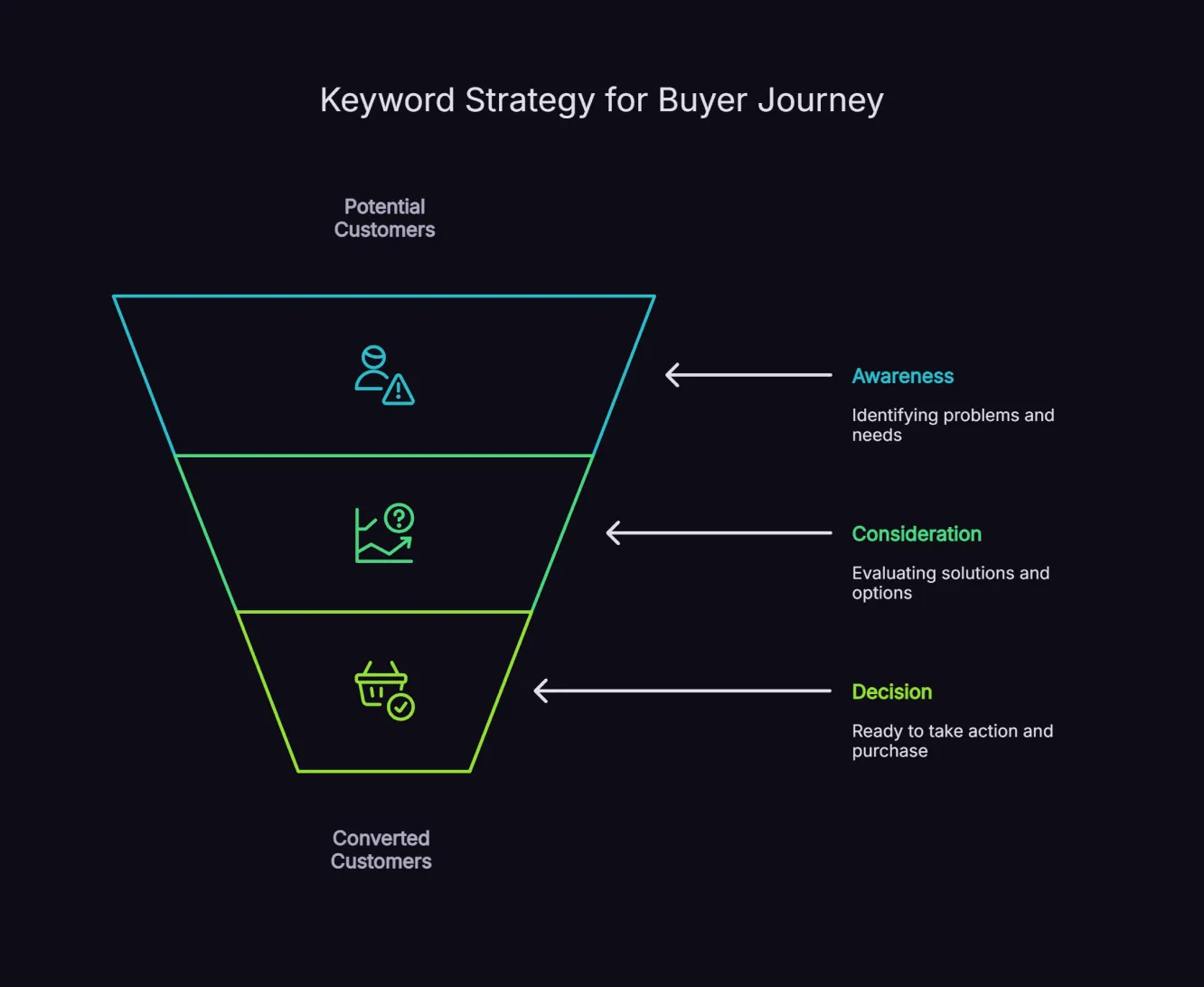
Effective keyword strategies meet customers at every stage of their decision process.
- Awareness stage: Target informational keywords where prospects identify problems. "Why is my website not getting traffic?" attracts users beginning their research.
- Consideration stage: Focus on commercial keywords where prospects evaluate solutions. "SEO agency vs in-house team" addresses users comparing options.
- Decision stage: Prioritise transactional keywords where prospects are ready to act. "AI SEO services pricing" signals strong purchase intent.
Mapping keywords across this journey means you capture and nurture potential customers wherever they enter your funnel.
Why Scoring Beats Collecting More Keywords
The biggest gains in keyword strategy rarely come from finding more keywords. They come from judging the ones you already have, and we think that is the single highest-return change most teams can make. On one eCommerce engagement, the turning point was not the size of the list. We clustered the keywords by intent and commercial value, not just search volume, and that revealed a pattern the competitors had missed: they were all fighting over the same high-volume terms while ignoring hundreds of specific, high-intent queries. The opportunity was sitting in the analysis, not the discovery.
That is the case for treating analysis as the centre of the work. A keyword with 10,000 monthly searches means nothing if you cannot realistically rank for it, or if the people searching have no intent to buy. A smaller, sharper term you can win in a quarter often returns more.
Search Intent Decides Whether a Keyword Is Worth It
Modern analysis starts with what the searcher actually wants. Search intent typically falls into four categories:
- Informational (learning something)
- Navigational (finding a specific site)
- Commercial (researching options)
- Transactional (ready to purchase)
Someone searching "best CRM software" wants comparison content. Someone searching "Salesforce login" wants their account. Score a keyword without reading its intent and you risk building the wrong page for it, which almost guarantees poor performance no matter how good the content is.
AI Search Rewards Authority, Not Keyword Matching
Discovery channels have widened. Google's AI Overviews now appear for many queries, and platforms like ChatGPT, Perplexity and Claude are becoming real ways people find answers.
Search Engine Land reported that AI-referred sessions grew 527% year on year from a small base. In a separate benchmark across 10 industries, ChatGPT accounted for 87.4% of AI referral traffic, making it the dominant source of AI-referred visits in that dataset. Semrush found the average AI search visitor was worth 4.4x the average traditional organic search visitor based on conversion rate.
Rankmax’s own case-study data shows AI traffic converting at or above organic in multiple engagements. Understanding how AI search works matters here, because these platforms synthesise information rather than rank ten blue links.
The signal that this channel is winnable is first-party, not theoretical. The same B2B property management engagement that produced 162 to 4,947 ranked keywords has also earned 598 AI cited pages across Google AI Overview, AI Mode, ChatGPT and Gemini over 27 months. AI platforms favour content that demonstrates genuine expertise, so your analysis has to flag the terms where you can realistically become the most authoritative answer, not just the terms with the highest volume.
From a Research List to a Scored Shortlist
A structured process turns a raw list into decisions. The first two stages are discovery, which the keyword research guide covers in depth. The stages that follow are where analysis earns its keep.
Build and Expand Your Keyword List
Seed keywords are the core terms tied to your products, services and industry. List the topics you cover, the problems you solve and the language customers use. Then use a research tool such as Ahrefs Keywords Explorer to expand the seeds into thousands of related terms with their search volumes and difficulty scores. Look for long-tail phrases, question-based queries and synonyms that capture audiences describing the same need in different words.
Analyse the Four Metrics That Actually Matter
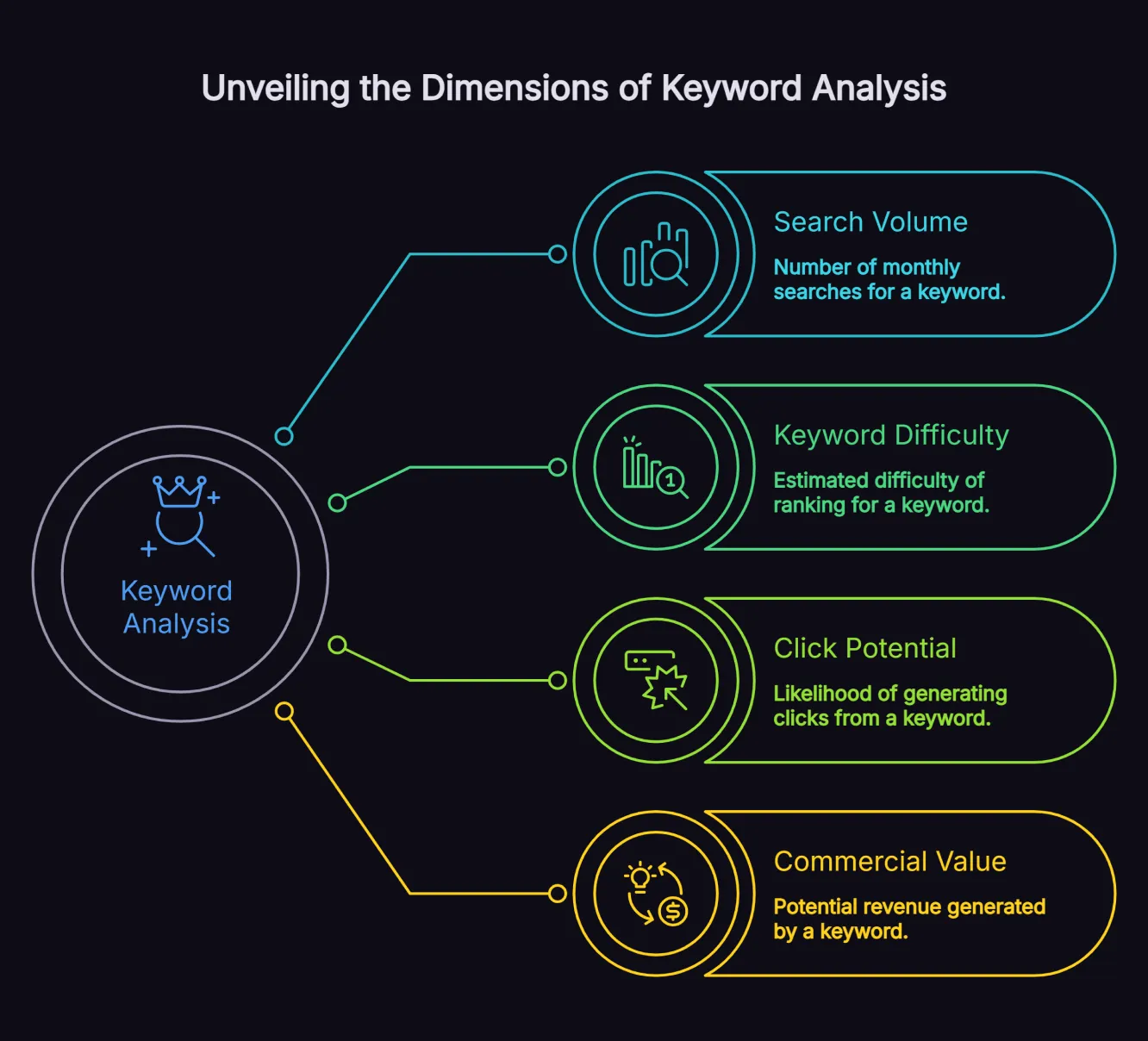
A raw list becomes a strategy input only after analysis. Four metrics carry the decision:
- Search volume: How many people search the term each month. Useful as a ceiling, misleading on its own.
- Keyword difficulty: A tool estimate of how hard ranking will be, based largely on the authority of pages already ranking. Treat it as a starting hypothesis, not a verdict.
- Click potential: Whether clicks are actually available. A term can have high volume but low click potential if a featured snippet or AI Overview answers the query on the results page.
- Commercial value: How close the searcher is to buying and how much that outcome is worth to you.
The metric most people over-trust is difficulty. Tool difficulty scores ignore content quality, topical relevance and your domain's specific strengths. Reading the actual results page is a more reliable assessment, because it shows exactly who you are competing against, what content formats Google is rewarding and which SERP features are eating the clicks.
The KOB Scoring Framework, Demonstrated
Naming a framework is easy. Showing it is what makes it useful. Keyword Opportunity and Benefit (KOB) scoring is the system we use to turn the four metrics above into a single comparable number, so a list of hundreds can be ranked by likely return rather than argued over one term at a time.
When we score keywords for a Rankmax campaign, we are looking for the gap between demand and achievability. A keyword can look attractive in a tool because the volume is high, but it should not lead the roadmap if the SERP is controlled by stronger domains, the intent is vague or the topic does not connect to revenue. The best opportunities usually sit where intent, SERP weakness and business value overlap. That is what the KOB framework is designed to find.
How the Four Factors Are Weighted
Each keyword is scored 1 to 5 on four factors, and the factors are not weighted equally. We give more weight to commercial intent and business alignment above raw volume, because a term that fits what you sell and what the searcher wants to do tends to convert. While a high-volume term with vague intent often does not. The weighting we use:
- Commercial intent: Weight 3
- Business alignment: Weight 3
- Keyword difficulty (inverted, so easier scores higher): Weight 2
- Search volume: Weight 1
A keyword's KOB score is the sum of each factor score multiplied by its weight. Higher scores rise to the top of the queue. The exact weights are a judgement call you can tune to your model, but the principle holds: intent and fit should outrank volume, which is the same lesson the eCommerce clustering above made plain.
A Worked Example: One Quick Win, One Strategic Target
Consider a representative pair from a B2C compensation claims engagement. The generic head term "compensation claims" had the highest search volume. The specific term "PTSD compensation claims" had lower volume, but stronger commercial intent because of its specificity and a more winnable results page.
In this example, “PTSD compensation claims” is the quick win because the intent is clearer and the SERP is more winnable. “compensation claims” remains the strategic target because it has broader demand but much higher competition. Scored on the framework, the two compare like this:

The high-volume head term loses on the factors that predict revenue, and the specific, high-intent term wins the queue despite a fraction of the volume. That matches what we saw in the engagement: terms like "PTSD compensation claims" and "permanent impairment claims" carried stronger commercial intent due to search specificity, despite lower volume than the generic searches. The scores above illustrate how the model weights the inputs rather than claiming exact measured volumes for these terms.
Sequencing Quick Wins and Long-Term Targets
A scored shortlist still needs an order. An effective plan runs achievable short-term targets alongside ambitious long-term ones, so momentum and authority build while you work toward the harder terms. This sequencing is the heart of the method. On the B2B property management engagement, “We prioritised these low-competition, high-relevance clusters first to establish strong topical authority and organic search signals quickly, before moving on to more competitive phrases that our competitors had long dominated.” That order helped grow the account from 162 to 4,947 ranked keywords and earn 598 AI cited pages across Google AI Overviews, ChatGPT, Gemini and Perplexity in an earlier climb window. The live B2B AI SEO case study now shows about $8.7M attributed over 27 months (ongoing).
The sequencing logic is not just intuition. My AI SEO strategy for clients always begins with a topical authority audit, identifying the topics where a client can realistically become the most comprehensive resource. That approach aligns with the direction of modern search: the leaked Google Search documentation included site-level topical coherence attributes, which support the strategic importance of topical authority, although the leak does not prove exact weighting or current use.
The same quick-wins-first sequencing also contributed to a SaaS client generating $1.31M in attributed revenue over 12 months, with $20.10 returned for every $1 invested, or a 1,909% average ROI. Our keyword research services turn this scoring and sequencing into a 12-month content roadmap so the order is deliberate rather than reactive.
Finding Keyword Gaps Your Competitors Left Open
Your competitors have already paid for keyword research. Their ranking terms are validated opportunities, and the gaps between their coverage and yours are where analysis pays off again. Competitor analysis reveals both the terms they rank for that you do not, and the terms where weaker content gives you a way in.
Identifying Your True SEO Competitors
SEO competitors are not always business competitors. Your SEO competitors are whoever ranks for your target keywords, which sometimes overlaps with your commercial rivals and sometimes does not. Search your main terms, note the domains that appear consistently and treat those as the set to analyse and eventually outrank.
Finding Competitor Keyword Gaps
Keyword gap analysis compares your ranking terms against a competitor's to surface what they rank for and you do not. Not every gap is worth chasing. Score each one the same way you score any candidate:
- Relevance to your business
- Realistic ranking potential
- Commercial value
The biggest gaps are often the ones nobody is contesting properly. As the eCommerce work showed, competitors frequently crowd the high-volume head terms while leaving the specific, high-intent queries open, and those are usually the gaps that score highest and convert best.
Once you have a scored shortlist, map winners to pages and clusters. That is the hand-off from research into keyword mapping and keyword clustering.
Common Keyword Research Mistakes to Avoid
Even experienced marketers make errors that undermine their keyword strategies. Avoiding these mistakes improves results.
1. Ignoring Search Intent
Targeting keywords without understanding intent leads to content that fails to rank or convert. Always analyse the current results to see what users expect before you create anything.
2. Chasing Only High-Volume Terms
High-volume keywords attract competition and often carry broad intent. A balanced strategy includes lower-volume terms with clearer commercial value.
3. Neglecting Competitor Analysis
Understanding what works for competitors gives you a roadmap. Study their top-ranking content to find both opportunities and threats.
4. Keyword Stuffing
Forcing keywords unnaturally into content hurts readability and can trigger penalties. Write naturally for people while placing keywords thoughtfully.
5. Failing to Update Research
Search behaviour shifts constantly. Keywords that performed last year may have faded. Review and refresh your keyword strategy on a regular cadence.
6. Overlooking Local Keywords
For businesses serving specific areas, local keyword variations often deliver the highest-intent traffic. Terms with city or region names capture ready-to-buy local customers. Our guide to local SEO covers this in depth.
Frequently Asked Questions
How is the KOB scoring framework calculated?
KOB (Keyword Opportunity and Benefit) scoring combines demand, ranking difficulty, commercial value and business fit into one comparable score so you can rank a large keyword list by likely return. In practice we score volume and intent upside against difficulty and the resources needed to win, then sort the shortlist highest opportunity first. Use it after discovery and clustering, not instead of them.
What is the difference between keyword research and keyword analysis?
Keyword research finds and expands the terms your audience uses. Keyword analysis judges those terms for volume, difficulty, intent and commercial value so you know what to create first. On this page both stages sit in one workflow: discover, cluster by intent, then score with KOB before you map pages.
Can you do keyword research without paid tools?
Yes, though with limits. Free methods include analysing Google autocomplete, studying "people also ask" boxes, reviewing competitor content, mining customer conversations and using Google Search Console data. Paid tools speed up the process and provide more complete data, but resourceful marketers can build effective keyword strategies using free resources alone.
How do keywords affect AI search visibility?
Keywords remain important for AI search, but context matters more than exact matches. AI platforms evaluate topical authority, content quality and source credibility when selecting information for responses. Focus on comprehensively covering topics rather than obsessing over individual keyword placement. Clear, authoritative content structured for easy extraction performs best across both traditional and AI search.
How many keywords should you target per page?
Focus each page on one primary keyword plus two to five closely related secondary keywords that share the same search intent. Targeting unrelated keywords on a single page dilutes focus and confuses both users and search engines. Create separate pages for keywords with different intent, even if they seem topically related.
How often should you do keyword research?
Conduct comprehensive keyword research quarterly and perform lighter refreshes monthly. Search behaviour shifts continuously as new trends emerge, seasonal patterns change and competitors adjust their strategies. Regular research ensures your content targets currently relevant terms rather than outdated opportunities.
What are the best free keyword research tools?
Google Keyword Planner provides reliable search volume data directly from Google. AnswerThePublic visualises the questions people ask around your topics. Google Search Console reveals which keywords already drive traffic to your site. Google Trends shows how keyword popularity changes over time.
What is the difference between short-tail and long-tail keywords?
Short-tail keywords contain one to two words and have high search volume but broad intent and fierce competition. Long-tail keywords contain three or more words, have lower volume but clearer intent and less competition. Most effective SEO strategies balance both, using long-tail terms to build momentum and authority before tackling competitive short-tail variations.
Your Path to Keyword-Driven Revenue
Keyword research is where every revenue-driving SEO campaign begins, but the win is in the decision, not the data. Choose terms by intent and revenue potential, cluster them to build topical authority and structure the content so both Google and AI search can use it. That is the same approach we used on the ongoing B2B property management engagement (about $8.7M attributed over 27 months) and the B2C professional services engagement (about $14.6M organic over 21 months). Do the research properly and every page you publish compounds.
About the Author
Want Insights Like This Fortnightly?

Our AI SEO strategies and tactics delivered fortnightly, including bonus trade secrets not shared anywhere else. No fluff. Just what's working right now. 5-minute read.


