
SaaS SEO: How We Drove $1.31M in Attributed Organic Revenue and 1,909% ROI for a B2B Software Client


Our B2B SaaS client generated $1.31M in attributed organic revenue at a 1,909% ROI over 12 months. Monthly organic revenue grew from $25,000 to $135,000 (a 440% increase), 63 new paying customers came purely from organic search (an 86% lift) and the same engagement earned first-position AI Overview citations. The playbook below is the one that produced those numbers, written for SaaS founders, marketing leads and growth teams who want SaaS SEO that ties to revenue rather than vanity traffic.
With over 30,800 SaaS companies competing for visibility and a global market projected to exceed USD 375 billion in 2026, the surface area you need to cover has expanded beyond Google. Your SaaS SEO strategy now has to get your brand cited, recommended and trusted across every platform where buyers are searching, including ChatGPT, Perplexity, Claude and Google AI Overviews. This guide covers the full playbook, from keyword research and content strategy to technical foundations and AI search optimisation, with the specific Rankmax numbers that proved each part works.
A Quick Guide to SaaS SEO
SaaS SEO is the process of optimising a software company's website and content to attract qualified buyers through organic search and AI-driven discovery platforms. It goes beyond traditional search engine optimisation by addressing the unique challenges of the SaaS business model: longer sales cycles, multiple decision-makers and the need to build trust before a prospect ever requests a demo. According to Semrush, B2B SaaS companies achieve an average SEO ROI of 702% with a breakeven period of around seven months. That number is the industry benchmark. The campaign I describe in this guide produced 1,909% ROI over 12 months, with an average return of $20.10 for every $1 invested.
See the Full SaaS SEO Case Study Behind the $1.31M Result
Every number in this guide comes from a single B2B SaaS engagement: $1.31M attributed organic revenue, 1,909% ROI, 63 new paying customers and first-position AI Overview citations over 12 months. The full case study breaks down the content velocity, the cluster map, the technical foundation and the month-by-month ROI trajectory.
Read the Full Case StudyWhat We Have Seen in SaaS SEO
This callout summarises the headline outcomes from the engagement that anchors this guide. Every number below is verifiable in the SaaS SEO case study.
- 1,909% ROI over 12 months, an average of $20.10 in revenue for every $1 invested in SEO
- $1.31M total attributed revenue from organic search across the 12-month engagement
- 440% monthly revenue growth as organic revenue moved from $25,000 to $135,000 a month
- 86% customer acquisition lift, with 63 new paying customers acquired purely from organic search
- 2.34% churn rate on organic-acquired customers, proving traffic quality
- First-position AI Overview citations earned through semantic rebuild, topic clusters, entity optimisation and schema markup
For broader context across all our B2B engagements, average ROI sits above 6,800% for B2B clients, so 1,909% is mid-pack rather than outlier. The reason this case study is the right reference for SaaS specifically is that it isolates the SaaS go-to-market model, with longer cycles and multi-stakeholder decisions, and shows what consistent execution produces in that context.
Why SaaS SEO Matters More in 2026 Than Ever Before
The SaaS market is growing fast, but so is the competition for buyer attention. Three reasons a dedicated SEO programme should sit at the centre of your growth plan in 2026.
Organic Search Is the Most Cost-Effective SaaS Growth Channel
Ahrefs notes that industry studies show about 53% of all website traffic originates from organic search, confirming that SEO remains the primary acquisition channel for most businesses. Unlike paid advertising, where costs rise as you scale, SEO compounds over time. A blog post published today can generate leads for years. Data from Semrush shows that 66% of B2B SaaS buyers use search engines to research solutions before making a purchase, which means your content needs to be present at every stage of the buyer journey.
In our SaaS engagement, this compounding effect was visible in the ROI trajectory. The first month delivered 400% ROI, but as topical authority built and rankings accumulated, later months consistently delivered 2,000% to 2,600% ROI. SEO is not a linear channel. It is a compounding asset that pays back at an accelerating rate when you publish through the dip.
AI Search Is Changing How SaaS Buyers Discover Software
Google AI Overviews now appear in 13.14% of all searches, up from just 6.49% in January 2025. ChatGPT, Perplexity and other AI platforms are increasingly where software buyers start their research. Search Engine Land reported that ChatGPT drove 82.3% of AI referral traffic to SaaS sites between November 2024 and December 2025. AI Overviews now reduce organic clicks by 58%, which means traditional ranking alone is no longer enough. Your content needs to be structured so AI systems can extract, cite and recommend it. This is where understanding how AI search works becomes a competitive advantage.
Most SaaS Companies Are Still Not Optimised for AI
Despite these shifts, most SaaS companies still have not systematically optimised their metadata for conversational queries or AI-generated summaries. That gap creates a meaningful window for companies willing to invest in a dual-channel AI SEO strategy that covers both traditional Google rankings and AI platform visibility.
How to Build a SaaS SEO Strategy That Drives Revenue
Building an effective SaaS SEO strategy requires a methodical approach that connects search visibility directly to your pipeline. These are the core components that separate high-performing SaaS SEO programmes from those that generate traffic without revenue.
Start With Your Go-to-Market Strategy
Before touching keyword research or content plans, align your SEO strategy with your GTM model. A product-led growth company targeting self-serve signups needs different content than an enterprise SaaS running a sales-led motion. Define what success looks like from SEO: trial signups, demo requests or sales-qualified leads. Every SEO decision should map back to these commercial outcomes.
Set Measurable SEO Goals Tied to Revenue
Avoid setting goals around vanity metrics like traffic volume alone. Instead, define targets for:
- Organic pipeline contribution
- Revenue from organic search
- Cost per acquisition through SEO
- Specific keyword positions that correlate with buying intent
Track these monthly and attribute revenue back to specific content pieces and keyword positions. On the engagement above, we tracked organic-attributed revenue as the headline KPI from month one. That single discipline is what made the $1.31M number defensible at the end of the 12 months.
SaaS Keyword Research: Finding Terms That Convert
Keyword research for SaaS is fundamentally different from other industries because you need to capture buyers across a longer and more complex decision cycle. The right keyword research approach maps terms to specific stages of your buyer journey.
Map Keywords to the SaaS Buyer Journey
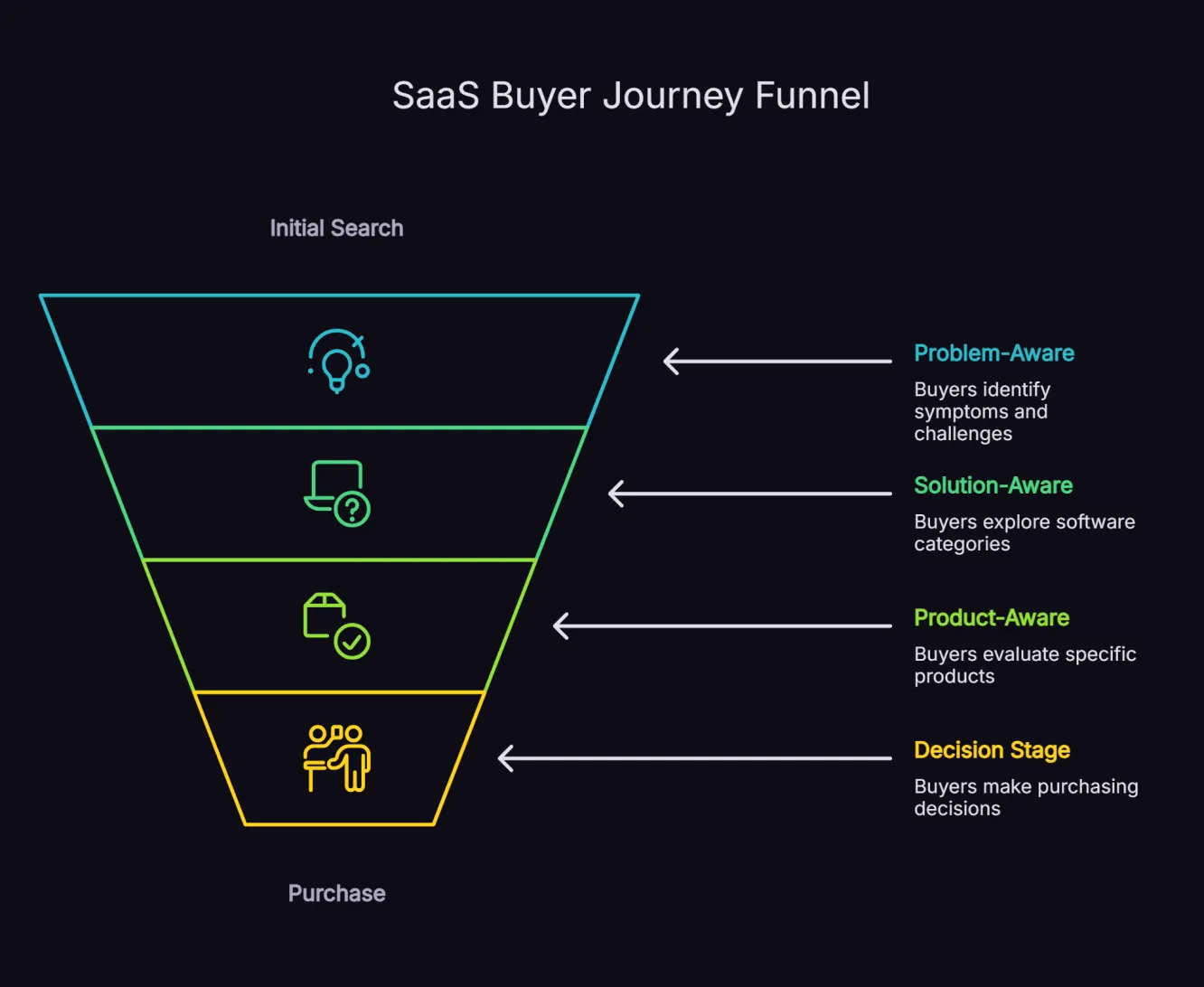
SaaS buyers typically move through four distinct stages, and your keyword strategy needs to cover all of them:
- Problem-aware: Buyers searching for symptoms and challenges. Informational queries like "how to reduce customer churn" or "automate invoice processing." High volume but lower immediate conversion intent.
- Solution-aware: Buyers who know a software category exists. They search for terms like "best project management software" or "CRM for small business." Stronger commercial intent.
- Product-aware: Buyers comparing specific products. They search for terms like "[Product A] vs [Product B]" or "[Product] pricing." High-intent queries at the bottom of the funnel.
- Decision stage: Buyers ready to act. They search for terms like "[Product] free trial" or "[Product] demo." Conversion rates here are the highest.
Anchor Your Mix to Real Touchpoint Data, Not "Balanced" Theory
Generic SaaS-SEO advice tells you to publish a "balanced content mix" across the funnel. The actual touchpoint distribution we measured on the SaaS engagement was 40/13/47: 40% of organic conversions came from early-funnel informational content, 13% from mid-funnel navigational and evaluation content, and 47% from late-funnel transactional and decision-stage content. The funnel is not flat. The bottom carries the largest single share of conversions.
The lesson is not "publish more bottom-funnel content and ignore the top." The early-funnel content was still pulling 40% of conversions, with an average of 2.7 touchpoints over 0.93 days from first visit to conversion. Buyers were arriving on informational pages and converting on commercial pages within the same week. The mix that worked was full-funnel, but weighted toward decision-stage assets (comparison pages, feature pages, product pages) at roughly half the total volume, with informational content sized to feed the top.
Prioritise High-Intent Keywords Over High-Volume Keywords
In SaaS SEO, a keyword with 200 monthly searches and strong buying intent will outperform a keyword with 10,000 searches that attracts casual browsers. Focus your efforts on keywords that signal a buyer is actively evaluating software solutions. In practice, long-tail keywords generate the majority of SaaS organic traffic and they usually convert at much higher rates than broad, generic terms.
Build Keyword Clusters Around Your Product Features
Create keyword clusters that group related terms around each core feature or use case of your product. This approach helps you build topical authority in the areas that matter most to your buyers. On the SaaS engagement, we mapped over 2,300 keywords into topical clusters before publishing a single article. Twelve months later, those clusters had produced 26,402 indexed organic keywords, 4,118 page-one rankings and 768 top-three positions. Cluster-level planning is what makes content velocity safe at scale.
SaaS Content Marketing: Creating Content That Ranks and Converts
Content is the engine of SaaS SEO. Without it, there is nothing to rank, and with the wrong kind, you attract visitors who never convert. Here is how we built a content marketing programme that drove both traffic and pipeline.
Publish at the Velocity Required to Compound
The single biggest lever in the engagement was publishing cadence. We ran a content production pipeline delivering five high-quality articles per week, which translated to approximately 260 optimised pages over 12 months. That cadence is what produced the 1,909% ROI and the $1.31M revenue outcome. Below five per week, the topical authority signal builds too slowly to compete with funded competitors. Above five per week, quality starts to drop without proportional editorial investment.
The key is not just volume. It is consistent volume against a clustered keyword map. Every one of those 260 pages targeted a specific cluster, with no cannibalisation between adjacent posts and clear internal-link routes from informational pages to commercial pages. Velocity without value wastes resources. Velocity against a clustered map compounds.
Create Content for Every Stage of the Buyer Journey
Your content library should span the full buyer journey. Most SaaS companies over-invest in awareness-stage blog posts while neglecting the comparison and decision-stage content that actually drives conversions. A balanced SaaS content strategy includes:
- Educational blog posts that establish topical authority and capture informational searches
- Product-led content that weaves your product into the solution naturally
- Comparison pages that help buyers evaluate your product against alternatives
- Use case pages that show how different industries or teams use your software
- Customer story content that provides social proof through real outcomes
Of those types, comparison pages have consistently delivered the highest conversion rates on the SaaS work we have done. Prospects researching alternatives are ready to buy. Comparison content meets them at the moment of highest commercial intent and the conversion rates show it.
Build Topical Authority With Pillar Content
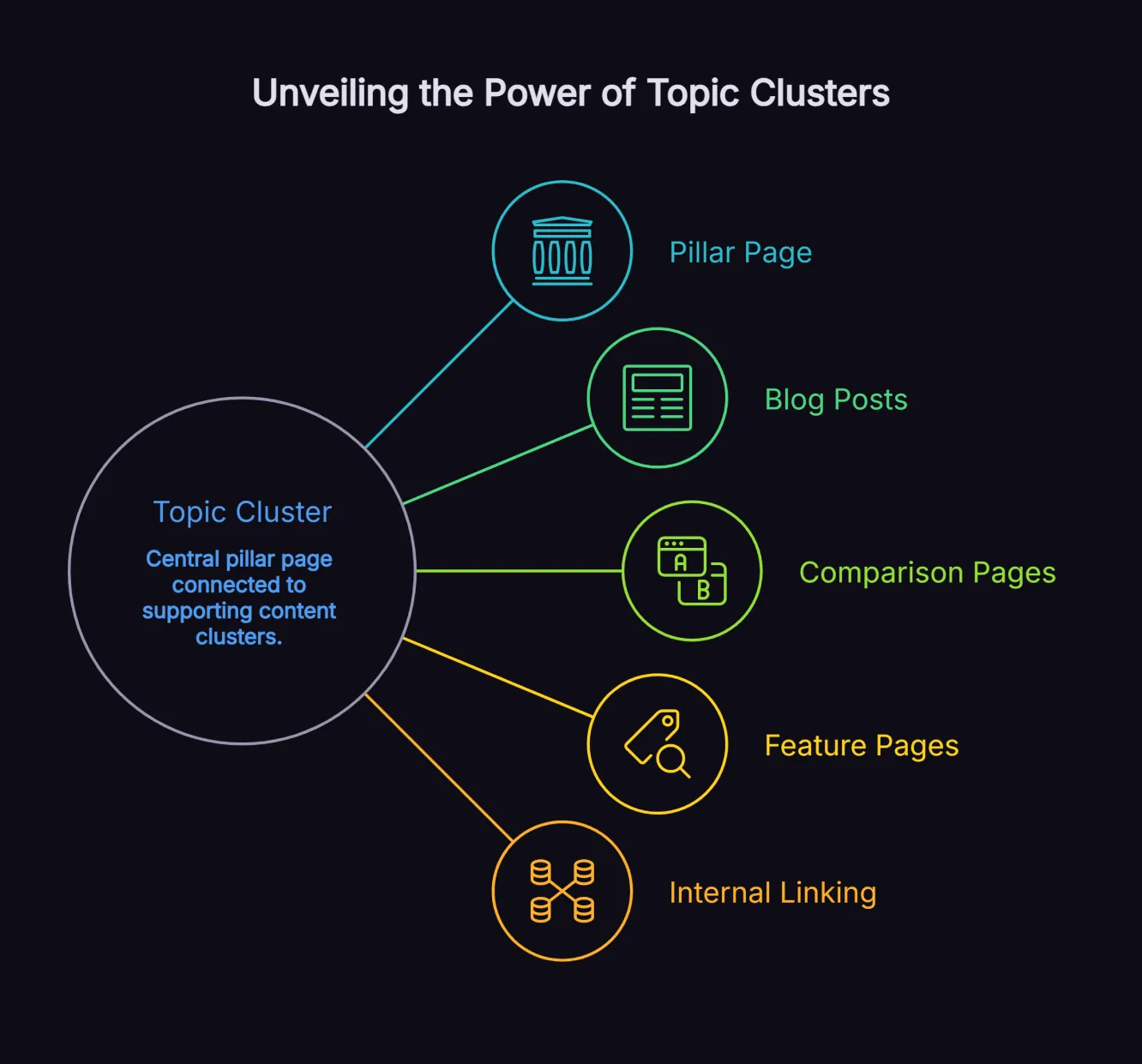
Rather than publishing isolated blog posts, build comprehensive pillar content hubs that cover a topic thoroughly. This signals to both Google and AI platforms that your site is the definitive source on a subject. A topic cluster strategy connects your pillar pages to supporting content through strategic internal linking, creating a web of authority that search engines reward.
Optimise Content for AI Citation and Extraction
With AI platforms now playing a major role in SaaS buyer research, your content needs to be structured for machine readability alongside human readability. This means writing with clear, direct answers in the opening sentences of each section, using structured data and schema markup, and including verifiable facts with cited sources. Passage-level optimisation ensures individual sections of your content can be extracted and cited by AI systems, even if the full page is not the primary ranking result.
Technical SEO Foundations for SaaS Websites
Technical SEO is the infrastructure that determines whether search engines and AI crawlers can access, understand and index your content. SaaS websites often have specific technical challenges that require specialised attention.
1. Ensure Crawlability and Indexation
SaaS websites frequently include logged-in areas, dynamic content and JavaScript-heavy interfaces. Make sure search engines can crawl and index all of your marketing pages by keeping them separate from your application. Use a clean sitemap, ensure proper robots.txt configuration and submit your pages through Google Search Console regularly. For AI crawlers specifically, maintain clean site architecture and reduce JavaScript rendering dependencies. AI crawlers like GPTBot are less sophisticated than Googlebot and may miss content hidden behind complex rendering.
2. Optimise Core Web Vitals and Page Speed
Google's Core Web Vitals (Largest Contentful Paint, Cumulative Layout Shift and Interaction to Next Paint) directly impact your rankings. SaaS marketing pages should load in under 2.5 seconds (LCP), remain visually stable during loading (CLS below 0.1) and respond to user interactions within 200 milliseconds (INP). To improve performance, focus on these key optimisations:
- Compress images
- Minimise third-party scripts
- Use a content delivery network to improve load times across different regions
On the SaaS engagement, maintaining technical health while publishing 260 pages was the discipline that prevented technical debt from offsetting content gains. Regular technical audits each quarter caught issues before they impacted performance.
3. Implement Schema Markup for Enhanced Visibility
Structured data helps both search engines and AI platforms understand your content. Implement organisation, article, FAQ and how-to schema on relevant pages. For SaaS companies, product schema on feature pages and software application schema can trigger rich results in search. This structured data also makes your content more accessible to AI systems building their knowledge bases, increasing your chances of being cited in AI-generated answers.
Link Building for SaaS Companies
Backlinks remain one of the strongest ranking signals in both traditional and AI search. SaaS companies have unique advantages when it comes to building high-quality links, but the approach needs to be strategic, not scattered.
Earn Links Through Original Research and Data, Not Outreach
In our experience, SaaS websites that focus on earning links through original research and genuinely useful content see more sustainable growth than those relying purely on manual outreach or cold link-building campaigns. The SaaS engagement is the proof. Over 12 months, dofollow referring domains grew organically from 120 to 284, a 137% increase, achieved without a single dedicated link-building activity. Zero outreach. Zero paid placements. The links came because business blogs, industry publications and relevant sites discovered the published content and cited it.
The mechanism is simple. Publish content valuable enough that other publishers want to cite it. Promote that content where the relevant audience already reads. The link velocity follows. The natural link profile signalled authentic authority to Google's algorithm and avoided the algorithmic risk that comes with manipulative tactics.
Use Product Integrations as a Link-Building Channel
Every integration your SaaS product has with another platform is a potential link opportunity. Partner pages, integration directories and co-marketing content with integration partners create natural, relevant backlinks. These links carry added value because they come from contextually related websites in your industry.
Pursue Digital PR for Authority Growth
Digital PR campaigns that place your brand in high-authority publications can rapidly accelerate your domain authority. Focus on stories around your product data, industry trends and executive thought leadership. Links from major publications carry significant weight in both Google's algorithm and the trust signals that AI platforms evaluate.
Optimising SaaS SEO for AI Search Platforms
AI search is reshaping how results are delivered, and the major providers have signalled they intend to move away from traditional "10 blue links" interfaces toward AI-first experiences. AI massively expands the surface area where your content needs to appear across both classic SERPs and AI answers.
Understand the AI Search Ecosystem
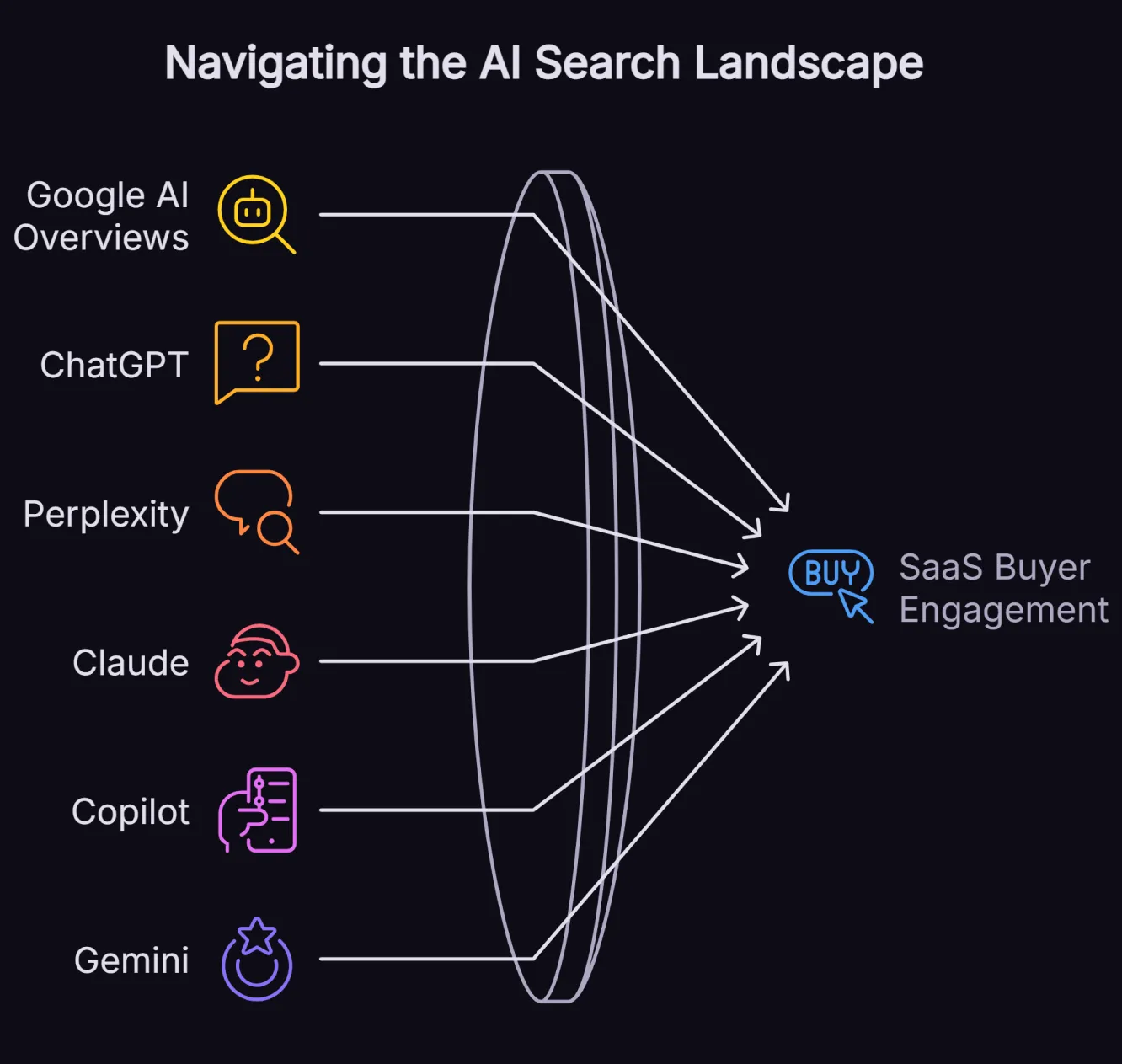
AI search now includes multiple platforms that SaaS buyers use:
- Google AI Overviews and AI Mode
- ChatGPT
- Perplexity
- Claude
- Microsoft Copilot
- Gemini
Each platform has different methods for retrieving and citing content, but they share common requirements: authoritative, well-structured content with verifiable claims and clear entity relationships. Understanding how AI search works at a technical level gives you a strategic advantage in structuring your content for maximum visibility.
What AI Overview Citations Looked Like on the SaaS Engagement
On the SaaS engagement above, the AI search outcome was concrete. By rebuilding the content strategy around topic clusters, entity optimisation and schema markup, the client achieved first-position AI Overview citations alongside the 1,909% ROI on traditional organic. The combination matters. Topic clusters established the topical authority that AI platforms look for when selecting sources. Entity optimisation and schema gave the platforms the structured signals they needed to extract and cite specific passages. Without all three layers, the AI Overview citations did not appear. With all three, they did.
Structure Content for AI Extractability
AI platforms pull specific passages from your content to generate answers. To increase your chances of being cited:
- Structure your content with clear question-and-answer formats in headings and opening sentences
- Use concise definitions and direct statements
- Include data points with attributed sources
- Organise information in tables and lists where appropriate
The goal is to make it easy for an AI system to extract a reliable, self-contained answer from any section of your content.
Build Entity Authority Across Platforms
AI platforms evaluate your brand's authority based on signals from across the web, not just your own website. Building your entity authority requires consistent signals across multiple channels. Key factors include:
- Mentions in industry publications
- Positive third-party reviews
- An active social media presence
- Citations from authoritative sources
When AI systems encounter a question about your product category, they are more likely to recommend brands that have strong, consistent signals across multiple trusted sources. This is where AI SEO differs from traditional SEO in meaningful ways.
Measuring SaaS SEO Performance and ROI
Measurement is where most SaaS SEO programmes fall short. If you cannot connect your SEO efforts to revenue, you cannot justify continued investment or make informed decisions about where to focus.
Track the Metrics That Matter
Move beyond traffic volume and track metrics that connect to business outcomes:
- Organic revenue attribution: How much revenue can be traced back to organic search visits
- Pipeline contribution: Number and value of opportunities sourced from organic
- Cost per acquisition (CPA): Compare your organic CPA against paid channels
- Keyword positions for high-intent terms: Track the terms that drive conversions, not just the ones with the most volume
- Churn rate of organic-acquired customers: Traffic quality is invisible until it shows up in retention. On the SaaS engagement, organic customers churned at 2.34%, well below most paid-acquired benchmarks, which is what made the unit economics work
- AI visibility metrics: Track brand mentions and citations across AI platforms, not just traditional SERP positions
Calculate Your SaaS SEO ROI
To calculate ROI from SEO, compare the revenue attributed to organic search against your total SEO investment (agency fees, tools, internal team time and content production costs). The industry benchmark from Semrush sits at 702% ROI over a one to three-year period, with breakeven typically at seven months. The SaaS engagement above delivered 1,909% ROI over 12 months, an average of $20.10 in revenue for every $1 invested.
The trajectory matters as much as the average. The first month of the engagement delivered 400% ROI. By month 13, the same investment was returning 2,000% to 2,600% ROI. The average smooths the compounding curve. The reality is that early months underperform the average and later months overperform it. Decisions made on month-three numbers will systematically under-invest in SEO compared to what month-12 numbers would justify.
Report on AI Search Performance Separately
AI search performance requires its own measurement framework. Track how often your brand appears in AI-generated answers for target queries across ChatGPT, Perplexity and Google AI Overviews. Measure citation frequency, sentiment and whether AI platforms are recommending your brand accurately. This data sits alongside your traditional SEO reporting and gives you a complete picture of organic visibility.
What a SaaS SEO Programme Typically Costs
For mid-market SaaS companies, we typically see effective SEO programmes in the $5,000 to $20,000 per month range, depending on product complexity, sales model and growth targets. Below $5,000 per month, you can rarely sustain the content velocity that produces topical authority on a competitive SaaS keyword set. Above $20,000 per month, the marginal return falls off unless you have an enterprise multi-market footprint or aggressive cross-vertical expansion ambitions.
The right way to evaluate the spend is against expected revenue return, not as a cost line item. The engagement that produced $1.31M and 1,909% ROI sat inside that band. At a 19x return, the question is less about whether to invest and more about how quickly you can scale execution without breaking the quality bar.
Common SaaS SEO Mistakes to Avoid
Even well-resourced SaaS companies make mistakes that limit their SEO growth. Three patterns we see most often.
1. Focusing Only on Top-of-Funnel Content
Many SaaS companies publish hundreds of blog posts targeting informational queries but neglect the comparison pages, feature pages and product-led content that actually convert. The 40/13/47 distribution above shows why. If 47% of conversions come from late-funnel content, an inventory that is 80% top-funnel is leaving the largest single conversion segment under-resourced.
2. Ignoring AI Search Optimisation
With AI-referred sessions growing 527% year-over-year and AI Overviews reducing organic clicks by 58%, ignoring AI search is leaving revenue on the table. Every piece of content you publish should be optimised for both traditional search and AI platforms.
3. Treating SEO as a Project Instead of a Programme
SEO is not a one-time fix. It is an ongoing programme that requires consistent investment. SaaS companies that publish content regularly, maintain their technical foundations and adapt to algorithm changes consistently outperform those that treat SEO as a quarterly initiative. The compounding curve only works if the cadence holds for 12 months minimum. Nine months in is when most teams quit. That is also when the curve usually steepens.
Frequently Asked Questions
How Long Does SaaS SEO Take to Show Results?
Initial improvements typically appear within 30 to 90 days for low-competition keywords and technical fixes. Significant traffic impact usually manifests by month four, with substantial transformation requiring 12 months of consistent execution. On the SaaS engagement that anchors this guide, 4,118 page-one rankings were achieved within 12 months. The industry-standard breakeven for B2B SaaS SEO is around seven months. Plan for a 12-month authority establishment timeline if you want results that compound rather than results that plateau.
Is SEO Worth the Investment for Early-Stage SaaS Companies?
Yes, but the approach should match your stage. Early-stage SaaS companies benefit from SEO by building foundational content and technical infrastructure that compounds over time. While paid advertising delivers faster initial results, SEO creates a sustainable acquisition channel that reduces your dependence on paid spend as you scale. The industry benchmark for B2B SaaS is around 702% ROI. The SaaS engagement above delivered 1,909% ROI averaged across 12 months, with the trajectory running from 400% in month one to 2,000% to 2,600% by the end of the engagement. The early months underdeliver against the average. The later months overdeliver. The compounding curve is what makes the investment worth it.
How Do SaaS Companies Optimise for ChatGPT and AI Search?
Optimising for AI search platforms requires a specific methodology beyond traditional SEO. This includes structuring content with clear, extractable answers at the passage level, building strong entity signals across the web, using schema markup to help AI systems understand your content, ensuring your technical foundations allow AI crawlers to access your site and creating authoritative content that AI platforms trust enough to cite. On the SaaS engagement above, the combination of topic clusters, entity optimisation and schema markup is what produced first-position AI Overview citations alongside the 1,909% organic ROI. The full approach is detailed in our guide on AI SEO for generative search.
What Is the Difference Between SaaS SEO and Traditional SEO?
The core principles of SEO apply across all industries, but SaaS SEO requires specific adaptations for the software business model. These include mapping content to longer, multi-stakeholder buyer journeys, creating product-led content that drives trial signups or demo requests, building comparison and alternative pages for the evaluation stage and optimising for retention-stage queries like onboarding and feature education. SaaS SEO also increasingly requires optimisation for AI platforms where software buyers conduct research.
How Much Should a SaaS Company Spend on SEO?
SaaS SEO budgets vary based on company size, competitive landscape and growth targets. For mid-market SaaS companies, we typically see effective SEO programmes in the $5,000 to $20,000 per month range, depending on product complexity, sales model and growth targets. The key is to evaluate SEO investment against expected revenue return, not just as a cost line item. With ROI ranges from the industry benchmark of 702% to engagement-specific outcomes like the 1,909% above, the question is less about whether to invest and more about how quickly to scale.
What Role Does Content Freshness Play in SaaS SEO?
Content freshness significantly impacts both traditional and AI search performance. Google rewards regularly updated content with better rankings for time-sensitive queries, and AI platforms favour recent data when generating answers. SaaS companies should refresh existing content quarterly by updating statistics, adding new examples and refining sections based on performance data. Fresh content signals to both search engines and AI platforms that your site is actively maintained and authoritative.
Your SaaS Growth Channel Is Waiting
SaaS SEO in 2026 is a multi-platform growth engine, connecting your product with high-intent buyers across Google, ChatGPT, Perplexity and the wider AI search ecosystem. The companies winning are the ones treating SEO as a revenue programme: optimising for both traditional and AI search, publishing expert content consistently and keeping their technical foundations clean. Audit your current SEO foundations, map your buyer journey to focused keyword clusters and build content that serves both humans and AI systems. If you want to accelerate that journey with a SaaS SEO agency that has produced $1.31M and 1,909% ROI in this exact vertical, talk to us about a strategy tailored to your growth targets.
About the Author
Want Insights Like This Fortnightly?

Our AI SEO strategies and tactics delivered fortnightly, including bonus trade secrets not shared anywhere else. No fluff. Just what's working right now. 5-minute read.


