
Content Refresh: How to Revive Your Blog Posts and Boost AI SEO Performance


Most marketing teams focus on creating new content while their best-performing pages from last year slowly lose rankings, traffic and revenue. This is the silent problem of content decay, and it eventually affects every website. A strategic content refresh transforms your existing content library from a declining asset into a consistent growth engine. Rather than starting from scratch, you leverage the authority and backlinks your pages have already earned to deliver faster SEO gains with less investment.
A Quick Guide to Content Refresh
A content refresh is the process of updating and optimising existing content to improve its relevance, search rankings and business results. This includes replacing outdated information with current statistics, improving SEO elements such as meta tags and internal links, adding new sections to address emerging search intent and enhancing readability and user experience. HubSpot reported that updating old blog posts can increase organic search traffic by up to 106%. For AI search platforms like ChatGPT and Perplexity, fresh content matters even more. Ahrefs analysed 17 million AI citations and found that AI-cited content is 25.7% fresher than organic Google results.
Ready to Transform Your Content Performance?
Your existing content library represents years of investment in research, writing and SEO. Rather than letting that value decay while competitors outrank you, a systematic content refresh strategy can turn those underperforming pages into reliable revenue drivers. Our content marketing services include comprehensive content audits and AI-optimised refresh strategies that sit behind the $26M+ in attributed client revenue across our case studies. When you work with Rankmax, you get a done-for-you approach that handles everything from identifying decay to publishing optimised content across Google and AI platforms.
View our COntent Marketing ServiceWhat Is a Content Refresh and Why Does It Matter?
A content refresh goes beyond simply changing a publication date or swapping out a few statistics. It involves systematically updating existing content to align with current search trends, user expectations and business objectives. Think of it as giving your best-performing pages the attention they deserve rather than abandoning them for newer content.
The key components of an effective content refresh include:
- Information updates: Replace outdated statistics, facts and examples with current data.
- AI SEO optimisation: Improve title tags, meta descriptions, header structure and keyword targeting.
- User experience enhancements: Boost readability, add multimedia elements and restructure content for better engagement.
- Internal linking: Connect refreshed content to newer pages and strengthen topical authority across your site.
Why does this matter for your business? Databox reported that nearly 90% of marketers said that repurposing or updating existing content is more effective than creating new content from scratch. You are building on established domain authority rather than starting fresh with every article. Pages with existing backlinks and ranking history respond more quickly to improvements than brand-new content competing for the same keywords.
The Business Case for Content Refresh Over New Content
Creating new content requires significant investment in:
- Research
- Writing
- Editing
- Promotion
Each piece starts with zero authority and must earn its way into search results. A content refresh leverages work you have already done, making it one of the highest-ROI activities in content marketing.
Consider the math. A page ranking in position 15 for a valuable keyword already has Google's recognition. With targeted improvements, it can often reach the top 10 results within weeks. However, does depends on how competitive the search reuslts are and what type of content Google is priortising for page one rankigns. A brand-new article targeting the same keyword could take 6-12 months to achieve similar results, if it ever does. The refresh approach compounds your existing investment rather than replacing it.
This efficiency becomes even more important when you consider AI search platforms like ChatGPT, which tend to prioritise fresh content. These platforms cite URLs that are 393-458 days newer than those that appear in organic Google results. By keeping your content current, you position yourself for visibility across both traditional and AI-powered search.
Understanding Content Decay: Why Your Rankings Slip Over Time
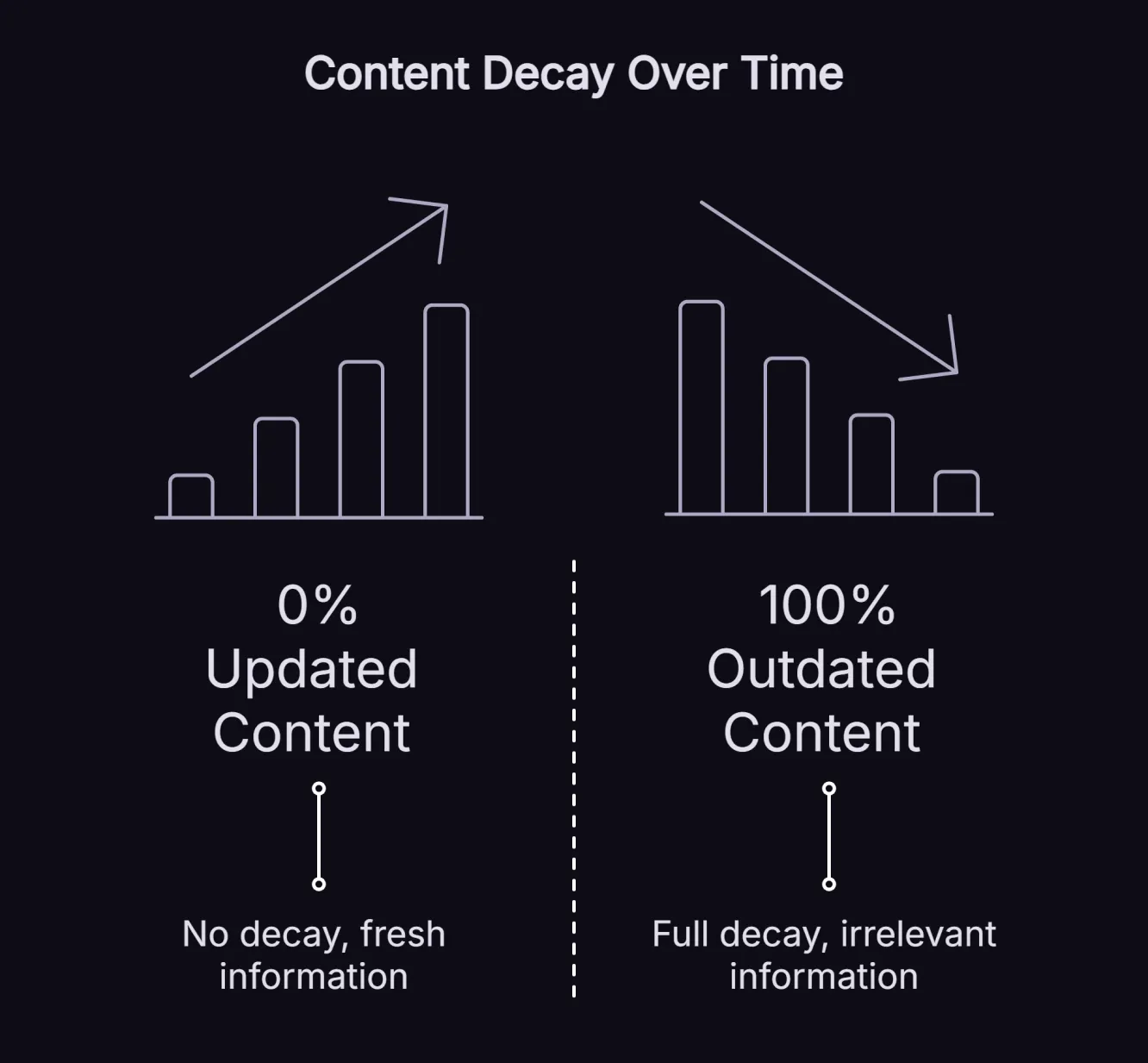
Content decay describes the gradual decline in a page's SEO performance. It happens to every piece of content eventually, regardless of how well it was written or optimised initially. Understanding the causes helps you recognise decay early and respond strategically.
Algorithm Updates and Shifting Signals
Google's algorithm evolves constantly. What ranked well three years ago may not align with current ranking factors. The growing emphasis on E-E-A-T (Experience, Expertise, Authoritativeness and Trustworthiness) means content needs to demonstrate genuine expertise and first-hand knowledge. Pages that felt authoritative in 2022 might seem thin or outdated by current standards.
Recent core updates have specifically targeted unhelpful and low-value content, raising the bar for what qualifies as high-quality. If your content has not been updated to meet these standards, it may be falling behind competitors who have invested in comprehensive refreshes.
Increased Competition
The content marketing landscape grows more competitive each year. Topics that had minimal coverage when you published might now have dozens of in-depth guides competing for the same keywords. Competitors analyse your content and produce longer, more detailed alternatives. Without regular updates, your pages lose their competitive edge.
This competitive pressure intensifies for valuable commercial keywords. The pages driving revenue for your business attract the most attention from competitors, meaning your highest-value content often faces the greatest decay pressure.
Search Intent Evolution
How people search for information changes over time. A keyword that indicated how-to intent in 2021 might now lean towards tool recommendations or service comparisons. If your content no longer matches user expectations in search results, Google recognises the mismatch and adjusts rankings accordingly.
Search intent shifts happen gradually, making them easy to miss until rankings have already dropped significantly. Regular content audits help you catch these changes before they impact traffic and conversions.
Outdated Information
Any content containing time-sensitive information will eventually become outdated, including:
- Industry statistics and market size figures
- Software tutorials and UI screenshots
- Legal, compliance or regulatory guidance
- Pricing, product availability or feature comparisons
When your content feels outdated, your readers leave quickly. High bounce rates and short time on page signal to Google that your content is not meeting their needs, creating a negative feedback loop that accelerates decay.
Signs Your Content Needs a Refresh: How to Identify Decay Early
Catching content decay early means faster recovery and less lost traffic. These indicators help you prioritise which pages need attention before performance drops significantly.
Declining Organic Traffic Patterns
The clearest sign of content decay is a sustained decline in organic traffic. Use Google Analytics to compare year-over-year performance for individual pages. Look for content that performed well 12-18 months ago but has since declined steadily.
We recommend:
- Reviewing priority content every 3–6 months (more often for competitive topics)
- Flagging any page that loses 20%+ of traffic over a 3–6 month period
This gives you a practical way to spot decaying content before it falls off the first few pages of results.
Ranking Position Drops
Monitor your keyword rankings using Google Search Console or third-party tools. Pages that have dropped from the first page to positions 11-20 are prime candidates for refresh. They remain relevant in Google's eyes but have been outcompeted by fresher or more comprehensive content.
Pages ranking in positions 6-15 for important queries represent quick-win opportunities. A targeted refresh can often push these pages back into the top results within weeks rather than months.
High Impressions With Low Click-Through Rates
Search Console data showing high impressions but low click-through rates may suggest your title tags and meta descriptions no longer resonate with searchers. Users see your listing but choose competitors. Updating these elements during a refresh can recapture clicks without changing the main content.
This pattern may indicate that competitors have more compelling search snippets or that search intent has shifted. A refresh offers an opportunity to test new headlines and descriptions that better align with current user expectations.
Outdated Statistics and References
Any content containing statistics more than two years old needs review. The same applies to:
- Product recommendations
- Software tutorials
- Regulatory information
- Industry trends
Audit your content for specific dates, version numbers, statistics and examples that may have changed. This audit process often reveals opportunities to provide insights that competitors have not yet covered.
Poor Engagement Metrics
Rising bounce rates and declining average time on page indicate that visitors are not finding what they expected. These behavioural signals affect rankings and indicate that the content no longer effectively meets user needs.
Content that shows poor engagement often needs more than minor updates. Consider restructuring the introduction, adding visual elements and ensuring the content delivers on its headline promise within the first few paragraphs.
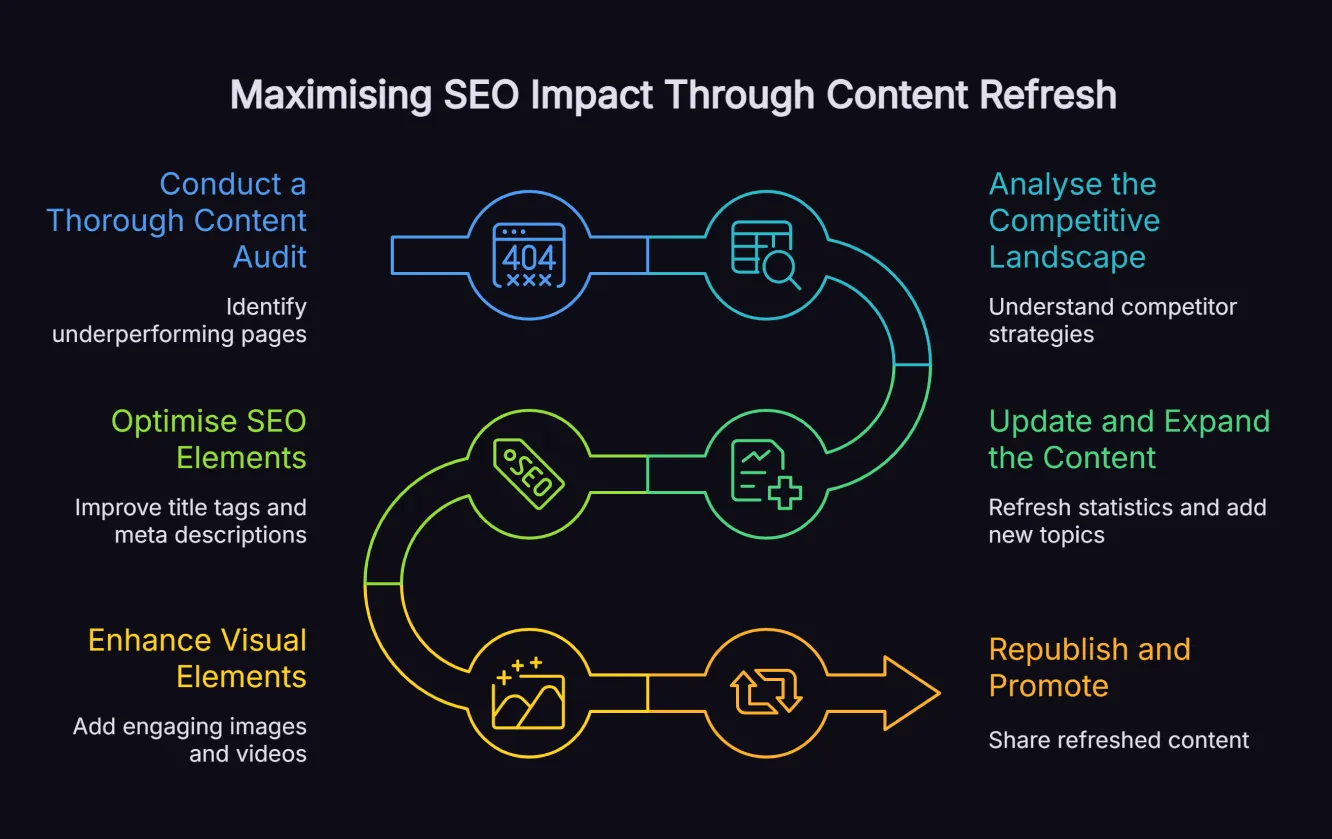
How to Refresh Content for Maximum AI SEO Impact: A Step-by-Step Process
Effective content refresh follows a systematic approach. Each step builds on the previous one to create comprehensive improvements that search engines and users both recognise.
Step 1: Conduct a Thorough Content Audit
Begin by inventorying all relevant content on your site. Use Google Analytics and Search Console to:
- Identify pages with declining performance
- High impressions but low clicks
- Content ranking just off the first page
Create a spreadsheet tracking URLs, current rankings, traffic trends and last update dates. Prioritise based on business impact. Focus on high-value pages like landing pages, evergreen content and pillar pages that drive the most traffic and conversions. These pages represent the greatest opportunity for return on your refresh investment.
For our AI SEO strategies, we analyse content performance across both Google and AI platforms. This dual-platform perspective reveals opportunities that single-channel analysis misses.
Step 2: Analyse the Competitive Landscape
Before making changes, understand what you are competing against. Search your target keywords and analyse the top-ranking pages. Note their:
- Word count
- Structure
- Topics covered
- Multimedia elements
Identify gaps in competitor content that your refresh could address. Competitive analysis reveals what commonly discussed information you need to add and where you can differentiate. Look for unique angles, comprehensive information and engaging elements that make competitor content stand out. Then plan how your refresh will match or exceed these benchmarks.
Step 3: Update and Expand the Content
With audit data and competitive insights in hand, begin the actual refresh work:
- Replace outdated statistics with current data from authoritative sources.
- Add new sections addressing topics that have emerged since the original publication.
- Remove information that is no longer relevant or accurate.
Expand thin sections to provide comprehensive coverage. In practice, more comprehensive articles that genuinely add value tend to attract more AI citations, but only when each section contributes something useful.
Focus on covering every relevant aspect of the topic rather than padding the word count. Clear, easy-to-read language also appears to help tools like ChatGPT and Perplexity surface and cite your content more often.
Step 4: Optimise SEO Elements
Update title tags and meta descriptions to reflect refreshed content and current search intent. Ensure the target keyword appears naturally in the H1, first paragraph and throughout the content. Review and refine the header hierarchy to improve logical flow.
Add internal links to relevant newer content on your site. Internal linking strengthens topical authority and helps Google understand relationships between your pages. Remove or update any broken external links.
Implement or update schema markup where appropriate. FAQ schema, HowTo schema and article schema help search engines understand your content structure and may qualify your pages for enhanced search results.
Step 5: Enhance Visual Elements
Add images, diagrams, tables or videos where they add genuine value. Visual content improves engagement metrics and helps explain complex concepts. Ensure all images have descriptive alt text that includes relevant keywords where natural.
Visual content increases engagement and makes your content more likely to be cited by AI platforms. Consider creating original graphics that other sites might link to, turning your refresh into a link-building opportunity.
Step 6: Republish and Promote
Once updates are complete, update the publication date to signal freshness. This is appropriate only when you have made substantial changes. Google can detect superficial updates and may ignore pages where dates change without meaningful content improvements.
Promote the refreshed content through email, social media and internal linking from other relevant pages on your site. Reach out to sites that linked to the original version to let them know about the updated content. Fresh, comprehensive content often earns additional backlinks that compound the refresh impact.
How to Prioritise Content for Refreshing: A Framework for Marketing Teams
With limited resources, you cannot refresh everything at once. A prioritisation framework helps you focus efforts where they will generate the greatest business impact.
The 80/20 Rule for Content Refresh
The Pareto Principle applies to content marketing. Roughly 80% of your results come from 20% of your content. Identify your top-performing pages and prioritise keeping them up to date. These pages have proven their value and deserve ongoing attention.
Start by listing pages that drive the most organic traffic, conversions or revenue. Then identify which of these are showing early signs of decay. Refreshing high-performing pages before they decline significantly is more efficient than attempting to recover pages that have already fallen out of the rankings.
Quick Wins Versus Strategic Investments
Categorise potential refresh candidates by effort required and potential impact. Quick wins include pages that need only minor updates to regain rankings. Strategic investments are comprehensive refreshes that require significant work but target high-value keywords.
Pages ranking on page two for valuable keywords represent the best quick-win opportunities. A focused refresh can often push these pages to the top of page one within weeks. Balance quick wins with longer-term strategic refreshes to maintain momentum while building toward larger goals.
Create a Content Refresh Calendar
Rather than refreshing content reactively, build proactive review cycles into your content calendar. For fast-moving industries like marketing and technology, plan to review key content every 3-6 months. For evergreen topics, annual reviews may be sufficient.
Set reminders to review high-priority pages before they begin to decay. This proactive approach prevents the traffic losses that occur when content goes stale before you notice.
Content Refresh for AI Search Visibility
Traditional SEO focused on ranking in Google results. Today, content must also perform across AI platforms like ChatGPT, Perplexity, Google AI Overviews and Claude. Content refresh strategy must address both audiences.
Why Freshness Matters More for AI Citations
AI search platforms show a strong preference for recently updated content. In our testing, Perplexity tends to cite content updated in the last few weeks more frequently than older pages. ChatGPT and Google AI Overviews also appear to favour fresh content, though less aggressively than Perplexity.
This preference for freshness means that content refreshes directly impact AI visibility. Pages that have not been updated in months may be invisible to AI platforms even if they still rank well in traditional search. Our AI SEO approach addresses both traditional and AI search simultaneously.
Optimising Refreshed Content for AI Extraction
AI platforms process content differently from traditional search engines. They favour content that is well-structured, easy to parse and provides direct answers to questions. During your refresh, consider how AI systems will extract and cite your content.
Use a clear heading hierarchy to help AI understand the content structure. Include direct answers to common questions early in each section. Add FAQ sections with concise, standalone answers that AI can extract and cite. Listicle and comparative content represent over 25% of all AI citations, so consider whether your content could benefit from more structured formats.
Update Frequency for AI Visibility
If Perplexity visibility is a priority, consider testing very frequent updates on your highest-value pages, for example, by refreshing key content every weeks. This kind of aggressive cadence is only realistic for a small set of priority URLs. ChatGPT and Google AI are less sensitive to very frequent changes, but monthly updates for important pages still help maintain strong visibility.
Establish tiered update schedules based on page priority:
- Tier 1 pages with the highest value might receive updates every few weeks.
- Tier 2 pages get monthlty attention.
- Tier 3 pages receive quaterly updates.
Evergreen foundational content often needs a bi-yearly review. Updates do not require complete rewrites. Adding new sections, refreshing statistics and incorporating recent examples all signal freshness.
Measuring Content Refresh Success
Tracking the right metrics helps you understand what is working and refine your approach over time. Set up measurement before making changes so you can accurately assess impact.
Key Metrics to Track
Monitor organic traffic changes at the page level using Google Analytics. Compare performance before and after the refresh, allowing 4–8 weeks for changes to take effect. Many well-executed refreshes deliver double-digit lifts in organic traffic, particularly when the original content was under-optimised, though actual results vary by site and competition.
Track keyword rankings using Search Console or third-party tools. Note changes in position for both primary and secondary keywords. Successful refreshes often improve rankings for related keywords beyond the primary target.
Measure engagement metrics, including:
- Bounce rate
- Time on page
- Pages per session
Improvements in these metrics indicate that the refreshed content better meets your audience's expectations. Thoughtful updates to title tags and meta descriptions can also drive substantial gains in click-through rate when existing snippets are weak.
Conversion Tracking
Traffic improvements only matter if they translate to business results. Track conversions from refreshed pages to understand revenue impact. This might include form submissions, demo requests, purchases or other actions aligned with your business goals.
Our AI SEO case studies show refreshed and optimised content driving more than $26M in client revenue, with consistent updates playing a key role in sustaining performance. Understanding the revenue contribution of each page helps justify ongoing investment in content refresh.
Timeline for Results
Content refresh typically yields faster results than creating new content because it builds on existing authority. However, timelines vary based on the extent of changes and competitive factors.
We often see improvements within days rather than months after substantial refreshes.
Consistently monitor results and be prepared to make additional adjustments. A refresh that improves rankings from position 12 to 7 is successful, but further optimisation could push the page into the top 3. Treat refresh as an iterative process rather than a one-time project.
Content Refresh vs Content Rewrite: When Each Approach Makes Sense
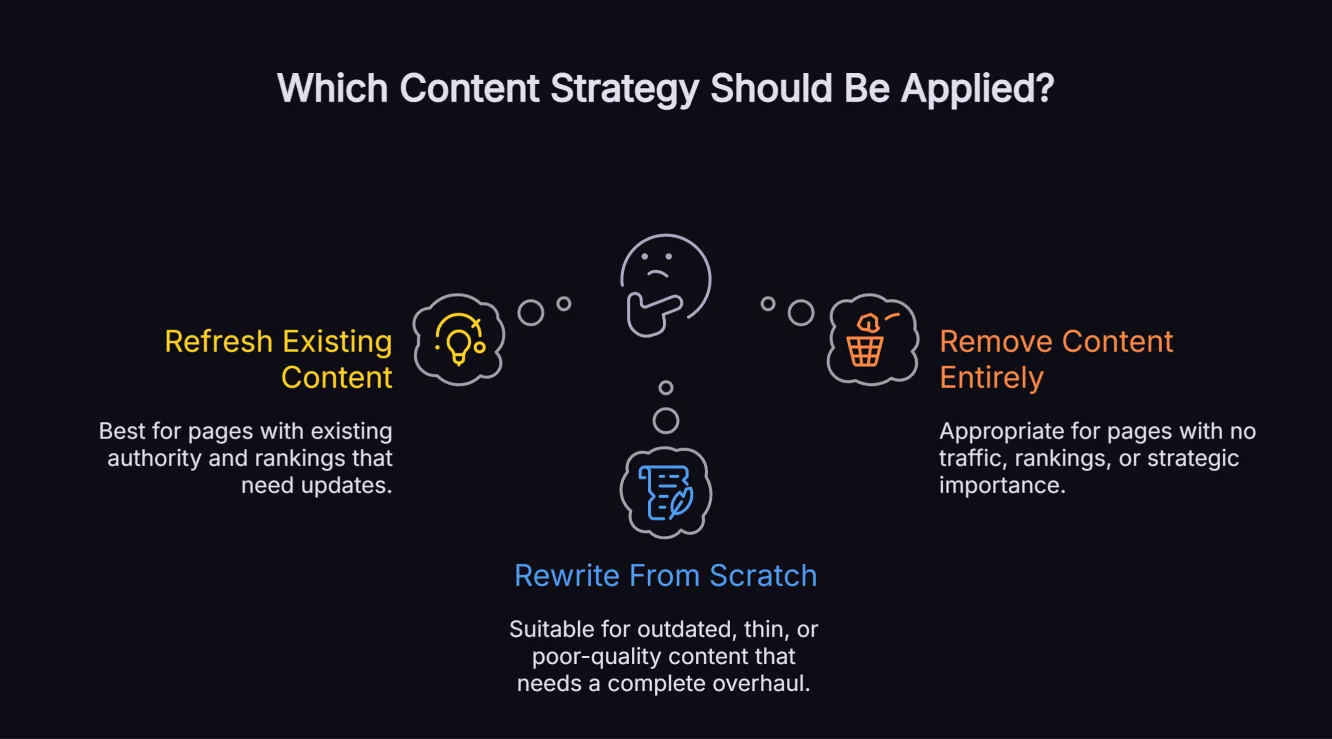
Not every piece of content deserves a refresh. Some pages need complete rewrites, while others should be removed entirely. Understanding when to apply each approach prevents wasted effort.
When to Refresh Existing Content
Content refresh works best for pages that have existing authority and rankings but have declined or plateaued. The page should have a solid foundation in structure and topic coverage, even if some specific information is outdated.
Consider refreshing when the existing content has some amount of traffic, rankings or backlinks. These signals indicate Google recognises the page's relevance. Your job is to update and improve rather than rebuild from scratch.
Refresh is also appropriate when competitive analysis indicates your content needs additional depth or updated information to keep pace with current top performers. You are building on what exists rather than replacing it entirely.
When to Rewrite From Scratch
Consider a complete rewrite when existing content is extremely outdated, thin or of poor quality. If the original page has very low engagement and conversion metrics, starting fresh may be more efficient than attempting to salvage inadequate content.
Rewrites make sense when you are pivoting to a fundamentally different topic or content type. If search intent has changed dramatically since the original publication, the existing structure may no longer serve users effectively.
Major technical or user-experience issues that require complete rebuilds also justify rewrites. Sometimes the underlying page template or design prevents effective optimisation, making a fresh start necessary.
When to Remove Content Entirely
Some content should be removed rather than refreshed or rewritten. Pages with no traffic, no rankings, no backlinks and no strategic importance are candidates for removal. Keeping them creates clutter and dilutes your site's topical focus.
Content pruning improves overall site quality by removing pages that do not serve users or business objectives. If you decide to remove pages with backlinks, implement 301 redirects to relevant alternative pages to preserve link equity.
Frequently Asked Questions
Does changing the publish date improve SEO?
Updating the publish date can improve click-through rates by signalling to searchers that content is fresh. However, Google can detect superficial updates and may ignore pages where dates change without meaningful content improvements. Update publication dates only when you have made substantial changes to the content. Minor tweaks do not justify date changes and may actually harm your credibility with both your audience and search engines.
How long does it take to see results from a content refresh?
We see improvements within days rather than months after substantial refreshes. Simple changes, such as updating meta descriptions, may show impact within days. Comprehensive refreshes involving new sections, restructuring and expanded content typically take 1-4 weeks to fully impact rankings. AI search platforms may reflect changes faster than traditional search. Continue monitoring for several months to understand the full impact of your refresh efforts.
How often should I refresh blog content?
Update frequency depends on your industry and content type. For fast-moving industries like marketing and technology, review key content every 3-6 months. Content in more stable industries may need updates only annually. High-priority pages that drive significant traffic or revenue warrant more frequent attention than lower-value content. Monitor performance metrics to identify when specific pages need attention rather than relying solely on arbitrary schedules.
What is the difference between content refresh and content optimisation?
Content refresh focuses on updating information, replacing outdated data and expanding coverage of topics. Content optimisation typically refers to improving SEO elements like keywords, meta tags and internal linking. In practice, effective content refresh includes both activities. You update the information to be current and accurate while also optimising SEO elements to improve discoverability. The distinction matters less than ensuring both aspects receive attention during any content improvement effort.
What tools do I need for content refresh?
Essential tools include Google Analytics for traffic analysis and Google Search Console for keyword and ranking data. These free tools provide the foundation for identifying which content needs attention. Additional tools, such as Ahrefs or Semrush, provide deeper competitive analysis and keyword research. Content optimisation tools help ensure refreshed content meets current SEO best practices. Choose tools based on your team's capacity and the scale of your content library.
Should I refresh content that is still ranking well?
Yes. Proactively refreshing high-performing content prevents decay before it impacts traffic. Your top-performing pages deserve regular attention to maintain their ranking position. Competitors continuously create new content targeting your valuable keywords. Regular updates help maintain your competitive advantage. Schedule periodic reviews of your best content even when performance metrics look healthy.
Turn Your Content Library into a Growth Engine
Content refresh is not a one-time project but an ongoing discipline that turns past content investments into compounding organic growth. Start by auditing your current library, prioritising quick wins and building refresh cycles into your content calendar so maintenance is proactive rather than reactive. Measure the impact of each update and double down on the formats, topics and optimisation patterns that move rankings, traffic and revenue. If you want specialist support, explore our content marketing services to turn your existing content into a reliable revenue driver across Google, ChatGPT, Perplexity and AI Overviews.
About the Author
Want Insights Like This Fortnightly?

Our AI SEO strategies and tactics delivered fortnightly, including bonus trade secrets not shared anywhere else. No fluff. Just what's working right now. 5-minute read.


