
Is AI Content Bad for SEO? What Earning 598 AI cited pages Taught Us


Is AI content bad for SEO, or is the real risk publishing content that sounds useful but adds nothing new? If you are using tools like ChatGPT or Claude, the concern is understandable: no one wants to scale content only to lose rankings, trust or search visibility. I have spent the last few years running AI inside real SEO production workflows at Rankmax, where AI-first campaigns have generated more than $26M in attributed client revenue across Google, ChatGPT and AI Overviews. In this guide, I will show you what Google actually says, how I use AI-assisted content in practice and what helped one B2B engagement earn 598 AI cited pages over 27 months and counting. Keep reading if you want to know the difference between AI content that ranks and AI content that quietly disappears.
Quick Overview: Is AI Content Bad for SEO?
Is AI content bad for SEO? Google says AI-assisted content can rank when it is helpful and original and is not produced mainly to manipulate search results. Ahrefs' analysis of 600,000 pages found a near-zero correlation (0.011) between detected AI content and Google rankings, which means Google neither rewards nor penalises a page simply for using AI. Quality, not creation method, is what moves the needle.
Run AI Content That Ranks and Gets Cited
The gap between AI content that ranks and AI content that fails is the process behind it. Our content marketing services pair AI efficiency with the human review, original data and editorial control behind outcomes such as 598 AI cited pages on a B2B engagement and about $8.7M attributed over 27 months on the same vertical.
Explore Our Content Marketing ServicesWhat Google Actually Says About AI-Generated Content
Google has been clear about its position on AI content, even though many marketers still read it the wrong way. Here is what the guidelines actually state and what it means for your strategy.
Google's Official Position on AI Content
Google's Search Central documentation states that "appropriate use of AI or automation is not against our guidelines", and that the line it draws is content created primarily to manipulate search rankings. That distinction is the whole game. Google is not at war with AI content. It is at war with low-quality content, whoever or whatever produced it.
Automation has powered helpful content for years, including weather forecasts, sports scores and financial reports. AI simply extends that to more complex writing. What Google cares about is whether a page shows real EEAT qualities and genuinely serves the person reading it.
What the Quality Rater Guidelines Say About AI
The Search Quality Rater Guidelines define generative AI and give examples of how it can be used well or badly. The point is the same one Google makes everywhere: generative AI can help with content creation, but like any tool, it can be misused, so raters judge the value of the result, not the method.
A page can earn the "Lowest" rating when all or almost all of its main content is copied, paraphrased or reposted with little effort, originality or added value. The signals that trigger a low-quality rating include telltale model phrases such as "as a language model, I don't have real-time data" and content that restates existing information without adding anything original.
Quality Versus Creation Method
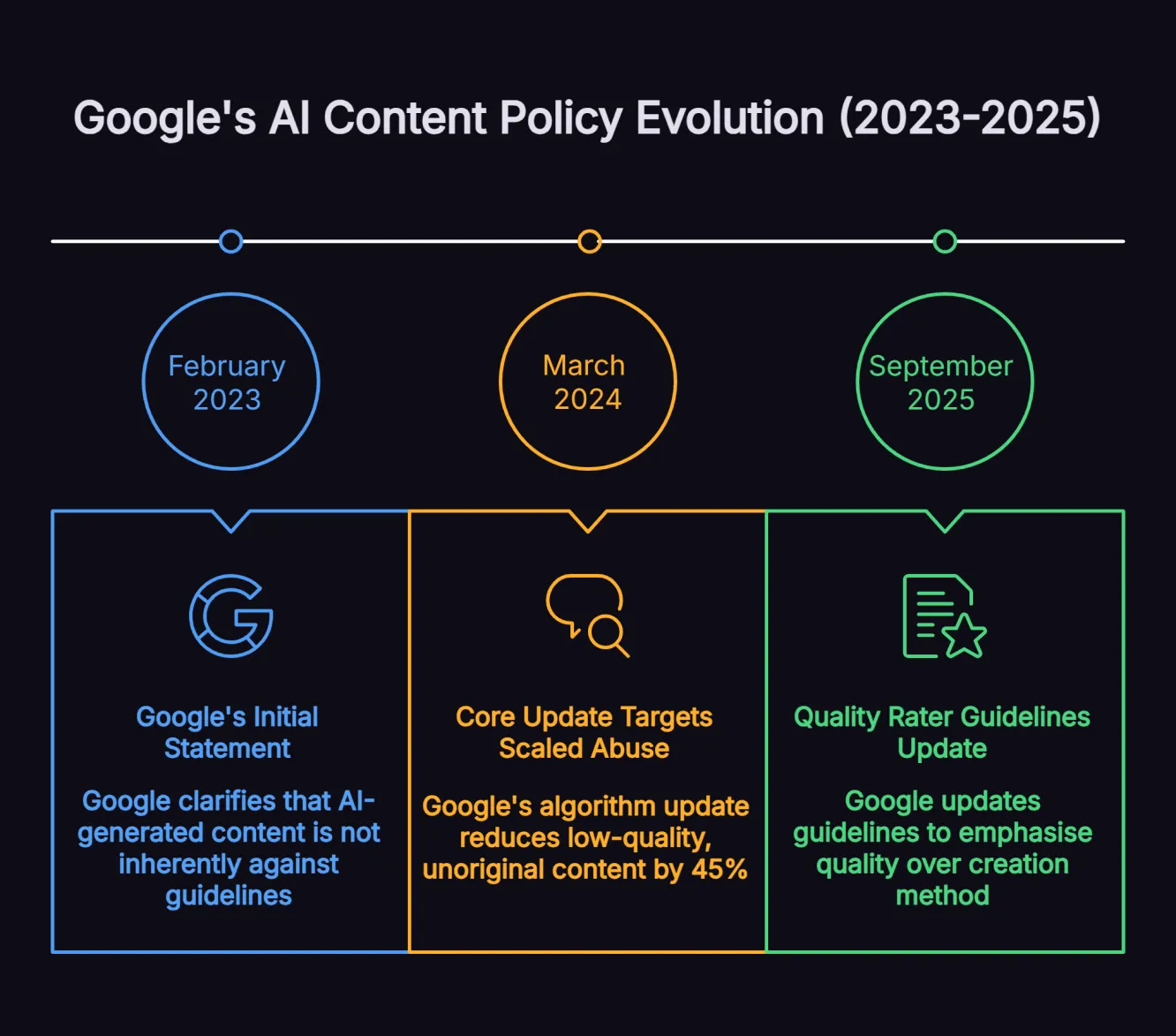
Google's guidance is that AI-assisted content is not automatically against the rules. What matters is whether the content is helpful and original and whether it breaks spam policies such as scaled content abuse.
The March 2024 Core Update targeted scaled content abuse directly, meaning the mass production of low-value pages, whether AI or humans made them. Google later confirmed the work cut low-quality, unoriginal content in search results by 45%, up from the 40% it first projected. That quality push is still relevant in 2026: Google’s Search Status Dashboard shows the May 2026 core update ran from 21 May to 2 June 2026. The point for AI content is not that every core update targets AI. It is that Google’s stated evaluation framework still rewards originality, usefulness and people-first content over low-effort scale.
The practical takeaway is that two pieces of AI content can be treated very differently:
- One that is carefully reviewed, fact-checked and improved with expert insight can rank well.
- One published straight out of ChatGPT with no editing will usually underperform or be flagged as spam.
Why Some AI Content Fails in Search Rankings
Understanding why AI content fails helps you sidestep the same mistakes. The problems are not unique to AI. They are the same issues that have sunk low-quality human content for years.
Lack of EEAT Signals
The "Experience" pillar of EEAT is the hardest one for AI content to satisfy. Google's guidelines prioritise content from creators with first-hand knowledge and practical familiarity with the topic. AI can synthesise existing information, but it cannot draw on the lived experience of using a product, visiting a place or running a strategy.
When AI writes about "the best hiking boots for beginners", it has never hiked in them. That gap shows up as generic recommendations, no mention of where products excel or fail, and missing practical details that only come from real use.
Factual Inaccuracies and Hallucinations
AI models sometimes produce plausible but fabricated information. Statistics, quotes, research findings and basic facts can be invented or misremembered from training data. Publishing inaccurate content damages trust in Google's eyes and erodes reader confidence.
A single factual error can dent any brand's credibility. The stakes climb for medical, financial and legal sites. Google treats these as YMYL (Your Money or Your Life) topics and applies extra scrutiny, because wrong information can directly harm someone's health, finances or legal standing. Publishing unchecked AI errors in those categories risks ranking drops and real harm to people who rely on you.
Generic, Unoriginal Output
When thousands of marketers prompt ChatGPT with the same question, the answers converge on generic, middle-of-the-road content. Google's systems increasingly detect and devalue that duplication.
The Quality Rater Guidelines call this out through their treatment of filler content, which is low-effort, low-relevance material that fills space without adding value. AI content that restates commonly known facts with no original insight lands squarely in that bucket.
Scaled Content Abuse
Publishing large volumes of AI content with no quality control is one of the clearest breaches of Google's spam policies. Scaled content abuse means creating content with little effort or originality and no editing or manual curation.
Sites that flood their pages with hundreds or thousands of thin AI articles may see a short-term lift, then sharp visibility losses as Google's systems and spam policies catch up. Google has taken targeted action against scaled content abuse under its updated spam policies, and many sites saw heavy ranking declines as a result.
How Rankmax Actually Uses AI in Content Production
AI content can support strong SEO performance when you run it properly. The key is pairing AI efficiency with human expertise and editorial oversight. The four steps below are the process we actually use, not a generic template.
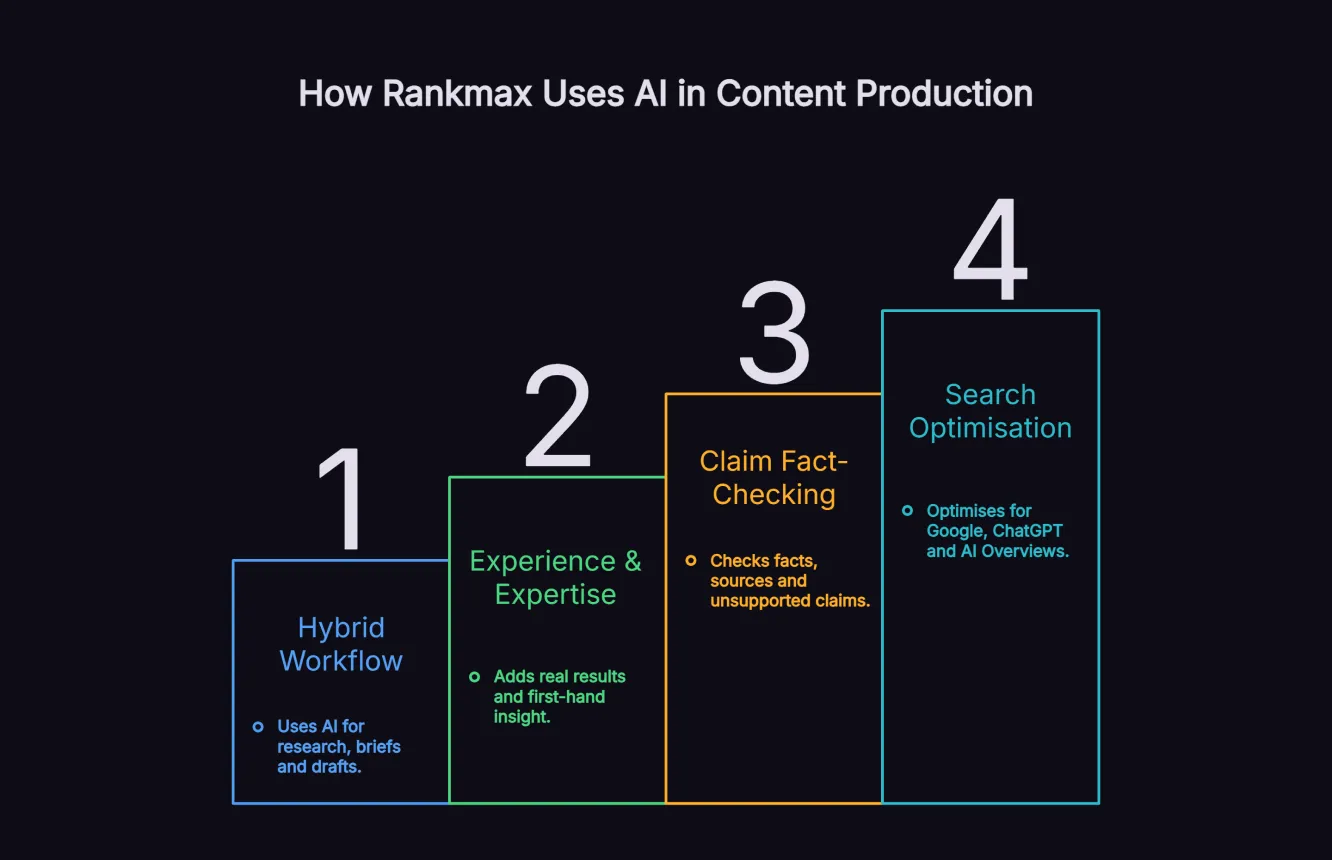
1. The Hybrid Workflow We Run
The most effective strategy treats AI as an assistant, not a replacement for human writers. We use AI to speed up research, generate a content brief and a first draft and spot gaps in what competitors cover. Then people take over to verify accuracy, add original insight and make sure the content genuinely serves the reader.
In practice, it runs in four stages:
- AI-assisted preparation: ChatGPT and Claude handle the early, mechanical work, including research synthesis, first-draft structure and gap analysis.
- Automated quality checks: Internal scripts flag unsupported claims, confirm internal links resolve correctly and validate schema.
- Human review and editing: A subject-matter reviewer checks accuracy and adds first-hand insight, while an editor rewrites for clarity, structure and brand voice and removes the telltale signs of unedited model output.
- SEO optimisation: An SEO specialist optimises the piece for the target query, internal linking and schema implementation.
Nothing reaches a client's site without that human layer.
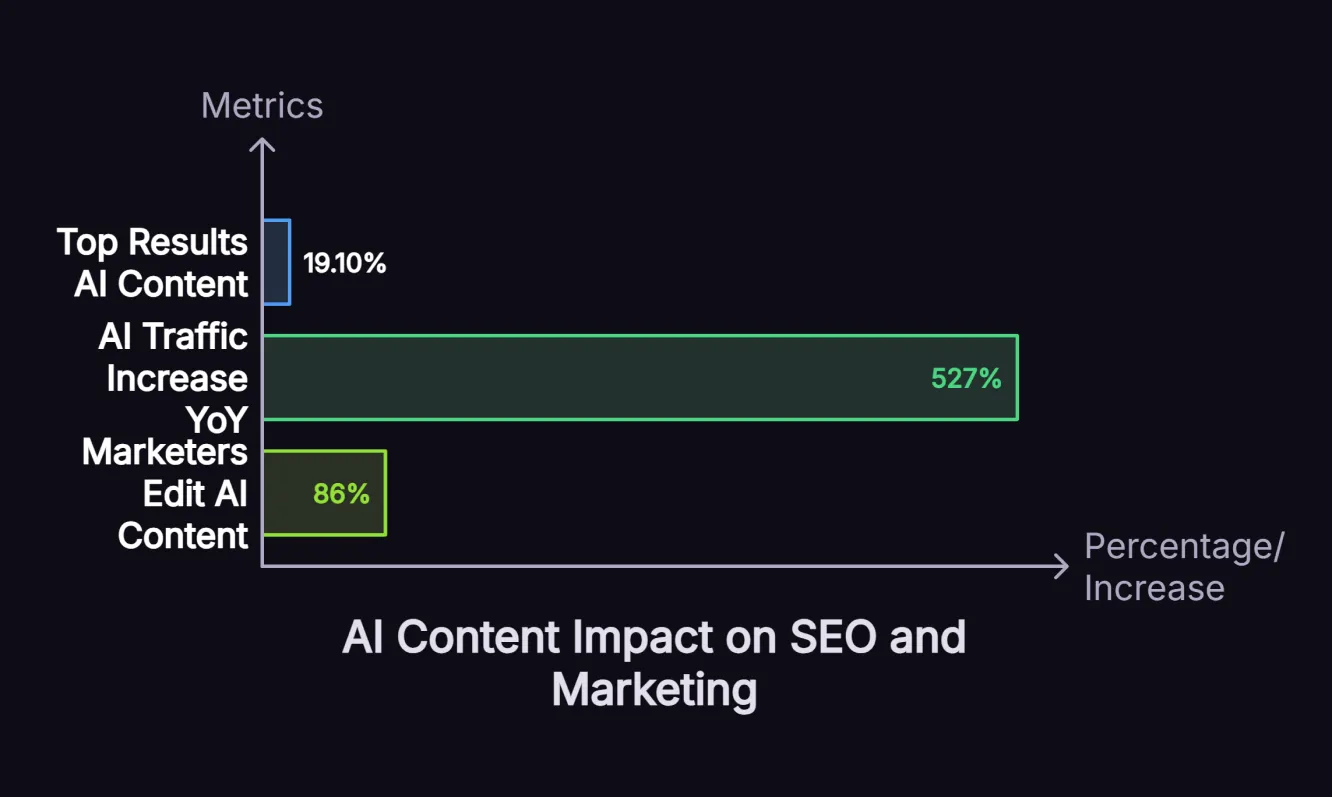
The numbers behind the process matter more than the diagram, and we will not invent internal productivity figures we have not locked for public use, because publishing unverified stats is exactly the failure this article warns against. What we can say publicly is the editorial standard: AI drafts, human experts own verification, originality and whether the piece ships. The broader pattern is well documented. HubSpot found that 86% of marketers edit AI-generated content before publishing, and a 2026 industry study reported that 87% of teams keep humans heavily involved in content creation, with human-led content still far more likely to take the top spot for competitive queries. The edit is not the exception. It is the job. In our experience, one definitive guide reliably outperforms twenty thin, loosely related posts.
2. Layering In Genuine Experience and Expertise
Google's EEAT guidelines reward content that shows real-world experience. Even when AI drafts the piece, you have to layer in what only humans can provide:
- Case studies from actual client work, with specific metrics and outcomes.
- Lessons from experiments that failed, not just the wins.
- Conversations with customers that surfaced something unexpected.
- The exact process your team follows, including the parts you got wrong first.
Here is a concrete example from our client work. For a B2B property management client, AI-assisted content supported an ongoing engagement now at about $8.7M attributed over 27 months, with an earlier climb window that earned 138 AI citations over 27 months and counting. AI did the heavy lifting on research, first drafts and structuring content for fast indexing. Humans did the part that mattered for ranking: clustering the right underserved topics, embedding the client's own first-hand expertise into every piece, fact-checking each claim and shaping the strategy. The AI made it faster. The expertise made the content rank.
3. Fact-Checking Every Claim
Every statistic, claim and reference in AI-assisted content has to be verified against an authoritative source. We build fact-checking into the editorial workflow as a non-negotiable step, not an optional review:
- Verify dates and figures against primary sources such as government statistics and peer-reviewed research.
- Cross-reference historical claims against multiple reputable sources.
- Update content regularly so statistics stay current.
- Remove or correct anything you cannot verify.
This is the discipline that builds the trust Google's systems reward. It also protects your brand and earns genuine authority in your market.
4. Optimising for Both Traditional and AI Search
Content strategy in 2026 has to account for both traditional Google search and AI platforms such as ChatGPT, Perplexity and Google's AI Overviews. One analysis reported LLM traffic up 527% year on year from January to May (2024 versus 2025), though it was based on a specific sample and a small baseline, so treat it as directional rather than universal.
AI citations also work differently from traditional rankings. A brand is not limited to one blue-link position; it can appear multiple times in a single AI response as a cited source, a recommended provider, a comparison point or a next-step solution.
The work compounds, because content that genuinely answers questions tends to rank in Google and get cited by AI. For the same B2B property management client, content built around verifiable results, original data and consistent author profiles earned 598 AI cited pages over 27 months and counting.
The lesson from those 138 citations was not that AI platforms simply cite whoever ranks first. The pages that earned citations had three things in common: verifiable client results, original data points and consistent author/entity signals. That matters because AI search needs extractable proof. A generic opinion is easy to ignore. A clear result, tied to a named entity and repeated across a trusted content ecosystem, is much easier for an AI system to reuse.
In a separate eCommerce engagement, that same structure meant pages reached traditional search results within about 60 days and started being cited by ChatGPT within about 90 days. To rank across both channels, structure content for easy extraction:
- Use clear headings that signal what each section covers.
- Give direct, factual answers to common questions early.
- Include specific data points that AI can cite as an authoritative source.
Our guides on Gen AI SEO and LLM SEO go deeper, but the core principle is simple: content that genuinely helps people performs well across every platform.
The Real-World Impact of AI on SEO Performance
Looking at the data separates the hype from the reality of AI content and SEO.
What the Research Shows
Ahrefs' study of 600,000 pages found no clear relationship between AI content levels and Google rankings. Pages with minimal AI use showed only a very slight correlation with higher rankings, an effect too weak to act on. Notably, around 86.5% of top-ranking pages contained some AI involvement, yet purely AI-generated pages rarely reached the number one spot, which points straight back to the value of human editing.
The latest dated figure we found in Originality.ai’s ongoing study shows AI-generated content made up 17.31% of Google’s top 20 search results as of September 2025, down from a July 2025 peak of 19.56%. A separate 2026 study found AI-assisted content competing widely while human-led content still held the advantage at the very top. Either way, the pattern holds: quality matters far more than method. AI content that meets Google's standards ranks. AI content that cuts corners fails.
What We See in Rankmax Campaigns
External studies are useful, but our own attribution data tells the sharper story. On the B2B property management engagement, traffic arriving from AI platforms converted at 6.24%, against 3.29% for traditional organic search. For a marketing leader, that changes the conversation from “Will AI search take clicks?” to “Which AI-referred visitors are already closer to buying?” The AI channel did not just add visibility. It brought better-qualified buyers, which is the outcome that actually matters to a business weighing whether AI search is worth the effort.
Success Stories and Cautionary Tales
Bankrate and CNET showed two very different sides of early AI-assisted publishing. Bankrate disclosed using AI and automation to organise data, optimise parts of its workflow and assist with a small minority of articles, while still requiring writer/editor involvement and full fact-checking before publication. CNET became the stronger cautionary example after errors were found in AI-generated articles and corrections were issued on 41 of 77 bot-written pieces. The lesson was not that AI is automatically bad for SEO. It was that editorial control decides whether AI-assisted content builds trust or damages it.
Plenty of other sites that scaled AI content aggressively lost significant traffic after Google's March 2024 update. The common thread was never AI use itself. The problem was content being published at scale without anyone checking the work.
The Shifting SEO Landscape
Google's AI Overviews are changing how people interact with search. In a Pew Research Centre analysis of real browsing behaviour, users clicked a traditional result 8% of the time when an AI summary appeared, against 15% when it did not, and sessions ended on the results page 26% of the time with AI summaries against 16% without.
That shift makes citation-worthy content more important, not less. When Google's AI summarises results, it draws from pages that show expertise and give clear, accurate answers. Earning those citations takes the same commitment to quality as traditional SEO. You can read how the two disciplines fit together in our guide to AI SEO versus traditional SEO.
AI Content That Ranks Versus AI Content That Fails
The difference between AI content that wins and AI content that gets buried comes down to a handful of signals. The two columns below summarise what separates them.
| Signal | AI content that ranks | AI content that fails |
|---|---|---|
| Human involvement | Reviewed and edited by a subject-matter expert | Published straight from the model |
| Experience (the first E in EEAT) | First-hand examples, client data, lessons learned | Generic advice with no lived detail |
| Accuracy | Every claim is fact-checked against primary sources | Unverified stats and possible hallucinations |
| Originality | Adds analysis or data that others do not have | Restates commonly known facts |
| Production intent | Built to help a real reader | Built at scale to manipulate rankings |
| Structure | Clear headings and direct answers AI can cite | Padding and filler with no extractable answers |
| QA gate | Claims, links, schema and examples checked before upload | No source review, broken links or unsupported claims |
Frequently Asked Questions
Can AI content rank on the first page of Google?
Yes, AI content can rank on the first page of Google when it meets quality standards. The latest dated figure we found in Originality.ai’s ongoing study shows AI-generated content made up 17.31% of Google’s top 20 results as of September 2025, down from a July 2025 peak of 19.56%. The factors that decide rankings stay the same: relevant keywords, comprehensive coverage, accurate information, strong EEAT signals and genuine value for the reader. AI-assisted content that adds human expertise and editing can compete on the first page.
How long does AI-assisted content take to rank or get cited by AI?
Timelines vary by site authority, competition and topic quality, but we would not treat AI content as an instant ranking shortcut. In one Rankmax eCommerce engagement, pages reached traditional search results within about 60 days and started being cited by ChatGPT within about 90 days. The key was not simply publishing with AI. It was building content around clear intent, original examples, strong internal links and fact-checked answers that both Google and AI platforms could understand.
Does Google penalise websites for using AI-generated content?
Google does not automatically penalise AI-generated content. Its systems judge content on quality, helpfulness and EEAT principles regardless of how it was created. That said, AI content produced at scale with no human oversight, published with factual errors, or created mainly to manipulate rankings can trigger spam penalties in exactly the same way low-quality human content does.
How do I make AI content sound more human and authentic?
Add specific examples from real experience, include stories about situations you have actually faced and share opinions that only come from working in your field. Reference real customer conversations and the practical detail generic content misses. Break the model's habit of formal, hedged language by editing for your natural voice, and cut the qualifications that make AI writing feel sterile.
How much should I edit AI-generated content before publishing?
Every piece of AI content needs human review at a minimum, but the depth of editing depends on the topic and the stakes. High-stakes content such as medical, financial or legal topics needs extensive fact-checking and expert review. Even for lower-risk topics, add unique insight from personal experience, verify every statistic, improve readability and align the piece with your brand voice. HubSpot found that 86% of marketers edit AI-generated content before publishing, which matches what we see in practice: the edit is where AI content becomes trustworthy, useful and brand-safe.
Is it better to use AI for some content types than others?
AI works best for initial research and drafts, product descriptions at scale, and data-driven content such as statistics roundups and outlines. It struggles with content that needs genuine personal experience, original opinion or expert analysis, nuanced topics such as health or finance, and creative storytelling. The most effective approach uses AI where it excels and applies human expertise where authenticity and experience matter most.
Can AI content get cited by ChatGPT and other AI platforms?
Yes, but AI platforms tend to cite content that is clear, verifiable and easy to extract. In one B2B property management campaign, Rankmax-supported content earned 598 AI cited pages over 27 months and counting by combining original client results, consistent author/entity signals and direct answers to high-intent questions. The lesson was simple: AI search does not reward generic volume. It rewards proof that can be reused with confidence.
Will AI content hurt my site's EEAT?
AI content can weaken your EEAT signals if it lacks genuine expertise and experience. To protect your standing, attach content to named authors with relevant credentials, include case studies and specific results from real work, and add insight that shows hands-on experience with the topic. Link to authoritative sources and make sure technical accuracy is confirmed through expert review.
Creating Content That Wins
The argument over whether AI content harms SEO misses the real point. The businesses winning organic and AI search today are not the ones that banned AI or the ones that automated everything. They are the ones who used AI to move faster and kept people in charge of judgement, experience and accuracy. In our experience, the method was never the question. The standard is. Hold AI-assisted content to the same bar you would hold your best writer to and it will compete. Drop the bar and no amount of volume will save it.
About the Author
Want Insights Like This Fortnightly?

Our AI SEO strategies and tactics delivered fortnightly, including bonus trade secrets not shared anywhere else. No fluff. Just what's working right now. 5-minute read.


