
Keyword Clustering: A Revenue-First Framework for Google and AI Search

Your content roadmap can look busy and still work against you. When every keyword variation becomes its own page, you split authority, create cannibalisation risk and make it harder for Google and AI platforms to understand which page deserves to rank. Keyword clustering fixes that by grouping related terms around shared intent, so fewer pages can win more rankings with a clearer commercial purpose. In this guide, we’ll show you the revenue-first clustering framework we use across campaigns, including the patterns behind a B2C campaign that grew from 15 keyword positions to 1,102 in 16 months and a SaaS campaign that generated $1.31M in attributed revenue from 2,300 mapped keywords.
A Quick Guide to Keyword Clustering
A keyword cluster is a group of closely related search terms that share the same intent and can be targeted together on a single page. Cover the topic comprehensively instead of creating separate pages for each variation. This lets you rank for more related queries while reducing keyword cannibalisation.
Ready to Turn Keyword Research Into Revenue?
Keyword clustering is one part of a revenue-first SEO system. Across Rankmax campaigns that system has contributed to over $26M in attributed client revenue, including a B2B programme with $8.7M attributed over 27 months.
View Keyword Research ServicesWhat Is Keyword Clustering and Why Does It Matter for SEO?
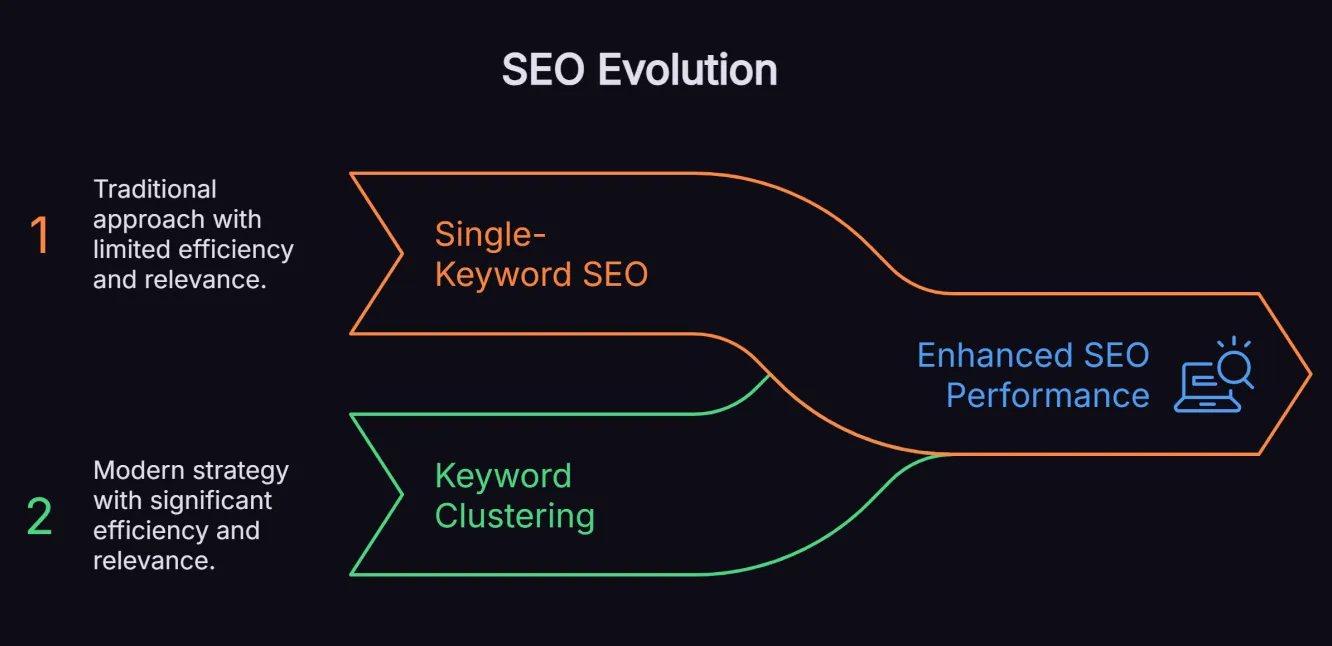
Keyword clustering groups related keywords based on their search intent and SERP similarity. The goal is to target them together on a single page. This technique emerged from a fundamental shift in how search engines work. Before 2013, Google relied much more heavily on exact keyword matching, with less emphasis on understanding the broader meaning of a query. The Hummingbird Google Search algorithm update marked a major shift toward parsing phrases and semantic relationships between words, rather than treating each keyword as an isolated string.
The impact on SEO strategy has been profound. Instead of creating dozens of thin pages each targeting a single keyword variation, you now build comprehensive resources that address entire topics. This approach:
- Allows you to rank for multiple related terms with shared intent
- Simplifies keyword management by filtering out irrelevant terms
- Reveals content connections that refine your site structure
The Difference Between Keyword Clusters and Topic Clusters
These terms are often confused, but they serve different purposes in your content strategy:
- A keyword cluster is a group of keywords you target on a single page. All the keywords in the cluster share similar intent and return similar search results. This indicates Google views a single page as sufficient for any of those terms.
- A topic cluster is a group of interlinked pages organised around a central pillar page. A group of topically related keyword clusters forms a topic cluster. Each cluster page targets its own related keywords while linking back to a comprehensive pillar page.
Think of it this way: keyword clusters work at the page level, deciding which terms a single piece of content should target. Topic clusters operate at the site architecture level, determining how multiple pages connect and support each other. The distinction matters when you sit down to plan a content roadmap, which is why we treat clustering and keyword mapping as two separate steps in our process.
How Keyword Clustering Works
The mechanics of keyword clustering rely on two primary signals: search intent alignment and SERP similarity.
Search intent alignment is the grouping of keywords that indicate searchers want the same type of content. There are four main types of search intent:
- Informational where users seek knowledge
- Navigational where users look for a specific site
- Commercial where users research options before purchasing
- Transactional where users want to complete a specific action like buying
SERP similarity examines whether keywords return similar pages in search results. The concept was first introduced in 2015 by Alexey Chekushin. The approach analyses the top 10 search results for different keywords and groups them if a minimum number of URLs appear in common. Most clustering tools use a threshold of three to five matching URLs to trigger grouping.
The Three Types of Keyword Clustering Methods
Different clustering approaches suit different situations and resources.
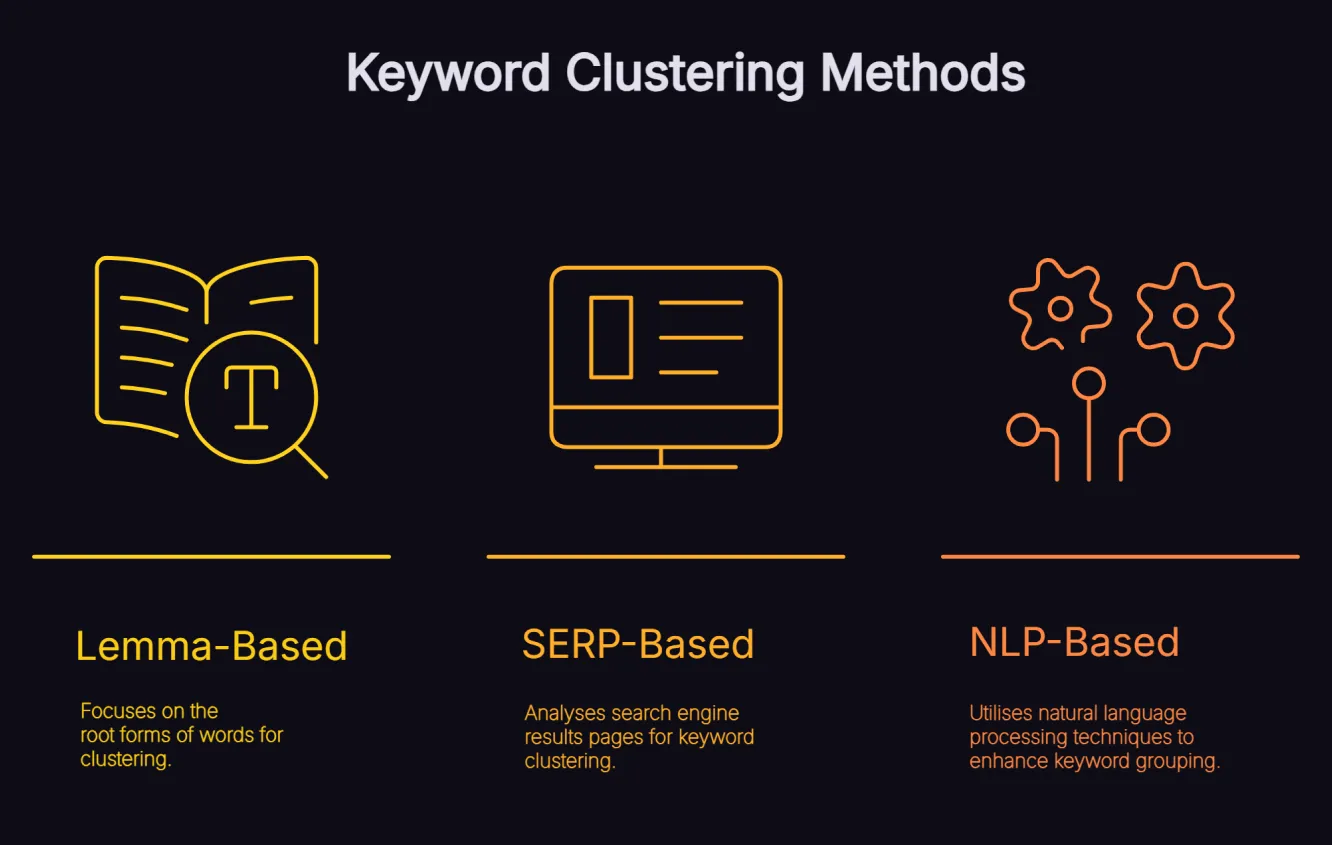
- Lemma-based clustering: Relies on linguistic analysis, grouping keywords that share the same root word or stem. For example, "cluster", "clusters" and "clustering" would be grouped. This method is simple and fast, but misses semantic relationships among words with similar meanings.
- SERP-based clustering: Analyses actual Google search results to determine which keywords should be grouped. This method groups keywords that co-occur in top search results, with results varying by clustering level and matching mode (soft, moderate or hard). This approach reflects how Google actually interprets keyword relationships.
- NLP-based clustering: Uses natural language processing and machine learning to understand semantic similarity between queries. This newer approach groups keywords by meaning and intent rather than relying solely on word overlap or SERP data, often producing more nuanced clusters that better reflect user needs.
How we Build Clusters in Practice
The mechanics above describe how clustering works in theory. What follows is how we actually run the process across Rankmax client campaigns. These four principles are where the structurally correct version of clustering becomes the version that drives revenue.
we Start With Scale, Not Selection
Most agencies begin clustering with 200 to 500 keywords. That is not enough surface area to find the patterns. On one eCommerce campaign, our team mapped the full meal delivery search landscape using Ahrefs, Semrush, People Also Ask, AnswerThePublic, Reddit and Quora, analysing more than 6,000 potential keywords before deciding what deserved a page. On a recent SaaS campaign, we also mapped 2,300 keywords into topical clusters, ensuring each article targeted specific buyer pain points while avoiding cannibalisation. That systematic approach produced $1.31M in attributed revenue and a 1,909% ROI over 12 months, documented in our SaaS SEO case study.
The reason we go wide before we go deep: clusters reveal themselves only when you can see the entire intent landscape, not a sampled slice of it. For initial keyword discovery, we use Ahrefs and Semrush as the structured backbone, then prompt ChatGPT, Claude and Perplexity with each priority seed term. The AI prompts typically surface 20 to 30 related queries per keyword that traditional tools miss. Those queries usually map to a sub-intent that becomes its own cluster.
we Cluster on Intent and Commercial Value, Not Volume
Volume-first clustering is the most common mistake we see in agency work. On an eCommerce campaign in the meal-delivery space, our team clustered keywords by intent and commercial value rather than search volume. That single decision revealed a pattern competitors had missed: they were all fighting over the same high-volume terms while ignoring hundreds of specific, high-intent queries. Within 30 days, content that had been stuck on page 3 jumped to page 1, and high-converting health queries such as "nutritionist-approved meal plans" started ranking. The full result is in our eCommerce AI SEO case study.
The lesson: a 200-volume cluster with strong commercial intent will out-earn a 5,000-volume cluster with informational intent, because the commercial cluster pulls qualified buyers and the informational cluster pulls research traffic.
we Sequence Low-Competition Clusters First
Once clusters are mapped, we deliberately sequence the rollout. On a B2B property management campaign, we prioritised low-competition, high-relevance clusters first to establish strong topical authority and organic search signals quickly, before moving on to more competitive phrases that the client's competitors had long dominated. The result over 27 months and counting is about $8.7M in attributed revenue and 598 AI cited pages across Google AI Overview, AI Mode, ChatGPT and Gemini.rankmax.com.au/articles/ai-overview-vs-ai-mode-seo">AI Overviews, ChatGPT, Perplexity, Gemini and Microsoft Copilot, documented in our B2B AI SEO case study.
This sequencing matters because topical authority compounds. Winning the low-competition cluster first signals to Google that your site is the authoritative source on the broader topic, which makes the harder cluster easier to win when you target it later.
we Anchor Each Cluster to a Specific Page Type and Intent Stage
A cluster is only useful if it maps to the right page in your funnel. A B2C compensation claims campaign demonstrates the principle: the site grew from 15 keyword positions in April 2024 to 1,102 positions by August 2025, a 7,247% increase, by mapping clusters to specific intent stages and page types. Informational clusters went to blog content. Commercial clusters with stronger intent signals - terms like "PTSD compensation claims" and "permanent impairment claims" - went to dedicated service pages. Transactional clusters went to landing pages built for conversion. The full result was $14.6M in attributed revenue over 21 months, documented in our B2C AI SEO case study.
If you cluster well but assign clusters to the wrong page types, the clusters will not convert. This is the step most agency clustering work skips.
Five Benefits of Keyword Clustering for SEO
Implementing keyword clustering delivers measurable improvements across multiple SEO metrics.
1. Rank for More Keywords With Less Content
A single well-optimised page can rank for dozens of related keywords. Clustering consolidates your SEO efforts and helps you answer search queries in greater depth while ranking for multiple keywords simultaneously. This efficiency lets you capture more search traffic without the resource burden of creating separate content for each keyword variation.
2. Build Topical Authority Faster
When you create comprehensive content that addresses multiple related queries, search engines recognise your expertise on the topic. Keyword clustering is one of the most efficient ways to build topical authority. It demonstrates the depth and breadth of your knowledge to both users and search algorithms. This authority then translates to higher rankings across your entire site for related queries.
3. Prevent Keyword Cannibalisation
Keyword cannibalisation occurs when multiple pages on your site compete for the same search terms. This:
- Splits your authority across multiple pages
- Dilutes backlinks
- Confuses search engines about which page to rank
4. Improve Site Structure and User Experience
Clusters naturally organise your content into logical groups. Topic clustering contributes to a cleaner and more organised website structure. It makes crawling and indexing easier for search engines while helping users navigate related content. This improved architecture benefits both rankings and engagement metrics.
5. Make Content Planning More Efficient
Starting with keyword clusters rather than individual keywords streamlines your entire content workflow. A large keyword list often maps to far fewer pages than you expect because many terms share the same intent. This clarity prevents wasted effort on redundant content and focuses resources on filling genuine content gaps.
How to Create Keyword Clusters Step by Step
Building effective keyword clusters requires systematic research and analysis. Follow this process to strategically group your keywords.
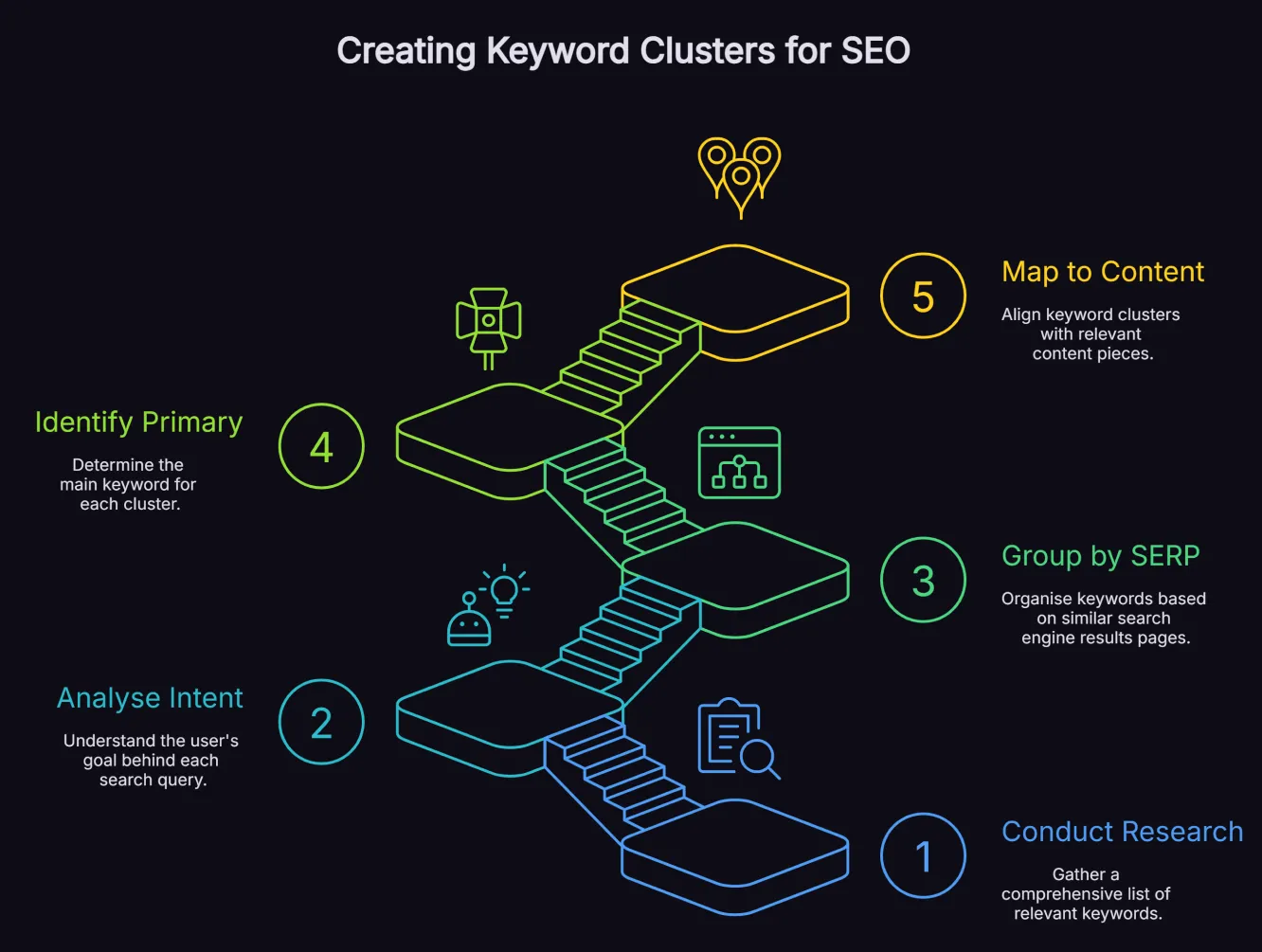
Step 1: Conduct Thorough Keyword Research
Start by gathering a comprehensive list of keywords related to your topic. Use any of these tools to identify seed keywords and their variations:
Explore different match types and review which keywords competitors rank for to fill gaps in your initial list. As we noted above, on larger campaigns we aim for at least 2,000 keywords before clustering, because cluster patterns only emerge once you can see the full intent landscape.
Step 2: Analyse Search Intent for Each Keyword
Before grouping keywords, understand what searchers want when they use each term. Subtle differences in wording can indicate different intents. For example, "apple cider vinegar for dog shampoo" indicates informational intent from someone looking for DIY bathing ideas. In contrast, "apple cider vinegar shampoo for dogs" indicates commercial intent from someone looking to buy a specific product.
Review the search results for ambiguous keywords to determine which content type Google believes best satisfies user intent. If the results show product pages, the intent is likely transactional. If they show guides and tutorials, the purpose is informational.
Step 3: Group Keywords by SERP Similarity
For each keyword in your list, analyse the top 10 search results and note which URLs appear. Keywords returning similar results belong in the same cluster. A common approach is to examine URL overlap among the top search results. If many of the same pages rank for two keywords, they can likely be targeted together on a single page. This step can be done manually for small keyword lists, but it becomes impractical at scale. Automated clustering tools like Keyword Insights significantly speed up this process.
Disclosure: Keyword Insights is an affiliate partner. We use the tool ourselves on every Rankmax campaign and recommend it on that basis. See our affiliate disclosure.
Step 4: Identify Primary and Secondary Keywords
Within each cluster, designate one primary keyword and mark the rest as secondary. Your primary keyword should best represent the search intent, commercial value and page type, with search volume treated as one input rather than the deciding factor. Our B2C compensation claims campaign, the target list averaged just 3.64 keyword difficulty, which showed us there were high-intent opportunities we could win through content quality and structure.
Step 5: Map Clusters to Content
Assign each cluster to either existing content that can be optimised or new content that needs to be created. To prioritise which clusters to tackle first, track keyword data for each cluster, including:
- Search volume
- Keyword difficulty
- Current rankings
Review your existing content library to identify pages that already partially address certain clusters. These optimisation opportunities often deliver faster results than creating entirely new content. This is also the step where clustering hands off to keyword mapping, which decides which page in your site architecture each cluster should live on.
Keyword Clustering for AI SEO Search Optimisation
As AI-powered search platforms like Google AI Overviews, ChatGPT and Perplexity grow in prominence, keyword clustering becomes more important, not less. These AI systems synthesise information from multiple sources to provide comprehensive answers, favouring content that thoroughly covers topics rather than pages optimised for single keywords.
Effective keyword clusters create content that demonstrates semantic completeness. This means covering not just the primary topic but all related subtopics, questions and considerations that a searcher might have. In our own client work, that topical depth has correlated with stronger AI citation visibility. The pattern is observable in our own client work: the B2B property management campaign has earned 598 AI cited pages over 27 months precisely because the content strategy covered the full topic cluster, not just the commercial keywords.
Our AI SEO strategy approach builds on keyword clustering by optimising content at the passage level for AI citation. This involves structuring content so that individual sections can be extracted and referenced by AI systems while maintaining the comprehensive coverage that supports traditional search rankings. If you want to understand why AI platforms reward this depth specifically, the mechanics are explained in our guide to query fan-out.
Implementing Keyword Clusters in Your Content Strategy
Once you have your clusters defined, the next step is integrating them into your content creation and optimisation workflow.
Creating Content Around Keyword Clusters
Each cluster should produce a single comprehensive piece of content that naturally incorporates all the keywords in the group. This means creating a content brief for each cluster that:
- Identifies the primary keyword
- Lists all secondary terms
- Outlines the topics and questions to address
When writing, avoid forced keyword inclusion. Focus on comprehensively answering the user intent behind the cluster. If you address all the questions and considerations searchers have, you will naturally incorporate most keyword variations. Use secondary keywords in subheadings where they fit logically.
Building Pillar and Cluster Page Structures
For broader topics, organise your keyword clusters into topic clusters with pillar and supporting pages. Your pillar page should provide a comprehensive overview of the main topic and link out to detailed cluster pages covering specific subtopics.
Interlinking pages within a topic cluster helps search engines understand their relationships and distribute authority more effectively. Ensure every cluster page links back to the pillar page and to other relevant cluster pages within the same topic.
Internal Linking Within Clusters
Strategic internal linking reinforces relationships between pages in your topic cluster and distributes authority across the group. Use distinct and descriptive anchor text when linking between cluster pages to send clear signals about each page's topic.
Avoid linking multiple pages with the same anchor text as this can send mixed signals about which page should rank for that term. Instead, vary your anchors using different keyword variations from each page's cluster.
Monitoring Cluster Performance
Track how each cluster performs over time using rank tracking tools or Google Search Console. we create content groups in Ahrefs Rank Tracker that mirror our keyword clusters one-to-one, which lets me monitor performance at the cluster level rather than just at the individual keyword level. The cluster view surfaces structural problems faster: if eight of the ten keywords in a cluster move up but two move sideways, that usually means the page does not address the intent behind those two terms and the cluster needs to be split.
Choosing a Clustering Tool
There is no single right tool for clustering. The right choice depends on your keyword volume, budget and how much manual control you need. The table below summarises how we think about the four main options.
| Tool | Best For | Keyword Limit | Method | Cost |
|---|---|---|---|---|
| Keyword Insights | Agency-grade clustering at scale, AI-assisted intent analysis, content briefs | Tens of thousands per project | SERP-based with NLP layer | Paid, monthly tiers |
| Cluster Keywords | Quick semantic clustering, mid-size projects on a free tier | Up to 3,000 free | Semantic similarity | Free up to 3K, then paid |
| SEO Scout | Exploratory grouping, n-gram pattern discovery | Smaller batches | n-gram word similarity | Free tool |
| Manual clustering | Sub-100-keyword lists, niche topics, full editorial control | Below 100 | Human judgement on intent + SERPs | Free, time-intensive |
For Rankmax client campaigns, we default to Keyword Insights because the SERP-plus-NLP combination is the most accurate we have used and the AI-assisted brief generation cuts hours per cluster. For sub-100-keyword projects, we still cluster manually because at that scale a human can see intent nuances that any tool will smooth over.
Free Clustering Options
For basic projects, you can also use Google Search directly by analysing autocomplete suggestions, related searches and People Also Ask boxes to identify natural keyword groupings. This is a slow approach but it is the closest free signal to what the SERP-based clustering tools are doing under the hood.
Common Keyword Clustering Mistakes to Avoid
Even experienced SEOs make mistakes when implementing keyword clustering. Here are the most common pitfalls and how to avoid them.
1. Clustering Keywords With Different Intents
The most common mistake is grouping keywords that look similar but have different search intents. Google's algorithm understands subtle differences in phrasing that indicate different user needs. Always verify intent alignment by checking actual search results before finalising clusters. If the SERP for two keywords shows fundamentally different page types, the keywords belong in different clusters even if the wording is nearly identical.
2. Creating Too Many or Too Few Clusters
Over-clustering spreads thin content across too many pages. Under-clustering creates unwieldy pages that try to address too many different topics. Aim for clusters that can be addressed comprehensively in a single page while still maintaining focus. If a cluster seems too broad, break it into subclusters.
3. Ignoring Existing Content
Before creating new content for your clusters, audit what you already have. You may already have pages that partially address certain clusters and simply need optimisation and expansion. Fixing existing content is often more efficient than creating new pages and avoids the risk of creating new cannibalisation issues.
4. Neglecting to Update Clusters Over Time
Search trends evolve and new keyword opportunities emerge faster than they used to, particularly as AI search surfaces new query patterns. we re-cluster every quarter for active client campaigns and every six months for steady-state ones. Annual reviews are too slow for any topic where AI search is changing how users phrase their queries.
5. Optimising Only for Volume
Volume-first clustering is the failure mode we see most often outside agency work. A 200-volume cluster with high commercial intent will routinely out-earn a 5,000-volume informational cluster, but only if you cluster on intent and commercial value rather than search volume alone. This is the principle that turned around the meal-delivery campaign described above.
Frequently Asked Questions
Can I use keyword clustering for eCommerce websites?
Yes. Keyword clustering is particularly valuable for eCommerce sites where products often have multiple name variations, attributes and related searches. Cluster product pages around all the different ways customers might search for that item. Category pages can also be optimised for clusters of broader commercial keywords related to product types.
How does keyword clustering help with AI search?
AI search platforms like Google AI Overviews and ChatGPT favour content that comprehensively covers topics rather than pages optimised for single keywords. Keyword clusters naturally create this comprehensive coverage by addressing all the related queries and considerations around a topic. This makes clustered content more likely to be cited as a source by AI systems, which is the pattern behind our B2B client's 598 AI cited pages across major platforms.
How long does it take to see results from keyword clustering?
Timelines vary based on your site strength and competition. On the eCommerce campaign described above, content that had been stuck on page 3 jumped to page 1 within 30 days of cluster restructuring. Most strategies, however, compound over multiple months rather than days. The benefits include not just higher rankings but also more efficient content creation and improved site structure, which compound over time.
How many keywords should be in a cluster?
There is no fixed number. Cluster size depends on the topic breadth and how many related variations exist. Some clusters may contain just five to 10 keywords while others could include 50 or more. The key criterion is that all keywords in the cluster share the same search intent and return similar search results, meaning a single page can rank for all of them.
Should I use manual or automated keyword clustering?
Manual clustering provides deeper insight and works well for small keyword sets of fewer than 100 terms. For larger projects, automated tools become essential to save time and ensure consistency. we use a hybrid approach on every campaign: automated tools handle the initial grouping, then we manually review and refine the results, particularly for clusters where the SERP signal is mixed.
How often should we re-cluster?
For active campaigns, we re-cluster every quarter. For steady-state campaigns, every six months. AI search is surfacing new query patterns faster than annual reviews can catch, so anything longer than a six-month cadence will leave opportunity on the table.
What is the difference between a keyword cluster and a topic cluster?
A keyword cluster is a group of related keywords that share the same search intent and can be targeted together on a single page. A topic cluster is a content architecture model where multiple pages, each targeting its own keyword cluster, are organised around a central pillar page and connected through internal links. Keyword clusters operate at the page level while topic clusters operate at the site structure level.
From Keywords to Revenue Growth
Keyword clustering helps you plan around intent, build topical authority and turn search demand into fewer, stronger pages that support revenue growth. The best results come from four principles: go wide before deep, cluster by intent and commercial value, sequence low-competition opportunities first and match every cluster to the right page type. Start by auditing your content, identifying your highest-value clusters and building a roadmap that fills gaps without duplicating effort. When you are ready to scale, explore our keyword research services and see how the framework behind $1.31M, $8.7M and $14.6M campaigns can support your next stage of organic growth.
About the Author
Want Insights Like This Fortnightly?

Our AI SEO strategies and tactics delivered fortnightly, including bonus trade secrets not shared anywhere else. No fluff. Just what's working right now. 5-minute read.


Want Help Putting This into Practice?
Everything we publish comes from the same methodology we run for clients every day. Book a discovery call and we will show you how it applies to your business.


