
Schema SEO: A Practical Framework for Structured Data, Rich Results and AI Readiness


Most websites publish content and hope Google figures out the rest. Schema SEO removes that guesswork. By adding structured data to your pages, you tell search engines, and AI platforms like ChatGPT, Perplexity and Google AI Overviews, exactly what your content means, who created it and why it matters. The gap between websites that appear in rich results and AI-generated answers and those that don't often comes down to one thing: schema. If you want to understand how schema SEO works, what types matter most and how to implement it correctly, this guide covers all of it.
Quick Overview: What Is Schema SEO?
Schema SEO is the practice of adding structured data to your website so search engines can understand your content more accurately and qualify eligible pages for rich results. It uses the Schema.org vocabulary, launched in 2011 by Google, Microsoft, Yahoo and Yandex, and Google recommends JSON-LD as the preferred implementation format. Schema SEO is not a direct ranking factor, but it helps search engines interpret entities, page purpose and relationships more clearly, which can improve visibility, relevance and rich result eligibility.
Speak to a Technical SEO Consultant Who Gets Schema Right
Implementing schema incorrectly is worse than not implementing it at all. Errors get flagged in Google Search Console, invalid markup prevents your pages from qualifying for rich results entirely, and conflicting entity IDs quietly undermine the brand recognition you are trying to build. Every Rankmax engagement includes a full schema audit, gap analysis and implementation roadmap, so if your structured data is broken, missing or out of date, we find it and fix it as part of a broader strategy built around measurable results.
Explore Our Technical SEO ConsultingWhy Schema SEO Matters More Than Ever in 2026
Schema has always been useful for traditional search. In 2026, it has become essential for a second reason: AI search visibility.
Rich Results Still Drive Click-Through Rates
When structured data is implemented correctly, your pages become eligible for enhanced SERP features. These include:
- FAQ accordions
- How-to carousels
- Review stars
- Event details
- Breadcrumb trails
Google’s case studies show that structured data can improve click-through rates when it helps pages qualify for richer search features. For example, Google reports that Rotten Tomatoes saw a 25% higher CTR on pages using structured data, while Food Network increased visits by 35% after enabling richer search experiences. Schema will not improve rankings on its own, but it can make your result more compelling and easier to understand in search.
AI Platforms Use Structured Data to Cite Content
This is where the stakes have risen significantly. Semrush reported that AI Overviews appeared in 13.14% of U.S. desktop searches in March 2025, showing how quickly this search experience was expanding. ChatGPT, Perplexity and Microsoft Copilot are also now widely used research tools for business buyers. These platforms do not just scan pages for keywords. They generate answers from multiple sources, and structured data can help them interpret entities, relationships and page context more clearly.
In March 2025 at SMX Munich, Microsoft's Principal Product Manager for Bing, Fabrice Canel, confirmed publicly that "schema markup helps Microsoft's LLMs understand content." That is an official statement from one of the companies whose search infrastructure powers most AI search products.
Structured data appears repeatedly in content that gets cited by AI systems, but the relationship is best understood as supportive rather than causal. Strong sites usually combine:
- Schema
- Clear authorship
- Consistent entity signals
- Well-structured content
This makes pages easier for machines to interpret and attribute.
Schema Helps Establish Entity Identity
Rather than isolated words, modern search engines organise information around:
- Entities
- Clearly defined people
- Organisations
- Products
- Concepts
Schema markup gives your brand a structured identity that search engines and AI platforms can recognise across queries and platforms. When your organisation's schema consistently describes:
- Who you are
- What you do
- Where you are located
You become a recognisable entity rather than an anonymous website. This supports your EEAT signals by making your expertise and authority machine-readable, not just human-readable.
How We Approach Schema SEO for Clients
Our approach to schema SEO strategy follows a structured methodology built around two principles: entity consistency and tiered implementation.
The Tiered Implementation Model
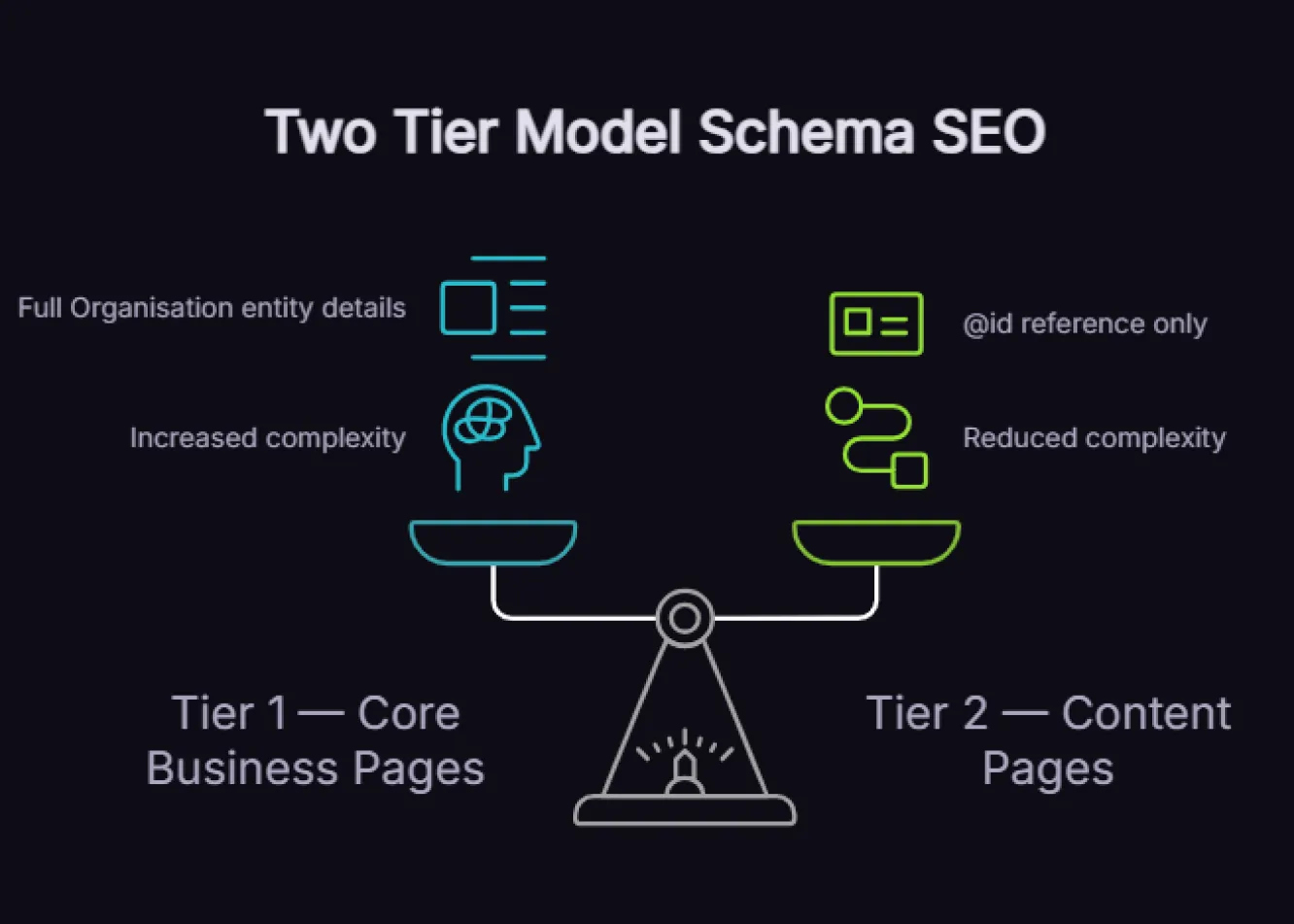
Not every page needs the same depth of structured data. Applying a full Organisation schema with 30+ properties to every blog post wastes resources and creates unnecessary maintenance overhead. We use a two-tier model:
Tier 1: Core Business Pages (Full Details Required):
These pages directly represent your business and need complete entity descriptions. They include:
- Homepage
- About page
- Main service pages
- Contact page
- Pricing page
On Tier 1 pages, we implement the complete Organisation entity with all properties:
- Name
- Legal name
- Address
- Contact details
- Founding date
- Social profiles
- Any relevant credentials
Tier 2: Content Pages (Reference Only):
Blog posts, case studies, category pages and resource pages reference the Organisation by its @id rather than repeating all details. This keeps the markup lightweight and consistent:
json
{
"@type": "Article",
"@id": "https://www.rankmax.com.au/blog/post-slug#article",
"publisher": {
"@id": "https://www.rankmax.com.au/#organization"
}
}
The @graph Format and Cross-Referenced Entities
Every schema implementation we build uses the @graph format, which groups multiple entity types in a single JSON-LD block. This allows proper cross-referencing using @id values so that entities relate to each other clearly without duplicating information.
For a blog article, a typical @graph includes:
- WebSite: Site-level identity
- Organisation: Publisher reference
- Article: The specific content piece
- Person: The author
- FAQPage: Use only when the page includes a genuine FAQ section
- HowTo: Use for genuine step-by-step content, not every instructional blog post
- BreadcrumbList: Recommended where the page has a clear breadcrumb hierarchy that matches visible navigation
Schema Types That Are Required, Not Optional
One of the most common schema mistakes we see in our technical SEO audits is applying FAQPage and HowTo markup too broadly. These schema types are not default add-ons for every blog post or case study. In our methodology, they are conditional and should only be used when the visible page content genuinely supports them.
- FAQPage: Use FAQPage markup only when the page includes a visible FAQ section and each question and answer matches the on-page text exactly. Google also limits FAQ rich results to well-known, authoritative government and health websites, so it should not be treated as standard markup for every page.
- HowTo: Use HowTo markup only when the page clearly presents a genuine step-by-step process and the structured data matches the visible content exactly. Google no longer shows How-to rich results in Search, so HowTo schema should be treated as contextual markup rather than a default requirement for every instructional article.
- BreadcrumbList: A useful best practice, not a universal requirement for every page. Use it where it reflects the real page hierarchy shown to users and supports a clearer navigation context for search engines.
What Google Does Not Support
Knowing what to avoid is as important as knowing what to implement. Google does not support Review or AggregateRating rich results for Service pages, so adding review markup there will not make those ratings eligible to display.
Supported review markup applies more broadly, but not to every schema type. Common Google-supported review snippet formats include:
- Product
- Recipe
- Book
- Course List
- Local Business
- Movie
- Event
- Software App
In some cases, review properties can be used with other Schema.org types. Google supports review markup in both simple and nested formats. Eligibility depends on the item type and the current review snippet guidelines, so it’s worth checking the documentation before implementation.
Google has phased out or clarified support for several structured data features over time, so it is important to be precise about what changed. In September 2025, Google removed documentation for several deprecated types. In November 2025, it added a deprecation notice for Practice Problem while clarifying that Dataset structured data is intended for Dataset Search, not general Google Search. QAPage remained supported.
These are the key changes to note:
- Course Info
- Estimated Salary
- Learning Video
- Special Announcement
- Vehicle Listing
- Practice Problem
- Dataset for Dataset Search only, not general Google Search
If your site still uses deprecated types, review whether they should be removed or replaced based on Google’s current structured data documentation.
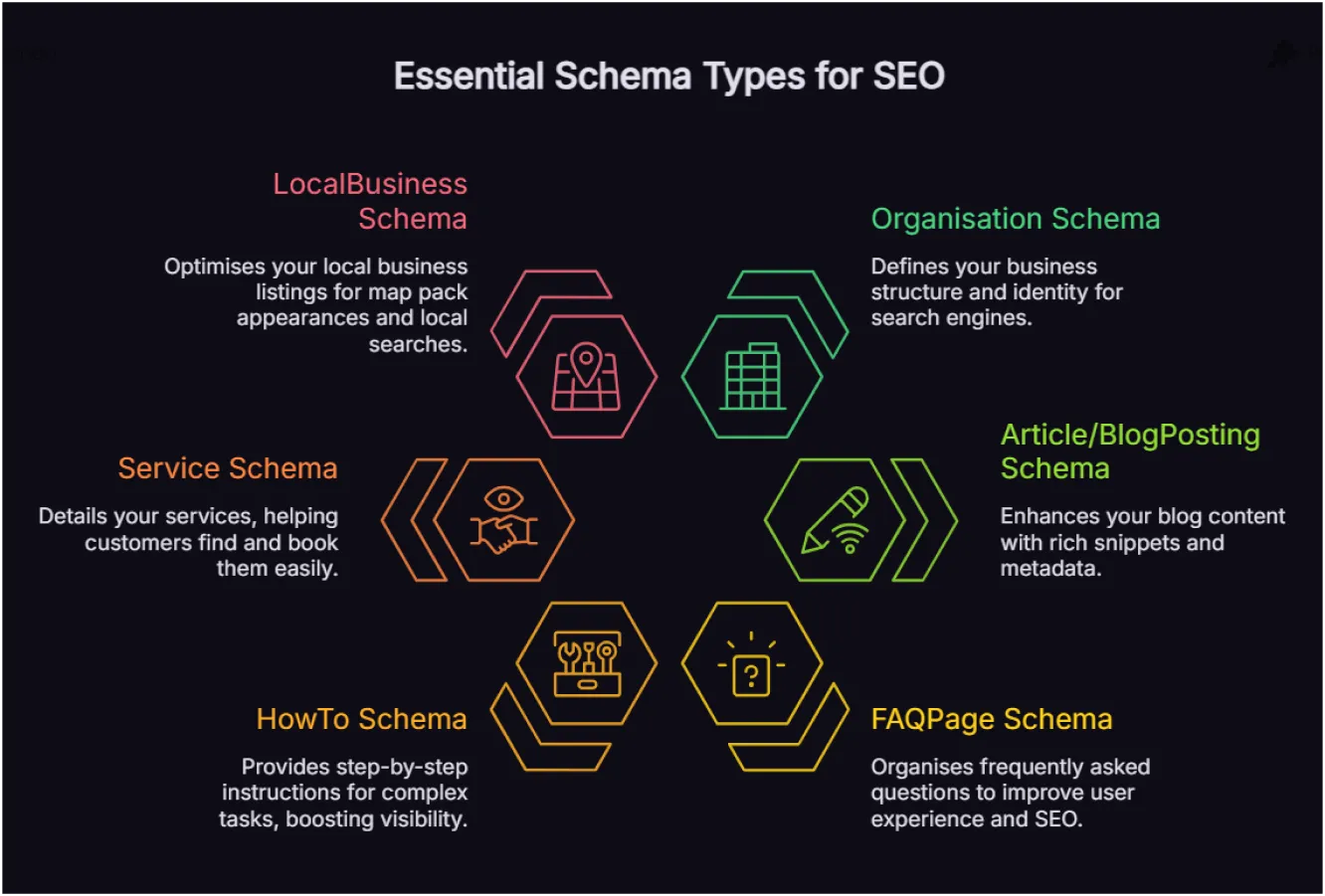
The Most Valuable Schema Types for SEO in 2026
Over 800 schema types are defined at Schema.org, but Google supports only a subset for rich results. Focus your implementation on the types that deliver real visibility benefits.
Organisation Schema
This is the foundation of every schema implementation. It establishes your brand as a recognised entity with consistent identity signals across all pages. Include:
- Name
- Legal name
- URL, logo
- Adress
- Contact information
- Social profiles
- Founding date
AggregateRating can be included in the Organisation schema where appropriate, but with an important caveat: Google does not show self-serving review snippets for organisations reviewing themselves on their own websites.
Article and BlogPosting Schema
Required for all blog posts. Include:
- Headline
- Author (linked to a Person entity)
- Publisher (linked to your Organisation entity)
- Date published
- Date modified
- A featured image
The dateModified property is particularly important for AI systems assessing content freshness.
FAQPage Schema
One of the highest-impact schema types for traditional and AI search. FAQPage markup can still help search engines understand your content, but Google now limits FAQ rich results to well-known, authoritative government and health sites. For AI platforms, clearly structured Q&A content is easy to extract and cite. Every question and answer in your FAQPage schema must appear verbatim in the visible page content.
HowTo Schema
For instructional content, HowTo schema labels each step of a process explicitly. HowTo markup can still help machines interpret a step-by-step process, but Google no longer shows How-to rich results in Search, so its value is now primarily semantic rather than SERP-driven.
Service Schema
For service businesses, Service schema describes what you offer, who provides it and where it is available. Note the critical limitation: Service schema does not support Review or AggregateRating. Use LocalBusiness schema if you need to combine service information with customer reviews.
LocalBusiness Schema
For businesses with a physical location or defined service area, LocalBusiness schema can help Google understand key business details. These details may support richer local search appearances, such as knowledge panels and other local search features. It also supports AggregateRating, unlike Service schema.
Implementing Schema the Right Way
Getting structured data right is not just about adding code to a page. It requires a consistent, validated and page-appropriate approach.
Step 1: Conduct a Schema Audit
Before adding anything new, map what schema already exists across your site. Use Search Console’s rich result status reports and Screaming Frog’s structured data export to identify what is present, what is missing and what has errors. Then, validate individual pages with Google’s Rich Results Test before rollout. In our AI SEO audits, we export structured data reports from every priority page type - service pages, blog posts, the homepage and case studies - and build a gap analysis that drives the implementation roadmap.
Step 2: Prioritise by Page Type
Not every page needs to be updated at once. The priority order for schema implementation is:
- High Priority: Homepage, service pages, pricing pages, contact page and case studies
- Medium Priority: About page, team page and blog articles
- Lower Priority: Category pages, integration pages and resource pages
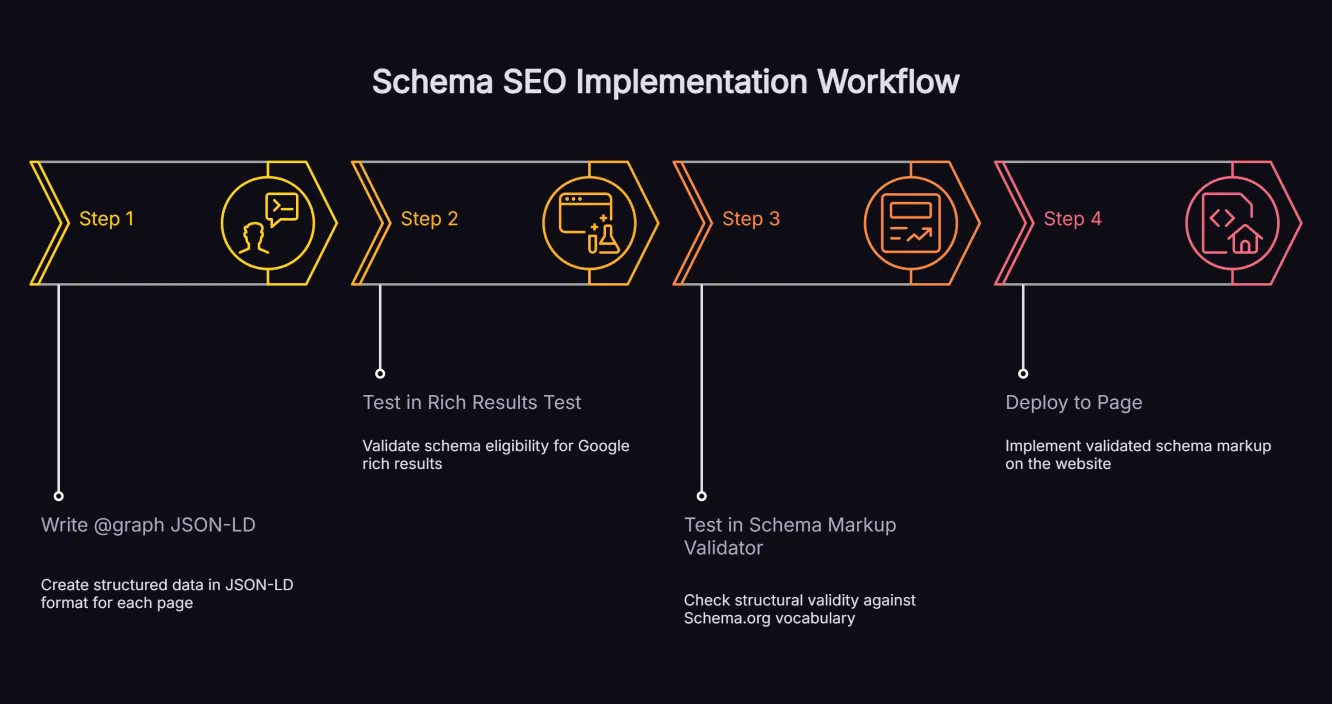
Step 3: Build and Validate Each Schema Block
Write JSON-LD schema in a single @graph block per page, cross-referencing entities by @id rather than duplicating details. Validate every implementation before deploying using two tools:
- Google Rich Results Test: Confirms eligibility for specific rich result types
- Schema Markup Validator: Checks structural validity against Schema.org vocabulary
Both tests should return zero errors before a schema block goes live. Warnings are acceptable in many cases, but errors must be resolved.
Step 4: Ensure Schema Matches Visible Content
If a question and answer appear in your FAQPage schema, those exact words must appear in the visible on-page text. If a HowTo step description is in your schema, it must be in the article. Google explicitly states that structured data cannot mark up content that is not visible to users, and AI systems extract from visible content, not hidden structured data.
Important content should still appear in the visible page text, and your structured data should match what users can see on the page. Schema works best when it reinforces visible content rather than trying to replace it.
Step 5: Monitor and Maintain
Schema is not a set-and-forget task. Google continues to update its structured data documentation, feature support and reporting, so existing implementations need regular review. Set a quarterly reminder to run your top-priority pages through the Rich Results Test and check for new errors or warnings in Google Search Console.
What Schema SEO Looks Like in Practice: A Client Example
In our B2B AI SEO case study, a national property management client achieved 138 verified AI citations across ChatGPT, Perplexity, Google AI Overviews and Copilot over a 17-month campaign. Schema implementation was one component of a broader strategy that included content restructuring, EEAT signal building and semantic SEO. The structured data ensured that every piece of published content was machine-readable, author-attributed and correctly categorised, making it easier for AI platforms to verify, trust and cite the client's content over less-structured competitors.
The result was not driven by schema alone. But the schema ensured that when the content earned authority, that authority was visible to machines.
Common Schema SEO Mistakes to Avoid
The most frequent errors we see when auditing client schema implementations include:
- Using Unsupported or Deprecated Schema Types: Some structured data types no longer generate standard Google rich results or have limited Search use. For example, SpecialAnnouncement has been phased out, Dataset markup is intended for Google Dataset Search rather than general web Search, and support for some other types has changed over time. Always check Google’s current structured data documentation before implementation.
- Adding Review Schema to Service Pages: Google does not support this, and it generates errors in Search Console
- Using Standalone Review Objects in @graph: Reviews must be nested directly in a supported parent entity
- Schema that Does not Match Visible Content: Both Google and AI platforms ignore schema that misrepresents the page
- Missing dateModified: Include dateModified and datePublished where accurate so Google can understand when the content was published and last updated.
- Inconsistent Entity IDs: If your Organisation @id changes between pages, you lose entity recognition benefits
- Ignoring BreadcrumbList: A missed opportunity on pages with a clear breadcrumb trail. Use it where it reflects the visible page hierarchy and matches the breadcrumb navigation shown to users.
Frequently Asked Questions
Does schema markup directly improve Google rankings?
No. Google has said structured data is not a direct ranking factor. What it can do is help search engines understand your content more clearly and make your pages eligible for richer search features, which can improve visibility and click-through rates. Those indirect benefits can support organic performance over time, but schema will not compensate for weak content or low authority on its own.
Which schema format should I use - JSON-LD, Microdata or RDFa?
Use JSON-LD. Google explicitly recommends it as the preferred format for structured data implementation. JSON-LD sits separately from your HTML content, making it easier to write, manage and update without disrupting your page markup. It is also the format most clearly parsed by AI systems during page fetch.
What is the difference between Schema.org and Google’s structured data?
Schema.org defines the full vocabulary of over 800 schema types and their properties. Google supports a subset of these types for rich results in Search. Not every Schema.org type generates a visual enhancement in Google; some are used purely for entity understanding. Always check Google's Structured Data documentation to confirm which types are supported before implementing.
Can schema markup help with AI overview visibility?
Yes, with caveats. Structured data can help search systems understand entities, relationships and page context more clearly, which may support how your content is interpreted in search. But it does not guarantee inclusion in AI Overviews or AI-generated citations. Content quality, topical authority and overall SEO strength still plays the bigger role.
How often should I update my schema markup?
Review your schema implementation quarterly. Google periodically updates which schema types it supports and deprecates others, as it did in late 2025. After any major content update, check that your schema still reflects the visible page content accurately. Any time a page is significantly rewritten, the schema block should be updated to match.
What is the @graph format in JSON-LD and why does it matter?
The @graph format groups multiple schema entities into a single JSON-LD block, allowing you to cross-reference them using @id values. Instead of repeating your full Organisation details on every page, you define them once and reference the Organisation by its @id in Article, Service or other entity types. This keeps implementations consistent, reduces maintenance overhead and helps search engines build a connected entity graph around your brand.
Should every page on my website have schema markup?
Use a schema that accurately reflects the page and adds clear value. Google specifically recommends Organisation markup on the home page, while BreadcrumbList and page-type schema such as WebPage, Article or Service should be added where they fit the page structure and content. Not every page needs the same depth of implementation. Prioritise your highest-traffic pages, key service pages and core content assets, then apply a tiered approach with full entity detail on core business pages and lighter reference-based markup on supporting content.
Get Schema Working Harder for Your Content
Schema SEO will not rank weak pages or guarantee AI citations, but it does help search engines understand your content, your entities, and your site structure with more clarity. That clarity can improve rich result eligibility, strengthen how your brand is interpreted across Google and AI search, and support stronger performance over time when paired with authoritative content. If you want a validated implementation that fits into a broader growth strategy, explore our technical SEO consultant service.
About the Author
Want Insights Like This Fortnightly?

Our AI SEO strategies and tactics delivered fortnightly, including bonus trade secrets not shared anywhere else. No fluff. Just what's working right now. 5-minute read.


