
EEAT for AI Search: How We Built the Trust Signals That Drove 598 AI Cited Pages and $8.7M for One B2B Client


EEAT is the framework Google's quality raters use to assess whether content deserves to rank. In 2026 it has become the gatekeeper for AI search citation, not just Google rankings. ChatGPT, Perplexity, Gemini and Google AI Overviews all surface answers from sources their training and retrieval systems trust. The signals those systems read for trust are the same signals EEAT codifies: verifiable expertise, real-world experience, authoritative entity associations and provable trustworthiness.
This guide explains what EEAT is, what each pillar requires, where the bar moves up for YMYL topics, and the structural work most mid-market sites are missing. I've built these patterns alongside the Rankmax team, based on what we've found when auditing EEAT for clients in B2B SaaS, professional services, legal, eCommerce and advocacy. I have cited real worked examples from those engagements wherever possible.
What EEAT Is: A Quick Summary
EEAT stands for Experience, Expertise, Authoritativeness and Trustworthiness. Google formalised the framework in its Search Quality Rater Guidelines and added the second E (Experience) in December 2022.
The four pillars in plain language:
- Experience is whether the person or organisation creating the content has actual hands-on involvement with the topic. Google's own example: a mechanic writing about engine repairs demonstrates experience; a freelance writer summarising a Wikipedia article does not.
- Expertise is whether the creator has the knowledge or qualifications to be making the claims they are making.
- Authoritativeness is whether the wider web treats the creator and the publishing site as a recognised reference on the topic.
- Trustworthiness is whether the site, author and content can be relied on to be accurate, transparent and safe to act on.
Google has been explicit that Trust is the most important component. Experience, Expertise and Authoritativeness are how you demonstrate Trust. The four pillars are not equally weighted; Trust is the outcome and the other three are the inputs.
EEAT is not a ranking factor in the algorithmic sense. There is no EEAT score in the index. It is the framework Google's human quality raters use to evaluate search results, and those evaluations train the algorithms that do affect rankings. AI platforms now use the same trust signals when retrieving citations.
Audit Your EEAT Foundation Before You Write More Content
If your authority signals are not visible to AI retrieval systems, every new piece you publish loses its citation upside. We have used the framework above to drive 598 AI cited pages and about $8.7M in attributed revenue for a B2B property management client over 27 months and counting. The audit produces a remediation list scoped to your site, prioritised by penalty risk and citation upside.
Explore AI SEO StrategyEEAT Is Now the Gatekeeper for AI Search Citation
Most EEAT explainers still frame the topic as a content quality standard for Google rankings. That framing is incomplete in 2026. EEAT signals now drive whether your content gets cited in AI answers at all, not just whether you rank in the blue links.
A working example from our own client work: we generated 598 AI cited pages for a B2B property management client across Google AI Overviews, ChatGPT, Perplexity and Gemini over 27 months and counting. The content that got cited was not the content with the highest keyword density or the most backlinks. It was the content built around three EEAT signals working together: verifiable client results, original first-party data and consistent author profiles tying every piece back to a credentialed subject-matter expert.
That same engagement attributed $8.7M in revenue over 27 months and counting; the 17-month climb window ran at a 6,864% average ROI. The content production was one part of it. The EEAT structural work the team did is what made the AI citations possible.
If you take one thing from this article: EEAT is not a Google ranking checklist any more. It is the structural foundation that makes your content quotable by every AI surface your buyers use.
The Rankmax EEAT Framework
Most EEAT advice on the web rephrases Google's documentation. It tells you to "share what you've personally seen" and to "include credentials". That advice is correct but not actionable. What I've found actually moves the needle for mid-market sites is a structured stack of signals that AI retrieval systems and Google quality raters can both read.
The framework I've developed with the Rankmax team is four interlocking layers:
1. First-Hand Experience Anchored in Real Work
Generic content writers cannot match real expertise. The B2B property management client I cited above sells against competitors using offshore content farms. The winning content drew directly on the founder's documented operational experience and a body of published material the founder had produced over years of running the business. This was not a citation tactic for SEO. It was genuine subject-matter knowledge that competitors using generic content writers could not reproduce.
The pattern repeats across every engagement we've run at Rankmax that has produced meaningful AI citation results, regardless of vertical. A legal client whose authority hangs off the principal's documented professional credentials and industry recognition. An advocacy client whose founder's documented expertise is the trust signal across every content piece. A B2B services client whose founder's prior operational experience is the spine of every blog post written in first person. Different content, same structural principle: a real person with real, verifiable involvement, attached to a real piece of work.
If you cannot point to the specific human whose hands-on experience the content is drawing from, your EEAT story is broken before any technical signal can fix it.
2. Expertise Made Visible in Structured Data
Credentials that exist offline do not count if they are not visible to crawlers. Across the EEAT audits we run, the most common gap I see is not absence of credentials. It is credentials that exist (years of experience, certifications, qualifications, awards, professional memberships, published work) but are buried in PDFs or marketing copy and not exposed in structured data.
The tactic stack we deploy at Rankmax on every engagement:
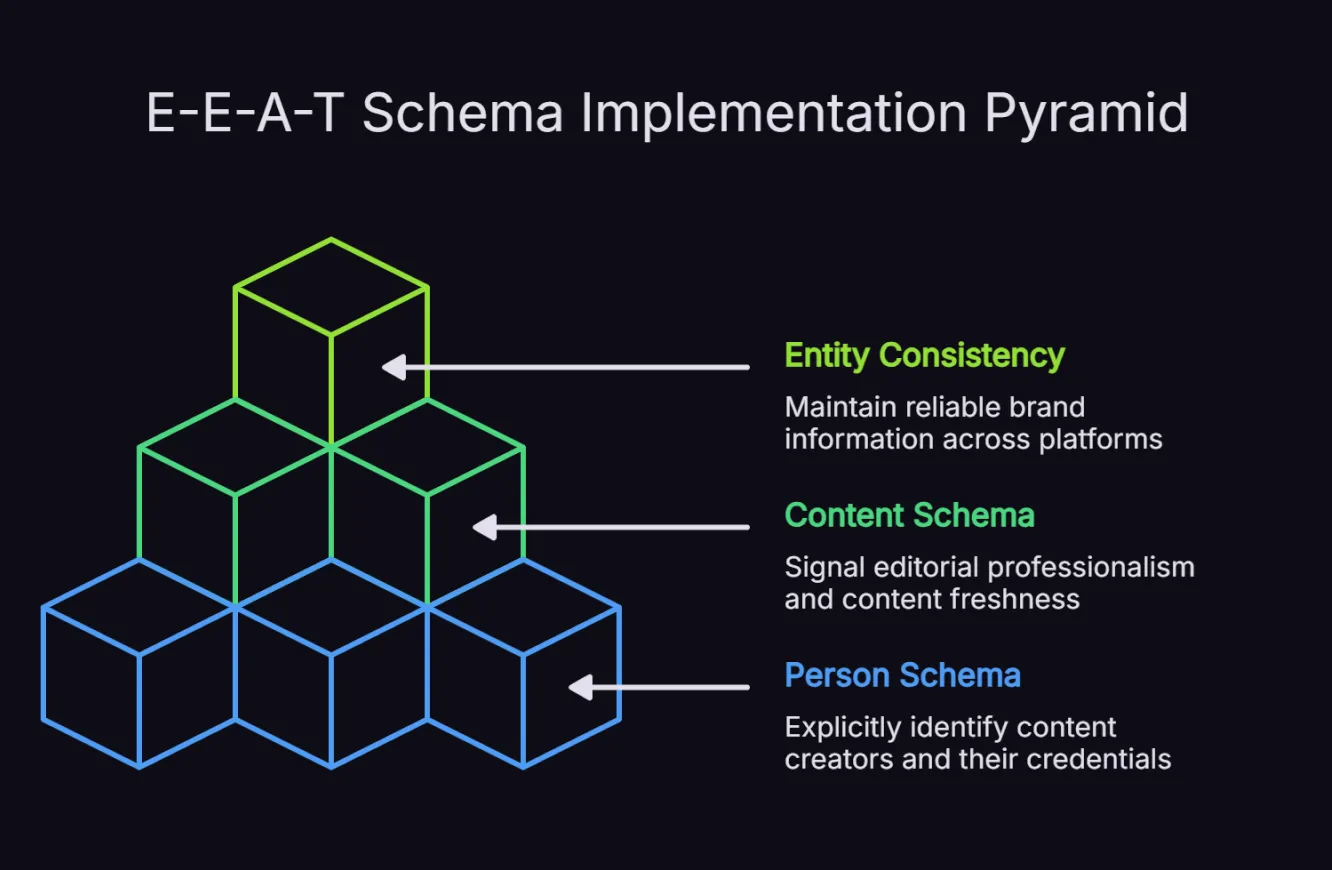
- Author profiles with full bios, credentials and the link relationships AI systems read (sameAs to LinkedIn, professional registrations, published author pages on industry sites)
- Person schema on author pages with credentials, alumniOf, hasOccupation and knowsAbout properties populated
- Author byline on every piece of content linking back to the individual author profile (and the author profile linking back to every byline)
- About Us and Meet the Team pages with individual sub-pages per team member, not a single page with a grid of names
- Organisation schema with contactPoint, founder, foundingDate, areaServed, sameAs and the credential or certification entities the business holds
The schema is not the EEAT signal. The schema is what makes the EEAT signal visible to systems that cannot infer it from prose.
3. Authoritativeness Through Recognition, Not Self-Assertion
Authority is what other entities say about you. It cannot be claimed; it has to be earned and then surfaced. The on-site work is making sure the authority signals you have already earned are present in formats AI systems can read.
In our client engagements that means surfacing third-party review scores with AggregateRating schema (so review stars become rich results in search), embedding awards and industry recognition on commercial pages rather than archive pages, and ensuring high-authority backlinks and brand mentions are reflected in the entity record search engines build of the brand.
A frequent finding in our audits: a site with strong external authority signals (high domain rating, links from reputable publications, customer logos from recognised brands) but on-site presentation that hides those signals behind navigation. The authority exists. It is not visible at the moments of evaluation. We move it forward.
4. Trust Surfaced Where Buyers and Crawlers Both Look
Trust signals are the most commonly under-surfaced component of EEAT. The pattern across every audit we run, regardless of vertical, is that trust infrastructure exists (SSL, privacy policy, terms of service, customer support contact, compliance certifications, transparent business addresses) but is not present at the points where buyers actually evaluate.
The fix is structural. Trust signals belong on:
- Homepage hero or near-fold area (compliance badges, customer logos, third-party ratings)
- Pricing page (review scores, security certifications, money-back terms)
- Service or product pages (industry-specific compliance, awards, testimonials with named attribution)
- Author pages (credentials, experience timeline, professional affiliations)
- Footer (registered business address, ABN or equivalent, contact phone, support hours)
Burying SOC 2, GDPR, ISO 27001 or industry-specific compliance on a separate trust page is one of the most common audit findings I see us surface. The certifications work for the audit. They do not work for the buyer or the crawler that never visits that page.

What an EEAT Audit Actually Finds
Across the EEAT audits we have run for clients in B2B SaaS, legal, professional services, eCommerce and advocacy, the same patterns recur regardless of vertical:
- Author bylines exist but bios are name and job title only. No credentials, qualifications, years of experience, professional memberships, published work or sameAs links to authoritative profiles. Google reads the byline as a label, not as a person.
- Credentials exist offline but are not in structured data. Years of operational experience, professional registrations, awards, published work, conference talks, certifications. All real. None visible to crawlers.
- No Person or Author schema even where bylines are visible. The author exists in the eye of a human reader but not in the entity graph.
- Organisation schema either missing or incomplete. Common omissions: contactPoint, sameAs, founder, foundingDate, areaServed, the credential or accreditation properties a B2B buyer would expect.
- Industry-specific schema absent even when the entity qualifies for it. Attorney schema for law firms. Person schema for consultants and advisors. MedicalBusiness or MedicalProfessional for health verticals. FinancialService for financial advice.
- Team or About pages thin or missing. Single grid of head shots with no individual pages, professional service profiles under 200 words, founder bios on the homepage that disappear from any other context.
- Trust signals exist but are not on commercial pages. Compliance buried in separate trust centres. Awards on archive pages. Third-party review scores displayed visually but not marked up with AggregateRating schema (so they do not appear as rich results in search).
- Authorship links to nowhere. A byline that points to /author/firstname or /team/lastname where the page is empty, redirects to a generic blog feed or returns a 404.
These are the patterns we keep finding. None of them are individually fatal. Together they make a site invisible to AI retrieval systems and weak under quality rater evaluation. The remediation is structural and bounded; most of it can be done in two to four weeks of focused work.
Worked Example: 598 AI cited pages from EEAT-First Content
The B2B property management engagement I cited at the top is the clearest worked example I have for the cause and effect between EEAT structural work and AI citation outcomes.
The starting state was a site with technically competent content, conservative claims, accurate documentation and named bylines. It was already well above the floor for spam policy compliance and quality rater Page Quality. It was generating modest organic traffic but minimal AI citations.
The EEAT-specific work the team and I did:
- Restructured every blog post to draw on the founder's documented operational experience as the primary source of the substantive claims. This anchored Experience to a verifiable individual with verifiable history in the space.
- Built individual author pages with credentials, photo, professional history, areas of expertise and sameAs links to LinkedIn and the founder's published material.
- Added Person schema to every author page and Article schema with author property linking to those pages on every piece of content.
- Restructured the Organisation schema to include founder, foundingDate, areaServed and the business registration details.
- Added an EEAT-grade About Us narrative covering the operational origin of the business, the founder's prior experience and the team's combined years in the vertical.
- Made the existing customer outcomes visible at the page-template level (results boxes on case studies, named customer logos on services pages, AggregateRating schema for the third-party reviews already collected).
The outcome over 27 months and counting: 598 AI cited pages across Google AI Overviews, ChatGPT, Perplexity and Gemini, and $8.7M in attributed organic revenue over 27 months and counting; the 17-month climb window ran at a 6,864% average ROI. The content production was one part of the campaign. The EEAT structural work is what made the citations possible.
This pattern is replicable. The specific signals matter less than the principle: EEAT becomes a citation engine when every layer is in place at the same time.

YMYL: Where the Bar Moves Up
For Your Money or Your Life topics (financial, medical, legal, safety, civic), Google explicitly raises the EEAT bar. Quality raters are instructed to evaluate YMYL pages against stricter expectations because mistakes on those topics can cause real harm.
The practical implication: EEAT signals that are sufficient for general topics are not sufficient for YMYL. A named author with a job title is not enough; the byline needs to demonstrate the credentials that justify advising on the topic. A general About Us page is not enough; the pages making YMYL claims need direct provenance to a qualified individual.
A worked example from our eCommerce health and nutrition engagement: the site sold meal plans and diet products. Pre-engagement, content ranked on page 3 for valuable health-related queries despite being technically well-formed. We diagnosed the gap as YMYL EEAT under-investment: no qualified nutritionist or dietitian credentials surfaced anywhere on the site, no Person schema for the people writing the content, no Organisation schema reflecting the credentials of the team behind the brand.
The team rebuilt the EEAT layer specifically for the YMYL bar. Within 30 days, content that had been stuck on page 3 jumped to page 1. High-value health queries like "nutritionist-approved meal plans" and "dietitian-designed keto meals" started ranking. Why? Because Google could finally verify the expertise behind the content, not just the keywords in it.
If you operate in a YMYL category, every signal in the framework above needs to be in place and verifiable. Generic EEAT is not enough.
Technical EEAT Signals
Technical signals are the structural infrastructure that makes EEAT visible to crawlers and AI systems. They are necessary but not sufficient. They reinforce the substantive EEAT work; they do not replace it.
The minimum viable technical EEAT layer:
- Organisation schema on every page, with contactPoint, founder, foundingDate, areaServed, sameAs, address and any credential or accreditation entities the business holds
- Person schema on every author profile page, with credentials, alumniOf, hasOccupation, knowsAbout, sameAs and a clear photograph
- Article schema on every content page, with author property linking to the author's individual page (not just a string)
- AggregateRating schema on commercial pages where third-party review scores already exist
- BreadcrumbList schema that accurately reflects the site's information architecture
- Industry-specific schema where the entity qualifies (Attorney, MedicalBusiness, FinancialService, LocalBusiness with the correct sub-type)
- HTTPS site-wide with no mixed content warnings
- Visible business identity in the footer (registered name, address, phone, ABN or equivalent jurisdiction-specific identifier)
A common observation from our audits: schema reinforces, it does not replace, the underlying authority. Marking up an organisation as authoritative without the substantive work to earn that authority does nothing. The schema layer's job is to make sure that when the content earns authority, that authority is visible to machines. Without the underlying work, the markup is decorative.
EEAT Maintenance: It Is Not a Metric, It Is a Setup You Maintain
The EEAT industry has a problem with framing the topic as if it were a metric. Tools advertise "EEAT scores". Dashboards claim to track EEAT progress month over month. The framing is misleading.
My position, shared by the Rankmax team: EEAT is not a metric. It is a set of structural signals on your website. The work splits into two phases.
The first phase is an EEAT audit that identifies what is missing or broken. That phase produces a remediation list (author schema, organisation schema, individual team profiles linked from author bylines, credentials surfaced on commercial pages, compliance certifications visible where buyers evaluate). The audit is a one-off setup engagement; the output is a list of fixes to ship, not a number to chase.
The second phase is ongoing maintenance. CMS template changes, page redesigns, plugin updates and routine content edits can silently delete a team profile page, break an authorship link, reset a schema block or detach a contributor from their bio. We have seen all of these happen on client sites where the original setup was correct. The monthly check is for breakage, not for measurement. The output is a list of fixes to restore.
We sit the maintenance check inside our monthly SEO audit and performance reporting. It is not a separate workstream and it does not need its own dashboard. It is one section of the recurring quality assurance work that keeps the structural EEAT layer intact over time.
If you find yourself looking for an "EEAT score" to chase, you are using the wrong unit of measurement. Audit the signals, fix what is broken, monitor for breakage, and trust that quality raters and AI retrieval systems will read the structure you have built.
FAQs
Can you track EEAT month over month?
Not as a metric. EEAT is a set of structural signals on your website, not a number you can chart. The work that actually moves EEAT is an initial audit that surfaces what is missing or broken, followed by ongoing monthly checks that confirm the fixes you shipped have not been silently undone by template changes, plugin updates or content edits. If you are tracking an "EEAT score" from a tool, you are tracking a vendor's interpretation of public Google guidance, not your actual EEAT position.
How long does it take to see results from EEAT work?
Schema and on-page structural fixes can begin influencing search visibility within a few weeks of being indexed. Content-led EEAT improvements (author bios, About Us, Meet the Team, individual team profiles, original first-party content) compound over months as quality raters and AI retrieval systems process the updated entity signals. The eCommerce health engagement I cited above moved from page 3 to page 1 within 30 days for YMYL queries because the structural work cleared a verifiability ceiling that had been blocking otherwise-good content. That is a faster than typical result. For non-YMYL B2B and professional services clients, meaningful AI citation growth tends to compound visibly over six to twelve months in our experience.
What is the biggest EEAT mistake mid-market brands make?
In my view, treating EEAT as a content tactic rather than a structural project. The most common pattern I see is a site with strong external trust signals (years of operation, recognised customers, real credentials, published work) and weak on-site EEAT structure. The trust exists. It is not visible to the systems that need to read it. The fix is not better blog posts; it is the structural layer (author profiles, schema, surfaced credentials, organisation entity completeness) that makes the trust legible to crawlers and AI retrieval systems.
Choose the Foundation Over the Score
EEAT in 2026 is the gatekeeper for AI search citation, not just a Google ranking framework. The brands winning visibility across Google, ChatGPT, Perplexity, Gemini and AI Overviews are the ones treating EEAT as structural infrastructure, auditing it once, fixing what is missing, and maintaining it monthly.
If you want to know where your site stands today, the Rankmax AI SEO Audit reviews EEAT signals as one of its core dimensions, against the same patterns we have used to drive 598 AI cited pages and about $8.7M in attributed revenue for B2B clients and page-3-to-page-1 ranking jumps for YMYL eCommerce clients within 30 days. The audit produces a remediation list scoped to your site, prioritised by penalty risk and citation upside.
About the Author
Want Insights Like This Fortnightly?

Our AI SEO strategies and tactics delivered fortnightly, including bonus trade secrets not shared anywhere else. No fluff. Just what's working right now. 5-minute read.


