
SEO Technical Audit: How to Find and Fix What’s Holding Your Site Back

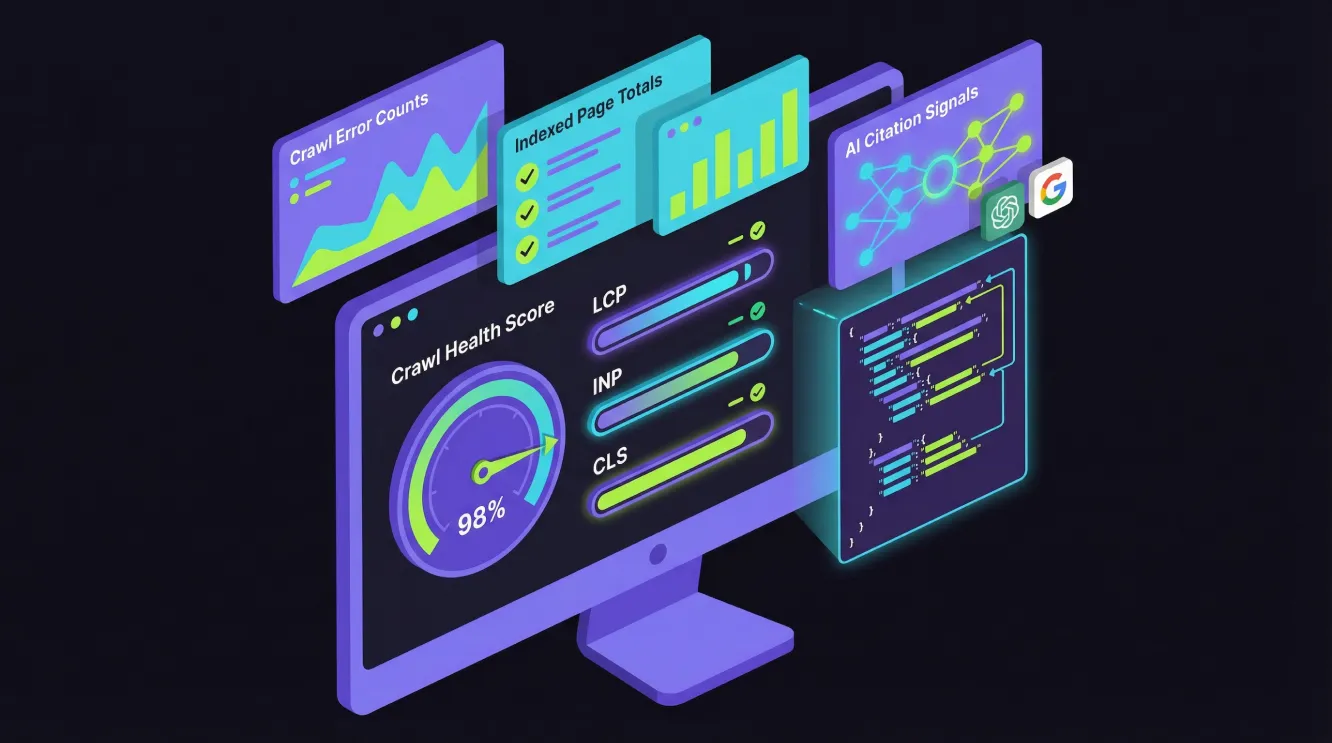
A strong content strategy and a healthy backlink profile are not always enough to move rankings. When a site plateaus despite real content investment, the cause is usually sitting in the technical foundation, invisible to you but obvious to every crawler that visits. A technical SEO audit is the diagnostic process that surfaces those hidden issues and turns them into a prioritised fix list. This SEO technical audit guide explains what the process covers, how to run it step by step and why it looks different from the version most teams learned two years ago. It also shows what our own audits surface most often, so you know where to look first.
Quick Guide: What Is an SEO Technical Audit?
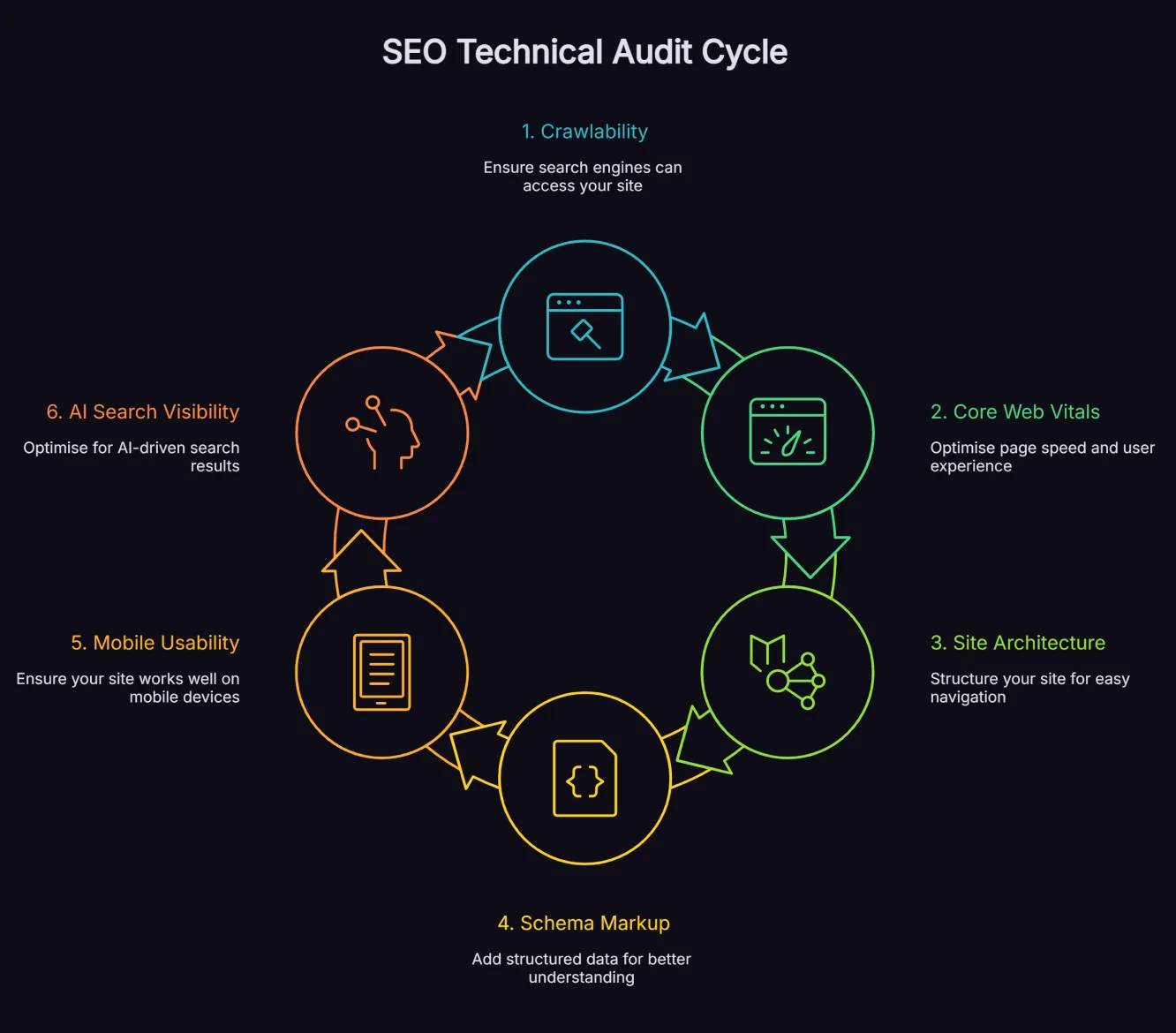
An SEO technical audit is a review of the technical factors that decide how well search engines and AI platforms can crawl, index and understand your site. It covers crawlability, indexation, page speed, Core Web Vitals, internal linking, site architecture, schema markup, mobile usability and AI search readiness. It matters because technical faults can suppress visibility even when your content is strong: Google uses mobile-first indexing, and Google's own mobile research found that as page load time grows from one second to ten seconds, the probability of a mobile visitor bouncing rises by 123%.
Turn Technical Issues Into Revenue With Expert Help
Finding the issues is the first step; fixing them in the order that protects revenue is the harder part. Our technical SEO consulting service gives you a fix list ranked by revenue impact, full schema implementation and ongoing monitoring built for both Google and AI search. You get a prioritised plan your developers can act on, not a raw data export.
Explore Technical SEO ConsultingWhat Does a Technical SEO Audit Cover?
A proper audit covers six core areas. Each one can limit your search visibility on its own, but they usually interact. A slow site with poor schema and a messy crawl structure compounds the damage across all three at once. The section below walks through each area and the finding we run into most often when we open a new audit.
1. Crawlability and Indexation
Search engines discover your pages by following links from one URL to the next. Your content may never be found if crawl paths are broken by any of the following:
- Redirect chains
- Orphan pages
- Blocked resources
- Incorrect robots.txt directives
The crawlability audit maps how efficiently Googlebot moves through your site and finds the barriers stopping it from reaching important pages. A single misconfigured line in your robots.txt file can hide a whole template from search.
Indexation analysis goes one step further. A crawled page is not always an indexed page. The audit reviews which pages sit in Google's index, which are excluded and why. Common issues include:
- Duplicate content that confuses indexation
- Noindex tags applied to pages that should rank
- XML sitemap problems that slow discovery
When we open a new audit, the most common finding in this area is a set of money pages that no internal link points to, noindex tags left behind on pages the business actually wants to rank and redirect chains sitting on high-value URLs. None of these show up as an error on the page itself, which is exactly why they survive for months. For multi-market sites, broken hreflang is the equivalent trap: our international SEO audit guide walks through what happens when those tags point at URLs that no longer resolve. This is also where a full technical SEO crawl earns its keep.
2. Core Web Vitals and Page Speed
Core Web Vitals are Google's standardised measure of user experience:
- Largest Contentful Paint (LCP) measures loading performance
- Interaction to Next Paint (INP) measures responsiveness
- Cumulative Layout Shift (CLS) measures visual stability
Poor scores on any of these can weaken your ranking competitiveness, especially in mobile search. Speed is not only a ranking issue, it is a conversion issue: Google research found that 53% of mobile visits are abandoned when a page takes longer than three seconds to load. A technical audit measures Core Web Vitals against Google's thresholds for every key page, not just the homepage, and identifies the specific elements dragging each score down.
The findings here are often blunt. In one recent eCommerce audit we ran, 590 images were over 100KB and not a single image on the site carried width and height attributes, which forces the browser to reflow the layout as each one loads. Fixing 982 images (compressing to WebP and adding dimensions) removed most of the layout shift and slow-loading problems in a single sprint. These are the kinds of issues our full Core Web Vitals audit is built to catch before they cost you rankings.
3. Site Architecture and Internal Linking
How your pages are organised and connected affects both crawl efficiency and how ranking signals spread across your site. Pages buried too deep receive less crawl attention and fewer internal links, which weakens their ranking potential no matter how good the content is.
The architecture audit reviews:
- Crawl depth
- URL structure
- Breadcrumb navigation
- Internal linking patterns
It finds orphan pages with no internal links pointing to them and highlights where navigation can be restructured so authority flows to the pages that matter most for revenue. The most common finding we see is a commercial page stranded four or more clicks from the homepage, with almost no internal links, quietly capped below its potential. Our guide to building a topical authority map shows how we plan internal links so this stops happening.
4. Schema Markup and Structured Data
Schema markup is the structured data layer that tells search engines and AI systems what your content means. Without it, Google and AI platforms infer context from unstructured text. With it, you hand them a clear, machine-readable signal about your:
- Business
- Services
- Content type
- Relationships
The schema audit reviews every key page type (service pages, blog posts, case studies, the homepage and any specialised content) and checks whether schema is present, whether it is implemented correctly in JSON-LD and whether it covers the types most likely to improve rich result eligibility. Structured data helps machines interpret your content and can make pages eligible for rich results, though there is no guaranteed uplift.
The most common schema finding in our audits is markup that describes something the visitor cannot actually see on the page, for example review or FAQ data with no matching visible content. That mismatch can reduce confidence in your structured data and undercut rich-result eligibility, so we keep the markup aligned with the page itself. Our schema SEO framework covers how we scope structured data by page type rather than bolting the same block onto everything.
5. Mobile Usability
Google uses mobile-first indexing, which means the mobile version of your site is what it crawls and indexes, not the desktop version. If your mobile experience is compromised, rankings can suffer even when your desktop site performs well.
The mobile-first indexing audit checks:
- Responsive design implementation
- Viewport configuration
- Touch target sizing
- Whether critical content or navigation is hidden from mobile crawlers by JavaScript rendering
That last point matters more every year. If your navigation only appears after a tap, Googlebot may never see your site structure at all. The gap is bigger than most teams expect: research shows only 11% of pages rank in the same position on desktop and mobile, so a desktop-strong site can still be losing on the version Google actually ranks. Closing that gap is where real revenue sits. One eCommerce meal delivery client we worked on moved monthly organic revenue from $77K to $147K once the technical foundation was fixed, a shift documented in the eCommerce AI SEO case study. Our mobile SEO guide goes deeper on content parity and performance.
6. AI Search Visibility
This is the area most traditional technical audits ignore. AI search still depends on the fundamentals that support discoverability in ordinary search:
- Crawlable pages
- Accessible content
- Clear structure
- Helpful, reliable information
For Google AI features, Google says there are no extra eligibility requirements beyond standard SEO best practice. Strong fundamentals still decide whether a page can surface in AI Overviews or AI Mode: it needs to be crawlable, indexable, clearly structured and genuinely useful. The AI visibility component of an audit reviews whether your site is technically accessible and easy for AI systems to interpret, including schema coverage, rendering quality, content accessibility and whether your structured data matches what users can see.
Treat AI citations as a visibility metric and a leading indicator, tracked alongside your rankings rather than in place of them. They move first and revenue tends to follow. After we fixed one eCommerce client's Core Web Vitals and technical foundation, their site earned 169 AI citations across five platforms, up from zero. In a separate six-month engagement, a client's site went from no AI presence to 126 Google AI Overview citations and 12 ChatGPT citations. Both are early signals that AI systems are reading and reusing that technical groundwork. Our AI SEO guide and semantic SEO guide explain how structure and meaning connect to that visibility.
What an Average Rankmax Audit Surfaces
These are the kinds of findings a technical SEO audit routinely turns up, drawn from recent client work:
- 590 images over 100KB on a single site, with 982 images fixed to bring page weight down
- 100% of images missing width and height attributes, forcing layout shift on load
- Only 11% of pages ranking the same on desktop and mobile (industry research)
- 53% of mobile visits abandoned when a page takes longer than three seconds (Google research)
These are not unusual numbers. Most sites we audit have similar problems hiding beneath the surface. The difference is whether you find them before or after they cost you rankings.
How to Conduct a Technical SEO Audit: Step by Step
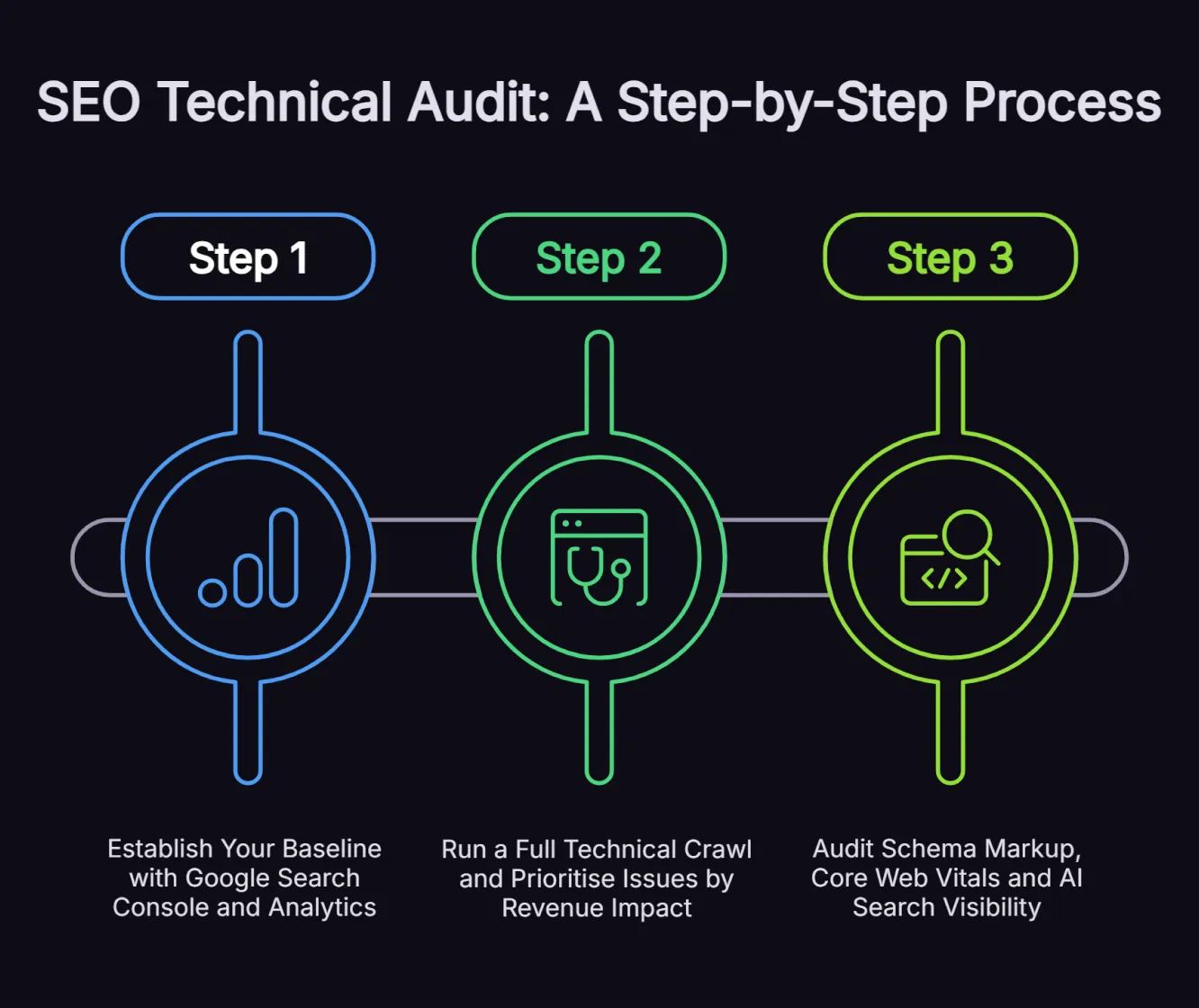
A proper technical SEO audit needs the right data sources in place before you touch a crawler. Starting with a raw crawl and no baseline leads to misreading the results, where issues that look serious turn out to be irrelevant and small-looking issues turn out to be your biggest blockers.
Step 1: Establish Your Baseline With Google Search Console and Analytics
Your first job is to understand how search engines currently experience your site. Open Google Search Console and review the Page indexing report. It shows which pages are indexed, which are excluded and the reason for each exclusion. Cross-reference this against your crawl data to spot patterns: if whole sections are excluded, that is a structural signal, not a random error.
Pull your organic traffic from GA4 at the same time. Segment by landing page so you can see which pages drive value, then cross-reference that against their technical health later. This step also sets your priorities, because the pages closest to revenue deserve more scrutiny than low-traffic informational pages.
Step 2: Run a Full Technical Crawl and Prioritise Issues by Revenue Impact
Use an enterprise-grade crawler to crawl the entire site. The crawl returns a list of technical issues across response codes, redirects, canonical tags, meta tags, page speed signals and internal linking structure.
The step most audits skip is prioritisation. Not every issue matters equally. A 404 on an obsolete 2019 blog post is not the same as a 404 on a key service page. Redirect chains on high-authority URLs cost more link equity than chains on low-traffic pages. Ranking fixes by likely business impact, rather than raw technical severity, is what separates a useful audit from a report that gathers dust.
Step 3: Audit Schema Markup, Core Web Vitals and AI Search Visibility
With crawl data in hand, move to the three areas that have grown most in importance since 2024. For Core Web Vitals, use Google's Chrome UX Report (CrUX) to work from real-world field data rather than lab estimates, viewable by device type. For schema, run key pages through Google's Rich Results Test and cross-check the structured data against what is visible on the page. Where the schema describes something different to the page, both rich-result eligibility and AI citation confidence can suffer.
For AI visibility, spot-check key queries in ChatGPT, Perplexity and Google AI Overviews to see which sources get cited. If competitors appear for your target terms and you do not, review both technical and content factors before drawing conclusions. Start with crawlability, rendering, internal linking, source accessibility and content quality.
Technical SEO Audit Checklist
Use this checklist as a fast recap of the six areas above. It is the short version you can run before a full audit, or hand to a developer to sanity-check a release.
Crawlability and indexation
- Confirm robots.txt is not blocking key templates or resources
- Check the Page indexing report for pages excluded by mistake
- Find redirect chains and loops on high-value URLs
- Locate orphan pages and noindex tags on pages that should rank
Core Web Vitals and page speed
- Measure LCP, INP and CLS on real templates, not just the homepage
- Compress oversized images and serve modern formats
- Add width and height attributes to every image
- Reduce render-blocking scripts on commercial pages
Site architecture and internal linking
- Keep important pages within a few clicks of the homepage
- Add internal links to stranded commercial pages
- Check breadcrumb and URL structure for consistency
Schema markup and structured data
- Validate JSON-LD on every key page type
- Confirm schema matches the content the visitor can see
- Cover the types that support rich results and AI interpretation
Mobile usability
- Compare mobile and desktop content for parity
- Check that navigation and key content render without a tap
- Confirm tap targets and viewport are set correctly
AI search visibility
- Confirm AI crawlers can access your content
- Keep structured data and visible content consistent
- Spot-check citations in AI Overviews, ChatGPT and Perplexity
How Often Should You Run a Technical SEO Audit?
The short answer is more often than most businesses currently do. Run a full technical audit at least once a year, with a lighter monthly health check to catch new issues before they compound.
Several triggers should prompt an immediate audit. A significant redesign or platform migration can introduce dozens of issues overnight. A major Google update can coincide with visibility changes worth investigating in Search Console. Sudden unexplained drops in organic traffic are often traceable to a technical change that went in quietly and was not noticed until rankings moved.
Technical SEO is not a one-off exercise. Sites evolve: new pages ship, old ones are removed, CMS updates change rendering and shifts in tracking affect crawl patterns. Monthly monitoring between full audits catches new issues early, before they erode the gains your content and link building have delivered.
Technical SEO Audit Tools
A credible audit uses a combination of data sources, not a single tool. Each one sees a different slice of the picture, so the value is in knowing what each catches that the others miss. The table below maps the core toolkit.
Google Search Console is free and should be the first tool anyone opens. Screaming Frog is the industry standard for comprehensive crawls, and its embedding-based analysis can also surface low-relevance content that weakens topical clarity. The Ahrefs Site Audit is useful when you need technical issues and link equity in one view. For real-world speed data, CrUX and PageSpeed Insights beat lab tools, while the Rich Results Test validates your structured data.
For AI search, a dedicated visibility tracker is now part of the kit. We tested the whole field in our review of the best AI visibility tools, and a broad platform like Semrush can also fold competitor and citation monitoring into the same workflow, which we cover in our SEO competitor monitoring comparison. The point is coverage: no single tool catches everything, so the audit combines them.
Why Most Technical SEO Audits Fall Short
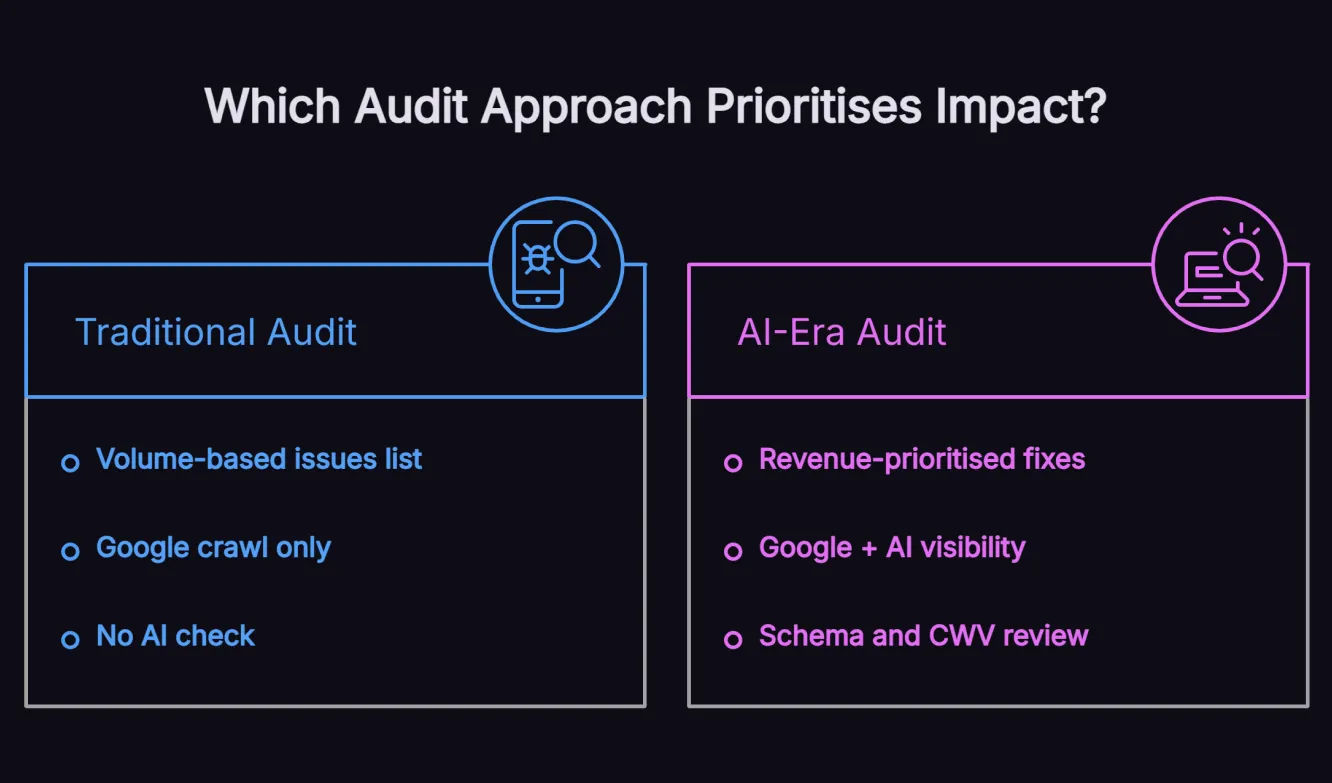
A technical audit is only useful if it leads to the right fixes in the right order. Many audits fail not because they lack data, but because they lack prioritisation, strategic context and a modern view of how search visibility now works.
1. Volume Over Value
The most common failure is confusing volume with value. A crawler report returns hundreds of issues. Share that raw list with your development team and ask them to work top to bottom, and you will spend real development time on changes with minimal search impact.
The fix is to sequence by revenue, not by row number. One client's technical health score climbed sharply once we ranked the fixes by business impact and worked the ones that mattered first, rather than grinding through every flagged item in order. Same crawl data, very different result, because the work went where the value was.
2. Technical SEO in Isolation
The second failure is treating technical SEO as separate from content and AI strategy. Technical health decides how much value your content can deliver, not just whether Google can find your pages. A site with brilliant content but poor Core Web Vitals, missing schema and a confusing link structure is consistently beaten by technically sound competitors with average content. The strongest campaigns integrate technical work with content from the start, which is why our AI SEO strategy begins with a full technical foundation review.
3. Ignoring AI Search
The third failure is leaving AI search out of the audit. Technical SEO that only addresses Google is half an audit. ChatGPT, Perplexity and Google AI features can only surface content they can access, crawl and interpret reliably. Your audit should review crawlability, rendering, structured-data consistency and content accessibility alongside the traditional checks. If you want the background on why, our guide to how AI search works breaks down the retrieval process. Skip this, and you are ignoring one of the fastest-growing channels available to your business.
What Our Audits Deliver Across SaaS, B2B and eCommerce
Technical work rarely travels alone; it is the foundation the rest of a campaign is built on. Across very different verticals, resolving the technical foundation and building on it has produced results we can attribute and measure.
The verticals differ, but the pattern holds: a clean technical foundation lets content and links reach their full value, and the AI citations that follow are an early sign the work is landing. Left unresolved, technical debt compounds the other way. Every month those issues remain, competitors improve while you stay static and crawl budget drains into low-value URLs. Schema gaps also quietly limit how confidently platforms interpret your content.
Frequently Asked Questions
What Is a Technical SEO Audit?
A technical SEO audit is a structured review of the infrastructure that decides how well search engines and AI platforms can crawl, index and understand your site. It covers crawlability, indexation, page speed, Core Web Vitals, site architecture, schema markup, mobile usability and AI search readiness. The output should be a prioritised fix list, not a raw data export that still needs interpreting.
What Should a Technical SEO Audit Include?
A complete audit checks the six core areas: crawlability and indexation, Core Web Vitals and page speed, site architecture and internal linking, schema markup, mobile usability and AI search visibility. For each area it should confirm what is working, flag what is broken and rank the fixes by likely revenue impact. The checklist earlier in this guide is a fast way to sanity-check whether an audit has covered the full scope.
How Long Does a Technical SEO Audit Take?
It depends on the size, complexity and condition of the site. Smaller sites can be audited quickly, while larger sites with thousands of URLs need more time for crawl analysis, Core Web Vitals assessment and schema review across page types. What you should receive is a written audit with prioritised recommendations, not just a data export.
What Is the Difference Between a Technical SEO Audit and a Full SEO Audit?
A technical SEO audit focuses on the infrastructure layer: crawlability, indexation, page speed, schema markup and site architecture. A full SEO audit covers technical health alongside content quality, on-page optimisation, keyword positioning and backlink profile. The technical audit is the foundation of any serious engagement, because infrastructure issues must be resolved before content or link building can reach their full potential.
Can I Run a Technical SEO Audit Myself?
Yes, with the right tools and technical knowledge. Google Search Console, Screaming Frog and the Chrome UX Report are all accessible to anyone with site access. The hard part is not collecting data, it is interpreting and prioritising it, knowing which issues matter for your specific site, which can be safely ignored and how to turn findings into revenue-based development priorities. That judgement usually comes from working across many sites, which is why many businesses find a professional audit returns more value than the time cost of a DIY pass.
Does a Technical SEO Audit Cover AI Search Visibility?
A modern technical audit should include AI visibility checks, because AI search products can only use content they can access and interpret accurately. Focus on crawlability, rendering, accessibility, content structure and markup consistency, without overstating any single factor as a direct citation trigger. Treat the AI citations that follow as a visibility signal you track alongside rankings.
What Are the Most Damaging Technical SEO Issues?
The most damaging issues stop pages being crawled or indexed at all: incorrect robots.txt directives, noindex tags on pages that should rank, severe Core Web Vitals failures on key commercial pages and content blocked by authentication or JavaScript rendering. After those, broken or chained redirects, missing schema on high-value pages and duplicate content that confuses indexing signals are the issues most consistently tied to ranking suppression.
Fix the Foundation, Unlock the Growth
Strong SEO performance starts with technical clarity. When crawl paths, schema and site performance work as they should, every content and link-building investment has a better chance to deliver. Run the audit, prioritise the fixes by impact and treat technical SEO as the foundation for sustainable growth rather than a one-off task. That is how you stop paying for issues you cannot see.
About the Author
Want Insights Like This Fortnightly?

Our AI SEO strategies and tactics delivered fortnightly, including bonus trade secrets not shared anywhere else. No fluff. Just what's working right now. 5-minute read.


