
Semantic SEO: How We Built Topic Authority That Drove 1,909% ROI


Every semantic SEO engagement we run starts the same way: with a topical authority audit. Before I'll let our team write a single brief, we map every topic the client could plausibly own, score where they currently sit on each one, and pick the small handful where the gap to "most comprehensive resource on the open web" is closeable in 12 months. That audit is the difference between an SEO programme that compounds and a content calendar that reads like everyone else's. This guide covers what semantic SEO is, how Google's entity layer actually decides which pages get rewarded, and the exact five-step build we used to take one B2B SaaS client from a thin keyword footprint to 4,118 page-one rankings and a 1,909% ROI in twelve months. The walkthrough sits in step three, where the methodology gets specific.
Quick Summary: Semantic SEO
Semantic SEO is the practice of optimising content for meaning, context, search intent and entity relationships, rather than exact-match keywords. Instead of targeting one phrase per page, you map relationships between topics, entities and the questions buyers actually ask, then build a cluster of pages that demonstrates topical authority across the whole space. The outcome is pages that rank for hundreds of related queries simultaneously and get cited by ChatGPT, Perplexity and Google AI Overviews. For businesses, semantic SEO is the foundation of sustainable organic growth in an era where roughly 60% of US Google searches end without a click according to SparkToro and Datos's 2024 zero-click study.
Audit Your Topical Authority Before You Brief More Content
Every engagement we run starts with a topical authority audit, because the cluster build only compounds if you target topics you can realistically own. Our AI SEO strategy has driven over $26M in attributed client revenue across B2B, B2C and SaaS, and the audit is where every one of those engagements began.
Explore AI SEO StrategyWhat Is Semantic SEO?
Semantic SEO is the strategy of creating content around complete topics rather than isolated keywords. It focuses on understanding what users are truly searching for and providing comprehensive, well-structured information that addresses their intent at every level.
Traditional keyword SEO was simple: include a phrase a set number of times and rank for it. That model began breaking down with Google's Hummingbird update in 2013, which shifted the algorithm toward understanding conversational intent rather than just matching text strings. Since then, RankBrain (2015), BERT (2019) and MUM (2021) have progressively deepened Google's capacity to understand meaning rather than just words.
Today, semantic SEO is not an advanced technique reserved for specialists. It is the baseline standard for content that ranks. The core shift has three parts:
- From keywords to topics
- From isolated pages to content ecosystems
- From keyword density to entity relationships
The frame I keep coming back to with our team is the one we observed across every case study we've published: content depth beats keyword density. Rather than writing multiple thin pages targeting keyword variations, the engagements that compounded were the ones where we wrote one comprehensive guide that answered fifteen to twenty related questions inside the same page. Google Search and AI systems both reward content that demonstrates topical authority through depth and interconnected information.
How Google Understands Semantic Meaning
Google does not read content the way humans do. It processes text through three systems that, together, decide whether a page deserves to rank for a topic: the Knowledge Graph, natural language processing, and intent classification.
The Knowledge Graph and Entities
Google's Knowledge Graph is a database of facts about entities (people, places, organisations, concepts and things) and the relationships between them. As of Google's official Knowledge Graph documentation, the graph holds billions of facts about hundreds of millions of entities, and Google has publicly described it as the structure that lets Search "understand information about real-world entities".
When Google indexes a page, it identifies the entities mentioned and cross-references them against the Knowledge Graph. A page about "electric vehicles" gets associated with entities like Tesla, lithium-ion batteries, charging infrastructure and tailpipe emissions, even if those exact phrases never repeat. That is why a well-structured page on a topic can rank for dozens of related queries without targeting each one individually.
Several signals contribute to entity recognition:
- Schema markup
- Wikipedia and Wikidata mentions
- Authoritative backlinks from sites already mapped to the entity
- Consistent structured data across your site, Google Business Profile and citations
Natural Language Processing
BERT, introduced in 2019, gave Google bidirectional context understanding, meaning the algorithm can interpret a word's meaning based on the words before and after it. MUM, released in 2021, extended that to multi-part queries across formats and languages. The practical effect: Google now understands that "my computer won't start" and "laptop not powering on" describe the same problem, and it penalises pages that use the right keywords without genuine depth.
For AI SEO, this matters even more. ChatGPT, Perplexity and Gemini all use their own large language models to evaluate content quality. Pages that provide clear, well-structured answers to specific questions get cited in AI responses. Shallow keyword content does not.
Search Intent Classification
Google classifies the intent behind a query into four buckets:
- Informational queries seek to learn
- Commercial queries compare options
- Transactional queries are ready to buy
- Navigational queries look for a specific brand or site
Semantic SEO requires matching not just the topic but the intent of every page. A page targeting "semantic SEO" serves an informational audience. A page targeting "semantic SEO services" serves a commercial audience. Misaligning content with intent is the single most common reason well-written pages fail to rank, and it is the first thing our team checks when a client's article underperforms.

Why Semantic SEO Matters More in 2026
The case for semantic SEO has never been stronger, and it comes down to two converging forces: Google's algorithm has gotten better at semantic evaluation, and AI search platforms have made semantic structure a citation prerequisite.
On the Google side, the May 2024 Search algorithm documentation leak confirmed something the SEO industry had inferred for years: page-level topical authority is a ranking factor. Pages that demonstrate expertise across related topic clusters receive ranking advantages over pages that mention the right keywords without surrounding context. The documents reference scores like siteAuthority and signals tied to topic-level expertise that align directly with what semantic SEO has been arguing for.
On the AI side, the bar is even higher. AI Overviews, ChatGPT and Perplexity all favour semantically rich, well-structured content when generating citations. According to seoClarity's analysis of ChatGPT-cited pages, the average cited page is significantly longer than the average organic-ranking page, and click-through rates from Google to publisher sites drop sharply when an AI Overview is present, based on Pew Research Center's 2025 study.
Across the engagements we've published, the framing I now use with every client is what I call triple-duty content: every cornerstone page we publish has to do three jobs at once.
- Rank in traditional Google for target keywords
- Be structured to be cited in AI Overviews and LLM answers
- Move the reader from problem awareness to consultation booking
The false choice between "awareness content" and "conversion content" disappears when you write to all three goals from the brief stage. Semantic SEO is the discipline that lets one page do all three.
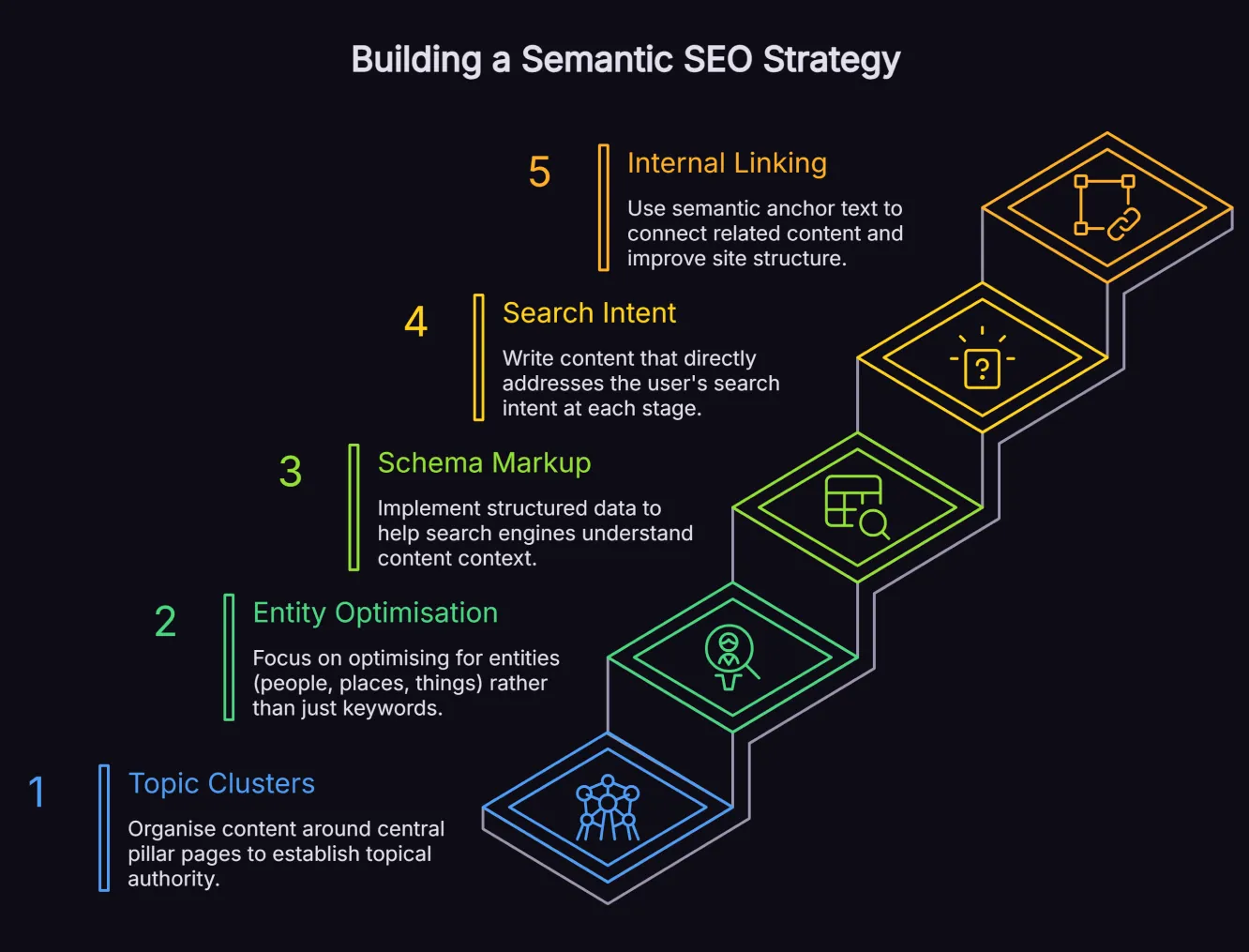
How to Build a Semantic SEO Strategy
The five steps below are the build I run with our team. They are not a generic framework. The shape of them came out of a B2B SaaS engagement where we mapped 2,300+ keywords into clusters in the foundation phase, then published five articles a week on top of that map. By month twelve, organic search had grown the client from $25,000 monthly revenue to $135,000 (a 440% increase verified in the SaaS case study) and delivered a 1,909% ROI. The walkthrough of the build appears in step three, where the work is most visible.
Step 1: Map Topic Clusters Around Pillar Pages With a Keyword-Cannibalisation Audit
Topic clusters are the structural backbone of semantic SEO, but I want to be specific about how we build them, because "build a topic cluster" is exactly the kind of generic advice that produces commodity content.
On the SaaS engagement that delivered the 1,909% ROI, our team manually selected 2,300+ keywords and mapped each one into a cluster before we wrote a single article. The cluster map is the cannibalisation audit: every keyword has exactly one assigned page, every page has exactly one primary keyword, and every cluster has exactly one pillar. That single rule prevented the most common failure mode I see in SEO programmes, which is two articles silently competing for the same SERP and dragging each other down.
The build sequence we run with every client now looks like this:
- Identify three to five core topics aligned with the business's offering and buyer intent.
- For each topic, pull every related keyword the audience searches for (we typically work with 500 to 2,500 keywords per cluster depending on vertical).
- Cluster the keywords by intent and topical proximity, not just lexical similarity.
- Assign exactly one URL per cluster as the pillar, then assign supporting URLs to every remaining cluster member.
- For commercial verticals, build the silo around a conversion-focused landing page and link 3-5 informational blog posts into it without back-linking from the conversion page itself, which preserves ranking authority on the page that drives revenue.
The pillar-cluster structure does two things at once. It signals topical depth to Google, demonstrating that your site covers a subject completely rather than skimming its surface. And it creates a logical internal linking architecture that passes authority between pages and tells search engines, explicitly, which pages relate to which topics.
Step 2: Optimise for Entities With First-Hand Expert Sourcing
Entity optimisation shifts the focus from which words appear on a page to which concepts, people, places and things are clearly identified and contextualised. The bit most agency advice misses is that the highest-value entities on your page are the ones tied to the actual operator, not the generic SEO entities like "Knowledge Graph" or "BERT" that every page on the topic mentions.
The methodology our team applies in B2B is straightforward: where a client has authored work in their field (a published book, a peer-reviewed paper, a long-running industry column), we cite that authored work directly inside cluster content. On one B2B services engagement, every cornerstone piece referenced specific chapters and frameworks from the client's published book on the discipline. That is not citation theatre for SEO. It is genuine first-hand expert sourcing that competitors using generic content writers cannot match, and it shows up in two places: in EEAT signals that Google's quality systems can detect, and in AI Overview citations that disproportionately reward content with verifiable named-author authority.
For clients without a published book, the same logic applies to original research, proprietary data, internal benchmarks, and named subject-matter experts on the team. The principle is content depth beats keyword density. Reference authoritative sources. Use precise, recognisable terminology. Treat your organisation itself as an entity, with a consistent name, address and description across:
- Your website
- Your Google Business Profile
- Third-party citations and review sites
- Wikipedia and Wikidata where eligibility permits
Keyword research still matters, but its job changes. It serves entity mapping, not isolated targeting decisions.
Step 3: Implement Schema and Semantic HTML for AI Citation
This is the step where the SaaS engagement walkthrough sits, because it is the step where semantic SEO crosses from Google ranking into AI search visibility, and the methodology gets specific.
Schema markup is structured data that tells search engines explicitly what your content is about in a format they can read directly. The schema types our team implements on every cornerstone page are:
- Article and BlogPosting: identifies content type and authorship for EEAT signals
- FAQPage: enables FAQ rich results and signals direct-answer content to AI engines
- HowTo: signals process-based content and improves rich-result eligibility
- Organisation and Person: establishes brand and author entities for Knowledge Graph association
- BreadcrumbList: reinforces site hierarchy and topical structure
But schema alone is not enough. The architecture pattern we built into the SaaS engagement (and have since reused on every B2C and B2B engagement) goes further. We restructure content using semantic HTML and passage-level optimisation so each section can be lifted intact into an AI Overview. Every page includes structured FAQ blocks designed for AI citation, with TL;DR summaries optimised for featured-snippet capture. The combination of semantic HTML, passage optimisation, FAQ blocks and TL;DRs is what lets a single page get cited across multiple AI platforms simultaneously.
The SaaS Engagement Walkthrough: 2,300+ Keywords, 4,118 Page-One Rankings, 1,909% ROI
Here is the full build that produced the 1,909% ROI number, because the audit found that paragraph buried at the end of the previous version of this article was its most original passage and deserved to be the spine of the piece.
The client was a B2B SaaS company sitting at $25,000 in monthly recurring revenue from organic search at month zero. The brief was to make organic the primary acquisition channel. Three workstreams ran in parallel.
First workstream: topic cluster build. In months one to three, we manually selected 2,300+ keywords and clustered them into targeted groups to prevent cannibalisation, exactly as described in step one. Three pillars structured the content programme: educational content for top-of-funnel awareness, comparison content for the consideration stage, and feature-focused content for the decision stage. We then built complete content silos around each topic, connecting informational blog posts to commercial landing pages and applying the no-back-link rule on conversion pages. By month three, the publishing infrastructure was producing five articles a week, or roughly 65 pages per quarter.
Second workstream: entity audit. We mapped every entity the client's category cared about (competing products, integrations, industry standards, named methodologies) and assigned each entity a canonical page. Every cluster pillar had to mention the relevant entities in passages structured for direct extraction. For named-author authority, we pulled internal SMEs into the byline process so each piece carried verifiable expertise, applying the same first-hand expert sourcing logic from step two.
Third workstream: schema and semantic HTML implementation. Article, BlogPosting, FAQPage, HowTo, Organisation and BreadcrumbList schema went onto every cornerstone page. We restructured the HTML using the AI content architecture pattern: passage-level sections, FAQ blocks, TL;DR summaries. Core Web Vitals stayed in the green throughout the 260-page expansion, which protected the technical foundation against the debt that usually accumulates when a site scales content rapidly.
By month twelve, the engagement had produced 4,118 page-one rankings, 768 top-3 placements, $1.31M in cumulative revenue, and a 1,909% ROI. Daily organic clicks grew from 72 to 883 (a 1,126% increase). Referring domains grew organically from 120 to 284 without active link building, because the content was cited by industry sites that found it on their own. Comparing month one to month thirteen, the same SEO investment delivered 400% ROI in month one and 2,600% ROI by month thirteen, which is the compounding effect semantic SEO enables.
The mechanics that produced the result are reusable. The cluster map prevented cannibalisation. The entity work made the pages defensible against AI rewrites. The schema and semantic HTML made the pages quotable, which is how AI Overview citations get earned.
For a deeper look at how schema interacts specifically with AI search, our LLM SEO guide covers the technical specifics.
Step 4: Match Intent at Every Stage With the Comparison-Page Lever
Semantic SEO requires content that matches intent at every stage of the user journey. The standard advice is to write awareness content for awareness queries, consideration content for consideration queries, and decision content for decision queries. That is correct but incomplete.
The lever I want to call out specifically (because it is the highest-leverage content type our team has measured in B2B SaaS) is comparison pages. Comparison pages convert at a markedly higher rate than how-to guides or feature pages, because the prospect researching alternatives is closer to a decision than the prospect reading an introductory explainer. On the SaaS engagement above, the comparison pages and the bottom-of-funnel feature deep-dives were the pages that did the heaviest lifting on revenue, while the educational and topic-cluster content carried the topical authority that fed those pages.
The order of operations matters:
- Educational guides establish topical authority and capture awareness traffic
- Comparison pages capture buyers in active evaluation
- Case studies and customer stories build trust and target commercial-intent searches
- Feature-deep-dive landing pages convert decision-stage buyers
Inside each page, write in natural language that mirrors how the audience actually searches. Use question-based subheadings. Start each section with a direct answer to the implied question before expanding with context. Passage optimisation (writing each section so it can stand alone as a clear answer) is the technique that earns featured snippets and AI citations. Avoid burying answers in paragraphs of context. AI systems extract specific passages when generating responses; if your answer is not clear and self-contained, it gets skipped in favour of content that is.
Step 5: Build Internal Links With Semantic Anchor Text
Internal linking is the mechanism that communicates semantic relationships to search engines. When you link from a cluster page to its pillar using descriptive anchor text, you signal the relationship between those topics explicitly, not just through content but through structure.
Three rules govern how our team builds internal links:
- Every anchor text describes the destination accurately. No "click here" or "read more". Use phrases like "topical authority audit" or "semantic keyword research".
- Every cluster page links up to its pillar. The pillar links down to every cluster member. Cluster pages link sideways only when the topical relationship is clear.
- Conversion-focused commercial pages do not link out to informational content. The no-back-link rule preserves the ranking authority on the page that drives revenue, while the informational content keeps feeding authority into the conversion page.
The aggregate impact across our engagements has been measurable. On the SaaS engagement, the internal link graph plus the cluster map produced 4,118 page-one rankings within twelve months. On the B2B services engagement we built around the same framework, internal linking was the lever that turned the service-page-plus-cluster expansion into a about $8.7M over 27 months (climb window $5.9M at 6,864% ROI on the 17-month climb window) outcome over 27 months and counting. Our content marketing approach treats internal linking as a deliverable in every cornerstone brief.
Semantic SEO and AI Search Visibility
Semantic SEO and AI SEO are not separate strategies. The signals that help Google understand your content are the same signals that AI platforms use when deciding which sources to cite. Specifically:
- Entity clarity
- Topical depth
- Structured data
- Intent-matched writing
- Passage-level extractability
ChatGPT, Perplexity and Google AI Overviews all use large language models trained on the open web. They evaluate sources by clarity, authority and relevance to the query at hand. A semantically rich content ecosystem that demonstrates genuine expertise across a topic is the strongest signal these platforms can receive.
The commercial implication is significant. AI Overviews now appear on a meaningful share of Google queries, and Pew Research Center's 2025 study found click-through rates drop from roughly 15% to 8% when an AI Overview is present. Brands that are not cited within AI responses are losing visibility they may not even be tracking.
This is also why query patterns are shifting. AI Mode and AI Overviews fan a single user prompt out into multiple sub-queries that the model resolves in parallel before composing the answer. A single page that already covers the topic comprehensively gets pulled into more of those sub-queries than five thin pages on the same subject. The mechanics of query fan-out are the technical reason content depth beats keyword density in AI search, and they are why our team builds clusters around comprehensive pillars rather than thin keyword-targeted articles. The same logic underpins how we approach AI Mode SEO for clients investing specifically in AI search visibility.
For multi-region clients, the same cluster discipline applies, just multiplied across markets. We've documented the playbook in our national SEO campaign guide.

FAQs: Semantic SEO
What Is the Difference Between Semantic SEO and Traditional SEO?
Traditional SEO focused primarily on keyword targeting, placing specific phrases in titles, headings and body text at calculated frequencies. Semantic SEO focuses on meaning, context and topical coverage. Rather than targeting individual keywords, semantic SEO builds content ecosystems that demonstrate expertise across entire topic areas. Both approaches share the same technical foundations of on-page optimisation, backlinks and site structure, but semantic SEO structures content around entities and intent rather than keyword repetition.
How Does Semantic SEO Help With AI Search Visibility?
AI platforms like ChatGPT, Perplexity and Google AI Overviews use language models that evaluate content by depth, clarity and semantic relevance rather than keyword density. Content that clearly identifies entities, covers topics comprehensively, uses structured data and answers questions in self-contained passages is far more likely to be cited in AI-generated responses. Semantic SEO directly addresses all of these signals, which is why it has become the foundation of AI search visibility rather than a separate discipline.
What Are Latent Semantic Indexing (LSI) Keywords?
In SEO, people often use the term "LSI keywords" to describe semantically related terms. Google has explicitly said it does not use Latent Semantic Indexing as a ranking system, so the technical term is misleading. What people usually mean by "LSI keywords" are simply words and phrases that naturally co-occur with the main topic in authoritative content. A page about "email marketing" would naturally include related concepts like "open rates", "subscriber lists", "automation" and "A/B testing". Including these related terms helps cover the topic comprehensively. They are best discovered through competitor analysis, related searches and semantic keyword research tools.
How Long Does It Take to See Results From Semantic SEO?
Results typically develop over three to six months, though initial improvements in rankings and crawl behaviour can appear within weeks. The compounding nature of the approach means results accelerate over time as topic cluster content builds authority and internal linking strengthens semantic relationships between pages. On the SaaS engagement detailed above, the same monthly SEO spend delivered 400% ROI in month one and 2,600% ROI by month thirteen, which is the compounding effect semantic SEO enables.
Does Semantic SEO Replace Keyword Research?
No. Keyword research remains a vital input, but its role shifts. Rather than identifying individual phrases to target, keyword research in a semantic SEO context maps the full topic space: what questions people ask, what variations of intent exist, where gaps in existing content can be addressed. The output of that research is a topic cluster strategy rather than a list of keyword targets.
Can Small Businesses Benefit From Semantic SEO?
Yes. Semantic SEO is particularly effective for businesses with limited domain authority, because it lets them build expertise in specific topic areas rather than competing head-to-head for high-volume competitive keywords. By establishing topical authority within a niche, smaller sites can outrank larger competitors for the queries that matter most to their audience. The key is choosing a clearly defined topic area and covering it more comprehensively than anyone else.
What Is Entity SEO and How Does It Relate to Semantic SEO?
Entity SEO is a component of semantic SEO that focuses specifically on helping search engines identify and understand the key entities referenced in your content (people, organisations, products, locations and concepts). When Google recognises an entity and connects it to its Knowledge Graph, it gains confidence in the authority and relevance of content associated with that entity. Semantic SEO is the broader strategy that uses entity optimisation alongside topic clusters, schema markup, intent matching and content depth.
Relevance Wins: Semantic SEO as a Long-Term Growth Asset
The businesses dominating organic search over the next three years are already building the content ecosystems semantic SEO demands. They are running topical authority audits before they brief content. They are mapping topic clusters at the keyword level to prevent cannibalisation. They are sourcing first-hand expertise from named authors. They are implementing schema and semantic HTML so their pages get cited in AI Overviews instead of summarised away. The competitive gap between the businesses doing this and the ones still chasing individual keywords is widening every month, and on a saturated topic like this one, the article that compounds is the article that demonstrates the methodology, not the article that explains the concept. For businesses ready to make that shift, our AI SEO strategy gives the complete framework, from topical authority audit through cluster build, entity work, schema implementation and AI platform optimisation.
About the Author
Want Insights Like This Fortnightly?

Our AI SEO strategies and tactics delivered fortnightly, including bonus trade secrets not shared anywhere else. No fluff. Just what's working right now. 5-minute read.


