
How to Run a National SEO Campaign: 162 to 4,947 Keywords and Multi-Year Revenue Growth


A national SEO campaign can turn organic search into a revenue channel, but only if you stop treating it like local SEO at a larger scale. I see the same mistake often: a business ranks well in one city, adds more landing pages, publishes more content and waits for national rankings that never arrive. The difference is that national SEO depends on topical authority, commercial intent, technical strength and AI search visibility, not proximity signals or location pages. That matters more now that AI Overviews appear in 47% of Google search results and Google says AI Overviews reach more than 2 billion monthly users across more than 200 countries and territories. In this guide, I’ll show the campaign mechanics I used to grow one B2B site from 162 to 4,947 ranking keywords and about $8.7M in organic revenue.
Guide to National SEO Campaign
A national SEO campaign is a structured search engine optimisation strategy designed to achieve visibility across an entire country, targeting broad, non-location-specific keywords that attract buyers regardless of where they are located. Unlike local SEO, which focuses on geographic proximity, a national campaign competes for high-volume, high-intent keywords across your entire industry. It includes keyword research, technical SEO, content strategy, link building and, in 2026, AI search optimisation, all coordinated to build authority at scale. Positive ROI from a well-executed national SEO campaign is typically achieved within 6-12 months, with peak results arriving in years two and three of the campaign.
See the National SEO Campaign Behind 4,947 Keywords and Multi-Year Revenue
The mechanics in this guide are the same ones we used for a B2B property management client: low-competition clusters first to build topical authority quickly, then competitive head terms. We build the national content and AI visibility system with transparent revenue attribution.
Explore National SEOWhat Is a National SEO Campaign?
A national SEO campaign targets buyers across the whole country rather than a specific city, suburb or region. It focuses on keywords with broad commercial intent, terms like "CRM software for small business", "accounting services for ecommerce" or "outsourced HR solutions", that are searched by potential customers regardless of location.
When we talk about results in this guide, we mean true national campaigns: brands competing for non-geo head terms and category authority across Australia (and similar country-wide markets), not a stack of city landing pages. Our B2B property management case study is one of those national builds - the same client expanded from 162 to 4,947 ranking keywords on a national content and AI SEO programme, not a local map-pack campaign.
When we assess whether a business is ready for national SEO, we look at four things: whether the site already has some authority, whether the market is large enough nationally, whether revenue attribution is set up properly and whether the business can support the content velocity needed to build topical authority.
This matters most for businesses that:
- Sell products or services online to a national audience
- Operate in multiple cities or states
- Offer remote or delivered services
- Compete for industry-level authority rather than local map pack visibility
National SEO builds compounding organic traffic that does not depend on paid media. 49% of marketers name organic search as the highest-ROI channel in their entire marketing mix, and the reason is structural: paid traffic stops the moment the budget does, while a ranking you have earned keeps working. For an established business with a national addressable market, that compounding is the whole point.
National SEO vs Local SEO: Key Differences
It is worth understanding where local and national SEO differ before building a campaign strategy. The two approaches share some technical foundations but diverge significantly in execution.
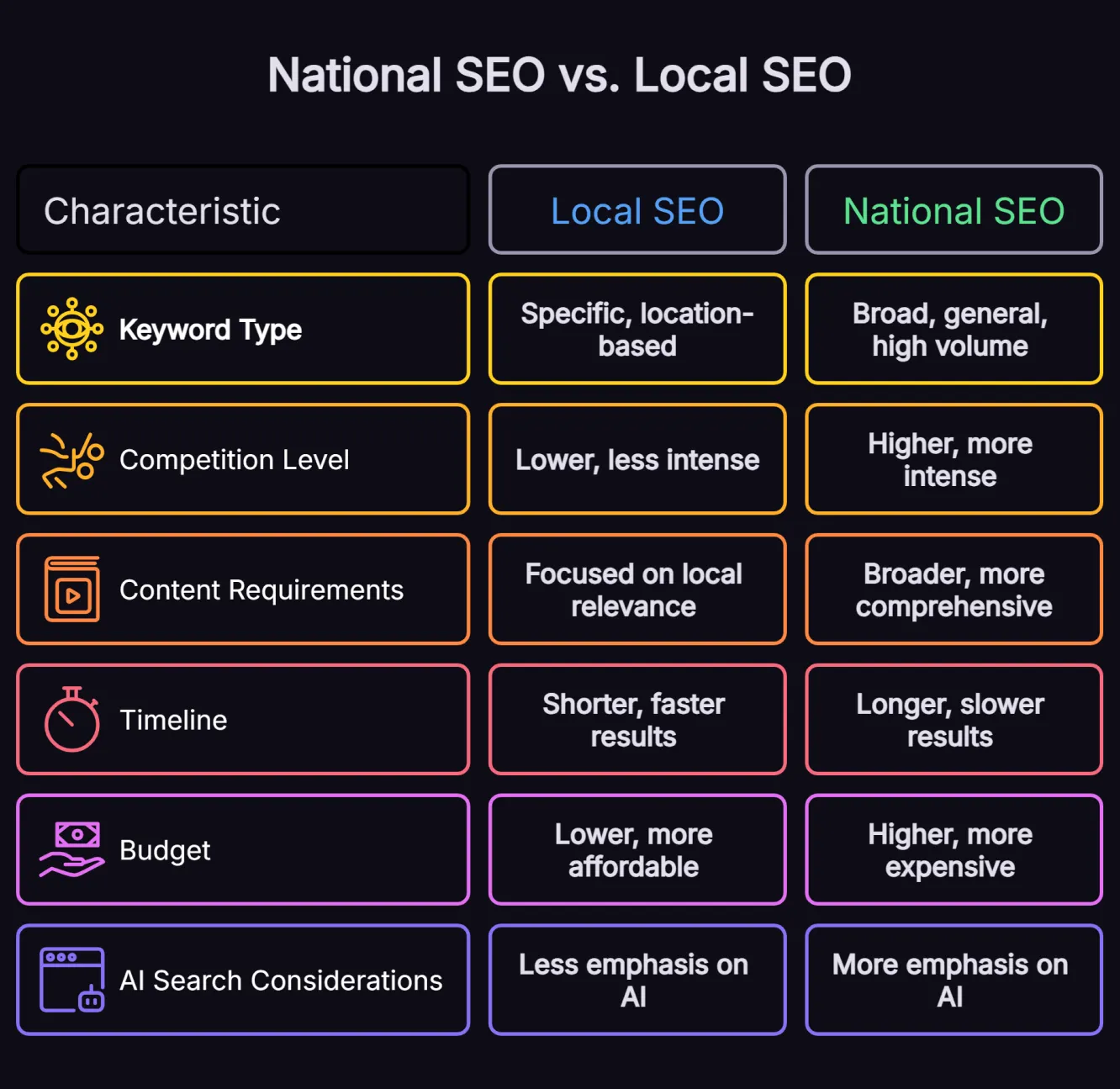
Local SEO targets geographic search intent, such as "plumber in Brisbane" or "accountant near me". It prioritises Google Business Profile optimisation, local citations and location-specific landing pages. National SEO targets intent without geographic qualifiers, "best accounting software for retail" or "B2B SaaS CRM platform". The competitive landscape, content requirements and link building expectations are substantially different.
Here is where the key differences play out in practice:
- Keyword Competition: National keywords face significantly higher competition. Ranking for a national term often requires stronger domain authority, more content depth and more referring domains than a local equivalent.
- Content Volume: Local SEO can succeed with a handful of well-optimised location pages. National SEO requires consistent, broad topic coverage mapped to buyer intent at every stage of the journey.
- Timeline: National rankings typically take 6-12 months, compared to 3-6 months for competitive local results. Peak results usually arrive in the second or third year.
- Budget: In our experience, a national campaign needs several times the monthly investment of a local strategy to produce meaningful results, because the content and authority bar is so much higher.
- AI Visibility: National search increasingly includes AI Overviews, ChatGPT citations and Perplexity answers. A national SEO campaign in 2026 must account for AI search optimisation alongside traditional ranking factors.
The Core Components of a National SEO Campaign
A successful national campaign is made up of five interconnected components. Each one supports the others; missing any one of them weakens the whole. What follows is not generic doctrine; each component is illustrated with what it actually produced in a campaign we ran.
1. Keyword Research and Topic Cluster Strategy
National keyword research starts broader than local research but must still connect to commercial intent. The goal is to map every stage of the buyer journey across the full scope of your industry, including:
- Awareness
- Consideration
- Decision
Effective national keyword research groups terms into topic clusters: a primary pillar page targeting a high-volume head term, supported by a range of cluster pages targeting longer-tail variations. Long-tail keywords account for 70% of all search traffic, and in a national campaign, these clusters are how you build topical authority systematically rather than chasing individual rankings.
The sequencing is where most campaigns go wrong, and it is the part we care about most. We do not start with the head terms everyone wants. On the B2B campaign that took a client from 162 to 4,947 ranking keywords, we prioritised the low-competition, high-relevance clusters first to establish strong topical authority and organic search signals quickly, before moving on to the more competitive phrases competitors had long dominated. That order matters: early wins on winnable clusters build the authority that later makes the hard terms rankable. Run it the other way around and you spend twelve months losing to incumbents on terms you were never positioned to win yet.
Keyword research for a national campaign should map four cluster types:
- Core service keywords with national appeal (high volume, competitive)
- Problem-focused keywords your audience searches for when looking for solutions
- Educational keywords that build awareness and trust earlier in the buyer journey
- Commercial and comparison keywords for buyers close to making a decision
The output is a 12-month content roadmap that sequences production to build topical authority progressively, covering the topic space more completely than any competitor in your industry.
2. Technical SEO Foundation
Even the strongest content strategy fails without a solid technical foundation. Search engine crawlers and AI platforms both require a fast, accessible, well-structured website to index and surface content effectively. In practice, technical work is what makes the content eligible to be ranked and cited at all; it rarely wins the race on its own, but it loses it reliably when neglected.
On the B2B national campaign, the technical work was not treated as a separate checklist. It was the infrastructure layer behind the content system. Before scaling production, we tightened crawl paths, used internal links to connect pillar pages with low-competition cluster content and made priority pages easier for search engines and AI systems to interpret. That foundation helped the campaign scale from 162 to 4,947 ranking keywords and 598 AI cited pages across Google AI Overviews, ChatGPT, Gemini and Perplexity.
The first thing we check is whether search engines and AI systems can reach the pages that actually make money. That means reviewing:
- Crawl paths to revenue-driving pages
- Orphaned cluster content that lacks internal connections
- The number and quality of internal links supporting each priority page
- Schema consistency across key page templates
- Core Web Vitals on pages most likely to convert
If those pages are buried, slow or disconnected from the topic cluster, publishing more content usually compounds the problem instead of fixing it.
For a national SEO campaign, the technical priorities are:
- Site Speed and Core Web Vitals: Google uses Core Web Vitals and overall page experience as ranking signals, and slower pages tend to see higher bounce rates and weaker visibility. Fast, stable pages give you a better chance of ranking and of being included in AI Overviews and other AI search experiences.
- Mobile-First Performance: Google uses mobile-first indexing for all websites, making mobile responsiveness a non-negotiable ranking signal.
- Crawlability and Internal Linking: A clean site architecture and logical internal linking structure help search engines understand content hierarchy and distribute authority across key pages.
- Schema Markup: Structured data helps both traditional search engines and AI platforms understand what your pages are about, enabling rich results and increasing the likelihood of citation in AI-generated answers.
- Canonical Tags and Duplicate Content: National sites with large content libraries need careful management of canonical URLs to avoid keyword cannibalisation and split authority.
3. Content Strategy at Scale
Content is the primary lever in a national SEO campaign. Websites with an active blog earn 97% more inbound links on average than those without fresh content, and consistent publishing signals ongoing authority to both search engines and AI platforms.
Depth is what separates content that ranks nationally from content that fills a calendar. The days of 500-word blog posts are over. On our highest-performing campaigns the most successful content averaged 3,400 words, included original research and data, comprehensively answered 15 to 20 related questions and featured interactive elements such as comparison tables and templates. One definitive guide consistently outperforms twenty thin, loosely related articles, because it covers the topic the way a buyer actually researches it.
That depth is not just a readability preference; it is part of how national SEO builds authority over time. Google has publicly documented a topic authority system for Search and News that helps surface expert sources for specialised, newsy queries, including topics such as health, politics and finance. While that documentation is not a blanket statement that every commercial page receives a “topical authority” score, the principle is still useful for national SEO: if you want to compete nationally, your site needs to show depth across the full topic cluster, not just publish one isolated page on the head term.
The content requirements for national SEO go well beyond quantity. Each piece must:
- Target a clearly defined keyword variation mapped to buyer intent
- Demonstrate genuine expertise, experience and authority (EEAT)
- Be structured for AI readability, semantic chunking, clear headings, concise answers to common questions
- Include relevant internal links that build topical depth across the cluster
The content marketing approach that produces national rankings is research-led and systematically executed, not ad-hoc publishing. It is the difference between a site that accumulates authority over time and one that stalls after the first few articles.
4. Link Building and Digital Authority
Backlinks remain a core ranking signal for national SEO. The difference in a national campaign is the quality and relevance bar. A national campaign requires links from authoritative, nationally recognised publications and industry sites, not local directories or low-authority blogs.
The way we judge authority is different from a standard DR checklist. A link only matters if it strengthens one of three things: the commercial relevance of the page, the brand’s chance of being cited in AI-generated answers or the entity signals that help search systems connect the business with its category. A high-DR link on an unrelated site might look good in a report, but it rarely moves revenue. For a national SEO campaign, authority building has to reinforce what the business wants to be known for.
Approximately 34% of AI citations come from PR-driven coverage, which means link building and digital PR serve a dual purpose: improving traditional rankings and building the brand authority that AI platforms use to decide which sources to cite.
This is why we now treat authority building as both an SEO and AI-search asset. In the B2C national campaign, first-mover visibility was not only about publishing more content; it was about building enough topical and brand authority for AI systems to trust the site as a source. That campaign earned 54 Google AI Overview citations and 65 total AI citations across Google AI Overviews, ChatGPT, Gemini and Copilot. In practical terms, authority work is no longer just about passing link equity. It helps decide whether your brand is visible when AI systems generate the answer.
For national SEO, the most effective link acquisition strategies include:
- Guest posts on industry publications with strong domain authority
- Digital PR campaigns that earn mentions in national media
- Original research and data that attracts organic inbound links
- Thought leadership content that builds brand citations across authoritative platforms
5. AI Search Optimisation
AI search is no longer a future consideration; it is part of national SEO strategy today. With Google AI Overviews reaching more than 2 billion searchers monthly, appearing in AI-generated answers is becoming as valuable as ranking position one in traditional results, and the urgency is not theoretical. Early data shows why this matters commercially, not just technically. Semrush’s AI SEO statistics report cites AI search traffic growing 527% year over year and states that the average AI search visitor is worth 4.4 times more than a traditional organic search visitor. Ignoring AI search means leaving revenue on the table.
This is an area where getting in early compounds. On one B2C national campaign, the campaign earned 54 Google AI Overview citations and 65 total AI citations across Google AI Overviews, ChatGPT, Gemini and Copilot, a first-mover position in AI search results that competitors could not quickly replicate. On the B2B campaign, the same AI-first approach produced 598 AI cited pages across Google AI Overviews, ChatGPT, Gemini and Perplexity. Those citations are not vanity numbers; in AI search, being the cited source is the equivalent of owning the answer.
AI search optimisation requires a specific set of techniques alongside traditional SEO:
- Passage-Level Optimisation: AI search experiences index the full page but surface and cite the specific passages that best answer a query. Structuring content so that clear, authoritative answers exist at the paragraph level makes it easier for both traditional search and AI Overviews to understand and quote your content.
- Query Fan-Out Targeting: AI systems expand single queries into multiple related sub-queries. Content should address the full scope of a topic, not just the primary keyword.
- Entity and Semantic Completeness: AI platforms evaluate topical completeness across a site. The more thoroughly a topic is covered, the more likely a site is to be cited as an authoritative source.
- Brand Mentions and External Footprint: AI platforms verify accuracy using third-party signals; consistent brand mentions across authoritative external sources build AI-specific authority.
Our AI SEO strategy integrates all of these techniques alongside traditional ranking optimisation, allowing clients to capture visibility in both blue-link results and AI-generated answers simultaneously.
How Long Does a National SEO Campaign Take?
Timeline is one of the most common questions in national SEO, and the honest answer is that it depends on where the campaign starts. A new domain with limited authority will take longer to gain traction than an established site with existing content.
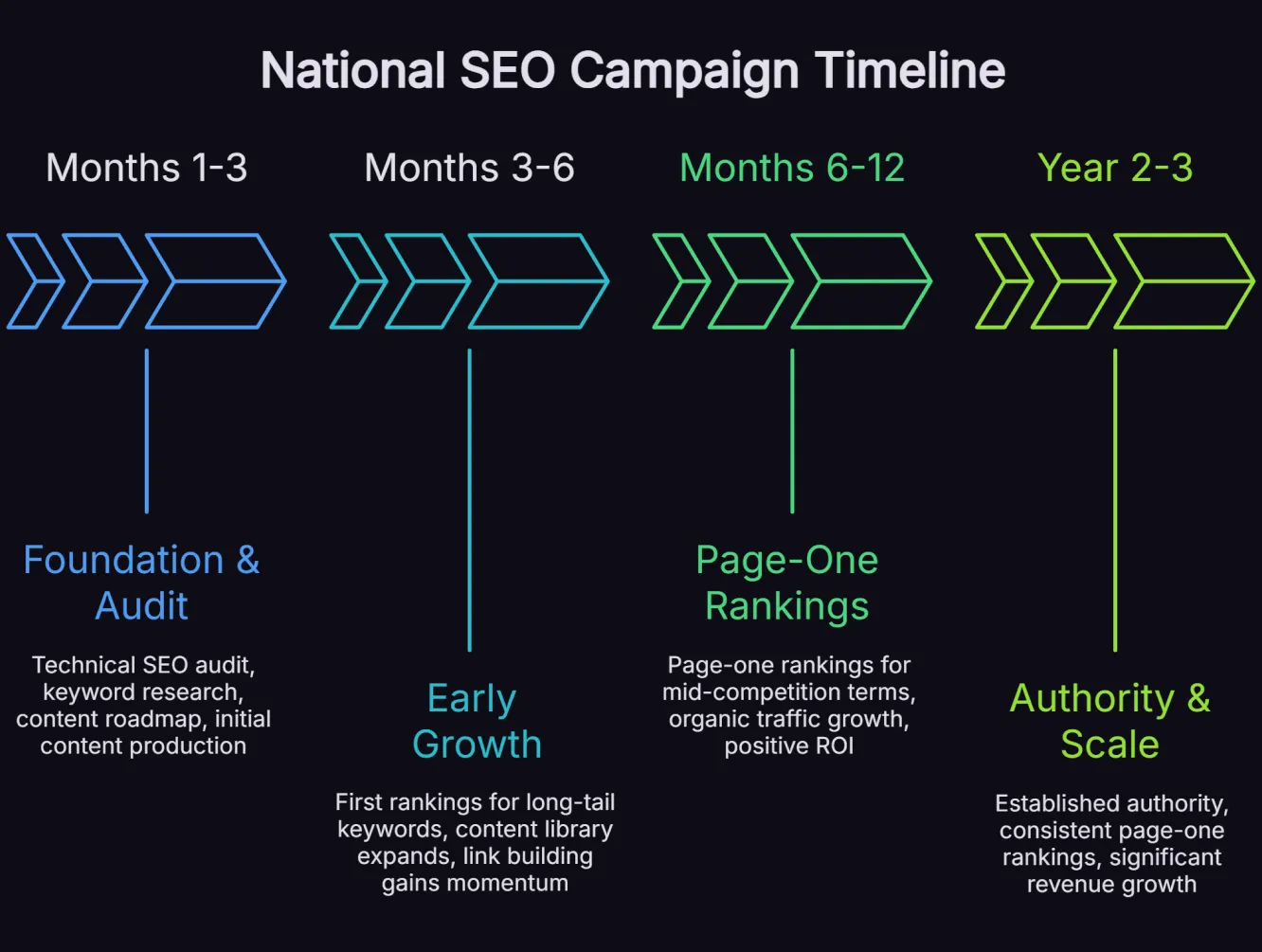
As a general guide:
- Months 1-3: Technical SEO audit and fixes, keyword research, content roadmap development, initial content production
- Months 3-6: First rankings begin to appear for long-tail variations; content library grows; link building gains momentum; positive ROI is realistic from month three when foundations and early content land
- Months 6-12: Page-one rankings for mid-competition terms; organic traffic growth becomes clearly measurable; ROI continues to compound for most campaigns
- Year 2-3: Rankings for competitive head terms; compounding content effect; national authority established
Well-run SEO campaigns can show positive ROI as soon as month three, with stronger compounding through months 6-12 and peak results arriving in years two and three. This is why consistency matters more than acceleration, national SEO rewards sustained execution over short bursts.
There is a strategic point hidden in that timeline that changes how you should read it. The late peak is not a delay to tolerate; it is a moat you are building. Once a campaign has a first-mover advantage in AI search and dominant traditional rankings, a competitor would need 18 to 24 months to catch up, assuming they started today with equivalent resources and expertise. The months you spend compounding are precisely the months that become very hard for a latecomer to make up. Framed that way, the timeline is not the cost of national SEO; it is the defensibility you get in return.
How to Measure National SEO Campaign Success
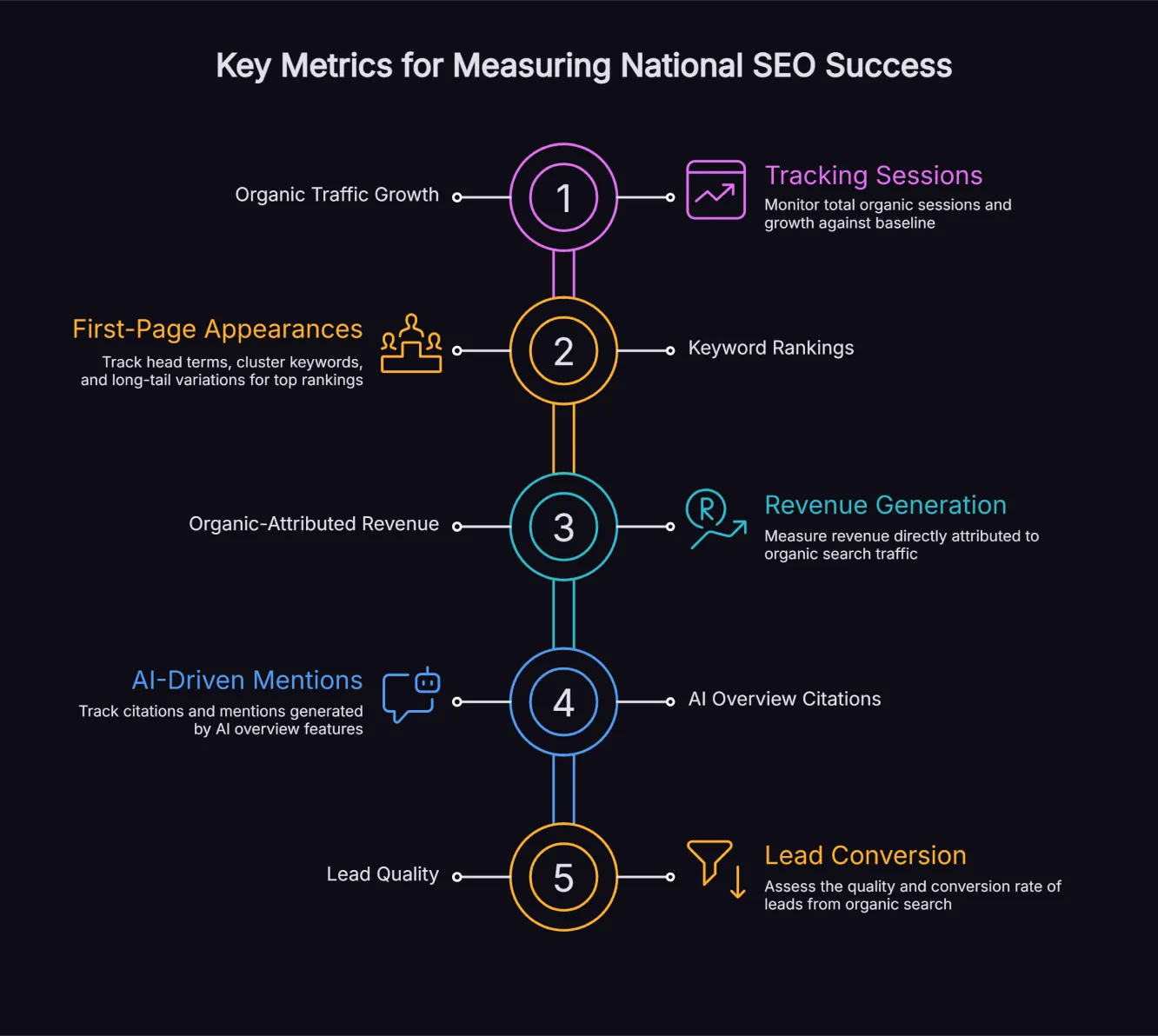
Measuring a national campaign requires tracking metrics that connect to business outcomes, not just search rankings. The metrics that matter most are:
- Organic Traffic Growth: Total sessions from organic search, segmented by landing page and keyword cluster. Growth should be measured against a baseline from Google Search Console.
- Keyword Rankings: Track head terms, cluster keywords and long-tail variations across all target topics. First-page appearances and top-3 rankings are the milestones that drive meaningful traffic.
- Organic-Attributed Revenue: The most important metric for any national SEO campaign. Revenue from organic sessions, tracked through GA4 with proper attribution modelling, shows the direct business impact of SEO investment.
- AI Overview Citations: Track where your brand is cited in Google AI Overviews and other AI surfaces using Google Search Console and Ahrefs' Brand Radar. Monitor how often your pages are selected as sources over time and how that compares to key competitors, as a leading indicator of growing authority in AI search.
- Lead Quality: Conversion rate and lead quality from organic sessions. National SEO should drive not just more traffic, but more qualified traffic that converts at a higher rate than other channels.
National SEO Campaign Results: What Is Possible?
The results from a national campaign compound over time. Businesses that invest consistently and execute strategically can see substantial revenue growth from organic search alone. The mechanics described above are the same ones behind these outcomes.
- B2C National SEO Case Study
- Grew from a single-page site with almost no organic presence
- 1,102 ranking keywords
- about $14.6M organic revenue over 21 months (ongoing)
- 90%+ of conversions from blog content
- B2B National SEO Case Study
- about $8.7M attributed revenue over 27 months (ongoing), with 6,864% average ROI on the 17-month climb window measured on the earlier climb window
- Organic traffic grew 429% (4,973 → 26,313 users)
- Ranking keywords expanded 162 → 4,947
- 598 AI cited pages across Google AI Overviews, ChatGPT, Gemini and Perplexity
- SaaS SEO Case Study
- $1.31M in organic revenue within 12 months
- Monthly organic revenue grew from $25,000 → $135,000 (440% growth)
- eCommerce National SEO Case Study
- An eCommerce meal delivery client grew monthly revenue from $77,000 to $147,000 in eight months
- about $1.75M attributed revenue over 16 months (2,087% average ROI across the full window)
- Consistent, compounding growth rather than a one-off spike
These results come from campaigns built on the same core components: keyword research mapped to commercial intent, consistent content production, technical excellence and AI search visibility, executed over time.
FAQs About National SEO Campaigns
What is the difference between a national SEO campaign and local SEO?
Local SEO targets searches with geographic intent, "accountant in Sydney" or "plumber near me", and prioritises Google Business Profile, local citations and location-specific landing pages. A national SEO campaign targets broad keywords without geographic qualifiers, competing for visibility across the entire country. National SEO focuses on topic authority, competitive backlink profiles and content that addresses buyer intent at every stage of the journey, regardless of where the searcher is located.
How long does a national SEO campaign take to show results?
Most national SEO campaigns begin showing measurable results from around month three, with positive ROI achievable as soon as month three when the technical foundation and early content are in place, then compounding through months 6-12. Peak results arrive in the second or third year as content clusters mature, domain authority builds and more competitive head terms begin to rank. Timelines vary depending on the starting point, sites with existing authority and content will progress faster than those starting from scratch.
How much does a national SEO campaign cost?
National SEO campaigns vary significantly based on industry competitiveness, the size of the content roadmap required and the current state of the website. In our experience, a national campaign needs several times the monthly investment of a local SEO strategy. The most useful framing is ROI rather than cost, a well-executed national campaign can generate a positive ROI as soon as month three, then a return that exceeds campaign cost well inside the first year as content and authority compound. For a transparent breakdown of what is included at each investment level, speak with our team.
Does national SEO include optimisation for AI search platforms?
In 2026, it should. Google AI Overviews now reach more than 2 billion searchers monthly, and AI platforms like ChatGPT and Perplexity are becoming primary discovery channels for B2B buyers. A national SEO campaign that only optimises for traditional blue-link rankings is leaving a significant share of search visibility on the table. AI search optimisation, including passage-level content structuring, query fan-out targeting and entity authority building, should be built into the campaign strategy from the start.
Can a B2B business benefit from a national SEO campaign?
Yes, and often more than a B2C business. The B2B buyer journey is longer, organic leads are more qualified and the lifetime value per client is higher, so each ranking that captures buying intent is worth more. In the campaigns we manage, national SEO consistently produces the highest-quality B2B leads of any channel. Our B2B case study documents how a national B2B property management brand grew from 162 to 4,947 ranking keywords and achieved 429% organic traffic growth over a multi-year AI SEO engagement (162 → 4,947 keywords was the early climb window).
What does AI search optimisation add to a national SEO campaign?
AI search optimisation focuses on structuring your content so systems like Google AI Overviews, ChatGPT and other LLMs can easily understand, trust and cite it, not just rank it in traditional results. It involves writing at the passage level so AI can extract clear answers. This approach covers the full scope of a topic to build semantic completeness. It also focuses on earning brand mentions on authoritative external sites that AI uses to assess credibility. For national brands in high-intent categories, this can meaningfully increase the chances of capturing qualified demand from buyers who may never click a traditional search result.
How do I know if my business is ready for a national SEO campaign?
The clearest signal is your revenue band and the size of the market you serve. For businesses in roughly the $2M to $100M revenue range that serve customers beyond a single local area, national SEO is one of the highest-ROI marketing investments available, because organic traffic compounds over time while paid costs only rise with scale. It works best when there is an existing website with some domain history, a defined content strategy and internal buy-in on SEO as a long-term revenue channel. The key is working with a team that focuses on revenue attribution, not just rankings. If your business currently relies heavily on paid search or outbound lead generation to drive leads, national SEO offers a compounding alternative that improves ROI over time. A starting-point SEO competitor analysis can clarify the opportunity size and the investment required to compete.
Building National Authority Is a Long Game Worth Playing
A well-executed national SEO campaign does not just generate traffic, it builds a durable revenue channel that compounds month after month. Businesses that commit to a national SEO strategy, produce content consistently and optimise for both traditional and AI search tend to own category-level visibility in their industry. The moat they build makes that position difficult to displace.
About the Author
Want Insights Like This Fortnightly?

Our AI SEO strategies and tactics delivered fortnightly, including bonus trade secrets not shared anywhere else. No fluff. Just what's working right now. 5-minute read.


