
LLM SEO: How We Earn AI Citations That Drive Revenue


The way people find information online is changing fast. ChatGPT, Perplexity, Claude and Google's AI Overviews now answer questions directly rather than displaying a list of links. This shift means your content needs to work for both traditional search engines and large language models. LLM SEO is the practice of optimising your website so AI systems can find, understand and cite your content when users ask questions. If your business isn't visible in AI-generated answers, you're already losing ground to competitors who are.
A Quick Guide to LLM SEO
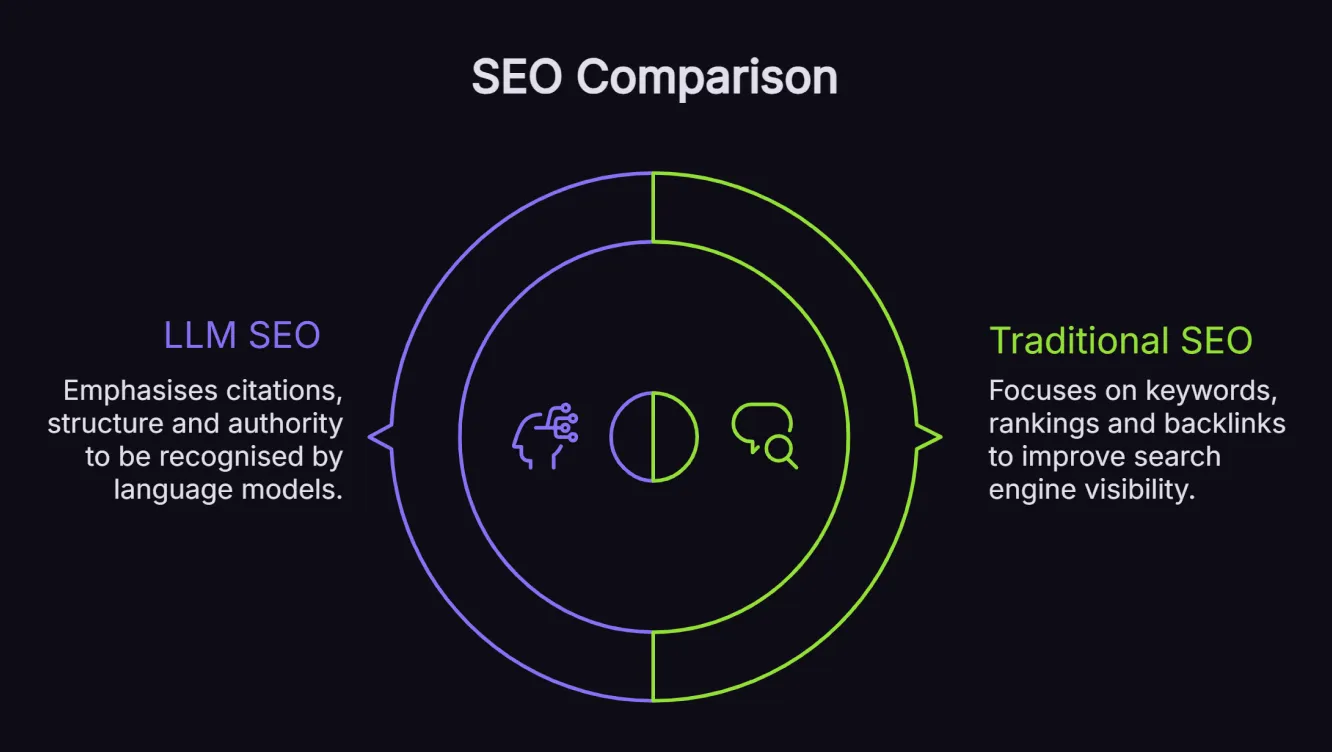
LLM SEO stands for Large Language Model Search Engine Optimisation. It means structuring your content so that AI platforms like ChatGPT, Perplexity and Google's AI Mode can understand and reference it in their responses. Search Engine Land reports that AI-referred sessions grew 527% year over year, highlighting how quickly AI-driven discovery is accelerating. Unlike traditional SEO, which focuses on keyword rankings, LLM SEO focuses on earning citations through clear, citable passages, authoritative sources and machine-readable structure.
Build AI Visibility That Compounds
Our AI SEO strategy connects traditional search visibility, AI citations and revenue attribution from day one. The goal is not just to rank. It is to make your content clear enough for buyers to trust and structured enough for AI systems to cite, so visibility compounds across Google and AI platforms.
Explore AI SEO StrategyWhy LLM SEO Matters for Your Business
The numbers tell a compelling story. According to Harvard Business Review, 58% of consumers now use AI chatbots for product and service recommendations. This represents a fundamental shift in how people research purchases and make decisions.
The Shift From Clicks to Citations
Traditional SEO focused on earning clicks from search results pages. LLM SEO focuses on earning citations in AI-generated answers. When someone asks ChatGPT for recommendations in your industry, you want your brand mentioned as the trusted source.
We treat a citation as the new position one. When an AI assistant names a source in your category, that mention does the job a top ranking used to do, and it often arrives with a warmer lead attached. Semrush research found the average AI search visitor was worth 4.4x the average traditional organic search visitor, based on conversion rate. That higher conversion rate makes sense. Users asking AI systems specific questions are usually further along in their buying journey than those typing broad search queries.
Where the Impact Is Strongest
AI-sourced sessions appear to be concentrated in consultative, high-trust industries. Search Engine Land reported that Legal, Finance, SMB, Insurance and Health accounted for 55% of all LLM-driven sessions in the dataset.
That pattern makes sense. These are categories where people often ask layered, context-heavy questions before they speak to a provider. For LLM SEO, the takeaway is not just that AI traffic is growing, but that the biggest early opportunity is in industries where buyers need explanation, comparison and trust before they convert.
How LLM SEO Differs from Traditional SEO
Understanding the differences helps you optimise effectively for both channels. Here's how they compare:
| Factor | Traditional SEO | LLM SEO |
|---|---|---|
| Primary Goal | Rank higher in search results | Get cited in AI answers |
| Success Metric | Clicks and rankings | Citations and brand mentions |
| Content Focus | Keywords and backlinks | Clarity, structure and authority |
| Optimisation Target | Search engine algorithms | Language model comprehension |
| User Journey | Click through to website | Answer provided directly |
The fundamental shift is from ranking to citing. With traditional SEO, you fight for position one on the results page. With LLM SEO, you make your content so clear and authoritative that AI systems naturally select it as a trusted source.
This doesn't mean traditional SEO becomes irrelevant. Independent analysis has found a majority overlap between Perplexity citations and Google's top results, a 60% overlap with Google's top 10, though this varies by query type and industry. Our B2B AI SEO case study shows how combining traditional search visibility with AI citation optimisation helped a property management client earn 598 AI cited pages in an earlier climb window, with the live headline now about $8.7M attributed over 27 months (ongoing).
Core Strategies for Effective LLM SEO
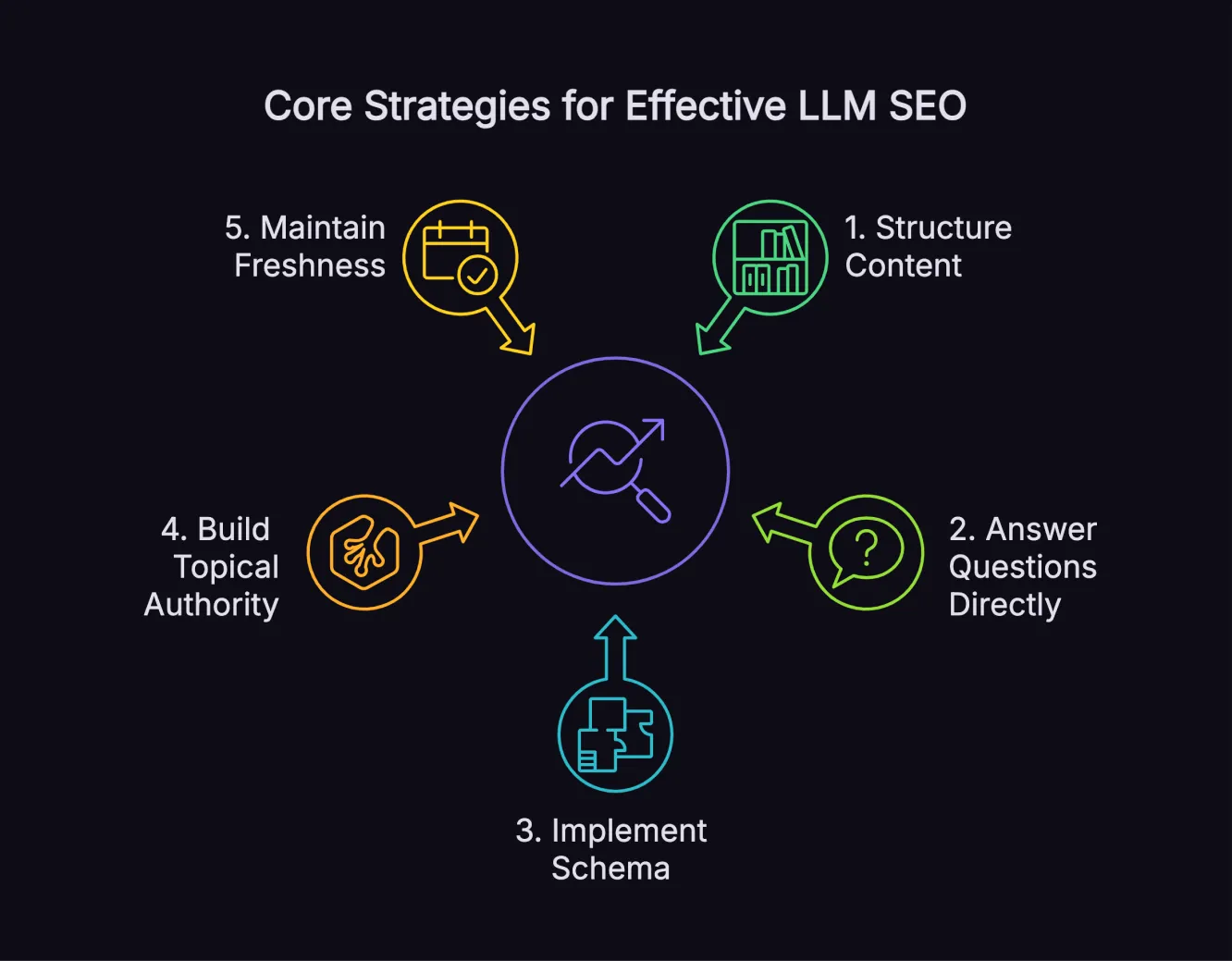
Implementing LLM SEO takes a structured approach across several areas, and each strategy reinforces the others to build AI visibility. In our own client work, three things consistently drive citations: verifiable client results, original data and consistent author profiles. That foundation is what produced the B2B result above.
1. Structure Content for Readers and AI Retrieval
Large language models process content differently from traditional search crawlers. They don't match keywords. They interpret meaning and context to generate responses.
- Clear heading hierarchies help AI systems understand your content structure. Use H1 for your main topic, H2 for major sections and H3 for subsections. This creates a logical flow that both humans and AI can follow easily.
- Short, focused paragraphs work better than long blocks of text. Each paragraph should contain one main idea. This allows AI systems to extract specific snippets when generating answers.
- Bullet points and numbered lists break complex information into digestible pieces. When you explain a process or list benefits, use formatting that makes extraction simple. In practice, a clear structure often makes content easier for systems to extract and cite. Schema can help, but it can't rescue poorly organised content.
2. Answer Questions Directly and Clearly
LLMs generate responses by finding and synthesising the clearest explanations of concepts. If your content directly answers questions people ask, you increase your chances of being cited.
Rankmax framework: “We write content to answer questions the way users ask ChatGPT, not just how they search Google.”
That means moving beyond keyword phrasing alone. Instead of only targeting short search terms, we build sections around the full questions, comparisons and follow-up prompts a buyer would naturally ask an AI assistant.
- Start sections with direct answers before providing supporting details. This inverted pyramid structure ensures AI systems can extract your key points even from brief scans.
- Use question-based subheadings that match how people phrase queries to AI assistants. Instead of "Our Services", write "What Services Does a [Your Industry] Provider Offer?" This alignment with natural language queries improves your visibility in AI responses.
- Include FAQ sections that comprehensively address common questions. Each question-answer pair becomes a potential citation source for AI systems answering related queries.
3. Implement Schema Markup Strategically
Schema markup provides explicit context that helps AI systems understand your content. Microsoft's Bing confirmed that schema markup helps their LLMs interpret web content for Copilot AI.
- Focus on schema types that directly support LLM comprehension. The FAQ schema makes question-answer pairs easy to extract. HowTo schema structures processes and procedures. The article schema provides context about authorship and publication dates.
- Organisation schema establishes your brand's identity within AI knowledge systems. Include consistent details like name, logo, contact information and social profiles across all pages where this schema appears.
- Avoid implementing schema just for the sake of having it. Each schema type should accurately describe visible page content. Misleading schema damages trust with both search engines and AI systems.
4. Build Topical Authority Through Content Clusters
LLMs favour sources that demonstrate comprehensive expertise on topics. Our AI SEO strategy for clients always begins with a topical authority audit, identifying the topics where a client can realistically become the most comprehensive resource and building the content roadmap to get there. Creating interconnected content clusters signals authority more effectively than scattered individual posts.
- Choose a main topic relevant to your business and cover it from multiple angles.
- Create guides for beginners, advanced techniques for experts, common mistakes to avoid and use case examples.
- Link these pieces together to show AI systems the breadth of your knowledge.
Our work with clients shows this approach delivers measurable results. In our SaaS SEO case study, we mapped 2,300+ keywords into topical clusters and built content silos, supported by 3-5 informational blog posts for each commercial page. This cluster-led approach helped drive 4,118 new page-one rankings and $1.31M in organic-search revenue at a 20.1:1 ROI within 12 months.
5. Maintain Content Freshness
AI systems are more likely to surface content that is accessible, accurate and current, especially for fast-changing topics. Outdated content loses citation opportunities even when the core information remains valid.
- Update statistics and examples regularly.
- Add current year references where appropriate.
- Republish with fresh dates when you make substantial updates.
This doesn't mean changing content constantly. It means treating content as a living asset that requires periodic maintenance. Quarterly reviews of key pages help identify outdated information before it impacts your AI visibility.
Technical Requirements for LLM Visibility
Beyond content strategy, technical factors determine whether AI systems can effectively access and process your pages.
1. Ensure Crawlability
AI bots must have access to your content before they can cite it. Check that your robots.txt file doesn't block important AI crawlers. For OpenAI, OAI-SearchBot supports inclusion in ChatGPT search summaries and snippets, while GPTBot relates to potential training use. If you want your content to appear in ChatGPT search, make sure your robots.txt file does not block OAI-SearchBot. If you want to exclude pages from potential training, OpenAI says publishers should block GPTBot for those pages.
Server-side rendering ensures content is available in the page source. JavaScript-rendered content may not be accessible to all AI crawlers. If you use client-side rendering, implement pre-rendering for important pages.
Page speed can affect crawl efficiency and user experience, so it is still worth improving for important pages.
2. Optimise for Bing
ChatGPT search sometimes partners with third-party search providers, including Bing, so maintaining visibility in Bing can support discovery and citation opportunities. Treat it as one input among multiple retrieval sources.
Set up Bing Webmaster Tools and submit your sitemap. Monitor how Bing indexes your site and address any crawl errors promptly. Many businesses focus exclusively on Google and miss this connection to AI search.
3. Connect Brand Signals Across Platforms
AI systems assess brand credibility by checking consistency across multiple sources.
- Ensure your business information is exactly the same across your website, social media profiles, Google Business Profile and industry directories.
- Encourage reviews on platforms AI systems frequently reference. G2, Capterra, Trustpilot and industry-specific review sites contribute to the authority signals AI systems evaluate.
- Participate genuinely in relevant online communities. Reddit and Quora discussions can influence how AI systems perceive brand relevance and expertise. Google AI Overviews frequently cite community forums such as Quora and Reddit, especially for informational queries.
Measuring LLM SEO Success
Traditional SEO metrics don't fully capture LLM performance. You need additional measurement approaches to effectively track AI visibility.
1. Track AI Referral Traffic
Set up analytics tracking for traffic from AI sources. Create custom channel groupings in GA4 for referrals containing openai.com, perplexity.ai and other AI platform domains. This shows you which content attracts AI-referred visitors.
2. Monitor Brand Mentions
Use brand monitoring tools to track mentions in AI responses. Test queries related to your products or services across different AI platforms. Document when and how your brand appears in responses.
Tools like Ahrefs Brand Radar now provide visibility tracking across major AI platforms. These tools show mention frequency and context, helping you identify gaps in your AI presence.
3. Test Manually and Regularly
There's no substitute for direct testing. Ask AI assistants questions your ideal customers would ask. Note whether your brand appears in responses, what sources get cited and how competitors are positioned.
Run these tests monthly to track changes over time. AI systems are updated frequently, and your visibility can shift with new training data and algorithm changes.
Common LLM SEO Mistakes to Avoid
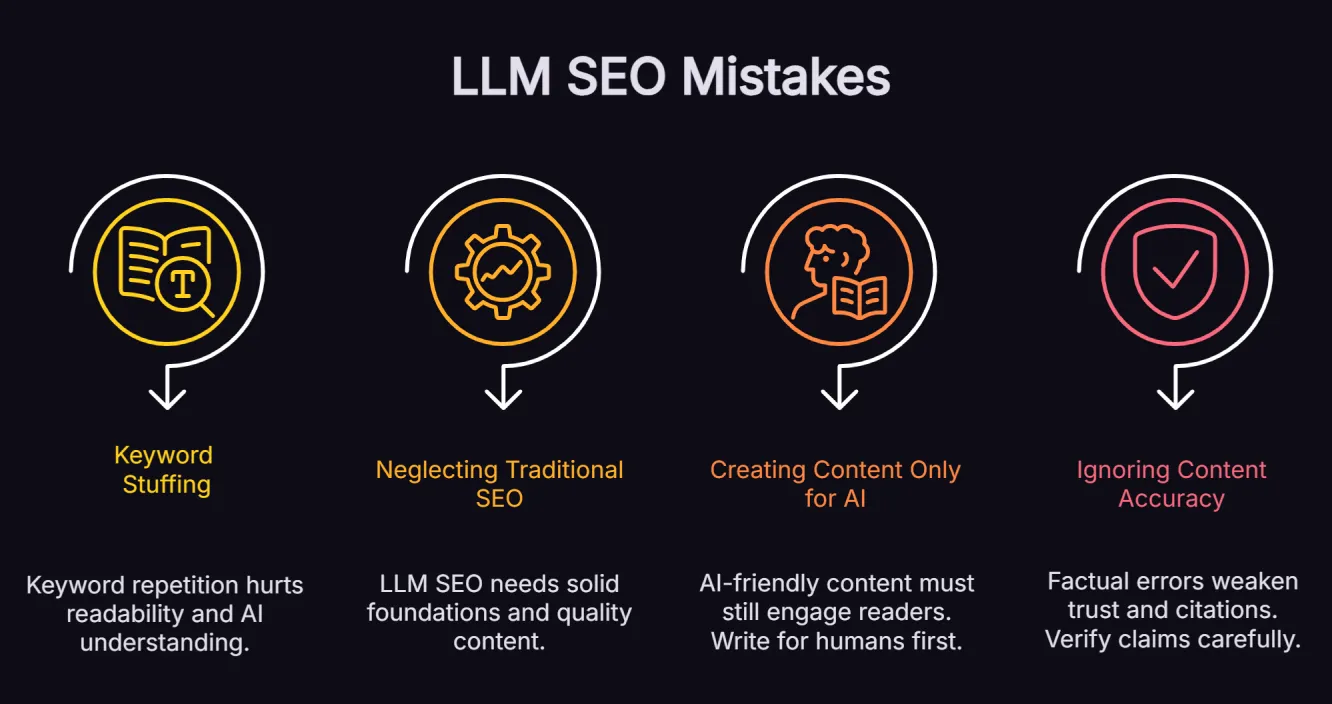
Several common errors undermine LLM optimisation efforts. Avoiding these pitfalls improves your chances of success.
1. Keyword Stuffing
LLMs interpret meaning, not keyword density. Repeating terms unnaturally makes content harder to read and doesn't improve AI comprehension. Write naturally and let semantic relevance develop through comprehensive coverage.
2. Neglecting Traditional SEO
LLM SEO builds on traditional SEO foundations. Sites with poor technical health, weak authority or thin content won't succeed with AI systems even if they implement LLM-specific tactics. Maintain your SEO fundamentals while adding LLM optimisation.
3. Creating Content Only for AI
Content optimised exclusively for AI extraction often fails to engage human readers. This creates a poor user experience that damages overall performance. Create content for humans first, then structure it for AI comprehension.
4. Ignoring Content Accuracy
AI systems aim to prevent misinformation. Content with factual errors, outdated statistics or unverified claims loses trust signals. Fact-check rigorously and cite authoritative sources for all claims.
The Future of LLM SEO
AI search keeps evolving, and the direction is settled: visibility increasingly depends on being cited rather than ranked. Brands that establish a strong AI presence now build a competitive advantage that compounds over time.
The proof shows up over the long run. Across our client work, we have generated $26M+ in attributed client revenue across Google and AI platforms. Live case-study headlines now include about $8.7M attributed over 27 months for a B2B property management engagement and about $14.6M organic over 21 months for a B2C professional services engagement, alongside strong visibility in Google AI Overviews earned through structured, authoritative content.
Frequently Asked Questions
Does LLM SEO replace traditional SEO?
LLM SEO complements rather than replaces traditional SEO. Strong Google rankings remain important because many AI systems reference top-ranking content when generating responses. Data shows 60% of Perplexity citations overlap with pages in Google's top 10 organic results. The most effective strategy combines both approaches. Traditional SEO builds the technical foundation, authority signals and search visibility that LLM SEO builds on. Businesses should maintain their existing SEO programmes while adding LLM-specific optimisations.
How do I know if my content appears in AI responses?
Test manually by asking AI assistants questions related to your products or services. Use variations of queries your customers might ask. Note whether your brand or content gets mentioned. Brand monitoring tools such as Ahrefs Brand Radar and similar platforms automatically track AI mentions. Review your analytics for referral traffic from AI platform domains. Increasing branded search volume can also indicate AI visibility, driving awareness even when direct citations don't include links.
How long does it take to see results from LLM SEO?
LLM SEO results do not follow a fixed timeline. In our client work, early signals often appear first through improved crawlability, stronger content structure, increased AI referral traffic or new brand mentions. Consistent AI citations usually take longer because they depend on topical authority, source quality, content freshness and how often AI platforms retrieve your pages. The safest approach is to monitor rankings, AI citations, referral traffic, leads and revenue together rather than judging performance from one metric alone.
What content formats work best for LLM SEO?
FAQ formats can work well because they match question-and-answer retrieval patterns, especially when the answers are specific, accurate and supported. How-to guides with numbered steps make procedural information easy to extract. Comparison content helps AI systems answer evaluative queries. Definition pages establish your authority on key concepts. Tables and structured data present information AI can parse efficiently. The common thread is clarity and structure. Content that answers specific questions directly and comprehensively earns more citations than vague or meandering content.
What is the difference between LLM SEO and traditional SEO?
Traditional SEO focuses on ranking web pages higher in search engine results through keyword optimisation, backlinks and technical improvements. LLM SEO focuses on getting your content cited by AI systems like ChatGPT, Perplexity and Google's AI Overviews. While traditional SEO measures success through rankings and clicks, LLM SEO measures success through mentions and citations in AI-generated responses. Both approaches share standard foundations such as quality content and technical health, but LLM SEO places greater emphasis on content clarity, structure and authoritative sourcing.
Which AI platforms should I optimise for?
Focus on the major platforms driving traffic in your industry. ChatGPT drives the largest share of AI referral traffic by a wide margin, based on Semrush's analysis of referral data across the major AI platforms. Perplexity, Google's AI Mode, Microsoft Copilot and Claude also drive meaningful traffic. Rather than optimising separately for each platform, focus on universal best practices like clear structure, authoritative content and proper schema markup. These fundamentals work across all AI systems because they all aim to surface helpful, accurate information.
Make Your Brand the Answer
AI search is accelerating, and the brands cited first are the ones capturing attention. If we had to pick one place to start, we would audit your most important pages for clear structure, direct answers and schema that supports what is already on the page, then build topical clusters that prove real expertise. Keep it human-first and accuracy-led, because that is what earns trust from both readers and AI systems. That is how you compound visibility every time someone asks for recommendations in your category.
About the Author
Want Insights Like This Fortnightly?

Our AI SEO strategies and tactics delivered fortnightly, including bonus trade secrets not shared anywhere else. No fluff. Just what's working right now. 5-minute read.


