
Enterprise SEO: The Complete Guide to Scaling Search Visibility and Revenue for Large Organisations in 2026


Enterprise SEO is no longer a marketing tactic you can delegate to a single team member and revisit quarterly. For organisations managing thousands to millions of web pages, it has become a revenue-critical function that demands cross-departmental coordination, AI search readiness and a direct connection to commercial outcomes. Research shows that organic click-through rates have dropped 61% on queries where Google AI Overviews appear, meaning the old playbook of “rank and collect traffic” simply does not work anymore. If your organisation relies on organic search to fill the pipeline, this guide walks you through what enterprise SEO actually requires in 2026 and how to turn it into a measurable growth engine.
A Quick Guide to Enterprise SEO
Enterprise SEO is the practice of optimising large, complex websites at scale to increase organic visibility, drive qualified traffic and generate measurable revenue across both traditional search engines and AI platforms. Unlike standard SEO that may target dozens of pages and a handful of keywords, enterprise SEO involves coordinating technical infrastructure, content strategy and cross-functional teams across thousands to millions of pages, multiple domains and often international markets. According to Pew Research Center, around 18% of all Google searches now generate AI summaries, with click-through rates dropping from 15% to just 8% when these summaries appear. This means enterprise SEO in 2026 must account for AI visibility alongside traditional rankings to protect and grow organic revenue.
Turn Enterprise SEO Into a Revenue Engine
Everything in this guide reflects the same enterprise-level strategy and execution methodology we use with our clients. Our AI SEO strategy has helped businesses achieve measurable results, including about $8.7M in attributed revenue for a B2B client over 27 months and counting and about A$14.6M for a B2C client over 21 months (14,738% average monthly ROI). If your enterprise is ready to turn search visibility into pipeline growth, talk to an expert who has done it before.
Explore Enterprise SEO ServicesWhat Is Enterprise SEO and How Does It Differ From Traditional SEO?
The term "enterprise SEO" gets used loosely, so it is worth defining properly before we go further.
Enterprise SEO refers to search engine optimisation strategies designed for large-scale websites with complex architectures, multiple stakeholders and significant revenue dependency on organic traffic. It uses many of the same techniques as traditional SEO, but applies them at a scale that demands automation, governance and cross-functional alignment.
The core differences come down to three factors:
- Scale
- Complexity
- Organisational coordination
Scale Changes Everything
On a smaller website, you might manually optimise 50 or 100 pages and see a measurable impact on rankings. Enterprise websites often manage thousands, tens of thousands, hundreds of thousands or even millions of pages across multiple product lines, service categories and geographic markets. At this scale, manual optimisation is not viable. You need systematic processes, templates and automation to ensure SEO standards are applied consistently across the entire site.
For example, internal linking is a well-known SEO best practice. On a 50-page site, you can manually plan and implement internal links in an afternoon. On a 10,000-page enterprise site, you need automated systems and clear governance frameworks to maintain link architecture without creating cannibalisation or orphaned pages.
Organisational Complexity Demands Governance
Unlike smaller businesses, where one or two people might own the entire SEO programme, enterprise SEO requires alignment across multiple teams, including:
- Development
- Content
- Marketing
- Legal
- Product
- Regional teams (in some cases)
Decisions about the following areas involve multiple stakeholders, each with their own priorities and timelines:
- URL structures
- Content publishing
- Technical changes
- Brand messaging
This is where most enterprise SEO programmes stall. The technical fix is rarely the hard part. The challenge is navigating multi-layered approval processes where recommendations need sign-off from several levels of management before implementation can begin. Getting work approved and into a development sprint can take significantly longer than it would at a smaller, more agile organisation, and this delay compounds when multiple SEO initiatives are queued simultaneously.
Enterprise organisations also operate within established policies, compliance requirements, brand guidelines, standard operating procedures and quality assurance processes that must be adhered to at every stage. While these frameworks exist for good reason, they add time to execution, particularly for content creation where legal review, brand compliance and editorial sign-off may all be required before a single page can be published. A strong AI SEO strategy addresses this by establishing governance frameworks that account for these realities and keep execution on track despite organisational complexity.
Revenue Attribution Is Non-negotiable
For smaller businesses, SEO success might be measured in traffic growth or ranking improvements. Enterprise organisations need to connect SEO performance directly to:
- Revenue
- Pipeline generation
- Customer acquisition costs
This requires proper attribution models, CRM integration and reporting frameworks that tie organic search activity to commercial outcomes.
Why Enterprise SEO Matters More in 2026
The search landscape has fundamentally shifted since Google launched AI Overviews in mid-2024. For enterprise organisations, these changes carry outsized consequences because of the volume of traffic at stake.
AI Overviews Are Reshaping Organic Traffic
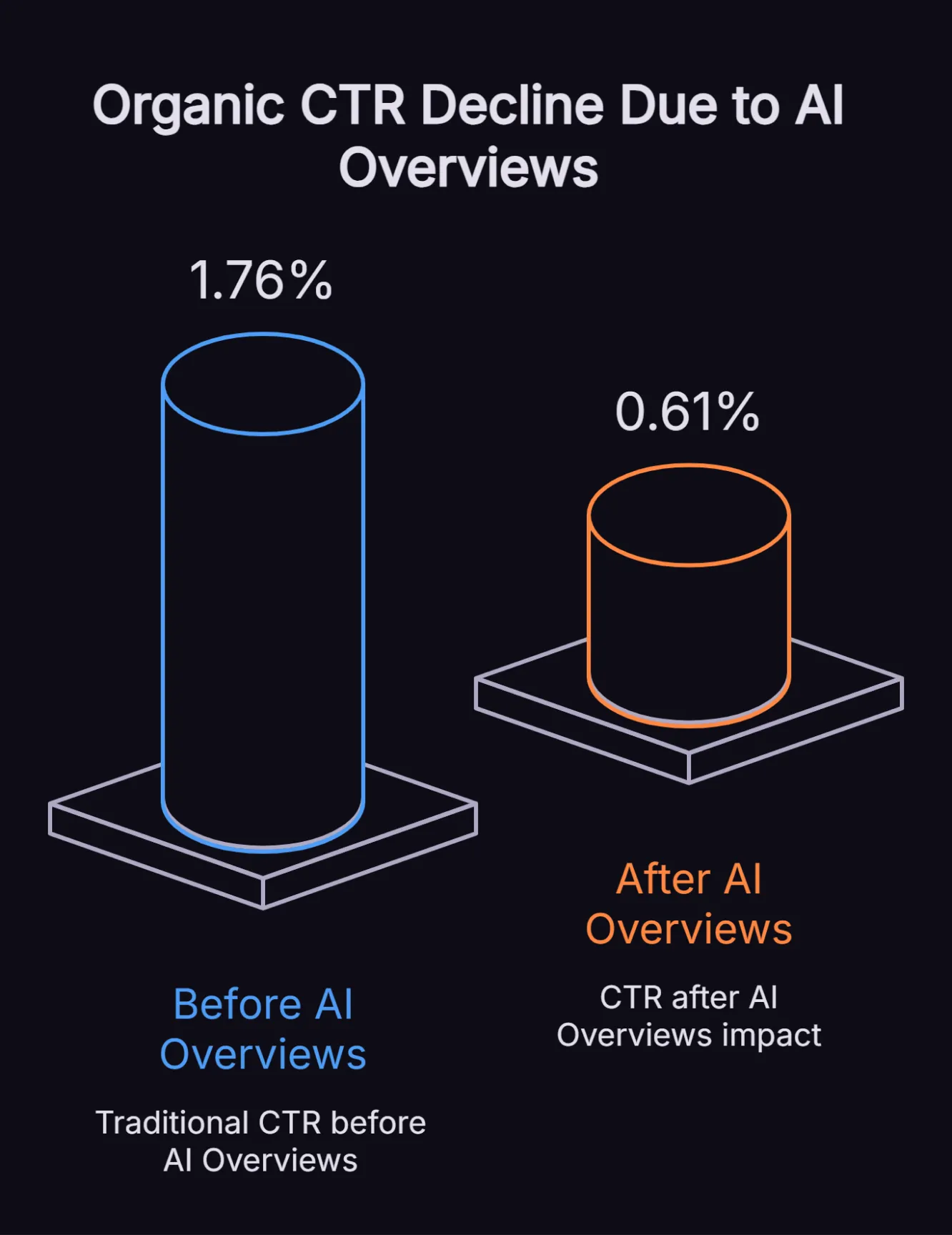
A September 2025 study by Seer Interactive analysed 3,119 informational queries across 42 organisations, tracking 25.1 million organic impressions. The findings were significant: organic CTR on queries with AI Overviews dropped from 1.76% to 0.61%, a 61% decline. Even on queries without AI Overviews, organic CTR fell 41% year-over-year.
For enterprise organisations ranking for thousands of high-volume keywords, these percentage drops translate into substantial lost traffic and revenue. A site generating 500,000 monthly organic visits could see a reduction of 200,000 or more visits simply from the CTR compression caused by AI Overviews.
The same research found that brands cited in AI Overviews earn 35% more organic clicks and 91% more paid clicks than those not cited. This makes AI search optimisation a priority for enterprise organisations that want to protect their organic revenue streams.
Multi-platform Discovery Is the New Reality
Search behaviour has shifted from single-destination Google searches to multi-platform conversations. ChatGPT now has over 800 million weekly active users, and platforms like Perplexity processed 780 million queries in May 2025 alone. Enterprise buyers increasingly use these AI platforms during research and evaluation stages before ever visiting a vendor’s website.
For organisations in B2B, SaaS, professional services, and other high-consideration categories, this means your content needs to perform simultaneously across:
- Google AI Overviews
- ChatGPT
- Perplexity
- Gemini
- Copilot
This is what we call AI SEO, and it requires a fundamentally different approach to content structure, schema markup and authority building.
The Cost of Standing Still Is Compounding
Every month that an enterprise organisation delays adapting its SEO strategy, competitors are building the content authority and technical foundations that AI systems prefer to cite. Once a competitor establishes itself as the trusted source on a topic cluster, displacing them becomes significantly harder because AI systems tend to reinforce existing authority patterns.
The Core Components of an Enterprise SEO Strategy
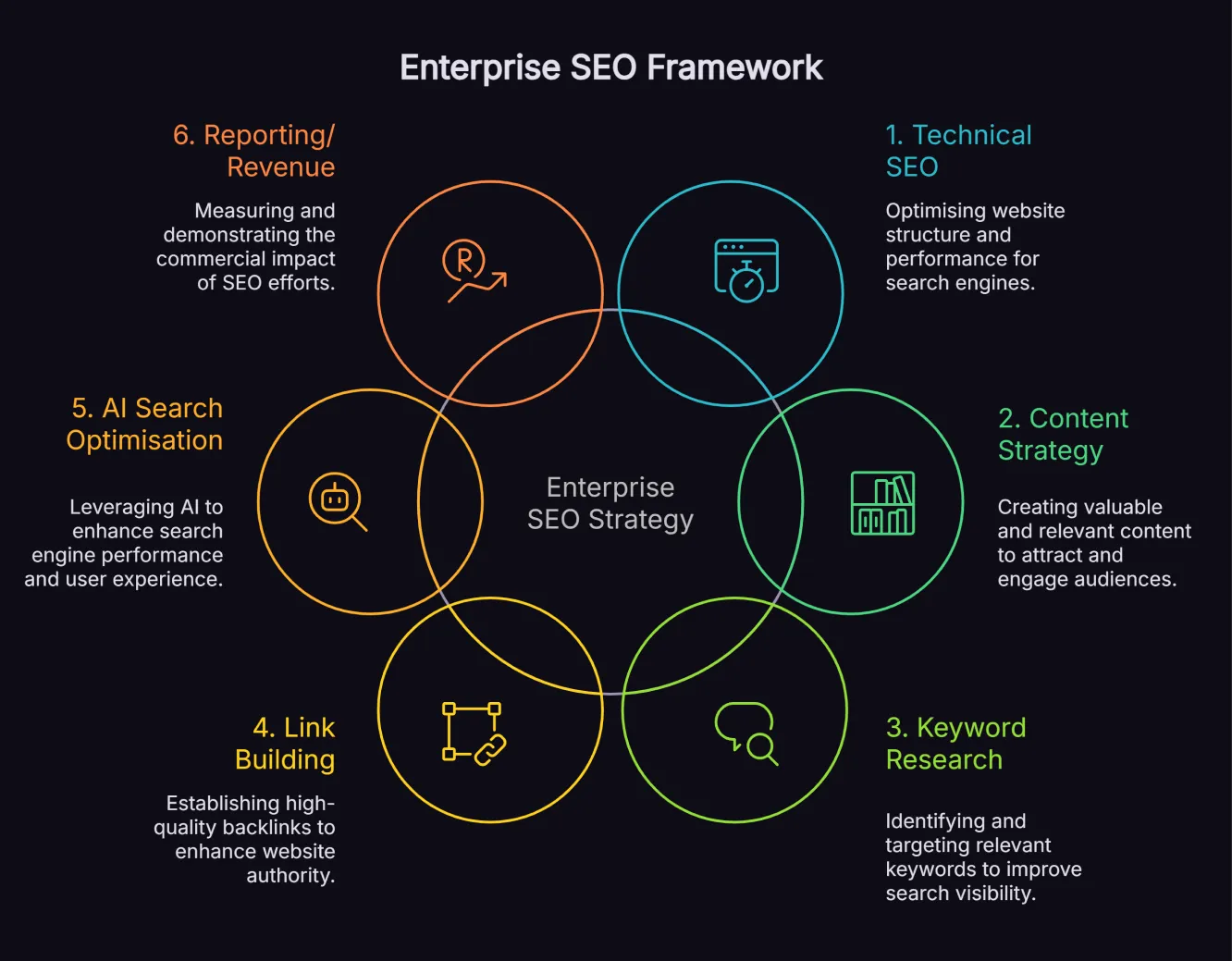
An effective enterprise SEO programme in 2026 requires coordinated execution across six core areas. Here is what each involves and why it matters at enterprise scale.
1. Technical SEO at Scale
Technical SEO forms the foundation that everything else builds on. Without clean technical infrastructure, even the best content strategy will underperform because search engines and AI crawlers cannot properly access, understand and index your pages.
At enterprise scale, technical SEO involves:
- Crawl budget management: Ensuring search engines prioritise your most valuable pages across a large site architecture
- Site speed and Core Web Vitals: Maintaining performance standards across thousands of pages, often built on different CMS platforms or legacy systems
- Structured data and schema markup: Implementing consistent, validated schema across all page types to help both search engines and AI systems understand your content
- International SEO: Managing hreflang tags, regional content variations and multiple domain structures for global organisations
- JavaScript rendering: Ensuring content rendered via JavaScript frameworks is accessible to all search crawlers, including AI platform crawlers
A defining challenge at the enterprise level is that many large organisations operate on proprietary or heavily customised content management systems. These platforms are often dated in both design and codebase, with all technical and code changes needing to go through an internal development team. These teams are frequently overworked and managing competing priorities across the business, which means SEO-related fixes can sit in development queues for months. The result is significant technical debt that accumulates over time and becomes increasingly difficult and costly to resolve.
Enterprise sites also carry legacy technical debt from years of platform migrations, team changes and ad-hoc development decisions. A thorough technical audit should be the starting point for any enterprise SEO programme, but teams should plan for longer implementation timelines than they would on a standard website. We cover the technical audit process in detail in our guide to how AI search works.
2. Content Strategy and Topical Authority
Content is where enterprise SEO generates its compounding returns. But at enterprise scale, content strategy is not about producing more pages. It is about building systematic topical authority across your key commercial areas.
This means:
- Topic cluster architecture: Organising content into hub-and-spoke structures where pillar content pages connect to supporting articles through strategic internal linking
- Content governance: Establishing editorial standards, approval workflows and publishing calendars that prevent keyword cannibalisation and ensure quality at scale
- Passage-level optimisation: Structuring content so that individual paragraphs and sections can be extracted by AI systems for citations and overviews. Our guide to passage optimisation covers this in detail
- Content refresh programmes: Systematically updating existing content to maintain relevance and accuracy, particularly important for enterprise sites with large content libraries. See our guide to content refresh strategies
3. Keyword Research and Mapping at Enterprise Scale
Enterprise keyword research goes beyond identifying target terms. It requires building a comprehensive keyword universe that maps to business objectives, buyer journey stages and content assets across the entire site.
At enterprise scale, this involves:
- Keyword clustering: Grouping related terms into topic clusters that inform content architecture. Our guide to keyword clustering explains the methodology
- Keyword mapping: Assigning target keywords to specific pages to prevent cannibalisation and ensure coverage. See our keyword mapping guide for the complete process
- Competitive gap analysis: Identifying keyword opportunities where competitors rank and your organisation does not
- Commercial intent prioritisation: Focusing resources on keywords that drive pipeline and revenue, not just traffic volume
Professional keyword research services can help enterprise teams build the strategic foundation for their content programmes.
4. Link Building and Digital Authority
For enterprise organisations, link building is about building brand authority rather than accumulating link volume. The focus should be on earning editorial placements in authoritative publications, industry thought leadership and brand mentions that signal trust to both search engines and AI platforms.
Enterprise-level link building typically includes:
- Digital PR campaigns: Earning mentions and links from high-authority publications in your industry
- Thought leadership content: Creating original research, surveys and data-driven insights that attract links naturally
- Strategic partnerships: Collaborating with industry bodies, educational institutions and professional associations
- Internal link architecture: Ensuring your own site’s link structure distributes authority effectively to your most commercially important pages
5. AI Search Optimisation (GEO and AEO)
This is the component that separates modern enterprise SEO from what worked even two years ago. Generative Engine Optimisation (GEO) and Answer Engine Optimisation (AEO) focus on getting your content cited by AI systems rather than just ranking in traditional search results.
Key elements include:
- Structured, citable content: Formatting key information in clear, factual statements that AI systems can extract and cite
- Schema markup for AI comprehension: Implementing structured data that helps AI crawlers understand entity relationships, facts and processes on your pages
- Multi-platform monitoring: Tracking your brand’s visibility and citation frequency across Google AI Overviews, ChatGPT, Perplexity, Gemini and Copilot
- E-E-A-T signals: Building demonstrated experience, expertise, authoritativeness and trustworthiness through author credentials, case study evidence and transparent methodology
Learn more about the relationship between traditional and AI search in our guide: how does AI impact SEO.
6. Reporting and Revenue Attribution
Enterprise SEO programmes live or die based on their ability to demonstrate commercial impact. Standard traffic reports are insufficient for enterprise stakeholders who need to see pipeline contribution, revenue attribution and return on investment.
Effective enterprise SEO reporting includes:
- Revenue attribution: Connecting organic search traffic to closed deals and revenue through CRM integration
- AI visibility tracking: Monitoring citation frequency and share of voice across AI platforms
- Competitive benchmarking: Tracking relative visibility against key competitors across both traditional and AI search
- ROI calculation: Providing clear cost-versus-return analysis that justifies continued investment
How to Build an Enterprise SEO Strategy: A Step-by-Step Process
Building an enterprise SEO strategy requires a systematic approach. Here is the process we recommend, based on what we refer to as our Enterprise SEO Strategic Audit and Strategy Process.
Step 1: Conduct a Comprehensive Technical and Content Audit
Start by understanding your current position. A thorough audit covers technical health, content inventory, competitive positioning and AI visibility across all relevant platforms.
This audit should document:
- Current ranking positions for target keywords
- Technical issues affecting crawlability and indexation
- Content gaps and cannibalisation problems
- Competitor content and link profiles
- Current AI citation status across ChatGPT, Perplexity and Google AI Overviews
- Revenue and conversion data by landing page
Step 2: Define Commercial Objectives and KPIs
Connect your SEO programme to business outcomes. Work with stakeholders to define specific targets for:
- Organic revenue
- Pipeline contribution
- Market share
- AI visibility
These KPIs should be realistic, time-bound and aligned with broader business goals.
Step 3: Build Your Keyword Strategy and Topic Architecture
Using competitive gap analysis and commercial intent data, build a prioritised keyword universe. Organise this into topic clusters that map to your site architecture and buyer journey stages.
Create a topical authority map that shows:
- Which content already exists
- Where gaps need to be filled
- How pages should link together to build authority systematically
Step 4: Implement Technical Foundations
Address critical technical issues before investing in content. This includes:
- Site speed improvements
- Schema markup implementation
- Crawl efficiency optimisation
- Resolution of any indexation issues
For enterprise sites with legacy technical debt, prioritise fixes by revenue impact. Focus first on the pages and page types that drive the most commercial value.
Step 5: Execute Content Strategy With Quality Controls
Deploy your content programme with:
- Clear quality standards
- Editorial workflows
- Publishing schedules
Each piece of content should target specific keywords, contribute to topical authority and be structured for AI citation potential.
For enterprise teams managing large content volumes, consider working with a content marketing agency that specialises in SEO-optimised content production at scale.
Step 6: Monitor, Measure and Optimise
Establish regular reporting cadences that track progress against KPIs. Use data to identify:
- What is working
- Where adjustments are needed
- How to allocate resources for maximum impact
This is not a "set and forget" process. Enterprise SEO requires ongoing monitoring and optimisation to respond to:
- Algorithm updates
- Competitive moves
- Shifts in search behaviour
Enterprise SEO Challenges and How to Overcome Them
Every enterprise SEO programme faces obstacles. Here are the most common ones and practical approaches to address them.
Stakeholder Buy-In and Cross-Functional Alignment
SEO changes often require input from:
- Development
- Content
- Legal
- Product team
Without executive sponsorship and clear governance, even technically sound recommendations get stuck in multi-layered approval queues. In many enterprise organisations, a single SEO recommendation may need approval from marketing leadership, legal, brand, IT and executive stakeholders before it can move to implementation, a process that can take weeks or months rather than days.
Solution: Present SEO as a revenue function, not a marketing tactic. Use revenue attribution data to demonstrate commercial impact and secure executive-level ownership. Build cross-functional working groups with clear decision rights and escalation paths.
Managing Scale Without Sacrificing Quality
Producing and maintaining content quality across thousands of pages is a significant operational challenge, compounded by the compliance requirements, brand guidelines, legal review processes and SOPs that enterprise organisations must follow. Many enterprise teams struggle with:
- Inconsistent quality
- Outdated content
- Duplicated topics
- Extended QA and approval timelines driven by compliance and governance requirements
Solution: Implement content governance frameworks that include editorial standards, quality scoring and regular content audits. Use templates and style guides to maintain consistency. Establish content refresh programmes that systematically update high-value pages.
Measuring ROI and Justifying Investment
Enterprise SEO budgets typically range from $5,000 to $25,000 or more per month, with global corporations sometimes exceeding $60,000 monthly. Justifying this investment requires clear attribution and ROI data.
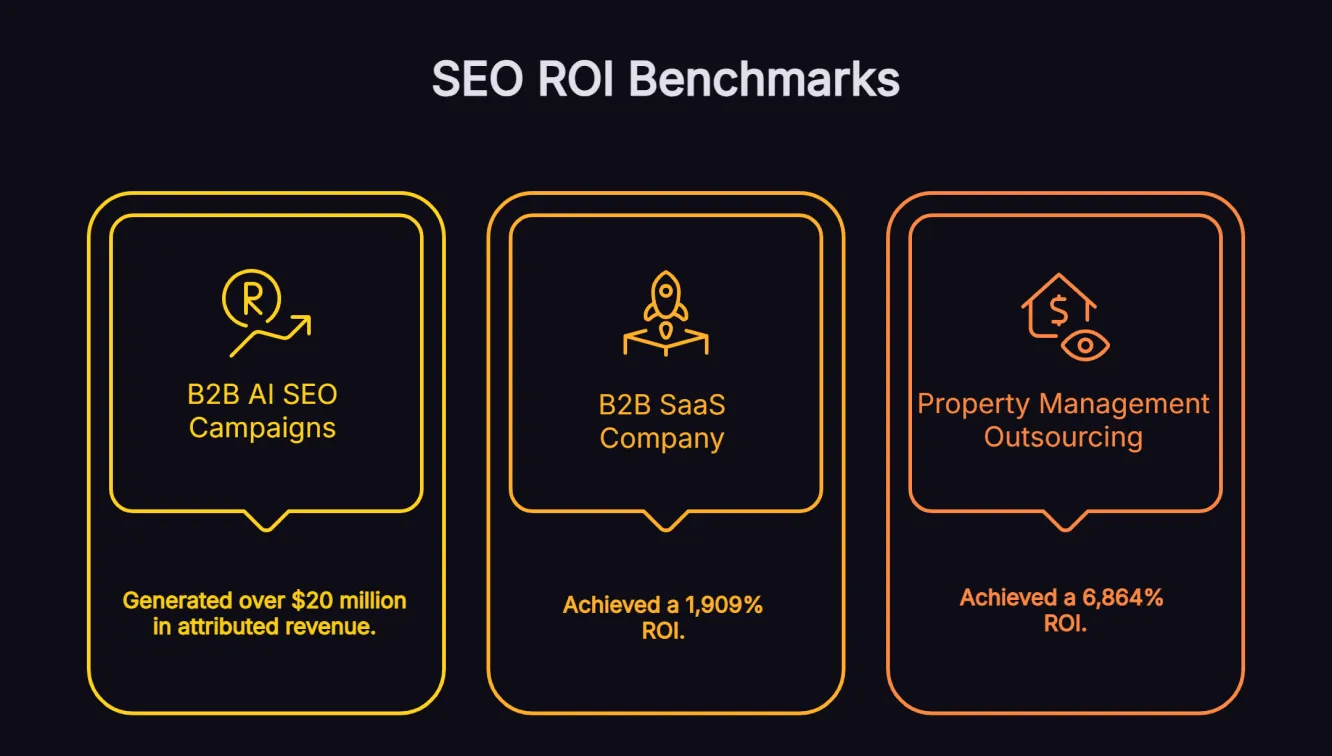
Solution: Build attribution models that trace every organic and AI search visit through to sales-qualified pipeline and closed revenue. Our B2B AI SEO campaigns have generated more than $26 million in attributed revenue with average ROI above 6,800% for B2B clients, including 1,909% ROI for a B2B SaaS company and 6,864% ROI on the 17-month climb window for a property management outsourcing brand. Use these proven ROI benchmarks alongside your own pipeline and revenue data to justify continued and increased investment in SEO.
Adapting to AI Search Disruption
The rapid expansion of AI Overviews and AI search platforms has caught many enterprise teams off guard. Traditional SEO metrics no longer tell the complete story of organic visibility.
Solution: Expand your measurement framework to include AI citation tracking, share of voice in AI platforms and zero-click visibility. Invest in LLM SEO strategies that ensure your content performs across all discovery platforms, not just Google’s traditional results.
Enterprise SEO and AI: What Has Changed in 2026
The relationship between enterprise SEO and AI has moved beyond experimentation. Here is what enterprise teams need to understand about the current landscape.
AI Overviews Are Expanding, Not Retreating
Data from Semrush shows that AI Overviews grew from appearing in 6.49% of queries in January 2025 to over 13% by March 2025. While growth rates have fluctuated, the overall trajectory is clear: AI-generated summaries are becoming a permanent feature of the search experience.
For enterprise organisations, this means that ranking on page one of Google is no longer sufficient. Your content also needs to be structured, authoritative and citation-worthy enough to be included in AI Overviews and AI platform responses.
Technical SEO Is the Prerequisite for AI Visibility
AI systems rely on the same technical signals that search engines use:
- Clean site architecture
- Proper schema markup
- Fast page loads and structured content
Enterprise sites with poor technical foundations will struggle to gain visibility in AI-generated results, regardless of their content quality.
This is why we recommend addressing technical SEO before investing heavily in content production. The technical foundation determines whether AI systems can access, understand and cite your content.
Content Quality Matters More Than Content Volume
AI systems reward content that demonstrates genuine expertise, provides factual accuracy and offers unique insights. Enterprise organisations that rely on high-volume, low-quality content production will see diminishing returns as AI systems become better at identifying and filtering generic content.
The most effective enterprise content strategies combine deep subject matter expertise with strategic keyword targeting and AI-ready formatting. Our article on whether AI content is bad for SEO explores this balance in detail.
Frequently Asked Questions: Enterprise SEO
What size company needs enterprise SEO?
Enterprise SEO is typically appropriate for organisations managing websites with thousands to millions of pages, operating in competitive search landscapes and generating significant revenue from organic traffic. It is most common among businesses with annual revenue in the multiple eight figures and higher, though the deciding factor is website complexity and commercial dependency on search visibility rather than company size alone.
How much does enterprise SEO cost in 2026?
Enterprise SEO investments typically range from $5,000 to $25,000 per month for mid-level programmes, with comprehensive global campaigns sometimes exceeding $60,000 monthly. The cost depends on website size, competitive landscape, geographic scope and whether content production is included. Most enterprise organisations see positive ROI within 6 to 12 months, with peak returns in the second and third year of a programme.
How long does enterprise SEO take to show results?
Most enterprise SEO programmes begin showing measurable improvements in rankings and traffic within 3 to 6 months. Revenue impact typically becomes clear between 6 and 12 months, depending on the organisation’s starting position, competitive landscape and the scope of technical and content improvements required. Results compound over time, making enterprise SEO one of the highest-ROI marketing channels over a 2 to 3-year horizon.
What is the difference between enterprise SEO and regular SEO?
The primary differences are scale, organisational complexity and commercial impact. Enterprise SEO involves optimising thousands of pages across complex site architectures, coordinating multiple stakeholders and departments, managing international markets and attributing SEO performance directly to revenue outcomes. Standard SEO typically operates on smaller sites with simpler governance structures and fewer competing priorities.
Can enterprise SEO work alongside AI search optimisation?
Yes, and in 2026, they should be treated as complementary rather than separate disciplines. Strong traditional SEO provides the technical foundation and content quality that AI systems need to cite your brand. AI search optimisation then extends that visibility into Google AI Overviews, ChatGPT, Perplexity and other AI platforms. Organisations that invest in both see compounding returns as authority built in one channel reinforces visibility in others.
What metrics should enterprise SEO teams track?
Enterprise SEO teams should track organic revenue attribution, pipeline contribution from organic traffic, keyword visibility and rankings, AI citation frequency and share of voice, Core Web Vitals and technical health scores, content performance by topic cluster, competitive share of voice and ROI against SEO investment. The most important shift in 2026 is adding AI visibility metrics alongside traditional search performance data.
Is enterprise SEO worth the investment?
For organisations with significant revenue dependency on organic traffic, enterprise SEO delivers some of the strongest returns of any marketing channel. Our B2B AI SEO case study shows that a property management outsourcing company has attributed about $8.7M in revenue from organic search and AI LLMs over 27 months and counting, with the 17-month climb window at a 6,864% average SEO ROI. The key is connecting SEO investment to revenue outcomes through proper attribution and choosing a strategic partner with demonstrated enterprise-level results.
Organic Search Is the Growth Channel Enterprise Organisations Cannot Afford to Ignore
Enterprise SEO in 2026 requires more than optimising title tags and publishing blog posts. It demands strategic coordination across technical infrastructure, content production, AI platform visibility and revenue attribution, all executed at scale with clear governance and commercial accountability. The organisations that treat SEO as a revenue function rather than a marketing tactic will build compounding competitive advantages that become increasingly difficult for competitors to overcome. If you are ready to build an enterprise SEO programme that delivers measurable revenue growth across both traditional search and AI platforms, start with our enterprise SEO services.
About the Author
Want Insights Like This Fortnightly?

Our AI SEO strategies and tactics delivered fortnightly, including bonus trade secrets not shared anywhere else. No fluff. Just what's working right now. 5-minute read.


