
Topical Authority Map: Build a Content Strategy That Drives Rankings and AI Citations


You have written dozens of blog posts, yet your website still does not rank. The problem isn't the quality of your content; it's how it's structured. Random articles competing against each other struggle to build the authority Google rewards with top rankings, and they give AI search engines nothing coherent to cite. A topical authority map turns scattered content into an interconnected strategy that demonstrates genuine expertise. This guide is the build-it companion to our complete topical authority guide. It walks you through mapping your content step by step, so it finally works together to earn rankings and AI citations.
What Is a Topical Authority Map?
A topical authority map is a strategic framework that organises all your website content around interconnected topics and subtopics. Unlike a basic keyword list, it visualises the semantic relationships between your content pieces and shows Google you comprehensively cover your subject matter.
Think of it as the blueprint for your entire content ecosystem. Pillar pages act as central hubs covering broad themes, while supporting articles dive into specific subtopics that link back to strengthen the whole structure. This interconnected approach signals to search engines that your site deserves to rank for related queries across your niche, and it gives AI systems a reliable source to summarise. The difference matters because Google now rewards helpful, people-first content and broad topical coverage rather than keyword-density tricks. In the campaigns we run, sites with strong topical coverage consistently outperform scattered-content sites.
Ready to build a topical authority map that drives revenue?
One B2B property management client we built this exact framework for has attributed about $8.7M over 27 months and counting; the 17-month climb window attributed $5.9M at a 6,864% average ROI. We build the 12-month content roadmap, keyword clustering and topical map for you, then hand you the execution plan.
Get your AI SEO strategy consultationWhy Topical Authority Maps Matter for SEO Success
Search engines have moved far beyond simple keyword matching. Google now evaluates how thoroughly and credibly your site covers entire subject areas, not just individual terms.
How Google Evaluates Topic Expertise
Google's ranking systems assess your depth of coverage across related topics. When your content addresses every angle of a subject through interconnected articles, Google recognises your site as an authoritative source. This connects directly to the E-E-A-T principles of experience, expertise, authoritativeness and trustworthiness. A well-structured topical authority map supports those signals by showing consistent, in-depth coverage rather than surface-level content scattered across unrelated topics.
The proof is in the pudding. The 2024 Google Content Warehouse API leak exposed more than 14,000 internal attributes. They include site-level signals such as siteFocusScore and siteRadius, which measure how focused and topically coherent a site is. When Google confirmed the documents were authentic, it confirmed what practitioners had long suspected. Topical relevance is a real, measurable signal, and a focused topical map is how you send it.
The Business Impact of Topical Authority
Beyond rankings, a topical authority map delivers tangible business outcomes. Sites that build topical maps rank for more keywords with fewer backlinks, and the content stays relevant longer because each piece forms part of a comprehensive resource rather than standing alone.
The clearest example from our own work is a B2B property management client. After we published 12 mapped articles per month across their core service topics, they grew organic traffic 429% and earned 598 AI cited pages from zero. Over 27 months and counting, that work has attributed about $8.7M in revenue; the 17-month climb window generated $5.9M at a 6,864% average ROI. The map was the difference: it let us build authority in low-competition clusters first, then expand into the head terms competitors had locked up. Internally, those interconnected articles also create the natural linking pathways that guide visitors from awareness through to a buying decision.
How AI Search Reads Your Topical Map
A topical authority map is built for readers first, but it happens to be exactly what AI search engines need to find, extract and cite you. Three behaviours make the difference.
AI systems expand a single question into many related sub-questions before they answer. This is query fan-out: ask ChatGPT or Google's AI Mode one question and it quietly runs a fan of related searches behind the scenes. A topical map that already covers those adjacent questions gets surfaced repeatedly, because your cluster answers the whole fan, not just the head term.
AI engines also pull specific passages rather than whole pages. A comprehensive cluster gives them more clean, self-contained passages to lift, which is the heart of passage-level optimisation. And AI Overviews lean on sites with deep, well-structured coverage because those hubs reliably answer the follow-up questions a generated summary needs.
We saw this play out with an eCommerce meal-delivery client. By mapping their topic comprehensively and answering the questions buyers actually asked, they earned 866 AI citations across platforms, with pages cited by ChatGPT within 90 days of publishing. The practical takeaway: write genuinely useful coverage for people, structure it cleanly, and track AI citations alongside your rankings as a leading indicator that the authority is landing. Citations are a visibility signal, not a replacement for rankings.
Core Components of an Effective Topical Authority Map
Every effective topical authority map contains four layers working together.
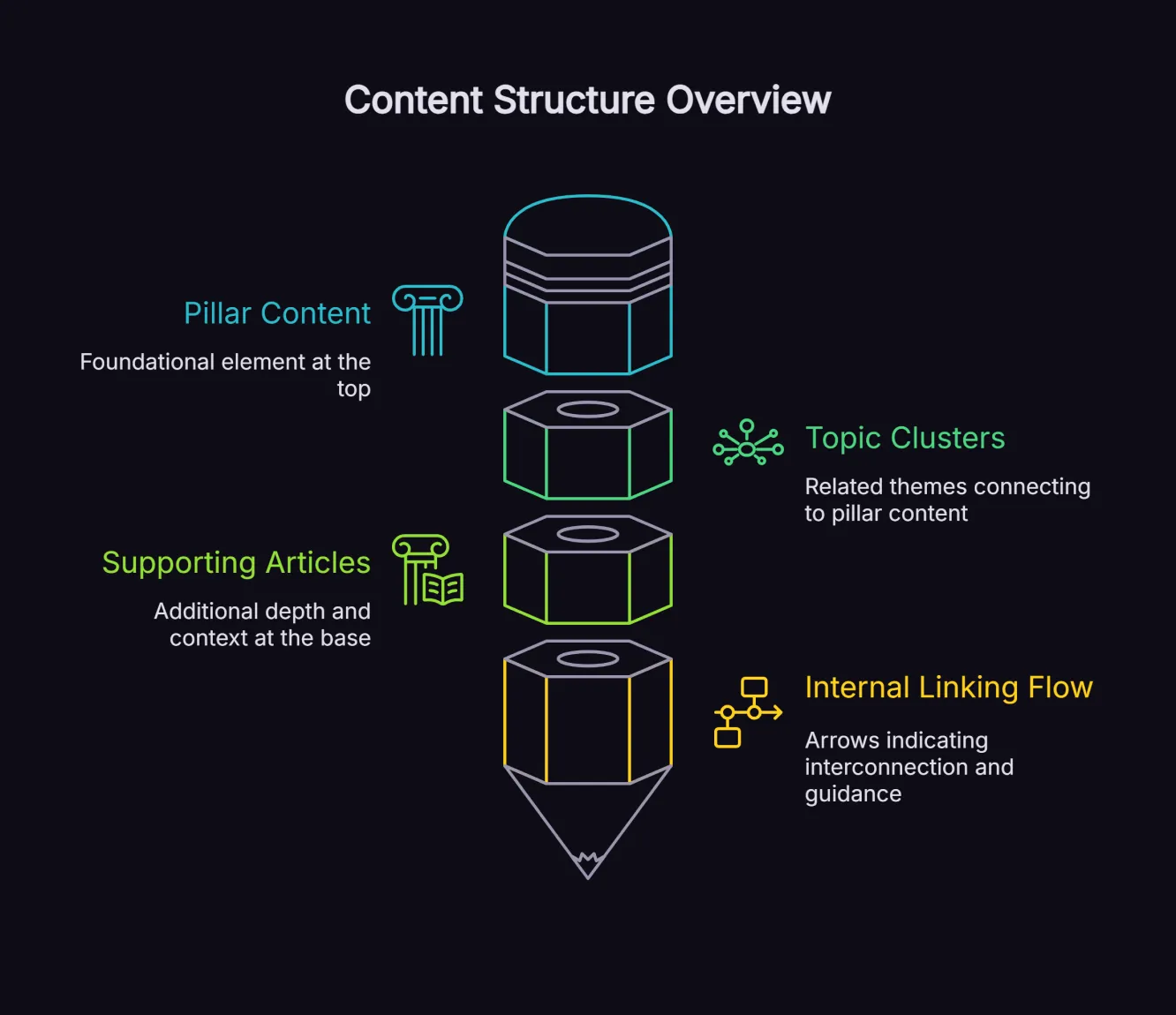
- Pillar content: Pillar pages are the foundation. These comprehensive articles cover a core topic broadly and target the high-volume terms that represent your main themes, usually 2,000 to 5,000 words. A pillar content strategy gives every supporting piece a hub to point back to.
- Topic clusters: Clusters group related subtopics around each pillar. Each supporting article targets a long-tail term that relates semantically to the pillar and links back to it. A topic cluster on topical authority, for instance, would connect keyword clustering, keyword mapping and pillar content.
- Supporting articles: These target narrow subtopics, answer detailed questions and fill the gaps competitors miss. The rule is simple: every supporting article serves a purpose within the structure, with no orphan content floating free of your core themes.
- Internal linking architecture: Strategic internal links tie everything together. Links flow from supporting articles up to cluster pages and on to pillars, with cross-links between related clusters. This is what turns a pile of individual articles into a cohesive ecosystem Google and AI systems can read.
The hierarchy is consistent: pillar pages at the top, topic clusters in the middle, supporting articles forming the foundation.
How to Build a Topical Authority Map Step by Step
Building an effective topical authority map takes systematic research and planning before you write a single word. Here is the process I use with clients.
Step 1: Identify Your Core Topics
Define the three to five main topic areas that align with your business goals and audience needs. These become the foundation for everything else. Consider what your ideal customers search for when looking for the solutions you provide, review existing content for themes already gaining traction, and analyse competitors for topic gaps you could own. Your core topics should be broad enough to support extensive clusters yet focused enough to demonstrate genuine expertise. A B2B software company might choose "sales automation", "CRM implementation" and "sales team productivity" rather than generic terms like "sales" or "business".
Step 2: Conduct Comprehensive Keyword Research
With core topics defined, uncover every relevant search term within each area. Tools like Ahrefs and Semrush surface short-tail keywords, long-tail phrases and the question-based queries your audience actually uses. Export a keyword list for each core topic to form the basis of your clustering work. Look past raw search volume: intent, keyword difficulty and commercial value matter more. A keyword with 500 monthly searches and strong purchase intent often beats a 5,000-search informational query that never converts.
Step 3: Cluster Keywords by Theme and Intent
Raw keyword lists need organising before they become actionable. Group related keywords into clusters based on semantic relationships and user intent. Variations of "how to choose CRM software" belong together, separate from "CRM implementation timeline" queries. A dedicated tool like Keyword Insights automates this at scale, grouping the keywords that should share one page versus those that warrant separate content. Done well, keyword clustering reveals the natural subtopic structure inside each core theme.
Step 4: Map Content to Keywords
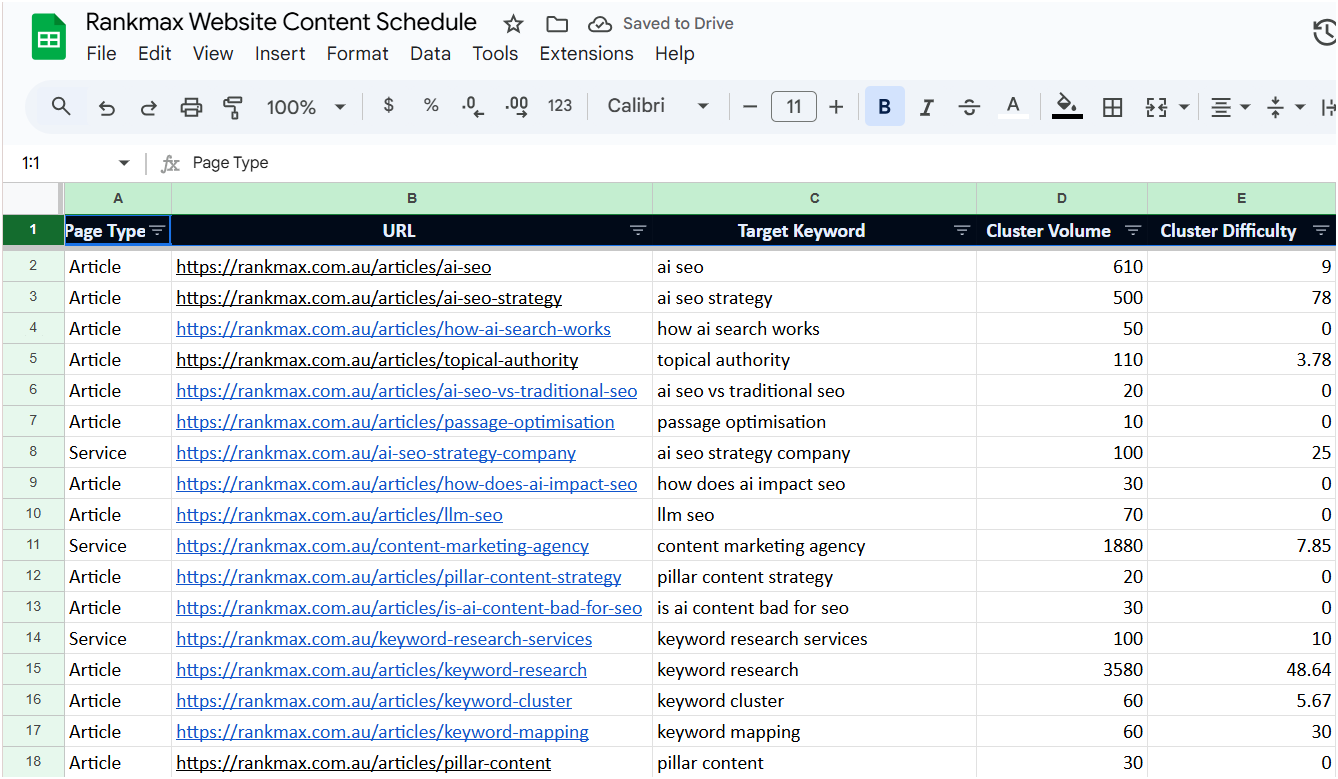
Assign each keyword cluster to either existing content or a planned new article. Build a simple spreadsheet recording the target keyword, the URL (existing or planned), the pillar connection and the priority level. This keyword mapping step is where you audit existing pages against your clusters, spot the gaps with no content at all, and catch pages that compete with each other.
This is also where intent discipline pays off. When we mapped the topic for the same eCommerce meal-delivery client, we clustered over 6,000 keywords by intent and commercial value rather than volume. That revealed hundreds of specific, high-intent queries the big competitors were ignoring while they all fought over the same head terms, and those queries became the fastest wins.
Step 5: Establish Your Content Hierarchy
Visualise how every piece connects: pillar pages at the top, cluster pages in the middle, supporting articles feeding each cluster. The format matters less than having a clear reference your team can follow during content creation and link building. Document the internal linking relationships so every article has a clear path to related content and up to its parent pillar.
A useful pattern here is the Nano Cluster structure we developed and piloted with a B2B SaaS client in legal tech. Each Nano Cluster follows a 1+2 shape: one commercial page targeting a transactional keyword, paired with two supporting informational pages answering the questions prospects ask before they buy. Mapping their content into these clusters, around 2,300 keywords in all, helped them reach 4,118 first-page rankings and $1.31M in revenue at a 1,909% ROI over 12 months. The structure gives you commercial intent and topical depth in the same motion.
Step 6: Prioritise and Schedule Content Creation
Not all content deserves equal priority. Rank planned pieces by business value, search opportunity, competitive difficulty and authority-building potential. High-priority content targets keywords with strong commercial intent, reasonable difficulty and direct relevance to what you sell. Lower-priority pieces fill gaps and round out coverage. Then set a publishing schedule your team can sustain, because consistency signals ongoing investment to search engines and protects quality from rushed deadlines.
Common Mistakes When Building Topical Authority Maps
Avoiding these pitfalls saves months of wasted effort.
- Gathering keywords without assessing business value: Building a massive keyword list without checking relevance wastes resources and dilutes your authority. If you cannot explain how a cluster supports customer acquisition or retention, question whether it belongs on the map.
- Ignoring search intent alignment: Mapping a commercial keyword to an informational article creates a mismatch that hurts rankings. Someone searching "best CRM software pricing" wants a comparison, not a general explainer. Match the content format to the intent.
- Creating competing pages for similar keywords: Without a map, teams publish multiple pages targeting the same variations, splitting ranking signals through cannibalisation. Your map should assign each cluster to a single URL and consolidate overlaps through merges or redirects.
- Neglecting internal linking: A map is worthless without the internal links that bring it to life. Build linking into your content workflow so every new article links to relevant existing content and is linked from related pages already published.
Measuring Topical Authority Progress
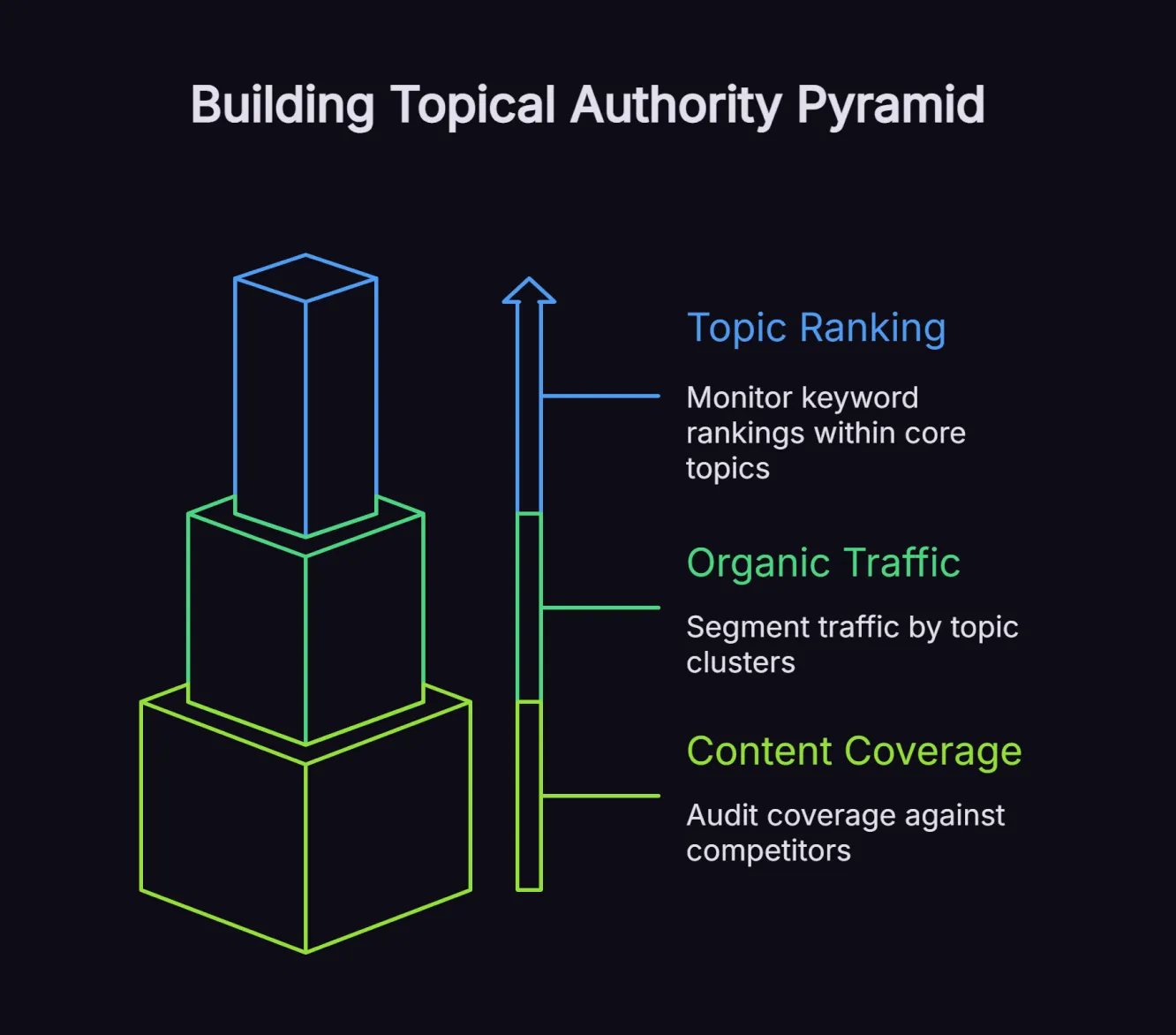
Tracking the right metrics shows whether the map is working.
- Topic-level ranking distribution: Monitor how many keywords you rank for within each core topic, not just individual page positions. Movement from pages two and three into the top 10 across multiple related keywords signals that Google is recognising your expertise.
- Organic traffic by topic cluster: Segment traffic by cluster rather than page. Sustained growth across a cluster, even as individual pages fluctuate, demonstrates stable authority that weathers algorithm updates.
- Content coverage completeness: Audit your coverage against competitors and against the questions your audience asks. Tools like AnswerThePublic and Google's People Also Ask surface the gaps worth filling.
- AI citations: Track how often AI platforms cite your pages, alongside your rankings. It is a leading indicator that your topical depth is being recognised, not a substitute for ranking and traffic.
Frequently Asked Questions
What Is the Difference Between a Topical Authority Map and a Keyword Map?
A keyword map assigns target keywords to specific pages. A topical authority map goes further by visualising the semantic relationships between content pieces, establishing topic hierarchy through pillar-cluster structures and ensuring the comprehensive coverage that builds genuine expertise signals. Keyword maps focus on individual terms; topical authority maps plan entire content ecosystems.
How Is a Topical Authority Map Different From a Single Topic Cluster?
A topic cluster is one pillar page plus its supporting articles around a single theme. A topical authority map is the layer above that: it organises every cluster across your whole site and the links between them. You can think of clusters as the neighbourhoods and the map as the city plan that shows how they all connect.
How Many Topics and Clusters Should a Topical Authority Map Have?
Start with three to five core topics, each broad enough to support a cluster of 10 to 20 supporting articles. The right number depends on your topic scope and competition, not an arbitrary target. Comprehensive coverage of three core topics builds more authority than shallow coverage of fifteen, so resist spreading thin before you have earned depth.
What Tools Do I Need to Build a Topical Authority Map?
You need three capabilities: keyword discovery, clustering and a place to visualise the hierarchy. A keyword tool such as Ahrefs or Semrush handles discovery. A clustering tool such as Keyword Insights groups terms into subtopics at scale, and a spreadsheet or mind-mapping tool holds the map itself. The tool matters less than using it consistently.
How Long Does It Take to Build Topical Authority?
Plan for 6 to 12 months of consistent content creation following your map, longer in competitive niches and faster for established sites adding depth to existing foundations. Across our campaigns we typically see measurable ranking improvement around month four, with gains accelerating from there as the interconnected content compounds.
Can Small Websites Compete on Topical Authority Against Larger Competitors?
Yes. Smaller sites win by focusing on niche subtopics larger competitors overlook rather than matching their breadth. A focused map covering one narrow subject comprehensively routinely outranks a large site with shallow coverage. Quality and completeness within your chosen scope matter more than overall site size.
Turn Your Content Strategy into Consistent Rankings
A well-structured topical authority map turns scattered posts into a content engine where every article, cluster and internal link compounds your rankings, your revenue and your AI visibility. Start now by mapping your core topics, clustering your keywords and planning the supporting content that positions your brand as the go-to answer in your market. If you want a partner to own the research, mapping and execution, our content marketing team builds 12-month content roadmaps and authority frameworks backed by real keyword and AI-citation data.
About the Author
Want Insights Like This Fortnightly?

Our AI SEO strategies and tactics delivered fortnightly, including bonus trade secrets not shared anywhere else. No fluff. Just what's working right now. 5-minute read.


