
KPIs for SEO That Actually Drive Revenue (And the AI Metrics You Can't Ignore)


Tracking the wrong SEO KPIs is one of the most expensive mistakes a marketing team can make. You can spend months climbing rankings, growing organic traffic and ticking every box on your dashboard, only to find your revenue hasn't moved. The problem often isn't your SEO. It's your measurement framework. KPIs for SEO need to connect visibility to business outcomes, not just report activity. In 2026, AI platforms are reshaping how people discover businesses, making measurement more complex. If your reporting stops at sessions and keyword positions, you're already working with an incomplete picture.
KPIs for SEO: What the Right Metrics Actually Tell You
KPIs for SEO are the core metrics that show whether your search strategy is driving real business outcomes, not just activity. The most useful KPIs for SEO usually include organic traffic, keyword rankings, click-through rate, organic conversion rate, and revenue from organic search. AI visibility now matters too. Semrush found that AI Overviews appeared in 13.14% of U.S. desktop searches in March 2025, later stabilising at around 16% of queries through much of the year.
Build a KPI Framework That Proves Real SEO ROI
Most SEO reports look impressive. Fewer actually prove business impact. Our AI SEO strategy builds a measurement framework alongside your campaign, tracking traditional SEO performance and AI platform visibility in one system, so you always know exactly what's working and why.
Explore Our AI SEO StrategyWhat Are SEO KPIs?
SEO key performance indicators are the signals that confirm your strategy is moving in the right direction for your business. Not just “things moved”: “things moved and revenue grew.”
The distinction between SEO metrics and SEO KPIs matters more than most reporting frameworks acknowledge. Metrics are data points:
- Impressions
- Clicks
- Sessions
- Positions
KPIs are the selected metrics that connect to specific:
- Business goals
- Leads generated
- Revenue attributed
- Market share gained
Choosing the wrong ones creates a reporting cycle that looks productive but doesn't inform better decisions.
A well-chosen KPI set does three things:
- Confirms that SEO investment is producing measurable outcomes
- Identifies where in the funnel performance is stalling
- Guides prioritisation so your team focuses on the work that actually moves the needle
The Core KPIs for SEO Every Campaign Should Track
The foundational SEO KPIs fall into three categories: visibility, engagement and conversion. Each tells a different part of the story.
Organic Traffic
Organic traffic is the number of visitors arriving on your site from unpaid search results. It remains the most fundamental SEO KPI because it shows whether your visibility efforts are translating into actual reach.
That said, raw organic traffic volume is only meaningful in context. Segment it by:
- Branded vs Non-Branded Traffic: Non-branded growth is the stronger indicator of organic search performance; branded spikes can reflect PR campaigns rather than SEO gains.
- Landing Page: Which pages are driving traffic, and do those pages align with commercial intent?
- Device Type and Geography: Particularly important for businesses with regional audiences.
Track organic traffic via Google Analytics 4 (GA4) under Reports → Acquisition → Traffic Acquisition, filtering for Organic Search.
Keyword Rankings
Keyword rankings measure where your pages appear in search results for target queries. They remain a useful KPI because they signal progress before traffic gains materialise, and they reveal competitive positioning on the terms that matter most to your business.
Keyword research and tracking should focus on commercial-intent terms, not just high-volume informational queries. A page ranking in the top three positions for a term searched 200 times a month by buyers will typically outperform a page ranking eighth for a term searched 5,000 times a month by researchers. Track rankings in Google Search Console alongside your preferred rank-tracking tool, and review position changes monthly against your target keyword set.
Click-Through Rate
Click-through rate (CTR) measures the percentage of users who click your result after seeing it in search. It is a critical KPI because ranking is only half the equation, a page sitting in position three with a 1.5% CTR may generate less traffic than a well-optimised page in position five with a 6% CTR.
CTR is influenced by several factors, including:
- Your title tag
- Your meta description
- Whether your result appears alongside rich features, such as sitelinks, review enhancements, or other rich results, your page is eligible for
Monitor CTR in Google Search Console under the Performance report, and compare by page and query to identify which results are underperforming their position.
Organic Conversion Rate
Organic conversion rate is arguably the most important SEO KPI for demonstrating business value. It measures the percentage of organic visitors who take a desired action, including:
- Making a purchase
- Submitting a form
- Booking a call
- Requesting a quote
Organic conversion rate benchmarks vary too widely by industry, offer and attribution model to apply universal ranges with confidence. Use your own baseline as the primary benchmark, and treat broader industry figures as directional context rather than fixed targets.
Track this in GA4 by marking your primary actions as key events, then filtering the Traffic acquisition report to Organic Search. If organic traffic is growing but conversion rate is flat or falling, you may have an intent mismatch, the wrong visitors, or friction in the page experience.
Engagement Metrics
User engagement KPIs reveal what happens after the click. The most relevant signals are:
- Average Engagement Time: How long are users spending with your content? GA4 replaces the old session duration metric with engaged sessions and engagement time, giving a cleaner picture.
- Bounce Rate (contextualised): A high bounce rate on an informational blog post may be acceptable; on a product or service page, it signals a problem.
- Pages Per Session: A useful proxy for content quality and internal linking effectiveness.
These metrics are best used as internal UX diagnostics, not as direct ranking factors. Google recommends focusing on helpful, people-first content and a strong page experience, rather than assuming bounce rate or engagement time directly influences rankings.
Backlink Profile Growth
Backlink profile strength helps show how much authority your site is earning from external links, but metrics such as Domain Authority and Domain Rating are third-party proxies, not Google metrics. Google has stated that Domain Authority is not a Google metric, while Ahrefs describes Domain Rating as its own backlink strength score.
Key metrics include:
- Referring domain count (quality over quantity)
- Domain Rating trend over time
- Follow vs no-follow ratio
- Topical relevance of linking domains
Backlinks remain a core ranking signal. Track profile growth monthly in Ahrefs or a comparable tool, and focus on earning links from topically relevant, authoritative sources rather than accumulating volume.
The New KPIs for SEO in 2026: AI Visibility
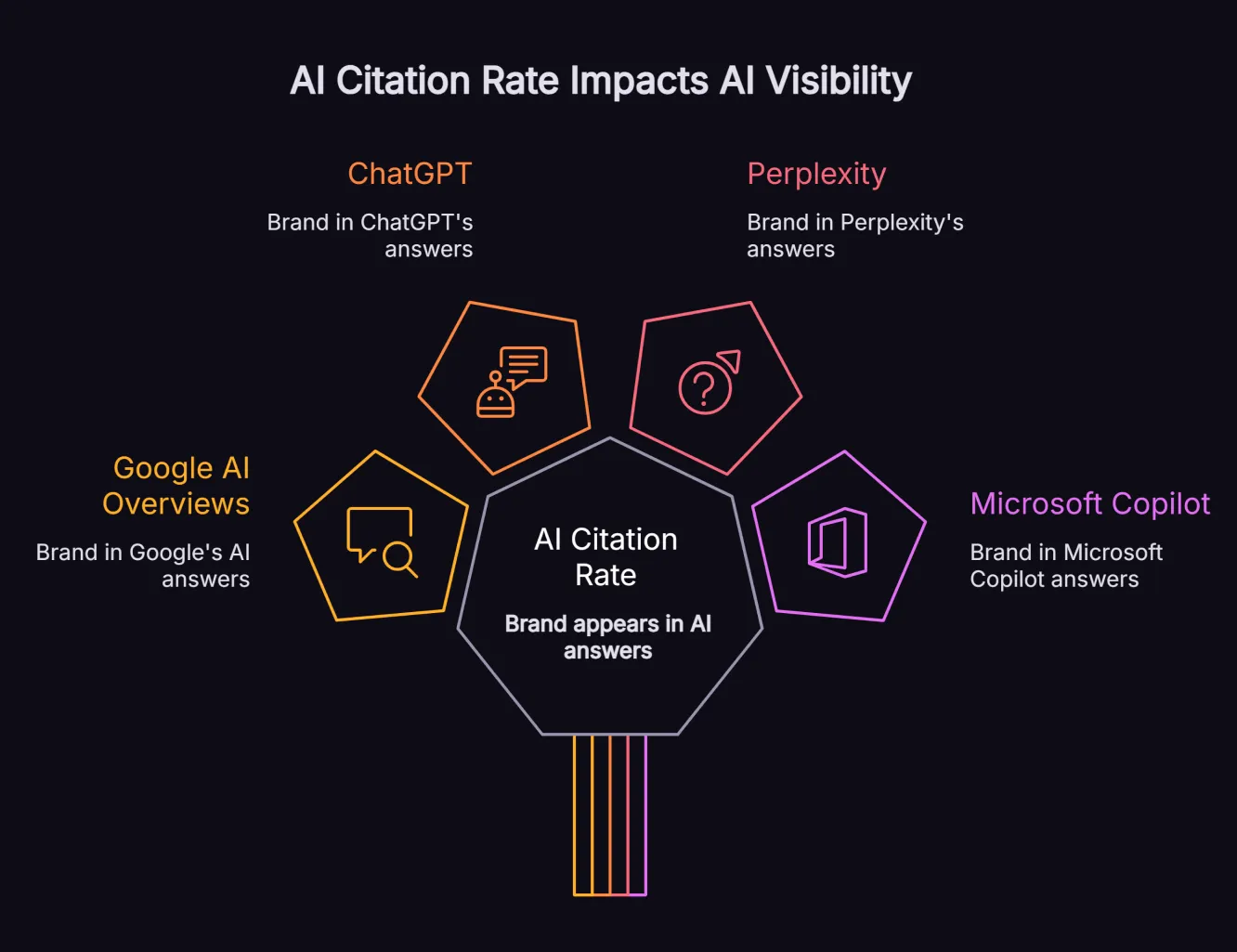
Traditional SEO KPIs capture how you perform in Google's standard results. They no longer capture the full picture. As AI Overviews, ChatGPT, Perplexity and Microsoft Copilot answer more queries without triggering a click, a growing share of your brand's discovery happens in places that don't show up in GA4 or Search Console.
Semrush found that visitors from non-Google AI search platforms converted at 4.4x the rate of traditional organic search visitors. While that figure should be treated as directional rather than universal, it still signals that AI visibility is becoming too commercially important to ignore.
AI Citation Rate
AI citation rate measures how often your brand or content is referenced when AI platforms respond to relevant queries. It is the closest equivalent to a first-page ranking in traditional SEO, except instead of appearing once for one keyword, you're measured across hundreds of buyer-intent questions across multiple platforms.
AI citation rate should be benchmarked against your own baseline and direct competitors, not against universal percentage bands. Performance varies too much by platform, topic and query set for fixed ranges to be reliable across every B2B market.
Track citation rate by benchmarking prompts across ChatGPT, Perplexity, Google AI Overviews and Microsoft Copilot. Then monitor trends in Ahrefs Brand Radar so you can compare visibility against your baseline and competitors over time.
AI Overview Inclusion Rate
AI Overview inclusion rate tracks how often your pages are cited in Google AI Overviews. It should be measured separately from keyword rankings, because Ahrefs found that only 38% of AI Overview citations came from pages ranking in Google’s top 10 for the same query.
Google Search Console reports AI Overview clicks, impressions, CTR and position within its standard Performance report, rather than in a dedicated AI Overview report. Supplement this with structured monitoring across the queries most relevant to your business.
AI Share of Voice
AI Share of Voice measures how often your brand appears in AI-generated answers relative to competitors, across a tracked set of prompts. It is the AI equivalent of a traditional search visibility score, your proportional presence in the conversations your buyers are having with AI platforms.
Building topical authority across a subject area can improve AI Share of Voice over time, because broader topic coverage gives AI systems more opportunities to retrieve and cite your content.
How to Set SEO KPIs That Connect to Business Goals
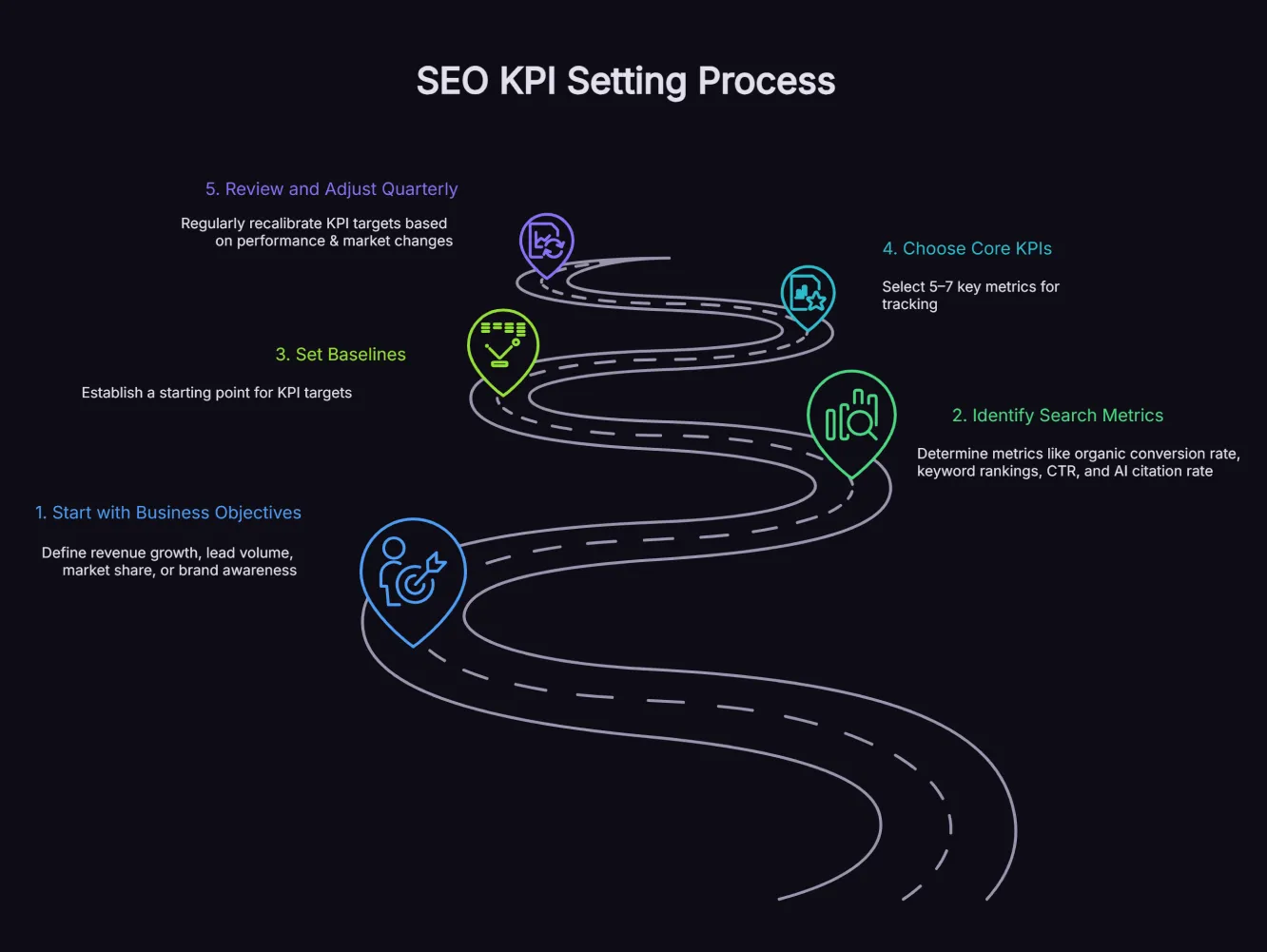
The most common KPI mistake is selecting metrics because they're easy to measure, not because they connect to what the business is actually trying to achieve. Here is a reliable framework for setting SEO KPIs that hold up in leadership reporting:
- Start with Business Objectives: Revenue growth, lead volume, market share or brand awareness. Every SEO KPI should be traceable back to one of these.
- Identify the search metrics that lead to those outcomes: Organic conversion rate leads to revenue. Keyword rankings and CTR lead to organic traffic. AI citation rate leads to brand discovery.
- Set baselines before targets: KPI targets are only meaningful when measured against a documented starting point. Run a baseline audit before setting growth targets.
- Choose 5–7 core KPIs: When everything is a KPI, nothing is. Tracking 20+ metrics fragments attention and makes it impossible to identify what's actually driving results. Use a focused core set and treat the rest as diagnostic data.
- Review and adjust Quarterly: SEO performance is dynamic. KPI targets set in January may need recalibration in April if algorithm updates or market conditions shift.
How Many SEO KPIs Should You Track?
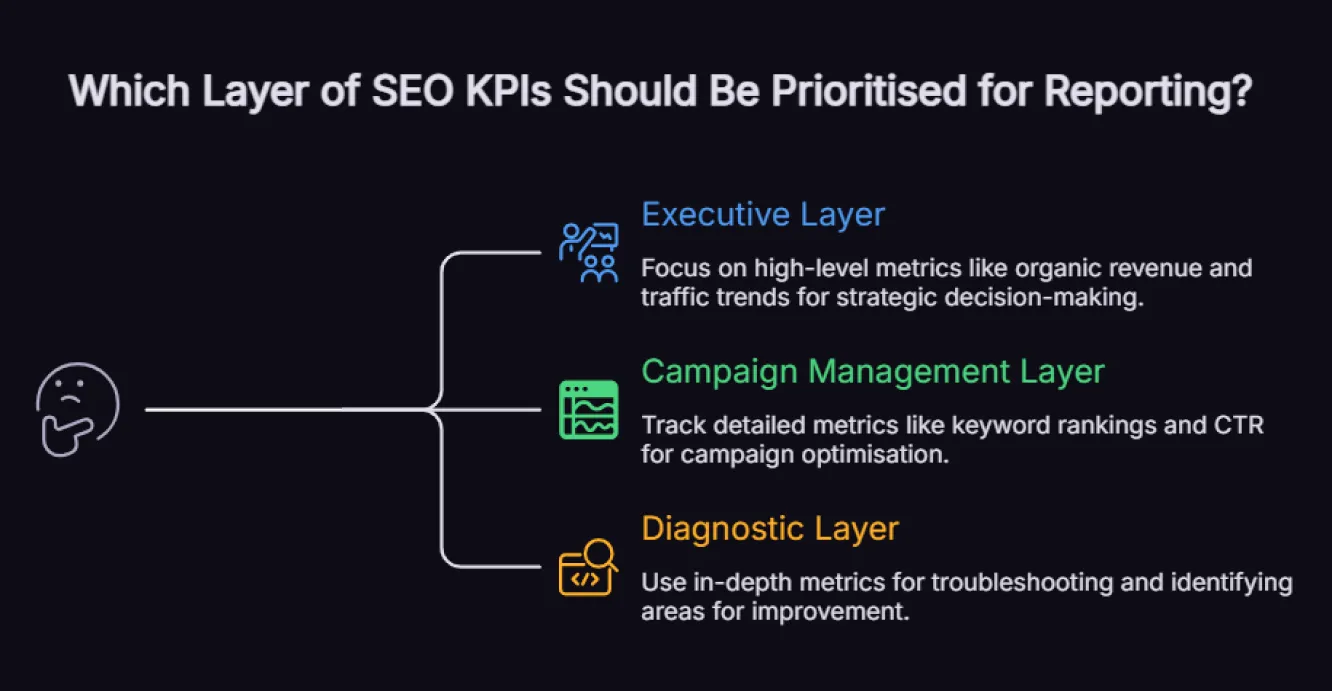
Fewer than you think. For executive reporting, keep the core KPI set to three to five decision-grade metrics. Put deeper diagnostic data in a separate dashboard layer so leadership sees what matters without the noise.
Practical SEO KPI Reporting Split
- Board/Executive Layer (3-5 KPIs)
- Organic revenue or leads attributed to organic search
- Organic traffic trend (month-on-month and year-on-year)
- AI citation rate or AI Share of Voice
- Campaign Management Layer (additional 5-10 metrics)
- Keyword rankings for priority terms
- Organic CTR by landing page
- Engagement rate and average engagement time
- Backlink growth (referring domains)
- Core Web Vitals scores
- Diagnostic Layer (everything else)
- Individual page performance
- Crawl health and indexation
- Internal link distribution
- Specific SERP feature appearances
This structure keeps leadership reporting clean and actionable while giving your team the depth it needs to diagnose and improve performance.
How We Track KPIs for SEO Campaigns
Our monthly reporting framework covers both layers, traditional SEO performance and AI platform visibility, in a single report. This dual-layer approach reflects how search actually works in 2026, not how it worked five years ago.
In practice, this means tracking:
- Keyword positions for the full target set, segmented by intent and funnel stage
- Organic traffic split by branded and non-branded, with landing page-level analysis
- Conversion events attributed to organic search via GA4
- Revenue attribution connecting organic conversions to actual business value
- AI citation count across Google AI Overviews, ChatGPT, Perplexity and Microsoft Copilot
- Backlink growth focused on topically relevant referring domains
The AI citation tracking has become one of the most meaningful KPIs for demonstrating campaign ROI.
- For our B2B property management client, we grew AI citations to 138 over 17 months while generating $5.9M in attributed revenue at a 6,864% average ROI. That does not prove direct causation, but it does show that citations can act as a meaningful visibility KPI within a broader SEO reporting framework.
- For our eCommerce client, conversion rate proved more useful than traffic alone as a KPI, improving from 6.97% to 9.73% year on year while monthly revenue rose from $77,000 to $147,000 over eight months. The campaign generated $968,000 in total revenue at a 2,327% average ROI.
This is the point of tracking the right KPIs. It’s not to build impressive-looking dashboards — it’s to make better decisions and prove that SEO investment is producing real, measurable returns.
Frequently Asked Questions
What is the difference between SEO metrics and Seo KPIs?
SEO metrics are raw data points that measure activity, impressions, clicks, sessions, crawl errors. SEO KPIs are the selected metrics that connect directly to business goals, such as organic revenue, lead volume or AI citation rate. Every KPI is a metric, but not every metric deserves KPI status. The distinction matters because tracking too many metrics dilutes focus and makes it harder to identify what's actually driving performance.
How do you measure Seo return on investment?
SEO ROI is calculated by comparing the revenue attributed to organic search against the cost of your SEO investment. The formula is: ROI = ((Revenue from Organic Search - SEO Investment Cost) ÷ SEO Investment Cost) × 100. Accurate ROI measurement requires proper conversion tracking in GA4, revenue values attached to conversion events, and clear attribution windows that account for SEO's typically longer sales cycle compared to paid media.
What is a good organic click-through rate for SEO?
Click-through rate varies by ranking position, query intent and SERP layout. As a directional benchmark, Semrush’s organic CTR research puts the first organic position at about 22% CTR on average, with rates dropping sharply after that. When AI Overviews appear, CTR can fall further, so use Google Search Console to benchmark your own pages by query and position, then improve titles and meta descriptions on high-impression, low-CTR pages.
What are AI citations and why are they an SEO KPI?
An AI citation is when an AI platform references your content as a source in a generated answer. It is a useful SEO KPI because it reflects visibility in AI-led discovery, and Semrush found the average AI search visitor is worth 4.4x more than the average traditional organic search visitor based on conversion rate.
How often should you review Seo KPIs?
Core SEO KPIs, organic traffic, conversion rate, keyword rankings and AI citation rate should be reviewed monthly. This cadence matches the typical update frequency of most SEO platforms and gives enough data for trends to emerge without the noise of daily fluctuations. Diagnostic metrics, crawl health, page-level CTR, and Core Web Vitals can be reviewed quarterly or as needed when performance signals prompt investigation. Strategy-level KPI targets should be reviewed quarterly and adjusted for algorithm updates, seasonal patterns and business priority shifts.
How long does it take to see Seo KPI improvements?
SEO KPI improvements typically appear on different timelines depending on the metric. Technical fixes and indexation improvements can show results within weeks. Keyword rankings for new or refreshed content generally move within 2-4 months for less competitive terms and 6-12 months for competitive ones. Organic traffic growth follows ranking improvements with a short lag. AI citation growth accelerates with content depth and distribution, and can build meaningfully within 3-6 months of a focused strategy. Revenue attribution from organic search is typically measurable within 3-6 months for lead-generation businesses and sooner for eCommerce.
Measure What Matters
The right KPIs for SEO do more than report traffic and rankings. They show whether organic search is driving leads, revenue and stronger visibility across Google and AI platforms. Start with a focused set of metrics, review them consistently, and build reporting that helps your team make better decisions. For a clearer path to revenue-focused SEO, see how we approach AI-first search strategy.
About the Author
Want Insights Like This Fortnightly?

Our AI SEO strategies and tactics delivered fortnightly, including bonus trade secrets not shared anywhere else. No fluff. Just what's working right now. 5-minute read.


