
International SEO Audit: What 2,402 Broken Hreflang URLs Taught Us About Multi-Market Migration Risk


An international SEO audit is the diagnostic process that reveals exactly where your global search visibility is breaking down, from misconfigured hreflang tags to poorly localised content that search engines serve to the wrong audiences. With cross-border eCommerce growing 219% faster than overall eCommerce and the global eCommerce market expected to total $6.88 trillion by the end of 2026, the commercial stakes of getting international search right have never been higher.
This guide walks through every component of a thorough international SEO audit and gives you a clear framework to identify, prioritise and fix the issues holding back your global organic performance. I have built it from the patterns my team and I keep finding in real audits we run for enterprise SaaS, eCommerce, B2B services and multi-market professional services clients.
Quick Guide to International SEO Audit
An international SEO audit evaluates how well your website performs in organic search across each country and language you target. It checks hreflang, geo-targeting, URL structure, localisation and regional links to find issues that stop the right version of your site appearing in local results. With roughly one in three international websites affected by hreflang errors, an international SEO audit gives you a clear roadmap to fix hidden problems and build a stronger foundation for your international SEO strategy.
Audit Your Multi-Market Site Before the Next Launch
Hreflang errors, traffic concentration risk and AI search visibility gaps are the most common issues we find in pre-launch international SEO audits. Our audits cover all three with revenue-based prioritisation that protects your existing traffic during the migration.
Book an International SEO Discovery SessionWhat 2,402 Broken Hreflang URLs Taught Us About Multi-Market Audits
In a recent international audit we ran for an enterprise SaaS client preparing to launch into a new English-speaking market, we found 2,402 hreflang tags pointing to URLs that returned 404 errors. The tags were live in production, indexed in Google Search Console, and quietly draining the site's crawl budget across both the existing primary market and the new market.
The root cause was structural. Hreflang annotations had been added to pages before the destination URLs existed in the target market, or after pages had been removed without the corresponding hreflang references being cleaned up. Google attempted to access the non-existent pages, logged thousands of soft 404s and 404s under the regional Search Console property, and used those signals when deciding which version of the site to serve to users searching from each country.
Two things stood out for us about that finding.
First, the number is shocking but the pattern is not unusual. Across the international audits we have run, hreflang errors at this scale show up routinely on enterprise multi-market sites because hreflang implementation often happens at scale through automated CMS rules that nobody re-validates after content changes. The smaller a site, the easier these errors are to spot. The bigger a site, the more likely they are to compound silently.
Second, the migration risk is not just the broken pages. On the same engagement, 75% of the target market's existing organic traffic was concentrated in just two pages. Any international launch for that site needed to protect those two pages first, before doing anything else. A migration that ignored the concentration risk would have lost half the existing traffic before the new market pages had a chance to index.
That is the real reason an international SEO audit matters. Not because hreflang errors are theoretically bad, but because at the scale most enterprise sites operate, the audit reveals which technical and structural issues will actively break the next phase of growth. Skipping the audit before a multi-market launch is the most expensive mistake I see in this space.
Why Most Multi-Market Sites Have Hidden Hreflang Errors
Most businesses expanding internationally invest heavily in translation and paid advertising, but overlook the technical and strategic SEO foundations that determine long-term organic visibility. The result is websites that look multilingual on the surface but fail to rank in their target markets.
How Widespread International SEO Errors Are
The scale of technical issues across international websites is significant. Data shows that 67% of websites have hreflang tag issues, the very tags that tell search engines which language and regional version of a page to show users. A study found that 31% of international websites contain conflicting hreflang directives, meaning search engines receive contradictory signals about which pages serve which markets.
These technical failures have direct commercial consequences. When Google cannot correctly identify which version of your site belongs to which market, it may show your Australian English product pages to users searching in German, or worse, not show your pages at all.
- Duplicate content signals get triggered
- Crawl budget gets wasted across redundant pages
- Your strongest market-specific pages compete against each other instead of against competitors
Why Localisation Impacts Revenue
The commercial opportunity makes fixing these issues urgent. 75% of international shoppers prefer to buy in their native language, which means localisation is not just an SEO tactic but a conversion requirement. Businesses that get international SEO right gain access to markets where competitors are still making basic technical mistakes.
Beyond traditional search, AI search platforms now generate answers using structured, well-organised content. If your international pages lack:
- Clear topical signals
- Consistent schema markup
- Passage-level clarity
You lose visibility in both Google AI Overviews and platforms like ChatGPT and Perplexity across every market you target.
Core Components of an International SEO Audit
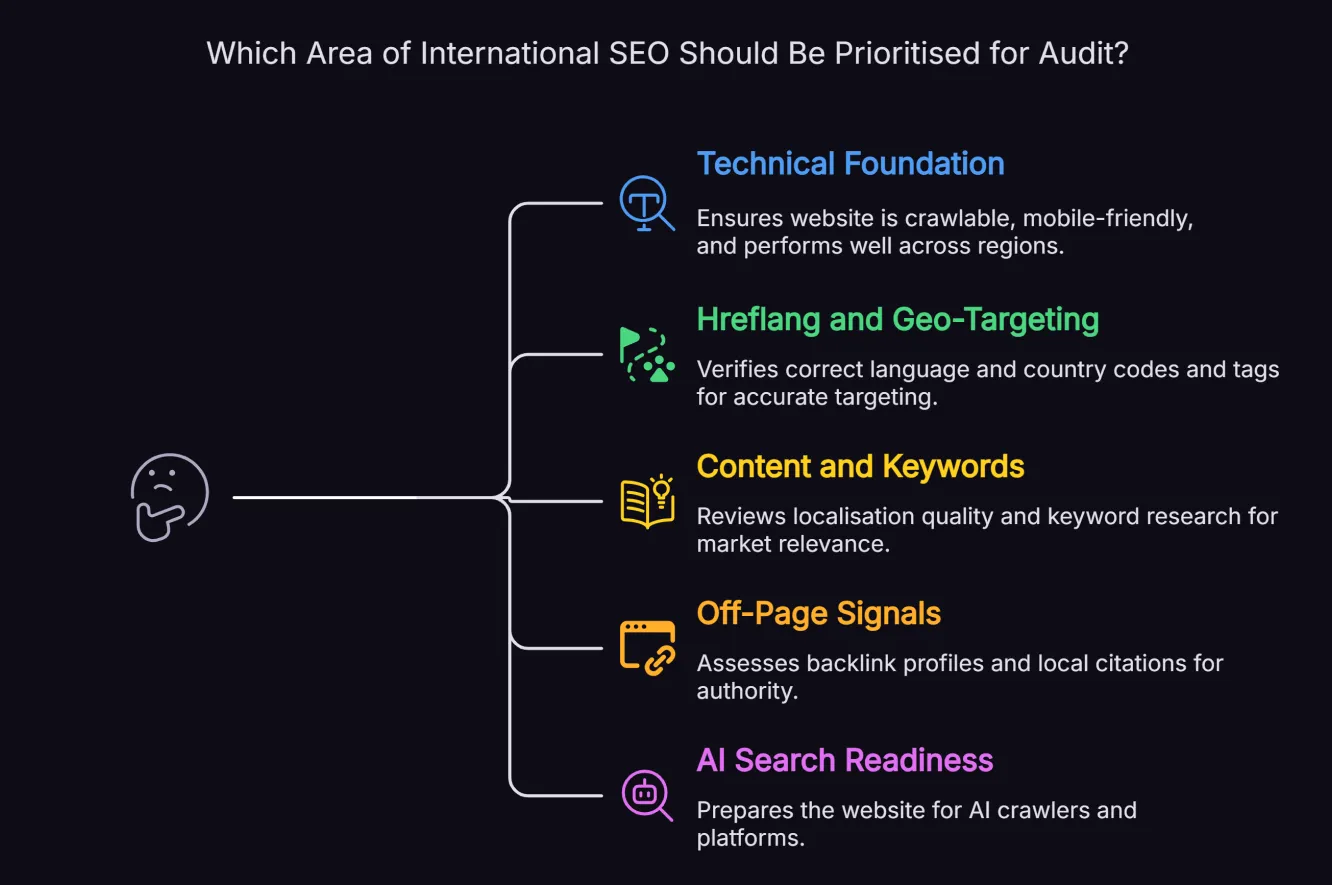
A thorough international SEO audit covers five interconnected areas. Missing any one of them creates blind spots that undermine your global search performance.
1. Technical SEO Configuration
Technical SEO forms the foundation of international search visibility. Without correct technical implementation, even the best-localised content will not reach the right audiences.
The audit begins with crawling your entire site architecture to map how pages are connected across languages and regions. This reveals orphaned pages, broken internal links between language versions and indexation issues that prevent specific market pages from appearing in search results.
Key technical elements to evaluate include:
- XML sitemap structure (separate sitemaps per language or region)
- Robots.txt configuration for each domain or subdirectory
- Page load speed across geographic regions using CDN performance data
- Mobile rendering across different device preferences by market
Server response codes across all language versions must return 200 status codes. Any 3xx, 4xx or 5xx responses on hreflang-annotated URLs create cascading errors. The 2,402 broken-hreflang finding I described earlier is exactly this category of error compounded at enterprise scale.
For enterprise websites with thousands of pages across multiple markets, technical auditing requires systematic crawling tools and structured data validation at scale.
2. Hreflang Implementation Audit
Hreflang is the most critical and most frequently broken technical element in international SEO. These HTML attributes tell search engines which language and country version of a page to serve to users in specific locations.
Search Engine Land analysis of 18,786 websites with hreflang implemented in the <head> found that:
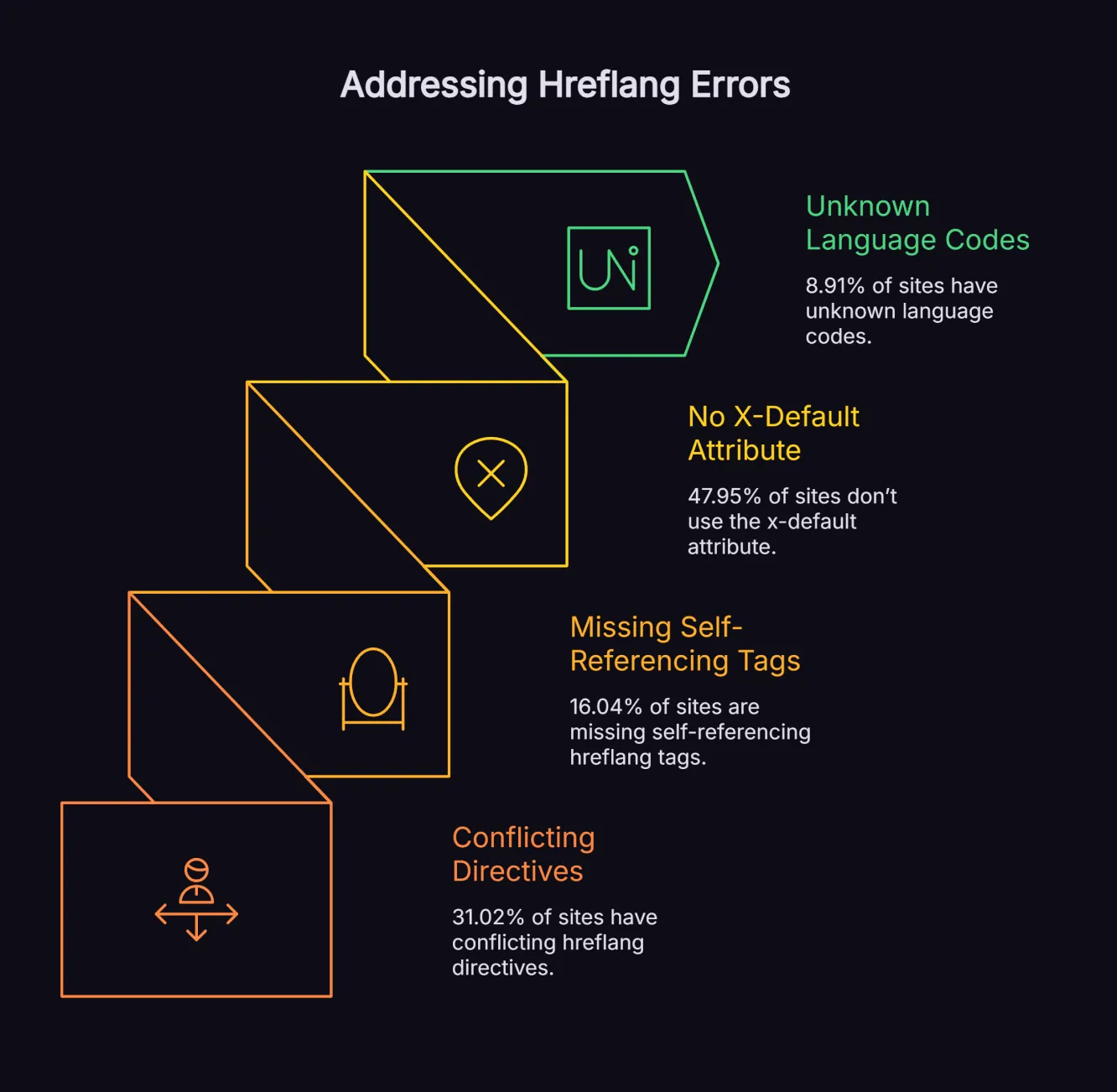
- 31.02% of sites serving multiple languages have conflicting hreflang directives
- 16.04% of multilingual sites are missing self-referencing hreflang tags
- 47.95% of multilanguage sites do not use the x-default attribute
- 8.91% of sites targeting more than one language have unknown language codes in their hreflang attributes
Missing return tags are among the most common hreflang implementation mistakes, and conflicts between canonical and hreflang tags can cause search engines to ignore your intended regional targeting.
The audit should document every hreflang error by page, categorise them by severity and map dependencies so fixes can be implemented in the correct order. In the engagement I cited earlier, separating the 2,402 broken URLs into clusters (URLs that never existed versus URLs that had been removed versus URLs with bidirectional return-tag mismatches) was what turned an unmanageable error pile into a sequenced fix list.
3. URL Structure Analysis
Your URL architecture determines how search engines understand the relationship between your market-specific pages. Three primary approaches exist, each with distinct trade-offs.
- Country-code top-level domains (ccTLDs): Such as example.com.au, example.de, and example.co.uk provide the strongest geo-targeting signal. Search engines automatically associate these domains with their respective countries. However, each domain builds authority independently, meaning link equity does not transfer between them. This approach requires the highest investment in domain management and separate SEO campaigns per market.
- Subdirectories: Such as example.com/au/, example.com/de/ and example.com/en-gb/ consolidate all markets under a single domain. Link authority accumulates on one root domain, making this the most efficient structure for building domain strength. Geo-targeting is configured through Google Search Console and hreflang tags. This is the most common approach for businesses scaling across multiple markets.
- Subdomains: Such as au.example.com and de.example.com sit between the two options. They offer some geo-targeting flexibility, but search engines may treat them as separate sites, diluting authority. Most SEO professionals recommend against this approach for new international rollouts.
The audit evaluates whether the current URL structure aligns with your business goals, market priorities and resource capacity. It also checks for inconsistencies (such as some markets using subdirectories while others use ccTLDs) that create confusion for both search engines and users.
4. Content Localisation Quality
Translation and localisation are not the same thing. Translation converts words from one language to another. Localisation adapts content to reflect local search behaviour, cultural expectations and market-specific terminology.
The most overlooked failure mode in this space is the same-language localisation gap. On the engagement I cited above, the source market and the target market both spoke English, but the search behaviour, terminology, compliance vocabulary and competitor landscape were materially different. A page that ranked well in the source market did not rank in the target market for the equivalent query, because users in the target market searched using different terms for the same product. Translation gets you nothing in that situation. Localisation, including market-specific keyword research and content rewrites, is what closes the gap.
An international SEO audit evaluates content localisation across several dimensions:
- First, keyword research must be conducted independently for each market. Direct translation of English keywords rarely matches how users in other markets actually search. German users search differently from Austrian users despite sharing a language. Brazilian Portuguese search patterns differ significantly from European Portuguese.
- Second, the audit examines whether the content addresses market-specific needs. A product page that works for the Australian market may need entirely different benefit messaging for the Japanese market based on local purchasing priorities and competitive landscape.
- Third, meta titles, descriptions and structured data must be localised, not just translated. These elements directly impact click-through rates from search results and influence how AI search platforms extract and present your content to users in each market.
- Fourth, content depth and topical coverage should reflect topical authority requirements per market. Thin translated pages that merely mirror your primary market content rarely build the authority signals needed to compete against established local competitors.
5. Regional Backlink Profile Assessment
Backlinks remain a core ranking factor and their value in international SEO is market-specific. A link from a high-authority Australian website helps your Australian rankings but does little for your German market visibility.
The audit maps your backlink profile by target market, identifying which markets have strong external link support and where gaps exist. It evaluates the relevance and authority of linking domains within each region, checks for toxic or spammy links that could trigger penalties in specific markets and identifies link-building opportunities from local directories, industry publications and regional media outlets.
For businesses with eCommerce operations spanning multiple markets, the regional backlink assessment often reveals that organic growth has stalled in markets where the backlink profile is thin, even when on-page content is well optimised.
Step-by-Step International SEO Audit Process
Following a structured process ensures nothing gets missed and creates a clear prioritisation framework for implementation.
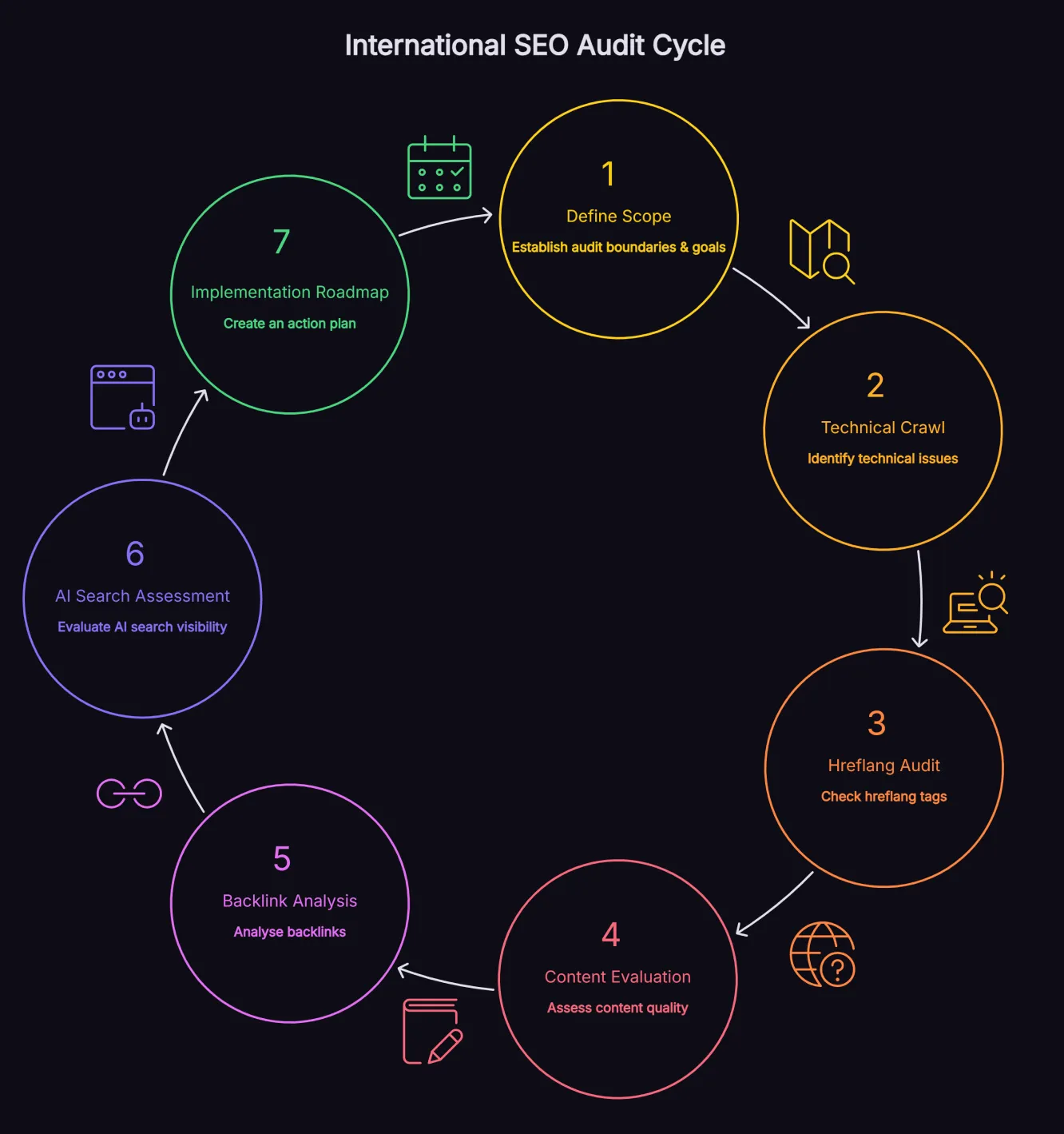
Step 1: Establish Audit Scope and Benchmarks
Before crawling a single page, define exactly what the audit covers:
- Document all target markets, languages, and regional variations
- Map the complete URL structure and note any inconsistencies
- Pull current organic traffic, keyword rankings, and conversion data per market from Google Analytics and Google Search Console as baseline benchmarks
This step also involves identifying which markets represent the highest revenue opportunity. The 75% traffic concentration finding I mentioned earlier is the kind of pattern that surfaces here. If two pages account for the majority of organic visits in a target market, the audit's prioritisation needs to start from the protection of those pages, not from a flat technical-severity ranking.
Step 2: Run a Comprehensive Technical Crawl
Use a site-crawling tool to audit the complete site across all language versions simultaneously. The crawl should capture:
- Hreflang annotations
- Canonical tags
- HTTP status codes
- Page load times
- Internal link structures
- Indexation status for every URL
Configure the crawl to respect market-specific settings. Some regions may have different robots.txt rules, different CDN configurations or different JavaScript rendering requirements. Cross-reference the crawl data against your XML sitemaps to identify pages that are listed but not crawlable, or crawlable but not listed.
Step 3: Audit Hreflang and Geo-Targeting Configuration
With crawl data in hand, systematically validate every hreflang annotation:
- Check that all language and country codes follow ISO standards
- Confirm bidirectional return tags exist for every page pair
- Verify that self-referencing tags are present on all pages
Cross-reference hreflang annotations with canonical tags to identify conflicts, then spot-check live search results in each target market to confirm that the correct regional URLs are being indexed and shown. Because Google has deprecated the International Targeting / country-targeting settings in Search Console, you can no longer rely on them for geo-targeting configuration or error reporting.
Instead, make sure the following consistently reinforce the intended country or region for each URL set:
- Your ccTLD or subfolder structure
- Technically valid hreflang clusters
- Strong local signals (on-site addresses, currencies, phone numbers, and internal links)
Step 4: Evaluate Content Quality Across Markets
Assess each market's content independently rather than comparing translations against the source.
- Review keyword mapping per market to confirm that target keywords reflect genuine local search demand
- Evaluate content depth against top-ranking competitors in each regional search engine, not just against your own primary market content
Check for duplicate content issues between similar language versions (such as US English and Australian English or European Spanish and Latin American Spanish). These near-duplicate pages often compete against each other in search results, splitting ranking signals.
Step 5: Analyse Regional Backlinks and Off-Page Signals
Pull backlink data for each market-specific URL set:
- Compare link velocity, referring domain diversity and topical relevance across markets
- Identify which markets have sufficient external authority to compete and where targeted link acquisition campaigns are needed
Map competitor backlink profiles in each target market to understand what a competitive link profile looks like locally. This often reveals that top-ranking local competitors have fundamentally different backlink compositions than your primary market.
Step 6: Assess AI Search Visibility Across Markets
Most international SEO audits we see (including ours, in earlier years) used to stop at Google organic rankings. AI search platforms like ChatGPT, Google AI Overviews and Perplexity are now significant traffic drivers, with AI referral traffic growing 357% year-on-year in 2025. We have updated our methodology accordingly.
The Rankmax AI-inclusive audit step:
- Runs branded query spot checks across ChatGPT, Perplexity and Google AI Overviews from each target market's regional perspective
- Checks whether AI crawlers (such as GPTBot and ClaudeBot) are blocked in robots.txt for any market-specific URL path
- Evaluates schema markup consistency across language versions
- Confirms whether each market's pages are structured for passage optimisation so AI platforms can extract self-contained citation-ready answers
- Flags content that exists in the source market but has not been adapted for the target market's AI-citation patterns
This is where most international SEO audits fall short, and where most of the citation upside currently sits. Businesses that include AI search analysis in their international audits gain a meaningful competitive advantage because most competitors have not yet adapted their global content for AI visibility.
Step 7: Prioritise Findings on Revenue Impact
Compile all findings into a prioritised action plan. The methodology that has produced our best client outcomes is revenue-based prioritisation: every issue gets ranked by the dollar revenue at risk if left unfixed, not by raw technical severity.
In practice that means:
- Group issues by impact (high, medium, low) and effort (quick wins, medium projects, major initiatives)
- Sequence fixes logically. Resolving hreflang errors before launching new market content prevents new pages from inheriting existing problems
- Assign clear ownership for each action item
- Establish measurement milestones
The goal is not just a list of problems but a structured plan that connects each fix to expected revenue improvements in specific markets. On the engagement I cited at the top, the prioritisation flipped the team's instinct: the 2,402 hreflang errors were technically the largest single issue, but the higher-revenue-priority fix was protecting the two pages that carried 75% of the target-market traffic during the migration window. Both got done. Sequencing mattered.
Three Modes of International Audit Failure
Across our international audits, three patterns account for almost every failed engagement we see (whether ours or one we inherit from a previous agency).
1. Volume Over Value
The audit produces hundreds of findings ranked by technical severity, with no commercial weighting. The team executes the top of the list and runs out of budget before reaching the issues that actually move revenue. Every audit needs a revenue-mapped prioritisation layer or it produces a backlog rather than an outcome.
2. Technical SEO in Isolation
The audit treats hreflang, schema and crawl issues as ends in themselves, divorced from the content and authority work needed to make them count. A site with perfectly implemented hreflang and weak market-specific content still fails to rank. The audit needs to evaluate the technical, content and authority layers as one system.
3. Ignoring AI Search
The audit reports on Google rankings only. Even in 2026, this is the most common gap I see in inherited audits. AI referral traffic is now a measurable growth channel, and the methodology needs to include it explicitly. Step 6 above is not optional.
If an international SEO audit you have received does not address all three of these failure modes, the audit is incomplete regardless of how thick the deliverable is.
How AI Search Changes International SEO Audits
The rise of AI-powered search has added new dimensions to international SEO auditing that traditional frameworks do not cover.
Why AI Overviews Change First-Page Visibility
AI Overviews now appear in 88% of informational queries, meaning that for many search terms, the AI-generated summary is the first thing users see. International sites must ensure their content is structured to be selected as a source for these summaries in each target market.
AI search platforms evaluate content differently from traditional algorithms. They prioritise clear, well-structured passages that directly answer specific questions. For international sites, this means each language version needs content that stands on its own as a definitive source, not just a translated version of content optimised for another market.
What AI-Ready International Content Requires
AI SEO strategy for international sites should focus on:
- Ensuring consistent entity markup across languages
- Implementing FAQ schema in each market's language
- Structuring content with clear passage-level answers that AI platforms can extract and cite regardless of language
The audit should also evaluate how AI platforms currently handle your brand across markets. Search your brand name and key product terms in ChatGPT, Perplexity and Google AI Overviews from different regional perspectives. The results often reveal that AI platforms present inconsistent or incomplete information about your business across markets, information that a well-structured international content marketing strategy can correct.
International SEO Audit Checklist
Use this checklist to ensure your audit covers every critical element.
Frequently Asked Questions
Why do smaller international sites often have more issues per page than enterprise sites?
In our audits, smaller international footprints (sites targeting two or three countries) often have proportionally more issues than enterprise multi-market sites because they receive less technical attention. Enterprise sites have dedicated SEO and dev resources monitoring hreflang at scale; smaller sites typically inherit a config from a previous agency or in-house attempt and never re-validate it. The 2,402 broken-hreflang finding I described above happened on an enterprise site, but the per-page error rate was actually lower than what we typically see on a 200-page two-market site. Scale hides the issues; smaller sites just expose them faster.
How often should you conduct an international SEO audit?
A comprehensive international SEO audit should be conducted at least once every twelve months. However, businesses actively expanding into new markets or making significant website changes should audit more frequently, quarterly during high-growth periods. Between full audits, monthly monitoring of hreflang errors, indexation status and organic traffic per market through Google Search Console catches issues before they compound. AI search visibility should be reviewed quarterly as platforms update their content selection algorithms regularly.
What is the difference between an international SEO audit and a standard SEO audit?
A standard SEO audit evaluates a single website's technical health, content quality and backlink profile for one market. An international SEO audit adds layers of complexity, including hreflang validation, multi-market keyword research, content localisation assessment, regional backlink analysis and geo-targeting configuration across multiple countries and languages. It also evaluates how search engines and AI platforms handle content routing between language versions, ensuring the right content reaches the right audience in each market. The international audit requires expertise in language-specific search behaviour, regional search engine differences and cross-market technical configuration that standard audits do not cover.
Audit Before You Launch, Not After
An international SEO audit keeps your pages from competing with each other and helps every market version rank where it should. Fix technical configuration, content localisation, regional authority and AI search readiness so your visibility keeps pace as search evolves. If international traffic is underperforming or expansion is on the roadmap, start with the audit and then partner with an international SEO company to turn the findings into a clear, market-by-market action plan. Get the fundamentals right now and you will build momentum internationally while competitors are still untangling hreflang and misrouted pages.
About the Author
Want Insights Like This Fortnightly?

Our AI SEO strategies and tactics delivered fortnightly, including bonus trade secrets not shared anywhere else. No fluff. Just what's working right now. 5-minute read.


