
AI SEO Consultant: How to Hire One Who Can Prove AI Citations and Revenue in 2026

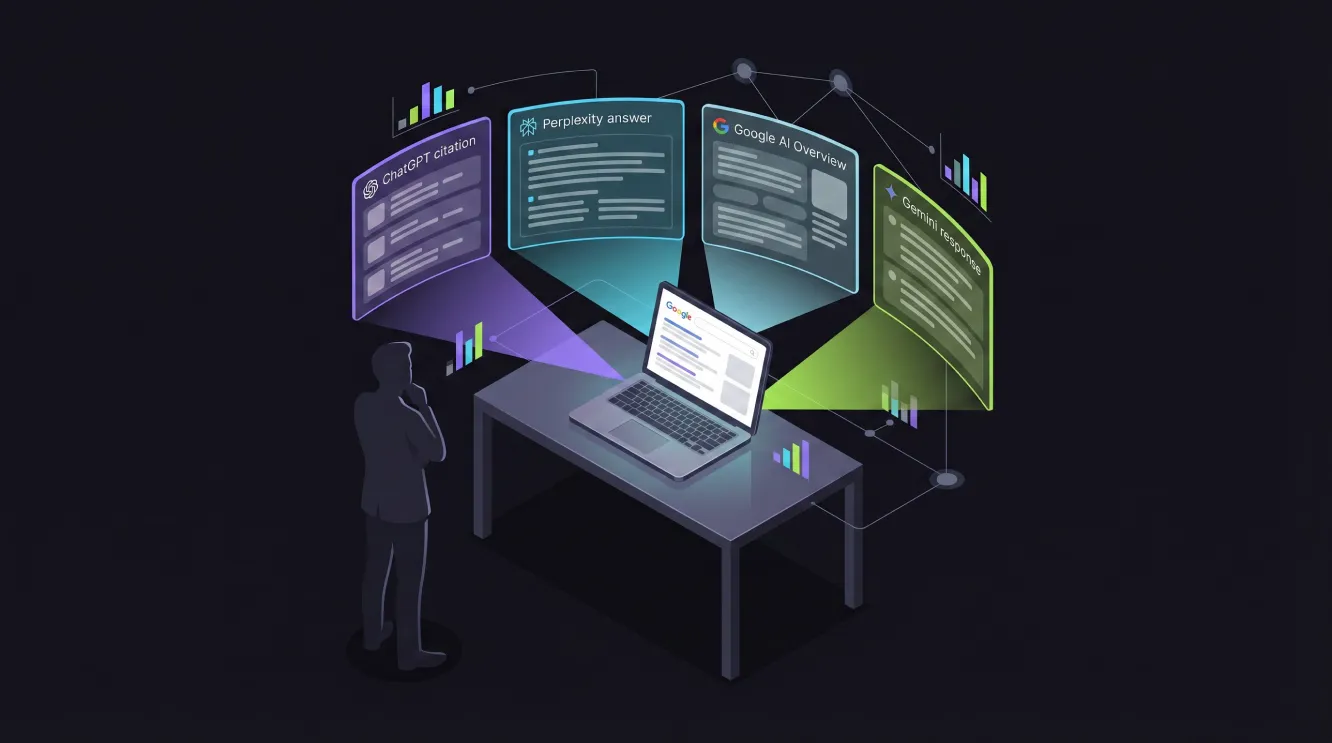
Hiring an AI SEO consultant is a different decision from hiring a traditional SEO. Search behaviour has shifted so far that optimising only for blue links now leaves most mid-market brands invisible on the channels their buyers actually use. ChatGPT serves over 900 million weekly active users, AI Overviews appear in 25.11% of Google searches as of Q1 2026, and Adobe reported that AI-driven referral traffic to U.S. websites increased more than tenfold between July 2024 and February 2025. The right consultant helps you get cited by ChatGPT, Perplexity, Gemini and Google AI Overviews while protecting the Google rankings and revenue you already have. This guide breaks down what an AI SEO consultant actually does, what to pay, what to ask, and how to measure return based on the $26M+ of client revenue we have generated doing this work.
A Quick Guide to AI SEO Consultants
An AI SEO consultant is a specialist who optimises your website, content and entity signals so you rank in Google and get cited by AI platforms like ChatGPT, Perplexity, Gemini and Google AI Overviews. The role combines traditional SEO fundamentals with new skills: entity modelling, passage-level optimisation, schema engineering and AI citation tracking. A good AI SEO consultant ties every deliverable to revenue, not vanity metrics, and reports on Google rankings and AI visibility in the same dashboard.
Why Your Business Needs an AI Search Strategy Now
AI Overviews now appear in 25% of Google searches, and AI-referral traffic grew tenfold between July 2024 and February 2025. The brands building visibility across Google and AI platforms first are harder to displace later. We have built AI SEO into the core strategy from day one for clients in property management, compensation claims, SaaS and eCommerce.
Explore AI SEO Strategy ServicesWhat We Have Delivered as AI SEO Consultants
Before the playbook, the proof. The Rankmax engagements we have led have produced more than $26M in attributed client revenue across Google, AI Overviews, ChatGPT, Perplexity, Gemini and Copilot. Three campaigns make the numbers concrete:
- A B2B property management client has earned 598 AI cited pages over 27 months and counting and has attributed about $8.7M over 27 months and counting; the 17-month climb window attributed $5.9M at a 6,864% average ROI.
- A B2C compensation claims client has generated about $14.6M in attributed revenue at a 14,738% average monthly ROI over 21 months and counting, with 477 AI cited pages and a #1 market position in their category.
- A SaaS client delivered $1.31M in organic revenue in 12 months at a 20.1:1 ROI (1,909% return) using the same AI-first content methodology.
That is the bar to vet against when you read the rest of this guide. If a consultant cannot point at named verticals, named platforms and named revenue contributions, you are paying for category description rather than execution.
What Does an AI SEO Consultant Do?
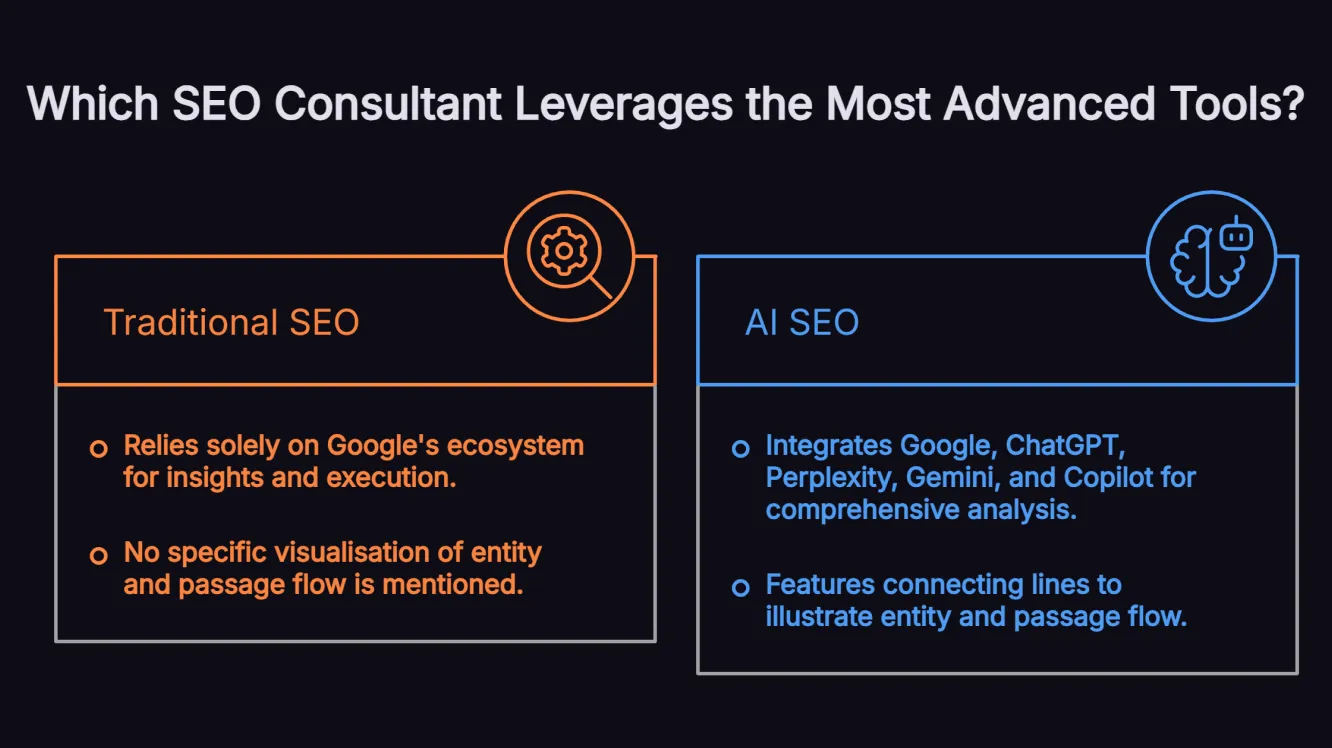
An AI SEO consultant delivers four interconnected workstreams that most generalist consultants are not equipped to handle. Each workstream is designed to protect your existing Google rankings while building visibility in the AI platforms where zero-click answers now dominate.
Audit Your Visibility Across Google and AI Platforms
A proper AI SEO audit maps your position across traditional search and every major AI surface. We pull organic performance data, run a technical crawl, check your schema markup, review your E-E-A-T signals, and run spot checks in ChatGPT, Perplexity, Gemini and Google AI Mode for your core commercial queries. The output is a diagnostic that shows exactly:
- Where you are visible
- Where you are missing
- What the opportunity is worth
At Rankmax, this diagnostic work feeds directly into the broader AI SEO strategy process.
Build an AI SEO Strategy Mapped to Revenue
Strategy is where most generalist consultants fall short. An AI SEO specialist translates audit findings into a 12-month roadmap that covers:
- Keyword clustering
- Topical authority mapping
- Technical fixes
- Schema upgrades
- E-E-A-T improvements
- Content silos
At Rankmax, we prioritise the roadmap using four filters: commercial intent, current ranking proximity, AI citation opportunity and implementation effort. That keeps the strategy focused on pages that can realistically influence revenue, not just topics that look good in a keyword export.
The strategy forecasts revenue impact at 3, 6 and 12-month milestones so finance teams can approve the budget with confidence. Our AI SEO Strategy service delivers a unified roadmap that optimises for Google, ChatGPT, Perplexity and AI Overviews inside a single integrated plan.
Write Non-Commodity Content for Readers and Structure It for AI Extraction
Original, non-commodity content is the foundation. AI platforms cite pages that human readers find valuable in the first place, and a model will not cite content that fails the human reader test. The work starts with first-hand experience, original data, and the kind of voice that earns the read.
The second layer is structural. AI platforms do not read a page the way a human does, they extract passages. When a buyer types a question into Google AI Mode, ChatGPT or Perplexity, the model typically splits the query into roughly 5 to 11 related sub-queries, retrieves content for each in parallel, then synthesises an answer. Original content structured cleanly for that retrieval pattern gets cited; buried under generic intros, it gets passed over.
Two specifics shape how we write for that:
- Ahrefs reports that 44.2% of ChatGPT citations come from the first 30% of a piece of content. We put a complete, citation-ready answer in the opening of every section rather than burying it under throat-clearing context.
- Headings are written as the sub-queries an LLM is likely to fan out into, with short, factual answers immediately underneath. That structure protects you on the long tail of related questions, not only the head keyword.
Passage optimisation is now as important as keyword targeting. The two move together.
Track AI Citations Alongside Google Rankings
Traditional consultants report on rankings, traffic and conversions. An AI SEO consultant adds three new layers:
- AI citation rate (how often the brand is named in AI answers)
- AI Share of Voice (versus competitors in the same prompt set)
- Referral traffic from AI platforms (and the conversion rate it produces)
That conversion lens matters more than the volume. AI-referred visitors convert 23x higher than organic search visitors in our data, which makes AI citation a disproportionately valuable channel for high-consideration purchase decisions. For tracking, we use Ahrefs Brand Radar, which monitors 405+ million prompts across seven AI platforms, including Claude.
In practical reporting, we separate this into prompt groups, cited URLs, competing brands, platform-level visibility, AI Share of Voice and downstream AI referral conversions. That stops AI visibility from becoming a vanity metric and shows which citations are actually tied to the pipeline. Without this layer, you cannot prove ROI on the AI search work and you cannot make informed decisions about where to invest next. AI referral traffic now accounts for 1.08% of all website traffic and is growing roughly 1% month over month, with ChatGPT driving 87.4% of it. Small numbers, real money, and growing fast.
AI SEO Consultant vs Traditional SEO Consultant
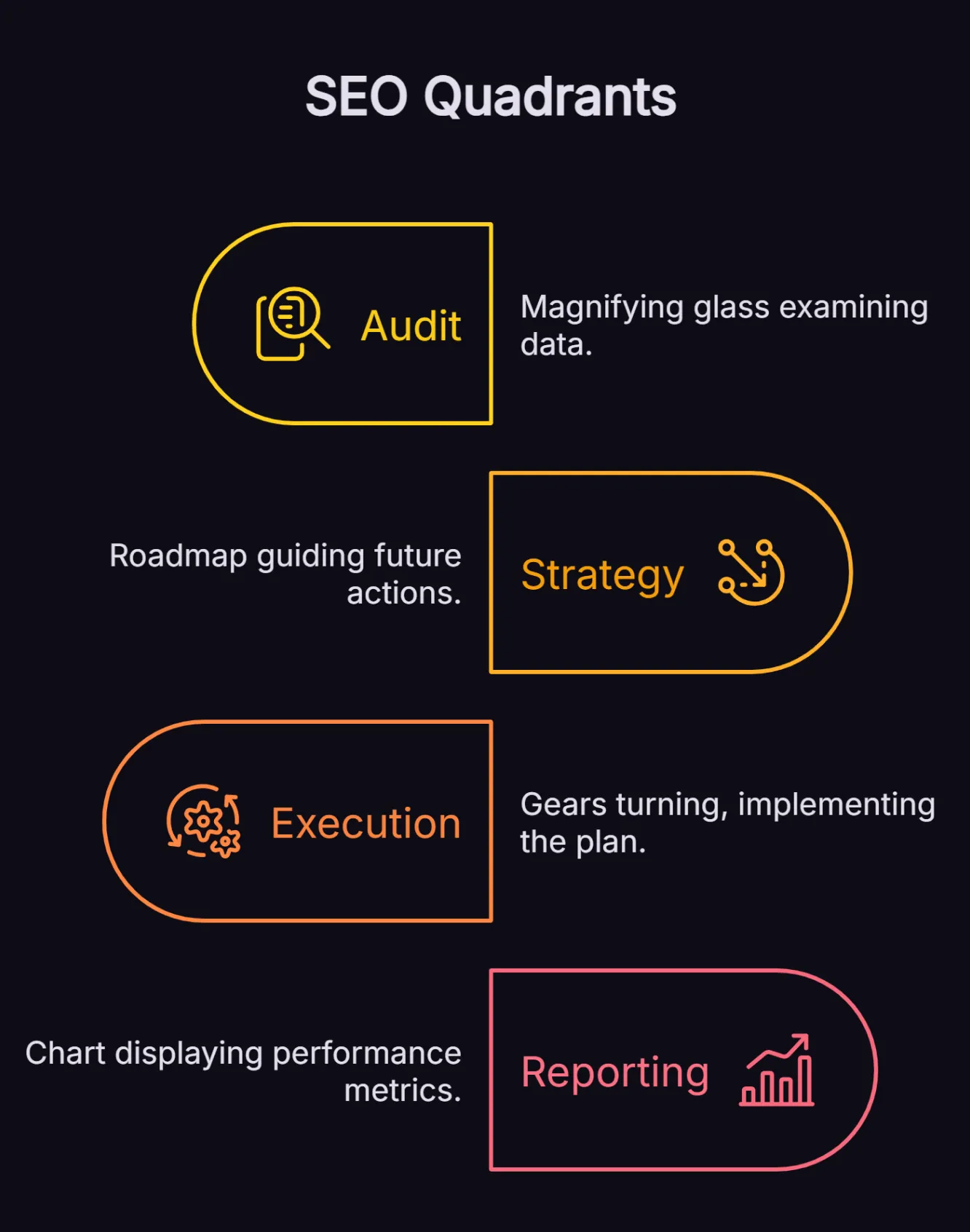
The difference is not cosmetic. Traditional SEO optimises pages for keyword rankings. AI SEO optimises entities, passages and citations for discovery across Google and LLMs. A traditional consultant writes content that ranks for "best accounting software." An AI SEO consultant writes content that ranks for "best accounting software" and gets cited when a CFO asks ChatGPT "what accounting software should a manufacturing business use."
Here is how the roles compare in practice:
| Dimension | Traditional SEO Consultant | AI SEO Consultant |
|---|---|---|
| Primary goal | Rank in Google's blue links | Rank in Google and get cited by AI platforms |
| Content approach | Keyword-matched articles | Passage-optimised, entity-rich content |
| Technical focus | Crawlability, Core Web Vitals | Crawlability, Core Web Vitals, schema, and search/bot controls for Google and AI platforms |
| Authority signals | Backlinks , Domain Rating | Backlinks plus branded mentions, entity associations |
| Reporting | Rankings, organic traffic, conversions | Rankings, AI citations, AI Share of Voice, AI referral traffic, revenue |
| Research tools | Ahrefs , Semrush , GSC | Ahrefs, Semrush, GSC, plus Ahrefs Brand Radar |
Traditional SEO still matters. SE Ranking's research found that Google visibility is the strongest predictor of AI Mode citations, while referring domains matter more for ChatGPT citations, which means your Google rankings feed your AI visibility. The two disciplines are not in competition. They are layers of the same strategy, and a capable AI SEO consultant covers both.
How an AI SEO Consultant Delivers Revenue
Revenue-focused AI SEO follows a repeatable sequence. The exact playbook varies by industry and starting point, but the four phases below apply to most mid-market engagements we have run. The structure keeps strategy, execution and measurement tightly linked to commercial outcomes.
Phase 1: Diagnose the Gaps With a Data-Led Audit
The audit phase combines three data sources:
- Technical crawl data from Screaming Frog
- Search performance data from Google Search Console and Analytics
- AI visibility data from prompt testing across ChatGPT, Perplexity, Gemini and Copilot, plus Ahrefs Brand Radar coverage
We cross-reference these to separate current issues from historical ones, map content gaps against competitor coverage, and quantify the revenue opportunity locked behind each fix.
A thorough audit covers:
- Organic baseline
- Technical health
- On-page factors
- Content gaps
- AI visibility
- E-E-A-T signals
- Competitor landscape
- Backlink profile
- Opportunity sizing
Phase 2: Build the Strategy and Revenue Forecast
Strategy is where raw audit findings become a 12-month commercial plan. In this phase, we:
- Run keyword research across Google and AI platforms
- Cluster the results by search intent
- Map each cluster to a silo in your content architecture
- Prioritise the schedule based on revenue potential
We then build forecasts for 3, 6 and 12-month milestones. This is the document that gets signed off by the CFO, not just the marketing team.
Phase 3: Execute Content, Schema and Authority Work
Execution is the longest phase and is where most engagements fail. Done right, the consultant:
- Publishes AI-optimised content on a predictable cadence
- Implements schema across every page type
- Resolves technical issues in priority order
- Builds AI-ready authority signals through digital PR, guest placements and brand mentions
Clients can begin seeing improvements in Google rankings and AI Overview visibility within the first few months of the execution phase, depending on the competition, site authority and implementation speed.
Phase 4: Report, Refine, Compound
Monthly reporting ties every input to an output:
- Rankings gained
- Keywords won
- AI citations earned
- Traffic generated
- Revenue attributed
We use this data to refine the roadmap each quarter.
ROI in this work compounds because authority, content depth and entity recognition stack on each other. The three campaigns we referenced earlier show the shape of that compounding:
- The B2B property management engagement reached 598 AI cited pages across Google AI Overviews, ChatGPT, Gemini and Copilot over 27 months and counting. The mechanism behind the citation count was a content programme built around verifiable client results, original data, and consistent author profiles, supported by a property-management book the founder had authored. Revenue attribution reached about $8.7M over 27 months and counting; the 17-month climb window closed at $5.9M at a 6,864% average ROI, and visibility rose from 4,973 to 26,313 organic search users.
- The B2C compensation claims engagement has generated about $14.6M in attributed revenue over 21 months and counting at a 14,738% average monthly ROI, with 477 AI cited pages as the current stack, while early coverage still noted 54 Google AI Overview citations and a #1 market position. The campaign moved 248 new clients through organic search at a 15% conversion rate, with PTSD compensation and permanent impairment claims as the strongest commercial-intent clusters.
- The SaaS engagement delivered $1.31M in revenue in 12 months at a 1,909% ROI. The conversion mix split 40% early touchpoint, 13% mid, 47% late, which tells you AI SEO is not only a top-of-funnel play.
What the three campaigns share is full metric transparency. If a consultant pitches you a case study without a named vertical, a named platform mix and a named revenue contribution, treat it as a marketing graphic, not a result.
How Much Does an AI SEO Consultant Cost?
AI SEO consultant pricing in 2026 reflects the specialist skill required. Pricing varies by geography, scope and delivery model, but AI SEO specialists typically sit at the higher end of SEO pricing because the work combines technical SEO, content engineering, and AI visibility strategy.
Project-based engagements, such as a one-time AI SEO audit, are scoped to site size and competitive complexity.
For ongoing work, scope usually falls into one of three bands:
- Strategic Advisory (consultant-led, in-house execution): strategic guidance, monthly reviews and quarterly roadmap updates, with your team doing the build
- Mid-market managed service: strategy, content production, technical implementation and reporting handled end to end
- Enterprise engagements: complex multi-brand, multi-market programmes with deeper technical and content capacity
Here is what we actually see delivered at each scope band in the wild, from observing dozens of engagements either as incoming consultants or by reviewing what clients had bought previously:
- Light freelance holding pattern: usually a generic keyword report and a handful of low-quality backlinks. No technical depth, no AI visibility work, no revenue attribution. Progress is slow and the opportunity cost is high.
- Basic technical-only retainers: basic technical work and templated, automated reporting. No real content production at this tier. Acceptable as a holding pattern for a low-priority site, but rarely enough to move the commercial needle.
- Light content plus advisory: very light content work, often delivered as content briefs you produce in-house, plus a small amount of link building and technical advisory. Real content production is usually still out of scope.
- Full-stack done-for-you: technical implementation, content production, link building, and AI citation tracking through Brand Radar or equivalent, all delivered hands-free. This is the tier the three case studies above sit in.
The economics of consultant-led AI SEO work best for businesses with $2M to $100M in revenue, a defined target market and a real budget for ongoing content and technical work. Below that threshold, the fixed costs of expert advisory rarely produce enough return to justify the spend.
Questions to Ask Before Hiring an AI SEO Consultant
The right questions separate genuine AI SEO expertise from generalist consultants who have added AI to their homepage. We use this list on every discovery call.
- Can you show specific AI Overview or ChatGPT citations you have secured for clients in the last 12 months?
- How do you track AI Share of Voice and citation rate across platforms?
- What does your keyword research process look like for AI search versus traditional search?
- How do you structure content for passage extraction and query fan-out?
- What schema types do you implement as standard, and why?
- How do you build entity signals for brands that do not yet have a strong Wikipedia or knowledge graph presence?
- What is your process when an algorithm or AI platform update causes a visibility drop?
- How do you connect organic performance to revenue in your reporting?
- What proportion of your client base uses AI SEO as a primary strategy versus a bolt-on service?
- What case studies can you share with full revenue attribution, not just traffic graphs?
If a consultant fumbles questions 1, 8 or 10, they are selling category description rather than execution.
What to Expect From a Great AI SEO Consultant
Working with a strong AI SEO consultant should feel different from a traditional SEO engagement in four ways.
- The reporting is broader. You see rankings, traffic and revenue alongside AI citation counts, AI Share of Voice and AI referral traffic.
- The content is engineered for extraction. Headings cover the sub-queries an LLM fans out into, and the first 30% of every section is written to be quotable.
- The schema and technical work includes AI crawler access, entity optimisation and citation-ready structured data.
- The strategy is tied explicitly to commercial milestones with 3, 6 and 12-month targets your CFO can validate.
Expect the consultant to be direct about what will not work. Ahrefs' analysis of 75,000 brands found that branded web mentions correlate more strongly with AI Overview visibility than traditional link metrics, but that does not make backlinks irrelevant. Traditional link building still matters, especially when paired with brand mentions, entity development and content depth. A consultant worth hiring will tell you that, then design a programme that covers backlinks, branded mentions, entity development and content depth in parallel.
FAQs: AI SEO Consultants
Is an AI SEO Consultant Different to a GEO or AEO Specialist?
GEO and AEO are narrower framings that sit inside the broader practice of AI SEO. A GEO specialist tends to focus on getting content cited inside generative answers. An AEO specialist focuses on direct-answer visibility. An AI SEO consultant covers both, plus traditional Google SEO, in one integrated practice. For most businesses, a single AI SEO consultant is more efficient than hiring separate specialists.
How Long Does It Take to See Results From an AI SEO Consultant?
Technical fixes and on-page improvements can begin influencing rankings within the first few months. Content-led growth may improve Google rankings and AI Overview visibility over time, depending on competition, site authority and implementation speed. Significant revenue impact usually compounds over 6 to 12 months. The B2C compensation claims engagement is at about $14.6M attributed revenue over 21 months and counting (the early 11-month mark was $7.7M). The B2B property management engagement compounded to about $8.7M over 27 months and counting. Past the 12-month mark, ROI tends to scale because authority, content depth and entity recognition all compound.
Can a Small Business Afford an AI SEO Consultant?
In our experience, the economics of consultant-led AI SEO work best for businesses in the $2M to $100M revenue range, with a defined commercial query set and the budget to publish original content monthly. Below that threshold, the fixed costs of expert advisory rarely produce enough return. If you are under $2M in revenue but want to start building AI visibility, a one-off AI SEO strategy diagnostic is a lower-cost entry point than a retainer and a clearer answer than DIY templates.
What Tools Does an AI SEO Consultant Use?
In our stack: Semrush for keyword research, backlinks and AI visibility monitoring; Screaming Frog for technical crawling; Google Search Console and Analytics for performance data; manual prompt testing across ChatGPT, Perplexity, Gemini and Copilot; and schema validators for structured data. The tool list is important but secondary. Strategic thinking and execution discipline matter more than the software.
Do I Need an AI SEO Consultant If My SEO Is Already Working?
Yes, but the urgency depends on your sector. If you are already ranking well in Google and your industry has low AI search adoption, you have time to build AI visibility progressively. If your competitors are already getting cited in AI Overviews for your core commercial queries, every quarter of delay widens the gap. A short AI visibility audit is the fastest way to know where you stand.
What Is the Difference Between Hiring an AI SEO Consultant and an AI SEO Agency?
A consultant typically delivers strategy, advisory and high-level execution while your in-house team handles production. An agency takes on the full execution, including content, technical implementation, link building and reporting. Consultants work well for businesses with strong internal marketing capacity. Agencies suit businesses that want fully managed delivery. We offer both models depending on the client's needs.
How Do I Measure the ROI of AI SEO Work?
We measure ROI across four layers. First, organic revenue attributed to content and rankings. Second, AI referral traffic and the conversions it produces, noting that AI-referred visitors convert 23x higher than organic search visitors in our data. Third, AI citation count and Share of Voice for your target commercial queries. Fourth, the lifetime value of customers acquired through organic and AI channels. A good consultant builds all four into monthly reporting, not just an annual review.
Choose the Consultant Who Can Prove It
Search now spans Google's blue links, AI answers, and LLM platforms that shape what buyers see first. The brands winning in 2026 are the ones building visibility across that full surface with a strategy tied to revenue, not just rankings. The right AI SEO consultant should show clear case studies, real commercial results, and a plan that fits your market. If you want a benchmark for what that looks like, the B2B, B2C and SaaS case studies are the work.
About the Author
Want Insights Like This Fortnightly?

Our AI SEO strategies and tactics delivered fortnightly, including bonus trade secrets not shared anywhere else. No fluff. Just what's working right now. 5-minute read.


