
Search Intent in 2026: How to Match Content to User Intent Across Google and AI Search


Every search query is a signal. Behind every keyword typed into Google, ChatGPT, or Perplexity is a person with a specific goal - and search intent is your map for reaching them at exactly the right moment. When your content matches what a searcher actually wants to find, rankings improve, bounce rates fall, and conversions follow. When it doesn't, even technically excellent content can stall on page two, where only 0.44% of Google users ever venture. Search intent sits at the intersection of keyword strategy, content creation and user experience, making it one of the most important concepts in modern SEO. Understanding it - and applying it correctly across both traditional search and AI platforms - is what separates content that earns revenue from content that simply exists.
A Quick Guide to Search Intent
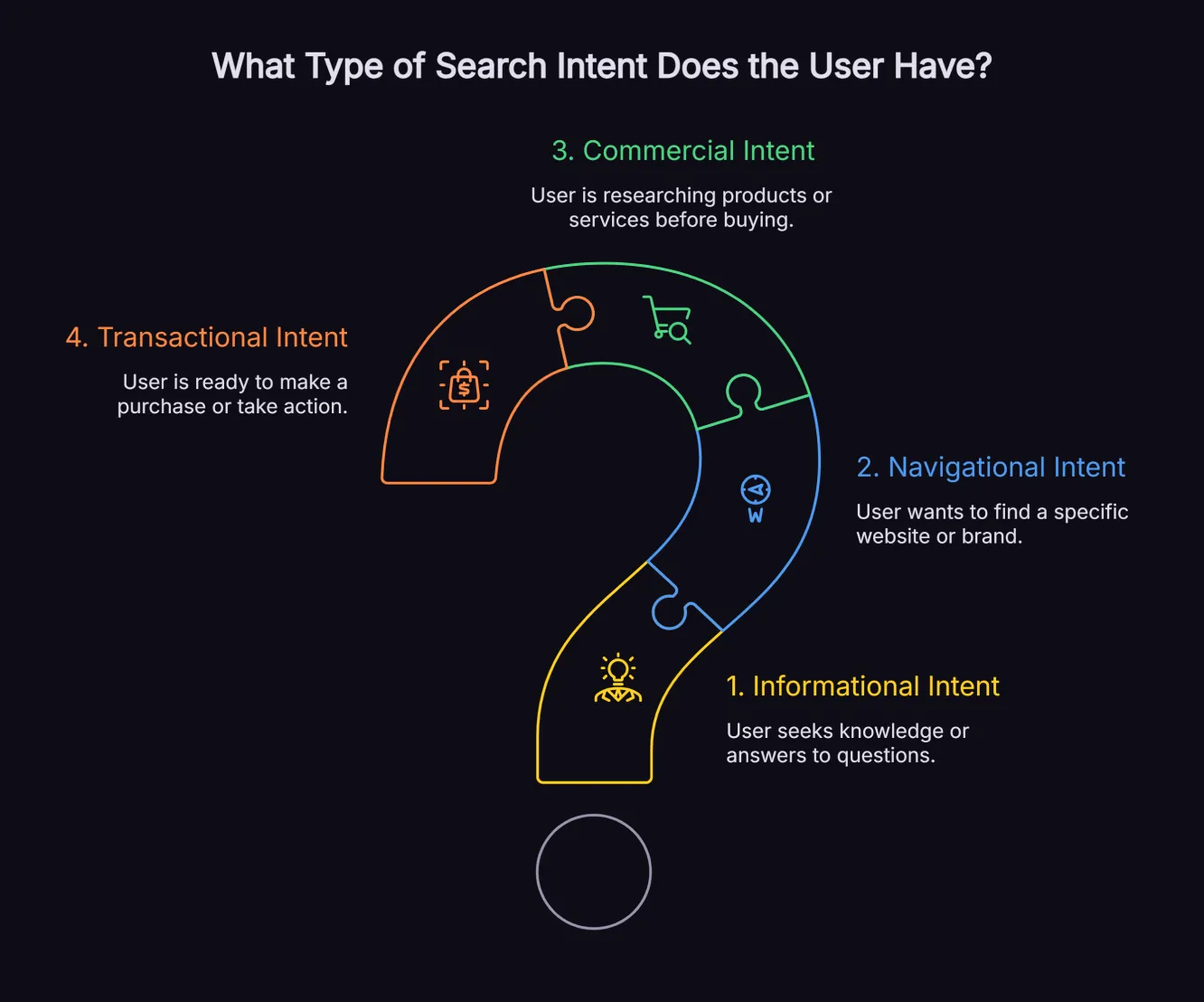
Search intent is the underlying reason behind a search query - the "why" behind the words. It falls into four core types: informational (learning), navigational (finding a specific site), commercial (comparing options) and transactional (ready to act). Google's algorithm is built to detect and reward content that correctly matches the dominant intent for any given keyword. With AI platforms like ChatGPT now processing 2.5 billion prompts per day. In AI chat environments, some analysts now describe an additional generative intent pattern, where people ask the model to create or transform something.
Stop Losing Revenue to Content That Misses the Mark
Understanding search intent is one thing. Turning it into revenue across Google and AI search is another - the same intent-led approach behind over $26M in attributed client revenue in our case studies.
Explore Our AI SEO ApproachWhat Is Search Intent?
Search intent, also called user intent or audience intent, is the purpose behind a search query. It answers a simple question: what does this person actually want to accomplish?
Every query tells a story. Someone searching "what is semantic SEO" wants to learn. Someone searching "Rankmax pricing" wants to navigate to a specific page. Someone searching "best AI SEO agencies Australia" is comparing options before making a decision. And someone searching "book an AI SEO Discovery Session" is ready to act.
Google's algorithm is designed to identify and serve the most relevant result for the dominant intent behind any query. When your content matches that intent, it earns rankings. When it doesn't, Google will surface a competitor that does - regardless of how many backlinks your page has or how well it's technically optimised.
Aligning content with search intent is critical for ranking success because Google’s ranking systems aim to show the most relevant, useful results for each query. Platforms like Ahrefs and Semrush also treat intent alignment as a core optimisation principle.
Search Intent vs Keywords: What's the Difference?
Keywords are the words a person types. Search intent is the meaning behind those words. Two people can search for similar terms with completely different goals.
For example, someone searching "AI SEO" might want to understand what it means. Another person searching the same phrase might be looking for an agency to hire. The keyword is identical - the intent is entirely different.
This distinction matters because Google doesn't just match words. It matches the meaning. Understanding semantic SEO and the intent signals within queries is what allows you to build content that ranks for the right reasons, with the right audience.
The Four Types of Search Intent
SEO has traditionally recognised four core types of search intent. Each one maps to a different user behaviour, content format and stage in the buyer journey.
1. Informational Intent
Informational intent is the largest search-intent category. SparkToro’s analysis of 332 million Google searches found that just over half of Google searches are informational, with users looking to learn, understand or answer a question.
These queries often begin with "how," "what," "why," "when", or "who." Examples include "how to do keyword research," "what is an AI Overview", or "why is our site not ranking on Google."
To serve informational intent, create content that educates clearly and completely:
- Use plain language
- Use logical structure
- Use visual aids where they help
Informational content sits at the top of the marketing funnel, building trust and authority before a user is ready to buy. A well-crafted topical authority strategy turns informational content into a long-term source of qualified traffic.
2. Navigational Intent
Navigational intent occurs when a user knows where they want to go and uses a search engine to get there faster. They are not exploring - they have a destination in mind.
Queries include brand names, product names or direct page references: "Rankmax case studies," "Google Search Console login", or "Ahrefs keyword explorer."
For navigational queries, the goal is simple: make your brand easy to find. To help users land exactly where they intend, your homepage, about page and key service pages need to be:
- Clearly indexed
- Well-structured
- Accurately titled
3. Commercial Intent
Commercial intent sits between learning and buying. The user has identified a need and is now researching options, comparing providers or reading reviews before committing to a decision. Think of it as the "tell me more" phase.
Signals include modifiers like "best," "top," "review," "compare" and "vs." Examples include "best keyword research tools," "Semrush vs Ahrefs", or "top AI SEO agencies Australia."
For commercial intent queries, the formats that perform include:
- Comparison guides
- Review articles
- "Best of" lists
Your content needs to answer the honest question: why should we choose this option over the alternatives? This is where trust is built - and where deals are won or lost before the user ever reaches a checkout page or a contact form.
4. Transactional Intent
Transactional intent signals readiness to act. The decision has been made. The user wants to buy, sign up, book or download - right now.
These queries often include words like "buy," "pricing," "hire," "book," "get a quote", or "sign up." Examples include "hire an AI SEO agency," "request an AI SEO audit," or "book a Discovery Session."
For transactional intent, your content must remove friction. Product pages, landing pages and pricing pages with strong calls to action serve this intent best. Every element should guide the user toward completing the action they came to take.
The Rise of Generative Search Intent
The four-category model of search intent was built for traditional keyword-based search. AI chat has introduced an additional behaviour that many analysts describe as generative intent, but the four core SEO intent types remain the standard framework.
Generative intent occurs when a user asks an AI to create or do something - not just find information. "Draft a content brief for an AI SEO campaign," "generate a keyword list for a B2B SaaS company", or "write a subject line for a re-engagement email" are all examples of generative intent.
AI platforms have expanded intent behaviour beyond the traditional four-category model. In addition to informational, navigational, commercial and transactional queries, many prompts now ask AI systems to create, transform or synthesise content directly.
This is a structural shift, not a trend. Gartner predicted that traditional search engine volume would fall 25% by 2026 as AI chatbots and other virtual agents took share from classic search behaviour. Understanding how AI search works - and what intent signals those platforms prioritise - is now as important as understanding Google's algorithm.
Notably, commercial intent prompts are far more likely to trigger a live web search in ChatGPT (53.5%) compared to informational queries (18.7%). If you sell a product or service, your commercial intent content is exactly what AI search is actively looking for - and citing.
How to Identify Search Intent
Knowing the four types of intent is the starting point. Identifying the dominant intent behind any specific keyword requires a structured process.
Analyse the SERP
The most reliable way to identify search intent is to look at what Google already ranks for a keyword. Open an incognito browser, search your target keyword and examine the top 10 results. Ask yourself three questions:
- What type of content is ranking? (Blog posts, product pages, landing pages, videos?)
- What format do the top pages use? (How-to guides, listicles, comparisons, reviews?)
- What angle do they take? (Beginner-friendly, expert-level, updated for the current year?)
The SERP tells you what Google believes users want to see. If every result is a listicle, a single product page will struggle to rank. If every result is an in-depth guide, a thin 500-word post will not compete.
Also, examine SERP features. A featured snippet signals informational intent. A shopping carousel signals transactional intent. People Also Ask boxes reveal the related questions users have - and the sub-intents within a broader topic.
Use Keyword Modifiers
The words that surround your core keyword carry strong intent signals. Common modifier patterns include:
- Informational: how, what, why, guide, tutorial, tips, explained
- Navigational: brand names, product names, login, pricing page
- Commercial: best, top, review, comparison, vs, alternatives, cheapest
- Transactional: buy, hire, book, get a quote, sign up, download, try free
Keyword mapping across your content cluster becomes far more accurate when you build intent signals into the process from the start. A well-structured keyword map groups related terms by intent, not just topic - ensuring each piece of content serves a specific audience at a specific stage.
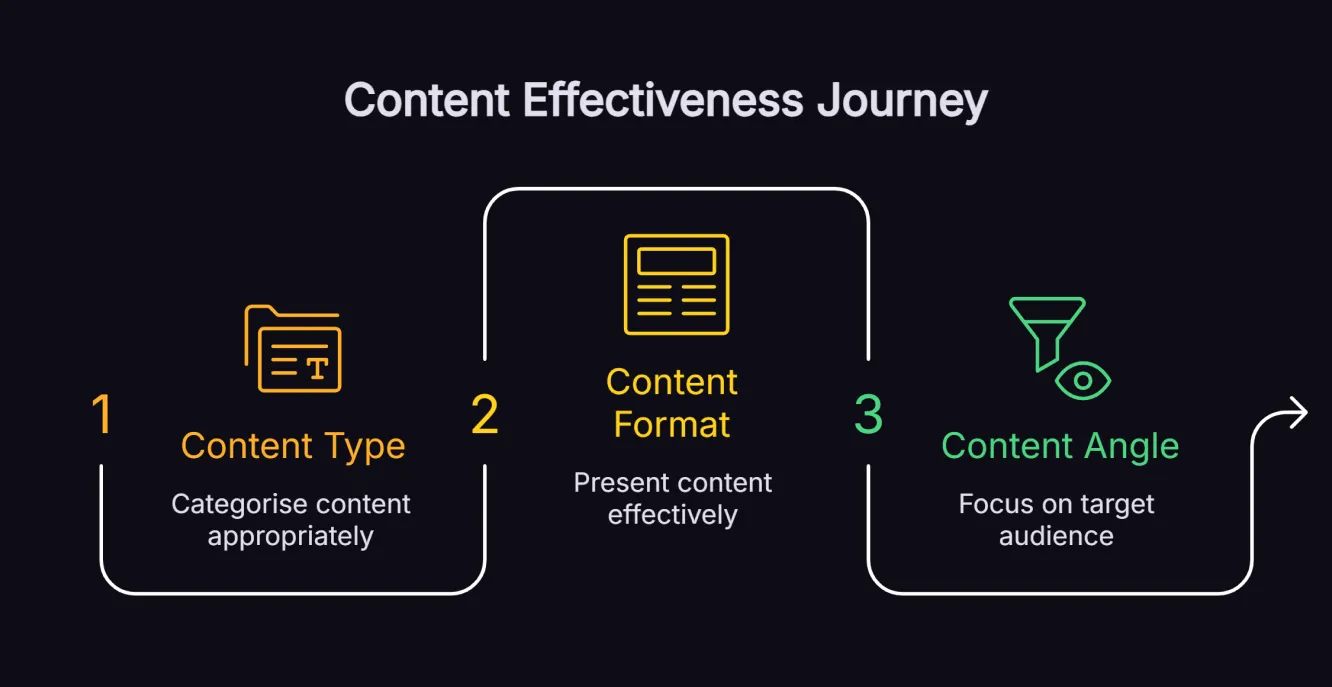
Apply the 3 Cs of Search Intent
Once you've analysed the SERP and identified keyword modifiers, the 3 Cs framework gives you a practical structure for matching your content to what users actually expect.
- Content Type: Refers to the dominant format of the top-ranking pages. Is it a blog post? A product page? A landing page? A video? The content type signals the broadest expectation users have for that query.
- Content Format: Goes deeper, describing how the content is structured. For blog posts, common formats include how-to guides, listicles, comparison articles and opinion pieces. For a keyword like "types of search intent," a listicle or guide typically dominates. For "buy AI SEO strategy package," a landing page wins.
- Content Angle: Is the specific hook or value proposition that makes top-ranking content stand out. For time-sensitive topics, "updated for 2026" often appears in titles. For competitive queries, "for beginners" or "for enterprise teams" signals a targeted audience angle that differentiates the content.
The 3 Cs help you move beyond simply writing about a topic and start writing the content a specific user actually wants at that specific moment.
How to Optimise Content for Search Intent
Identifying intent is half the work. Executing it correctly in your content strategy is where rankings and revenue are won.
Match Content Type to User Intent
Every stage of the marketing funnel maps to a different content type. Producing the wrong type - however well-written - puts you in direct competition with results that are structurally better suited to the query.
- Informational intent: blog posts, guides, tutorials, explainers, FAQs
- Navigational intent: branded landing pages, homepage, about page
- Commercial intent: comparison articles, buying guides, reviews, case studies
- Transactional intent: product pages, pricing pages, service landing pages, sign-up forms
Your keyword research process should include an intent classification step for every keyword before content briefs are written. This prevents the common mistake of sending a high-intent buyer to a top-of-funnel explainer - and losing the conversion as a result.
Align Content Format With What Google Rewards
Within each content type, the dominant format in the SERP tells you how to structure your content. If how-to guides are winning, structure your content as a step-by-step process. If listicles dominate, a numbered list format will outperform long prose.
This doesn't mean you copy the competition. It means you meet the baseline expectation users have for that content type and then exceed it with:
- Better depth
- Clearer examples
- More actionable advice
A pillar content strategy applies this thinking at scale, ensuring your most important keywords are covered with intent-matched formats across an interconnected content cluster.
Angle Your Content for Maximum Relevance
The content angle is your competitive differentiator within an intent category. Two how-to guides can both target informational intent for the same keyword, but the one that takes the right angle for its specific audience will outrank the one that takes a generic approach.
Common angles that perform well include:
- Year-specific: "in 2026" signals freshness and relevance for competitive keywords
- Audience-specific: "for B2B teams" or "for eCommerce brands" narrows focus and improves relevance
- Results-oriented: Leading with a specific outcome ("how to double organic traffic in 90 days") attracts higher-intent informational searchers
- Contrarian: Challenging a widely held belief builds authority and earns links from people looking for a fresh perspective
For our clients, the angle that consistently performs is revenue rather than vanity metrics like traffic or rankings. The B2B AI SEO case study shows exactly how this angle differentiates results-focused content from generic SEO output.
Search Intent and the Marketing Funnel
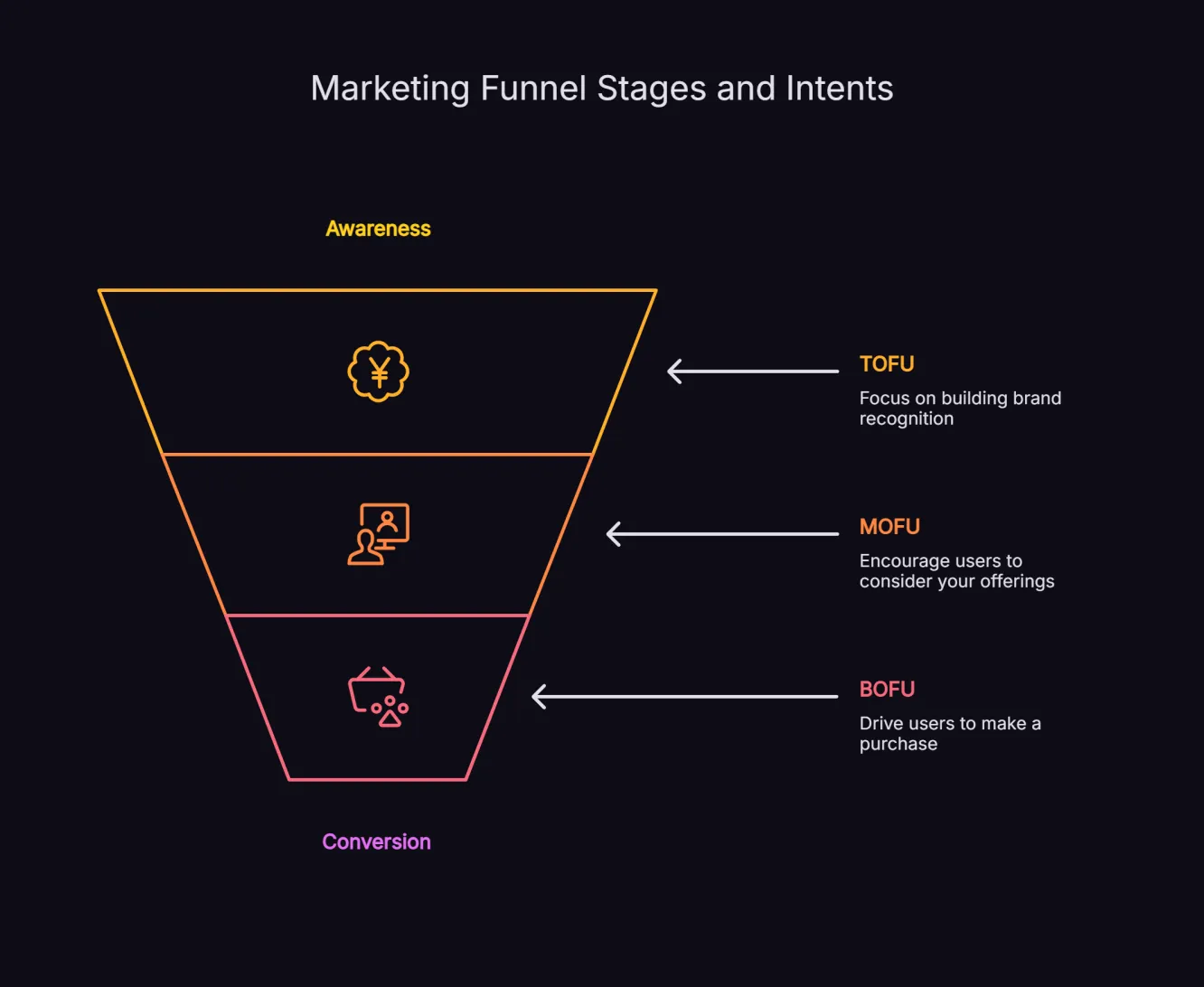
Search intent maps directly to the three stages of the marketing funnel. Understanding this connection allows you to plan a content strategy that moves users through their decision journey rather than simply attracting traffic at one stage.
1. Top of Funnel (TOFU)
Is dominated by informational intent. Users are aware of a problem or question but haven't begun evaluating solutions. Content at this stage should educate, not sell. Blog posts, guides and explainers serve TOFU well.
2. Middle of Funnel (MOFU)
Is where commercial intent lives. Users know what type of solution they need and are comparing options. Comparison articles, case studies and review content are the formats that convert research into shortlisted choices. AI SEO strategy content that demonstrates real results - not just theory - performs exceptionally at this stage.
3. Bottom of Funnel (BOFU)
Is where transactional intent converts. Users are ready to act. Service pages, pricing pages and direct response landing pages with clear calls to action are designed for this moment. Every element should reduce friction and build the final layer of trust needed to trigger a decision.
A content strategy that only targets one funnel stage will create gaps. You might attract traffic without the conversion content to capitalise on it, or invest in conversion pages without the awareness content to fill the funnel above them.
Search Intent in AI Search: A New Dimension
AI search platforms don't operate the same way as keyword-based search. Understanding intent in this context requires thinking about how people interact with AI - not just what they type into a search bar.
On client programmes, intent-matched content is what turns AI visibility into revenue. In one B2B AI SEO engagement, passage-level answers mapped to commercial intent helped the site earn 598 AI cited pages across Google AI Overviews, ChatGPT, Gemini and Perplexity and $8.7M in attributed revenue over 27 months. The lesson is practical: match the intent of each sub-query with a self-contained answer, then measure citations alongside rankings.
In traditional Google search, a user submits a query and evaluates a list of results. In AI search, a user has a conversation. The intent signals are richer, the follow-up questions reveal deeper context, and the platform synthesises an answer rather than presenting a list.
This creates new optimisation requirements. Content that earns AI citations tends to:
- Answer questions directly and early in the text (Kevin Indig's February 2026 analysis found that 44.2% of ChatGPT citations come from the first 30% of a piece of content)
- Use clear, specific language that makes the answer easy to extract
- Be grounded in original, helpful, fact-based content rather than vague or generic copy
- Be structured with question-based headings and concise answers that match conversational queries
- Be published on pages that are crawlable, indexable and technically accessible, with any structured data matching the visible content
The intent-driven content principles that work for Google - matching type, format and angle to user expectations - also apply to AI platforms. But the execution differs. Where Google rewards depth and structure, AI platforms reward clarity, directness and citation-worthiness.
Understanding the full AI SEO picture means building content that satisfies intent across both traditional search and AI platforms simultaneously - not treating them as separate channels.
How to Track Whether Your Content Matches Search Intent
Publishing intent-matched content is not a set-and-forget task. User expectations evolve, SERP formats shift and AI platforms change what they prioritise. Regular review is essential.
Key signals that indicate intent misalignment include:
- High bounce rate: Users land and immediately leave. The content did not deliver what the query promised.
- Low average time on page: Users scanned and found insufficient depth for an informational query, or couldn't find the action they wanted for a transactional one.
- Poor click-through rate from SERP: Your title and meta description don't reflect the intent clearly enough to earn the click.
- Ranking plateau: The content ranks on page two or three and won't improve. Often this is because the content type or format doesn't match what's winning on page one.
A quarterly SERP check for your priority keywords is the minimum review cadence. This includes:
- Whether the dominant content type has changed
- Whether new format patterns have emerged
- Whether your title and meta description still reflect the correct intent angle for the current competitive landscape
For keyword research services that include intent classification from the outset, this review process becomes systematic rather than reactive - with every keyword mapped to its correct intent type, funnel stage and content format before a word is written.
Frequently Asked Questions
What is search intent in SEO?
Search intent is the reason behind a user's search query - the goal they want to achieve when they type words into a search engine. It determines what kind of content Google and AI platforms will surface in response to that query. Aligning your content with the dominant intent behind a keyword is one of the most important factors in whether that content ranks and converts.
What are the four types of search intent?
The four main types of search intent in SEO are informational, navigational, commercial and transactional. In AI chat environments, some analysts also describe an emerging generative intent pattern, where users ask the model to create or transform something rather than simply find information. That is best treated as an AI-specific behaviour alongside the standard four SEO intent categories, not a replacement for them.
How has AI changed search intent?
AI chat has expanded how intent shows up in practice. Alongside informational, navigational, commercial and transactional queries, many prompts now ask AI systems to create, rewrite, summarise or transform content directly. That changes how marketers should think about intent, because the goal is often not just to find information, but to generate an output.
How do I identify search intent for a keyword?
The most reliable method is SERP analysis - search the keyword in an incognito browser and examine what content types, formats, and angles are dominating the top 10 results. Complement this with keyword modifier analysis (words like "how," "best", and "buy" signal specific intent types) and apply the 3 Cs framework to identify Content Type, Content Format and Content Angle. SEO tools, including Ahrefs, Semrush and SE Ranking, also provide built-in intent classification for keywords.
What happens if our content doesn't match search intent?
Content that mismatches search intent will struggle to rank regardless of its technical quality or backlink profile. Google's algorithm is designed to surface results that match what users actually want to see - so a blog post targeting a transactional keyword, or a product page targeting an informational query, will consistently underperform. Beyond rankings, intent misalignment increases bounce rates and reduces conversions because the content doesn't serve the specific need the user arrived with.
Does search intent matter for AI Overviews and ChatGPT?
Yes - intent is arguably even more important in AI search than in traditional search. AI platforms synthesise answers rather than ranking pages, which means content that clearly and directly answers the intent behind a query is more likely to be cited. Commercial-intent prompts are more likely than informational prompts to trigger ChatGPT web retrieval, which may increase citation opportunities for high-intent commercial content. This makes them prime opportunities for brands to earn citations in high-intent research conversations.
Intent Is Where Rankings and Revenue Begin
Search intent is not a technical detail. It is the strategic foundation behind every content decision that drives organic performance. When you understand what users want at each stage of their journey and match your content to that expectation, you stop competing on volume and start competing on relevance. The payoff is not just higher rankings, but content that converts because it was built for the right person, at the right moment, with the right answer. As AI platforms accelerate the shift in how people search, intent-matched content becomes the asset that earns visibility across both Google and the AI experiences your buyers are increasingly using first. For brands looking to turn that shift into a competitive advantage, a clear AI SEO strategy helps connect intent, content and discoverability into a system that is much harder to displace over time.
About the Author
Want Insights Like This Fortnightly?

Our AI SEO strategies and tactics delivered fortnightly, including bonus trade secrets not shared anywhere else. No fluff. Just what's working right now. 5-minute read.


