
What Answer Engine Optimisation Actually Is, and How We Earn Citations


Answer engine optimisation is the work of making your content the source an AI answer quotes, rather than a blue link a user has to go and find. Over the last two years I have watched the same client pages get pulled into Google AI Overviews, AI Mode, ChatGPT and Gemini at very different rates, which told us something useful: these engines do not all read a page the same way. In this guide I will walk you through the process we use at Rankmax to earn those citations, including the platform-by-platform citation split from one client campaign that now sits at 598 cited pages. I will also answer the question the market keeps dodging, which is whether AEO is actually different from generative engine optimisation or just a different name for it. The honest answer is more useful than the marketing one.
A Quick Guide to Answer Engine Optimisation
Answer engine optimisation is the practice of structuring content so AI systems can retrieve, parse and quote it directly inside a generated answer. It matters because the answer layer now sits between your page and the reader: in Pew Research Center's March 2025 study of US users, people clicked a result on 8% of visits where an AI summary appeared, against 15% where it did not. The practical work is passage-level: answer the question early, keep each passage self-contained and back the claim with evidence an engine can verify.
Get an AI SEO Strategy for Google Rankings and AI Citations
Ranking and citation are different contests, and most campaigns only run one of them. We build the technical foundation, the topical depth and the passage structure that earn both organic rankings and AI citations, then report each separately so you can see which is moving.
Explore AI SEO StrategyWhat Is Answer Engine Optimisation?
Answer engine optimisation, usually shortened to AEO, is the discipline of getting your content selected as a source when an AI system answers a question. The "answer engine" is any system that returns a synthesised response instead of a list of links:
- Google AI Overviews
- Google AI Mode
- ChatGPT
- Gemini
- Perplexity
- Microsoft Copilot
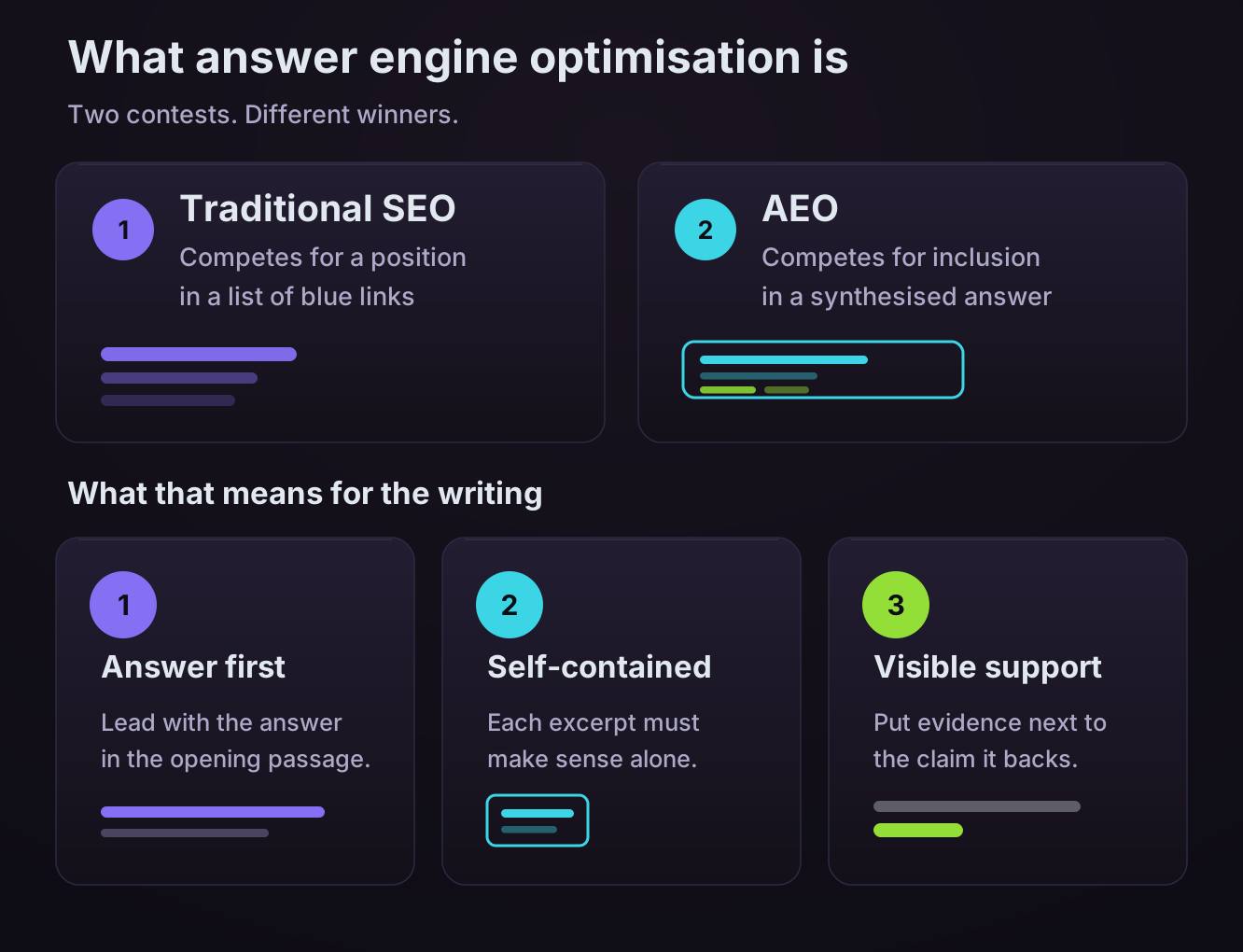
The shift it responds to is straightforward. Traditional SEO competes for a position in a list. AEO competes for inclusion in an answer. Those are different contests with different winners, and a page can win one while losing the other.
What makes AEO distinct as a practice is the unit of competition. Google already reads below page level: its passage ranking system identifies individual sections of a page to judge how relevant that page is to a search. Answer engines take the same idea a step further and quote those sections directly in an answer. So a 3,000 word guide rarely gets cited as a whole, while one specific paragraph inside it can be.
That single shift reshapes how the content gets written.
Three things follow from it:
- The answer has to come first: An engine extracting a response will take the passage that resolves the question cleanly, not the one that builds to it over four paragraphs.
- Context cannot live elsewhere on the page: Suppose a passage says "this approach delivered a large increase". It is unusable if the subject sits three headings above it.
- Claims need visible support: Engines favour content with evidence attached, because a citation is a trust decision as much as a relevance one.
Answer Engine Optimisation vs Generative Engine Optimisation vs SEO
This is the question Google itself platforms in People Also Ask, and almost nobody ranking for the term answers it directly. So here it is.
The Honest Version
AEO and generative engine optimisation (GEO) describe substantially the same work. Anyone who tells you there is a clean methodological wall between them is selling a framework. In our own campaigns, the actions that earn a ChatGPT citation are the actions that earn an AI Overview citation:
- Clear structure
- Self-contained passages
- Verifiable claims
- Genuine topical depth
The industry has not settled on one term either. Some practitioners argue AEO is the better name because answering is the goal and generation is only the mechanism. Others keep GEO because it points at the specific class of engine involved. A third group has quietly folded both into "AI SEO" and moved on.
Where the Emphasis Genuinely Differs
There is a real distinction, it is just narrower than the term wars suggest. It is a difference of emphasis, not of method.
| Dimension | Traditional SEO | Answer engine optimisation | Generative engine optimisation |
|---|---|---|---|
| What you compete for | A ranked position | Inclusion as the quoted answer | Inclusion as a cited source in a synthesised response |
| Unit of competition | The page | The passage | The passage, weighted by source authority |
| Where it shows up | Blue links | Direct answers, AI Overviews, voice results, snippets | Multi-source generated responses in ChatGPT, Gemini, Perplexity |
| Historical root | 1990s onward | Featured snippets and voice assistants, pre-dating LLMs | The 2023 research on generative engines |
| Success signal | Position and clicks | Your answer is the one returned | Your domain appears in the source list |
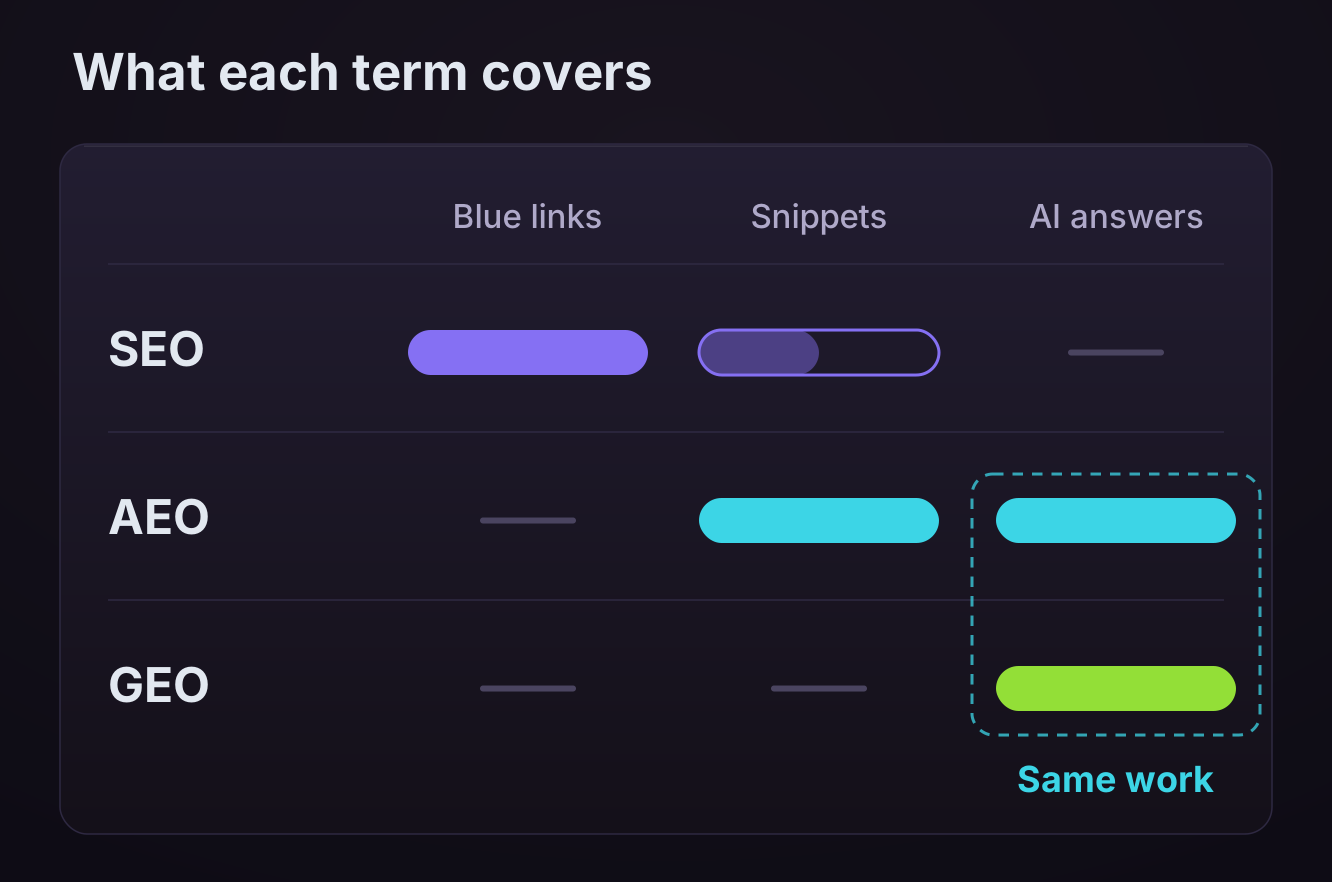
AEO carries an older meaning. Before large language models, "answer engine" meant featured snippets, knowledge panels and voice assistants. AEO meant winning position zero. GEO has no such history. The term comes from a 2023 research paper by teams at Princeton, IIT Delhi, Georgia Tech and the Allen Institute. That paper introduced a benchmark of around 10,000 queries and found that specific content changes could lift visibility in generative responses by up to 40%.
So AEO is the broader and older label, covering both the snippet era and the LLM era. GEO is the narrower and newer one, specific to generative engines. In day to day practice the work overlaps almost entirely, which is why we treat them as one campaign rather than two.
What This Means for Your Content Plan
You do not need an AEO strategy and a GEO strategy. You need one campaign that makes your best pages quotable, verifiable and topically deep, then measures which answer engines pick them up. Splitting them into separate workstreams creates duplicate effort and, on your own website, duplicate pages competing for the same intent.
Which Answer Engines Actually Cite You
This is where most guides go quiet, because answering it requires data rather than opinion. Here is ours.
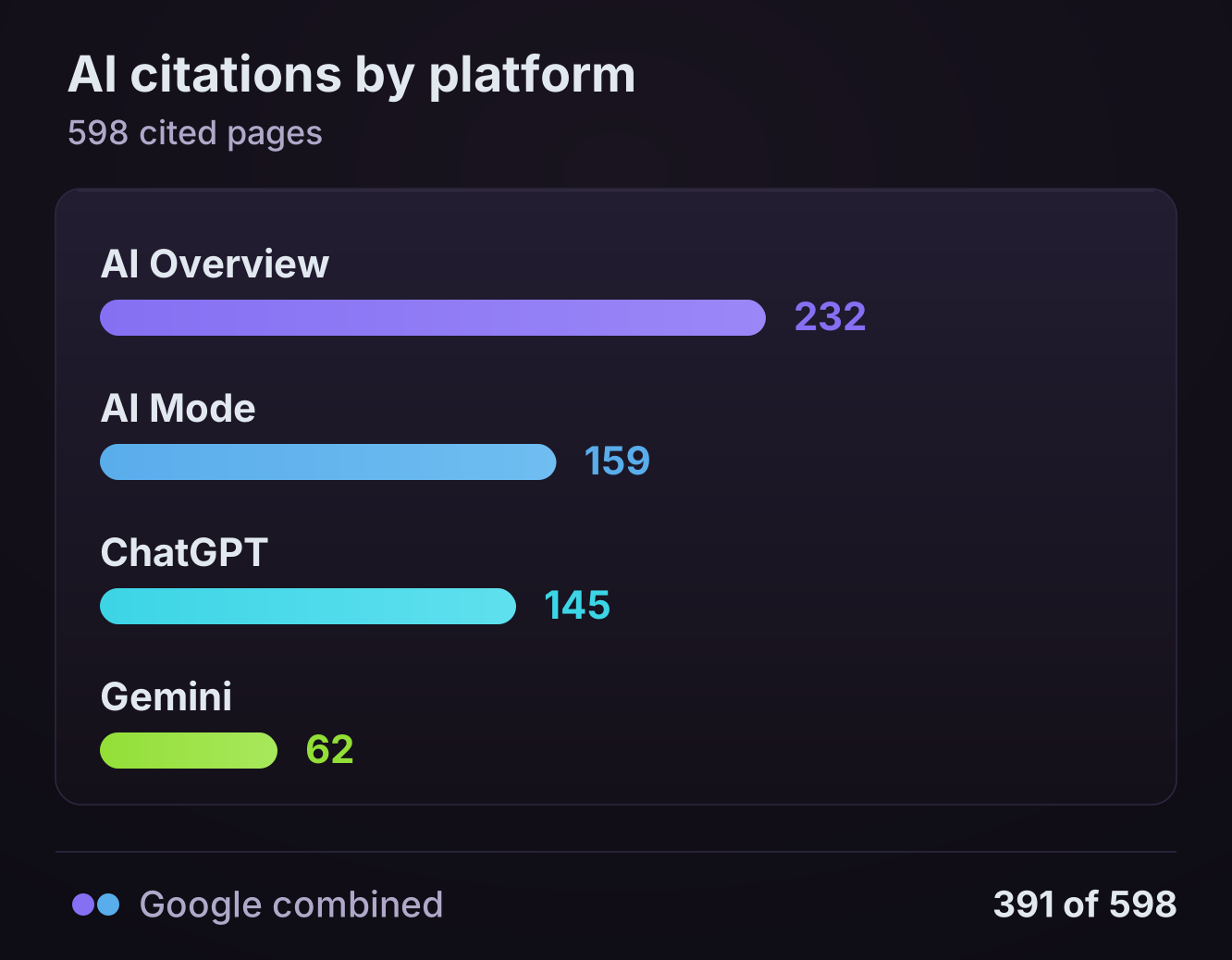
Across a B2B property management outsourcing campaign we have run since April 2024, the client now holds 598 AI cited pages. The split across platforms is not even:
| Answer engine | Cited pages | Share |
|---|---|---|
| Google AI Overview | 232 | 39% |
| Google AI Mode | 159 | 27% |
| ChatGPT | 145 | 24% |
| Gemini | 62 | 10% |
Three things stand out, and each one changes how you would spend your time.
1. Google's AI Overviews and AI Mode together account for roughly two thirds of citations: AI Overviews and AI Mode are separate systems with separate selection behaviour, and treating them as one thing costs you. We cover the split in detail in our guide to AI Overviews and AI Mode.
2. ChatGPT is significant but not dominant: It draws a quarter of citations here, which is material, though the attention it receives in most AI SEO commentary runs well ahead of its share.
3. Gemini is the smallest platform share: At 10% it is the smallest contributor in this campaign, which is a reason to weight effort accordingly rather than to ignore it.
One caveat worth stating plainly. This is one campaign, in one B2B vertical, in one market. The ratio will differ for a consumer brand or a different category. What the data supports is the principle that the answer engines behave differently and are worth measuring separately. It does not support treating 39/27/24/10 as a universal benchmark.
That campaign has now produced roughly $8.7 million in attributed organic and AI revenue across 27 months, with share of voice moving from 0.6% to 6.2%. The case study sets out the full numbers and the attribution method behind them.
How Answer Engines Choose What to Cite
Understanding the selection mechanism is what separates AEO that works from AEO that is a checklist.
Retrieval Happens Before Generation
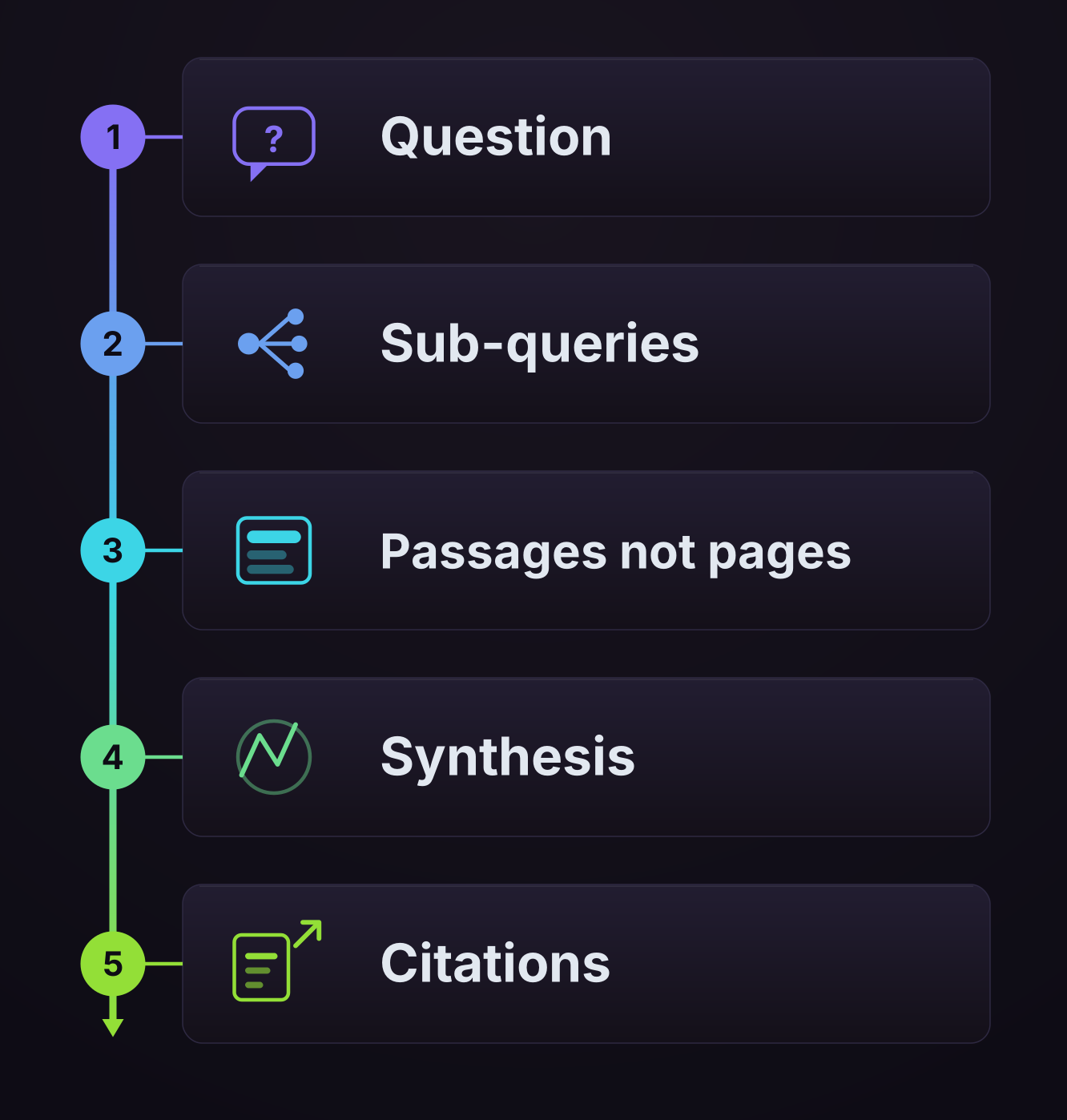
An answer engine does not read your page when someone asks a question. It searches an index, retrieves a small set of candidate passages and only then generates an answer from what it retrieved. Your page is part of the retrieval corpus. If a passage cannot be retrieved, parsed and quoted cleanly, the model answers from someone else's content instead.
This has a blunt implication: being excellent but unretrievable is the same as not existing. Crawlability, indexation and clean rendering are AEO prerequisites, not separate technical concerns. The mechanics of this process are covered in depth in how AI search works.
One Question Becomes Many
Answer engines rarely search for the phrase the user typed. They decompose it into multiple sub-queries, run those and assemble an answer from the results. A question about choosing an outsourcing provider might fan out into sub-queries about cost, risk, contract terms and typical timelines.
The consequence for content is that partial coverage loses. If your page answers three of the five sub-questions, it competes for a share of the answer rather than the whole of it. This is why topical depth outperforms keyword density in AEO, and it is covered fully in our guide to query fan-out.
The Passage Is the Unit of Selection
Retrieval systems chunk pages into passages and compare those chunks against the query. The page is the container, the passage is the candidate. Passage optimisation covers the technique in full, but the short version is that every section should read as though it might be lifted out and shown alone, because that is exactly what happens.
How to Do Answer Engine Optimisation
This is the process we run on client campaigns. It is deliberately ordered, because the early steps are what make the later ones work. It also sits comfortably alongside Google's AI optimisation guidance, which makes the point that there is no separate technical trick for AI answer engines. Good pages win, and the work is to make a good page legible.
Answer the Question in the First Two Sentences
Open every section with the direct answer, then expand. Not context, not a preamble about why the topic matters, the answer.
This feels blunt when you are used to writing that builds an argument. It is also the single highest-leverage change most pages can make, because it puts a complete, quotable response at the top of every chunk an engine might retrieve.
Structure the Page Around Real Questions
Use the questions people actually ask as headings. Pull them from People Also Ask, from the follow-up suggestions AI platforms offer after an answer and from your own sales calls, which are usually the richest source and the one nobody mines. Our guide to LLM SEO covers how we build this question layer out across a whole content set.
Phrase headings the way a person would speak them. "How much does answer engine optimisation cost" retrieves better than "Pricing considerations", because it matches the shape of the query.
Make Every Passage Self-Contained
Each section should carry its own subject, its own timeframe and its own qualifiers. Test it by reading any single paragraph in isolation and asking whether it still makes sense.
Pronouns referring back to earlier headings are the most common failure. Suppose a paragraph says "it cut churn sharply". That is unusable when extracted, whereas "restructuring the onboarding sequence cut churn over six months" survives on its own.
Add Schema That Confirms What the Page Says
Structured data helps an engine parse what a passage is and how confident it can be about the relationship between a question and an answer. FAQPage, HowTo, Article and Organization markup all carry weight, and our schema guide covers the implementation. Those type names keep their US spelling because they are literal schema.org values.
The rule that matters: schema marks up content the reader can already see. Never describe content in schema that is not on the page. That is a spam signal, and engines increasingly check.
Build the Topical Depth That Earns Retrieval
A single page rarely earns citations across a topic. A connected set of pages that covers the topic properly does, because it gives the retrieval layer more topical coverage and more consistent signals of subject expertise. This is the same mechanism behind topical authority in traditional search, and it transfers directly.
In the campaign above, the citation stack more than quadrupled in under a year. That growth came from expanding coverage across a topic, not from optimising a handful of pages harder.
Strengthen the Trust Signals Behind the Claim
Citation is a trust decision. Engines favour content with named authorship, verifiable evidence, current dates and specific sourcing over content that asserts without support. Our E-E-A-T guide covers how we build these signals, but the practical version is simple: attribute your claims, date your data and name the person who did the work.
What About Featured Snippets and Voice Search?
This is the older meaning of answer engine optimisation and it has not stopped mattering.
Featured snippets, knowledge panels and voice assistant results are answer engines too, and they reward the same structural work:
- A direct answer
- A clean passage
- A clear question-to-answer relationship
A page structured for AI Overview citation is usually already structured for snippet capture.
The difference is competitive. Snippet optimisation targets a single winner slot. Generative citation is multi-source: in the same Pew study, 88% of AI summaries cited three or more sources. That makes AI citation a more forgiving target than position zero ever was, because several sources can win at once.
If your existing content already performs well for snippets, you have a real head start. That work was AEO before the term meant what it means now.
How to Measure Answer Engine Optimisation
Measurement is where most AEO advice falls apart, because the honest answer is less tidy than a dashboard.
Track Citations as a Visibility Metric
We treat AI citations as a visibility KPI and a leading indicator that the engines have started to trust the content. They are tracked alongside rankings, never instead of them. They are also not a revenue number in their own right. Revenue comes from the whole campaign. Citations are how we know the AI layer is working before the revenue shows up.
This distinction matters commercially. A citation count that climbs while enquiries stay flat is a signal to examine the commercial fit of the pages being cited, not a result to report as a win.
The Metrics Worth Watching
- Cited pages by platform: How many distinct pages each engine quotes, tracked separately per answer engine rather than as one total.
- Share of voice in AI answers: How often you appear against competitors for the queries that matter to your business.
- Referral sessions from AI platforms: Small in absolute terms for most sites, but the trend line is informative.
- Conversion quality of AI-sourced sessions: Worth isolating, because AI-referred visitors often arrive later in the buying cycle.
- Rankings, still: Google's AI answer engines draw on the same index as its traditional results, so ranking health remains a leading input on the platforms producing most of the citations above.
A caution on attribution. Most analytics platforms classify AI-referred traffic as direct or referral rather than organic, so it will be undercounted unless you segment for it deliberately. Our guide to SEO KPIs covers how we structure this reporting, and the AI visibility tools review covers the tracking platforms we tested.
Frequently Asked Questions
What is answer engine optimisation in simple terms?
It is the work of making your content the source an AI answer quotes. Instead of competing for a position in a list of links, you are competing to be the passage an engine extracts and presents as the answer.
Is AEO replacing SEO?
No, and framing it that way leads to bad decisions. Google's AI answer engines draw on the same index that powers its traditional results, so ranking health remains a major input to citation there. As of mid 2026 ChatGPT and Perplexity also run their own crawlers alongside borrowed indexes, so that overlap is narrowing rather than fixed. Either way, treating AEO as a replacement usually means neglecting the technical foundation that makes retrieval possible at all.
What is the difference between AEO and GEO?
In practice they describe the same work. AEO is the broader, older term covering featured snippets and voice assistants as well as AI answers, while GEO is specific to generative engines and comes from 2023 academic research. The techniques overlap almost entirely, so we run them as one campaign.
How long does answer engine optimisation take to work?
In our campaigns meaningful citation growth typically appears over several months rather than weeks, then compounds. One B2B campaign went from 138 cited pages in August 2025 to 598 by June 2026, so most of the volume arrived well after the foundational work was done.
Does schema markup help with AEO?
Yes, though it is an amplifier rather than a substitute. Schema helps an engine parse the relationship between a question and an answer, but it will not make a weak passage citable. Mark up content the reader can already see, never content that only exists in the markup.
Which answer engines should I optimise for?
Start with Google's platforms and ChatGPT, which is where most of the citation volume sat in the campaign above. Perplexity and Copilot are worth tracking but rarely justify dedicated effort early on. The right answer depends on where your buyers actually search, so measure before you commit effort.
Can small websites earn AI citations?
Yes. Citation is multi-source rather than winner-takes-all, so several sites can be quoted for the same query, which lowers the barrier compared to competing for a single top position. Depth on a narrow topic tends to beat shallow coverage of a broad one.
How is AEO different from optimising for featured snippets?
Structurally they are close, and work done for snippets usually transfers. The difference is that a snippet has one winner while a generated answer typically cites several sources, so AEO is a less zero-sum contest than snippet optimisation ever was.
The Work Behind the Answer
Answer engine optimisation is the same discipline as SEO, judged at a smaller unit. The page still has to be findable, the topic still has to be covered properly and the claims still have to hold up. What changes is that the passage is now what gets selected, and the citation is what tells you it worked.
The campaigns where this compounds are the ones that treat AI citations as a signal rather than a scoreboard, and keep building the depth that makes retrieval likely in the first place. If you want to see how the whole system fits together, our AI SEO strategy guide is the place to start.
About the Author
Want Insights Like This Fortnightly?

Our AI SEO strategies and tactics delivered fortnightly, including bonus trade secrets not shared anywhere else. No fluff. Just what's working right now. 5-minute read.


