
AI Overview vs AI Mode SEO: What Marketers Need to Know in 2026


If your rankings still look healthy but clicks are getting harder to win, AI Overview vs AI Mode SEO is likely part of the reason. Google now serves two very different AI search experiences, and each one changes how your content gets discovered, cited, and clicked. That creates a real problem for marketing teams already under pressure to prove SEO ROI while keeping up with how search is changing. This guide shows you how the two surfaces work, where the visibility opportunities differ, and what to prioritise so your SEO strategy holds up in 2026. Keep reading and you will see where the overlap ends and where the real optimisation work begins.
AI Overview vs AI Mode SEO: A Quick Guide
AI Overview vs AI Mode SEO comes down to two different Google AI surfaces with different behaviour, citation patterns, and optimisation needs. In Semrush’s 10 million-keyword dataset, AI Overviews appeared on 15.69% of queries in November 2025 after peaking at 24.61% in July, while Ahrefs estimated that position-one CTR drops by about 34.5% when AI Overviews are present; separate early-adopter data from Semrush also found roughly 93% of AI Mode sessions ended without an external click, which is why both surfaces need the same SEO foundations but different content and measurement strategies.
Want to See What Optimising for Both Looks Like in Practice?
Our AI SEO strategy service covers visibility across Google AI Overviews, AI Mode, ChatGPT, Perplexity and Gemini simultaneously. We have generated $26M+ in attributed client revenue across these platforms, including a B2B client that has earned 598 AI cited pages and about $8.7M in revenue over 27 months and counting (17-month climb window: $5.9M at 6,864% average ROI on the 17-month climb window). If you want a strategy built around your business, speak with me to get started.
See How AI Mode SEO WorksWhat Are AI Overviews and AI Mode?
Before comparing strategies, it helps to be clear on what each feature actually is.
Google AI Overviews Explained
Google AI Overviews, previously called Search Generative Experience (SGE), are AI-generated summary boxes that can appear alongside traditional Google search results. Google began rolling them out to everyone in the U.S. in May 2024 and expanded them to more than 200 countries and territories by May 2025.
The key point is that AI Overviews do not replace the traditional results page. They sit alongside the familiar blue links, so your organic rankings still matter. Earning a citation in an AI Overview can improve visibility, but avoid adding prevalence or CTR-lift claims here unless they are backed by approved sources such as Google, Ahrefs or Semrush.
Google AI Mode Explained
AI Mode is different. Google introduced AI Mode in Search in March 2025 in the US, then expanded its capabilities and availability over time. When a user selects the AI Mode tab, the traditional 10 blue links give way to a conversational search experience built on Google’s Gemini models.
Its rollout evolved in stages:
- It launched with a custom version of Gemini 2.0.
- In May 2025, Google added Gemini 2.5 to Search.
- In July 2025, Gemini 2.5 Pro became available in AI Mode for Google AI Pro and AI Ultra subscribers.
- In December 2025, Google began bringing Gemini 3 to AI Mode in more countries to handle more complex, multi-step queries through an extended back-and-forth dialogue.
Think of AI Mode as Google's answer to ChatGPT or Perplexity - a full-session research environment rather than a single search result. Google also recently introduced a two-stage flow: users can now tap from an AI Overview directly into AI Mode for deeper research on any topic.
Key Differences Between AI Overview and AI Mode SEO
Understanding how these two surfaces differ is the starting point for building a strategy that covers both. The differences span how the systems retrieve information, how users behave and what content gets cited.
How Each System Retrieves Information
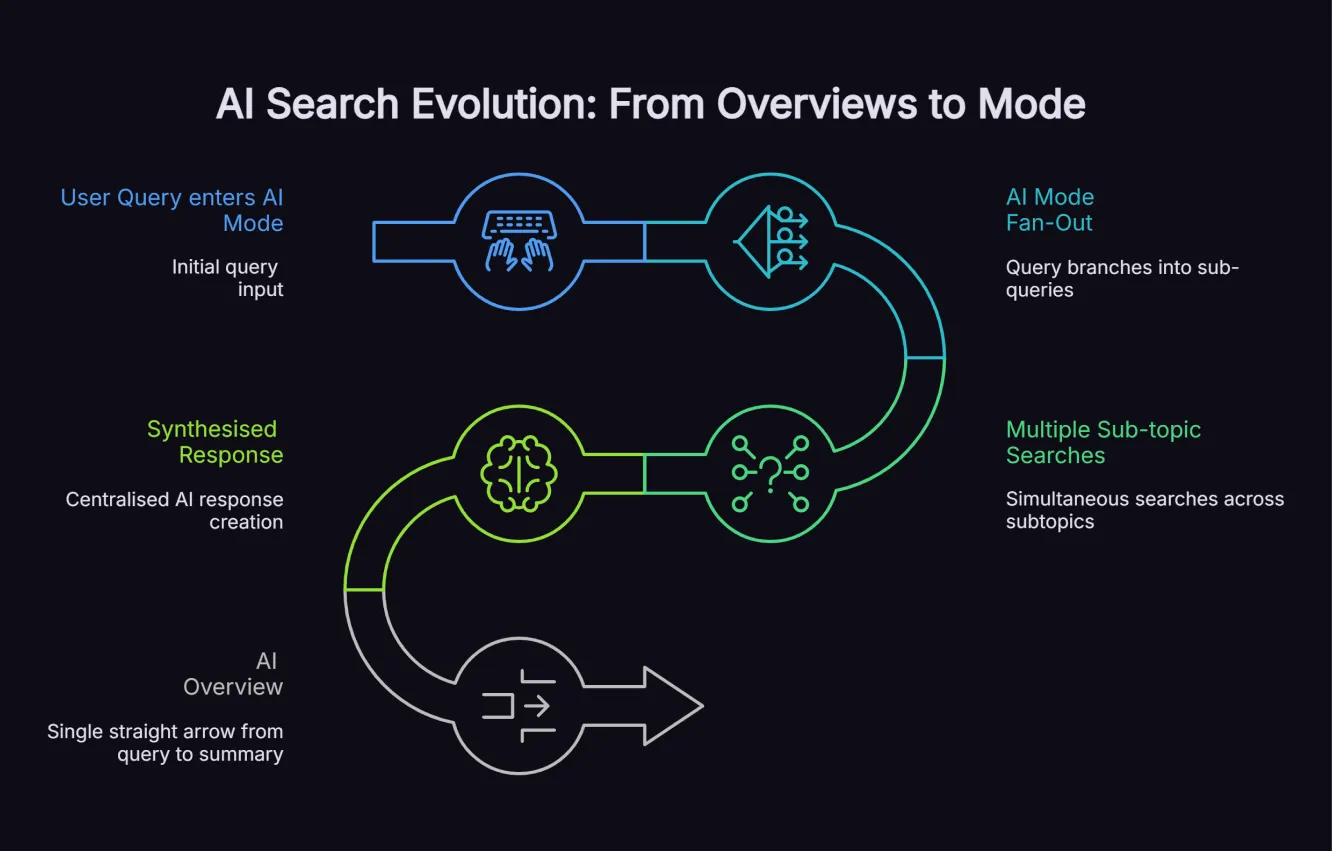
AI Overviews and AI Mode are closer than many marketers assume. According to Google’s AI search documentation, both surfaces may use a query fan-out technique, which means Google can issue multiple related searches across subtopics and data sources before building a response. Google’s AI Mode help page says AI Mode does this explicitly by dividing a question into subtopics and searching for each one simultaneously, but Google does not publish a fixed number of sub-queries in its official guidance. Our query fan-out article breaks down what that means for SEO in practice.
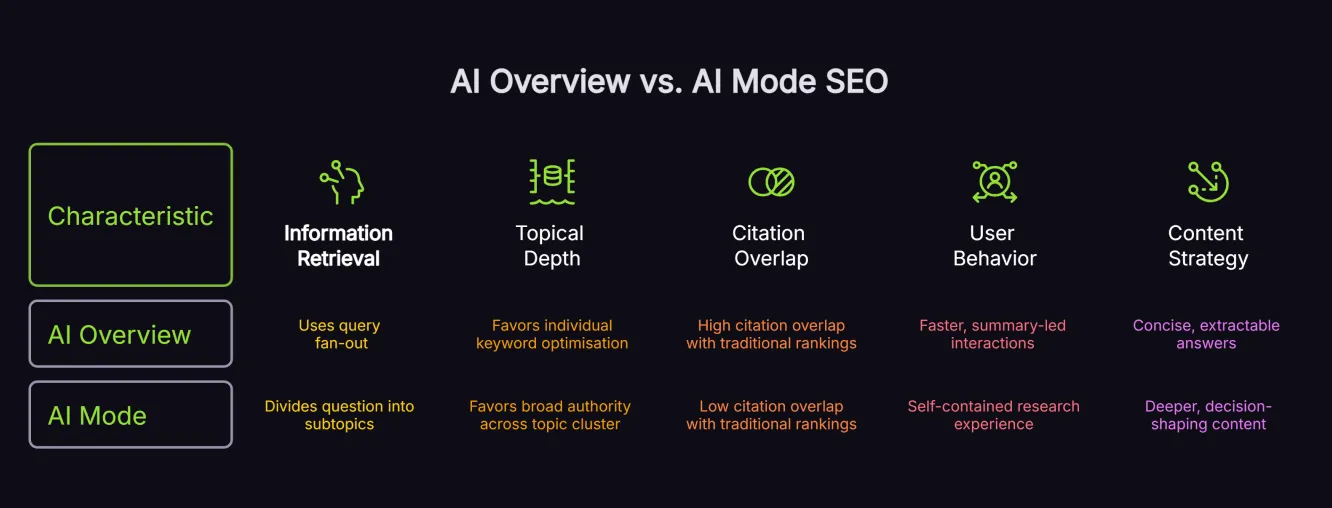
This has a direct strategic implication. A page that ranks well for one exact keyword may not appear in AI Mode at all if your site lacks topical depth across related sub-queries. AI Mode favours brands that demonstrate broad authority across a topic cluster, not just individual keyword optimisation.
Citation Overlap Between the Two Features
One of the most important findings for any AI SEO strategy is that Ahrefs found only 13.7% citation overlap between AI Overviews and AI Mode in December 2025. In other words, being cited in AI Overviews does not automatically make you visible in AI Mode, and the reverse is also true.
These two answer engines rely on different source patterns, content formats and authority signals. You cannot treat them as interchangeable. Each one needs deliberate, targeted optimisation. For the Gemini side of that stack (AI Overviews, AI Mode and the Gemini app as three citation pools), see our Gemini SEO guide.
User Behaviour and Session Time
The user intent gap between the two features is still important, but the data should be framed as directional rather than definitive. AI Overviews tend to support faster, summary-led interactions, while early third-party AI Mode studies point to a more self-contained research experience with far higher zero-click behaviour. That suggests AI Mode users are more likely to compare options, refine questions, and explore a topic in depth than someone quickly scanning an AI Overview. Your content strategy needs to support both behaviours, with concise, extractable answers for AI Overviews and deeper, decision-shaping content for AI Mode.
Traditional Rankings vs Citation-Based Visibility
This is where the landscape has shifted most dramatically. As Ahrefs found, only 38% of pages cited in AI Overviews also ranked in the traditional top 10 in March 2026, down from roughly 76% in Ahrefs’ July 2025 analysis. That shift shows how quickly AI Overview citation behaviour has moved beyond the main search results. Citation sources have decoupled from rankings far faster than most marketers expected.
A brand with modest traditional rankings can consistently appear in AI Mode if its content is structured in a way that AI models find authoritative and easy to synthesise. The reverse is also true - a page-one ranking is no longer a guarantee of AI visibility.
How to Optimise for Google AI Overviews
Optimising for AI Overviews shares DNA with traditional EEAT-based SEO, but with more emphasis on passage-level clarity and structured answers.
Prioritise Passage-Level Optimisation
A February 2026 ChatGPT citation analysis covered by Search Engine Land found that 44.2% of citations came from the first 30% of a page, which makes front-loading key answers a useful general LLM optimisation principle. That does not make it a Google AI Overviews-specific rule, because Google has not published an equivalent AI Overview citation pattern in its own documentation. Your answers to key questions should still appear early, clearly, and in complete sentences, with each section written as a self-contained answer unit that AI systems can extract and cite independently.
Our passage optimisation guide covers the exact formatting techniques that increase citation rates in Google AI Overviews.
Use FAQ and HowTo Structured Data
Google’s official guidance says no special schema is required for AI features, so standard SEO best practices still apply. Structured data remains useful because it helps Google understand the content of a page and can make pages eligible for certain search features, but Google does not say FAQ or HowTo schema directly increases AI Overview or AI Mode citations. That distinction matters even more because Google significantly restricted FAQ rich results in 2023, limiting them primarily to government and health-related websites, and deprecated HowTo rich results in Google Search. Structured data should still be paired with a clean, crawlable page structure to improve content clarity and eligibility for search features, without overstating its impact on AI visibility.
Demonstrate E-E-A-T Across the Page
AI Overviews are designed to surface information from high-quality, reliable sources. Google’s core ranking systems aim to prioritise content that demonstrates strong experience, expertise, authoritativeness, and trustworthiness (E-E-A-T). This is reflected in content that includes:
- Named authors with demonstrated credentials
- First-person or demonstrable experience where appropriate
- Citations to authoritative external sources
- Original data, case studies, or unique research
For a B2C compensation claims client we worked with, this broader AI SEO approach generated about A$14.6M in attributed revenue and a 14,738% average monthly ROI over 21 months and counting, alongside strong visibility in Google AI Overviews earned through structured, authoritative content. You can see the full strategy in our B2C AI SEO case study
Build Topic Clusters, Not Isolated Pages
AI citation sources are becoming less tied to single-page rankings, which means strong visibility in the traditional top 10 no longer guarantees inclusion in AI-generated answers. A growing share of AI Overview citations now come from pages outside the main search results.
That shift makes broader topical coverage more important than relying on one highly optimised page. A well-structured cluster of connected content helps Google understand your subject depth more clearly, while strong internal linking improves how your content is discovered, interpreted and cited across related queries.
How to Optimise for Google AI Mode
AI Mode requires the same SEO foundations but with a distinct layer of strategic thinking on top. The fan-out technique changes everything about how you need to build authority.
Build Topical Authority Across Sub-Query Clusters
Because AI Mode issues multiple simultaneous sub-queries, your visibility depends on appearing across all of them - not just the head term. This makes topical authority the single most important factor for AI Mode performance. Map out every sub-query a user researching your topic cluster would plausibly ask, then build content that answers each of them.
For a B2B property management client, this approach resulted in 598 AI cited pages across multiple search surfaces over 27 months and counting. The content strategy covered the full topic cluster, not just commercial keywords. Revenue attributed to the campaign reached $5.9M - you can read the full breakdown in our B2B AI SEO case study.
Create Comparison and Evaluation Content
AI Mode is built for queries that need deeper exploration, comparison and reasoning. As Google says, it is particularly helpful when people are comparing options, working through complex questions or asking follow-up questions that would normally take multiple searches. Because AI Mode is designed to handle research-heavy queries by synthesising and comparing information, you should create content that:
- Clearly compares different options side by side
- Explains the trade-offs between each option
- Provides practical, actionable recommendations based on those comparisons
Establish Off-Site Authority Signals
AI Mode appears to draw from a broader mix of sources than traditional rankings alone would suggest. As Google explains, AI features can use query fan-out techniques to pull together information from multiple relevant sources. That makes the following especially valuable for expanding where your brand is discovered and assessed:
- Authoritative third-party coverage that reinforces credibility
- Industry mentions that increase topical relevance and visibility within your niche
- Genuine editorial links that help search engines and users evaluate trust and authority
A stronger off-site footprint can improve your visibility and credibility across the wider web. Avoid claiming that publishing across multiple external publications directly increases AI citation coverage unless you can support it with an approved source.
Optimise for Depth, Not Just Length
A March 2026 analysis summarised by Search Engine Land found that pages above 20,000 characters averaged 10.18 citations, compared with 2.39 for pages under 500 characters. That is a broad LLM citation pattern, not a Google AI Mode rule, and the effect varies by vertical. In the same analysis, finance was a clear exception, with shorter, denser, more authoritative pages often outperforming long-form guides. Depth still matters, but only when it is:
- Structured
- Authoritative
- Genuinely useful
Padding content with filler achieves nothing.
Shared Optimisation Principles for Both Features
Despite their differences, AI Overviews and AI Mode share the same underlying infrastructure. These principles apply to both.
Technical SEO Is Non-Negotiable
Google's documentation is explicit: pages must be indexed and eligible to appear in Google Search with a snippet. A page that cannot be crawled, cannot be indexed or is excluded from snippets cannot appear in either AI feature. Strong technical foundations - fast load times, mobile responsiveness, clean heading hierarchy, no crawl blocks - are the baseline, not an optional extra. Our AI SEO strategy guide covers the full technical checklist.
Format for Machine Readability
Both features favour content that AI can easily parse and extract. Use:
- Clear H2 and H3 heading hierarchies
- Bullet points for non-sequential items
- Numbered lists for sequential steps
- Short paragraphs with one key idea each
- Comparison tables for multi-attribute decisions
- Definitions and direct answers in early sentences
Measure Citation Visibility, Not Just Rankings
Traditional metrics like clicks, impressions and keyword rankings no longer tell the full story. Traffic from AI Overviews and AI Mode is included in the overall Search Console Performance report rather than broken out into separate surface-level reports. That means Search Console is still useful, but you need additional tracking, such as Ahrefs Brand Radar, if you want clearer visibility into AI citation performance.
To get a clear picture of your AI citation performance, you need additional tracking across platforms, including Google, ChatGPT, Perplexity and Gemini. KPI measurement for AI SEO looks meaningfully different from traditional organic reporting.
Frequently Asked Questions
What is the main difference between AI Overviews and AI Mode?
AI Overviews are AI-generated summary boxes that appear within the standard Google results page. AI Mode is a separate conversational search experience that replaces the traditional list of blue links with a more interactive response format. AI Overviews appear alongside organic rankings, while AI Mode functions as a standalone interface powered by Google’s Gemini models.
Do I need a different SEO strategy for AI Overviews vs AI Mode?
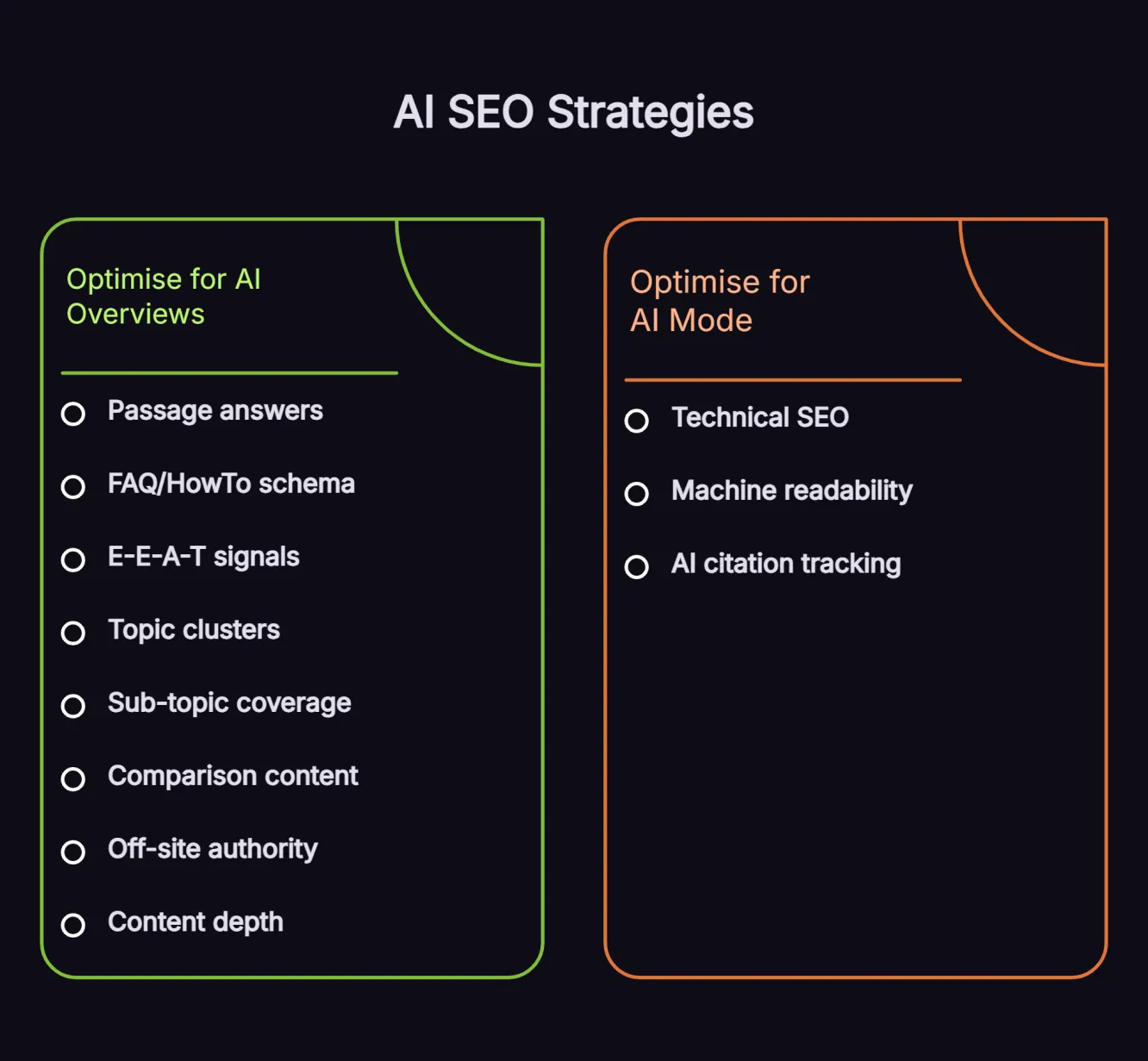
You need a shared technical and content foundation, but the optimisation emphasis differs. AI Overviews reward featured-snippet-style, passage-level answers and strong E-E-A-T signals on individual pages. AI Mode rewards topical authority across entire topic clusters because of its fan-out query technique. The best approach addresses both simultaneously through a structured AI SEO strategy rather than treating them as separate campaigns.
How much do AI Overviews and AI Mode overlap in the sources they cite?
Very little. Ahrefs' research from December 2025 found that only 13.7% of citations overlap between the two features. This means you cannot assume that being cited in AI Overviews makes you visible in AI Mode. Each surface rewards different content signals and needs deliberate, targeted optimisation.
Can a page rank #1 in Google but not appear in AI Overviews or AI Mode?
Yes - and this is increasingly common. Only 38% of pages cited in AI Overviews also rank in the traditional top 10. A brand with a modest traditional ranking can appear consistently in AI Mode if its content is structured to match what AI systems consider authoritative and extractable. Traditional rankings and AI citations have largely decoupled.
Does schema markup help with AI Overviews and AI Mode?
Google’s official documentation states that no special schema is required for AI features. Structured data still plays an important role because it helps Google understand page content and can make that content eligible for certain search features, but Google does not say FAQ or HowTo schema directly improves AI Overview or AI Mode citation rates. Implementing schema correctly remains a strong practice for traditional SEO and content clarity, without overstating its impact on AI visibility.
How do zero-click rates differ between AI Overviews and AI Mode?
The difference is meaningful, but the data should be treated as directional rather than fixed. Early third-party research suggests AI Mode produces far more zero-click sessions than AI Overviews, which points to a more self-contained research experience overall. That does not make AI Mode low value. Being cited can still build brand recognition, trust, and recall even when a user does not click through straight away. Click behaviour also varies by query type, with higher-intent and transactional searches often driving more website visits than purely informational prompts.
What types of content perform best in AI Mode?
AI Mode is designed for queries that need deeper exploration, reasoning and comparison. As Google explains, it is particularly helpful when people are comparing options, working through complex questions or exploring a topic through follow-up searches. Content that tends to perform well includes in-depth comparison guides, expert evaluation frameworks, step-by-step process pages and content that brings multiple data points into a clear recommendation. Thin pages or single-keyword content without topical depth are less likely to align with how AI Mode retrieves and presents supporting sources.
How does AI Mode affect B2B vs B2C SEO strategy?
B2B companies are particularly exposed to AI Mode because enterprise buying journeys often involve deeper research, longer comparisons, and more back-and-forth evaluation before a decision gets made. Buyers researching software, services, or complex solutions are more likely to use AI Mode to compare vendors, weigh trade-offs, and narrow their shortlist. That puts B2B brands with strong case studies, original research, expert commentary, and comparison content in a much better position to be cited. B2C brands can also benefit during the product research phase, but direct transactional SEO often remains more resilient because many purchase-driven searches still depend on product pages, merchant trust signals, and clear commercial intent.
The Race Is Already On
AI Overviews and AI Mode are already changing how buyers discover and compare businesses. The companies that move now to build topical authority, publish content AI can extract, and strengthen trust beyond their own site will be far harder to dislodge over the next 12 to 24 months. See how our AI Mode SEO strategy helps brands build visibility across both Google AI surfaces and the broader AI search ecosystem.
About the Author
Want Insights Like This Fortnightly?

Our AI SEO strategies and tactics delivered fortnightly, including bonus trade secrets not shared anywhere else. No fluff. Just what's working right now. 5-minute read.


