
What Gemini SEO Involves: 125 Client Pages Cited by Gemini


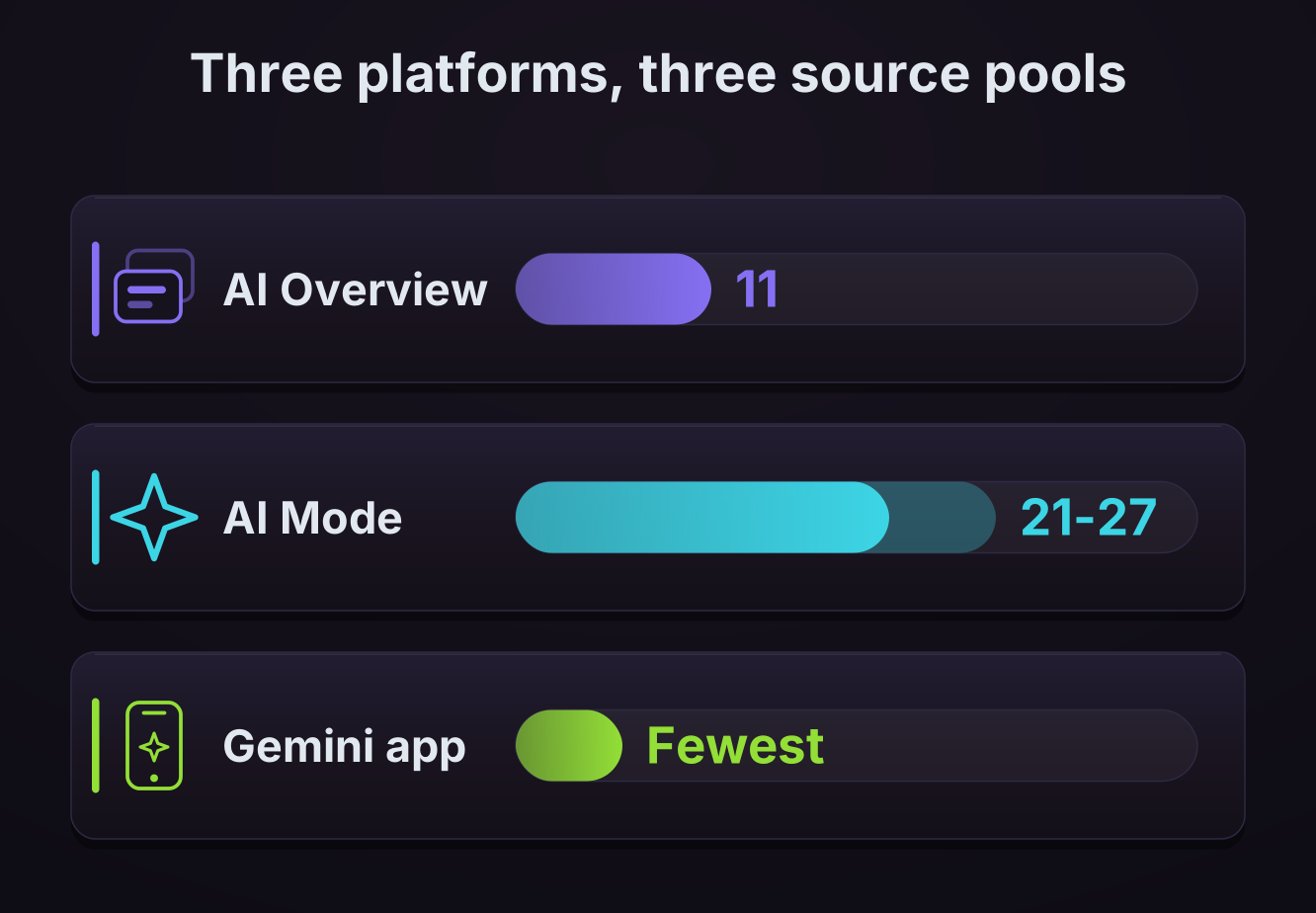
Most advice on Gemini SEO treats Gemini as one destination. It is not. When I ran the same query through Google's classic AI Overview, AI Mode and the Gemini app on the same afternoon, the three systems cited three almost completely different sets of sources and the source counts ranged from 11 to 27. That gap is the whole problem, because a page optimised for one platform can be invisible on the other two. Across three published case studies with explicit Gemini platform splits, Rankmax clients have earned exactly 125 Gemini cited pages. In this guide, I will walk you through what Gemini SEO actually involves, how each platform picks its sources, which optimisation levers have real evidence behind them, and the one robots.txt setting that quietly locks you out of Gemini without touching your Google rankings.
A Quick Guide to Gemini SEO
Gemini SEO is the practice of earning citations in Google's Gemini-powered answer engines, rather than only ranking blue links beneath them. Because Gemini grounds its answers in the Google Search index at prompt time, the foundations are familiar: crawlable pages, genuine expertise and clear passage structure. What changes is the unit of success, which becomes the cited passage rather than the ranked page.
Turn Gemini Visibility Into Revenue, Not Just a Screenshot
Getting cited once is a nice screenshot. Getting cited consistently, across AI Overviews, AI Mode and the Gemini app your buyers actually use, is a campaign. As an AI SEO agency, we run Gemini SEO inside a full AI SEO strategy, and one B2B client reached 598 AI cited pages and $8.7M in attributed revenue over 27 months.
See How AI SEO WorksGemini Is Three Platforms, Not One
Almost every guide on this topic collapses Gemini into a single thing. In practice, you are optimising for three distinct answer products that share a model family but not a citation pool.
1. The classic AI Overview: The summary box at the top of a standard Google results page. In my test, it cited 11 sources and showed them behind a "Show all related links" panel.
2. AI Mode: The dedicated conversational search experience, which Google says surpassed one billion monthly users within a year of launch. It cited 21 to 27 sources for the same query, roughly double the AI Overview.
3. The Gemini app: The standalone assistant at gemini.google.com. It cited the fewest sources of the three and a different set again.
The practical consequence is that a citation in one platform tells you very little about the other two. In a December 2025 study of 730,000 response pairs, Ahrefs found only 13.7% citation overlap between AI Overviews and AI Mode. That is why we treat AI Mode as its own optimisation target rather than a variant of AI Overviews. Our AI Overview vs AI Mode comparison explains the operational differences.
One caveat worth holding. At the time of writing, Gemini 3 class models power both AI Overviews and AI Mode, and Google describes the transition from AI Overviews into AI Mode as one fluid Search experience. The version numbers change often, and the platforms may well converge. The durable move is to optimise the foundation that feeds all of them, not to chase each release.
How Gemini Actually Chooses Its Sources
Gemini does not rank ten results and stop. It retrieves passages, evaluates them and assembles an answer, which is why a page can rank well and still never get quoted. We have covered the full mechanics in our guide to how AI search works, but two behaviours matter most here.
Query Fan-Out Explains the Source-Count Gap
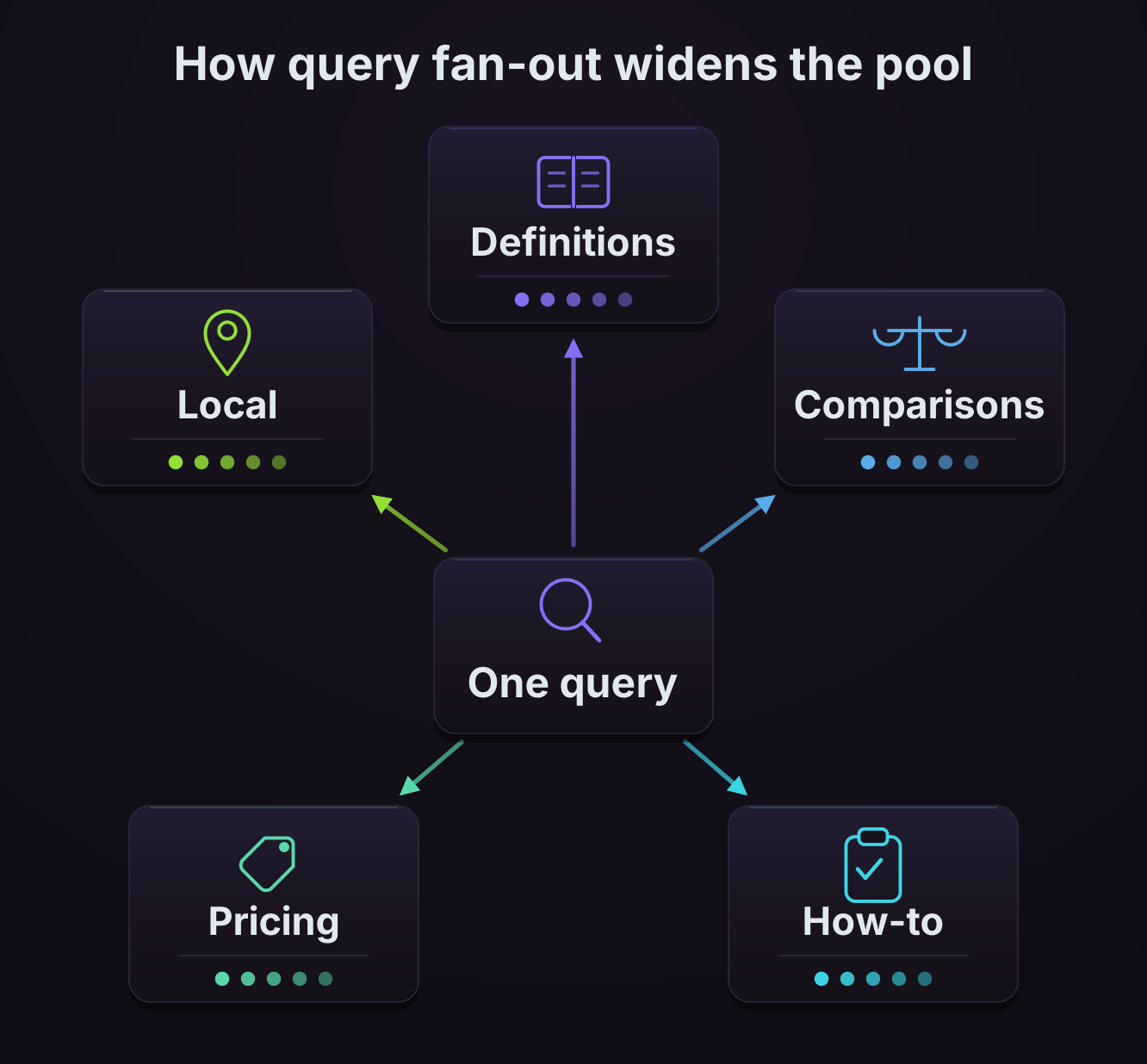
Gemini takes one question and quietly breaks it into many related sub-queries, then gathers sources for each. Google calls this query fan-out. It explains why AI Mode can retrieve a wider source pool than a classic AI Overview for the same query.
This changes what you should target. You are not competing for one keyword. You are competing to be the best available answer to a cluster of sub-questions the user never typed, which rewards depth and comprehensive coverage over exact-match phrasing.
The Same Question, Phrased Twice, Gets Different Sources
This one surprised me. I asked Gemini about Gemini SEO twice, once as the bare keyword and once as a natural sentence describing the identical intent: how do I optimise my website to get cited by Google Gemini. The two answers cited almost entirely different sources, with only one domain appearing in both.
The second phrasing also pulled in sources the first never touched, including an individual consultant's site cited three separate times on a technical point the keyword query missed entirely.
In the competitor pages reviewed for this article, I found no discussion of this behaviour. It matters because single-query citation checks are close to worthless as a measure of visibility. If you test one phrasing, see yourself cited and declare victory, you have measured noise. It also means the long conversational questions people actually ask an assistant are a separate battleground from the short keyword you track in a rank tool, and the two do not reliably move together.
The Optimisation Levers With Actual Evidence Behind Them
Plenty of Gemini SEO advice is assertion. Some of it has research behind it. The GEO: Generative Engine Optimization study from Princeton, Georgia Tech, IIT Delhi and the Allen Institute tested optimisation methods across roughly 10,000 queries and found five that reliably lifted visibility in generative answers by up to 40%:
- Citing sources
- Adding quotations
- Including statistics
- Improving fluency
- Writing with an authoritative voice
We unpack how we apply these in our guide to generative engine optimisation.
Three levers do the heavy lifting for Gemini specifically.
1. Write passages that can be lifted cleanly: Gemini quotes passages, not pages. A section that answers one question completely, in a self-contained block, can be extracted without the model needing surrounding context. A section that depends on three paragraphs above it cannot. This is passage optimisation, and it is the single most mechanical change most sites can make. In practice, that means a clear question-shaped heading, a direct answer in the first two sentences, then the supporting detail, not a slow build to a conclusion.
2. Use structured data to remove ambiguity: Google says no special schema.org structured data is required for AI Overviews or AI Mode. That is not an argument for skipping it. Schema can remove ambiguity about what a page is, who wrote it and when it was updated. Our approach treats schema as a parsing layer over content the reader can already see, never as a place to stash claims that are not on the page.
3. Give the model a reason to trust you: Gemini is selecting sources it can stand behind. Named authors with real credentials, visible publication and update dates, first-hand data and citations to primary sources all raise the odds. This is ordinary E-E-A-T work, and it is doing more lifting in AI answers than it ever did in blue-link rankings.
What This Looks Like in Australia
Most Gemini SEO guidance is written for international audiences. Our first-hand review of the live Australian results found a materially different source set, so Australian businesses need to test locally rather than assume a United States result is representative.
When I checked the live Australian results for this topic, the AI Overview was already citing an Australian agency's own service page alongside the American publishers. Gemini is clearly willing to cite locally relevant sources for Australian users, which means the local field is still open in a way the American one is not.
Two practical consequences follow for Australian businesses:
- Check your citations on Australian results: The cited set genuinely differs from the American one, so a default US view will tell you the wrong thing about your own visibility.
- Treat locally grounded evidence as a ranking asset: Australian pricing, Australian regulation and Australian case data are worth real effort here, because almost none of the incumbent pages carry any.
The robots.txt Setting That Blocks Gemini and Leaves Your Rankings Untouched
This is the trap almost nobody covers, and it is the one I would check first.
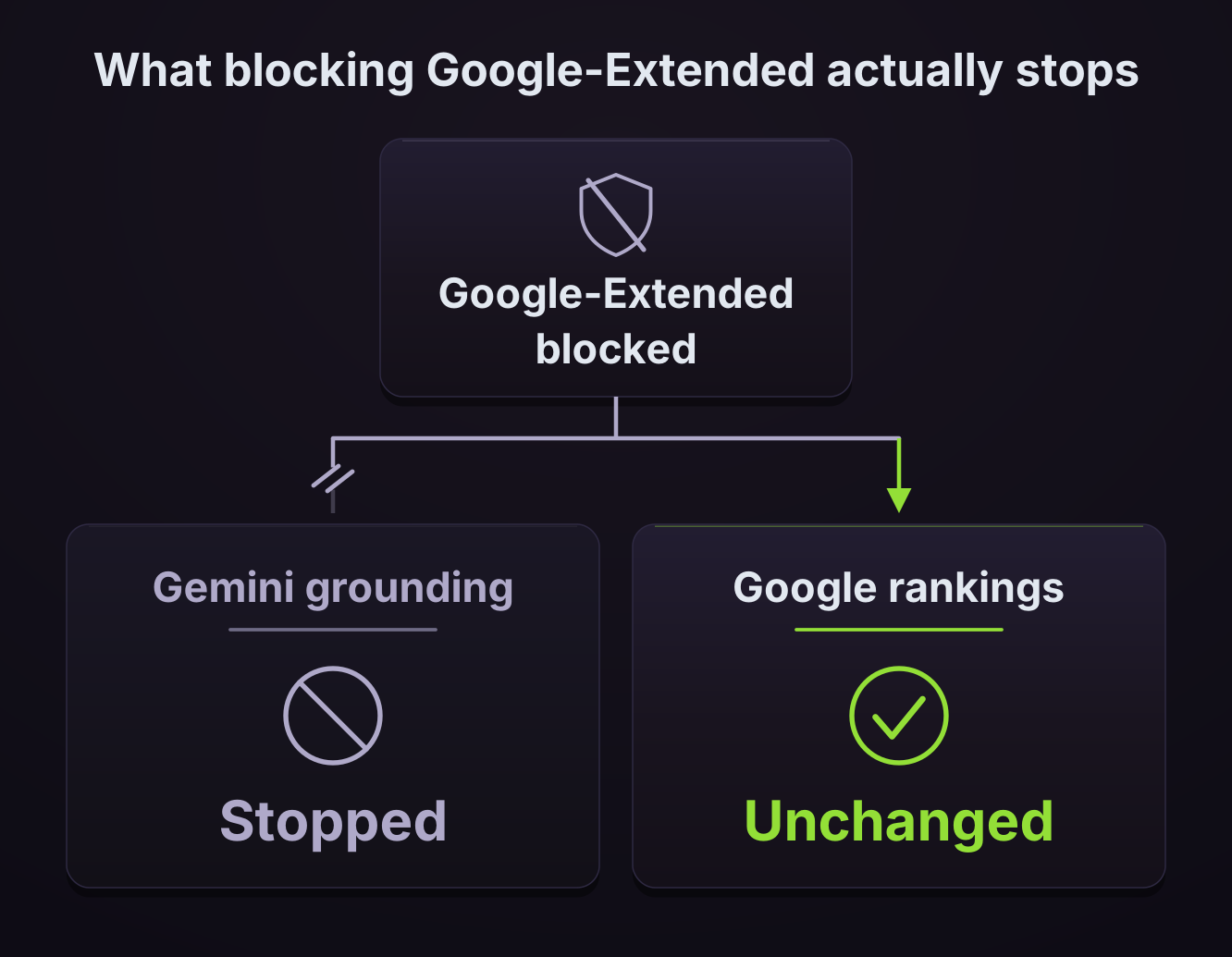
Many sites added Google-Extended to robots.txt believing it only opts them out of AI model training. It does more than that. Per Google's own crawler documentation, the Google-Extended token controls whether your content may be used both for training future Gemini models and for grounding, which Google defines as providing content from the Search index to the model at prompt time to improve factuality and relevancy in Gemini Apps.
Block it and you are not just declining to train a model. You are telling Gemini it may not use your pages to ground its answers.
The reason this goes unnoticed is in the next line of the same documentation: Google-Extended does not affect your inclusion in Google Search and is not a ranking signal. So nothing breaks. Rankings hold, traffic holds and the only thing that changes is that you quietly stop being citable in Gemini Apps. If Gemini visibility is a goal, this belongs in your next technical SEO audit.
How to Measure Gemini Citations Without Fooling Yourself
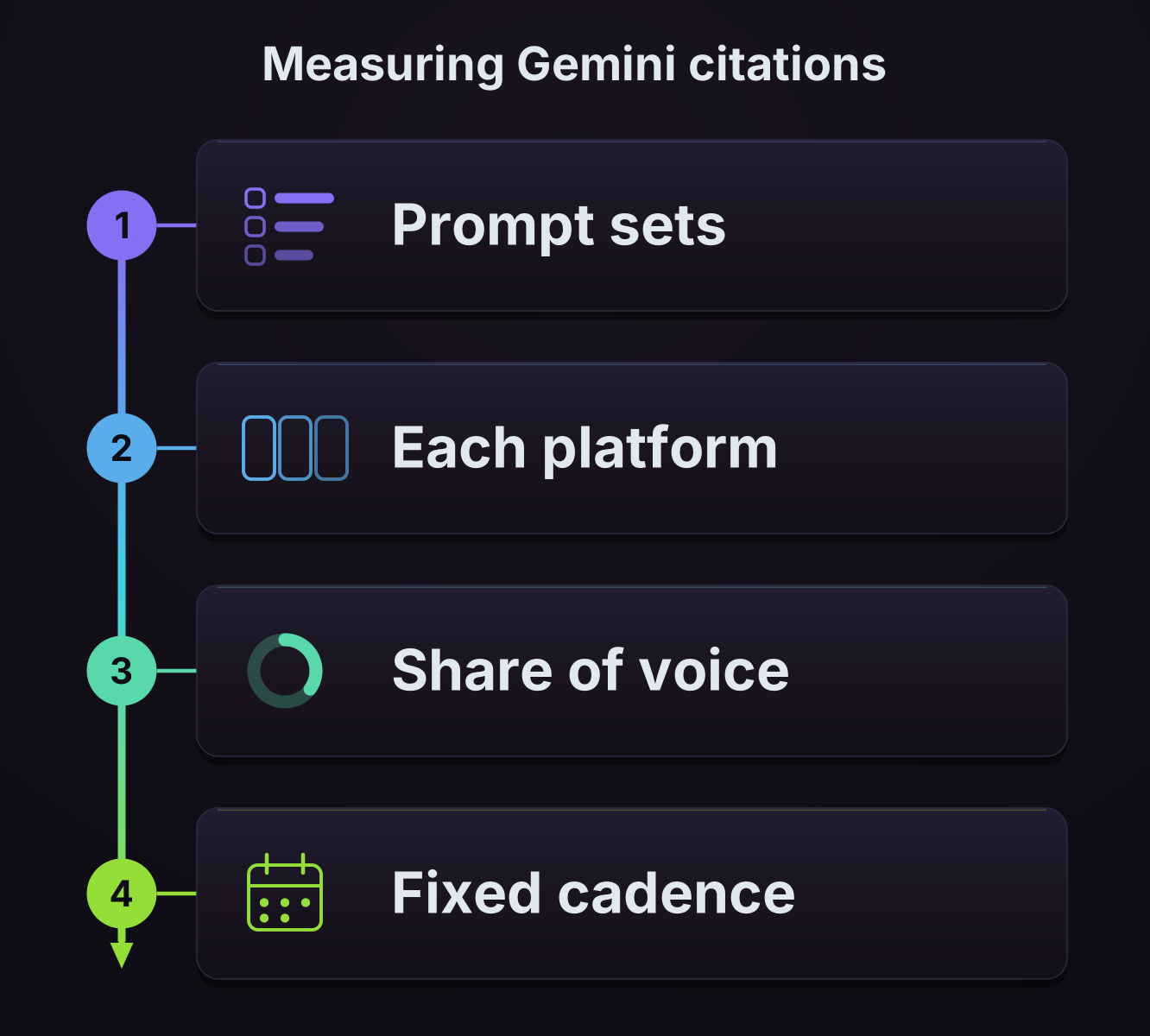
A manual one-prompt spot check looks convenient, but our repeated-query test above shows why it is unreliable. Change the phrasing and the cited source set can change with it. Reliable measurement needs a stable prompt set, separate tracking for each answer engine and repeated observations over time.
What works is closer to rank tracking than to spot checks:
1. Track a set of prompts, not one query: Cover several phrasings of each commercial question, because one phrasing is a sample size of one.
2. Track each answer engine separately: AI Overview, AI Mode and the Gemini app are different pools and should never be averaged together.
3. Track share of voice, not just presence: Being one of 27 cited sources is not the same as being one of three.
4. Re-measure on a fixed cadence: These answers move week to week, so a single snapshot ages badly.
Purpose-built tooling now covers most of this, and we maintain a tested breakdown of the best AI visibility tools for exactly this job.
In practice, this is how we run it on a client campaign. We build a prompt set from the questions a buyer actually asks at each stage, usually 30 to 60 of them, weighted toward the commercial end rather than the definitional queries a government or encyclopaedia domain will always own.
Those run on a monthly cadence against each answer engine separately, and the output we care about is the split: how many cited pages on AI Overviews versus AI Mode versus Gemini and whether the brand is named or merely used as an uncredited source. That distribution is the diagnostic.
When one platform lags badly while the others climb, the cause is almost always structural rather than a content-quality problem, and it points at a specific fix rather than a vague instruction to write better.
One framing point we hold firmly. AI citations are a visibility KPI and a leading indicator, tracked alongside rankings, never a replacement for them and never a revenue metric in their own right. Our view on which SEO KPIs actually connect to revenue sets out where citations sit in that chain. Across our campaigns, the pattern is consistent: citations climb first, then the revenue follows.
Across the published Rankmax case studies with explicit Gemini platform splits, clients have earned 125 Gemini cited pages in Semrush AI Visibility (B2B 62, B2C 46, B2B fintech 17), tracked beside ChatGPT, AI Overviews and AI Mode rather than as a vanity total. One B2B client reached 598 AI cited pages and $8.7M in attributed revenue over 27 months, with share of voice moving from 0.6% to 6.2%. A B2C client reached 477 AI cited pages alongside $14.6M. A B2B fintech reached 666 AI citations while organic clicks grew ninefold.
Frequently Asked Questions
Is Gemini good for SEO?
Gemini is useful as an assistant for SEO tasks such as clustering keywords or drafting outlines, but that is a different question from optimising to be cited by it. This guide covers the second one. Treat Gemini as a search channel you need visibility in, not only as a tool you use.
How do you do SEO for Gemini?
Start by confirming Gemini can actually access your site, including the Google-Extended check above. Then structure content so individual passages answer complete questions, strengthen author and trust signals and measure citations across each Gemini answer channel separately rather than as one number.
Is SEO dead because of Gemini?
No, though the unit of success is shifting. Gemini grounds its answers in the Google Search index, so pages that cannot be crawled or do not rank are rarely cited in the first place. What changes is that ranking becomes the entry ticket rather than the finish line, and the cited passage becomes the thing you optimise for.
Which AI platform should Australian businesses prioritise?
It depends entirely on where your buyers are, which is why we measure before recommending. Gemini answer channels carry the advantage of sitting inside Google Search itself, so they reach people who never open a separate assistant. If your audience skews toward standalone assistants, our ChatGPT SEO guide covers that side.
How long does it take to get cited by Gemini?
In our campaigns, the first citations typically appear within weeks of publishing genuinely differentiated content on a crawlable site, while meaningful share of voice takes months. The eCommerce campaign that reached 866 AI citations built that over 16 months, not overnight.
Does schema markup help with Gemini citations?
Google says no special schema.org structured data is required for AI Overviews or AI Mode, so treat schema as a supporting lever rather than the main one. It can still earn its place by making visible page information less ambiguous to crawlers.
Can I rank in Gemini without ranking in Google?
Rarely, because Gemini Apps use the Google Search index for grounding. If a page is absent from that index, it is not available to be retrieved. Traditional crawlability and indexation work remains the foundation.
Where This Leaves Your Next Move
Gemini SEO rewards the unglamorous things: pages a crawler can reach, passages that answer one question cleanly, trust signals a model can verify, and measurement honest enough to survive the phrasing volatility built into these systems. The three systems will keep converging, and the model versions will keep changing, but none of that alters the foundation, which is the only part worth building on.
Start with the Google-Extended check, because it takes five minutes and it is the one setting that can silently cost you every Gemini citation you would otherwise earn.
About the Author
Want Insights Like This Fortnightly?

Our AI SEO strategies and tactics delivered fortnightly, including bonus trade secrets not shared anywhere else. No fluff. Just what's working right now. 5-minute read.


