
B2B FinTech AI SEO Case Study: $589,766 New Customer LTV Over 12 Months

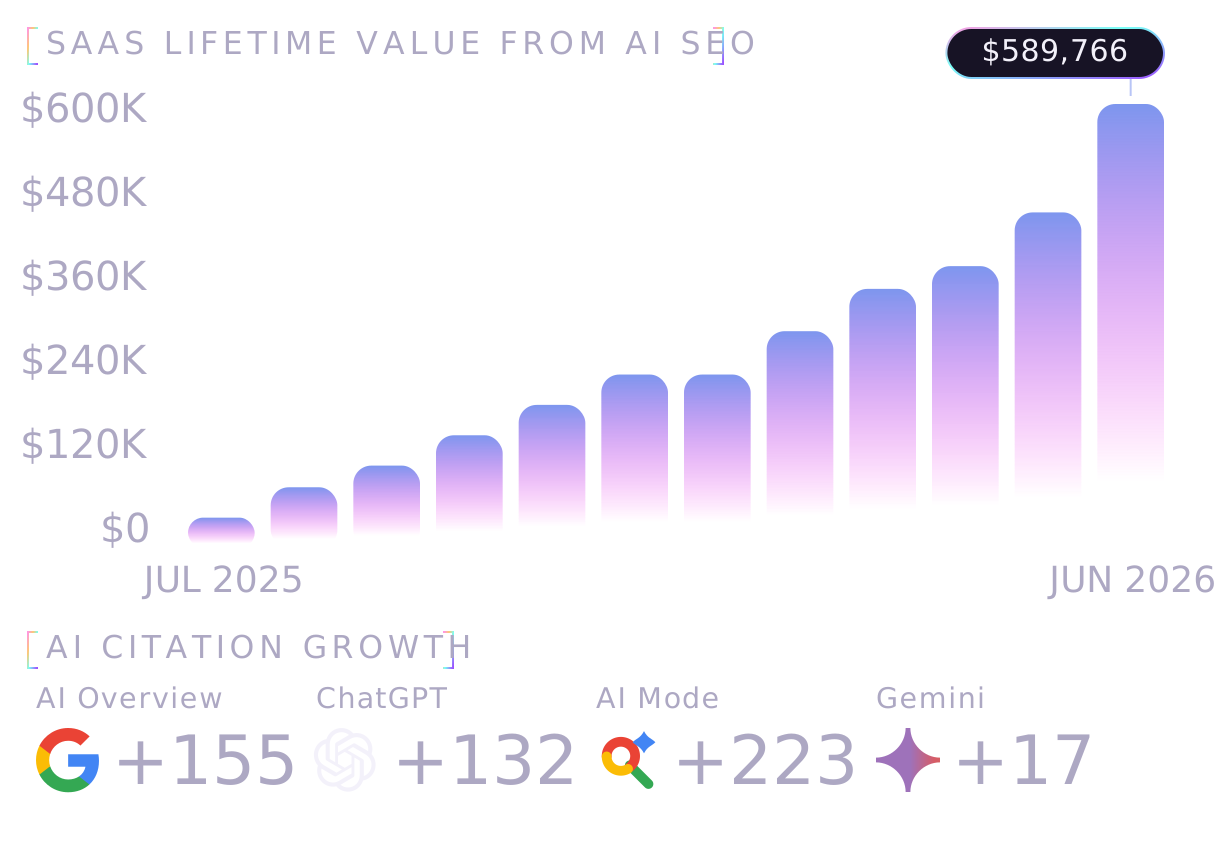
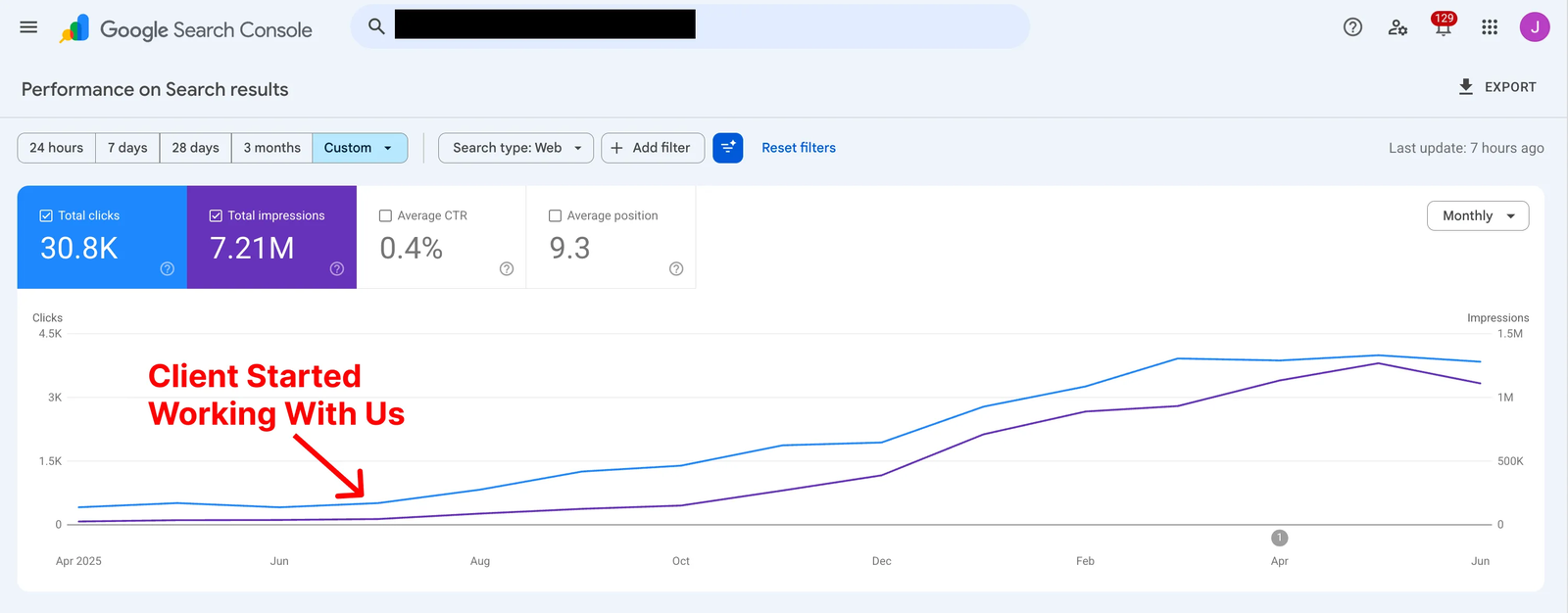
When an Australian B2B fintech SaaS platform for multi-entity financial consolidation and automated reporting partnered with Rankmax, organic search was not reliable at generating free trial signups. Twelve months later, Google Search Console shows organic clicks rising from 412 to 3,840 (9x), impressions from 38,000 to 1.11 million (29x), and average position from 37.3 to 7.6. Over the same campaign window, CRM post-purchase survey attribution (Incremental ROI table) models about 31 new customers from organic search and AI assistants, for $589,766 in total modelled lifetime value added to date at an average campaign modelled ROI of 883%. This B2B fintech AI SEO case study is a first-party review of dual Google and AI SEO work through June 2026.
A Quick Overview of This B2B Fintech AI SEO Case Study
The client connects finance and operations systems (including Xero and downstream tools such as Power BI and Excel) so finance teams can consolidate multi-entity reporting without manual copy-paste. Buyers are CFOs, financial controllers and BI-minded operators who research both in Google and in assistants such as ChatGPT, Claude, Copilot and Perplexity.
We ran a continuous AI SEO growth campaign focused on commercial Xero consolidation and reporting clusters, technical foundations, and content structured for both classic rankings and AI citation. Measurement below uses Search Console, Ahrefs and CRM survey attribution. Commercial proof on this page is CRM survey attribution and Search Console demand - not GA4 ecommerce revenue.
Twelve-month snapshot (June 2025 to June 2026):
- Organic clicks: 412 to 3,840 (9x) - Google Search Console
- Impressions: 38,000 to 1.11 million (29x)
- Average position: 37.3 to 7.6
- Ahrefs (global): ranking keywords 148 to 460; top-3 keywords 2 to 240; estimated organic traffic value $70 to $2,872/mo (Ahrefs)
- Ahrefs (Australia): keywords 53 to 69; top-3 2 to 31
- CRM commercial path (Incremental ROI table, full series): 130 SEO/AI-attributed free trials (100 organic + 30 AI); about 31 modelled new customers; $589,766 total modelled LTV added to date at $19,200 average 24-month LTV; series average modelled ROI about 883% (investment columns not published). Company-wide wins in the same window were 149 (all channels - context only)
- AI citations (Semrush AI Visibility, June 2026): 666 citations, 17 mentions, 395 cited pages across tracked AI surfaces
- AI-sourced demand: CRM now names ChatGPT, Claude, Copilot and Perplexity as sources; June 2026 logged 20 SEO/AI-attributed free trials (12 organic + 8 AI) at 37.5% trial-to-customer conversion - the strongest AI trial month in the series
- Content system: over 100 new pages published plus 8 content refreshes completed by the June review (about 40 further pieces still in production)
- Product proof alongside SEO: highest-rated connector social proof on the Xero App Store (5.0 rating class), with 90+ verified marketplace users and 300+ businesses on product metrics used in client content (product proof, not SEO KPIs)
- End-month commercial snapshot (June 2026, CRM model): $144,000 modelled LTV and 2,780% ROI on the CRM deal path for that month alone (modelled LTV return, not booked revenue; fee amounts not published)

The Challenge: Winning Trust in a Crowded Fintech Category
B2B fintech SaaS discovery is unforgiving. Buyers compare consolidation and reporting tools long before a trial, and incumbents already owned much of the "best Xero multi-entity" conversation in both Google and AI answers.
Competitive, high-intent keywords
Head terms around Xero consolidation, multi-entity reporting and Power BI financial dashboards sit in a crowded set. Generic thought leadership was not enough. The client needed durable positions on commercial and mid-funnel queries finance teams actually type.
Trial-led commercial model
This B2B fintech SaaS sells on a free-trial motion, not ecommerce checkout. Success is trials becoming paying customers, not search impression vanity metrics. Reporting therefore had to connect rankings to CRM-attributed trials and wins, while staying honest about survey gaps and analytics limits.
AI answer engines as a second SERP
Finance buyers increasingly ask assistants which consolidation platform to use. Being crawled is not the same as being recommended. Separate work later in the programme showed assistants sometimes filed the product under "data warehouse / BI engine" rather than "multi-entity consolidation for finance teams" - a positioning and entity problem as much as a pure ranking problem. Dual Google + AI SEO had to treat category language, comparison coverage and citable product pages as first-class work.
Migration risk mid-programme
In May 2026 the marketing site moved from WordPress to Astro on Vercel. Migrations create ranking and tracking noise. Any honest case study has to show the climb and the migration month, not only peak screenshots.
The Solution: Dual Google and AI SEO for B2B Fintech SaaS
We built an AI SEO strategy around commercial Xero and reporting clusters, technical clarity, EEAT for finance content, and pages written so both Google and answer engines can retrieve precise passages. Ongoing execution sat inside a Rankmax AI SEO growth campaign with ongoing content publishing and continuous technical improvement.
Phase 1: Keyword and competitor map
We prioritised:
Primary cluster: Xero consolidation, multi-company / multi-entity consolidation, financial consolidation
Secondary cluster: Xero to Power BI, Power BI financial dashboards, reporting automation
Supporting themes: connectors, Excel add-ins, management reporting, month-end close / AI data jobs
Competitors were tracked in Ahrefs Rank Tracker against the live SERP, not tool exports alone. Reporting for this account later formalised live Google AU verification whenever Ahrefs claimed large wins or losses - because tracker drift repeatedly mis-stated page-one reality in this niche.
Phase 2: Technical foundations and site architecture
Pre-launch and post-launch audits tackled crawl clarity, internal links, indexation and structured data gaps. Site health reached 99/100 on Ahrefs Site Audit during the strong early-2026 run. The May 2026 Astro migration temporarily pulled health down (broken internal paths and SPA analytics issues) before recovery work with the client's development team. Technical SEO stayed a support layer for content, not a one-off checklist.
Phase 3: Content system built for rankings and citations
The Rankmax AI SEO growth campaign shipped a high volume of dual-optimised articles and commercial landing support.
Intent research - commercial value first, not volume alone
Query fan-out - how assistants expand finance questions (see our query fan-out work)
Real operator questions - consolidation, eliminations, GST/VAT, month-end close, Power BI joins
Content briefs optimised for clear, passage-level answers finance buyers can trust
Human accuracy pass - especially for Xero product claims
By June 2026, we'd shipped over 100 completed new pages and 8 refreshes, with further pieces still in production. Volume only works when topical clusters reinforce product pages (for example Xero consolidation and connector landing URLs) instead of scattering thin posts.
Phase 4: Product pages and entity clarity
Blog growth without product-entity clarity still loses "best platform" AI answers. We supported:
Stronger internal linking into commercial URLs (including connector and consolidation paths)
Footer and IA signals so Google preferred the right landing URL over a weaker blog variant
Structured, features-first copy aligned with how finance buyers evaluate software
Ongoing positioning work so assistants stop mis-filing the product purely as a generic BI pipe
Phase 5: AI search visibility and attribution
We treated AI assistants as measurable acquisition surfaces:
Content shaped for citation (clear definitions, steps, comparisons)
CRM survey paths that separately tag organic search vs AI tools
Monthly reporting that shows AI-attributed trials from CRM source data
By mid-2026, CRM rows named ChatGPT, Claude, Copilot and Perplexity as hear-about sources. That is still voluntary survey data - directional, and almost certainly under-counted when respondents leave the field blank - but it is enough to prove AI search is already in the trial mix for this B2B fintech SaaS.
Phase 6: Conversion honesty for a trial product
Unlike ecommerce revenue pixels, this client's commercial story uses:
Free trial starts
Post-signup "where did you hear about us"
Won / lost / open deals
Modelled lifetime value on attributed wins
Commercial ROI and trial attribution come from the CRM (post-purchase source survey and deal outcomes), not from GA4. Site migration can affect analytics session paths; it does not change the CRM Incremental ROI model used on this page.
Implementation Notes
What "good" looked like operationally
Weekly content production against a living cluster map
Rank tracking plus live SERP spot checks before calling a keyword won or lost
Continuous technical improvement through a full platform migration
Client-visible monthly reporting with separate organic and AI trial lines
No paid-link dependency as the growth story - authority came from topical coverage, marketplace proof and editorial citations earned by useful resources
Multi-channel honesty
Xero Marketplace remains a meaningful partner channel for this product. This case study does not claim every trial or win came from SEO. The CRM figures below are the self-attributed organic + AI search subset, and total company wins in the window were higher (149). That split is intentional.
Results Through June 2026
Organic visibility: Search Console
| Metric (GSC) | Jun 2025 | Jun 2026 | Change |
|---|---|---|---|
| Clicks | 412 | 3,840 | 9x |
| Impressions | 38,000 | 1.11M | 29x |
| Average position | 37.3 | 7.6 | Much deeper page-one gravity |
Absolute monthly clicks later sat in a high three-to-four thousand band (for example 3,920 in March 2026 and 3,990 in May 2026 on YoY cuts), with year-on-year click growth rates from roughly +435% (January) through +617% (March) and +837% (April) on those month pairs. The twelve-month start-versus-end table is the cleanest single before/after.
Keyword breadth: Ahrefs
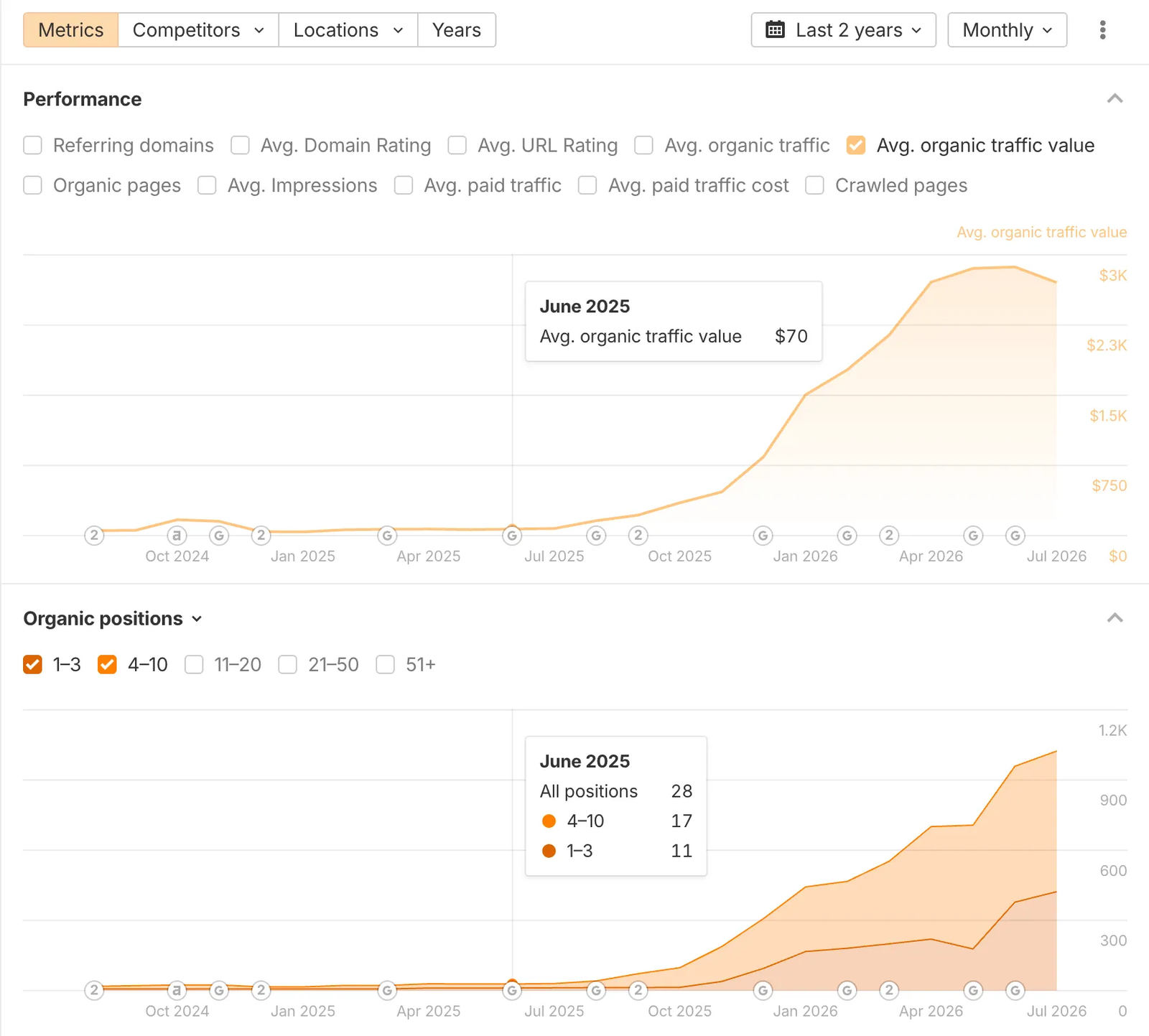
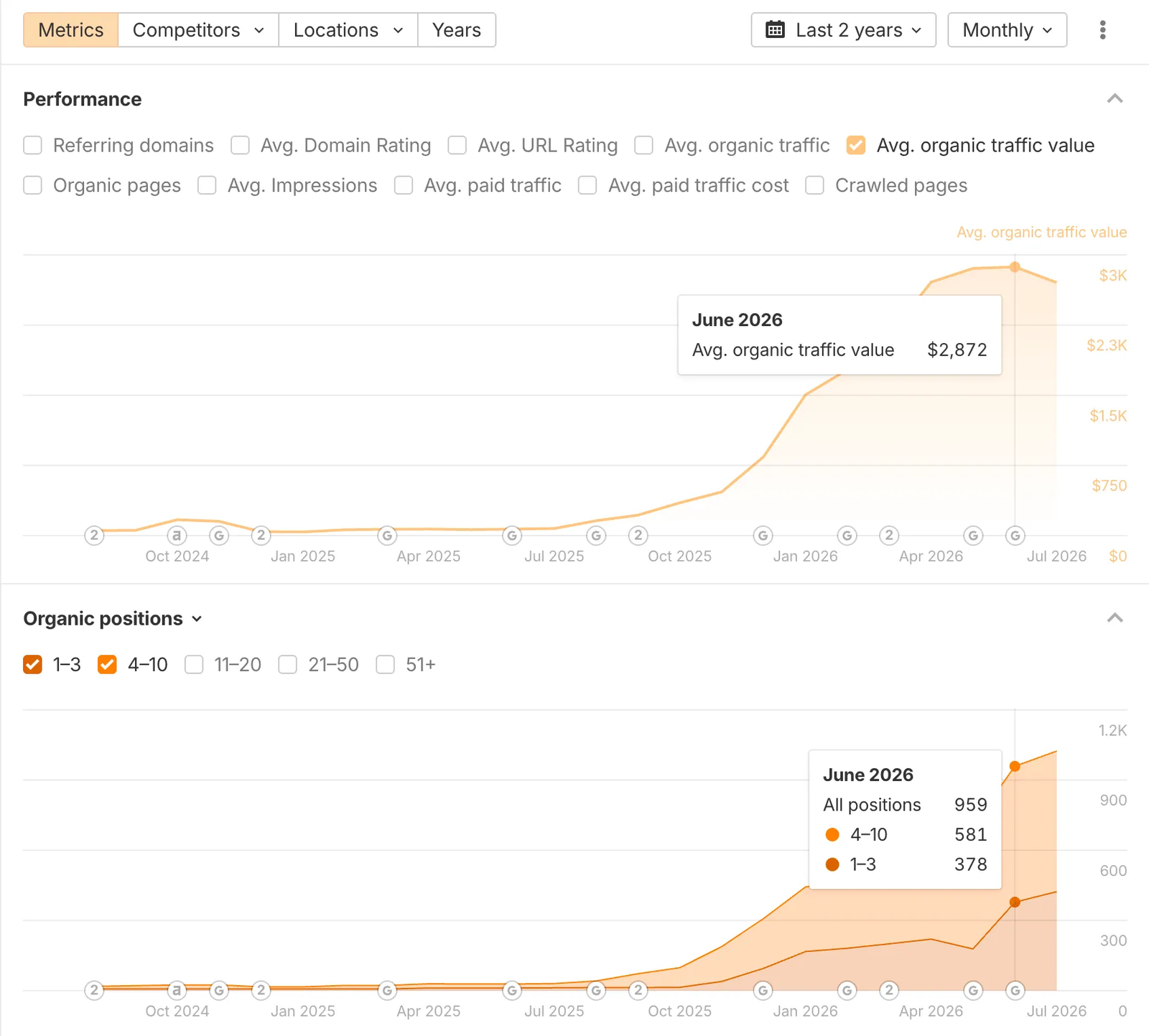
Global breadth expanded sharply. Australia stayed a focused commercial battlefield - fewer total keywords than global, but a clear lift in top-three holdings on the AU index Rankmax cares about for this account.
Commercial outcomes: CRM-attributed organic and AI search
| Commercial metric | Campaign window figure |
|---|---|
| SEO/AI-attributed free trials (full CRM series) | 130 (100 organic + 30 AI) |
| Modelled new customers (trials x monthly conv. rate) | 31 |
| Total modelled LTV added to date | $589,766 |
| Average LTV per customer (model) | $19,200 (24 months) |
| Total company wins in the same window (all channels) | 149 (context only) |
| June 2026 SEO/AI-attributed free trials | 20 (12 organic + 8 AI) |
| June 2026 trial-to-customer rate (CRM path) | 37.5% |
| June 2026 modelled new customers | 7.5 |
| June 2026 modelled LTV (CRM path) | $144,000 |
| June 2026 modelled ROI (CRM path) | 2,780% |
| Historical full-funnel trial-to-customer benchmark | 12.1% (H2 2024) to 26.2% (2025) |

How to read modelled LTV: figures come from the monthly Incremental ROI from AI SEO [CRM PPS & Deal Data] table: (organic + AI free trials) x that month's trial-to-customer conversion rate x $19,200 average 24-month LTV. Summed across Jul 2025-Jun 2026 that is about 31 modelled customers and $589,766 total LTV added to date. It is not GA4 ecommerce revenue and not all-channel company revenue. Monthly ROI % is the modelled LTV return for that month only (fee amounts are not published).
May 2026 CRM snapshot (migration month): 13 SEO/AI-attributed trials in the CRM path, about $71,386 modelled LTV and roughly 1,328% ROI on the CRM model for that month - from the CRM path for that month.
AI-assisted trials


AI visibility was tracked in Semrush AI Visibility alongside CRM source tags for AI-assisted trials.
End-window AI visibility (Semrush, June 2026): 666 citations, 17 mentions, 395 cited pages. LLM mix is dominated by Google AI Overviews / AI Mode for mentions, with ChatGPT and AI Mode strong on cited pages.
We do not invent a multi-platform "total AI citations" hero number for this page. Citation quality and category framing remain active work; traffic and CRM paths are the inventory-backed commercial proof today.
What B2B Fintech SaaS Teams Can Take From This
What The Client Had To Say:
"I was blown away by the accuracy and attention to detail from Rankmax. As someone with over 25 years in the industry, I was initially sceptical if the Rankmax team could fully reflect my experience in the content they produced for my website - but they were spot on. James and his team demonstrated an immense understanding of both the technical details and strategic implications for my business. The level of research and accuracy in their work was phenomenal. I couldn't have done better myself. This is exactly the kind of expertise that can transform your business's online presence. My reaction says it all: WOW! This can only help! Highly recommend Rankmax to any business serious about their SEO strategy."
- Kevin W., Founder, B2B Fintech SaaS | ⭐⭐⭐⭐⭐ (5/5) | ✓ Verified Google Review
Frequently Asked Questions
What is a B2B fintech AI SEO case study?
It is a documented engagement showing how a financial technology software company improved visibility in Google and AI answer engines, with commercial outcomes such as free trials and attributed customer value - not traffic screenshots alone.
How is this different from a generic SaaS SEO case study?
The product type is still SaaS, but the category pressures are fintech-specific: trust, multi-entity accounting language, Xero ecosystem competition and cautious buyers. Rankmax also maintains a separate SaaS SEO case study for a different engagement; this page is the B2B fintech proof URL.
How did you attribute revenue without ecommerce tracking?
This client does not run classic ecommerce purchase pixels for this story. Commercial proof uses CRM post-purchase survey attribution for organic vs AI sources, deal outcomes and a modelled lifetime value on attributed wins, alongside Search Console demand metrics.
Did AI search actually create customers?
CRM rows show free trials and wins self-attributed to AI tools as well as classic organic search. AI volume is still smaller than Google organic in the survey data, and blanks in the survey mean true AI contribution is likely understated. The point is direction and proof of channel mix, not a claim that AI already outranks Google for this account.
What happened to results during the website migration?
May 2026 introduced temporary technical debt during the WordPress to Astro move. Search Console demand stayed strong on a year-on-year basis, and rank/health metrics needed live verification and engineering fixes. Commercial ROI tracking stayed on the CRM path throughout - it was not dependent on GA4.
How long before B2B fintech SEO compounds?
This review covers roughly a year of continuous work from mid-2025 strategy into a June 2026 end state. Early months build foundations; the clearest step-change in clicks and commercial attribution shows once clusters, technical health and product URLs reinforce each other.
Which services did Rankmax use on this engagement?
Strategy and ongoing AI SEO execution: research, technical SEO, content production, AI visibility work and revenue-aware reporting. See AI SEO strategy and SEO for SaaS for how that offer is packaged.
Closing
This twelve-month arc is a practical B2B fintech AI SEO case study: 9x organic clicks, 29x impressions, average position pulled from the mid-thirties into the high single digits, and $589,766 total modelled LTV added to date from about 31 organic- and AI-attributed modelled customers - with AI assistants already visible in the CRM trial mix. The work continues; the June 2026 cut is a measurement window, not a claim that the category is finished.
If you run a B2B fintech or finance SaaS product and want the same dual Google + AI system behind your trials, start with a focused strategy conversation via our AI SEO strategy page or browse more case studies.
About the Author


Want Help Putting This into Practice?

Everything we publish comes from the same methodology we run for clients every day. Book a discovery call and we will show you how it applies to your business.


