
How to Rank in ChatGPT and Earn AI Citations in 2026

ChatGPT now answers more than 2.5 billion messages a day, and a growing share of those are people asking which product, service or agency they should choose. If your business is not showing up in those answers, you are invisible to buyers who never reach a traditional search results page. ChatGPT SEO is how you fix that. In this guide we will walk you through exactly how ChatGPT picks the pages it cites, the three step framework our team uses to earn those citations, and the client benchmarks that tell you what is realistic. Everything here is what is actually working for us in 2026, not theory.
Quick Guide: What Is ChatGPT SEO?
ChatGPT SEO is the practice of optimising your content so ChatGPT surfaces, cites and recommends your business when users ask buying questions. It works by making your pages easy for ChatGPT to retrieve through its live search ecosystem, easy to extract through clean structure and answer capsules, and trustworthy enough to cite through real expertise and verifiable results. One Rankmax client, a B2B property management business, earned 598 AI cited pages over 27 months and counting using this approach, with attributed revenue now about $8.7M over 27 months (ongoing).
Dominate ChatGPT and AI Search With a Proven Strategy
Your competitors are already being cited in ChatGPT responses. Our team has delivered about $8.7M over 27 months for a B2B property management client, about $14.6M over 21 months for a B2C professional services client, and $1.31M over 12 months for a SaaS client. Explore ChatGPT SEO services to map how your business can appear in ChatGPT answers.
Explore ChatGPT SEO ServicesWhy ChatGPT SEO Matters for Your Revenue in 2026
The shift to AI search is not a forecast anymore, it is measurable in your competitors' traffic. This section covers the demand signals that make ChatGPT SEO a revenue priority this year.
ChatGPT now serves over 900 million weekly active users, and users send more than 2.5 billion messages a day. That scale matters, but the intent behind those messages matters more. Commercial intent prompts are far more likely to trigger a live web search in ChatGPT, at 53.5% compared with 18.7% for informational queries. If you sell a product or service, your commercial pages are exactly what AI search is actively looking for and citing.
The money is already following the behaviour. Adobe reported that AI-driven referral traffic increased more than tenfold between July 2024 and February 2025, while Forrester found that 89% of B2B buyers have adopted generative AI as a self-guided information source across the buying process. When nine in ten of your buyers are consulting an AI assistant before they speak to you, being absent from those answers is a direct revenue leak.
This is why Rankmax clients who invested in AI SEO early are compounding ahead of the market. The same B2B property management campaign that earned 138 citations has now attributed about $8.7M over 27 months (ongoing), and a SaaS client achieved $1.31M in revenue at a 20.1:1 ROI over 12 months using the same AI first content methodology.
How ChatGPT Selects and Cites Content
ChatGPT does not crawl the live web the way Google does. Understanding the retrieval path is the difference between guessing and engineering citations, so this section breaks down the mechanics before the tactics.
The Three Crawler Model
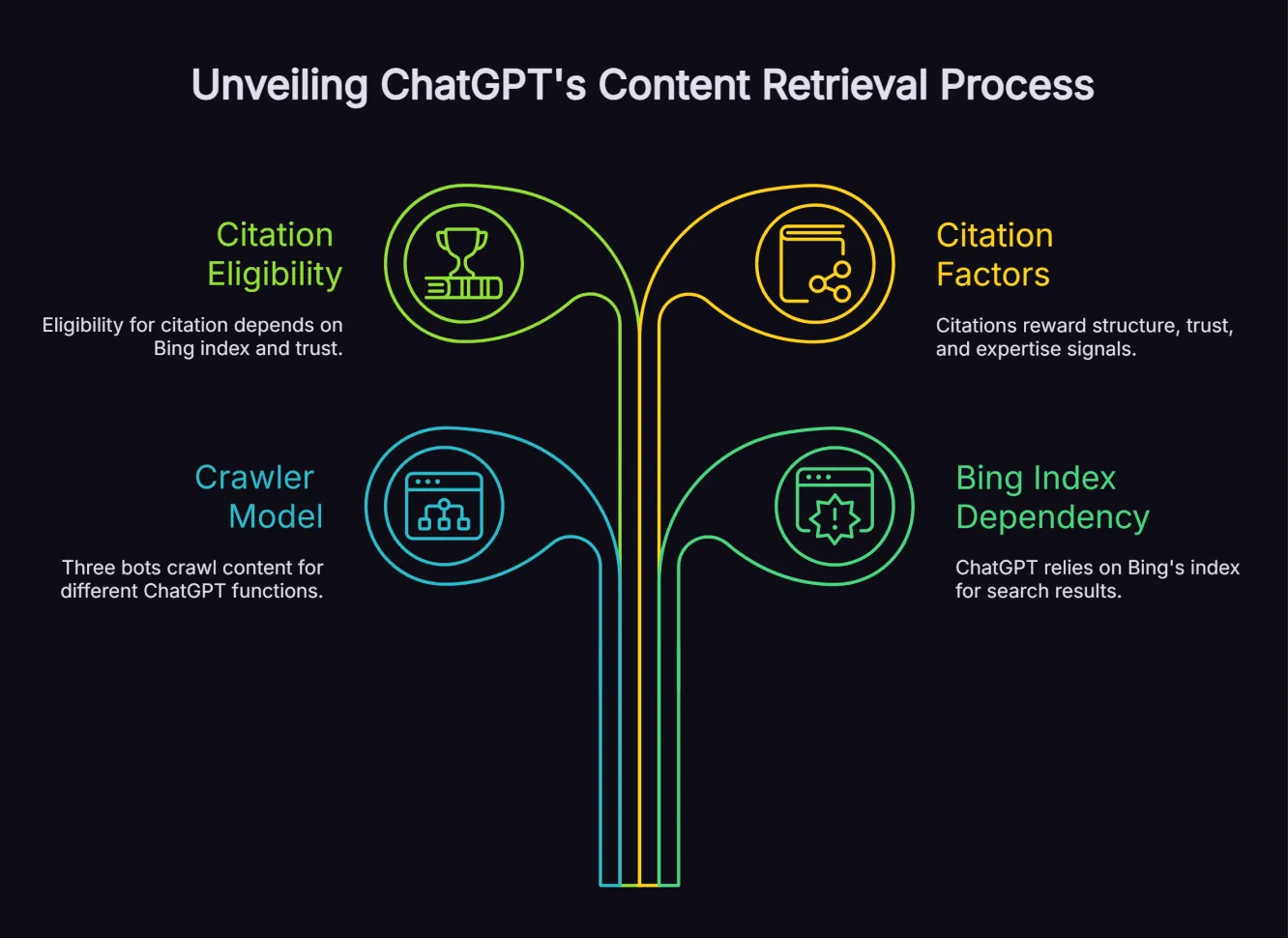
For organic ChatGPT visibility, three OpenAI user agents matter most, and confusing them is the most common technical mistake we see. GPTBot crawls content for training future models, so blocking it does not affect your ChatGPT Search visibility. The bot you must allow is OAI-SearchBot, which powers the live search and citation feature. ChatGPT-User is the third, triggered when a user clicks through. If your robots.txt blocks OAI-SearchBot, your site may be excluded from ChatGPT search answers, although OpenAI says it may still appear as a navigational link.
The Bing Index Dependency
ChatGPT Search does not rely on a private crawl in the same way Googlebot builds Google Search. OpenAI says ChatGPT search uses third-party search providers, content provided directly by partners and OAI-SearchBot access to help surface sites in ChatGPT search. Bing visibility may still matter because Bing is listed as one of OpenAI’s search providers, but it should not be framed as the only source or a one-to-one proxy for ChatGPT visibility. The practical takeaway is broader: make sure your priority pages are crawlable, technically sound, accessible to OAI-SearchBot, indexable by major search providers and supported by content signals strong enough to be cited.
What Gets Cited Once You Are Eligible
Being accessible is only the entry ticket. Getting cited depends on whether your content is easy to extract and trustworthy enough to use. Ahrefs found that blog list formats account for 43.83% of ChatGPT citations in certain “best of” query types, which explains why comparison pages, roundups and clearly structured recommendation content often appear in AI answers. Across Rankmax's own campaigns, we see the same underlying pattern: citations reward verifiable client results, original data and consistent author profiles. The B2B property management content that drove 138 citations was built around those signals, not keyword density.
The Three Step ChatGPT SEO Framework
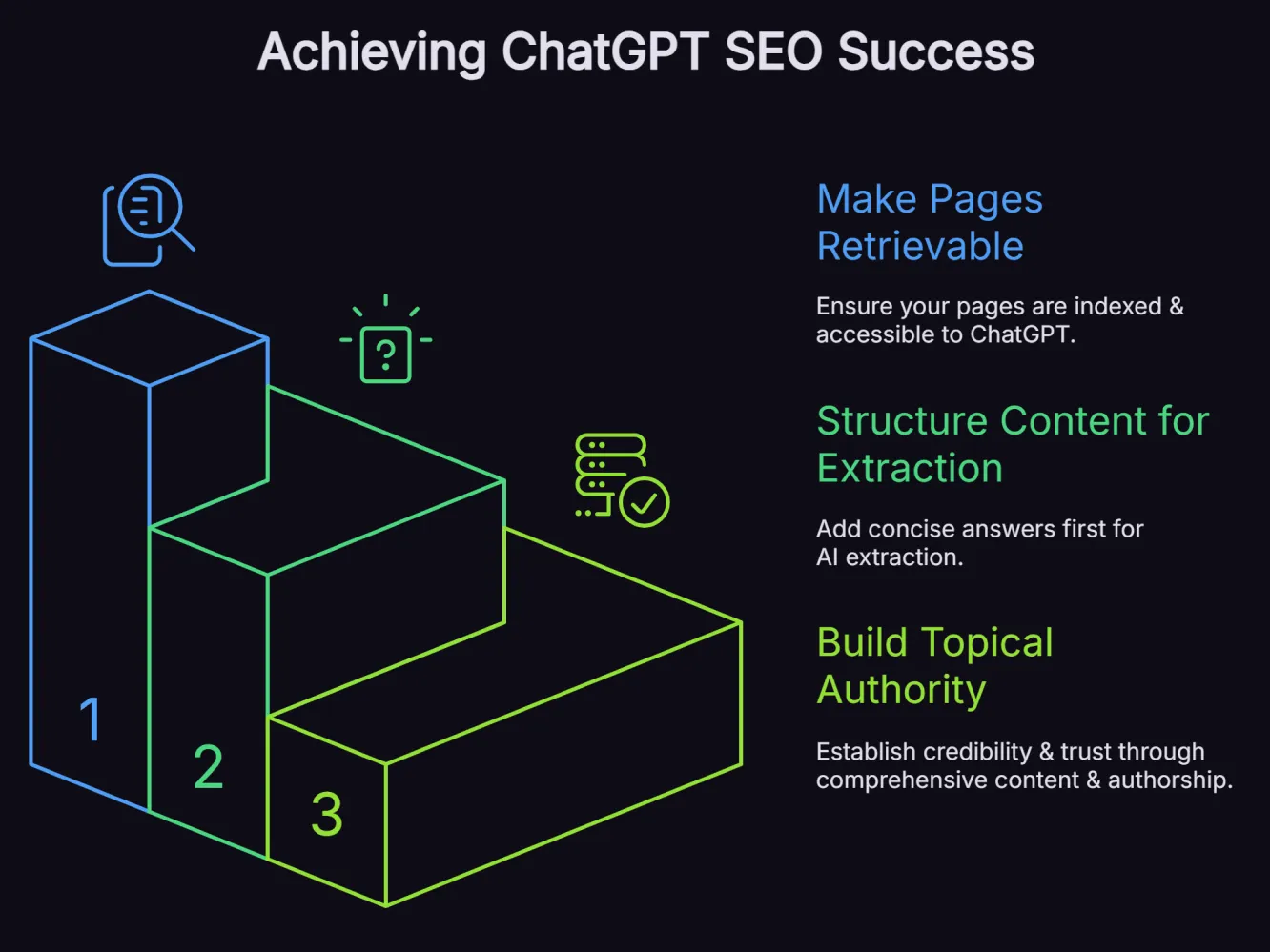
This is the framework our team runs on every AI SEO campaign. Each step maps to one of the three things ChatGPT needs: retrieval, extraction and trust.
Step 1: Make Your Pages Retrievable
Start with the index. Confirm OAI-SearchBot is allowed in robots.txt, verify your priority pages are indexed in Bing Webmaster Tools, and fix the crawl and rendering issues that keep pages out of the pool. No amount of clever copy helps a page ChatGPT cannot retrieve.
Step 2: Structure Content for AI Extraction
Once a page is retrievable, ChatGPT needs to lift a clean answer out of it. Place a 40 to 60 word answer capsule at the start of each section that fully answers the heading question. This is not a style preference, it is where the citations live. Kevin Indig (Growth Memo, Feb 2026) found that 44.2% of ChatGPT citations come from the first 30% of a piece of content, as also reported by Search Engine Land, so the answer a buyer needs has to appear before they have to scroll. Lead with the answer, then expand with the detail and proof.
Step 3: Build Topical Authority and E-E-A-T Signals
Retrieval and extraction get you considered. Trust gets you cited repeatedly. Cover the full topic cluster rather than only your commercial keywords, attach real authorship with credentials and anchor claims to verifiable results. For the B2B property management client, covering the complete cluster rather than just the money pages is what produced 138 citations across multiple search surfaces over 27 months and counting. Original data and consistent author profiles did the rest. Internal structure matters here too, which is why we pair this with deliberate keyword clustering so each page reinforces the others.
How to Measure ChatGPT SEO Performance
Most teams still measure ChatGPT SEO with screenshots and guesswork. We prefer a tracked baseline, consistent AI citation monitoring and a conversion lens. This section covers the tooling we use to measure AI visibility and the revenue metric that actually matters to the board.
Track Citations With Semrush AI Visibility
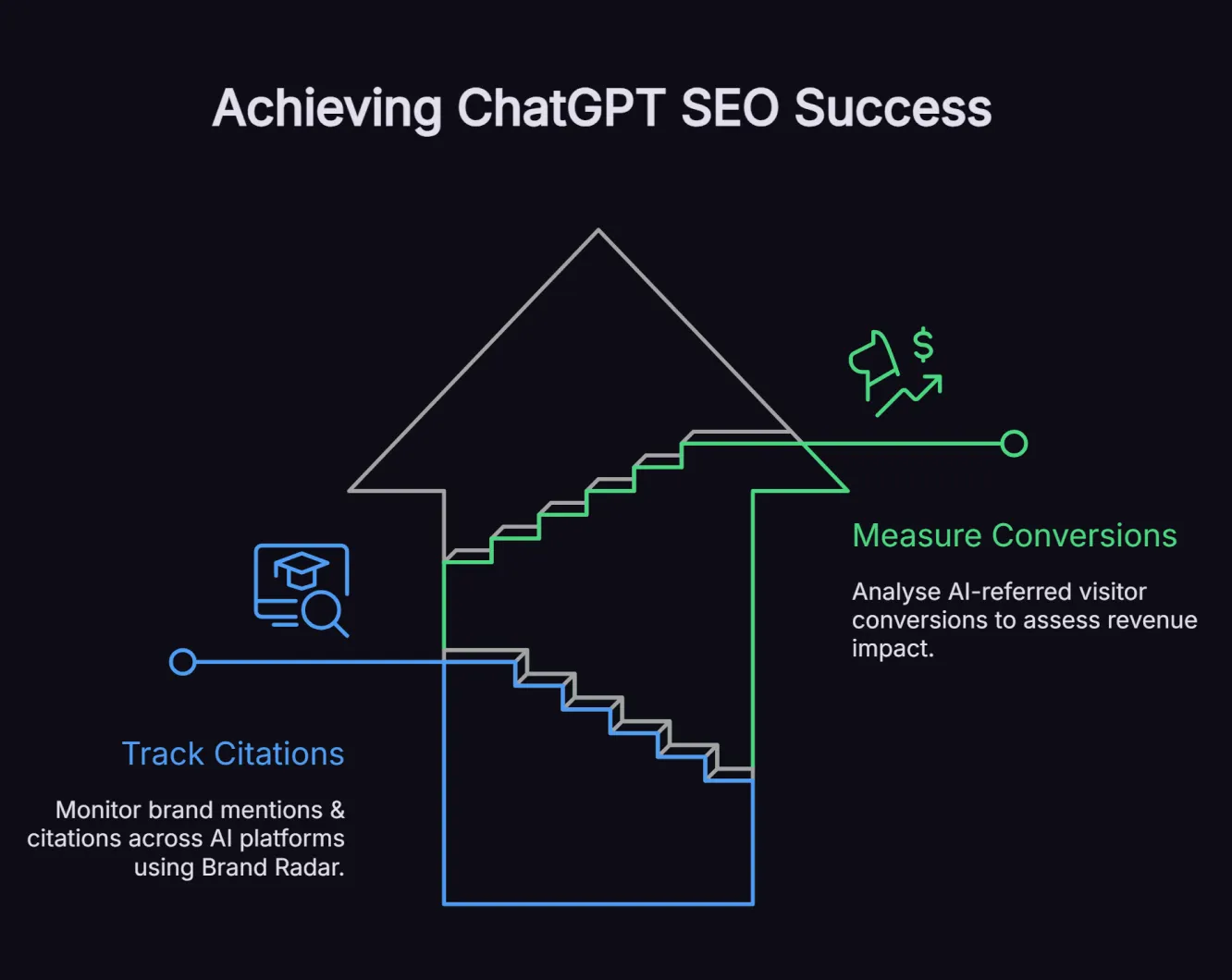
Our primary tracker is Semrush AI visibility tracking, which we run weekly across client accounts. It sits in the same platform as the rest of the SEO workflow and covers ChatGPT, Google AI Overviews, Google AI Mode and Gemini in the Visibility Overview, with Perplexity available in Brand Performance on Pro+ and Advanced. For Google-side Gemini citation work specifically, use our Gemini SEO guide. The numbers we watch are mentions, citations, cited pages, share of voice and prompt-level movement month to month.
The feature we lean on hardest is citation gap analysis: where AI engines discuss competitors and we are not in the answer yet. That is what turns monitoring into a fix list. For a fuller head-to-head of the category, see our AI visibility tools review, where Semrush ranks first from hands-on client testing.
Ahrefs Brand Radar as a Secondary Check
We still use Ahrefs Brand Radar as a secondary cross-check when we want another read on brand mentions, citations and share of voice across ChatGPT, Perplexity, Google AI Overviews and other AI platforms. It is useful insurance, not our weekly operating system. With AI Overviews now appearing in over 16% of searches and growing, multi-surface tracking has moved from nice to have to essential.
Measure the Metric That Pays: Conversion
Citation counts are the leading indicator. Revenue is the one your CFO cares about. In our E-E-A-T analysis, AI-referred visitors converted 23x higher than organic search visitors, which is why we measure AI visibility against revenue, not just citations. That multiple is what turns a modest citation count into a serious revenue channel, especially for businesses with high consideration purchase decisions where buyers research hard before they commit.
Common ChatGPT SEO Mistakes to Avoid
We have audited enough sites to see the same handful of errors repeat. Each one quietly caps your citation potential.
- Blocking the wrong bot: Teams block GPTBot to protect their content from training, then accidentally block OAI-SearchBot too and disappear from search citations.
- Burying the answer: When the direct answer sits halfway down the page, it falls outside the first 30% of content where 44.2% of citations are pulled from.
- Chasing only commercial keywords: Thin topic coverage reads as a sales page, not an authority. The campaigns that earn citations cover the full cluster.
- No author, no proof: Anonymous content with no verifiable results gives ChatGPT no reason to trust you over a competitor who shows their working.
- Treating search-provider visibility as optional: If your priority pages are not crawlable, indexable and accessible to OAI-SearchBot and major search providers, they are less likely to be retrieved and cited.
How Much Does ChatGPT SEO Cost?
ChatGPT SEO investment depends on your starting position, your competition and how quickly you want to build AI visibility. For businesses serious about AI search, comprehensive Rankmax campaigns are scoped in discovery. That depth of work suits brands where AI citations can influence high-value leads, sales or pipeline. In Rankmax client data, the B2B property management campaign has attributed about $8.7M over 27 months (ongoing), while the SaaS campaign returned $1.31M at 20.1:1 over 12 months.
FAQs
How Long Does ChatGPT SEO Take to Produce Results?
Faster than most people expect when the foundations are right. On a recent eCommerce campaign, pages appeared in traditional search results within 60 days and started being cited by ChatGPT within 90 days. Over five months, that same campaign went from zero to 126 Google AI Overview citations and earned 12 ChatGPT citations across 20 pages. Your timeline depends on your domain's existing trust, but 60 days to rank and 90 days to first citation is a realistic benchmark from Rankmax data.
Can I Use ChatGPT to Do My ChatGPT SEO?
You can use it to draft, but it will not earn you citations on its own. ChatGPT cites pages with verifiable results, original data and credible authorship. Those are the things a model cannot invent for you. Use AI to speed up production, then add the proof, the data and the named expertise that make a page citation worthy.
Is ChatGPT SEO Different From Traditional SEO?
It shares the foundations and adds a layer. The Bing index, clean technical SEO and topical authority all still apply. What changes is the emphasis on answer capsules, clear page structure and citation-worthy proof, plus tracking through tools like Semrush AI visibility tracking (and Brand Radar as a secondary check) rather than rank positions alone. Think of it as traditional SEO with an extraction and trust layer built for AI answers.
Does Blocking GPTBot Hurt My ChatGPT Visibility?
No. GPTBot is for model training, not search. You can block it to keep your content out of training data and still be fully visible in ChatGPT Search, as long as OAI-SearchBot is allowed. Confusing the two is one of the most common and costly mistakes.
Which Industries Benefit Most From ChatGPT SEO?
Any business with a considered purchase, because AI referred visitors convert 23x higher. We have seen strong results across B2B services, SaaS and eCommerce. Commercial intent prompts trigger live ChatGPT search 53.5% of the time, so if buyers research your category before they buy, your commercial content is exactly what AI search wants to cite.
About the Author
Want Insights Like This Fortnightly?

Our AI SEO strategies and tactics delivered fortnightly, including bonus trade secrets not shared anywhere else. No fluff. Just what's working right now. 5-minute read.


