
AI Mode SEO: How to Get Cited in Google's New AI Search Experience


Think ranking first still guarantees the click? AI mode SEO matters because Google introduced AI Mode as an experimental Labs feature in March 2025 and started rolling out in the U.S. in May 2025. The feature provides AI-generated answers with supporting links instead of relying only on traditional search results. At the same time, AI Overviews reach over 2 billion monthly users, so search visibility is no longer just about blue links. This guide shows you how to improve your chances of being cited, so your content keeps driving qualified traffic as search shifts. Keep reading to see what is actually working now.
What Is AI Mode SEO?
AI mode SEO is the practice of optimising your website to earn supporting links and citations in Google’s AI search experiences, not just traditional rankings. According to Google’s AI features guidance, there are no additional technical requirements beyond being indexed and eligible to show a snippet, which means content quality, structure, and authority are what separate cited pages from ignored ones.
Get Cited in AI Mode Before Your Competitors Do
The businesses getting cited in Google's AI Mode right now are building an advantage that compounds over time. Our AI Mode SEO agency helps mid-market companies develop and execute the strategies to earn those citations - across Google AI Mode, ChatGPT, Perplexity, and more. We have generated over $26M in attributed client revenue through AI-first SEO, and we'd like to show you how the same approach can work for your business.
See How AI Mode SEO WorksWhat Is Google AI Mode?
Google AI Mode is an AI-first Search experience that Google introduced as an experimental Labs feature in March 2025, initially built on a custom Gemini 2.0 experience. Since May 2025, it has been available as a separate tab in Google Search for users in the US, where people can ask complex, multi-part questions and get synthesised answers with supporting links. Google later brought a custom version of Gemini 2.5 into both AI Mode and AI Overviews in the US, expanding its ability to handle more advanced queries.
Unlike clicking through ten results to piece together an answer, AI Mode does the research for you. It:
- Processes your query
- Retrieves information from multiple sources across the web
- Generates a single coherent response
- Let you ask follow-up questions
- Maintains conversation context, similar to ChatGPT or Perplexity, but built directly into Google Search
How AI Mode Differs from AI Overviews
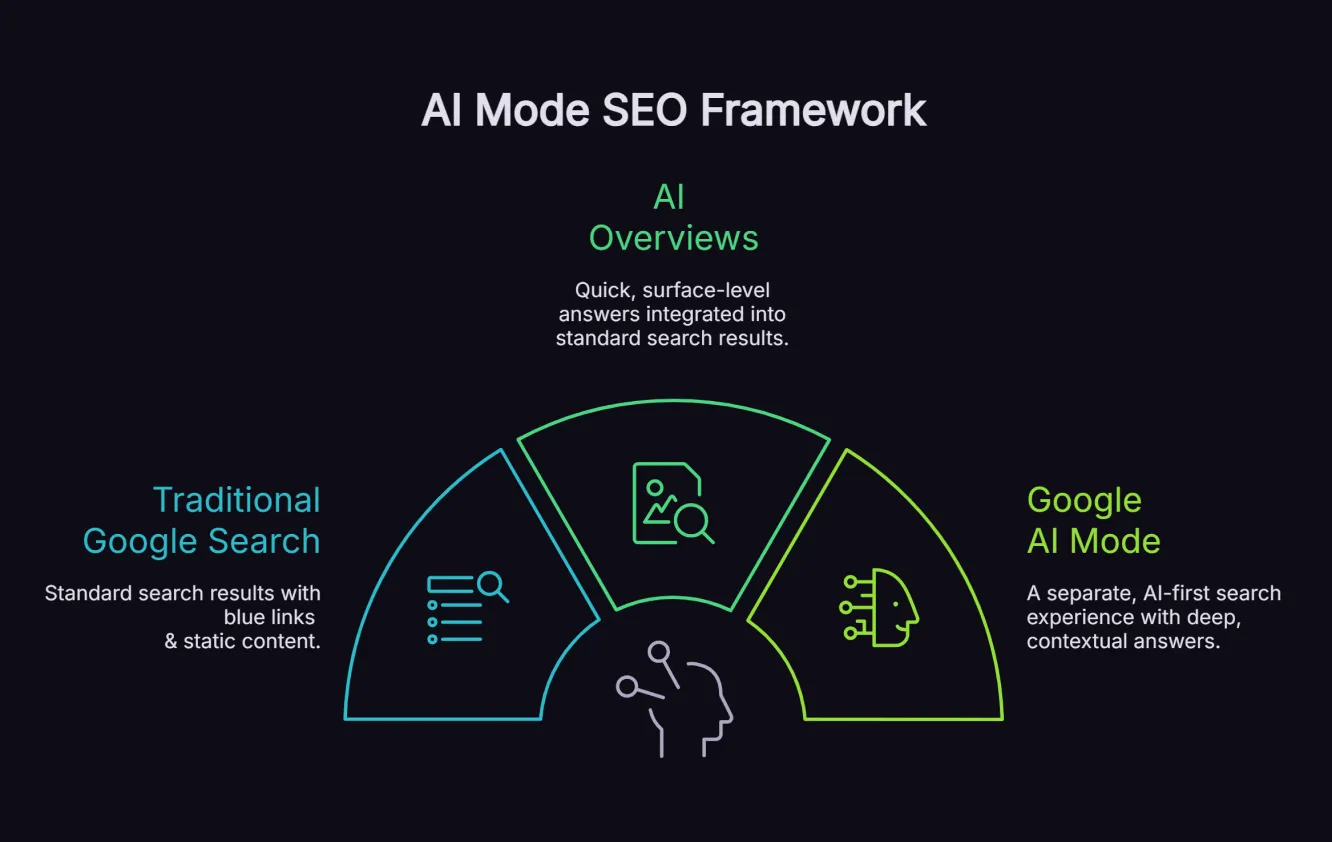
AI Overviews and AI Mode look similar on the surface, but they function differently. AI Overviews appear within standard Google Search results alongside the traditional blue links. AI Mode is a separate AI-first search experience that foregrounds an AI-generated response, with supporting links and sources integrated into the experience rather than presented in the usual results layout.
The other key difference is depth. AI Overviews are designed for quick, surface-level answers. AI Mode handles complex, multi-layered queries and maintains conversation context across follow-up questions. It also connects to Google's real-time data infrastructure, including Google Finance, Shopping Graph, and localised business data, to deliver answers that go well beyond static web content.
The Query Fan-Out Technique Explained
The technology powering AI Mode is called query fan-out. When a user types a question, AI Mode doesn't just search for that exact phrase. It uses Gemini to decompose the query into a series of related sub-queries that are fired simultaneously across the web.
According to Google’s I/O 2025 announcement, AI Mode uses a query fan-out technique that breaks a question into subtopics and issues multiple queries at once to dig deeper into the web. Google also introduced Deep Search as an advanced AI Mode capability for more complex research tasks, designed to run many more searches and return a fully cited response. In practical terms, when someone searches “best AI SEO agency in Australia,” AI Mode may explore related subtopics such as:
- Search results from across the web
- Case studies and real-world examples
- Service comparisons
- Signals of industry credibility and authority
Then it synthesises these inputs into a single, coherent answer. The implication for your SEO strategy is significant. You're no longer optimising for one query. You're building content that can answer the range of sub-questions that sit underneath any given topic.
How AI Mode Is Reshaping SEO
AI Mode doesn't just change where your content appears - it changes the entire model by which content earns visibility. Here's what that shift looks like in practice.
From Rankings to Citations
Traditional SEO was a game of rankings. You targeted a keyword, built a page around it, earned backlinks, and watched your position climb. The reward was a place on page one and the traffic that came with it.
AI Mode shifts visibility closer to a citation model than a pure ranking model. A page in position seven may still be surfaced as a supporting source, while a page in position one may not. One large AI Overviews study found that about 68% of cited pages were not in Google’s top 10 organic results, but that finding should be treated as evidence about AI Overviews, not proof that AI Mode behaves identically.
This is an opportunity as much as it is a challenge. Position your content as the most comprehensive, authoritative source on a topic, and you can earn citations even in competitive spaces where traditional SEO dominance would take years to build.
What the Data Says About Traffic
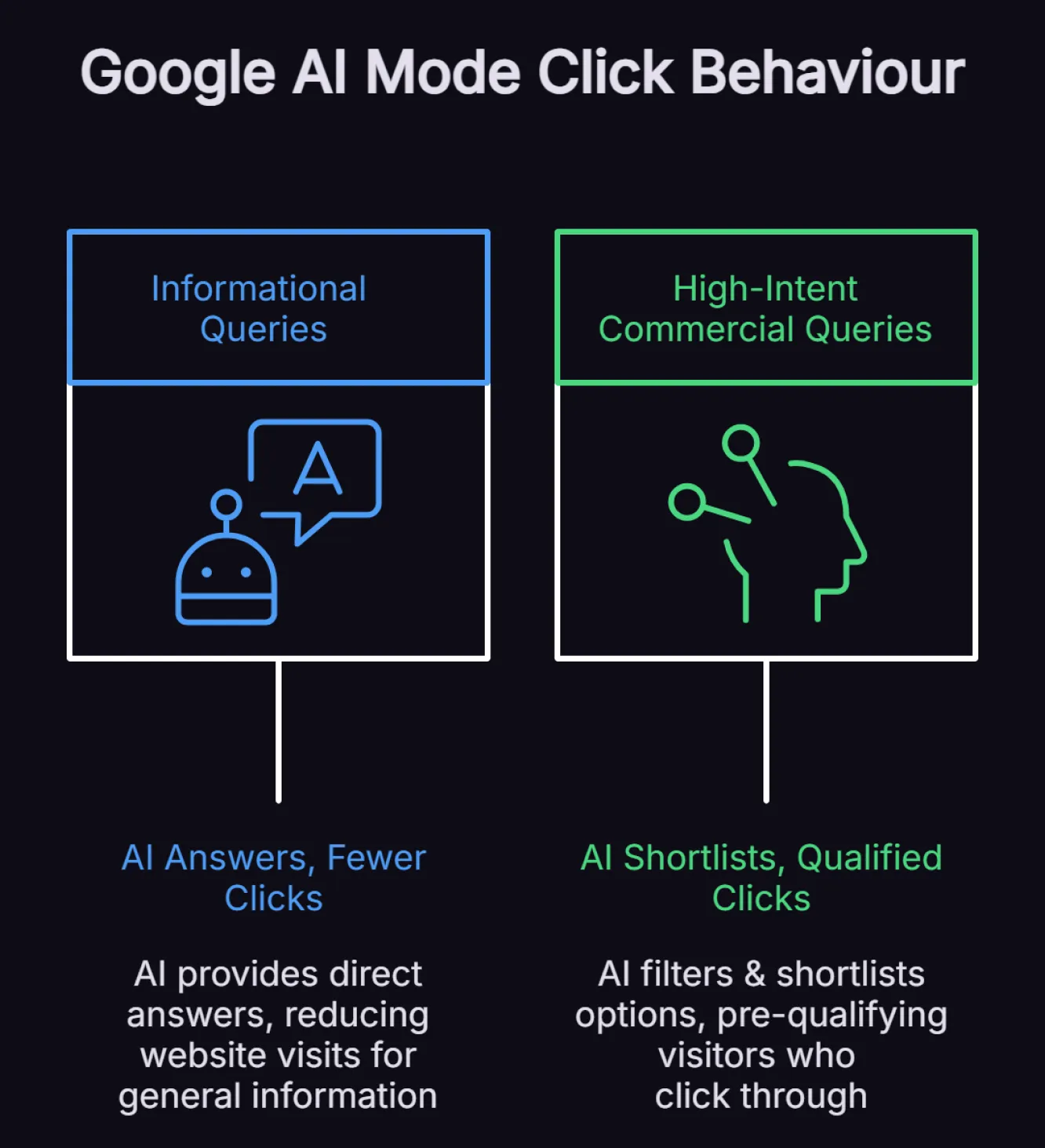
Zero-click concerns are real, but the picture is more nuanced than the headlines suggest. Early third-party studies suggest AI-generated answers can reduce click-through rates for some searches, especially informational queries, but the reported impact varies widely by keyword type, intent, and methodology. That matters for marketing teams that rely on organic traffic, yet it does not mean AI search removes the need to visit websites.
For commercial and high-intent searches, users still click through to compare options, validate claims, and assess fit for themselves. When someone is choosing a law firm, a B2B service provider, or a complex product, the AI summary often acts as a shortlist rather than a final decision. The goal is no longer just winning position one. It is earning a place among the sources people see, trust, and click during the consideration stage.
For many service businesses and complex-product categories, AI Mode citations may send highly qualified visits because searchers often click through to compare providers, validate claims and assess fit.
How to Optimise for AI Mode SEO
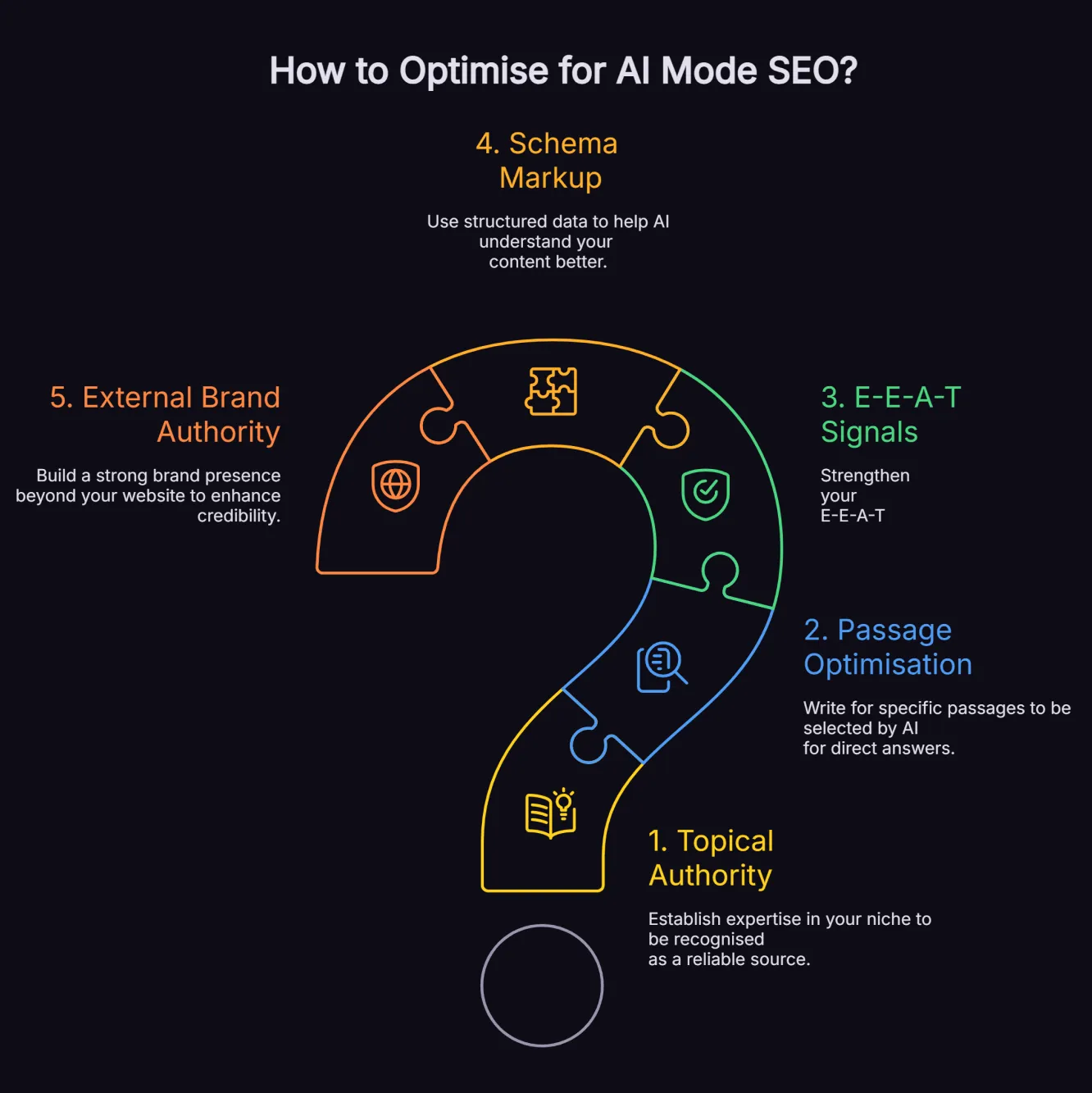
AI mode SEO requires updating your approach across content strategy, technical implementation, and off-page authority building. The following areas offer the most direct impact on your AI citation rate.
Build Topical Authority Across Your Niche
AI Mode rewards depth. Rather than creating standalone pages targeting individual keywords, the most visible sites are building comprehensive content ecosystems that cover every angle of their core topics.
This means creating content clusters: a pillar page covering a broad topic, supported by detailed sub-pages that address specific questions, use cases and comparisons. A structure like this helps build deeper topical coverage across your niche, which can improve your chances of being surfaced for the range of sub-queries AI search systems explore.
Our AI SEO strategy for clients always begins with a topical authority audit - identifying the topics where a client can realistically become the most comprehensive resource, and building the content roadmap to get there. It's a longer-term investment than traditional keyword targeting, but it compounds in a way that individual page optimisation never could.
Write for Passage-Level Selection
Traditional SEO has usually focused on helping whole pages rank for relevant searches. In AI Mode, visibility can come from how clearly your content answers specific parts of a broader query, not just from where the page ranks overall. That means a well-written section or paragraph may still help your page surface as a useful supporting source, even in competitive search results.
This changes how you write. Every section of your content should be able to stand alone and answer a specific question without requiring the surrounding context:
- Write clear, self-contained paragraphs
- Open each with the key point
- Back it with evidence
- Close with a practical implication
- Avoid padding - passages that meander without delivering clear information are unlikely to be selected by AI systems optimising for response quality
Structure also matters. Bullet points, numbered lists, tables, and FAQ sections are formats that AI systems can extract cleanly. When you review your content, ask yourself: "Could an AI pull this paragraph out of context and have it still make complete sense as an answer to a specific question?"
Strengthen Your E-E-A-T Profile
E-E-A-T - experience, expertise, authoritativeness, and trustworthiness - has long shaped how Google evaluates content quality. In AI Mode, those signals still matter because Google’s published guidance continues to emphasise helpful, reliable, people-first content, clear sourcing, and credible authorship over polished writing alone.
Practical steps to strengthen E-E-A-T for AI Mode include:
- Publishing content under named author profiles with verifiable credentials and bios
- Including original research, proprietary data, and first-hand client case studies in your content
- Building external citations from reputable publications and industry bodies
- Maintaining a clear "about" page with verifiable company information and team credentials
Our B2B property management client generated 598 AI cited pages over 27 months and counting. This was driven by content built around:
- Verifiable client results
- Original data
- Consistent author profiles
These elements strengthened the page’s credibility and made the content more useful, trustworthy, and easier for Google to treat as a reliable source.
Use Schema Markup Strategically
Schema markup gives AI systems explicit, structured information about your content. Where a human reader might infer meaning from context, schema spells it out in machine-readable format - making it easier for Gemini to categorise, understand, and cite your content accurately.
Google does not require any special schema markup for AI Overviews or AI Mode. Structured data still helps Google understand your content more clearly, but its main role is to support eligible search features and reinforce the meaning of the page rather than act as a direct shortcut to AI citations. For AI Mode SEO, prioritise:
- FAQPage schema: Helps search engines interpret your FAQ content more clearly and may support how that content is understood across search features.
- HowTo schema: Gives step-by-step content a clearer structure, which can help search engines interpret instructional pages more accurately.
- Article and Person schema: Establishes authorship and publication credibility
- LocalBusiness schema: Particularly important for service businesses targeting local AI Mode queries
- BreadcrumbList schema: Helps AI understand your site structure and the relationships between content pages
Schema markup is still a worthwhile technical improvement, but it should be treated as a supporting signal rather than a direct shortcut to AI Mode citations.
Build External Brand Authority
A stronger third-party brand footprint can support your visibility in AI-driven search experiences. If your business only exists on your own website, you are limiting the external signals people and search systems can use to validate your credibility. Editorial coverage, industry mentions, directory listings and review profiles all help reinforce that your brand is recognised beyond your own content.
Specific actions that build AI-relevant external authority:
- Secure features and mentions in industry publications relevant to your sector.
- Build a consistent presence on Google Business Profile with complete information and active review management.
- Ensure name, address, and phone (NAP) consistency across all directory listings.
- Respond to journalist queries through platforms like Help a Reporter Out (HARO) to earn editorial citations.
- Encourage customers to leave detailed Google and industry-specific reviews.
A December 2025 user study found that 74% of AI Mode users read reviews on Google Business Profile before making a decision. Your external review profile can influence how people assess your brand after discovering it in AI-driven search experiences. Strong reviews and an up-to-date Business Profile still support trust, credibility, and click-through potential once your business appears.
Measuring AI Mode SEO Performance
Tracking AI Mode performance is still developing. Google reports AI Mode and AI Overview activity within Search Console’s overall Web search data, so there is no clean, fully separated AI Mode report to rely on. That means you often need to pair Search Console with Analytics, branded search trends, and conversion data to get a clearer picture of AI-driven visibility and impact.
Metrics worth tracking alongside your standard SEO KPIs:
- Branded search volume: A rise suggests AI Mode is increasing awareness and driving people to search specifically for your brand after seeing you cited.
- Direct traffic: Users who first encounter your brand in an AI Mode citation often navigate directly to your site in a later session.
- Conversion rate on organic traffic: If AI Mode is filtering for intent before sending visitors, your conversion rate on organic sessions should improve.
- AI visibility tools: Use Google Search Console, Ahrefs, and specialist AI tracking platforms such as Ahrefs Brand Radar to monitor how often your brand appears across AI-generated responses in ChatGPT, Perplexity, and Google.
The goal is shifting from a single-metric focus - rankings - to a multi-signal approach that reflects how AI Mode is generating awareness, consideration, and revenue. Tracking SEO ROI in an AI Mode world requires connecting organic search performance to pipeline data, not just traffic numbers.
AI Mode SEO Questions Answered
What is AI Mode SEO?
AI mode SEO is the practice of optimising your website content so that Google's Gemini-powered AI Mode cites it in synthesised search responses. It extends traditional SEO by focusing on topical authority, passage-level content quality, E-E-A-T signals, and schema markup - the signals that determine whether AI systems select your content as a trusted source.
How does Google AI Mode differ from AI Overviews?
AI Overviews appear within standard Google Search results and show links to relevant web pages. AI Mode is a separate AI-first Search experience that lets users ask more complex questions, continue with follow-up prompts, and explore supporting links surfaced by Google’s AI systems. Google has also said AI Mode can draw on real-time sources and specialised datasets, including Shopping Graph data, to produce more useful answers for certain queries.
Does Google AI Mode still send traffic to websites?
Yes, AI Mode can still send traffic to websites, especially for commercial and high-intent searches. While AI-generated answers may reduce clicks on some informational queries, users still visit websites when they need to compare providers, validate credibility, or make a purchase decision.
What is the query fan-out technique?
Query fan-out is the mechanism AI Mode uses to process a single search query. Rather than searching for just the phrase you typed, AI Mode uses Gemini to decompose your query into a series of related sub-queries, fires them simultaneously across the web, and synthesises the results into a single comprehensive answer. This means your content needs to address not just one keyword but the range of sub-questions that sit beneath any given topic.
How long does it take to start appearing in AI Mode?
The timeline depends on factors like crawlability, indexation, site authority, and content quality. Google does not publish a fixed timeframe for appearing in AI Mode, and even eligible pages are not guaranteed to be surfaced. What you can control is the foundation: stronger topical coverage, clearer structure, credible sourcing, and content that genuinely helps users. Our SaaS client achieved $1.31M in revenue with a 20.1:1 ROI over 12 months using the same AI-first content methodology.
Do you need different content for AI Mode vs. traditional Google search?
Not exactly. The fundamentals still matter, but AI Mode requires a different emphasis than traditional search alone. You need content that is structured for passage-level extraction, built to cover the follow-up questions query fan-out systems explore, and organised into topic clusters that reflect the full range of related sub-questions and use cases. Clear schema, stronger E-E-A-T signals and broader topical depth all support that visibility. When done well, this usually strengthens traditional rankings too.
Build for What Google Is Becoming
AI Mode SEO does not make traditional SEO irrelevant, but it is changing how visibility is earned in Google Search. It rewards brands that publish with depth, clarity and trust, while making citations and source selection more important than ever. The sooner you build topical authority, stronger trust signals and cleaner technical foundations, the harder you become to dislodge as AI search expands. If you want a faster path to that advantage, see how our AI Mode SEO agency helps businesses earn more visibility where Google is heading next.
About the Author
Want Insights Like This Fortnightly?

Our AI SEO strategies and tactics delivered fortnightly, including bonus trade secrets not shared anywhere else. No fluff. Just what's working right now. 5-minute read.


