
The Future of SEO With AI: Lessons From $26M+ in Ranked and Cited Demand

Most "future of SEO" posts still read like a warning label. In live work, the shift is already visible. Google is rebuilding Search around AI Mode and agents, buyers keep asking assistants before they click, and across Rankmax client work, we have already attributed over $26 million in client revenue under one dual model: rank in Google and get cited in AI answers. This guide is what that work has taught us about the future of SEO with AI.
A Quick Overview of the Future of SEO With AI
The future of SEO with AI is a wider operating model, not a choice between rankings and citations. You still need crawlable, useful pages Google can retrieve, and you also need to earn citations when assistants answer buying questions, while keeping the site readable as Search becomes more agentic. Google still says foundational SEO feeds its generative AI features, including AI Overviews and AI Mode. In practice, that means one commercial brief with three lines on the scoreboard: rankings, AI citations and attributed revenue. Teams that only chase ten blue links will feel the squeeze; teams that publish non-commodity proof still have a clear commercial path.
Build an AI SEO Strategy That Ranks and Gets Cited
AI Mode, citations and agents are already changing how buyers find you. We run one plan that ranks in Google and earns AI citations, with dual KPIs tied to attributed revenue. See how the method works on real campaigns.
See How AI SEO WorksSEO Is Not Ending. The Operating Model Changed.
I still get asked whether SEO has a future, and the answer is yes, but the job description has grown larger.
Google's line is blunt: SEO is still relevant for generative AI search because AI Overviews and AI Mode still retrieve from core Search. Blue-link SEO still matters, and answer visibility now sits beside rankings. We track both as visibility KPIs. For the longer measurement story, see how AI impacts SEO. This page is the forward view: what Google just shipped, what to ignore and how to prepare without renaming the whole team.
What Google I/O 2026 Actually Changed
Any "future of search" piece that skips the latest Search keynote is already stale. On 19 May 2026, Elizabeth Reid, Google's VP of Search, set the next chapter in public.
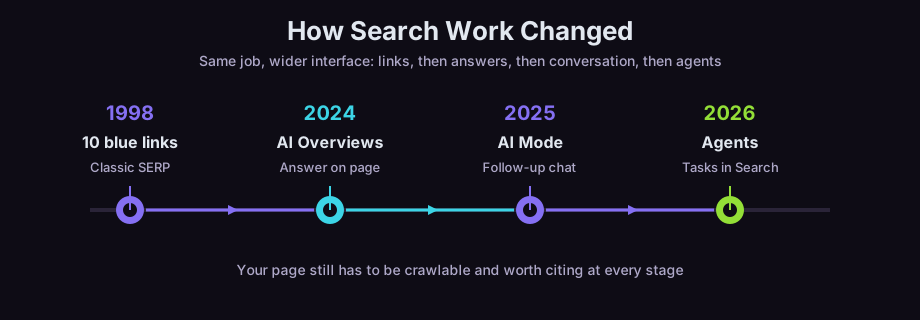
Here is what that post actually said:
I will not pretend AI Overviews now "run on" Gemini 3.5 Flash. Google did not say that. It said AI Mode's default model changed, and that distinction matters if you are briefing a board.
The practical implication is simpler. Search is moving from "ten blue links plus a summary" towards "ask, follow up, then let an agent keep working". Pages that cannot be retrieved and trusted are weak inputs for both the answer layer and any later agent step.
What the Live SERP Is Already Teaching
When we pulled the live Google AU results for "the future of seo with ai", the page was full of 2025 and 2026 enterprise posts, tool pitches and "will SEO survive" roundups. The AI Overview itself framed the shift as citations in generative answers, brand authority and structured data. That is useful colour, but it is not a Rankmax differentiator on its own.
What almost none of those ranking pages do is put a dated Search flagship next to first-party revenue and a dual scoreboard. That is the gap this article fills. We are not competing to publish another AEO glossary. We are showing what already works when rankings and AI citations sit on the same commercial brief.
Dual Visibility as an Operating Choice
The operating choice is dual visibility. You still need page-one real estate for demand you can attribute, and you also need to be the source an assistant cites when a buyer asks a purchase-related question in ChatGPT, Gemini, Perplexity, Copilot or Google AI Mode.
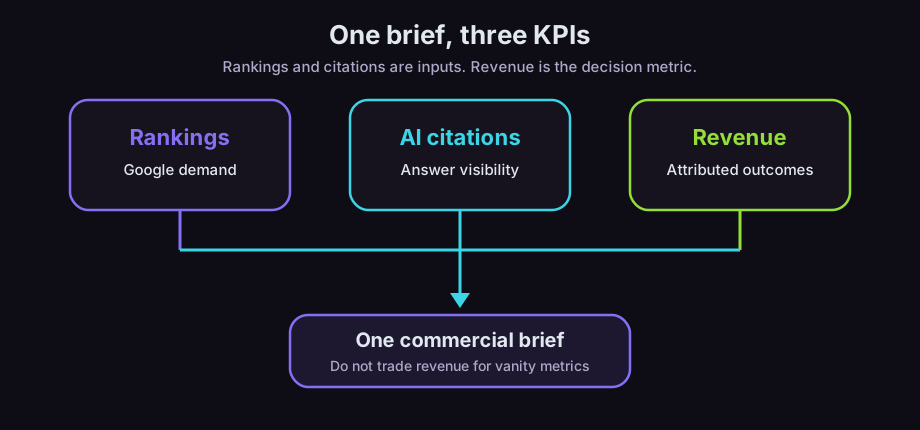
A short brief for a marketing lead:
Do not swap one for the other. A citation with no commercial landing path is vanity, and a ranking that never appears in AI answers is incomplete.
I am not rebuilding the full citations-as-KPI guide here. That lives in the sister article linked above. Use this page for the forward operating model after I/O 2026.
One retrieval note still belongs here: other assistants will not all borrow the same index forever. At the time of writing, OpenAI publishes separate crawlers for training and for ChatGPT search. Treat any "Bing powers ChatGPT" line as a dated input, not a permanent law. Allow the search crawler if you want to be eligible. Block training if that is your policy. Do not confuse the two.
What We Already See in Client Work
I can describe the next two years because parts of them are already in the numbers. The $26M+ rollup is the full Rankmax case-study portfolio behind the headline proof figure, not only the three examples below. These three show the dual model in different verticals.
On a B2B property management engagement, dual Google and AI SEO has attributed about $8.7 million from April 2024 through June 2026. The same window shows 598 AI cited pages across ChatGPT, AI Overviews, AI Mode and Gemini, with share of voice moving from 0.6% to 6.2%. Citations did not replace revenue; they showed up while commercial keywords and signed work kept moving.
On a B2C compensation claims site that started as a single page ranking only for its brand, the same model attributed about A$14.6 million across 21 months to June 2026, at 14,663% campaign ROI, with 477 cited pages in the June 2026 Semrush snapshot.
On an eCommerce meal-delivery catalogue, sixteen months produced about $1.75 million in attributed organic and AI revenue at a 2,087% average ROI, with 866 AI citations. Paid media peaked in the same window as the strongest SEO month. When paid was later reduced, organic-and-AI attribution cooled from that joint high. That is the honest read, not "SEO died when the ads stopped".
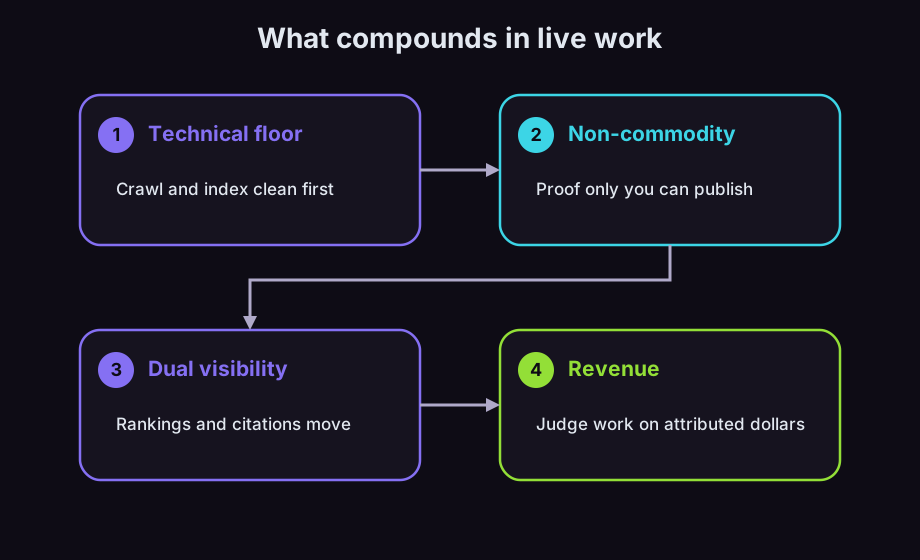
The pattern we keep seeing on these engagements:
That is the future in miniature: not a new acronym, but a wider scoreboard for the same commercial work.
Why Commodity Content Will Keep Losing
Google's AI optimisation guide and its helpful-content guidance put the quality bar in plain language: unique, non-commodity, people-first content still determines who is worth retrieving. The AI optimisation guide is explicit that foundational SEO still feeds generative AI features on Search.
Commodity content is the stuff anyone could have written from the same three ranking pages. Non-commodity content has a point of view you only get by doing the work:
That is why we refuse to "write for AI extraction" as the first move. Original work for a human reader comes first. Clear structure, sourced claims and crawlable HTML come second, so Google and other assistants can lift the useful passage.
The same rule applies when a writer uses a model to draft. Google has not flipped to "AI content is banned". Quality and helpfulness still decide. Scaled, unhelpful pages fail whether a person or a model produced them. I unpacked that policy in is AI content bad for SEO.
What You Can Ignore
Google published a myth list so teams stop burning a quarter on theatre. According to the official AI optimisation guide, you do not need these for Google Search:
Google also treats "AEO" and "GEO" as labels people use for AI-search work, not as a separate ranking system. For Google, that work is still SEO. We use generative engine optimisation as a teaching term for citation work across assistants. We do not sell it as a loophole around quality.
How to Prepare: Do Now, Test, Ignore, Monitor
Skip the acronym debate. Brief the work in four buckets.
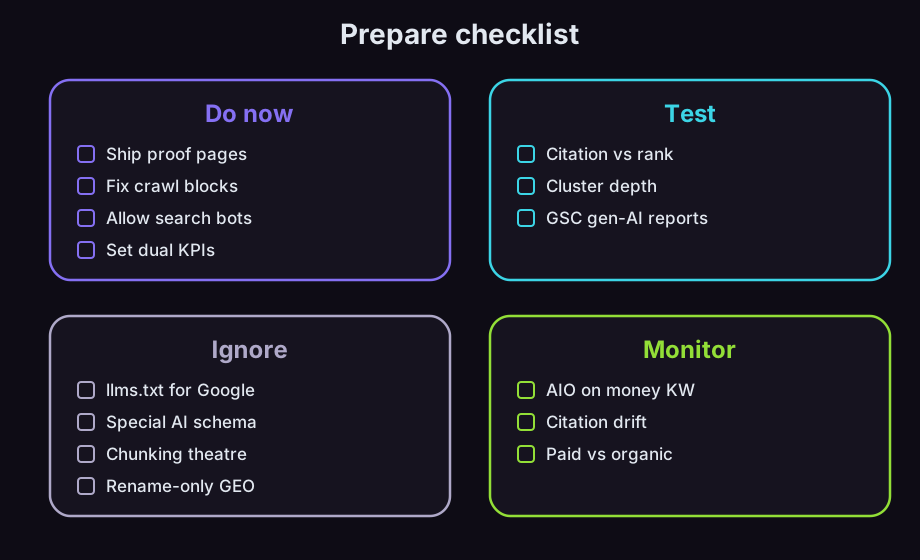
Do now
Test
Ignore
Monitor
A specialist tracker helps when you need ChatGPT, Gemini, Perplexity and Copilot in one place. We use Semrush AI visibility first and keep a tested tool shortlist for the rest of the stack.
Model versions will keep changing, but the measurement rule should not.
Frequently Asked Questions
Is SEO going to be replaced by AI?
No. AI is changing how answers are packaged and where some clicks go. It is not removing the need for crawlable, trusted pages. Google still retrieves from Search for AI Overviews and AI Mode. Teams that only chase ten blue links will feel the squeeze. Teams that publish useful proof will still have a commercial path.
How is AI changing the future of SEO?
It widens the scoreboard. Rankings still matter, but buyers also get synthesised answers in Google AI features and assistants. The work shifts towards non-commodity proof, clean technical access and measuring citations alongside rankings. The I/O 2026 Search updates make follow-up chat and agents part of that path, not a side hobby.
Is SEO obsolete with AI?
Obsolete is the wrong word; incomplete is closer if you only measure classic rankings. The future of SEO with AI is rankings plus citations plus revenue, not rankings alone.
What is AI SEO called now?
People say AEO, GEO, AI visibility and a dozen other labels. For Google, the official framing is still SEO work aimed at generative AI features. Use the label that helps your stakeholder hear "AI answers". Do not rebuild the org chart around the acronym.
Can AI replace SEO experts?
It can automate research grunt work, outlines and first drafts. It cannot own commercial judgement, first-hand proof, risk calls or the decision to kill a bad page. The human still owns strategy, quality and accountability.
Can ChatGPT do SEO?
It can help with research and drafting when a human directs it. It cannot replace technical access, first-hand experience or a revenue scoreboard. If the output is generic, it fails the same way generic human copy fails.
Which AI tool is best for SEO?
There is no single best tool. Pick one for the job: technical crawling, content research, rank tracking or AI citation visibility. For AI visibility, we start with Semrush and keep a shortlist of tested options rather than chasing every new grader.
Should I replace SEO with GEO or AEO?
No. Use those labels if they help a stakeholder hear "AI answers" more clearly. Do not rebuild the team around a separate religion. For Google, the official line is that this is still SEO. For other assistants, strong pages with proof are still the usual citation candidates.
Do I need an llms.txt file to show up in AI search?
Not for Google Search. Google says it ignores llms.txt and similar files. If another tool in your stack reads one, keep it as an optional extra. Do not delay the real work to maintain a file Google will not use.
How long until an AI SEO campaign shows revenue?
It depends on the starting point. On the B2B engagement above, early modelled return showed inside the first quarter once technical blockers were cleared in parallel with publishing. The larger attributed total compounded across more than two years. Treat "AI SEO" as the same compounding channel as SEO, with an extra visibility KPI, not as a two-week trick.
Is SEO a good career in 2026?
Yes, if you want to own commercial search outcomes, not only keyword lists. The role is moving towards people who can manage technical access, non-commodity content, dual measurement and multi-platform visibility. Pure "write 40 thin posts a month" work is the part under pressure.
The Next Search Era Rewards the Same Fundamentals, Done Harder
The future of SEO with AI is already here in pieces: billion-user AI Mode, agent roadmaps and client campaigns where citations and rankings move with revenue. You do not need a new religion to meet it. You need useful pages only you could have written, a site agents can read and a scoreboard that refuses to trade commercial outcomes for vanity metrics. That is the work we already run, and it is the work that will still make sense when the next model name lands.
About the Author
Want Insights Like This Fortnightly?

Our AI SEO strategies and tactics delivered fortnightly, including bonus trade secrets not shared anywhere else. No fluff. Just what's working right now. 5-minute read.


