
How to Choose the Best eCommerce SEO Company: A Revenue-First Framework for 2026


Choosing the best eCommerce SEO company is one of the most important decisions your online store will make this year. With global eCommerce sales reaching $6.86 trillion in 2025 and organic search driving nearly a quarter of all online orders, the right partner can add hundreds of thousands of dollars to your bottom line. The wrong one wastes months of budget on vanity metrics that never convert. This guide gives you the same revenue-first framework I use to judge eCommerce SEO performance: attributed organic revenue, AI search readiness, technical health and proof that the work compounds beyond traffic.
A Quick Guide to the Best eCommerce SEO Company
The best eCommerce SEO company is one that turns organic visibility into measurable revenue, not just rankings or traffic. As a worked example, the AI-first eCommerce SEO campaigns I lead have generated up to 2,087% average ROI and about $1.75M in attributed revenue over 16 months for a national brand.
This matters because organic search drives around 23.6% of US eCommerce orders, while AI shopping-related searches have surged 4,700% year on year. Look for a partner that can prove this level of revenue attribution, has deep platform expertise and a clear strategy for winning visibility across both Google and AI-powered search.
See How AI SEO Drives eCommerce Revenue
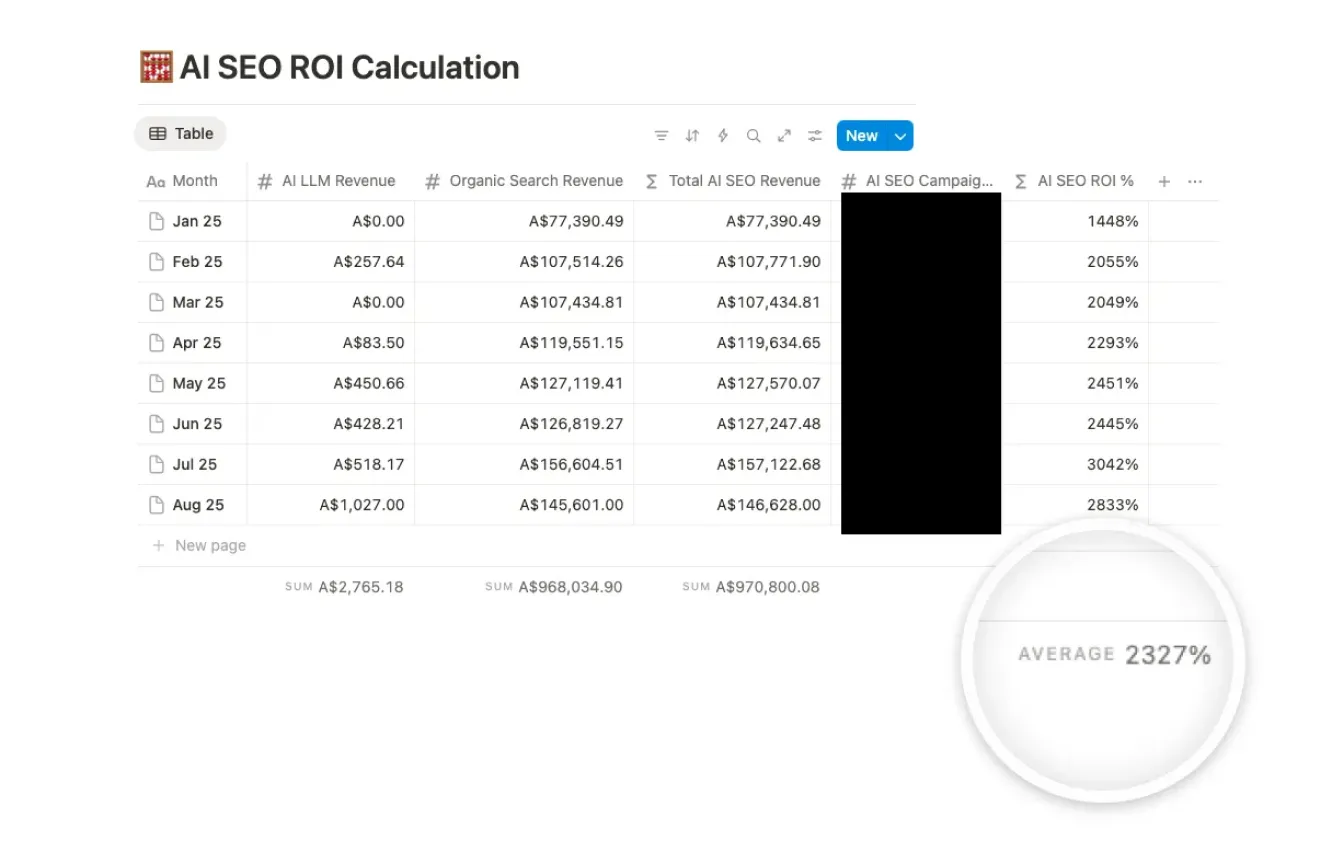
My AI-first SEO strategy generated about $1.75 million in attributed revenue over 16 months for an Australian meal delivery brand, lifting monthly revenue from $77,000 to $147,000 and delivering an average 2,087% average ROI.
Read the Full Case StudyWhy Your Online Store Needs Specialist eCommerce SEO Expertise
Agencies without real eCommerce experience often treat online stores the same way they handle service businesses or local shops. That approach fails because online stores have unique challenges that need specialist knowledge.
How eCommerce Site Structure Complicates SEO
eCommerce websites typically manage hundreds or thousands of:
- Product pages
- Category hierarchies
- Filtered navigation systems
Each of these creates potential SEO issues like:
- Duplicate content
- Crawl budget waste
- Thin product descriptions
In my eCommerce audits, I separate revenue-driving category and product URLs from low-value filtered URLs first, then prioritise fixes based on crawl access, indexation risk, and commercial value rather than treating every technical issue equally.
An agency with deep eCommerce SEO experience understands how to structure these elements so search engines can index your most valuable pages efficiently. If you want the underlying playbook, my guide to eCommerce SEO breaks down how store structure affects rankings.
The ROI Advantage of Expert eCommerce SEO
The financial case for expert eCommerce SEO is strong. Research shows that 23.6% of US eCommerce orders come directly from organic traffic, and organic search converts at 5.0% on average, outperforming most paid channels over time. Every improvement in organic visibility translates directly to revenue your store would otherwise miss.
How AI-Led Shopping Changes the Stakes
Beyond traditional Google rankings, the search landscape has shifted. Nearly a quarter of global consumers now rely on AI as their main starting point when shopping. Across my client portfolio, AI-referred sessions grew 500% year over year, and visitors arriving from AI platforms can be several times more valuable than traditional organic traffic. If your SEO agency is not optimising for AI search platforms like ChatGPT, Perplexity and Google AI Overviews, your products are invisible to a growing segment of buyers.
What Makes the Best eCommerce SEO Company Stand Out
Not all eCommerce SEO agencies are built the same. Here are the qualities that separate the best from the rest.
Proven Revenue Results With Transparent Attribution
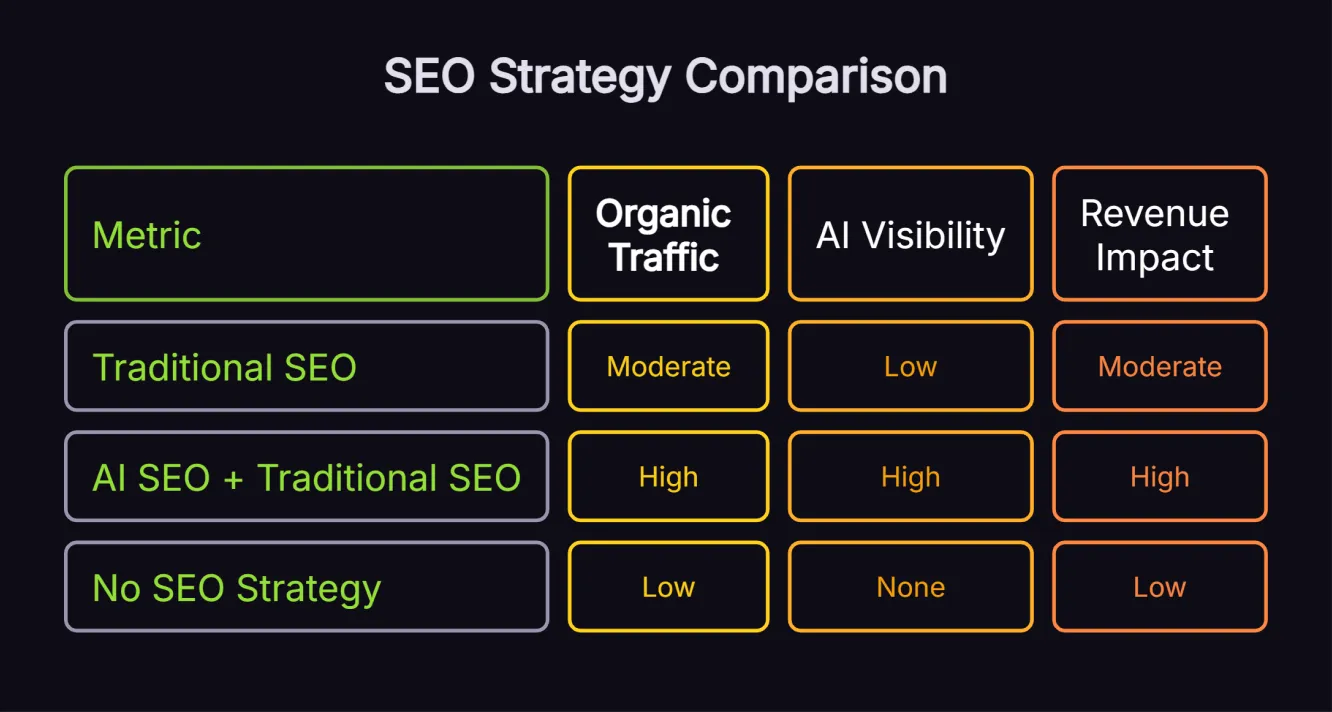
The most important quality is proof of revenue impact. Many agencies report traffic increases or ranking improvements, but these mean nothing without revenue attribution. The best eCommerce SEO company connects organic search performance directly to sales figures using tools like Google Analytics, revenue reports and conversion tracking.
For example, my eCommerce AI SEO case study shows an Australian meal delivery company increasing monthly revenue from $77,000 to $147,000 in just eight months, while also lifting its conversion rate from 6.97% to 9.73%. These results are supported by the client's own testimonial in the case study.
Ask any agency you are considering to show you revenue data from their eCommerce clients. If they can only show ranking charts or traffic graphs, they may not be tracking what matters most.
AI Search Optimisation for eCommerce
Search is no longer just about Google's traditional results. According to Adobe Analytics' Holiday 2025 report, traffic to retail sites from generative AI tools increased 693.4% year over year, including tools like ChatGPT, Gemini and Perplexity. OpenAI has introduced shopping research and Instant Checkout in ChatGPT, with product discovery supported by merchant catalog data and checkout options expanding through commerce partners.
The best eCommerce SEO agencies now optimise for both traditional search engines and AI platforms at once. This includes structured data implementation, conversational content optimisation and making sure your products appear when shoppers ask AI assistants for recommendations.
The proof here should be specific, not theoretical. In the eCommerce engagement I led, the same client went from zero to 126 Google AI Overview citations across 32 pages, alongside 12 ChatGPT citations across 20 pages within five months, plus citations on Perplexity, Gemini and Microsoft Copilot. The campaign also lifted the client to a 4.7% AI search share of voice, a 135% increase that positioned the brand as the market leader in its tracked category. That is what AI search readiness looks like when it is measured rather than promised. A genuine AI SEO strategy for eCommerce goes beyond basic schema markup. It structures product information so AI systems can accurately understand, compare and recommend your products over competitors, often through query fan-out, where a single shopper question is expanded into many sub-queries.
Technical SEO Expertise for Online Stores
eCommerce sites face technical challenges that most service-based websites never encounter. Obstacles that need specialist knowledge include:
- Faceted navigation
- Product variants
- Seasonal inventory changes
- Platform-specific limitations
The best eCommerce SEO companies have deep experience with platforms like:
- Shopify
- WooCommerce
- Magento
- BigCommerce
They understand how each platform handles:
- URL structures
- Canonical tags
- Sitemap generation
- Page speed
This is not abstract. In the same meal delivery engagement, technical SEO improvements, including image compression and mobile responsiveness fixes, helped lift the site’s technical health score from 82 to 99 during the eight-month growth campaign. Authority also improved, with referring domains increasing from 250 to 391, Domain Rating moving from 27 to 30, and the site earning 913 followed backlinks. These gains supported monthly organic revenue growth from $77,000 to $147,000. Page speed alone is a revenue lever: a one-second delay in load time reduces conversions by 7%. For a store generating $100,000 per month, that single second can cost $7,000 in lost sales. Technical SEO expertise is not optional for eCommerce; it is a direct revenue driver.
How to Evaluate and Choose the Best eCommerce SEO Company
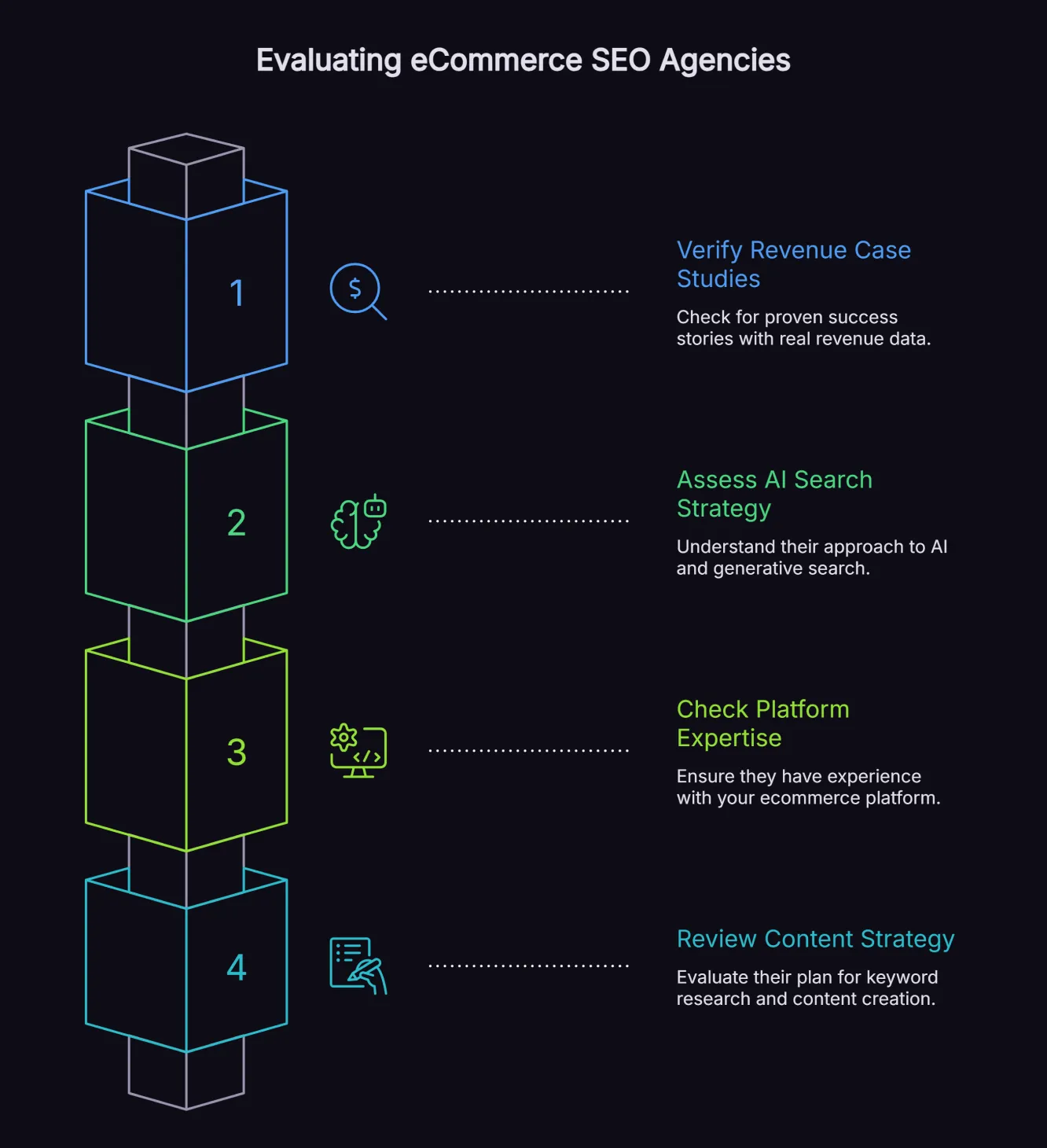
Choosing the right agency requires a structured evaluation. These four areas help you separate proven performers from those making empty promises.
1. Check for Verified Case Studies With Revenue Data
Start with case studies. The best agencies show specific revenue figures, not vague percentage improvements without context. Look for before-and-after comparisons with timelines. A strong case study includes the client's industry, the timeframe, the specific strategies used and the measurable business outcome.
I publish detailed AI SEO case studies across B2B, B2C, SaaS and eCommerce clients, with each campaign showing clear revenue and ROI figures, including the eCommerce results referenced throughout this guide.
2. Ask About AI and Generative Search Strategy
In 2026, any eCommerce SEO agency worth hiring should have a clear answer when you ask about AI search optimisation. The Business of Fashion and McKinsey's State of Fashion 2026 report found that 53% of US consumers who use generative AI for search also use it to shop, and ChatGPT now has 900 million weekly active users.
Ask potential agencies how they plan to get your products cited in AI-generated responses. Understanding how AI search works and how it differs from traditional keyword-based optimisation is no longer a bonus skill, it is a core requirement.
3. Assess Their Technical eCommerce Platform Experience
Your SEO agency should have hands-on experience with your specific eCommerce platform. Each platform has unique technical requirements, limitations and opportunities.
Ask about their approach to common eCommerce SEO challenges:
- How do they manage duplicate content from filtered navigation?
- How do they optimise product pages at scale?
- How do they manage crawl budget for stores with thousands of URLs?
A strong agency describes specific solutions rather than generic answers.
Also, ask about schema markup implementation. Pages with structured data achieve 25% higher click-through rates, and rich results achieve up to 82% higher CTR compared to standard listings. For eCommerce sites, Product schema, Review schema, and accurate merchant data help search systems understand product details more clearly. In Google, structured data can support rich results when the page meets the relevant guidelines. In AI shopping experiences, complete product feeds, current pricing, availability, images, and reviews are increasingly important because these systems need reliable product data to compare and recommend options.
4. Review Their Content and Product Page Strategy
Content strategy for eCommerce goes beyond writing blog posts. The best agencies develop keyword research that maps buyer intent across the entire purchase journey, from awareness and research through to comparison and purchase.
Your agency should explain how they will prioritise product descriptions, category pages, buying guides, comparison pages, and internal links based on revenue potential, not just search volume. They should also show how they build topical authority in your product categories so search engines and AI platforms recognise your site as an expert source.
Strong content marketing for eCommerce turns informational searches into revenue-driving pages that attract buyers at every stage of the funnel.
How Australian eCommerce SEO Agencies Compare
The Australian eCommerce SEO market includes specialist SEO agencies, performance marketing agencies and AI-first search partners. This is not a ranked list. It is a neutral snapshot of publicly available positioning, services and case-study evidence.
| Agency | Geography | Publicly stated services | Public case-study evidence |
|---|---|---|---|
| Rankmax | Australian AI SEO agency working with eCommerce, B2B, B2C and SaaS clients nationally. | AI SEO, traditional SEO, eCommerce SEO, technical SEO, content strategy and revenue attribution. | Published eCommerce AI SEO case study reporting about $1.75M in revenue generated over eight months, 91% monthly revenue growth and 2,087% average ROI for an Australian meal delivery brand. |
| StudioHawk | Melbourne and Sydney, with additional international offices. | SEO, AI search, technical SEO, eCommerce SEO, enterprise SEO, link building and digital PR. | Public case studies include The Cruiser Store, Officeworks and other SEO campaigns, with the case-study hub showing eCommerce and retail examples. |
| Impressive | Melbourne-based agency serving eCommerce businesses across Australia. | eCommerce SEO, SEO, paid media, data and analytics, plus performance marketing for retail and eCommerce brands. | Public case studies include Mattel Australia, reporting 198% non-branded traffic growth and 39% organic revenue growth, plus Kogan, reporting 14% year-on-year growth in non-brand clicks. |
| Reef Digital | Sydney-based agency with an additional Vancouver office. | SEO strategy, technical SEO, content strategy, link building, influencer campaigns, digital PR, PPC and CRO. | Public eCommerce-related case study for Fresh Flowers reports 114.41% growth in users, 229.14% more transactions and 310.11% additional revenue during the Valentine’s Day campaign period. |
| eMarket Experts | Melbourne-based digital marketing agency. | eCommerce SEO, SEO, PPC, Google Shopping, website design, copywriting and content marketing. | Public case-study material includes Safety Xpress, described as an Australian eCommerce supplier, with a reported 1,300% boost in online sales. |
How Rankmax Meets This Framework
I built this framework around the same standards I hold myself to, so it is fair to show how I measure against it. In the Australian eCommerce SEO landscape, Rankmax’s clearest differentiator is a published AI-first eCommerce SEO case study that connects organic search work to attributed revenue, ROI, AI citation growth, share-of-voice movement and technical health improvements. While many agencies publish ranking or traffic outcomes, my focus is on showing how SEO translates into measurable revenue across Google, Google AI Overviews, ChatGPT, Perplexity and other AI platforms.
Proven eCommerce Revenue Results
In just eight months, my AI-first SEO strategy delivered:
- Monthly revenue from organic search and AI traffic growing from $77,000 to $147,000 (a 91% increase)
- About $1.75M in attributed revenue over 16 months
- A 75% year-over-year revenue lift
- Conversion rates improving from 6.97% to 9.73%
- Average purchase revenue per active user up 38.7% between 2024 and 2025
- Total purchases increasing 73%, from 4,070 to 7,053
Cross-Category ROI Impact
This is not a one-off. Across all client categories, my AI SEO strategies have generated over $26 million in attributed revenue, with an average eCommerce client ROI of 2,087%. In February 2026 alone, the eCommerce campaign generated A$93,110.17 in organic revenue at 1,762% ROI. The same revenue-first methodology has produced 6,864% ROI on the 17-month climb window over 27 months and counting for a B2B client and 14,738% average monthly ROI over 21 months and counting for a B2C client.
As Rankmax founder, with 18+ years of SEO experience and recognition as a Semrush Search Awards finalist, I operate as a strategic partner, not a service vendor. Every eCommerce campaign includes a comprehensive AI SEO strategy, technical health monitoring, content creation and monthly revenue reporting.
What to Expect When Working With a Top eCommerce SEO Agency
Understanding the typical engagement timeline helps set realistic expectations. The pattern I see most often looks like this:
- Months 1-2: Technical audits, keyword research and strategy development
- By day 60: Well-structured pages typically start ranking in Google
- By day 90: Those same pages typically start earning citations in AI platforms like ChatGPT
- Months 3-6: Meaningful ranking improvements compound
- From Month 4 onward: Significant revenue impact often becomes visible
- Months 6-12: Positive SEO ROI is typically achieved
- Second or third year: Peak results appear as SEO compounds with decreasing marginal costs
The 60-day ranking and 90-day citation benchmarks above are drawn from my own eCommerce campaign, not industry averages. A good agency provides transparent monthly reporting that connects SEO activity directly to revenue: organic revenue attribution, conversion tracking by content type, keyword ranking progress and technical health scores. If an agency only reports rankings without connecting them to business outcomes, they are not measuring what matters.
Red Flags When Hiring an eCommerce SEO Company
Knowing what to avoid is just as important as knowing what to look for. Four warning signs matter most.
- Guaranteed rankings: No legitimate SEO professional can promise a number-one position, because search algorithms factor in hundreds of variables outside any agency's control. Guaranteed rankings usually signal inexperience or dishonesty.
- No revenue data: Be cautious of agencies that cannot show revenue results from previous clients. Traffic and rankings are useful intermediate metrics, but they are not business outcomes. If an agency has never tracked revenue attribution, it may not know how to connect SEO work to its bottom line.
- Outdated tactics: Avoid agencies that rely on mass directory submissions, low-quality link building or keyword stuffing. These can trigger Google penalties that take months or years to recover from.
- No AI search strategy: With shopping-related AI searches growing 4,700% year on year and major retailers integrating directly with AI platforms, ignoring this channel leaves significant revenue on the table. Any agency still treating SEO as a purely Google-focused discipline is already behind.
Frequently Asked Questions
How much does an eCommerce SEO company charge?
Professional eCommerce SEO retainers commonly range from $5,000 to $25,000 per month, depending on store size, platform complexity, competition, content volume and technical scope. Larger enterprise or global eCommerce programmes can exceed $60,000 per month where international SEO, complex migrations, multi-market content and technical architecture are involved. Smaller retainers may suit narrow technical fixes or limited product-page optimisation, but growth-focused eCommerce SEO should be assessed against revenue return, not the monthly fee alone.
How long does it take to see results from eCommerce SEO?
Well-structured pages can start ranking in Google within about 60 days and start earning AI platform citations within about 90 days, based on my own eCommerce campaign. Broader ranking improvements usually build over 3 to 6 months, with meaningful revenue impact often appearing from month 4 onward. Positive ROI is generally achieved within 6 to 12 months, with peak performance often in the second or third year as compounding gains build.
What is the difference between traditional SEO and AI SEO for eCommerce?
Traditional SEO focuses on ranking in Google's standard results through keyword optimisation, technical fixes and link building. AI SEO extends this to AI-powered platforms like Google AI Overviews, ChatGPT and Perplexity. Learn more about how AI impacts SEO to understand why both approaches are needed for eCommerce success in 2026.
Can a small eCommerce store benefit from hiring an SEO agency?
Yes, though the approach differs by budget. Smaller stores should prioritise technical SEO fixes and product page optimisation for the highest ROI. Even modest improvements like faster page speeds and better product schema can increase organic conversions. Research shows that a 0.1-second improvement in load time increases retail conversion rates by 8.4%.
Should I hire a specialist eCommerce SEO agency or a general SEO company?
What matters is proven eCommerce SEO experience, not whether an agency works exclusively with online stores. Choose a partner that can demonstrate platform-specific technical work, product page optimisation and revenue results for eCommerce clients. Agencies with no eCommerce track record often miss faceted navigation, product schema markup and the conversion-focused strategies that drive eCommerce revenue.
What eCommerce platforms do SEO agencies typically work with?
The best eCommerce SEO companies work across major platforms, including Shopify, WooCommerce, Magento, BigCommerce and custom headless setups. Each platform has unique SEO requirements, so your agency should show hands-on experience with your specific platform to avoid costly technical mistakes.
How do I measure the success of my eCommerce SEO agency?
Focus on revenue attribution from organic search rather than vanity metrics. Track organic revenue in Google Analytics, conversion rates by landing page, average order value from organic visitors and overall organic traffic growth. The best agencies provide monthly reports connecting SEO activity directly to business outcomes.
Your Next Step Toward eCommerce Growth
Finding the best eCommerce SEO company comes down to one thing: whether they can clearly prove they have turned search visibility into measurable revenue for stores like yours. In a market where AI search is reshaping how people discover products and organic search still drives a major share of orders, choosing an AI-first, technically strong partner is one of the highest-leverage growth decisions you can make. Look for verified case studies, transparent revenue attribution and a joined-up strategy that wins across both Google and AI-powered search. If you are ready to see what that looks like in practice, explore how my done-for-you eCommerce SEO turns your existing demand into predictable, compounding revenue growth.
About the Author
Want Insights Like This Fortnightly?

Our AI SEO strategies and tactics delivered fortnightly, including bonus trade secrets not shared anywhere else. No fluff. Just what's working right now. 5-minute read.


