
What Is a Content Pillar? How Core Themes Build Topical Authority and AI Citations

Most content calendars fail for the same reason: they are a list of one-off ideas with nothing holding them together. You publish a how-to one week, a product post the next and a trend reaction after that. None of it compounds. So what is a content pillar, and why does getting your pillars right fix that scattered feeling? A content pillar is one of the few core themes your brand commits to owning. It is the difference between brands that simply post content and brands that build an audience which returns. In this guide, I will walk you through what content pillars are, show real examples, walk through how to choose yours and connect the idea to the topical authority that earns rankings and AI citations.
Build Content Pillars That Compound Into Authority
We help growth brands turn a handful of themes into topical authority that drives rankings, AI citations and revenue. Book a strategy session and we will map your content pillars to a plan.
Get a Content StrategyThe Short Answer on Content Pillars
A content pillar is a core theme or topic category your brand consistently creates content around. Most brands run three to five pillars, and every piece they publish maps back to one of them. Pillars give your content focus, keep your message consistent and build the depth that search engines and AI platforms reward when they decide who to cite.
Where Content Pillars Fit in Your Wider Strategy
Content pillars are the planning layer. Turning them into pages that actually rank and get cited is the execution layer, and that is the work our content marketing service is built around. If you want a done-for-you strategy that maps your pillars to revenue rather than just a posting schedule, this is where to start.
What Is a Content Pillar?
A content pillar is a recurring theme that defines what your brand talks about. Think of it as one of the load-bearing columns your whole content library rests on. Instead of choosing topics at random, you decide on a small set of themes that matter to your audience and your business, then create everything under those themes.
The term comes from content marketing and social media, where a pillar is sometimes called a content bucket, a category or simply a theme. They all mean the same thing: a repeatable subject area you return to again and again. A fitness studio might run four pillars:
- Nutrition
- Training
- Recovery
- Mindset
A software company might choose different themes:
- Product education
- Industry trends
- Customer stories
- Behind-the-scenes culture
We use the same discipline on our own site. The Rankmax content library is organised around a handful of themes such as AI SEO, technical SEO and content strategy, and every article we publish sits inside one of them. That is what keeps a large library coherent instead of letting it become a pile of disconnected posts.
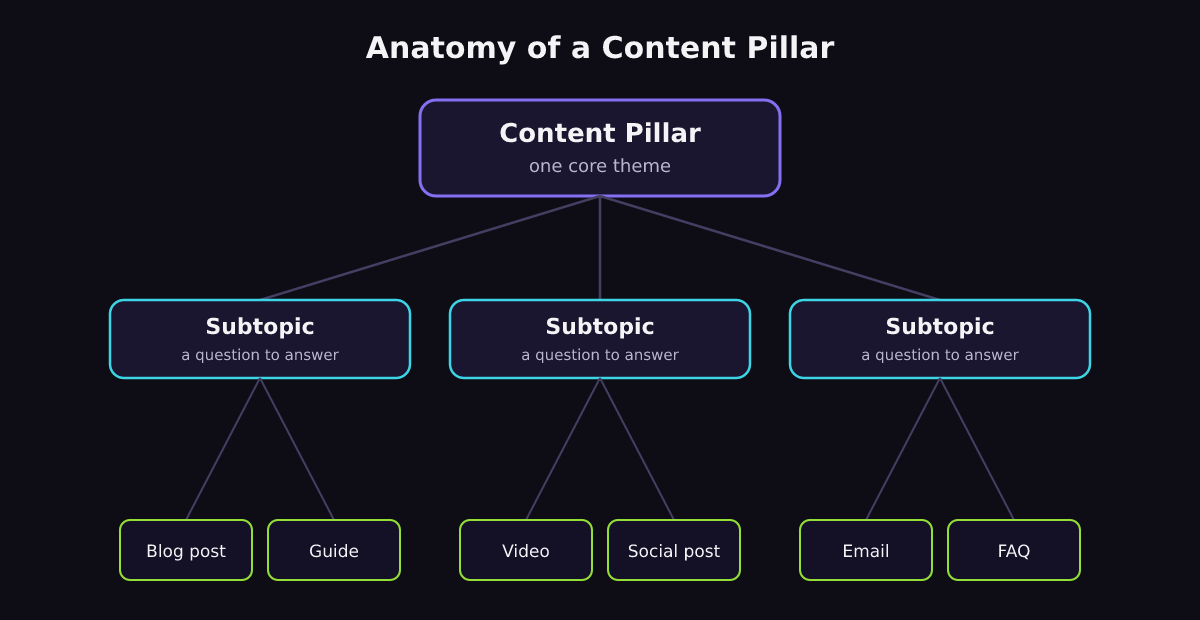
A useful way to picture it: a content pillar is the theme, the subtopics are the questions inside that theme, and the individual posts, videos and pages are the content that answers them. Get the pillar right and everything below it has a clear home.
Why Content Pillars Matter
Pillars sound like a simple planning trick, but they change the economics of your content. When every piece supports a theme, each new post makes the others more valuable instead of competing with them. That is where the compounding comes from.
Here is what content pillars give you:
- Consistency: They keep your message steady, so your audience always knows what your brand stands for rather than seeing a different topic every week.
- Focus: They stop you chasing every trend and force a decision about what you will and will not cover.
- Audience relevance: They anchor your content to the subjects your buyers actually care about, which improves engagement and return visits.
- Planning efficiency: They make the calendar almost write itself, because you are filling known themes rather than inventing topics from scratch.
- Authority: They concentrate your effort in a few areas, which is exactly how you become the recognised source on a subject.
The failure mode we see most often is the opposite of this. A business publishes constantly but spreads itself across dozens of unrelated topics, so it never goes deep enough on any of them to be seen as an authority. Pillars are the fix, because depth beats breadth every time a search engine or an AI model decides who to trust.
Types of Content Pillars (With Examples)
There is no fixed list of pillars every brand must use, but most successful ones draw from a common set of theme types. The mix you choose depends on your audience and your goals.
- Educational: How-to guides, explainers and tutorials that teach your audience something useful. This is usually the largest pillar for B2B and professional services brands.
- Product or promotional: Content that shows your product or service in action, including use cases, comparisons and feature deep-dives.
- Entertaining: Lighter content that builds affinity, such as quick tips, topical commentary or light-hearted posts that fit your brand voice.
- Behind-the-scenes: A look at your team, process or culture, which humanises the brand and builds trust.
- Community and user-generated: Customer stories, reviews, testimonials and reshared content from your audience.
- Thought leadership: Original opinions, data and industry analysis that position your brand as a voice worth following.
To make it concrete, here is how the same idea plays out across different businesses:
- A meal-delivery brand might run pillars for recipes, nutrition, sustainability and customer stories.
- A SaaS company might run product education, industry trends, founder thought leadership and community.
- A professional services firm might run client education, process transparency, proof of results and team expertise.
The point is not to copy any of these lists. It is to choose the three to five themes that let your brand show up with something genuine to say.
Content Pillars Across Channels
A pillar is a theme, so it can appear anywhere your audience does. The theme stays the same while the format changes to fit each channel. A single "customer stories" pillar might become a long case study on your website, a short testimonial clip on social media, a subscriber email and a slide in a sales deck.
That flexibility is the point. On social platforms your pillars keep a feed varied but recognisable, so followers know what to expect from you. On your website the same pillars become the topic areas that structure your blog and anchor your pillar pages. Planning at the theme level rather than the post level is what lets one idea work hard across every channel you publish on.
How Many Content Pillars Should You Have?
For most brands, three to five content pillars is the right range. Fewer than three and your content starts to feel repetitive, since you run out of fresh angles inside a single theme. More than five and you spread your effort so thin that no pillar gets the depth it needs to build authority.
The right number depends on your capacity. A small team publishing twice a week is better served by three focused pillars than by six it can only touch occasionally. As your output grows you can add pillars, but it is far better to own a few themes completely than to have a shallow presence across many. Depth is what gets you cited.
How to Create Your Content Pillars
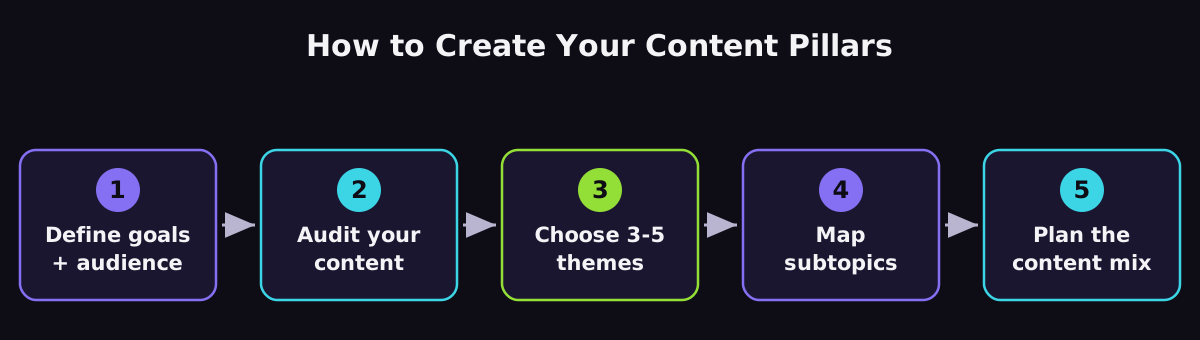
Choosing pillars is a strategic exercise, not a brainstorm. Work through these five steps in order.
- Define your goals and audience: Start with what the business needs and who you are trying to reach. Your pillars should sit at the overlap between what your audience wants to learn and what your brand is qualified to teach.
- Audit your existing content and competitors: Look at what you have already published and what is working, then review which themes competitors own and where the gaps are. You are looking for subjects where you can add something they cannot.
- Choose your three to five core themes: Select the themes that best match the overlap from step one. Each should be broad enough to sustain months of content but specific enough to be genuinely yours.
- Map subtopics under each pillar: Break every pillar into the questions and subjects your audience actually searches for. This subtopic map becomes your content backlog and your internal linking plan.
- Plan the content mix and cadence: Decide how each pillar shows up across your channels and how often. A healthy calendar rotates through your pillars rather than over-indexing on one.
The step most teams skip is the audit. Choosing themes without checking what you already rank for or what your competitors have locked down is how you end up with pillars that look good on paper but never win attention. Ground the decision in data and each pillar earns its place.
Content Pillars vs Pillar Pages: Clearing Up the Confusion
This is where the terminology trips people up, because "content pillar" and "pillar page" sound identical but describe two different things.
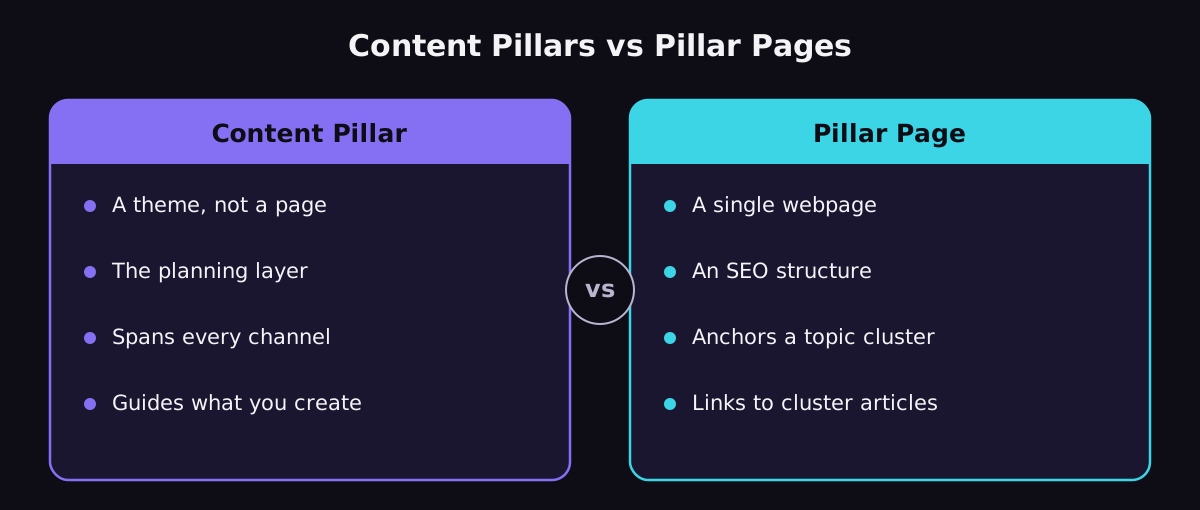
A content pillar is a theme, as we have covered throughout this guide. A pillar page is a specific type of webpage: a comprehensive, long-form page that covers a broad topic in full and links out to more detailed cluster articles beneath it. This pillar-and-cluster approach, which HubSpot helped popularise, is an SEO structure known as the topic cluster model, while content pillars are a content-planning structure.
The two connect naturally. Your content pillar is the theme; a pillar page is often the flagship page that anchors that theme in search, with cluster content filling in the subtopics around it. If you want the full mechanics of building those pages, our guide to pillar content covers the hub-and-spoke structure in detail. Keep the distinction clear and you will avoid the most common mistake we see: treating a planning theme and a page structure as if they were the same job.
From Content Pillars to Topical Authority
Content pillars are where topical authority begins. When you commit to a few themes and cover them in genuine depth, you produce the kind of helpful, people-first content Google rewards, and you signal to AI platforms that your site is a real source on those subjects, not a dabbler. That signal is topical authority, and it is one of the most durable advantages in search.
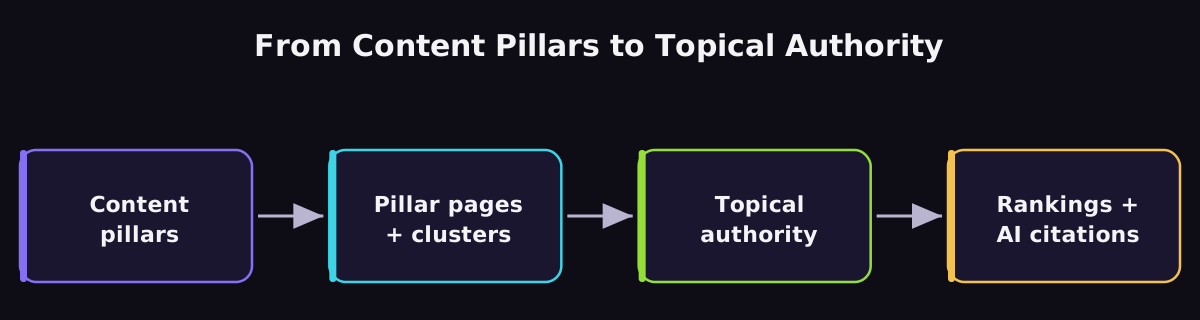
We have watched this play out directly. For one B2B property management client we built content clusters around a small set of underserved themes, publishing pillar pages supported by detailed subtopic articles under each one. That structure drove ~$8.7M in attributed revenue over 27 months and earned 138 citations across Google AI Overviews, ChatGPT, Gemini and Perplexity, up from zero, over 17 months. The AI citations are a visibility measure we track alongside rankings and revenue, and they climbed for the same reason the rankings did: depth on a focused set of themes.
For your readers, that depth means they can find complete answers in one place. For search engines and AI models, it means you are the obvious source to cite. Content pillars are simply how that depth gets planned before it gets built.
Frequently Asked Questions
What is a content pillar in social media?
In social media, a content pillar is a core theme you post about consistently across your profiles, such as education, entertainment or behind-the-scenes content. Most brands run three to five pillars and rotate through them so their feed stays varied but still recognisably on-brand. The pillars keep your posting focused instead of reactive.
What is a content pillar in content marketing?
In content marketing, a content pillar is a broad theme your whole campaign is built around, spanning blog posts, videos, emails and landing pages rather than just social posts. It works the same way as a social pillar but at a larger scale, and it often anchors a dedicated pillar page supported by cluster content. The theme gives every asset a clear purpose.
What are some examples of content pillars?
Common pillars include educational content, product or promotional content, entertaining content, behind-the-scenes content and community or user-generated content. A gym might use nutrition, training, recovery and mindset, while a software company might use product education, industry trends, customer stories and culture. The best examples are specific to what a brand can speak on with genuine authority.
How many content pillars should a brand have?
Three to five content pillars suits most brands. Fewer than three tends to feel repetitive, and more than five usually spreads a team too thin to build real depth in any theme. Match the number to your publishing capacity rather than to an ideal on paper.
Are content pillars the same as pillar pages?
No. A content pillar is a theme your content is organised around, while a pillar page is a comprehensive webpage that covers a broad topic and links to related cluster articles. Content pillars are a planning concept and pillar pages are an SEO page structure, though the two often work together.
How do content pillars help SEO and AI search?
Content pillars concentrate your effort on a few themes, which builds the topical depth that search engines and AI platforms use to decide who is a credible source. Covering a subject thoroughly across connected pages is what earns rankings and citations, rather than publishing shallow content on many unrelated topics. Depth on a focused theme is the durable advantage.
How often should you review your content pillars?
Review your pillars once or twice a year or whenever your business goals, audience or market shift noticeably. Pillars should be stable enough to build authority but not so fixed that they stop reflecting what your audience needs. An annual audit of what each pillar is producing keeps the set honest.
Pillars Before Posts
The brands that win with content are rarely the ones publishing the most. They are the ones who decided what they stand for, chose a few themes worth owning and went deep enough to become the obvious source. Content pillars are how that decision gets made and how a random calendar turns into a strategy that compounds. Start with three to five themes your audience cares about and your brand can speak to with authority, map the subtopics beneath each and let every piece you publish make the others stronger.
About the Author
Want Insights Like This Fortnightly?

Our AI SEO strategies and tactics delivered fortnightly, including bonus trade secrets not shared anywhere else. No fluff. Just what's working right now. 5-minute read.


