
International SEO Strategy: A Revenue-First Framework for Global Search Growth


Most businesses treat international expansion as a translation exercise. Swap out the English, plug in the French and wait for traffic. It rarely works that way. A successful international SEO strategy needs market selection, technical precision, localised search intent and revenue tracking by region. In this guide, I’ll show the framework I use to expand search visibility across borders without turning global SEO into a vanity-traffic project. Whether you are targeting two markets or twenty, this framework gives you a clear path to measurable results.
International SEO Strategy: A Quick Summary
International SEO strategy is the process of optimising your website so search engines deliver the right content to the right audience in the right country and language. It involves technical elements like hreflang tags and URL structure, combined with localised content and region-specific keyword research. The goal is not simply more traffic from more countries. It is the right traffic that converts into revenue. An effective international SEO strategy aligns your website architecture, content and authority-building efforts with the search behaviour of each target market, ensuring your visitors in each region find a version of your site that feels native to them.
Expand Your Search Visibility Across International Markets
Most international expansions stall because they are treated as translation projects instead of multi-market search strategies. Our Multi-Market AI SEO Method connects technical international SEO, localised content, AI platform optimisation and market-by-market revenue attribution into one measurable framework. If you are planning global expansion and want visibility measured by revenue rather than traffic, work with an international SEO company built for revenue-led global search.
Build Your Global Search StrategyWhat Is International SEO and Why Does It Matter?
International SEO is the practice of optimising your website so that search engines can identify which countries and languages your content targets. It goes beyond standard SEO by addressing the unique challenges of serving multiple audiences across different regions, languages and search platforms.
The Business Case for Going Global
The demand for international expansion is strong. Research from Equinix found that 72% of business owners planned global expansion, even during periods of economic uncertainty. For businesses with strong domestic performance, international markets represent a significant growth opportunity, but only when approached with the right search strategy.
Without a proper international SEO strategy, you risk several costly problems. Search engines may serve your English-language page to French-speaking users. Duplicate content issues can dilute your rankings across every market. And your team wastes budget creating content that no one in the target market actually searches for.
How International SEO Differs From Standard SEO
Standard SEO focuses on ranking in a single market. International SEO adds layers of complexity that include language targeting with:
- Hreflang tags
- Region-specific URL structures
- Localised keyword research for each market
- Content adapted to the cultural context rather than simply translated
- Separate authority-building campaigns for each region
These elements work together as a system. Getting the technical setup right but neglecting content localisation will underperform. Creating brilliant localised content on a broken URL structure will frustrate search engines. The strategy needs to be holistic.
How to Choose the Right Target Markets
Before building anything, you need clear data on which markets deserve your investment. Gut instinct is not a strategy. The best international SEO strategies start with evidence.
Analyse Your Existing Traffic Data
Start by reviewing your Google Analytics and Google Search Console data for international signals. Look for countries already sending organic traffic to your site, even in small volumes. Check whether Google has auto-translated your search snippets for any regions. This is a strong indicator of existing demand. Review your server logs for international IP addresses, and examine which pages receive the most engagement from non-domestic visitors. These signals point you towards markets where demand already exists, reducing the risk of your expansion.
Evaluate Market Opportunity
Once you have identified candidate markets, dig deeper into each one. Consider factors such as:
- Total addressable market size for your product or service in that region
- Local competition levels for your target keywords
- Internet penetration and device usage patterns
- Regulatory requirements that might affect your business
- Ease of doing business including payment processing, logistics and legal considerations
Government trade databases like Trade.gov and the World Trade Organisation offer free data on international commerce that can inform your market selection. Combine this with keyword research tools that support multi-country analysis, and you will have a clear picture of where the opportunity sits.
Start Small and Expand
Rather than launching in ten markets simultaneously, start with one or two where your data shows the strongest opportunity. This lets you:
- Refine your processes
- Learn what works
- Build internal capability before scaling
Our B2B AI SEO case study shows how a focused approach delivered about $8.7M attributed over 27 months (ongoing), a principle that applies equally to international expansion.
There is a technical reason to start narrow as well. In our experience, smaller international footprints often carry proportionally more issues than large multilingual deployments, because they receive less ongoing technical attention. Keeping the initial footprint to one or two markets keeps that surface small enough to maintain properly.
In one anonymised international rollout, we chose the UK as the first expansion market because Search Console was already showing non-domestic impressions, auto-translated snippets and early engagement from that country. We kept the setup on the main domain using a dedicated subdirectory, then fixed hreflang, canonicals and country-level tracking before publishing new pages. Content velocity was deliberately narrow: the first sprint focused on fully localising the highest-intent commercial cluster, then supporting content was added in controlled batches instead of thin-translating the whole site. The first result was not an immediate page-one ranking. It was a movement into the 11 to 30 position band, which showed the market was responding before the campaign widened into broader localisation.
URL Structure for International Websites
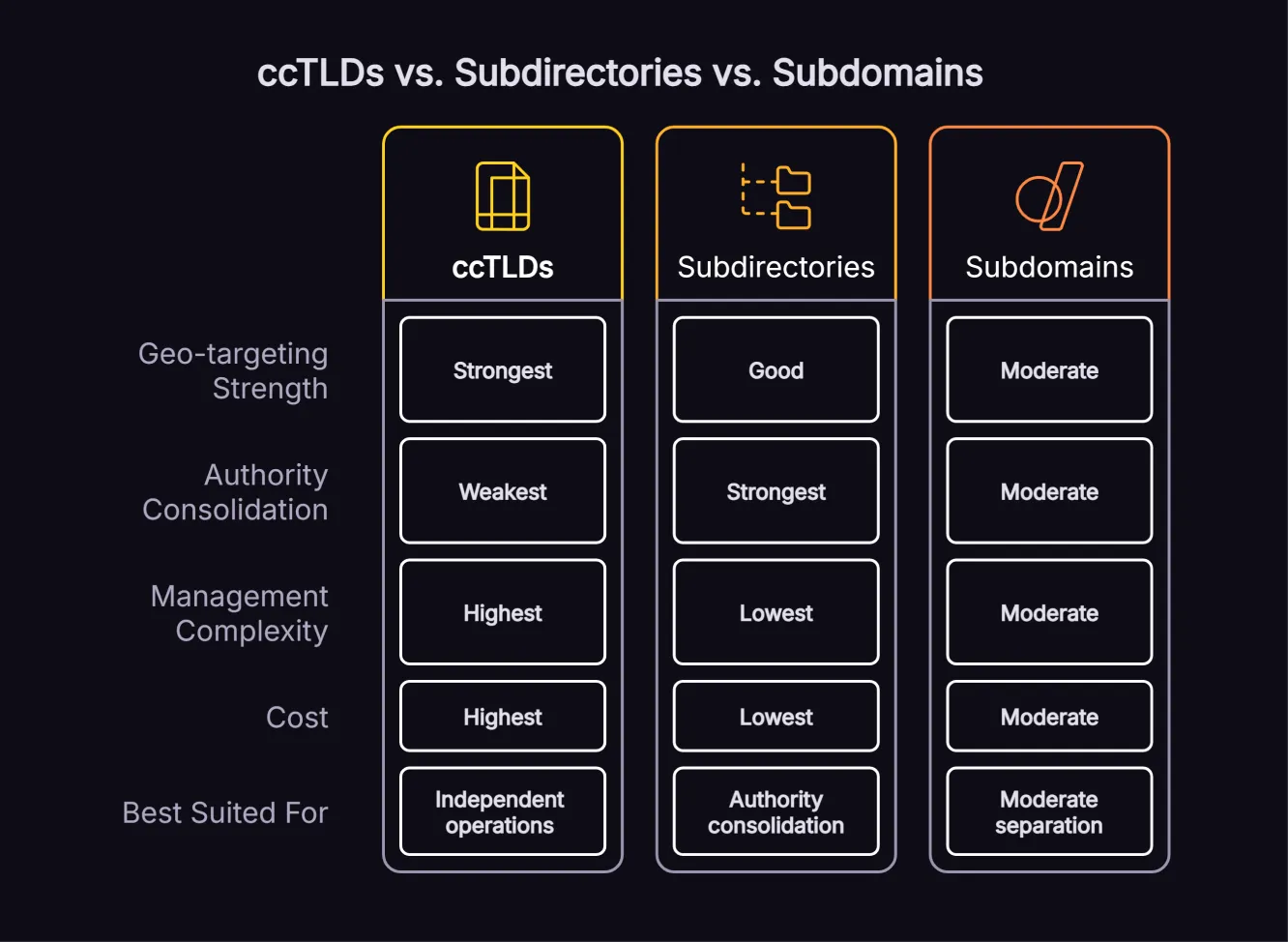
Your URL structure tells search engines how your international content is organised. There are three primary approaches, each with distinct trade-offs.
1. Country-Code Top-Level Domains (ccTLDs)
This approach uses separate domains for each country, such as example.fr for France or example.de for Germany. ccTLDs send the strongest geo-targeting signal to search engines. They also build trust with local users who recognise their country's domain extension. The downsides are significant, though. Each domain starts with:
- No existing authority requiring you to build trust and rankings from scratch
- Separate hosting environments and SSL certificates, increasing infrastructure requirements
- Growing operational complexity, as management overhead expands with every new market you enter
2. Subdirectories With a Generic Top-Level Domain
The subdirectory approach places international content within your main domain, such as example.com/fr/ for France. This is the most popular choice for mid-sized businesses because it consolidates domain authority. All link equity flows to a single domain, making it easier to build authority across markets. The trade-off is a weaker geo-targeting signal compared to ccTLDs, though hreflang, localised content signals, regional internal linking and consistent country-specific page architecture can close much of this gap.
3. Subdomains
Subdomains like fr.example.com sit between the other two options. They offer more separation than subdirectories but share some domain authority. However, search engines often treat subdomains as separate entities, which can dilute your overall authority.
In the international engagements we lead, subdirectories tend to outperform ccTLDs for mid-sized businesses. The pattern is consistent enough that we treat a subdirectory as the default starting point, not a neutral option beside ccTLDs and subdomains.
The reason is practical. A single domain compounds link equity across every market, while separate ccTLDs each start from zero authority and need their own link profile. The geo-targeting gap largely closes once hreflang, localised content signals, regional internal linking and consistent country-specific architecture are in place. One domain also carries less management overhead than a separate property, certificate and authority profile for every country you enter. For most businesses expanding internationally, that combination gives subdirectories the best balance of:
- Authority consolidation
- Management simplicity
- Geo-targeting effectiveness
The exception is the business that genuinely needs independent operations in each market, where ccTLDs can justify their added complexity.
A Step-by-Step Guide to Hreflang Implementation
Hreflang is the HTML attribute that tells search engines which language and regional version of a page to serve to specific users. It is also one of the most error-prone elements of international SEO. An Ahrefs study across 374,756 domains found that 67% of hreflang implementations had errors, making it the single biggest technical challenge in international SEO.
1. Understanding Hreflang Syntax
An hreflang tag follows a specific format that combines an ISO 639-1 language code with an optional ISO 3166-1 country code. For example, hreflang="en-GB" targets English speakers in the United Kingdom, while hreflang="en-US" targets English speakers in the United States. Using hreflang="en" without a country code targets all English speakers regardless of location.
The language code always comes first, followed by the country code. Getting this order wrong, such as writing "GB-en" instead of "en-GB", will cause search engines to ignore the tag entirely. Each page in your hreflang cluster must reference every other page in the cluster, including itself. This self-referencing requirement is easy to overlook but critical for correct implementation.
2. Three Implementation Methods
You can implement hreflang through:
- HTML link tags in your page head
- HTTP headers for non-HTML files like PDFs
- XML sitemaps
HTML link tags are the simplest approach for most websites and look like this in your page head: <link rel="alternate" hreflang="en-AU" href="https://example.com/au/" />. For websites with dozens of language versions, XML sitemap implementation is often preferable because it avoids adding large blocks of code to every page. HTTP headers work best for non-HTML resources that cannot contain link tags.
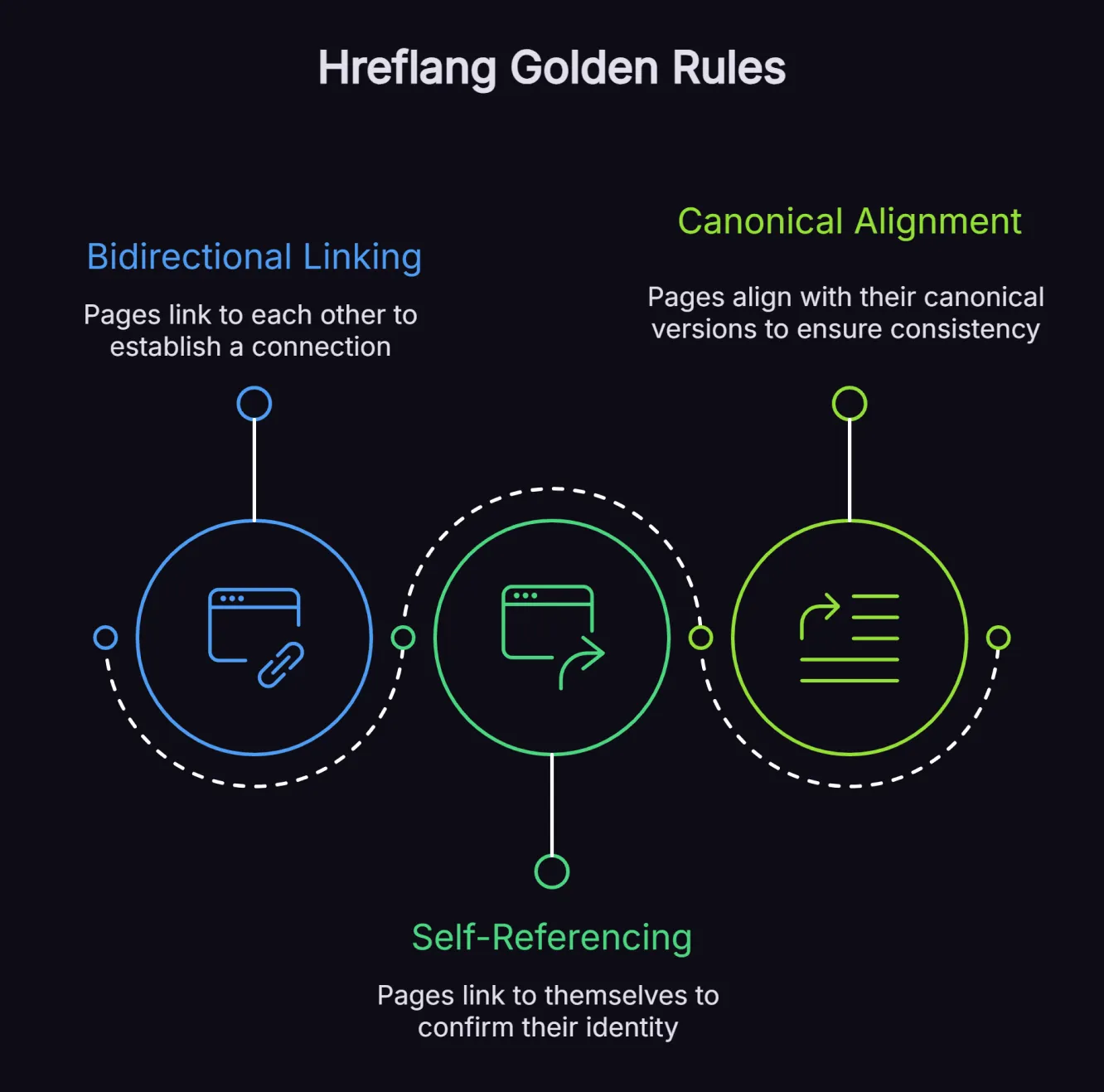
3. The Three Golden Rules of Hreflang
Every hreflang implementation must follow three non-negotiable rules.
- First, every tag must be bidirectional. If your English page points to your French page, the French page must point back to the English page. Missing return links are the most common cause of hreflang failures.
- Second, every page must include a self-referential tag. Your French page needs a hreflang tag pointing to itself.
- Third, hreflang URLs must match your canonical URLs exactly. If your canonical tag points to https://example.com/fr/ but your hreflang points to https://www.example.com/fr/, search engines will flag a conflict and may ignore both signals.
Using X-default for Fallback Targeting
The x-default hreflang value designates a fallback page for users whose language or region does not match any of your specified versions. Hreflang best practice recommends including x-default to ensure every user reaches an appropriate page, even if you do not have a version specifically targeting their region. This is typically your primary language version or a language-selection page. While optional, implementing x-default prevents users from landing on an irrelevant version of your content and improves the overall user experience.
Localisation Versus Translation: Why the Difference Matters
Translating your content word-for-word into another language is the minimum viable effort. Localisation goes further by adapting your content to the cultural context, search behaviour and expectations of each target audience.
Why Direct Translation Fails
Consider a simple example. An Australian business writing about waste disposal might reference a "wheelie bin." Direct translation into American English would keep this term, but Americans search for "trash can" or "garbage can." The content might be grammatically correct, but it will not match the search terms your audience actually uses. This applies to everything from:
- Product descriptions
- Calls to action
- Currency formats
- Date conventions
- Measurement units
- Cultural references
- Colour preferences
Content that ignores these differences feels foreign to local users and performs poorly in both search and conversions.
Building a Localisation Framework
Effective localisation requires a systematic approach:
- Start by conducting separate keyword research for each target market to understand how local audiences search for your products and services.
- Work with native speakers who understand local idioms, cultural references and search behaviour.
- Adapt visual content to be culturally appropriate for each market.
- Localise pricing, currency symbols and measurement units.
- Adjust calls to action to match local buying behaviours and expectations.
- Review all examples, case studies and statistics for regional relevance.
This is where many businesses underestimate the investment required. Machine translation has improved dramatically, but it cannot replicate the cultural understanding needed for content that ranks and converts. AI tools can assist with initial drafts, but human refinement is essential for the nuance that drives results.
International Keyword Research That Drives Revenue
Keyword research for international SEO is fundamentally different from domestic keyword research. The same product or service can have dramatically different search volumes, competition levels and user intent across markets.
Conduct Market-Specific Research
Never assume that your domestic keywords translate directly into other markets. A term that drives thousands of monthly searches in Australia might have minimal volume in Singapore, even though both markets speak English. Ahrefs supports keyword research across 242 countries and 10 search engines, making it possible to compare search demand across your target markets. Similarly, Google Trends allows you to compare search interest by region to identify where demand is strongest. Use Google Search Console performance reports filtered by country to find keywords you already rank for in target markets. These existing positions represent low-effort opportunities to build upon.
Map Keywords to Search Intent
For each target market, map your keywords against search intent categories.
- Informational queries require educational content
- Commercial investigation queries need comparison and evaluation of content
- Transactional queries demand conversion-optimised pages.
The distribution of intent can vary significantly between markets. A keyword that is primarily informational in one country might carry strong commercial intent in another, depending on market maturity and buying behaviour.
Build a Multi-market Content Plan
Use your keyword research to build a content plan that prioritises the highest-revenue opportunities across all target markets. Identify which content can be localised from existing assets and which requires entirely new creation. The Rankmax content marketing services follow this revenue-first approach, ensuring every piece of content connects directly to measurable business outcomes rather than vanity traffic metrics.
Building Regional Authority and Backlinks
Domain authority does not automatically transfer between countries. A website with strong authority in Australia will not necessarily rank well in Germany, even with perfect technical implementation. You need to build authority in each target market.
Develop a Regional Link-Building Strategy
Earning backlinks from websites within your target market sends strong relevance signals to search engines. Focus on:
- Regional industry publications
- Local business directories
- Country-specific resource pages
- Partnerships with local organisations
- Digital PR campaigns targeting journalists in each market
The key is relevance over volume. Ten high-quality links from respected German publications will outperform a hundred low-quality links from irrelevant international sources.
Leverage Local Citations and Directories
Register your business in country-specific directories and industry listings. Google Business profiles (or equivalent local platforms) help establish your presence in each market. Ensure your business name, address and contact information are consistent across all citations in each region.
Create Content That Earns Regional Links
Produce content specifically designed to attract links from your target market. This might include:
- Original research relevant to the local market
- Localised guides that address region-specific challenges
- Data visualisations using local statistics
- Expert commentary on regional industry trends
Our eCommerce AI SEO case study shows how a targeted content and authority-building approach delivers measurable results, a methodology that scales effectively across international markets.
Optimising for Regional Search Engines Beyond Google
Google dominates most Western markets, but international SEO strategy must account for the search engines that matter in each target region.
China: Optimising for Baidu
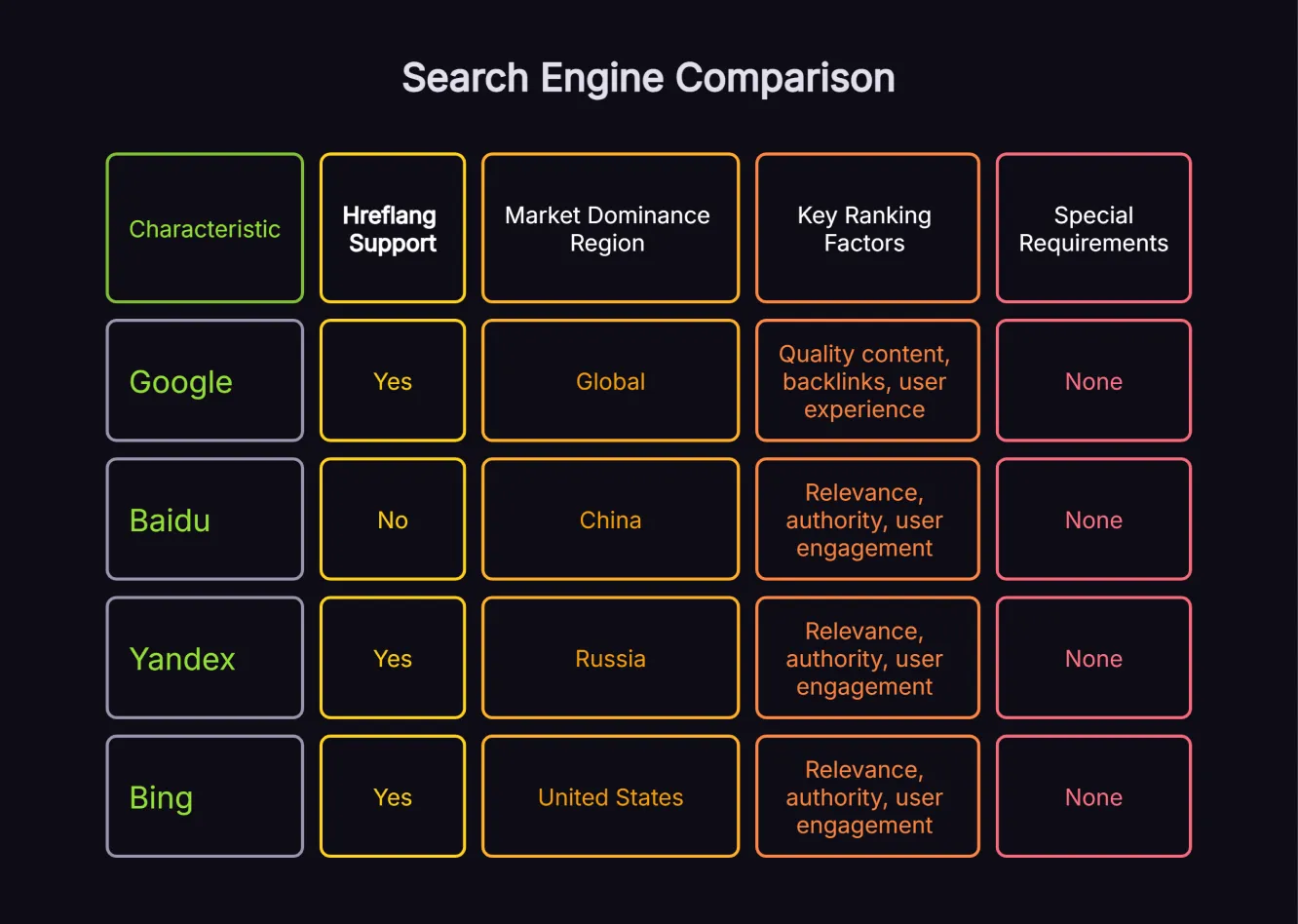
Baidu remains China’s leading search engine, but its share varies by source, device and month. StatCounter’s May 2026 all-platform data places Baidu at about 47.16% of China’s search market, with Bing and Haosou also holding meaningful share. For international SEO, the takeaway is not “optimise for Baidu only”; it is that China requires a market-specific search strategy rather than a Google-only playbook.
Baidu does not use hreflang tags, relying instead on the content-language HTML attribute. Hosting your site within China significantly impacts Baidu rankings, and you will need an ICP licence to host on Chinese servers. Baidu also favours simplified Chinese content, and its algorithm places heavier emphasis on meta tags than Google does.
Russia: Optimising for Yandex
Yandex remains the dominant search engine in Russia, with StatCounter showing it at 70.57% market share in May 2026. Unlike Baidu, Yandex supports hreflang tags, although it also places greater weight on regional hosting and user behaviour signals. Having a .ru domain and hosting within Russia improves your positioning significantly. Yandex also indexes content more slowly than Google, so patience is required.
Bing and Microsoft Copilot
While Bing has a smaller market share than Google in most countries, it matters for international SEO because it powers Microsoft Copilot's AI answers. Bing considers hreflang a weak signal and relies more heavily on the content-language attribute, link patterns and user behaviour data. Optimising for Bing and AI search simultaneously requires a different approach to content structure and technical implementation. Our guide on how AI search works explains the technical foundations that underpin these platforms.
Measuring International SEO Performance
Tracking international SEO performance requires separating your data by market to understand what is working where.
Set Up Regional Tracking
Configure Google Analytics 4 to segment traffic by country, allowing you to monitor key metrics for each target market independently. For each region, separately track:
- Organic sessions
- Conversion rates
- Revenue attribution
- Bounce rates
- Engagement metrics
This granular view reveals which markets are performing and which need attention. Google Search Console performance reports filtered by country show your ranking positions, click-through rates and impressions in each market. Use these reports to identify keyword opportunities and track your progress over time.
Focus on Revenue Metrics
Traffic growth is a vanity metric without a revenue context. An international SEO strategy that drives 50,000 monthly visits from Germany means nothing if those visitors do not convert. Focus your reporting on revenue attributed to organic search in each market, conversion rates by country, customer acquisition cost compared to other channels and return on investment for your international SEO spend.
In our own engagements, that measurement discipline is built on three components:
- Revenue attribution that ties organic and AI-driven sessions back to closed revenue by market.
- Conversion tracking configured per country, so performance is not obscured by a single global average.
- AI citation tracking that records when ChatGPT, Google AI Overviews and Perplexity quote your content in each region.
Our SaaS SEO case study shows what that produces: a $1.31M result with a 20.1:1 return, equal to 1,909% ROI over twelve months, measured this way from the start.
The same revenue-first discipline runs across verticals. The B2B engagement referenced earlier is now about $8.7M attributed over 27 months (ongoing), the eCommerce engagement delivered about $1.75M attributed over 16 months, and our B2C AI SEO case study is about $14.6M organic over 21 months (ongoing). Across every one of them, the figure we focus on is revenue, and our aggregate client results now exceed $26M in attributed revenue. The vanity-metric trap is most dangerous in international SEO precisely because traffic from a new market looks like progress long before it produces a single sale.
Monitor Technical Health
International websites have more moving parts, which means more things can break. Regularly:
- Audit your hreflang implementation to identify errors or inconsistencies.
- Ensure canonical tags correctly align with corresponding hreflang references.
- Monitor page speed performance across regions using local testing locations.
- Confirm that your XML sitemaps include all language and regional versions.
- Use Google Search Console's Indexing and URL Inspection reports, alongside SEO crawling tools, to detect localisation and hreflang issues early.
Automated monitoring catches problems before they impact your rankings, and quarterly manual audits ensure nothing has drifted from your original implementation.
How AI Search Changes International SEO Strategy
Most international audits we review stop at Google organic rankings, and that is the gap. AI search platforms like Google AI Overviews, ChatGPT and Perplexity are now significant traffic drivers across languages and borders, and they are increasingly where international visibility is won or lost. This is the differentiator most competitors have not adjusted to yet, which makes it an opportunity.
AI Platforms and Multi-language Content
AI search engines can summarise content across languages, which means your English-language content might be cited in responses to queries made in other languages. This is both an opportunity and a risk. The opportunity is broader visibility without full localisation for every market. The risk is that AI platforms may prioritise competitors who have properly localised content over your English-only versions. Understanding how AI impacts SEO across different markets helps you stay ahead of this shift.
Structuring Content for AI Citation
AI search platforms favour content that is clearly structured, factually accurate and authoritative. For international SEO, this means ensuring your localised content maintains the same quality standards as your primary market content.
- Use clear heading hierarchies
- Include specific data points
- Cite authoritative sources
- Structure answers in formats that AI platforms can easily extract and reference
There is a mechanical reason this matters more for international content. When someone queries an AI platform, it does not match your exact words. It typically expands the query into roughly 5 to 11 related sub-queries, retrieves content for each in parallel, then synthesises an answer. The evaluation happens at the passage level, not the page level, so a single well-localised paragraph from a mid-ranking page can be cited ahead of a comprehensive guide if it answers a specific sub-query more directly. That is both the risk and the route in for international content: thin, machine-translated pages rarely own any passage cleanly, while one genuinely localised section can earn citations a whole translated site misses. Our guide to query fan-out explains how this retrieval mechanism works in detail.
Building topical authority in each target market increases your chances of being cited by AI platforms serving users in those regions.
Common International SEO Mistakes to Avoid
Even well-planned international SEO strategies can fail when common mistakes creep in.
- Automatic redirects based on IP address frustrate your visitors and confuse search engines. Instead, let users choose their preferred language version, and use hreflang tags to guide search engines.
- Duplicate content across language versions without proper hreflang implementation causes search engines to choose which version to index, often selecting the wrong one. Every language version needs proper hreflang tagging and unique canonical URLs.
- Neglecting mobile optimisation in specific markets can destroy your international performance. Mobile usage patterns vary dramatically between countries. Some markets are mobile-first, meaning desktop-oriented content will underperform.
- Ignoring local link-building leaves your international pages without the authority signals they need to compete. Your domestic backlink profile does not help your French or German pages rank.
- Using automated translation without human review produces content that feels unnatural. Search engines increasingly detect and deprioritise content that reads like machine output, and users bounce from pages that do not feel authentic.
Frequently asked questions
How long does it take to see results from an international SEO strategy?
Most international SEO campaigns take 6 to 12 months to deliver meaningful results, depending on the competitiveness of the target market and whether you are building on existing domain authority or starting fresh with a new domain. Markets where you already have some organic visibility will typically show results faster than entirely new territories.
Should I use subdirectories or separate domains for international SEO?
Subdirectories (example.com/fr/) are the best choice for most mid-sized businesses because they consolidate domain authority under a single domain. Separate country-code domains (example.fr) provide stronger geo-targeting signals but require building authority from scratch for each domain. Your decision should balance your budget, team capacity and long-term growth plans.
Do I need to create completely new content for each market, or can I translate existing content?
Translation is a starting point, not a complete strategy. You should localise your highest-performing content by adapting it to local search terms, cultural references and user expectations. Some content will work well with localisation adjustments, while other topics may need entirely new content created specifically for the local market based on regional keyword research.
What is the biggest technical mistake in international SEO?
Incorrect hreflang implementation is the most common and damaging technical error. Research shows that around 67% of websites using hreflang have implementation issues, including missing return links, mismatched canonical URLs and incorrect language or region codes. Regular auditing with tools like Google Search Console's Indexing and URL Inspection reports, combined with dedicated crawlers that validate hreflang at scale, helps catch these issues early.
How do I handle international SEO for markets where Google is not the dominant search engine?
Each search engine has specific optimisation requirements. Baidu in China does not recognise hreflang tags and relies on the content-language attribute instead, while Yandex in Russia supports hreflang but places greater emphasis on regional hosting and user behaviour metrics. Research the dominant search engine in each target market and adapt your technical implementation accordingly.
Can AI tools handle international SEO content creation?
AI tools can accelerate initial content drafts and help with keyword research across languages, but they cannot replace human understanding of cultural nuance, local idioms and market-specific search behaviour. The most effective approach combines AI efficiency with native speaker review to ensure content that ranks and resonates with local audiences.
Your Next Move in the Global Search Landscape
International SEO is not a launch-and-forget project. It is an ongoing commitment to understanding new markets, adapting your content and refining your technical setup as your business and the search landscape evolve. The brands that win treat each market with the same rigour as their home market, combining solid technical foundations, genuinely localised content and steady authority building. Whether you are entering your first new market or scaling across many, this framework gives you a clear path from strategy to measurable results, and partnering with an international SEO company can help you prioritise, localise effectively and build sustainable organic growth.
About the Author
Want Insights Like This Fortnightly?

Our AI SEO strategies and tactics delivered fortnightly, including bonus trade secrets not shared anywhere else. No fluff. Just what's working right now. 5-minute read.


