
Bing SEO in 2026: How Ranking on Bing Gets You Cited by Copilot and ChatGPT

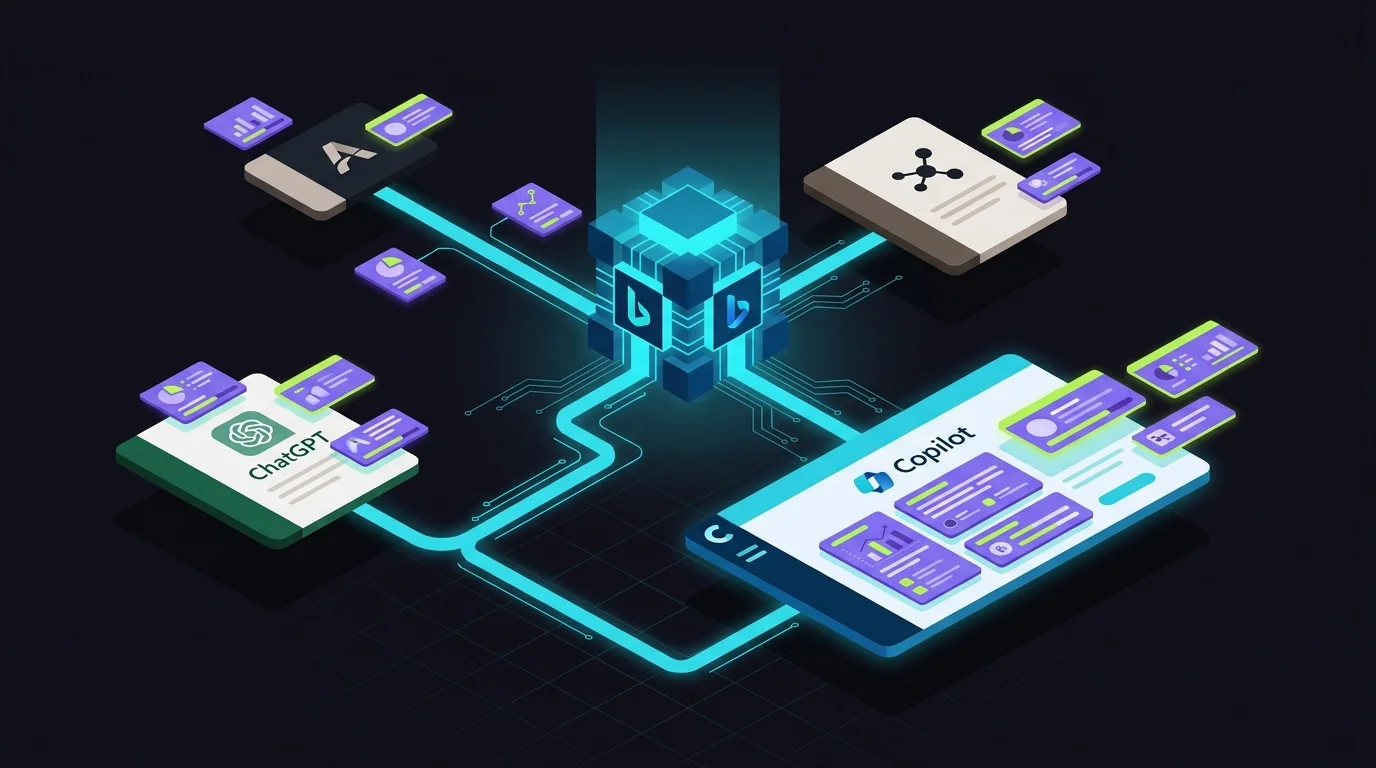
Most Australian businesses write Bing off in about ten seconds. Google handles the overwhelming majority of search here, so why spend any time on an engine with a single-digit market share? Here is the answer we give every client: Bing SEO is no longer a traffic play, it is an AI visibility play. Bing's index powers Microsoft Copilot directly, and it is still one of the biggest sources feeding ChatGPT and Perplexity, so the work you do to rank on Bing helps decide whether the AI assistants your buyers use can find you and cite you. This guide covers what Bing SEO actually involves in 2026, how it differs from Google, and whether it is worth your time.
Bing SEO at a Glance
Bing SEO is the practice of optimising your website so it is indexed, ranked and surfaced by Microsoft Bing. In 2026 its value has shifted: Bing's index powers Microsoft Copilot and is still a major source for ChatGPT and Perplexity, so ranking well on Bing is one of the cheapest, lowest-competition ways to get your content in front of AI assistants. Direct Bing traffic in Australia stays small, but the AI visibility it unlocks is the real prize.
Make Your Content Visible Across AI Search
We build AI SEO strategies that get you found and cited across Google, ChatGPT, Copilot and Bing, not just ranked. See how our AI SEO strategy work turns visibility into revenue.
Explore Our AI SEO StrategyWhat Bing SEO Actually Means in 2026
The fundamentals of Bing SEO look familiar. You make sure Bing can crawl and index your site, you publish genuinely useful content, you earn links, and you give clear on-page signals about what each page is for. Most of the work that helps you on Google helps you on Bing.
What has changed is the reason to bother. For years the honest case for Bing SEO was weak in Australia: a few percent of extra traffic, mostly older desktop users, rarely worth carving out a separate workstream. Plenty of the guides still ranking for this topic were written in 2017 or 2024 and never updated for what happened next, which is that Bing quietly became the plumbing for two of the most-used AI products in the world.
So in 2026 Bing SEO means two things at once: a modest direct-traffic channel, and a back door into AI search. The second is why it now earns a place in a serious strategy.
The Real Reason to Care: Bing Feeds Copilot and ChatGPT
Here is the part almost every generic Bing guide buries in a single sentence, and it deserves to be the headline.
Microsoft Copilot runs on Bing's index. Copilot is built into Windows 11, the Edge browser, Bing itself and Microsoft 365, which puts it in front of an enormous base of everyday and enterprise users. When someone asks Copilot a question that needs the live web, it reaches into Bing's index to find and cite sources. If Bing has not indexed you, Copilot cannot quote you.
ChatGPT search leans heavily on Bing too, though the picture is more layered than the headlines suggest. According to OpenAI, ChatGPT search draws on third-party search providers to fetch live results, and Bing is the documented one. An analysis by the agency Seer Interactive, which examined more than 500 ChatGPT search citations, found that roughly 87% matched Bing's top organic results for the same query. But ChatGPT no longer relies on Bing alone. OpenAI now runs its own crawler, OAI-SearchBot, licenses content directly from publishers, and is steadily building its own search index. So a strong Bing presence is one of the largest inputs into what ChatGPT cites, not the only one, and you also need to let OAI-SearchBot crawl your site for your pages to show up there at all.
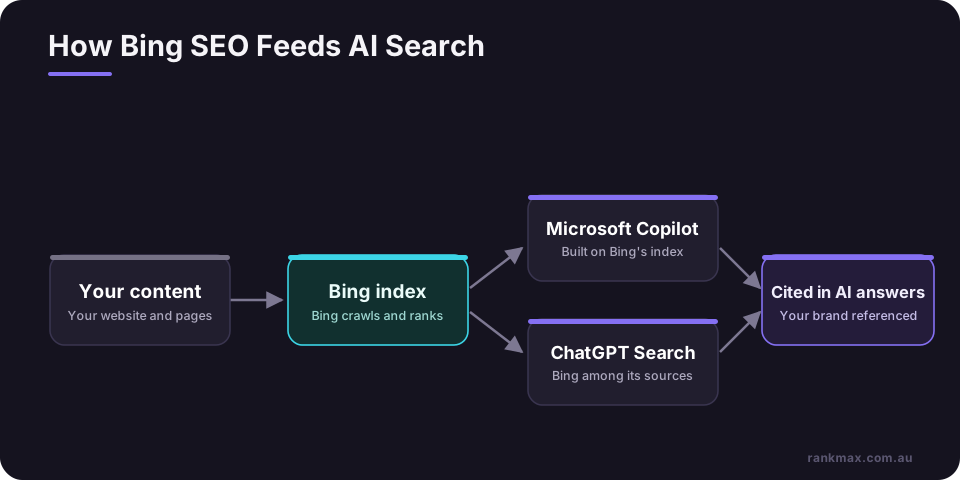
This is the wider shift across AI search, and it is worth being straight about. Perplexity runs its own PerplexityBot crawler and index while still leaning on Bing and other engines, and Google's AI features run on Google's own index, not Bing's. The AI platforms are increasingly building their own indexes rather than borrowing one, and OpenAI's overlap with Bing has been sliding as it does. None of that closes the Bing opportunity, it just sharpens what it is. Bing is one important input among several, clearly strongest for Copilot, still significant for ChatGPT and Perplexity, and the setup work it takes is cheap enough to pay off across all of them.
Underneath all of it, the work is the same. The content engine that earns citations in ChatGPT, Perplexity and Google's AI features is the same one that earns Bing and Copilot visibility, because they are all reading and ranking the open web. For one B2B property management client we took AI citations from zero to 138 over an engagement that drove $5.9 million in attributed revenue, and Bing indexing was part of making sure every AI surface could find the content. If you are building visibility for AI assistants, Bing is not a side quest, it is part of the main one. It is the same logic behind our work on ChatGPT SEO: get the foundations right once, get found in several places.
How Big Is Bing, Really?
It pays to be honest about the numbers rather than overselling them, so let us put Bing in proportion.
Across all devices, Bing holds only around 4% of the global search market, according to StatCounter. That is the figure people quote when they dismiss it. But the all-device number hides where Bing actually competes:
- On desktop, Bing's global share sits closer to 10-12%, and in the United States desktop share runs higher again. Desktop is where Windows, Edge and enterprise environments push Bing as the default.
- In Australia, direct Bing usage is on the lower end, which is exactly why the traffic case alone has never been compelling here.
- The AI layer sits on top of all of this. Copilot and ChatGPT usage is not counted in Bing's search-share figures at all, yet both pull from Bing's index, so Bing's real reach is wider than the raw percentage suggests.
The takeaway is not "Bing is secretly huge". It is that Bing's direct share is small but its leverage is large, because the index does double duty as an AI retrieval layer.
Bing SEO vs Google SEO: The Differences That Change What You Do
Around 90% of Bing SEO is just good SEO, and a healthy site usually ranks on both. But a handful of differences are worth knowing, because they change where you put effort. Bing publishes its own ranking framework in its Webmaster Guidelines, built around three pillars it calls Authority, Utility and Presentation.
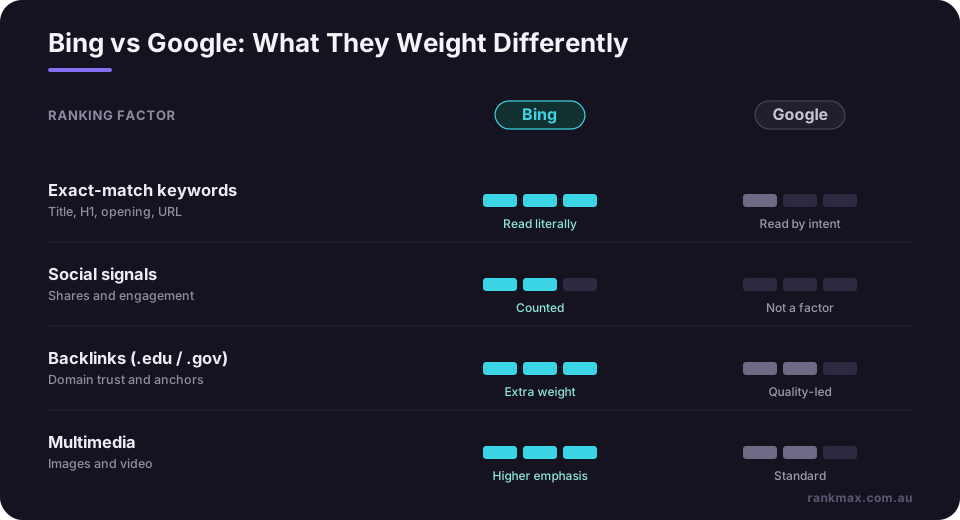
The differences that actually matter in practice:
- Exact-match keywords carry more weight. Bing leans more literally on the words in your title tag, H1, opening paragraph and URL. Google has moved further towards interpreting meaning and intent, so it is more forgiving of looser phrasing. On Bing, being clear and explicit about your primary term helps.
- Social signals are an acknowledged factor. Bing has stated it considers social engagement as part of how it judges a page, while Google maintains it does not use social signals directly. If a page earns genuine shares and discussion, that can help on Bing.
- Backlinks are weighted a little differently. Bing tends to value the overall authority of linking domains, with extra trust for established .edu and .gov sources, and it pays attention to exact-match anchor text. Google leans harder on topical relevance and link quality.
- Multimedia gets more emphasis. Bing has historically given more visible weight to images and video, so well-optimised media can earn extra surface area.
None of this means running two separate strategies. It means that when you optimise for Google, a few small Bing-aware habits, clear exact-match titles, real social engagement, clean media, cover the gap.
How to Set Up Bing Webmaster Tools
The practical starting point for Bing SEO is Bing Webmaster Tools, which is free and takes minutes to set up. It is the equivalent of Google Search Console for Bing, and it has picked up some genuinely useful features.
To get set up properly:
- Create an account and add your site, verifying ownership with a meta tag, DNS record or file upload.
- Import from Google Search Console. Bing lets you import your verified sites and settings directly from GSC, so you do not start from scratch.
- Submit your XML sitemap so Bing has a complete map of your URLs.
- Use URL Inspection (Bing's version of fetch-and-render) to check how Bing sees a specific page and to request indexing for new or updated content.
- Check the AI Performance Report. This is the standout: Bing now reports how your content performs in AI experiences separately from traditional search clicks, making it one of the first major engines to break out AI visibility as its own metric. It is a useful, free read on whether your Bing work is translating into AI surfacing.
If you only do one thing on Bing, verify the site in Webmaster Tools and submit your sitemap. Everything else builds on Bing actually knowing your pages exist.
IndexNow: The Fast Lane Into Bing and AI Search
IndexNow is a small protocol with an outsized payoff. Launched in 2021 by Microsoft Bing and Yandex, it lets you ping participating search engines the moment you publish, update or delete a page, instead of waiting for them to crawl around to it.
How it works in practice:
- You generate an API key and host a small key file at your domain root.
- Whenever content changes, your site (or your CMS plugin) sends a single ping to the IndexNow endpoint with the changed URL.
- The receiving engine accepts it and shares it with the other IndexNow participants, so one ping covers several engines.
It is supported by Bing, Yandex, Naver, Seznam and Yep. Google has tested IndexNow but does not support it as of 2026, so this is firmly a Bing-and-friends advantage. The result is that fresh content can be discovered in minutes rather than days.
Here is the connection most guides miss: because Bing feeds Copilot and ChatGPT, getting indexed faster on Bing means getting into the AI grounding layer faster. If you have published something timely that you want AI assistants to reference, IndexNow is the quickest route to making it eligible. Freshness on Bing is freshness for AI search.
On-Page Moves Bing Rewards More Than Google
Most on-page best practice is shared, but a short checklist of Bing-aware moves earns extra mileage:
- Put your primary keyword in the title tag, H1 and first paragraph, clearly and naturally, since Bing reads these literally.
- Write descriptive, keyword-aware meta descriptions. Bing is more likely than Google to use your meta description and to factor its keywords in.
- Optimise images and video properly, with descriptive filenames and alt text, to benefit from Bing's stronger multimedia emphasis.
- Keep technical foundations clean, with a valid sitemap, sensible internal linking and fast, mobile-friendly pages, all of which Bing rewards the same way Google does.
- Earn real social engagement, since Bing counts it where Google does not.
- Build authoritative backlinks, with a little extra value from established .edu and .gov domains.
None of these are exotic. They are the same habits good SEO already encourages, tuned slightly for Bing's stated preferences.
Bing Places and Local Search
If you are a local or service business, claim and complete a Bing Places for Business listing. It is the Bing counterpart to a Google Business Profile, and like Webmaster Tools it lets you import your existing Google Business Profile rather than rebuilding it by hand. For Australian service businesses the direct local traffic from Bing will be modest, but a complete, consistent listing supports the same trust and consistency signals that help everywhere, and it is a quick job once your Google listing is in good shape.
Our Take: Is Bing SEO Worth It for an Australian Business?
Yes, but for the right reason. If you measure Bing SEO purely on direct Australian traffic, it will almost always look like a poor use of time, because that traffic is genuinely small. Measured on AI visibility, the maths flips.
Bing SEO is worth doing because it directly powers Microsoft Copilot and remains one of the largest inputs into what ChatGPT and Perplexity cite, even as those platforms build out their own indexes. For a fraction of the effort and competition you would face chasing the same visibility on Google, you can make your content eligible to be surfaced and cited by the AI assistants your buyers increasingly use. The direct Bing clicks are a rounding error. The AI leverage is the point.
Our honest recommendation: do not build a separate Bing campaign. Get your Google and AI SEO foundations right, then spend the small additional effort to verify in Bing Webmaster Tools, submit your sitemap, switch on IndexNow and apply the handful of Bing-aware on-page tweaks above. That is a few hours of work that opens a disproportionately large door into AI search. For most Australian businesses, that is a trade worth making.
Frequently Asked Questions
Does Bing SEO matter if Google has around 90% of search?
It matters more than the traffic numbers suggest, because Bing's index powers Microsoft Copilot and is one of the biggest sources feeding ChatGPT and Perplexity. Even if very few people visit your site directly from Bing, ranking there helps decide whether those AI assistants can find and cite your content. The value is AI visibility, not direct clicks.
Is Bing SEO different from Google SEO?
Most of it is identical, and a healthy site usually ranks on both. The differences are that Bing weighs exact-match keywords more literally, openly counts social signals, gives extra trust to .edu and .gov backlinks, and places more emphasis on multimedia. You optimise for Google first, then apply a few Bing-aware habits on top.
Does ranking on Bing get me into ChatGPT and Copilot?
For Copilot, yes, it runs on Bing's index. For ChatGPT it helps a great deal but is not the whole story: Bing is one of its biggest sources, with research finding about 87% citation overlap with Bing's top results, but ChatGPT also uses its own OAI-SearchBot crawler and is building its own index, so you need to let that crawler in too. Ranking on Bing is one of the most direct ways to become eligible, rather than a guarantee.
How do I get my site indexed on Bing faster?
Verify your site in Bing Webmaster Tools, submit your XML sitemap, and use URL Inspection to request indexing for individual pages. For ongoing speed, switch on IndexNow, which pings Bing the moment you publish or update a page so it can be discovered in minutes rather than days.
What is IndexNow and which search engines support it?
IndexNow is an open protocol that instantly notifies search engines when you add, update or delete a URL, instead of waiting for a crawl. It is supported by Bing, Yandex, Naver, Seznam and Yep. Google has tested it but does not currently support it, so IndexNow is mainly a Bing-side advantage.
Is Bing SEO better than Google SEO?
Neither is better; they are complementary, and you should not choose between them. Google drives the bulk of direct search traffic, while Bing's outsized value in 2026 is the AI visibility it unlocks through Copilot and ChatGPT. The right approach is to do strong SEO once and make sure both engines can crawl, index and surface your content.
Do I need separate SEO for Bing, or does my Google SEO already cover it?
Your Google SEO covers most of it, since the fundamentals are shared. You do not need a separate campaign, only a short Bing-specific setup: verify in Bing Webmaster Tools, submit your sitemap, enable IndexNow and apply a few Bing-aware on-page tweaks. That small addition is what turns your existing work into Bing and AI visibility.
The Cheap Door Into AI Search
Bing SEO has quietly changed jobs. It used to be a marginal traffic channel that most Australian businesses were right to ignore. In 2026 it is the lowest-competition entry point into AI visibility, because the same index you optimise for Bing is the one Copilot reads and the one behind ChatGPT's search. You do not need a separate campaign or a big budget to benefit, just a few deliberate hours layered on top of the SEO you are already doing. For the businesses willing to take them, those hours buy a seat in the AI answers their customers are already reading.
About the Author
Want Insights Like This Fortnightly?

Our AI SEO strategies and tactics delivered fortnightly, including bonus trade secrets not shared anywhere else. No fluff. Just what's working right now. 5-minute read.


