
12 Best Local SEO Tools in 2026 (Tested & Ranked)

Quick Summary:
I’ve spent 18 years helping businesses dominate local search and these are the tools that actually move the needle for local rankings, citations and reviews.
- Semrush: Best all-in-one platform for local, organic and AI search visibility
- BrightLocal: Best dedicated local SEO platform
- Google Business Profile: Best free essential (mandatory for everyone)
- Local Falcon: Best for visual geo-grid rank tracking
- Whitespark: Best for citation building and discovery
- Moz Local: Best budget-friendly listing management
- Localo: Best for guided GBP optimisation
- SE Ranking: Best for SEO and AI search tracking without the full marketing stack
- Local Viking: Best for GBP-focused agencies
- Yext: Best for enterprise multi-location businesses
- Ahrefs: Best for local competitor research
- Advanced Web Ranking: Best for agency rank tracking across local, Maps and AI search
Local SEO decides whether customers find you or a competitor when they search “near me”, and the stakes are high: 46% of Google searches have local intent and 76% of local searchers visit a business within 24 hours. That game is now being rebuilt around AI: Google is weaving Gemini deep into local discovery, with its March 2026 Ask Maps turning Google Maps into a conversation, AI Overviews and AI Mode increasingly answering “near me” and “best [service] in [city]” queries, and people often shortlisting a business in ChatGPT, Gemini or Perplexity before they ever open a map. Managing citations across hundreds of directories, monitoring reviews, tracking local rankings and keeping your Google Business Profile optimised is workable by hand for one location but needs specialised tools at scale, so having tested dozens across client campaigns from single-location trades to multi-location franchises, this guide covers the 12 that consistently deliver, with honest notes on where each wins and falls short.
Why Trust This Review
I've been working in SEO since 2007, running campaigns for businesses ranging from local service providers to ASX-listed companies. We manage local SEO campaigns that have generated over $26 million in attributed client revenue across Google, AI Overviews, ChatGPT and other platforms.
How I evaluated these tools:
- Citation management: How effectively does the tool build and maintain consistent NAP data across directories?
- Rank tracking accuracy: Does the tool show where you actually appear in local search results at the street level?
- Review management: Can you monitor, respond to and generate reviews efficiently?
- Ease of use: How quickly can you or your team get value without a steep learning curve?
- Value for money: Does the pricing align with the results you can achieve?
A note on my experience: I've used most of these tools with paid subscriptions across client campaigns. For tools where I have current active subscriptions, I've included observations from recent use. For tools I've used previously but no longer subscribe to, I've noted the timeframe. For any tools I haven't used personally, I've clearly stated this and based my assessment on documentation, user feedback and industry reputation.
Local SEO Tools Compared
Prices in this table are for guidance only. Always visit the tool's website for the current pricing before subscribing.
| Tool | Best For | Starting Price | Free Trial | Key Strength | Action |
|---|---|---|---|---|---|
| Semrush | Local + organic + AI search visibility | From $139/mo | 7 days | All AI channels (AI Overviews, AI Mode, ChatGPT, Gemini) tracked to neighbourhood level, plus full SEO and the local toolkit | Start Free Trial |
| BrightLocal | All-in-one local SEO | $39/month | 14 days | Citation tracking + review management + rank tracking in one platform | Start Free Trial |
| Google Business Profile | Every local business | Free | N/A | Direct control over how you appear in Google Search and Maps | Get Started |
| Local Falcon | Geo-grid rank tracking | $24.99/month | 100 free credits | Visual heatmaps showing exact ranking positions by location | Start Free Trial |
| Whitespark | Citation building | from $33/month | Limited free | Manual citation building for higher quality placements | Get Started |
| Moz Local | Budget listing management | $16/month | Limited | Automated duplicate deletion | Get Started |
| Localo | Guided GBP optimisation | $39/month (billed annually) | 14-day trial | AI-powered weekly task recommendations | Start Free Trial |
| SE Ranking | SEO + AI without the marketing stack | $129/month | 14 days | Local rank tracking alongside LLM citation tracking in one platform | Start Free Trial |
| Local Viking | GBP-focused agencies | $39/month | 7-day money-back | GBP post scheduling + geo-grid tracking combined | Get Started |
| Yext | Enterprise multi-location | $199/year | Demo | Real-time sync across hundreds of directories | Request Demo |
| Ahrefs | Local competitor research | $129/month | No (free tools only) | Backlink analysis and citation source discovery | Start Trial |
| Advanced Web Ranking | Agency rank tracking across local, Maps and AI search | $139/month | 7 days | Street-level rank tracking plus AI Overviews, ChatGPT and Perplexity in one platform | Start Free Trial |
How These Tools Compare on AI Visibility
Local discovery increasingly runs through AI Overviews, AI Mode and chat assistants like ChatGPT and Gemini. Here is how the tools on this list handle AI search visibility: the platforms they track, how granular their local prompt tracking gets, whether they show the citations AI is pulling from, and whether they measure your share of voice.
| Tool | AI platforms tracked | Local prompt-tracking granularity | Citation / source tracking | Share of voice |
|---|---|---|---|---|
| Semrush | AI Overviews, AI Mode, ChatGPT, Gemini (+ Perplexity on Pro+ / Advanced) | Country to state to city to suburb to neighbourhood | Yes | Yes |
| Ahrefs Brand Radar | Up to 7 platforms incl. Claude (custom prompts included on Lite+; full AI-index packs from ~$199/mo per channel or ~$699/mo for all) | Not to neighbourhood level | Yes | Yes |
| Advanced Web Ranking | AI Overviews, ChatGPT, Perplexity | Local and Maps tracking | Partial | No |
| SE Ranking | AI Overview tracker | Country / location | Limited | No |
| BrightLocal, Google Business Profile, Local Falcon, Whitespark, Moz Local, Localo, Local Viking, Yext | Not built for AI search visibility | n/a | No | No |
Track a query like “best [service] in [city]” in the AI visibility tracking and it reports whether your business is cited in the AI Overview and chat answers, your share of voice against named competitors for that query set, and which specific pages the AI is pulling from, all the way down to a single suburb. That last signal, the citation sources, is what tells you which local pages to build or strengthen next.

1. Semrush
Best for: Local businesses and agencies that want local SEO, organic SEO and AI search visibility tracked in one platform
Pricing: Semrush from $139/mo (see plans) | Free trial: 7 days
Start Free Trial | View Pricing
Overview
Semrush is the unified version of the platform, combining the SEO toolkit, the Local toolkit and the AI visibility tracking in one subscription. For local businesses that means citations, listings, map rankings and Google Business Profile management sit alongside your organic keyword strategy, and, crucially in 2026, tracking how your business appears in AI Overviews, Google’s AI Mode, ChatGPT and Gemini.
My Experience
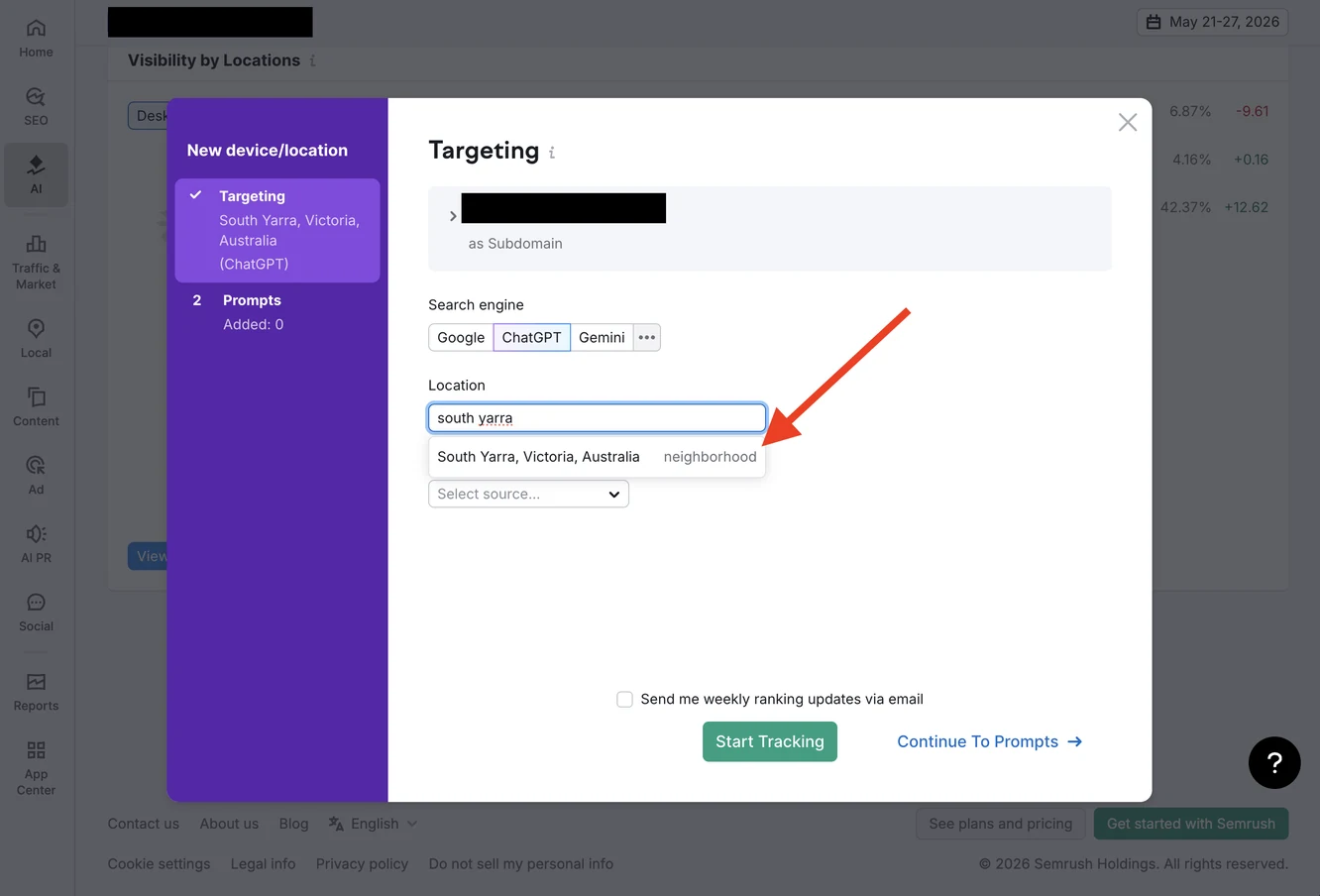
The single biggest reason Semrush tops this list for local is the granularity of its AI visibility tracking. It is the only AI visibility platform I have used that lets you track prompts right down to the neighbourhood level, not just nationally. Most prompt trackers I have come across only report at country level.
Semrush lets you drill from country to state to city to suburb to individual neighbourhood, which is exactly the resolution local SEO needs, because whether you surface in an AI answer for “best [service] near me” depends entirely on where the searcher is standing. Being able to see your AI visibility at suburb and neighbourhood level, at the $139/mo entry price, is something I have not seen any other prompt tracker match, and for local work that alone makes it hard to beat.
Semrush is now our daily driver across the whole Rankmax client portfolio, which is a genuine shift, as Ahrefs was our primary platform for about five years. Two things moved me. The first was data reliability. After Google deprecated the &num=100 parameter in September 2025, rank tracking broke across the industry, and since then I have run into persistent problems with Ahrefs data: gaps in tracking, reports that used to load instantly now erroring out or refusing to display, and a general inaccuracy I cannot rely on for client decisions. Semrush, by contrast, absorbed the change across every plan tier, and I have not hit a data-quality issue with it since.
That gap matters more than people think: third-party tracking data should never be your single source of truth, but if you do act on poor or inaccurate data, you can easily make the wrong optimisation call and do real damage to a site’s visibility. When you are leaning on third-party data, Semrush’s is simply more accurate and more dependable than what I get from Ahrefs now.
The second is value. For AI visibility, the only genuinely comparable platform is Ahrefs, and the maths is lopsided. Semrush gives you all of its available AI channels, AI Overviews, AI Mode, ChatGPT and Gemini, with Perplexity on the higher tiers, for $139/mo.
With Ahrefs, Lite includes Brand Radar custom prompt checks, while full AI-index packs still start around $199/month for a single channel or about $699/month for all platforms on top of the base subscription. Semrush still gives you materially more bundled AI visibility coverage, at neighbourhood-level granularity, before those deeper Ahrefs index packs.
Key Features
- AI visibility tracking to neighbourhood level: Track whether you are cited in AI Overviews, AI Mode, ChatGPT and Gemini for local queries, and drill prompt-level visibility from country down to state, city, suburb and neighbourhood.
- Local toolkit: Listing distribution to 70+ US and 40+ international directories, a map rank tracker with geo-grid heatmaps, AI-assisted review management with hourly updates, and GBP posting and editing.
- Citation and source tracking: See which pages and citations AI answers pull from, plus your share of voice against competitors, so you know which local content to build next.
- Unified SEO platform: Keyword research, competitor analysis, backlink data and PPC intelligence in the same subscription, with API and MCP access on every tier.
Pros
- AI visibility tracking down to neighbourhood level, granularity I have not seen another prompt tracker offer
- All available AI channels included from the entry tier (from $139/mo), rather than paying per channel
- Kept rank-tracking data consistent and reliable through the 2025 &num=100 disruption
- Local, organic, paid and AI visibility in one subscription, with a 7-day free trial
Cons
- More expensive than dedicated local-only tools if all you need is citations and GBP management
- The Local toolkit is a paid add-on billed per location, on top of the base plan
- The breadth of the platform has a learning curve for new users
Verdict
For a local SEO article in 2026, Semrush is our top pick because local discovery now runs through AI as much as the map pack, and no other platform lets you track that AI visibility at neighbourhood resolution, with all AI channels included, for $139/mo.
Choose Semrush if: you want local SEO, organic SEO and AI search visibility, tracked at local granularity, in one platform.
Skip Semrush if: you only need citation building and GBP management, where a dedicated tool like BrightLocal is cheaper and more focused.
Semrush Pricing (2026)
Semrush plans start from $139/mo, with AI visibility tracking across ChatGPT, AI Overviews, AI Mode and Gemini (Perplexity on the higher tiers). See the current Semrush plans and pricing for the latest tiers.
The Local toolkit is an add-on from around $30/month per location; the AI visibility tracking is included from the Starter plan. Prices are for guidance, always check current Semrush pricing before subscribing.

2. BrightLocal
Best for: All-in-one local SEO management for businesses and agencies
Pricing: $39-59/month (1-5 locations) | Free trial: 14 days (no credit card required)
Start Free Trial | View Pricing
Overview
BrightLocal is a dedicated local SEO platform that handles:
- Citation management
- Review monitoring
- Rank tracking
- Google Business Profile auditing.
It serves over 5,000 agencies and has become the industry standard for local SEO campaigns. The platform excels at providing comprehensive local visibility data without requiring multiple tool subscriptions.
My Experience
BrightLocal is my personal favourite platform for local citation submission and management. We use it for local directory listing submissions and management as well as Google Business Profile management and optimisation across client campaigns.
Their customer support team is really excellent and responsive, which makes a genuine difference when you're managing citations at scale. One thing to be aware of is that you need to keep on top of submissions after they've been requested. Some directory platforms can take a long time to respond and occasionally won't process your submission at all. I'd recommend regularly checking the status of pending citations and following up where needed to make sure you get all the citations you're paying for.
It's also worth noting that local citations are still valuable in the AI search era. Even no-follow local citations influence AI search visibility through local references and entity signals. If you're questioning whether citation building is still worth the investment, it absolutely is - the mechanics of how citations contribute to visibility have evolved, but their importance hasn't diminished.
Key Features
- Local Rank Tracker: Monitor your positions in Google's local pack, organic results and Maps across different locations and devices. Set up tracking grids to see exactly where you rank at street-level precision.
- Citation Tracker: Audit your NAP consistency across 100+ directories and identify sites with incorrect or missing information. The tool flags discrepancies that could harm your local rankings.
- Review Management: Aggregate reviews from Google, Facebook, Yelp and other platforms into one dashboard. Monitor sentiment, respond to reviews and track your rating trends over time.
- Citation Builder: Pay-as-you-go service ($2–$3.20 per citation) to submit your business to directories, with optional Data Aggregator Network submissions (e.g. Foursquare, GPS networks) available as separate add-ons for broader distribution.
Pros
- Comprehensive local SEO suite covering citations, rankings, reviews and audits in one platform
- White-label reporting available on all plans for agencies
- 14-day free trial with no credit card required
- Citation Builder is pay-as-you-go rather than subscription, so you only pay for what you use
Cons
- Review management features only available on the highest tier (Grow plan at $59/month)
- Citation Builder is a separate service, not included in subscription plans
- Interface can feel overwhelming for new users during initial setup
Verdict
BrightLocal is the most complete dedicated local SEO platform for businesses serious about dominating local search. It handles the three pillars of local SEO (citations, reviews, rankings) effectively without requiring you to juggle multiple platforms.
Choose BrightLocal if: You manage local SEO for one or more locations and want everything in one platform with reliable data.
Skip BrightLocal if: You only need basic GBP management and want something simpler.

3. Google Business Profile
Best for: Every local business without exception
Pricing: Free | Free trial: N/A (completely free)
Get Started | View Documentation
Overview
Google Business Profile (formerly Google My Business) is Google's free tool for managing how your business appears in Google Search and Google Maps. It's not optional. If you have a physical location or serve customers in specific areas, your GBP listing directly determines whether you appear in the local pack when customers search for your services.
My Experience
Google Business Profile is a no-brainer if you want to rank in organic search and AI search. It should be one of the first things you do once your website is online - or even before your website is online. Get your profile sorted and uploaded as early as possible.
One critical warning from experience: Google has become extremely sensitive to people trying to keyword-stuff their Business Profile, especially the business title. Your Google Business Profile name must be a 100% exact match with your actual business name. If you try to get smart and insert keywords into the title, Google will force you to verify the business through a very tedious and time-consuming manual video verification process. If your business name doesn't match your signage exactly during that verification, you'll be denied and your profile will be locked.
I've seen businesses lose weeks of local visibility because they tried to optimise their profile title with keywords. It's not worth the risk. Keep your business name clean and exact and focus your optimisation efforts on categories, descriptions, posts and reviews instead.
Key Features
- Listing Management: Control your business name, address, phone number, hours, categories, attributes and service areas directly through Google's interface.
- Review Management: Respond to customer reviews, which Google has confirmed influences local ranking factors.
- Posts and Updates: Publish updates, offers, events and product information that appear directly in your Google listing.
- Performance Insights: Track how customers find your listing, what actions they take (calls, directions, website visits) and how your visibility compares over time.
Pros
- Completely free with no subscription fees for core features
- Direct influence on how you appear in Google's local pack and Maps
- Built-in analytics showing customer actions and discovery patterns
- Integration with Google Ads for local campaigns
Cons
- Limited to Google's ecosystem only; doesn't help with Bing, Apple Maps or other directories
- No automation for citation building or multi-directory management
- Reviews are public and you have limited control over negative feedback
- Vulnerable to spam edits and competitor manipulation; Google does monitor suggested changes, but some manual oversight or third-party monitoring is still needed
Verdict
Google Business Profile isn't just recommended. It's mandatory. BrightLocal's Local Consumer Review Survey found that 87% of consumers use Google to evaluate local businesses and your listing quality directly affects whether you appear in the local three-pack.
Choose Google Business Profile if: You're a local business. Full stop.
Skip Google Business Profile if: You don't have a physical location and don't serve customers in specific geographic areas.

4. Local Falcon
Best for: Visual geo-grid rank tracking at street-level precision
Pricing: $24.99-199.99/month (credit-based) | Free trial: 100 free credits on signup
Start Free Trial | View Pricing
Overview
Local Falcon specialises in geo-grid rank tracking, showing you precisely where you rank for local keywords across a visual map. Instead of knowing you're "ranking in the local pack," you see exactly which streets and neighbourhoods you dominate versus where competitors outrank you. The platform also tracks Apple Maps rankings, which most tools ignore.
My Experience
I haven't personally used Local Falcon, so this assessment is based on documentation, industry reputation and observations from peers who use it in their local SEO workflows.
That said, the geo-grid system is genuinely valuable for local SEO. It's particularly useful when working in dense urban environments such as CBDs, where block-by-block visibility is critical. Standard rank tracking doesn't capture the nuance of local search in these areas - you might rank well two streets over but be invisible at the exact location that matters for foot traffic. Geo-grid tracking solves that problem.
For agencies presenting local SEO progress to clients, the visual heatmaps are also far more intuitive than tables of ranking numbers. Clients can immediately see where they dominate and where work is needed.
Key Features
- Geo-Grid Rank Tracking: Create custom scan grids (3x3 to 10x10) showing your ranking position at each point. A 5x5 grid = 25 data points, giving you street-level visibility into your local rankings.
- Share of Local Voice (SoLV): Proprietary metric that calculates your overall visibility across the grid versus competitors. Useful for tracking progress over time.
- Falcon AI: AI-powered analysis (+25 credits per report) providing specific recommendations for improving rankings based on your grid data.
- Apple Maps Tracking: One of the few tools that tracks Apple Maps rankings alongside Google Maps.
Pros
- Most precise visual representation of local rankings available
- Credit system is flexible; pay for what you use rather than flat subscription
- Apple Maps tracking captures the 20%+ of people using iOS devices, who often rely on Apple Maps by default.
- Competitor reports show exactly where rivals outrank you geographically
Cons
- Credit-based pricing can get expensive for multiple locations with frequent scans
- Credits expire monthly on monthly plans (roll over on annual plans)
- Focused solely on rank tracking; no citation or review management included
- Learning curve to understand optimal grid configurations
Verdict
Local Falcon is the best tool for understanding exactly where you rank at the street level. If you're investing in local SEO and want to see precisely which areas need work, the geo-grid visualisation is unmatched.
Choose Local Falcon if: You need precise geographic ranking data to guide your local SEO strategy.
Skip Local Falcon if: You want an all-in-one platform that also handles citations and reviews.

5. Whitespark
Best for: Citation building and discovery
Pricing: $33/month to $149/month for Local Citation Finder | Free trial: Limited free plan (3 searches/day)
Overview
Whitespark is a Canadian company that has focused on local SEO since 2005, with their Local Citation Finder being the standout tool. Unlike automated citation services, Whitespark emphasises finding high-quality, relevant citation opportunities rather than mass-submitting to every directory. They also offer separate tools for rank tracking and reputation management.
My Experience
Whitespark is one of the original local SEO platforms and they've earned their reputation. Their Local Citation Finder is a genuinely useful discovery tool, particularly if you plan to handle citation building in-house or have someone on your team you can delegate it to.
My recommendation, though, is to avoid doing the actual citation submissions yourself unless you have no other option. The discovery side is valuable - knowing where your competitors are listed and identifying gaps in your citation profile. But the submission process is very time-consuming and repetitive. It can often be outsourced for a very low fee, freeing up your time to focus on higher-impact local SEO work like review generation, content and GBP optimisation.
If you prefer a more hands-off approach to citation building, a platform like BrightLocal handles both discovery and submission. But if you want granular control over exactly which directories you target and prefer quality over quantity, Whitespark's discovery-first approach is the better fit.
Key Features
- Local Citation Finder: Discover citation opportunities by analysing where competitors are listed. The tool prioritises quality directories relevant to your industry rather than quantity.
- Local Rank Tracker: Separate tool ($14-200/month) tracking your positions across search engines in different result types.
- Reputation Builder: Review generation and management tool ($79/month/location) for soliciting and responding to customer feedback.
- Free Review Checker: Check your reviews across multiple platforms in one view, available free.
Pros
- Focus on manual, high-quality citation building rather than automated mass submissions
- Pick-and-choose pricing model lets you pay only for tools you need
- Free review checker provides value without subscription
- Strong reputation in the local SEO community for citation quality
Cons
- Tools sold separately, which can add up if you need multiple features
- Free tier is limited; serious use still requires a paid plan
- Less automated than alternatives like BrightLocal
- Interface feels dated compared to newer competitors
Verdict
Whitespark is the choice for businesses that prioritise citation quality over quantity. Their citation finder helps you target the directories that actually matter for your industry rather than submitting to every site in existence.
Choose Whitespark if: You want high-quality, targeted citations and prefer paying only for specific tools.
Skip Whitespark if: You want an all-in-one platform with unified pricing.

6. Moz Local
Best for: Budget-friendly listing management
Pricing: $16-33/month per location depending on plan | Free trial: No free trial
Overview
Moz Local focuses on listing management and citation building at an accessible price point. The platform distributes your business information to major aggregators and directories, monitors for inconsistencies and includes automated duplicate deletion. For businesses wanting basic local SEO management without the complexity of larger platforms, Moz Local delivers.
My Experience
Moz is the OG SEO tool. It was the leading platform back when Rand Fishkin was running it and for a long time it was the go-to for anyone serious about SEO. After Fishkin left, I felt like Moz went by the wayside somewhat. Their database and data quality got eclipsed by Ahrefs and Semrush, which both invested heavily in building out their crawling and indexing infrastructure.
Where Moz Local still holds its own is in listing management at an accessible price point. The automated duplicate deletion is a genuinely useful feature that saves real time. For businesses new to local SEO who find platforms like BrightLocal or Semrush overwhelming, Moz Local's simpler interface makes it easier to get started.
The Domain Authority metric, despite its limitations, remains widely understood and useful for quick competitive comparisons when evaluating local citation sources. If you need affordable listing management without the complexity of a full-featured local SEO platform, Moz Local delivers on that promise.
Key Features
- Listing Distribution: Push your business data to 90+ directories including major aggregators, ensuring NAP consistency across the web.
- Automated Duplicate Deletion: Moz Local identifies and removes duplicate listings that can confuse search engines and customers. This is a standout feature.
- Review Monitoring: Track reviews across platforms and respond directly from the dashboard.
- GeoRank Tracking: Local map pack tracking showing your visibility across different geographic areas.
Pros
- Most affordable comprehensive listing management option at $16/month per location
- Automated duplicate deletion saves significant manual effort
- Simple interface that doesn't overwhelm new users
- Backed by Moz's reputation and domain authority research
Cons
- Less comprehensive than BrightLocal or Semrush for advanced local SEO
- Per-location pricing adds up for multi-location businesses
- Citation building is less granular than Whitespark's targeted approach
- Social posting features only available on higher tiers
Verdict
Moz Local is the best entry point for businesses new to local SEO who want listing management without the complexity or cost of larger platforms. The automated duplicate deletion alone justifies the investment for many businesses.
Choose Moz Local if: You want affordable listing management with a simple interface.
Skip Moz Local if: You need advanced rank tracking or comprehensive review generation features.

7. Localo
Best for: Guided Google Business Profile optimisation
Pricing: From $39/month | Free trial: 14-day free trial
Start Free Trial | View Pricing
Overview
Localo takes a different approach to local SEO by providing AI-powered, personalised weekly tasks that guide you through GBP optimisation. Rather than giving you data and expecting you to interpret it, Localo tells you exactly what to do each week. It's particularly valuable for service-based businesses like HVAC, dental practices or salons where GBP visibility directly drives appointments.
My Experience
I haven't personally used Localo, so this assessment is based on documentation and industry feedback.
One important caveat about tools like Localo that automate GBP optimisation: Google Business Profile has become extremely sensitive today. Any type of content updates or changes made to your profile that could be flagged as keyword or SEO spam will take your profile offline or block it from being edited. I've seen this happen to businesses that were using optimisation tools and automated posting without careful oversight.
My general approach is that GBP optimisation is often best done manually and with a very careful hand. If you do use a tool like Localo, review every recommendation and every piece of content it generates before publishing. The task-based guidance is helpful for knowing what to focus on, but always apply your own judgment before making changes - especially to your business title, categories and primary description.
Key Features
- Smart Tasks: AI analyses your GBP and generates specific, actionable tasks each week. Instead of "optimise your description," you get exact recommendations with instructions.
- GBP Protection: Alerts when competitors or users attempt unauthorised edits to your listing, such as marking you as "permanently closed."
- Automated Review Responses: AI-powered responses to reviews that you can customise and approve before posting.
- Local Rank Checker: Track your visibility in local search results with accuracy the team claims exceeds competitors.
Pros
- Task-based approach removes guesswork from GBP optimisation
- GBP protection catches malicious competitor edits before they damage your visibility
- Free plan allows you to test core features before committing
- Newer tool that's actively developing based on user feedback
Cons
- Relatively new to the market compared to established players
- Focus is primarily on GBP; less comprehensive for citation management
- Task recommendations can feel repetitive once you've optimised the basics
- Limited reporting compared to more established platforms
Verdict
Localo is ideal for business owners who want clear guidance on what to do rather than just data to interpret. If you don't have time to learn local SEO strategy and want someone (or something) to tell you exactly what steps to take, Localo delivers.
Choose Localo if: You want hands-on guidance for GBP optimisation without learning the full complexity of local SEO.
Skip Localo if: You need comprehensive citation management or prefer data-heavy analysis.

8. SE Ranking
Best for: SEO and AI search tracking without the full marketing stack
Pricing: $129-279/month | Free trial: 14 days
Start Free Trial | View Pricing
Overview
SE Ranking is an SEO-focused platform that covers local rank tracking, GBP management, organic SEO and an AI Search Toolkit (brand mentions and citations across ChatGPT, Gemini, Perplexity, AI Mode and AI Overviews). It sits between specialist tools like BrightLocal and full marketing platforms like Semrush, covering the search side of the picture without the paid, content and social tools you'd find on a broader stack.
My Experience
I've used SE Ranking only sparingly. With Ahrefs as my primary tool, I find I don't need it for day-to-day SEO work. That said, SE Ranking has a good API and if you're looking for an SEO data solution that's more cost-efficient than Ahrefs or Semrush, it's a solid starting point.
The trade-off is data quality. SE Ranking's database isn't as comprehensive or well-built as either Ahrefs or Semrush. For the local SEO features specifically, SE Ranking offers a reasonable combination of local rank tracking and GBP management alongside broader organic SEO tools. For smaller businesses or freelancers who don't need the depth of data the premium platforms offer, the value proposition at this price point is hard to argue with.
Where SE Ranking makes most sense for local SEO is when you need both local and organic capabilities in one affordable subscription and you're willing to accept less depth in exchange for broader coverage at a lower cost.
Key Features
- Local Rank Tracker: Tracks positions in Google Search and Google Maps across multiple locations, with map-based grid views and configurable tracking points down to ZIP code.
- GBP Management: Connect and manage your Google Business Profile directly from SE Ranking, with business information synced automatically and review responses available from Google, Facebook, Yelp and TripAdvisor.
- Local SEO Audit: Produces an overall score and specific recommendations across local SEO factors.
- AI Search Toolkit: Tracks brand mentions and citations across ChatGPT, Gemini, Perplexity, AI Mode and AI Overviews in the same subscription as the rest of the platform.
- White-Label Reporting: Generate branded reports for clients if you're managing local SEO for multiple businesses.
Pros
- Local pack and Google Maps rank tracking with multi-location support
- Covers local, organic and AI search tracking without paying for a full marketing platform
- Connects to GA4 so you can correlate search performance with traffic
- White-label reporting makes it suitable for agencies
- Integrates with Zapier for workflow automation
Cons
- Local features aren't as deep as specialist tools like BrightLocal
- No built-in dedicated citation building service; it includes listings management and cleanup, but not a full automated citation campaign engine.
- Can feel like more than you need if local SEO is your only requirement
- Entry price has moved from a budget-friendly tier to mid-market ($129/month starting), so the value-vs-specialist argument is thinner than it used to be
- Cross-channel correlation (local + organic + AI + traffic) isn't automated; you draw the conclusions yourself
Verdict
SE Ranking is the right choice for businesses that want SEO and AI search tracking under one subscription without paying for a full growth marketing platform. It won't match BrightLocal for local-specific depth or Semrush for the full marketing stack, but it covers the SEO and AI side of the picture in one place.
Choose SE Ranking if: You want local, organic and AI search tracking in one platform without paying for the broader marketing tools you won't use.
Skip SE Ranking if: You need specialist local SEO features like comprehensive citation management.

9. Local Viking
Best for: GBP-focused agencies with geo-grid tracking needs
Pricing: $39-200/month | Free trial: No free trial; they also offer a live demo and a 7-day 100% money-back guarantee.
Overview
Local Viking positions itself as a GBP management and optimisation platform that includes geo-grid rank tracking similar to Local Falcon. The combination of GBP post-scheduling, review management and visual rank tracking makes it particularly suited for agencies managing multiple client locations.
My Experience
I haven't personally used Local Viking, so this assessment is based on product documentation and industry feedback.
From what I've seen, it looks like a fair alternative to Local Falcon for geo-grid rank tracking. The added GBP management features - post scheduling, review monitoring and attribute protection - make it a more bundled offering. For agencies that want geo-grid tracking combined with GBP management in one subscription rather than paying for separate tools, the value proposition is reasonable.
Key Features
- GeoGrid Rank Tracker: Credit-based grid tracking that visualises your Google Business Profile visibility for chosen keywords across multiple lat/long points. Grid credits roll over each month and vary by plan tier.
- GBP Post Scheduling: Automate and schedule posts, including recurring posts and bulk CSV uploads, to one or multiple GBP listings from the dashboard to maintain consistent profile activity.
- Review Management: Aggregate and monitor GBP reviews centrally with AI-powered response suggestions and direct posting from the dashboard.
- White-Label Reporting: Available on mid-to-higher plans such as Pro and above, generating branded local SEO and visibility reports for clients.
- Attribute Protection / Alerts: Monitors your GBP for unauthorised or unwanted changes, such as closure suggestions and helps you safeguard listing information.
- Traditional and local rank tracking: In addition to geo-grid tracking, Local Viking supports organic and local ranking tracking tied to keyword credits and schedules.
Pros
- Combines GBP management with geo-grid tracking that competitors sell separately
- Credit allocation is generous compared to Local Falcon's pricing
- Annual billing includes 2 months free
- White-label features built for agency use
Cons
- No free trial; only a 7-day money-back guarantee
- Less established than BrightLocal or Local Falcon in the market
- Citation management isn't a core feature
- Interface can feel less polished than premium alternatives
Verdict
Local Viking is worth considering if you need both GBP management and geo-grid tracking without subscribing to multiple platforms. The combined functionality at this price point offers good value for agencies.
Choose Local Viking if: You manage multiple GBPs and want geo-grid tracking included in your GBP management tool.
Skip Local Viking if: You prefer established platforms with longer track records and free trials.

10. Yext
Best for: Enterprise multi-location businesses and franchises
Pricing: Start $199/year per location minimum | Free trial: Demo available
Overview
Yext is the enterprise solution for multi-location listing management. When you're managing 50, 100 or thousands of locations, the real-time sync capabilities and API integrations justify the higher price point. Yext powers the listing management behind several other tools on this list, including portions of Semrush Local.
My Experience
Yext used to be the leaders in citation management and submission, and they still have the best network of local citation listing inventory and management available. If you need to do bulk citation management across hundreds of submissions and multiple locations, Yext is very powerful for that use case.
Their API is also very strong if you need programmatic access to local citation management - useful for enterprise teams with custom workflows or developers building internal tools around listing data.
However, for most businesses that don't need that level of scale, Yext is overkill. If you're looking for a simpler solution with good coverage and responsive support, BrightLocal is the better fit. Yext makes most sense when you've outgrown what BrightLocal can handle - typically at 50+ locations where the real-time sync and API capabilities start justifying the higher investment.
Key Features
- Real-Time Sync: Updates your business information instantly across 200+ direct publisher connections when you make changes. No waiting for manual submissions or aggregator distribution.
- Knowledge Graph: Structured data that helps search engines and AI systems understand your business entities and their relationships.
- Voice Search Optimisation: Supports accurate information for voice assistants and AI systems by structuring your business data so these platforms can interpret and surface it correctly.
- Analytics and Insights: Enterprise-level reporting on listing performance, customer actions and competitive positioning.
- Reviews: Aggregates reviews from many platforms (80+), shows sentiment metrics, and enables centralised response management and review generation outreach.
- Local Pages: Allows businesses to create location‑specific, SEO‑optimised pages tied to listings and structured data, improving website presence and local search discovery.
Pros
- Unmatched scale for multi-location businesses
- Real-time updates eliminate the lag of traditional listing management
- Voice search optimisation addresses emerging search behaviours
- API integrations for enterprise tech stacks
- Structured Knowledge Graph enhances visibility and improves structured data and AI readiness, not just in traditional listings but also in AI-driven and voice-assisted discovery.
Cons
- Pricing is significantly higher than alternatives for small businesses
- Minimum investment makes it impractical for single or few locations
- Can feel like overkill for businesses that don't need enterprise features
- Annual contracts with less flexibility than monthly alternatives
- Interface and workflow present a complex learning curve and can feel overwhelming and less intuitive for small teams.
Verdict
Yext is the right choice when you need to manage local presence at scale. For franchises, national chains or businesses with 50+ locations, the real-time sync and enterprise features justify the investment. For smaller businesses, it's overkill.
Choose Yext if: You manage 50+ locations and need real-time listing sync at enterprise scale.
Skip Yext if: You have fewer than 20 locations and don't need enterprise-level features.

11. Ahrefs
Best for: Local competitor research and citation source discovery
Pricing: From $129/month | Free trial: Free limited plan (Webmaster Tools)
Overview
Ahrefs isn't a local SEO tool in the traditional sense. It's a comprehensive SEO platform that's invaluable for local competitor research. By analysing where competitors get their backlinks and citations, you can identify the directories and local websites that matter in your market. The Content Gap and Link Intersect features are particularly useful for local strategy.
My Experience
I've been using Ahrefs since around 2015 and have worked with almost every feature the platform offers across hundreds of client campaigns. It remains my daily driver for SEO work.
Ahrefs isn't a local SEO tool in the traditional sense, but it's invaluable for the research side of local campaigns. Where it really shines for local SEO is competitor backlink analysis - you can quickly identify which local directories, chambers of commerce and industry associations are linking to competitors, then target those same sources. The Content Gap feature is excellent for uncovering location-specific keywords your competitors rank for that you're missing.
Their MCP connector and API are also strong, which I use regularly for pulling data into client reporting. The rank tracker handles local keyword monitoring well enough, though it's not a replacement for geo-grid tools like Local Falcon or BrightLocal for street-level precision.
The main barrier for newcomers is the learning curve. Ahrefs has a lot of features and it can feel overwhelming if you've never used it before. Once you get past that initial ramp-up, though, it becomes an incredibly powerful part of your local SEO research workflow.
Key Features
- Site Explorer: Analyse competitor backlink profiles to discover which local directories, chambers of commerce, industry associations and local news sites are linking to them.
- Content Gap: Identify keywords your competitors rank for that you don't, including location-specific terms you might be missing.
- Link Intersect: Find sites that link to multiple competitors but not to you, revealing citation opportunities you've missed.
- Keyword Explorer: Research local keywords with accurate volume data for specific geographic areas.
Pros
- Best-in-class backlink analysis reveals citation sources competitors use
- Content Gap feature identifies local keyword opportunities
- Comprehensive SEO toolkit useful beyond just local SEO
- Reliable data that's updated frequently
Cons
- Not designed specifically for local SEO; requires interpretation
- No listing management, review monitoring or GBP features
- Higher price point than dedicated local SEO tools
- Learning curve for users new to technical SEO analysis
Verdict
Ahrefs belongs in your toolkit if you're serious about understanding the competitive landscape. While it won't manage your citations or reviews, it reveals exactly where your local competitors are getting their authority, which informs everything else you do.
Choose Ahrefs if: You want to understand exactly where competitors get their local authority and backlinks.
Skip Ahrefs if: You only need listing management and review monitoring.

12. Advanced Web Ranking
Best for: Agencies that need precise rank tracking across local, Maps and AI search results
Pricing: From $139/month | Free trial: 7 days
Start Free Trial | View Pricing
Overview
Advanced Web Ranking (AWR) is a long-running rank tracking platform from Caphyon, in market since 2002. It sends live queries to search engines rather than relying on cached data, and it covers local Google Organic, Google Maps and AI search results (Google AI Overviews, Google AI Mode, ChatGPT, Perplexity) in one platform.
For local SEO, the headline feature is tracking down to specific zip codes, cities or street addresses across 170+ countries, with desktop and mobile results separated. The Agency and Enterprise plans add white-label reporting, secure permalink sharing and a developer API.
My Experience
I haven't run AWR as a paid subscription across client campaigns the way I have with Ahrefs , BrightLocal or Local Falcon. What follows is based on AWR's product documentation, the public free SERP feature data I've referenced over the years (including their Google Organic CTR study), and AWR's reputation in the rank tracking space.
The stand-out for local SEO work is the breadth of tracking accuracy in one dashboard. Most local SEO tools either do geo-grid visualisation (Local Falcon) or position-based tracking (Semrush Local), but rarely combine street-level local and Maps tracking with AI Overviews and ChatGPT citation data in the same view.
The trade-off is that AWR is a pure rank tracker. There is no citation management, no review monitoring, and no Google Business Profile tooling. To run a full local campaign you would still need to pair AWR with something like BrightLocal or Whitespark for citations and reviews.
Key Features
- Hyper-local rank tracking: Track rankings down to zip code, city, region or street address across 170+ countries, with separate desktop and mobile results.
- Google Maps tracking: Treats Maps positions as a dedicated result type alongside organic, giving a complete view of local SERPs.
- AI search visibility: Tracks citations and rankings inside Google AI Overviews, Google AI Mode, ChatGPT and Perplexity in one platform.
- Competitor intelligence: Market Share and Keyword Gap analysis surface terms where competitors rank but you don't.
- White-label reporting: Customisable dashboards with drag-and-drop widgets, custom branding and secure permalink sharing for client access without an AWR login.
- Integrations: Connects with Google Analytics 4, Google Search Console, Looker Studio and BigQuery, plus an unlimited API on Agency and Enterprise plans.
Pros
- Live search queries deliver position accuracy that cached data sources can't match
- Street-level local tracking covering both Maps and organic results in one view
- AI search visibility across Google AI Overviews, ChatGPT and Perplexity in a single platform
- Strong white-label reporting suite built for agency client management
- 20+ years of operating history and a 30-day money-back guarantee on all plans
Cons
- No citation building, review management or Google Business Profile features
- Needs pairing with a specialist tool like BrightLocal for full local SEO coverage
- No geo-grid visualisation; position-based tracking rather than visual heatmaps
- Pricing uses a keyword-unit model that takes some setup to estimate upfront
Verdict
AWR is the right choice when tracking accuracy across local, Maps and AI search results is the priority, particularly for agencies reporting on multiple client locations. It goes deeper on rank data than most all-in-one platforms, but it's a specialist rank tracker rather than a complete local SEO solution.
Choose AWR if: You need precise rank tracking across Google Maps, organic and AI search results for multi-location agency reporting.
Skip AWR if: You need citation management, review monitoring or GBP features built into the same tool.
How I Chose These Tools
When evaluating local SEO tools, I focused on five key criteria:
1. Citation Management (25%)
How effectively does the tool help you build and maintain consistent NAP (Name, Address, Phone) data across directories? Inconsistent citations confuse search engines and erode local rankings. I weighted tools that either automate citation building or provide quality-focused discovery.
2. Rank Tracking Accuracy (25%)
Does the tool show where you actually rank in local search results? Generic rank tracking isn't enough for local SEO. You need to know your position in the local pack, Maps and organic results at specific geographic points. Geo-grid visualisation gets bonus points.
3. Review Management (20%)
Can you efficiently monitor, respond to and generate reviews across platforms? BrightLocal's Local Consumer Review Survey found that 76% of consumers regularly read online reviews when browsing local businesses, so review management directly impacts conversion. I evaluated aggregation capabilities, response tools and generation features.
4. Ease of Use (15%)
How quickly can you or your team extract value? Some tools require SEO expertise to interpret. Others guide you through specific actions. Both approaches are valid, but the learning curve matters for implementation speed.
5. Value for Money (15%)
Does the pricing align with the results you can achieve? A $500/month tool that saves 20 hours monthly and drives measurable ranking improvements is better value than a $50/month tool that sits unused. I evaluated pricing relative to feature depth and business impact.
How to Choose the Right Local SEO Tool
Choosing the right local SEO tool isn't about finding the most powerful platform; it's about matching features to your specific needs, budget, and business model. Use the breakdown below (by use case, budget, and business type) to narrow your options to a short, practical shortlist.
By Use Case
- If you need comprehensive local SEO management: Consider Semrush if you also want organic and AI search visibility in one platform, or BrightLocal for a dedicated local specialist. Both cover citations, rank tracking and review management; Semrush adds AI visibility tracking and broader SEO.
- If you only need listing management: Consider Moz Local for budget-friendly simplicity or Yext for enterprise scale. The choice depends primarily on your number of locations and budget.
- If you need precise rank tracking: Consider Local Falcon or Local Viking. Both provide geo-grid visualisation that standard tools can't match. Local Falcon is more focused; Local Viking combines tracking with GBP management.
- If you want guided optimisation: Consider Localo for its task-based approach. It tells you what to do rather than just showing you data.
By Budget
Under $50/month:
- Google Business Profile (free, mandatory)
- Moz Local ($16-33/month)
- Local Falcon Starter ($24.99-199.99/month)
- BrightLocal Track ($39-59/month 1-5 locations)
$50-100/month:
- BrightLocal Manage or Grow ($49-59/month)
- Semrush Local ($30-60/month per location)
- SE Ranking ($129/month)
$100+/month:
- Semrush (from $139/mo): our top pick, local, organic and AI search visibility in one platform
- Ahrefs for research ($129/month)
- Local Viking Agency ($39-200/month)
- Yext for enterprise ( $199/year per location minimum)
By Business Type
- Single-location service business: Start with Google Business Profile (mandatory), then BrightLocal Track or Localo for optimisation guidance, or Semrush if you want local, organic and AI search visibility tracked together.
- Multi-location business (5-20 locations): Semrush to manage local, organic and AI visibility across every location from one platform, with BrightLocal or Local Falcon for detailed rank tracking.
- Enterprise/Franchise (50+ locations): Yext for real-time sync at scale, potentially combined with BrightLocal for reporting and review management.
- Agency managing client local SEO: Semrush for unified local, organic and AI visibility tracking across clients, plus BrightLocal for white-label reporting and Local Falcon or Local Viking for visual rank data.
Frequently Asked Questions
Can I do local SEO without paid tools?
Yes, to a degree. Google Business Profile is free and essential. You can manually submit to directories, track rankings by searching incognito and monitor reviews across platforms individually. However, this becomes impractical beyond one or two locations. The time investment in manual processes often exceeds the cost of tools that automate these tasks. Paid tools also provide data and insights that manual processes simply can't match.
Do I need multiple local SEO tools?
It depends on your needs. A single platform like Semrush or BrightLocal can handle most local SEO requirements for typical businesses. However, you might add Local Falcon for more precise rank tracking or Ahrefs for competitor research. Agencies often use multiple tools for different purposes. The risk is tool sprawl where you pay for overlapping features. Start with one comprehensive platform and add specialist tools only when you have specific gaps.
How long before I see results from local SEO tools?
Citation updates typically take 2-8 weeks to propagate across directories and impact rankings. Review generation campaigns can show results within weeks if you have customer flow. Rank tracking improvements depend on your starting position and competition level. Most businesses see measurable progress within 3-6 months of consistent local SEO work. The tools accelerate this by identifying priorities and automating time-consuming tasks.
How much should I spend on local SEO tools?
For a single location, budget $40-80/month for essential tools (Google Business Profile is free; add BrightLocal or a similar platform). Multi-location businesses should budget $100-300/month depending on location count. Enterprise operations with 50+ locations often invest $500+/month in tools like Yext combined with reporting platforms. The key is measuring ROI; if your tools help you rank higher and generate more calls, they're worth the investment.
What is the best local SEO tool overall?
For most businesses in 2026, Semrush is the best overall choice because it combines local SEO, organic SEO and AI search visibility in one platform, including AI visibility tracking down to neighbourhood level across AI Overviews, AI Mode, ChatGPT and Gemini. If you only need dedicated local SEO (citations, reviews, rank tracking and GBP auditing), BrightLocal is the more focused and affordable specialist, with a 14-day free trial.
What's the difference between local SEO tools and regular SEO tools?
Regular SEO tools focus on organic rankings, backlinks, content optimisation and technical site health. Local SEO tools focus specifically on the factors that influence local pack rankings: citation consistency, Google Business Profile optimisation, review signals and geographic relevance. Some platforms like Semrush and SE Ranking combine both. Specialist platforms like BrightLocal focus exclusively on local factors.
Your Next Step in Local Search
The tools in this guide represent the current best options for local SEO management. Semrush stands out as our top overall pick for businesses that want local SEO, organic SEO and AI search visibility in one platform, while BrightLocal remains the best dedicated local specialist. Google Business Profile remains non-negotiable for everyone.
For businesses just starting with local SEO, the combination of Google Business Profile (free) and one paid tool (Semrush, BrightLocal or Moz Local) covers the essentials. As your local presence grows, add specialist tools such as LocalFalcon for detailed tracking or Ahrefs for competitive intelligence.
The most important thing isn't which tool you choose. It's consistently working on the fundamentals:
- Accurate citations
- Optimised GBP
- Positive reviews
- Relevant local content.
Tools make this work faster and more precise, but they can't replace the strategy behind them.
If you'd rather have experts handle your local SEO while you focus on running your business, learn more about our local SEO services and how we've helped businesses dominate their local markets.
About the Author
Want Insights Like This Fortnightly?

Our AI SEO strategies and tactics delivered fortnightly, including bonus trade secrets not shared anywhere else. No fluff. Just what's working right now. 5-minute read.


