
12 Best SEO Competitor Monitoring Tools in 2026

Quick Summary:
I've tested dozens of SEO competitor monitoring tools over 18 years of running campaigns for clients and my own businesses. In this guide, I'll show you which tools actually deliver actionable competitive intelligence and which ones waste your budget.
Best Competitor Monitoring Tools at a Glance
- Semrush - Best for unified SEO, AI visibility, PPC & social competitor monitoring
- Ahrefs - Best for backlink intelligence and link gap analysis
- SE Ranking - Best for budget-conscious marketers
- SpyFu - Best for PPC competitor intelligence
- Similarweb - Best for website traffic analysis
- Visualping - Best for website change monitoring
- Klue - Best for enterprise competitive intelligence
- Moz Pro - Best for SEO beginners
- BuzzSumo - Best for content competitor analysis
- Sprout Social - Best for social media competitor monitoring
- Brandwatch - Best for brand and sentiment monitoring
- Google Alerts - Best free competitor monitoring option
Tracking your competitors' SEO strategies shouldn't require piecing together data from a dozen different sources. The right competitor monitoring tool reveals exactly what's working for your rivals so you can adapt your strategy before they pull ahead.
After running SEO competitor analysis campaigns for businesses generating between $2M and $100M+ in revenue, I've learned that most tools promise comprehensive competitor intelligence but deliver surface-level metrics. The tools in this guide actually help you analyse why competitors rank where they do and what you can do about it.
Why Trust This Review
I've been working in SEO since 2007, running campaigns for businesses ranging from local service providers to publicly-traded companies. I've generated over $26 million in attributed revenue for clients through SEO and built one of the first AI SEO writing tools in 2023.
How I evaluated these tools:
- Competitor data accuracy: How closely does the tool's data match actual search performance?
- Monitoring capabilities: Can you track ranking changes, content updates and backlink movements over time?
- Actionable insights: Does the tool clearly show you what to do next?
- Value for money: Does the feature set justify the price point?
A note on my experience: I have a current active subscription to Semrush (Advanced plan), which I use daily for client work and migrated my entire Rankmax client stack across to in May 2026 (the reasoning is documented in detail in the Semrush section below). I previously held active subscriptions to Ahrefs, SE Ranking, Similarweb, Moz Pro, BuzzSumo, Sprout Social and Mangools across the last 18 years of running SEO campaigns. For tools I've used previously but no longer subscribe to, I've paired product documentation with my experience-based observations. For any tool I haven't personally used, I've clearly noted this and based my assessment on documentation, user feedback and industry reputation.
Competitor Monitoring Tools Compared
Quickly compare leading competitor monitoring tools by use case, pricing, and trials to find the best fit for your needs. Prices shown are correct as at the date of publication and may change. Please refer to each provider's website for the most current pricing.
| Tool | Best For | Starting Price | Free Trial | AI Visibility Tracking | Key Strength | Action |
|---|---|---|---|---|---|---|
| Semrush | SEO + AI visibility | From $139/mo | 7-day trial | Native, included from Starter (AI visibility tracking) | All-in-one SEO, AI visibility, PPC & social competitor monitoring | Start Free Trial |
| Ahrefs | Backlink intelligence | $129/month (Lite) | No (free tools only) | Brand Radar custom prompts included on Lite+; full AI-index packs from $199/$699 | Industry-leading backlink database | Get Started |
| SE Ranking | Budget marketers | $129/month | 14-day trial | AI Overview Tracker included | Excellent value for features | Start Free Trial |
| SpyFu | PPC intelligence | $39/month | Limited free version | SpyGPT included (ChatGPT only) | 15+ years of PPC historical data | Start Free Trial |
| Similarweb | Traffic analysis | $125/month | 7-day trial | None native | Website traffic intelligence | Start Free Trial |
| Visualping | Website changes | $13/month | Free plan available | None | AI-powered change detection | Start Free Trial |
| Klue | Enterprise CI | Custom pricing | Demo available | Compete Agent (AI-powered) | Sales battlecard automation | Get Demo |
| Moz Pro | SEO beginners | $99/month | 30-day trial | None native | Intuitive interface | Start Free Trial |
| BuzzSumo | Content analysis | $199/month | 30-day trial | None native | Content performance tracking | Start Free Trial |
| Sprout Social | Social monitoring | $249/month | 30-day trial | None native | Cross-platform social analytics | Start Free Trial |
| Brandwatch | Brand monitoring | Custom pricing | Demo available | AI-powered sentiment | AI-powered sentiment analysis | Get Demo |
| Google Alerts | Free monitoring | Free | N/A | None | Zero cost entry point | Get Started |

1. Semrush
Best for: Unified SEO, AI visibility, PPC and social competitor monitoring in one platform, at consistent data quality across all plan tiers
Pricing: From $139/mo (see plans) | Free trial: Yes (7 days)
Overview
Semrush is one of the most widely used search visibility platforms globally, trusted by over 10 million marketers. In late 2025, Semrush consolidated its SEO, content, traffic intelligence and AI visibility tooling under a single product line called Semrush, which combines traditional SEO competitor monitoring with the AI visibility tracking (AVT). AVT tracks how brands appear across LLM-driven search experiences. The Starter tier covers ChatGPT, Google AI Overviews, Google AI Mode and Gemini. Pro+ and Advanced add Perplexity, taking the coverage to five platforms.
The platform now covers competitor monitoring across four channels in one subscription: organic search, AI search visibility, paid search and social. That breadth makes Semrush the most comprehensive single-platform competitor monitoring tool available in 2026 for teams that don't want to stitch together separate point tools.
My Experience (Updated May 2026)
I've been using Semrush since around 2015. As of May 2026, I've migrated my entire Rankmax client stack to Semrush (Advanced plan). That's a 180-degree shift from where this article started in January, and worth explaining.
The trigger was Google deprecating the &num=100 URL parameter on 11 September 2025, which forced rank-tracking tools to make 10 API calls per keyword instead of one to pull top-100 data. Semrush absorbed the cost across every plan tier and kept top-100 data flowing for clients on Starter through Advanced. Ahrefs restored the fix for Enterprise customers first (around $15,000 USD/year) and the broader rollout to lower tiers has been slow and incomplete eight months on. I had originally read the Adobe acquisition as Semrush losing focus. Watching how each company responded to NUM=100 made me reconsider. It's possible the Adobe tie-up is actually helping Semrush absorb structural shifts like this better than competitors who are still bootstrapped.
On AI visibility, Semrush includes AI visibility tracking from $139/mo (ChatGPT, AI Overviews, AI Mode and Gemini on Starter; Perplexity added on Pro+ and Advanced). Lite and higher Ahrefs plans now include Brand Radar custom prompt checks (150/month on Lite), with Claude among the seven tracked AI platforms. Full multi-platform AI-index packs still start around $699 USD/month on top of the base plan, so deep all-index coverage can still run well above Semrush's bundled entry price.
On the agentic side, Ahrefs now includes API v3 from Lite rather than Enterprise only, though MCP can still throttle heavy agentic work. Semrush API and MCP remain available on every plan tier with pay-per-unit pricing and the option to buy additional API blocks as needed.
Net result: intact rank data, AI visibility tracking from the entry tier, transparent agentic access, and organic search, AI search, PPC and social competitor monitoring all in one subscription. Decisively the better proposition for an agency that leans heavily on agentic workflows for SEO across multiple clients in a tight market. Semrush is now my daily driver across the entire Rankmax client portfolio.
Key Features
- AI visibility tracking: Track how your brand and competitors are cited across ChatGPT, Google AI Overviews, Google AI Mode and Gemini on the entry plan, with Perplexity added on Pro+ and Advanced. Daily prompt tracking, mention monitoring and AI-readiness site auditing included.
- Organic Research: Competitor keyword rankings, estimated traffic, top pages and historical position data with consistent top-100 coverage across all Semrush plans.
- Position Tracking: Daily rank tracking against competitors across multiple locations and devices. Stayed intact through the post-NUM=100 disruption that broke equivalent tooling elsewhere.
- Keyword Gap Tool: Compare up to five domains simultaneously to find keywords competitors rank for that you're missing.
- Advertising and Social Research: Built-in PPC competitor analysis (ad copy, estimated spend, ad history) and social competitor monitoring, both included in the same subscription.
- MCP and API access: Native MCP and API both included from Starter, with pay-per-unit pricing and the option to purchase additional API blocks. MCP plugs natively into ChatGPT, Claude and other AI agent stacks.
Pros
- Only major platform to maintain consistent top-100 ranking data quality across all plan tiers post-NUM=100
- AI visibility tracking available within the Semrush platform alongside your SEO data
- API and MCP both available on every plan tier, with transparent pay-per-unit pricing and the ability to purchase additional API blocks as needed.
- Native MCP plugs into ChatGPT, Claude and other AI agent stacks for agentic SEO workflows from the entry plan
- Covers competitor monitoring across organic search, AI search visibility, PPC and social in one subscription
- 7-day free trial available
Cons
- Breadth of tooling can feel overwhelming for new users
- LLM platform coverage on AVT is currently 4 platforms on Starter and 5 on Pro+ and Advanced, vs Ahrefs Brand Radar's seven-platform coverage (including Claude), though closing fast
Verdict
Semrush is ideal for SEO teams and agencies that need consistent SEO competitor data alongside AI visibility tracking, plus PPC and social competitor monitoring, all in one subscription, without paying enterprise-tier prices to get any of it working properly.
Choose Semrush if: You want a single platform that handles SEO competitor monitoring, AI visibility tracking, PPC and social competitor analysis, with data quality that has stayed intact through the recent industry disruptions, and API access on every plan tier.
Skip Semrush if: Your work is purely backlink-focused with no AI visibility or PPC requirement, and the depth of Ahrefs' link database is your only need.

2. Ahrefs
Best for: Backlink intelligence and link gap analysis at scale
Pricing: $129/month (Lite, includes 150 Brand Radar custom prompt checks; full AI-index packs extra) | Free trial: No (free tools available)
Overview
Ahrefs is widely regarded as one of the most comprehensive SEO toolsets available, particularly for backlink analysis and competitor research. The platform maintains one of the largest backlink indexes in the industry, with AhrefsBot ranking as the most active SEO crawler on Cloudflare Radar. Ahrefs discovers approximately 10 million new pages daily and updates metrics for 300 million pages every 24 hours.
My Experience (Updated May 2026)
I used Ahrefs as my daily driver for around five years, from approximately 2020 through to early 2026. Site Explorer is genuinely strong. The backlink database remains one of the largest and most frequently updated in the industry, and the platform has been my reference point for link intelligence for a long time.
The full story of why I migrated my entire Rankmax client stack from Ahrefs to Semrush in May 2026 is documented in detail in the Semrush section above. The short version: the post-NUM=100 data quality issue, the enterprise-first rollout of the fix, the $699 USD/mo Brand Radar pricing on top of an already-premium subscription, and the way agentic workflows get throttled outside the Enterprise plan, all added up to the wrong product trajectory for an agency that leans heavily on agentic workflows for SEO across multiple clients in a tight market.
Ahrefs has publicly stated that Brand Radar is its fastest-growing new product, adding $1M in ARR every 2 weeks. The pricing model is clearly working commercially for them. But full multi-platform AI-index coverage that can still approach $828+/month versus Semrush bundling AI visibility from $139/mo still looks hard to justify for many teams, even with Lite now including entry custom prompt checks.
The keyword clustering feature has also been disappointing in my use. I've never been able to get useful output from it for client work.
Net result: Ahrefs is still a strong tool for backlink intelligence specifically, and Site Explorer remains best in class for link data. But it's no longer my daily driver.
Key Features
- Site Explorer: Analyse competitor websites for backlink profiles, organic keywords and traffic estimates with one of the industry's largest indexes of 456.5 billion pages.
- Content Gap Analysis: Identify keywords your competitors rank for that you don't, revealing content opportunities you may be missing.
- HTML Change Monitoring: Track changes competitors make to their key ranking pages over time, allowing you to reverse-engineer their optimisation strategies.
- Brand Radar: Monitor how AI platforms like ChatGPT, Perplexity, Google AI Overviews, Gemini, Copilot, AI Mode and Claude mention your brand versus competitors across 405+ million tracked prompts. Lite includes 150 custom prompt checks/month (daily, weekly or monthly cadence); standalone custom prompt packs start from $50/mo; full AI-index add-ons still start around $199/platform or $699/mo for all platforms.
Pros
- Industry-leading backlink database with the most frequent crawl updates
- Site Explorer remains best in class for link analysis specifically
- Clean, intuitive interface that's easier to navigate than many competitors
- Excellent educational resources through Ahrefs Academy
Cons
- Top-100 ranking data quality has been compromised since the September 2025 Google &num=100 change, with the fix prioritised for Enterprise customers ($15,000 USD/year)
- Full Brand Radar AI-index packs ($699 USD/mo on top of the base subscription) can still push all-in cost toward $828+ USD for deepest multi-platform coverage, even though Lite now includes entry custom prompt checks
- API v3 access is now included from the Lite plan ($129/month), so it is no longer Enterprise-only. MCP is available on lower tiers but can still throttle heavy agentic work
- New credit-based pricing model can feel restrictive on lower plans
- No proper free trial (only limited free tools available)
- Keyword clustering feature is not fit for purpose
Verdict
Ahrefs is ideal for SEO teams whose primary need is deep backlink intelligence and who are not relying on the platform for accurate top-100 ranking data on entry or mid-tier plans, or for high-volume API-driven workflows without capacity planning.
Choose Ahrefs if: Backlink analysis is your primary use case and Site Explorer's link database depth is the deciding factor.
Skip Ahrefs if: You need reliable top-100 ranking data on a non-enterprise plan, you want deep multi-platform AI-index coverage fully bundled into the base plan, or you need high-volume agentic API/MCP capacity without rate-limit friction.
3. SE Ranking
Best for: Budget-conscious marketers who need comprehensive features
Pricing: $129/month (Core) | Free trial: Yes (14 days)
Overview
SE Ranking is an SEO platform that delivers strong competitor analysis capabilities at a more accessible price point than enterprise tools. The platform offers a comprehensive set of SEO tools, including:
- Rank tracking
- Keyword research
- Site audits
- Backlink monitoring
- Competitor analysis
These features make it a solid choice for small to mid-sized businesses.
My Experience
I've used SE Ranking only sparingly. With Ahrefs as my primary platform, I've found there's little need for SE Ranking in my workflow.
That said, SE Ranking does have a good API. If you're specifically looking for an SEO data API solution, it's a sensible place to start and would be more cost-efficient than pulling data from Ahrefs or Semrush. The trade-off is that the data quality isn't as comprehensive or robust as either of those two platforms.
Key Features
- Competitive Research: Analyse competitor organic and paid keywords, traffic estimates and top-performing pages.
- Rank Tracker: Monitor your rankings alongside competitors across multiple search engines and locations with daily updates.
- Backlink Gap Analyser: Compare your backlink profile against competitors to identify link building opportunities.
- AI Overview Tracker: Monitor and optimise your website's visibility in Google's AI Overviews.
Pros
- Excellent value for money with comprehensive features at lower price points
- Clean, intuitive interface that's easy for beginners to navigate
- Flexible pricing based on keyword tracking needs
- All-time historical ranking data included
Cons
- Smaller backlink database compared to Ahrefs or Semrush
- Less comprehensive PPC analysis than dedicated tools
- Some advanced features require higher-tier plans
Verdict
SE Ranking is ideal for small businesses, freelancers and agencies who need solid competitor monitoring without enterprise pricing.
Choose SE Ranking if: You want comprehensive SEO tools at a budget-friendly price point.
Skip SE Ranking if: You need the largest possible backlink database or advanced enterprise features.

4. SpyFu
Best for: PPC competitor intelligence and historical ad data
Pricing: $39/month (Basic) | Free trial: Limited free version available
Overview
SpyFu specialises in competitor research for both SEO and PPC, with a particular strength in paid search intelligence. The platform offers over 15 years of historical ad data, making it invaluable for understanding long-term competitor advertising strategies and identifying seasonal patterns.
My Experience
SpyFu is particularly good for PPC competitor intelligence. It's not really built for organic search, though it can be adapted for that purpose.
If you're looking for something specialised for PPC competitor analysis, I'd recommend trying SpyFu. It focuses solely on that service and does it well. It's also significantly more cost-effective than using Ahrefs or Semrush as all-in-one platforms when PPC intelligence is your primary need.
Key Features
- PPC Competitor Analysis: View competitors' Google Ads keywords, ad copy, estimated spend and campaign history dating back 15+ years.
- Kombat Tool: Compare multiple domains visually to identify keyword overlaps, gaps and opportunities using Venn diagram-style analysis.
- SpyGPT: Analyse how AI platforms like ChatGPT reference your brand across 250 million questions.
- RivalFlow: AI-powered content gap analysis that identifies missing elements in your content compared to top-ranking competitors.
Pros
- Most affordable entry point among comprehensive competitor tools at $39/month
- Unmatched historical PPC data spanning 15+ years
- Unlimited searches and data exports on all plans
- Excellent for agencies managing multiple client campaigns
Cons
- Backlink analysis is less comprehensive than dedicated tools
- No site audit or technical SEO features
- Data accuracy can vary, particularly for smaller websites
Verdict
SpyFu is ideal for PPC specialists and marketers who want deep insights into competitor advertising strategies without breaking the budget.
Choose SpyFu if: You need extensive PPC competitor intelligence at an affordable price.
Skip SpyFu if: Your primary focus is backlink analysis or technical SEO.

5. Similarweb
Best for: Website traffic analysis and market intelligence
Pricing: $125/month (Starter) | Free trial: Yes (7 days)
Overview
Similarweb provides comprehensive website traffic intelligence, helping businesses understand where competitors get their traffic and how audiences engage with competing sites. The platform is particularly valuable for:
- Market research
- Competitive benchmarking
- Identifying traffic acquisition strategies
My Experience
Similarweb has a strong underlying data source. I believe Ahrefs and Semrush utilise Similarweb data in their platforms and potentially vice versa.
While it's not as well built out as Semrush or Ahrefs when it comes to competitor analysis from a user experience perspective, the quality of data it provides is solid. If you're not concerned about the UI or user experience of the SaaS platform and just want raw data via API, Similarweb could be a very good solution for that specific use case.
Key Features
- Traffic Analysis: See estimated traffic volumes, sources and engagement metrics for any website in your competitive landscape.
- Audience Insights: Understand competitor audience demographics, interests and browsing behaviour patterns.
- Industry Benchmarking: Compare performance against industry averages and identify market leaders in your sector.
- Referral Traffic: Discover which websites send traffic to your competitors, revealing partnership and link building opportunities.
Pros
- Most comprehensive website traffic intelligence available
- Excellent for market research and competitive positioning
- Strong audience demographic data
- Useful for investor due diligence and market sizing
Cons
- Higher price point than SEO-focused tools
- Traffic estimates can vary significantly from actual analytics data
- Limited SEO-specific features compared to dedicated tools
Verdict
Similarweb is ideal for marketing strategists, business development teams and executives who need broad market intelligence beyond traditional SEO metrics.
Choose Similarweb if: You need comprehensive traffic intelligence and market research capabilities.
Skip Similarweb if: Your primary focus is SEO optimisation or you have a limited budget.

6. Visualping
Best for: Website change monitoring and price tracking
Pricing: $13/month (Starter) | Free trial: Yes (free plan available)
Overview
Visualping is an AI-powered website change monitoring tool that tracks any web page for updates and sends alerts when changes are detected. The platform is trusted by 85% of Fortune 500 companies for competitive intelligence, regulatory monitoring and price tracking.
My Experience
Visualping is a great solution for tracking visual changes to competitor websites. This is something that neither Ahrefs nor Semrush handles well. Ahrefs does have a useful HTML change tracker, but it's not tracking visual changes - there's an important difference.
If you find that using the Wayback Machine for competitor page comparisons isn't effective or efficient for your workflow, Visualping offers a more practical and affordable alternative.
Key Features
- AI Change Detection: Automatically identifies meaningful updates versus insignificant changes, reducing alert fatigue.
- Visual Comparison: See side-by-side screenshots highlighting exactly what changed on monitored pages.
- AI Summaries: Receive plain-language explanations of detected changes, distilled into two to three lines.
- Flexible Monitoring: Set check frequencies from every 5 minutes to monthly, depending on your needs.
Pros
- Most affordable dedicated website monitoring tool starting at $13/month
- Free plan available for basic monitoring needs
- Excellent for tracking competitor pricing, product launches and messaging changes
- Integrates with Slack, Teams, Zapier and other workflow tools
Cons
- Doesn't provide SEO metrics like rankings or backlinks
- Can generate false positives on dynamic pages with frequently changing elements
- Limited to website monitoring (no social media or news tracking)
Verdict
Visualping is ideal for competitive intelligence professionals who need to track specific competitor web pages for pricing changes, product updates or messaging shifts.
Choose Visualping if: You need automated monitoring of competitor website changes at an affordable price.
Skip Visualping if: You need comprehensive SEO competitor analysis beyond website change tracking.
7. Klue
Best for: Enterprise competitive intelligence and sales enablement
Pricing: Custom (contact for quote) | Free trial: Demo available
Overview
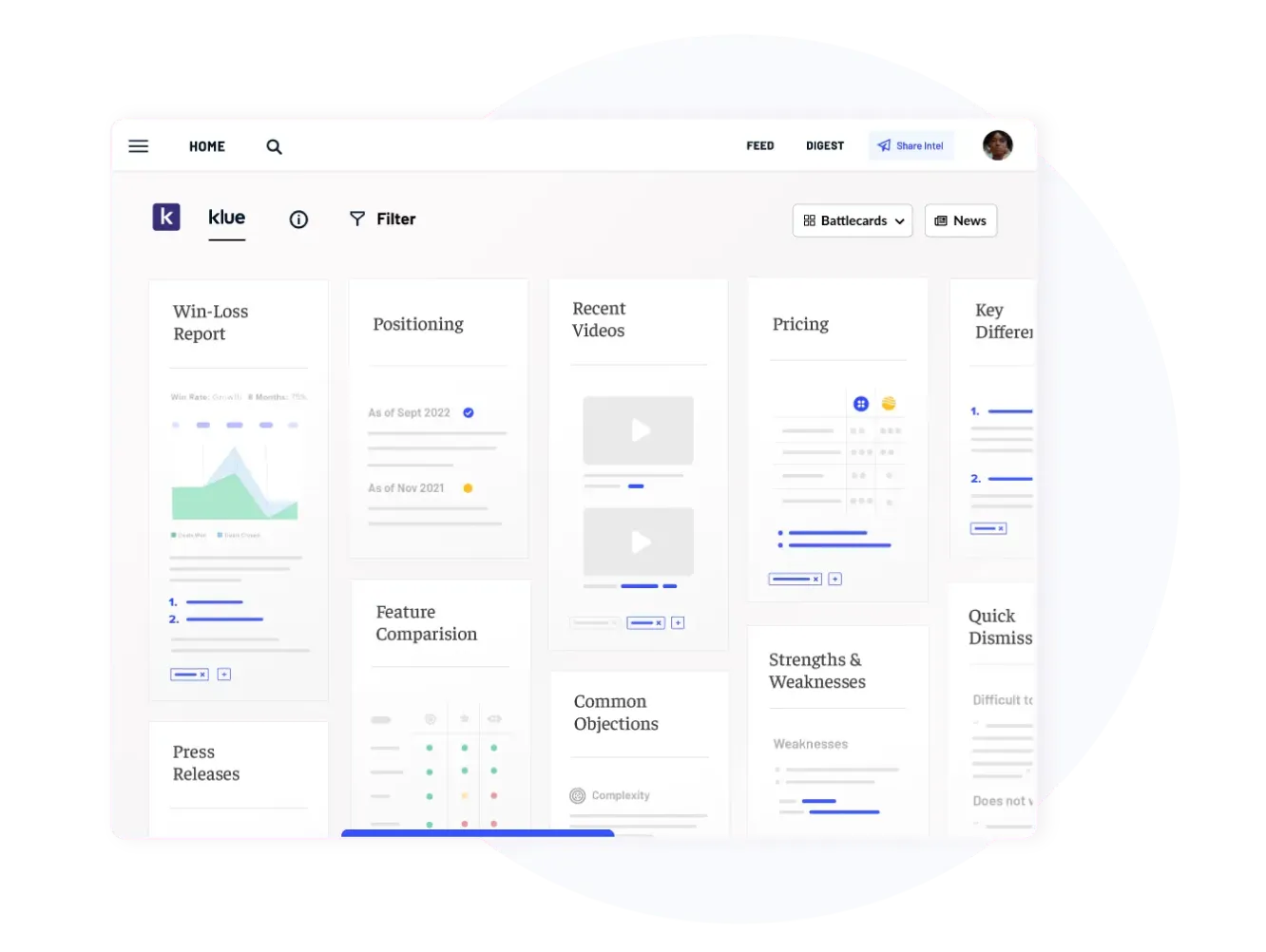
Klue is an AI-powered competitive enablement platform designed for mid-sized to enterprise organisations. The platform combines competitive intelligence collection with sales enablement features, including automated battlecard creation and win-loss analysis integration.
My Experience
I haven't personally used Klue. My assessment of this platform is based on documentation, user feedback and industry reputation rather than hands-on experience.
Key Features
- Automated Intel Collection: Aggregates competitor information from websites, news, reviews, job postings and more into a centralised platform.
- Sales Battlecards: Create and distribute dynamic competitor battlecards that update automatically as new intelligence arrives.
- Compete Agent: AI agent that delivers real-time competitive deal intelligence directly to sellers where they work.
- Win-Loss Analysis: Capture objective buyer feedback to understand why deals are won or lost against specific competitors.
Pros
- Purpose-built for B2B competitive intelligence at scale
- Strong integration with CRM and sales enablement platforms
- Excellent for enabling sales teams with actionable competitive insights
- Sophisticated AI-powered analysis and content generation
Cons
- Enterprise pricing puts it out of reach for smaller businesses
- Primarily focused on B2B sales cycles, less suited for B2C
- Requires dedicated resources to maintain and maximise value
Verdict
Klue is ideal for B2B organisations with dedicated competitive intelligence or product marketing teams who need to enable sales with real-time competitive insights.
Choose Klue if: You have a sales team competing against known competitors and need scalable CI infrastructure.
Skip Klue if: You're a smaller organisation or primarily need SEO competitor data.

8. Moz Pro
Best for: SEO beginners and small marketing teams
Pricing: $99/month (Starter) | Free trial: Yes (30 days)
Overview
Moz Pro is an established SEO platform known for creating the Domain Authority metric. The platform offers a more accessible entry point into SEO competitor analysis, with an intuitive interface that makes complex data easier to understand for those newer to SEO.
My Experience
Moz was the original SEO tool before Semrush and Ahrefs came along and overtook it. It was the leading platform back when Rand Fishkin was at the helm, but after he left the company I felt it went by the wayside. Its database and data quality were eclipsed by Ahrefs and Semrush over time.
That said, I still believe Moz offers genuine value through its API and data sources. If you're looking for an SEO data source via API at a lower price point than the bigger platforms, Moz remains a solid option.
Key Features
- Link Explorer: Analyse competitor backlink profiles with Domain Authority and Page Authority metrics.
- Keyword Explorer: Research competitor keywords with difficulty scores and organic CTR estimates.
- True Competitor: Automatically identify SEO competitors based on keyword overlap.
- Rank Tracking: Monitor your rankings versus competitors across locations and devices.
Pros
- Most beginner-friendly interface among professional SEO tools
- Generous 30-day free trial to fully evaluate the platform
- Domain Authority is widely understood and useful for quick comparisons
- Strong educational resources and community support
Cons
- Smaller backlink database than Ahrefs or Semrush
- Fewer advanced features for experienced SEO professionals
- Data refresh rates are slower than some competitors
Verdict
Moz Pro is ideal for:
- Small businesses
- In-house marketers
- SEO beginners
It provides an accessible entry point into competitor analysis.
Choose Moz Pro if: You're new to SEO tools and want an intuitive platform to learn competitor analysis.
Skip Moz Pro if: You need the most comprehensive data or advanced features for enterprise-level analysis.

9. BuzzSumo
Best for: Content competitor analysis and influencer research
Pricing: $199/month (Content Creation) | Free trial: Yes (30 days)
Overview
BuzzSumo specialises in content analysis, helping marketers understand what content performs best in their industry. The platform tracks social engagement, backlinks and trending topics across millions of articles, making it invaluable for content strategy and competitor content analysis.
My Experience
BuzzSumo is excellent for social media intelligence - that's what they specialise in. It's not particularly useful for organic SEO, but for social media intelligence and competitor tracking it's one of the best platforms available, if not the best.
Key Features
- Content Analyser: Find top-performing content by topic, domain or competitor, sorted by social shares and backlinks.
- Content Alerts: Monitor when competitors publish new content or receive significant engagement.
- Influencer Identification: Discover influencers who share competitor content and could amplify yours.
- Trending Topics: Identify emerging topics in your industry before competitors capitalise on them.
Pros
- Best-in-class content performance analysis
- Excellent for identifying content gaps and opportunities
- Strong influencer and journalist database for outreach
- Useful content alerts for monitoring competitor publishing
Cons
- Higher starting price at $199/month
- Primarily focused on content, limited SEO technical analysis
- Social engagement data can be delayed or incomplete for some platforms
Verdict
BuzzSumo is ideal for content marketers and PR professionals who need deep insights into what content resonates in their industry.
Choose BuzzSumo if: Content marketing is central to your strategy and you need to benchmark against competitor content.
Skip BuzzSumo if: You need comprehensive SEO analysis beyond content performance.

10. Sprout Social
Best for: Social media competitor monitoring and analysis
Pricing: $249/month (Standard) | Free trial: Yes (30 days)
Overview
Sprout Social is a comprehensive social media management platform with robust competitor analysis features. The platform helps businesses:
- Monitor competitor social activity
- Benchmark their performance
- Identify content strategies that drive engagement
My Experience
I haven't personally used Sprout Social. However, it is widely regarded and frequently recommended as a strong alternative to BuzzSumo for social media competitor monitoring. My assessment is based on industry reputation and documented capabilities rather than direct experience.
Key Features
- Competitive Reports: Compare your social performance against competitors across Facebook, Instagram, X (Twitter), LinkedIn and more.
- Social Listening: Monitor competitor mentions, industry conversations and sentiment across social platforms.
- AI-Powered Insights: Leverage a decade of historical data for sentiment analysis and trend identification.
- Share of Voice: Understand how your brand's social presence compares to competitors in your market.
Pros
- Most comprehensive social media competitor analysis available
- Excellent cross-platform monitoring and reporting
- Strong AI-powered sentiment analysis and trend detection
- Combines competitor monitoring with social media management
Cons
- Premium pricing starting at $249/month per seat
- Primarily focused on social media, limited SEO features
- Per-seat pricing can become expensive for larger teams
Verdict
Sprout Social is ideal for social media managers and marketing teams who need comprehensive social competitor intelligence alongside their management tools.
Choose Sprout Social if: Social media is a primary channel and you need deep competitor social insights.
Skip Sprout Social if: You primarily need SEO or website competitor analysis.

11. Brandwatch
Best for: Brand monitoring and AI-powered sentiment analysis
Pricing: Custom (contact for quote) | Free trial: Demo available
Overview
Brandwatch is an enterprise-grade consumer intelligence platform that monitors brand mentions, sentiment, and conversations across:
- Social media
- News outlets
- Blogs
- Forums
- Review sites
The platform provides deep insights into how consumers perceive your brand versus competitors.
My Experience
I haven't personally used Brandwatch. My assessment of this platform is based on documentation, user feedback and industry reputation rather than hands-on experience.
Key Features
- Consumer Research: Analyse millions of online conversations to understand competitor perception and market trends.
- Sentiment Analysis: AI-powered analysis of how people feel about your brand versus competitors.
- Crisis Detection: Real-time alerts for emerging issues or competitor crises you could capitalise on.
- Trend Analysis: Identify emerging topics and conversations before they go mainstream.
Pros
- Most comprehensive brand monitoring and sentiment analysis available
- Powerful AI that can process millions of data points
- Strong crisis management and early warning capabilities
- Excellent for understanding market perception at scale
Cons
- Enterprise pricing makes it inaccessible for smaller businesses
- Steep learning curve to fully utilise all features
- Overkill for basic competitor monitoring needs
Verdict
Brandwatch is ideal for enterprise organisations with significant brand equity who need to monitor and protect their reputation while tracking competitor perception.
Choose Brandwatch if: Brand perception is critical to your business and you have enterprise budget for monitoring.
Skip Brandwatch if: You need SEO competitor analysis or have budget constraints.

12. Google Alerts
Best for: Free basic competitor monitoring
Pricing: Free | Free trial: N/A (completely free)
Overview
Google Alerts is a free service that monitors the web for new content matching your specified search terms. While basic compared to paid tools, it provides a no-cost entry point into competitor monitoring that any business can implement immediately.
My Experience
Google Alerts is a great free system if you simply want to stay updated on brand mentions of competitors or your own brand - tracking how Google references them and what has been published around those terms.
The main downside is that it can get overwhelming very quickly with the volume of email notifications. A practical workaround is to set up a dedicated inbox specifically for these alerts and pair it with an email filtering system. That combination gives you a decent competitor monitoring setup for free out of the box.
Key Features
- Brand Monitoring: Track mentions of competitor brand names across news, blogs and web content.
- Keyword Alerts: Monitor industry keywords to see when competitors publish new content.
- News Coverage: Track when competitors appear in news publications or press releases.
- Flexible Delivery: Choose immediate, daily or weekly digest notifications via email.
Pros
- Completely free with no usage limits
- Simple setup taking just minutes to configure
- Covers news, blogs and general web content
- Good starting point for basic competitor awareness
Cons
- Limited to text content (no social media or visual monitoring)
- Often misses content from smaller websites
- No analytics, sentiment analysis or advanced features
- Results can be inconsistent and incomplete
Verdict
Google Alerts is ideal for businesses just starting with competitor monitoring who need a free solution while building their intelligence capabilities.
Choose Google Alerts if: You have no budget for monitoring tools and need basic competitor awareness.
Skip Google Alerts if: You need comprehensive, reliable competitor intelligence for strategic decisions.
How I Chose These Tools
Selecting the right competitor monitoring tools requires evaluating multiple factors. Here's the methodology I used to assess each platform in this guide:
- Data Accuracy (30% weighting): How reliable and current is the competitor data? I compared tool outputs against known benchmarks and Google Search Console data where possible.
- Feature Depth (25% weighting): Does the tool provide actionable insights beyond surface-level metrics? I evaluated the depth of analysis available for backlinks, keywords, traffic and other competitive signals.
- Ease of Use (20% weighting): Can a marketing professional use this tool effectively without extensive training? I assessed interface design, learning curve and workflow integration.
- Value for Money (15% weighting): Does the pricing align with the value delivered? I considered both absolute costs and what you get at each price tier.
- Integration & Workflow (10% weighting): Does the tool fit into existing marketing workflows? I evaluated API access, export options and integrations with other platforms.
How to Choose the Right Competitor Monitoring Tool
Choosing the right competitor monitoring tool depends on what you need to track, your budget, and your experience with SEO and competitive intelligence. Use the breakdown below to quickly match tools to your use case, price range, and skill level.
By Use Case
- For SEO + AI visibility in one subscription at a reasonable price point: Semrush is the most complete platform, combining traditional SEO competitor monitoring with AI visibility tracking from the entry tier (from $139/mo). The closest deep multi-platform setup on Ahrefs still often means Lite plus a Brand Radar all-platforms pack, which can push total subscription cost toward $828+ USD/month before team expansion, even though Lite now includes entry custom prompt checks. For a multi-client agency or in-house team working under a tight budget, the price-to-coverage difference is decisive.
- For backlink intelligence specifically: Ahrefs remains a strong specialised tool if your primary need is depth of link data and Site Explorer is the deciding factor.
- For PPC Intelligence: SpyFu specialises in paid search competitor data with 15+ years of historical ad information. Semrush also offers strong PPC analysis as part of its all-in-one platform.
- For Website Change Tracking: Visualping is purpose-built for monitoring competitor website changes at an affordable price point.
- For Enterprise CI: Klue provides the infrastructure for scaling competitive intelligence across large sales organisations.
- For Content Strategy: BuzzSumo reveals what content performs best in your industry, helping you identify gaps and opportunities.
By Budget
- Free: Google Alerts provides basic monitoring at no cost.
- Under $50/month: SpyFu ($39) offers excellent value for PPC and SEO competitor research.
- Under $150/month: SE Ranking ($65) and Moz Pro ($99) deliver solid all-round competitor analysis.
- Under $250/month: Semrush (from $139/mo) is the only platform at this price point that includes AI visibility tracking alongside traditional SEO competitor monitoring, PPC research and social competitor analysis. Ahrefs Lite ($129) now includes 150 Brand Radar custom prompt checks per month, so entry AI tracking is included. Deep multi-platform AI-index coverage still usually means adding the ~$699 USD/mo all-platforms bundle on top of the base subscription.
- Enterprise: Klue, Brandwatch and Similarweb's advanced plans cater to larger organisations with bigger budgets.
By Technical Level
- Beginners: Moz Pro and SE Ranking offer the most accessible interfaces for those new to SEO competitor analysis.
- Intermediate: Semrush and Ahrefs provide depth without overwhelming complexity once you learn the basics.
- Advanced: Enterprise platforms like Klue and Brandwatch offer the most sophisticated analysis for experienced CI professionals.
Frequently Asked Questions
What is the best competitor monitoring tool overall?
For most SEO teams in 2026, Semrush is the best overall competitor monitoring tool. It consolidates competitor monitoring across organic search, AI search visibility, paid search and social media in one subscription, with consistent data quality across all plan tiers, including through the post-NUM=100 environment that has compromised top-100 ranking data on several competitor platforms. No other single platform covers all four competitor monitoring channels at this depth and price point. Ahrefs remains a strong specialised tool for backlink intelligence if that's your primary need, but for unified SEO, AI visibility, PPC and social competitor work, Semrush is the platform we now run across the entire Rankmax client portfolio.
How do you track competitors' SEO effectively?
Effective SEO competitor monitoring involves tracking multiple signals. Monitor keyword rankings to see which terms competitors rank for that you don't. Analyse backlink profiles to identify link building opportunities. Track on-page changes to understand their optimisation strategies. Tools like Ahrefs, Semrush and SE Ranking automate this process by aggregating competitor SEO data into actionable dashboards.
What is SEO competitor monitoring?
SEO competitor monitoring is the ongoing process of tracking and analysing your competitors' search engine optimisation activities. This includes monitoring their keyword rankings, backlink acquisition, content publishing, technical SEO changes and overall organic visibility. The goal is to identify opportunities to outperform competitors and anticipate their strategic moves.
How often should you monitor competitors?
Monitoring frequency depends on your industry's pace of change. For fast-moving industries like technology or e-commerce, daily or weekly monitoring is advisable. For more stable industries, monthly competitor reviews may suffice. Set up automated alerts for significant changes (new content, major ranking shifts, pricing updates) and conduct deeper analysis quarterly.
Is there a free competitor analysis tool?
Google Alerts provides free basic competitor monitoring for brand mentions and new content. SpyFu offers a limited free version with basic competitor data. Ahrefs provides free tools including a backlink checker with limited data. However, free tools have significant limitations in data depth, accuracy and features. For serious competitor intelligence, investing in a paid tool typically delivers better ROI.
Can AI tools help with competitor monitoring?
Yes, AI visibility tracking is now a core competitor monitoring capability rather than a nice-to-have. Semrush's AI visibility tracking (included from $139/mo) tracks how your brand and competitors appear across ChatGPT, Google AI Overviews, Google AI Mode and Gemini on Starter, with Perplexity added on Pro+ and Advanced. Daily prompt tracking and mention monitoring are included. Ahrefs Brand Radar offers similar functionality across seven AI platforms, including Claude. Lite includes custom prompt checks, while full multi-platform AI-index packs still start around $699 USD/mo on top of the core subscription. SE Ranking includes an AI Overview Tracker in its standard plans. SpyFu's SpyGPT covers ChatGPT references. Klue uses AI to generate competitive battlecards. As search shifts from one platform to multi-platform, AI visibility tracking has become essential rather than optional.
Finding Your Competitive Edge
After testing these 12 tools extensively, here are my recommendations:
- Best overall: Semrush has become my recommendation for most SEO teams in 2026. It's the platform I migrated the entire Rankmax client stack to. Consistent SEO data through the post-NUM=100 disruption, AI visibility tracking included from the entry plan, plus PPC and social competitor monitoring in the same subscription.
- Best for backlink intelligence specifically: Ahrefs Site Explorer remains best in class for link analysis if that's your primary use case.
- Best free starting point: Google Alerts won't replace paid tools, but it costs nothing and takes minutes to set up.
The right tool depends on your specific needs, budget and how you plan to act on competitive intelligence. Start with a free trial of the platforms that match your use case, and invest in the tool that delivers insights you'll actually use to improve your marketing performance.
About the Author
Want Insights Like This Fortnightly?

Our AI SEO strategies and tactics delivered fortnightly, including bonus trade secrets not shared anywhere else. No fluff. Just what's working right now. 5-minute read.


