
Gen AI SEO: How to Rank in Google and Get Cited by ChatGPT in 2026

Generative AI has changed how people find information online. Gen AI SEO is the shift from chasing keyword rankings to becoming a source that AI systems cite and recommend. ChatGPT now serves more than 900 million weekly active users, and AI Overviews are a standard part of Google's results. Your content has to serve two audiences at once: classic search rankings and large language models. This guide shows how I do both, and shares the first-party data behind it.
A note on terms before I start. I treat "Gen AI SEO" as the broad discipline of being found across both Google and generative AI platforms. Some people use "AI SEO" to mean the same thing and others use it more narrowly for the AI-layer work alone. I use the broad sense throughout this guide.
Gen AI SEO: A Quick Summary
Gen AI SEO is the practice of optimising your content to rank in traditional search engines while making sure AI platforms like ChatGPT, Perplexity and Google AI Overviews cite your brand as a trusted source. It combines foundational SEO with AI-layer techniques so your content surfaces in both classic blue links and AI-generated answers, capturing visibility wherever your customers search. Pew Research found the share of people clicking any result fell from 15% to 8% when an AI Overview appeared, which is exactly why this dual approach matters for protecting traffic and revenue.
Ready to Rank in Google and Get Cited by AI Search?
While competitors are still debating whether AI changes SEO, the brands moving now are claiming first-mover positions in ChatGPT and Google AI Overviews. My B2B AI SEO case study is one example: about $8.7M in attributed revenue and 598 AI cited pages across platforms over 27 months and counting. The brands investing in gen AI SEO today will shape how the next generation finds information.
Get Your Custom AI SEO StrategyWhat Is Gen AI SEO?
Gen AI SEO merges traditional search engine optimisation with the newer discipline of optimising for generative AI platforms. At its core, it recognises that search behaviour is fragmenting across multiple platforms, each with its own algorithms and visibility requirements.
The Dual Search Ecosystem
Traditional SEO focuses on helping Google understand and rank your content through:
- Keywords
- Backlinks
- Technical optimisation
Gen AI SEO adds a second layer: making sure large language models can interpret, trust and cite your expertise when they generate answers.
This distinction matters because AI systems don't rank pages. They synthesise information from several sources into a single response. Your goal shifts from holding position one to being the source AI systems quote when someone asks a question in your domain.
Recent benchmarks put AI referrals at about 1.08% of all visits, with ChatGPT responsible for over 87% of that AI traffic. AI referrals are still small next to organic, but the channel is climbing fast, and the visitors behave differently once they arrive.
Why Traditional SEO Alone No Longer Works
The data is stark for brands relying only on traditional tactics. A study of more than 3,000 search terms found:
- Organic click-through rates fell 61% for queries showing AI Overviews
- CTR dropped from 1.76% to 0.61% for organic results
- Paid search suffered even more, with CTR down 68%
It is worth separating two numbers that get quoted together and read as contradictory. The 61% figure above is the drop in the organic listing CTR specifically (Seer's 1.76% to 0.61%). Other studies report a roughly 47% fall in the overall click rate across the whole results page. They use different denominators, the organic listing versus the entire SERP, so both can be true at once.
The shift is not temporary. Google keeps expanding AI Overviews into more query types, with some industries seeing appearance rates above 50%. For example:
- Entertainment queries saw a 528% increase in AI Overview coverage
- Restaurants saw 387% growth
- Travel queries jumped 381%
For marketing leaders, this means rankings and click-through rates now tell only part of the story. Success means measuring visibility across Google, ChatGPT, Perplexity, Claude and emerging assistants at the same time.
How Generative AI Has Transformed Search
Understanding how AI systems process and present information is fundamental to optimising for them. Where traditional search engines match keywords and rank pages, generative AI pulls from several sources to build a conversational answer.
From Retrieval to Reasoning
Traditional search runs on retrieval: algorithms match a query against indexed pages and return ranked results. Generative AI runs on reasoning: models interpret intent, draw on training data and live sources, and construct an original response to the underlying question.
This shift has real implications. Research from Andreessen Horowitz found that:
- AI queries average 23 words, against roughly 4 words for traditional search
- Sessions last about 6 minutes
- Responses vary with context and source material
Where traditional search rewards precision and repetition, generative engines favour content that is well organised, easy to parse and dense with meaning.
There is a deeper mechanic underneath this that most marketers miss. When you type a question into Google AI Mode, ChatGPT or Perplexity, the AI does not stop at your exact words. It typically splits your query into roughly 5 to 11 related sub-queries, retrieves content for each in parallel, then synthesises the answer. I cover this in detail in my query fan-out guide, and it changes how you should structure a page.
The practical upshot is that your content has to work for human readers and AI interpreters at once. Clear structure and scannable formatting help models extract and reproduce your points. But surface formatting is not enough. AI systems judge whether your content shows genuine expertise across connected topics.
Why Passages Beat Pages in AI Search
In traditional search, Google evaluates your whole page and ranks it against a query. In AI search with query fan-out, the evaluation happens at the passage level. A single paragraph from a mid-ranking page can outperform a comprehensive guide if that paragraph answers a specific sub-query more directly. This is the part most content teams have not adjusted to. It means a tightly written 60-word answer buried in a longer article can earn a citation that the page as a whole would never rank for. Structure each section so it stands on its own and answers one clear question.
The Zero-Click Reality
Zero-click searches are the most visible impact of AI on traditional SEO. They happen when users get their answer in the results without clicking through to a site.
Semrush's analysis of 200,000+ keywords found that:
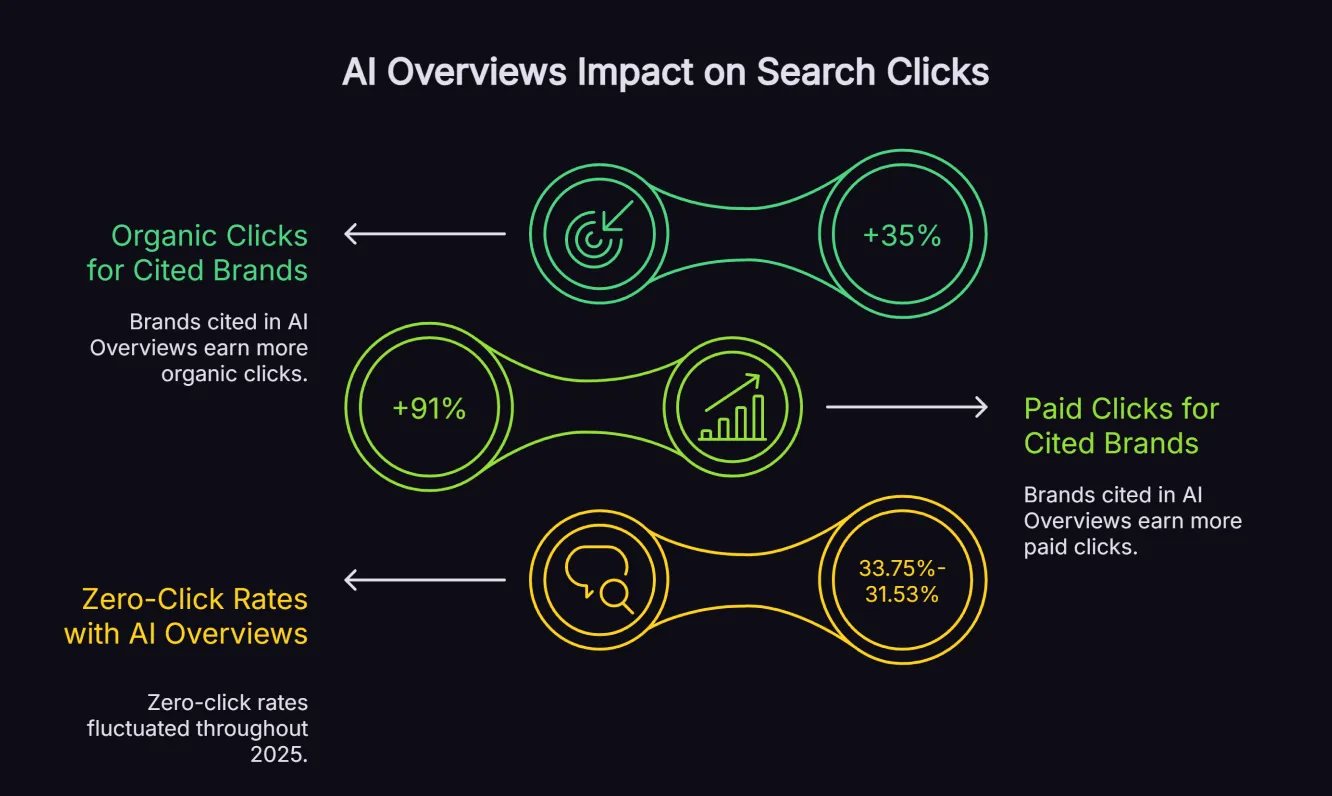
- Zero-click rates for queries with AI Overviews fell from 33.75% to 31.53% across 2025
- For news publishers, searches ending in no click to news sites grew from 56% to 69% year on year
- Brands cited within AI Overviews earn 35% more organic clicks and 91% more paid clicks than those appearing only in traditional results
The goal is not to fight zero-click search. It is to become the source AI systems cite when they hand out those instant answers.
Here is the part that changes the business case. The visitors who do click through from AI tend to be worth more. Across my own campaigns, I have seen AI search traffic convert at 6.24% against 3.29% for traditional organic search. AI tools act as a kind of intent filter: by the time someone clicks your link, the AI has already done the comparison work and pre-qualified the visit. In high-consideration categories, the gap is wider still: Ahrefs' research found AI search visitors converting up to 23 times higher than organic search visitors. A small, fast-growing channel that converts at twice the rate is not a rounding error. It is a priority.
Gen AI SEO vs Traditional SEO
Gen AI SEO builds on traditional SEO rather than replacing it. Understanding the difference helps you allocate resources and avoid the common implementation mistakes.
Foundation First, AI Optimisation Second
Technical foundations stay essential for AI visibility. Without clean technicals, strong information architecture and quality content, generative and answer-based optimisation has nothing reliable to stand on. AI systems then have nothing dependable to ingest, understand or cite.
The relationship works in layers. Technical SEO (crawlability, indexation, architecture, Core Web Vitals, structured data) makes your content machine-readable for LLM crawlers and AI overview systems. Classic SEO pillars, including intent-mapped content, E-E-A-T signals, internal linking and performance, are the signals AI systems lean on when they choose which sources to surface and trust.
Key Differences in Approach
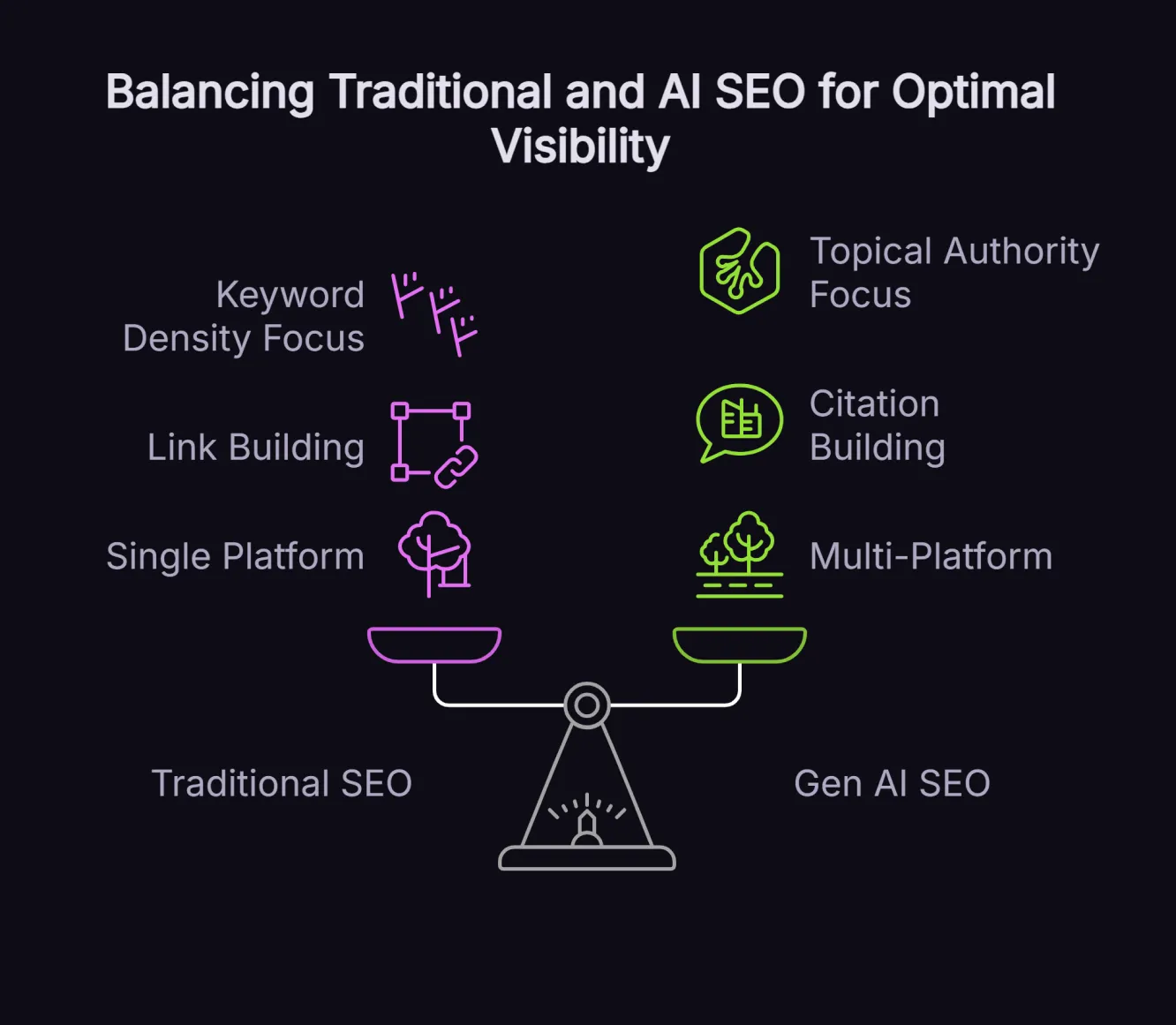
Traditional SEO optimises for explicit keyword matching and link-based authority. Gen AI SEO optimises for semantic understanding and citation worthiness. Here is how they differ in practice:
- Content structure: Traditional SEO focuses on keyword placement in titles, headings and body. Gen AI SEO prioritises answer-first formatting with clear definitions, structured explanations and scannable summaries that AI systems can lift.
- Authority signals: Traditional SEO builds authority through backlinks from relevant domains. Gen AI SEO builds citation authority through media mentions, expert quotes, first-party research and consistent brand messaging across platforms. Around 34% of AI citations come from PR-driven coverage, with another 10% from social channels.
- Success metrics: Traditional SEO measures rankings, traffic and conversions. Gen AI SEO adds AI presence rate, citation authority and share of AI conversation. I cover all five in the measurement section below.
The Topical Authority Imperative
Gen AI SEO demands topical authority in ways traditional SEO never did. AI algorithms assess whether you genuinely understand a subject and how its concepts connect, not just whether you mentioned the right keywords.
Data from major SEO platforms shows no simple link between keyword density and high rankings in AI-influenced results. Top-ranking pages often use lower keyword density. What matters is showing comprehensive understanding through semantic variety and related concepts. Interconnected content positions you as the definitive source on a topic.
That is why topical authority sits at the centre of gen AI SEO. Building content clusters around core topics signals to both Google and AI systems that you are the expert worth citing. My SaaS SEO case study shows how strategic topical authority building generated $1.31M in revenue within 12 months.
Implementing a Gen AI SEO Strategy
Effective implementation runs across technical foundations, content optimisation and authority building. Here is the framework for each.
Technical Foundations for AI Visibility
Technical SEO is the translation layer between your content and AI systems. Schema markup gives AI engines a roadmap to your customer Q&As, product specifics, user feedback and author expertise.
Start with structured data:
- FAQPage schema for common questions helps AI systems find and cite your expert answers.
- HowTo schema for process content lifts your odds of featuring in step-by-step AI responses.
- Organisation schema establishes entity recognition, helping AI systems link your brand to specific topics.
A point on how I build schema, because it affects how reliably AI systems read it. My schema model works in two tiers:
Tier one defines the core entities search and AI systems need to understand the site:
- Organisation
- WebSite
- WebPage
- Article
- BreadcrumbList
- Person (or Author)
Tier two adds page-specific schema where it genuinely supports the content:
- Service
- Product
- Review
- FAQPage
I implement this in an @graph JSON-LD structure, which groups related entities in a single block so they can reference each other through @id values rather than sitting as disconnected schema blocks.
Then make sure your site is reachable by AI crawlers. Agents like GPTBot, ClaudeBot and PerplexityBot now account for a meaningful share of discovery. They usually do not render JavaScript, they expect fast pages and they rely on clear plain-text content. If AI crawlers cannot easily understand your brand, you risk becoming invisible to the next generation of buyers.
Content Optimisation for Dual Visibility
Content must serve human readers and AI interpreters. That takes specific structure without losing readability:
- Lead with non-commodity content: Unique and original first-hand insights, proprietary research and data that exist nowhere else. AI systems synthesise answers from sources that add something new, and commodity content restating what every competitor already says gives them no reason to cite you. Original data, documented results and first-hand experience do.
- Write for the answer first: If a user asks "What is gen AI SEO?", give a clear, complete definition before you expand. That makes it easy for AI to lift your answer as the cited response.
- Add short summaries under key sections: A one or two sentence summary can stand alone if an AI system excerpts it. Structure each section so it fully answers one question while connecting to the broader topic.
- Target "People Also Ask" queries: These often feed AI summaries directly, which makes them high-value citation targets.
- Use statistics and specific claims with proper citations: Depth and clear sourcing matter most for AI citations. Traditional metrics like raw traffic and backlinks have limited pull on AI inclusion.
Building AI Citation Authority
AI platforms favour content from trusted, credible sources. Building citation authority takes consistent effort across channels:
- Demonstrate expertise through author bios, credentials and first-hand case studies. Do not just claim it, prove it with specific examples and documented results. My eCommerce AI SEO case study is a good example: I drove an AI citation explosion to 169 citations across five platforms, with 126 in Google AI Overviews, 12 in ChatGPT, 10 in Perplexity, 12 in Gemini and 9 in Microsoft Copilot. That is the kind of documented result AI systems weigh when they pick sources.
- Earn mentions on podcasts, news outlets and industry publications. Even unlinked mentions build the authority footprint AI systems read. Keep your bio, tone and credentials consistent across LinkedIn, YouTube and your site so AI can verify you are a real entity with real experience.
- Create content types AI systems cite often:
- Ultimate guides that consolidate a topic into one authoritative resource
- Comparison tables that make differences explicit and scannable
- Statistics pages that centralise data points
- Glossaries that define terms clearly
These formats signal completeness, recency and reference value. Citation counts are not vanity numbers either. A B2C compensation-claims client reached 65 total AI citations, including 54 in Google AI Overviews, and a B2B client went from zero visibility to 138 citations across platforms. When the same brand keeps appearing as a cited source across Google, ChatGPT, Perplexity, Gemini and Copilot, that consistency is itself a trust signal.
The Rankmax Gen AI SEO Framework
I do not treat Google AI Overviews, ChatGPT and Perplexity as three disconnected playbooks. I build one crawlable, extractable and evidence-rich source system, then tune it by platform. My framework has three steps: fix the technical foundation, structure content for AI extraction and build the topical authority that earns citations over time.
1. Fix the Technical Foundation
AI visibility starts with crawlable, indexable and machine-readable content. That means clean site architecture, fast pages, accessible HTML, structured internal links and schema that helps search systems understand the entities on the page.
2. Structure Content for AI Extraction
AI systems do not only evaluate whole pages. They extract useful passages that answer specific sub-queries. That is why each key section needs a clear answer, a concise explanation and supporting evidence.
This is especially important for ChatGPT and Perplexity, where source selection can differ from traditional Google rankings. A page does not need to hold position one in Google to become useful to an AI answer. It needs to answer the extracted question clearly, credibly and in a format the model can reuse.
3. Build Topical Authority That Earns Citations
Once the technical and content structure is in place, the next step is authority. I build content clusters, first-party data, original case studies and consistent author/entity signals so AI systems have repeated reasons to associate the brand with the topic.
Platform nuance still matters. Google AI Overviews often correlate with strong traditional rankings, while ChatGPT and Perplexity can surface different source sets. But the core strategy is the same: make the brand technically accessible, make the content easy to extract and make the evidence strong enough to cite.
Measuring Gen AI SEO Success
Rankings and traffic still matter, but they no longer tell the whole story. Gen AI SEO needs extra measurement to capture AI-specific visibility.
Essential Gen AI SEO Metrics
A traditional SEO dashboard will not tell you whether ChatGPT is recommending your competitors instead of you. You need metrics built for dual visibility. These are the five I track for every client campaign:
- AI Presence Rate: The percentage of target queries where your brand appears in AI-generated responses, tracked across ChatGPT, Google AI Overviews, Perplexity and other relevant platforms through manual prompt testing or specialised tools.
- Citation Frequency: How often your content is cited as a source in AI responses. More citations signal greater authority recognition. For context, my case-study range runs from 65 citations for a B2C client to 169 for an eCommerce client across five platforms.
- Share of AI Conversation: Your semantic presence in AI answers against competitors. This shows whether you are gaining mindshare in AI discovery or losing ground.
- AI Referral Traffic: Use UTM parameters to track traffic from AI platforms. Google Analytics can track ChatGPT traffic with utm_source=chatgpt, though it takes some technical setup. Pair the volume with the conversion rate, because as my data shows, AI referral traffic often converts well above organic.
- Business Outcomes from AI Search: Leads, sales, new customer value and customer lifetime value (LTV) added from generative AI. Visibility metrics tell you whether AI platforms surface your brand; these tell you what that visibility is worth in revenue terms. Tie AI-attributed conversions back to your CRM so you can compare the revenue and LTV of AI-referred customers against your other channels.
Tracking AI Citations
Manual prompt testing is still valuable because it lets you define exactly what you are measuring.
- Run regular searches across ChatGPT, Perplexity and Google AI Overviews for your target queries.
- Record whether your brand appears, how it is positioned and which competitors are cited instead.
Specialised tools are emerging to automate this, though capabilities vary by price tier. Many entry-level tools track only ChatGPT, while broader platform coverage is often gated behind enterprise plans.
My recommendation here is the Semrush AI Visibility Toolkit, which I run weekly across every Rankmax client account. It tracks how your brand and pages are cited across ChatGPT, Google AI Overviews, AI Mode and Gemini, and its citation gap analysis shows you exactly where AI engines cite competitors but not you. I tested 12 platforms across our client work for my best AI visibility tools guide, and it came out at number one. Combine automated and manual approaches: automation handles volume, human judgment interprets the results and spots the opportunities.
HubSpot AEO is also a solid choice if you are looking for a platform with a slightly lower price point, or if you already use other products within HubSpot's ecosystem. You can either use HubSpot AEO independently or bundled with Marketing Hub for omnichannel brand visibility tracking and management.
Common Gen AI SEO Mistakes to Avoid
Knowing what fails is as useful as knowing what works. These are the mistakes that quietly undermine gen AI SEO efforts.
1. Treating AI Optimisation as Separate from SEO
Gen AI SEO builds on traditional foundations. Some brands chase AI citations while ignoring technical fundamentals, so their content is not indexed properly and lacks the authority signals AI systems use to judge trust. The brands that win treat gen AI SEO as a layer on top of traditional SEO, not a replacement. Both have to work together.
2. Autonomously Publishing Large Volumes of AI-Generated Content
The mistake is not using AI in content production. It is autonomously or automatically publishing large volumes of AI-generated content with no human review. Google's spam policies call this scaled content abuse: creating many pages primarily to manipulate rankings rather than help people, however that content is generated. Google has applied both algorithmic ranking drops and manual actions under this policy, and the same low-value pages give AI platforms nothing worth citing.
Use AI to speed up production while keeping human oversight for strategy, quality and brand voice. The sweet spot pairs AI efficiency with human expertise and the storytelling that demonstrates real E-E-A-T. I unpack what Google's guidelines actually say in my guide to whether AI content is bad for SEO.
3. Ignoring Platform-Specific Behaviours
Each platform cites differently. Optimising only for Google AI Overviews ignores the very different source preferences of ChatGPT, Perplexity and emerging platforms. The clearest example is the inverse correlation between platforms: AI Overviews tend to favour top-10 pages, while Semrush found ChatGPT cites pages ranking 21st or lower almost 90% of the time. Build platform-specific strategies, keep quality consistent and track each platform on its own.
The Future of Gen AI SEO
The landscape keeps moving. Watching the emerging trends helps you prepare for the next shift in discovery.
Google's I/O 2026 Announcements
At its May 2026 I/O keynote, Google announced the biggest changes to Search in years. AI Mode has passed one billion monthly users a year after launch, with queries more than doubling every quarter, and Gemini 3.5 Flash is now the default AI Mode model globally. Google also unveiled its biggest Search box upgrade in over 25 years: an intelligent, AI-powered box that accepts text, images, files, videos and Chrome tabs as inputs, and suggests questions beyond autocomplete.
Two announcements matter most for gen AI SEO. First, Search agents: information agents that run in the background 24/7, monitoring the web and sending users synthesised updates, launching first for Google AI Pro and Ultra subscribers. Second, generative UI: Search can now build custom layouts, tables, simulations and even mini apps on the fly to answer a query. Both point the same way. Your content will increasingly be consumed, recomposed and re-presented by machines, so being the trusted, extractable source those systems draw from is the whole game.
AI Agents and Agentic Search
AI agents now browse on behalf of users, fetching information in real time rather than indexing it for later. Agents like GPTBot, ClaudeBot and PerplexityBot mark a real change in how content gets found and delivered, and Google's new information agents bring the same pattern to mainstream Search. Brands need to make it easy for agents to retrieve information, present it accurately and drive action. That means clean technical foundations, clear information architecture and content structured for machine consumption.
Integration Across Marketing Disciplines
Gen AI SEO is becoming inseparable from brand and omnichannel marketing. Success takes tight integration between:
- SEO
- Content
- Technical teams
- PR and AI specialists
Digital PR and brand visibility are now AI inputs in their own right: the same work that earns coverage, links and social engagement also improves your odds in AI summaries. Brands that master this convergence will win across Google, ChatGPT and whatever comes next.
Frequently Asked Questions
Does gen AI SEO replace traditional SEO?
No. Gen AI SEO builds on traditional SEO rather than replacing it. Technical foundations, including crawlability, indexation, site architecture and structured data, stay essential for AI visibility. Without clean technicals, strong information architecture and quality content, optimisation falls apart because AI systems have nothing reliable to ingest, understand or cite. The most effective approach treats both as complementary disciplines.
How do I get my content cited by ChatGPT?
Getting cited by ChatGPT takes comprehensive, well-structured content that directly answers questions in your area of expertise. Demonstrate E-E-A-T through detailed author bios, original research and documented case studies. Structure content with clear definitions and a scannable format AI systems can extract. Unlike Google rankings, ChatGPT weighs semantic relevance and content quality independently of traditional authority signals, which is why about 90% of its citations go to pages ranked 21 or lower in Google.
How do I measure Gen AI SEO success and what kind of ROI is realistic?
Start with the metrics that matter to your business: revenue attributed to AI search visibility, share of AI conversation against competitors, and the five tracking metrics I use (AI Presence Rate, Citation Frequency, Share of AI Conversation, AI Referral Traffic and Business Outcomes from AI Search). On ROI, I point to documented results rather than a single headline multiple. Across my case studies, returns have ranged widely by vertical and timeframe, from a B2B client at 6,864% ROI on the 17-month climb window over 27 months and counting to a B2C client at 14,738% average monthly ROI over 21 months and counting. Your range depends on your starting foundation, vertical and investment level. See my case studies for full methodology.
How quickly will Gen AI SEO impact my traffic?
Timelines vary with your current foundation and content quality. Tactical changes like adding structured data and improving formatting can influence AI citations within 30 to 45 days. Building comprehensive topical authority and citation history takes sustained investment. Meaningful results usually appear within a quarter of dedicated work, with compounding returns after that.
What is the difference between Gen AI SEO and traditional SEO?
Traditional SEO focuses on ranking in search results through keyword optimisation, backlinks and technical improvements. Gen AI SEO adds optimisation for AI platforms like ChatGPT, Perplexity and Google AI Overviews so your content gets cited in AI-generated responses. Both work together, with traditional foundations supporting AI-specific optimisation.
Which AI platforms should I prioritise for optimisation?
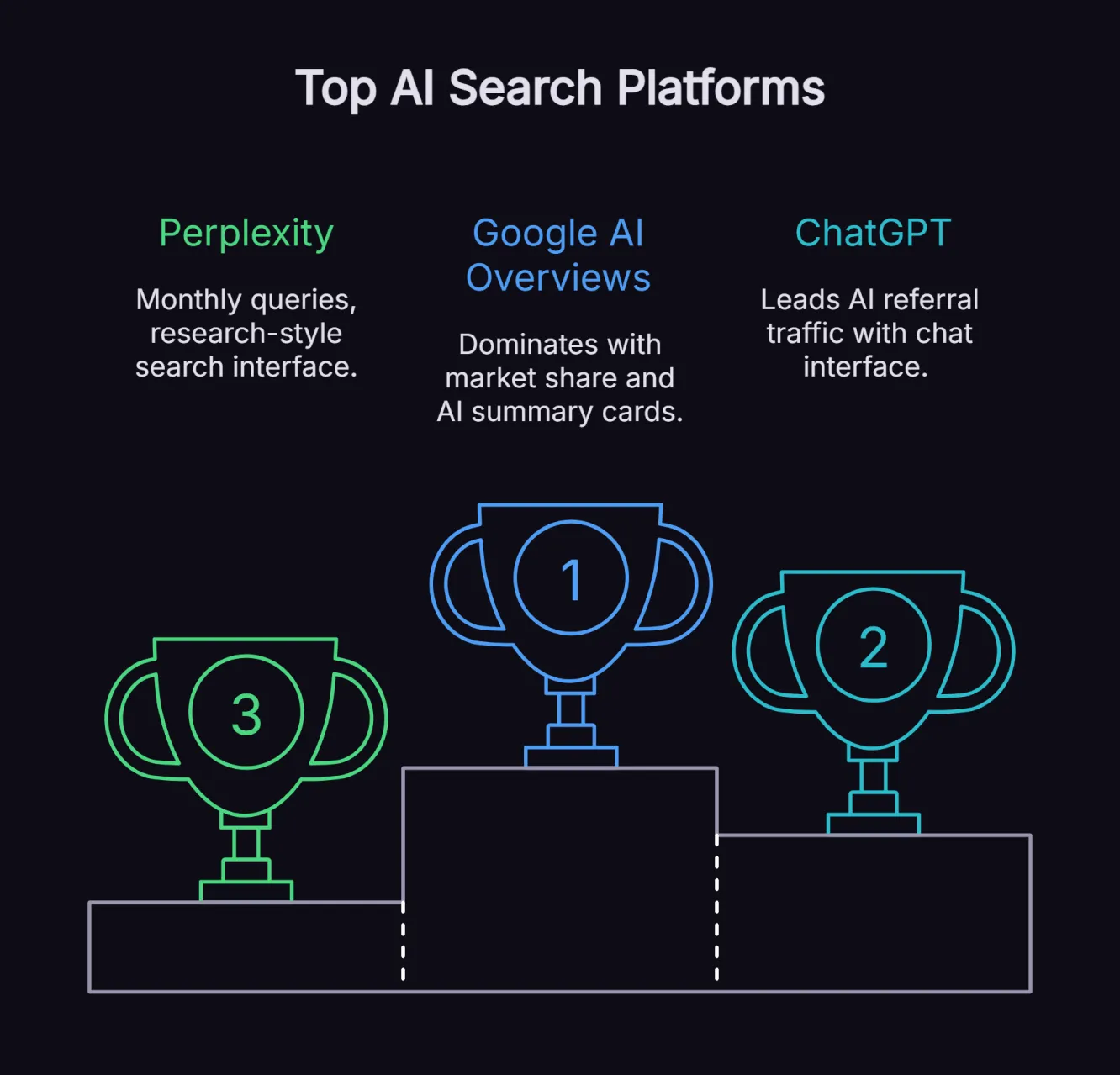
Prioritise by your audience's behaviour. Google AI Overviews reach the largest audience, given Google's market share. ChatGPT dominates AI referral traffic at 87.4% of AI-driven visits, which makes it critical for brands targeting information seekers. Independent traffic studies show Perplexity has become a meaningful share of US AI referrals, especially among research-heavy and tech-savvy audiences. Track where your specific audience searches and allocate resources from there.
Own Your AI Search Future
Gen AI SEO is the biggest shift in discoverability since Google rose to dominance, and the brands that master both traditional and AI search first will define the next decade of visibility. Combine technical excellence, topical authority and citation-worthy content for the foundation. Smart, platform-specific optimisation for ChatGPT, Perplexity and Google's AI experiences then puts your brand in front of customers wherever they search. Rankmax has generated over $26M in attributed client revenue through AI-first SEO, and I would happily show you how the same approach could work for your business. If you are ready to turn this into a roadmap, explore my AI SEO strategy services.
About the Author
Want Insights Like This Fortnightly?

Our AI SEO strategies and tactics delivered fortnightly, including bonus trade secrets not shared anywhere else. No fluff. Just what's working right now. 5-minute read.


